

B2B Branding for Manufacturers: A Guide for Owners
B2B branding is how buyers recognize, trust, and describe your company before they talk to your sales team. For a manufacturer, it lives in five places: your words, your proof, your website, your sales documents, and your visual identity. Fix them in that order.
TL;DR
- B2B branding is the sum of what buyers see, read, and hear about your company before the first call. It is built from positioning, messaging, proof, and presence.
- Owner-led manufacturers often look smaller than they are. Buyers judge a supplier in the first ten minutes of research, and many of them check before they contact you.
- Buyers meet your brand in six places: your website, quotes, LinkedIn, printed pieces, your people, and your facility.
- Write one plain sentence that says who you serve, what you do for them, and why they can believe you. Use those same words everywhere.
- Proof beats polish. Named customers, real numbers, and certifications do more for trust than a new logo.
- Fix the brand in this order: the words, the proof, the website, the sales documents, then the visual identity.
- Measure it with leading signals such as how often prospects describe you correctly. Brand awareness surveys cost too much for a company your size.
In this guide:
- What B2B branding means for a manufacturer
- Why it matters before the first call
- How B2B branding differs from consumer branding
- The six places buyers meet your brand
- How to write what you do in one sentence
- What proof your brand should carry
- The order to fix things in
- Cost, time, and who should do the work
- How to measure it
- Common mistakes
- Where to start this week
An owner told us recently, “Every customer we have says we’re the best in the business. Then a new prospect looks at our website and asks if we’re still making that part.”
That company had 40 years of clean work behind it. Its website still described the business as it was in 2012. Its quotes went out as plain spreadsheets. Its salespeople each described the company a little differently. Nothing about the work was weak. The brand had fallen behind it.
We call this the best-kept-secret syndrome. An excellent company looks smaller than it is, and the right buyers never get a reason to call. This guide is for owners and presidents of privately held manufacturers, roughly $5M to $50M in revenue. It shows what B2B branding includes, where buyers meet it, and what to fix first.
What is B2B branding for a manufacturer?
B2B branding is the set of impressions that tells a business buyer who you are and who you serve. It also tells them whether you can be trusted with their work. It includes what you say, what you can prove, and how your company shows up wherever a buyer looks. The logo is one small piece of it.
Defined Term: B2B branding.
The sum of what buyers see, read, and hear about your company before and during the sale. It has four parts. Positioning is who you serve and why you win. Messaging is how you say it. Proof is the evidence behind the claim. Presence is where and how the brand shows up.
Those four parts match the ones we lay out in our guide to B2B brand strategy. That guide covers how to build the strategy. This guide covers what the brand looks like from the buyer’s side of the table, and which pieces to fix first.
Know the four parts of a brand
Positioning is the choice of customers you serve best. Messaging is the short way you say it. Proof is the evidence: customer names, numbers, certifications, and years of work. Presence is every place a buyer runs into you, from your website to your trucks.
A weak part drags down the others. Strong messaging with no proof reads as a claim. Strong proof with a dated website gets missed. Most owner-led manufacturers have more proof than they show.
Treat branding as a revenue tool
A manufacturer with a 12-month sales cycle needs a brand that shortens the trust-building part of the sale. Fame has no part in it. A buyer who already believes you are a serious supplier asks fewer questions on call one. That buyer also brings fewer competitors into the comparison and moves to a quote faster.
Why does B2B branding matter before the first sales call?
B2B branding matters because buyers research a supplier before they contact it, and what they find decides whether the call happens. A purchasing manager, an engineer, or an owner will search your name, read your site, and look for anything written about you by someone else. That research takes about ten minutes and often ends the conversation.
Think about the last time you checked out a supplier or an advisor. You skimmed the website, looked for names you knew, and asked yourself one question: do these people look like they can do this job? Your buyers ask the same question about you.
Expect a committee of readers
Most B2B purchases involve several people. The engineer checks capability. Purchasing checks price and terms. Finance checks stability. The owner or plant manager checks whether they would enjoy working with you. Each person looks at a different page and forms a separate opinion, and they compare notes. Our guide to the B2B buying committee covers who sits at that table.
A brand that says the same clear thing in every place gives all of them the same answer.
Expect an AI assistant to read you too
Buyers now ask AI tools to shortlist suppliers and summarize what each one does. The tool reads your public pages, your product documents, and what other people have written about you. Our articles on how the buyer’s AI does the first round and what suppliers are checked on go into the details.
We can’t see which sources any given tool picks. We do know that clear, consistent facts in text give the tool more to work with. A company whose website says one thing, whose quote says another, and whose LinkedIn page says nothing gives it very little.
How is B2B branding different from consumer branding?
B2B branding differs from consumer branding because the buyer is a group of professionals making a long, high-stakes decision. The brand has to carry trust across all of them. Consumer brands win attention and quick purchases. A manufacturer’s brand wins a place on a shortlist and holds it for a year or more.
The table below shows where the two diverge for an owner-led manufacturer.
| Question | Consumer brand | Owner-led manufacturer’s brand |
|---|---|---|
| Who decides? | One person, often in minutes | A group, over months |
| What carries the decision? | Feeling and familiarity | Proof, references, and risk |
| How big is the audience? | Millions of people | A few hundred accounts and the people at them |
| What does the buyer fear? | Wasting money | A late shipment, a bad part, a failed program |
| What builds the brand? | Advertising reach | Customer stories, a clear website, and a consistent team |
| How long does it last? | A purchase | A relationship that can run for decades |
Most branding advice online comes from agencies serving software firms and consumer companies. A manufacturer with 80 employees and 300 active accounts needs a different plan. The audience is small and the stakes are high, so every impression counts for more.
Our article on B2B brand authority covers how a company earns a reputation over time. For a manufacturer, authority comes from the same four parts: positioning, messaging, proof, and presence.
What does a strong B2B brand look like in a manufacturing company?
A strong B2B brand in a manufacturing company is easy to describe, easy to verify, and the same everywhere. A buyer can say in one sentence what you do. They can find proof in two clicks. Whether they meet you online, on paper, or in person, the company sounds like the same company.
Five traits show up in the manufacturers we see doing this well:
- One sentence everyone repeats. The owner, the sales lead, and the person at the front desk describe the company the same way.
- Named customers on the front page. The site shows real accounts and real numbers, with permission.
- Facts in text. Lead times, certifications, and capabilities appear as plain words on the page. A buyer or an AI tool can read them without opening a PDF.
- Matching documents. The quote, the capabilities deck, and the follow-up email carry the same message and look like they came from the same company.
- A site that looks current. The photos, product names, and claims match what the plant makes today.
Most companies with 20 or 30 years of history are strong on the first four in practice and weak on the way they show it. The fixes in this guide close that gap. The work is mostly editing and gathering what you already have.
Where do buyers meet your brand?
Buyers meet your brand in six places. They are your website, your quotes, your email and LinkedIn pages, your printed pieces and booth, your people’s answers to “what do you do,” and your facility. A weak spot in one can undo the work done in the others.
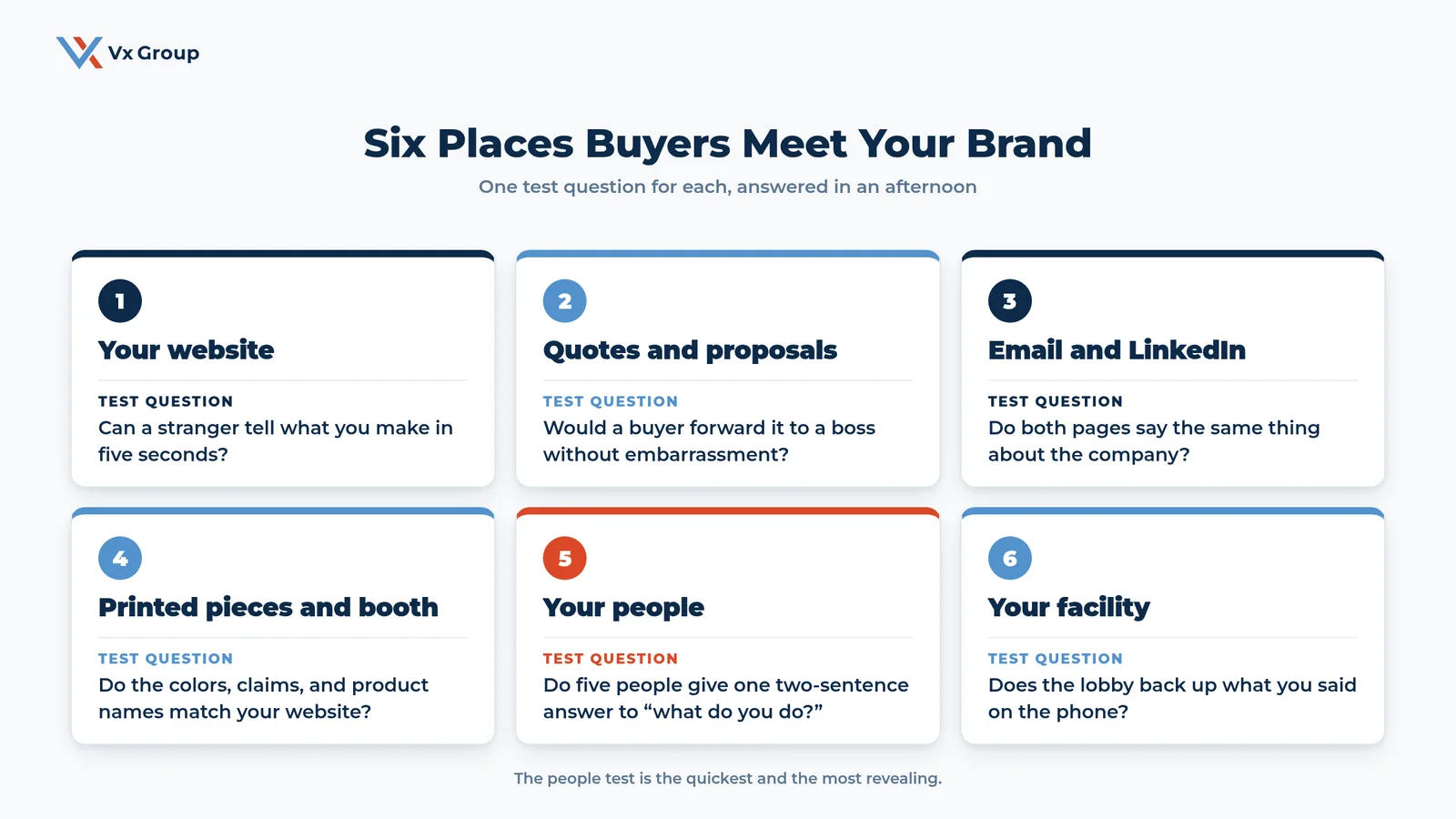
The graphic lists each place with a test question. The sections below walk through them in the order most buyers see them. Run the six checks in one afternoon and write down what you find. You will end up with a short, honest list of fixes.
Check your website's first screen
Open your homepage on a phone. In five seconds, can a stranger tell what you make, who you make it for, and where you are? Many manufacturer sites lead with a slogan or a stock photo of a handshake. The buyer needs a plain statement and a real photo of your shop floor or product.
Then check the pages buyers use to qualify you: capabilities, industries served, certifications, and contact. If a certification or lead time exists only inside a PDF or an image, an AI tool may skip it. Put it in plain text. Our guide to B2B website redesign covers what to fix before changing how the site looks.
Check your quotes and proposals
Pull the last three quotes you sent. Would a buyer forward them to a boss without embarrassment? Check for a logo and a clear summary on page one. Look for the price and lead time in text, and a line on why you are the right supplier for this job.
A quote is a brand document. It lands on the desk of a person who may know you only through that page. Every deal passes through one, so fix it early.
Check your email signature and LinkedIn pages
Look at your own LinkedIn page and your company page. Does each say the same thing about the business? Check the email signature your salespeople use. A signature with a different tagline for each person tells buyers nobody agreed on the message.
Check your printed pieces and booth
Pull a brochure, a line card, and a trade show banner from the closet. Compare them with your website. If the colors, claims, or product names differ, the buyer who sees both starts to wonder which company is real. Our article on trade show booth ideas shows how to make the booth carry your message in one glance.
Check how your people answer "what do you do?"
Ask five people on your team, separately, to describe the company in two sentences. Write down the answers. If you get five versions, buyers hear five versions. This is the quickest and most revealing check on the list.
Check your facility and vehicles
Buyers who visit your plant form a brand impression in the parking lot. Look at the entrance, the lobby, the shop floor, and the signage. A clean, well-lit plant with clear signs supports every claim you made on the phone. A tired lobby does the opposite.
Ready to grow?
Share the results of your six checks. We will help you sort the fixes into a plan that fits your sales cycle.
How do you write what your company does in one sentence?
You write it by filling in four blanks: who you serve, what problem you solve for them, how you do it, and what proves it. The result is one plain sentence that every person in the company can say the same way. That sentence is the base for your website, your quotes, and your sales conversations.
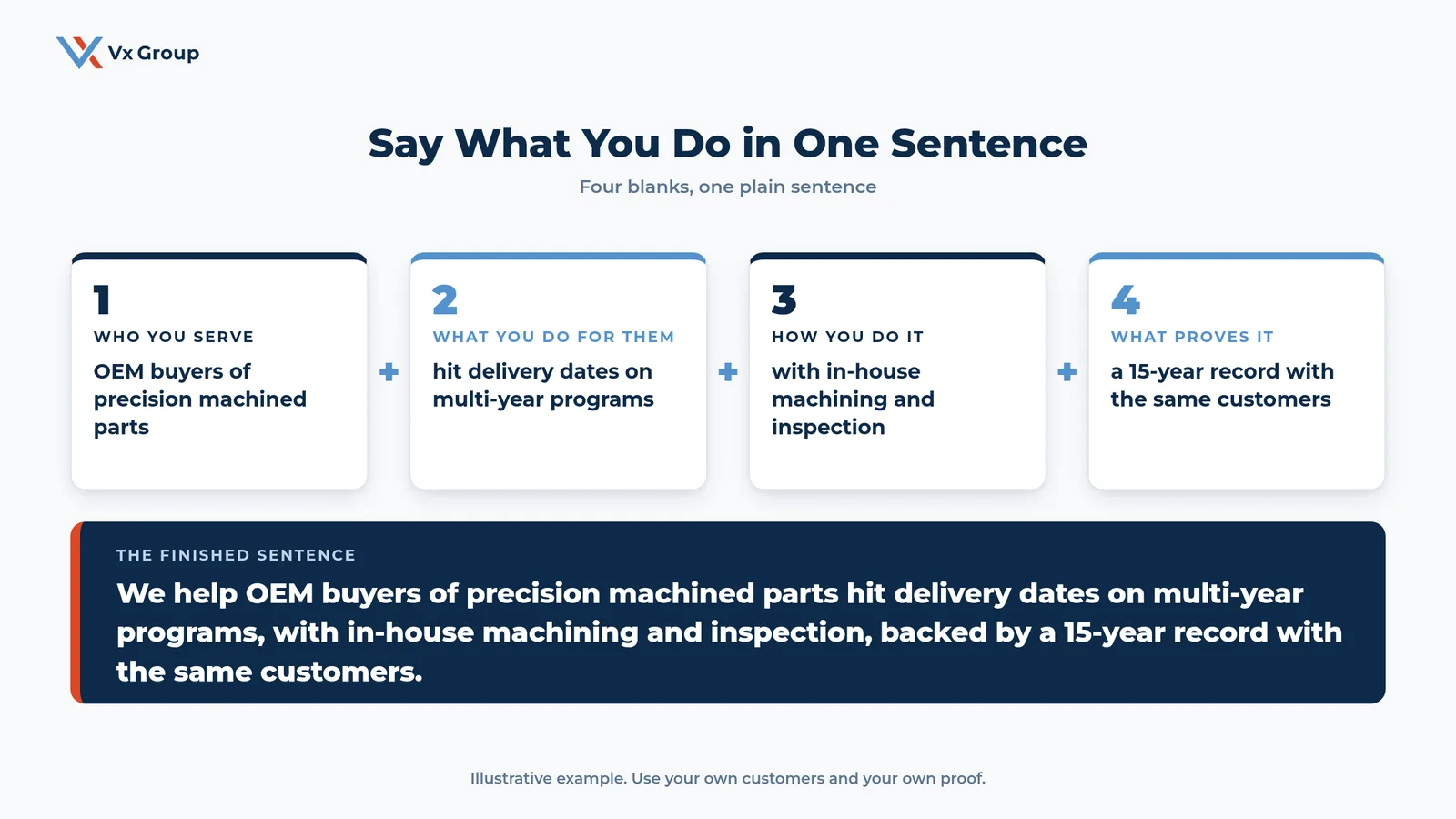
The builder shows the parts and one example. The example is illustrative. Your own sentence will use your own customers and your own proof.
Write the first version in plain words
Use this shape: “We help [type of customer] [get a specific result] by [what you do], backed by [proof].” Write it fast. Then cut every word a customer would never say. Take out “solutions,” “world-class,” and “best-in-class.” Put in the part names, the industry, and the number.
Test it with three customers
Read the sentence to three customers who have bought from you for years. Ask one question: is that why you buy from us? Listen for the word they use to describe you. Their word usually belongs in the sentence.
Use the same words everywhere
Put the final sentence at the top of your homepage and in your quote template. Add it to both LinkedIn pages and the email signature. Give it to your salespeople and ask them to say it in their own voice. Consistency is cheap and it compounds, because each place a buyer sees it reinforces the others.
What proof should a manufacturer's brand carry?
A manufacturer’s brand should carry named customers, specific numbers, certifications, and the years you have served the same accounts. Proof is the part of the brand that a buyer can check. A claim of quality sounds like every competitor. A 15-year customer who will take a reference call sounds like you.
Most owner-led manufacturers hold more proof than they use. The work is gathering it and putting it where buyers look.
Field Notes:
A composite of a pattern we see. A mid-sized fabricator has supplied the same OEM customer for 15 years. Its website says “quality and service” and shows no customer names. When a new salesperson asks the OEM’s buyer for a short story about the work, the buyer says yes the same day and adds a quote about on-time delivery. That page becomes the most visited customer page on the site, and the salesperson attaches it to every quote. The proof existed for years. It sat in a relationship nobody wrote down.
List your proof in one place
Make a one-page inventory with five columns:
- Customers you can name
- Results with numbers
- Certifications and audits
- Years of service on key accounts
- People who will take a reference call
Ask each department for what they know. Accounting knows who has paid on time for 12 years. Quality knows the audit record. Production knows the parts that no one else would take.
Turn the best items into customer stories
A customer story needs a situation, what you did, the result, and a quote. Keep it to a page. Get the customer’s written approval on every figure. Our article on B2B public relations for manufacturers shows how to turn one story into a website page, a sales attachment, and an editor pitch.
Put proof where each reader will see it
Place two or three named customers and one number near the top of your homepage. Add a certification line to every quote. Add a short proof block to your email signature or LinkedIn page. Buyers rarely hunt for proof. They notice it when it sits in front of them.
In what order should you fix your brand?
Fix the brand in this order: the words, the proof, the website, the sales documents, and last the visual identity. Each step builds on the one before it. Starting with a new logo or a new website before the words are settled means paying to say an unclear thing in a nicer way.
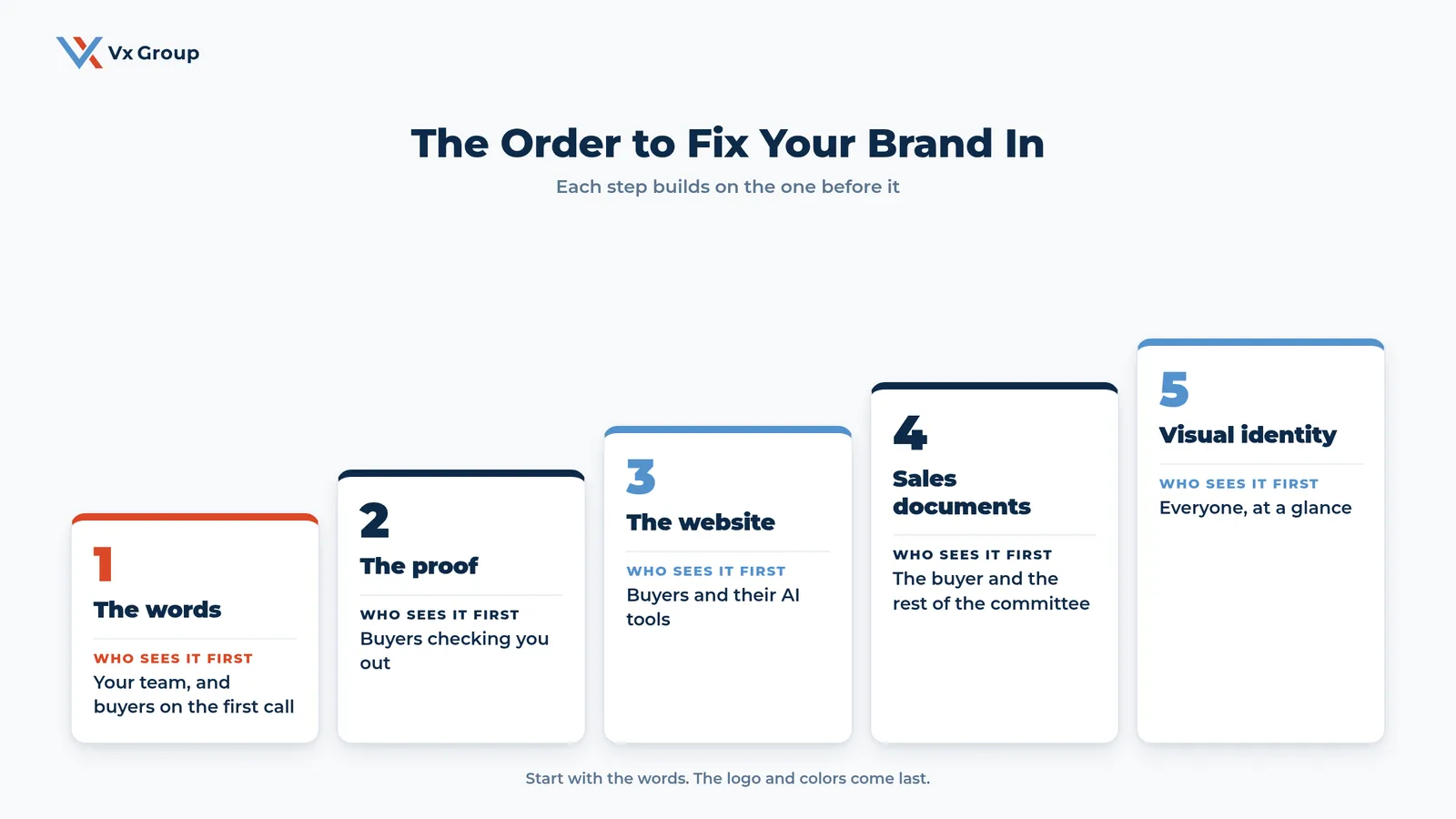
The staircase shows the order and who sees each step first. The steps below explain what finishing each one looks like.
Finish the words first
You are done when the one-sentence description is settled, tested with three customers, and used by the leadership team. This step costs a few hours of conversation and no outside spend.
Gather the proof second
You are done when the proof inventory is complete and three customer stories are approved. Two of the three should come from your best accounts. If a customer says no, ask for a reference call instead.
Rebuild the website third
You are done when the homepage states the one-sentence description, shows named proof, and lists capabilities in text. The look of the site can come later. Fix the content and structure first, because that is what buyers and AI tools read.
Update the sales documents fourth
You are done when the quote, the capabilities deck, and the follow-up email all carry the same words and proof. Our guide to the sales follow-up email shows what to send after a first meeting.
Refresh the visual identity last
A logo and color refresh matters when the current look makes a good company look dated. It comes last because it only works once the other four are settled. Our guide to brand modernization for B2B companies covers when to do it and what it includes.
What does B2B branding cost, and who should do the work?
B2B branding costs staff time for the first four steps and outside spend for the last two. Owners can finish the words and the proof with a few focused weeks of effort. The website, sales documents, and visual identity usually need a designer, a writer, or an agency, and prices vary widely by scope and by firm.
The table compares three common ways to do the work.
| Option | Who does the work | Cost shape | Best fit |
|---|---|---|---|
| In-house | Owner plus one sales or marketing person | Staff time over a few weeks | Companies fixing the words and proof first |
| Freelancer or fractional marketer | One experienced person on a set scope | A monthly or project fee | Companies with a clear message and a small team |
| Agency | A team handling strategy, website, and design | A project fee that varies by scope and agency | Companies ready to rebuild the website and identity |
Ask any outside partner for deliverables in writing, such as the positioning sentence, the proof page, and the website message brief. Compare at least two quotes. Our guide on how to choose a B2B branding agency lists the questions to ask before you sign. If you only need part-time senior help, our article on the B2B fractional CMO covers when that fits.
How do you measure whether B2B branding is working?
Measure B2B branding with leading signals you can count each quarter. Track how accurately prospects describe you and how often they mention a proof point. Track how consistent your own materials are. Brand awareness surveys cost too much and tell a company of your size very little.
The table lists five signals, how to count each, and how often.
| What to track | How to count it | How often |
|---|---|---|
| Prospects who describe you correctly | Ask “What do you know about us?” on the first call and score the answer | Each new lead |
| Mentions of a proof point | Note when a prospect names a customer, a story, or a certification | Each new lead |
| Consistency of your materials | Compare the website, quote, LinkedIn, and signature against the one sentence | Every quarter |
| Length of the first-to-quote stage | Count days from first call to quote on new deals | Every quarter |
| Referrals that name a reason | Ask referrers why they sent the introduction and write it down | Every quarter |
Start with the first signal. It takes one question and tells you what buyers actually believe about you. Write the answers in your CRM notes so you can compare quarter to quarter. Our article on leading indicators that predict B2B revenue explains how to pair these signals with sales results.
Give the work two quarters. Brand changes show up slowly, first in how people describe you, and later in win rates and the length of the sales cycle.
Hold a 30-minute review each quarter
Once a quarter, put the owner, the sales lead, and whoever runs marketing in a room for 30 minutes. Bring the first-call answers, the proof inventory, and one copy of each sales document. Check three things: are prospects describing the company the way the one-sentence version does, has any new proof been added, and do the materials still match each other? Write down one fix per person and check it at the next review. A short, regular review keeps the brand from drifting back into five different versions.
What are the common mistakes in B2B branding for manufacturers?
Seven mistakes show up most often. They are starting with the logo, writing for the wrong reader, hiding proof, and letting each salesperson pitch differently. The others are copying a software playbook, judging too early, and treating the website as a brochure. Each one wastes money or time, and each is easy to avoid once you see it.
- Starting with a new logo. The visual identity is the last step. Doing it first locks in a nicer look for a message that is still unclear.
- Writing for yourself. An owner who loves the technical detail writes a site full of specifications and no buyer benefit. Write for the person doing the research.
- Hiding the proof. Many sites show the product and leave out the customers. Put names and numbers where buyers look.
- Letting every person pitch differently. A team with five descriptions of the company sends five signals. Settle on one sentence and use it.
- Copying a software company’s playbook. Software brands win with reach and speed. A manufacturer wins with trust over a long cycle.
- Judging the work in a month. Allow two quarters before deciding if the changes helped.
- Treating the website as a brochure. Buyers and AI tools use it to check facts. Keep capabilities, certifications, and lead times in plain text.
Where should an owner start with B2B branding this week?
Start with the five-person test. Ask five people on your team to describe the company in two sentences, separately, and write down the answers. Two or more different versions means the words are the first thing to fix, and that costs nothing but a few hours of your time.
Then call your longest-standing customer and ask what they would tell a friend about working with you. Write down their exact words. Those words are the raw material for your one-sentence description and your first customer story.
An agency, a new logo, and a new website can all wait. You need one clear sentence, a page of proof, and the discipline to use both everywhere. Our articles on the generational customer and the lead generation playbook for manufacturers show why the relationships behind your best accounts deserve a brand that matches them.
Ready to grow?
Bring your five answers and your list of proof. We will help you turn them into a brand plan your sales team can use.
FAQs
About the Author: David Tisdale
