

Transactional vs Relational Selling for B2B Manufacturers

Transactional selling wins spot orders, and relational selling wins customers who stay for twenty years. Most manufacturers need both, sorted by account. Sell on speed and price where the order is one-time. Build a relationship system where one customer could be worth millions over time.
TL;DR
- Transactional selling is built around the single order. Price, lead time, and speed decide it, and the sale ends at delivery.
- Relational selling is built around the customer. Trust across several people decides it, and each order makes the next one easier.
- Transactional selling fits spot orders, commodity parts, and first orders. Relational selling fits accounts that could be worth six or seven figures a year.
- The biggest risk in relational selling is founder-dependent sales, where the whole relationship lives in one person’s head.
- Sort your customers into three groups: spot orders, repeat buyers, and relationship accounts. Give each group a different selling style and a named owner.
- Relational selling needs a light system: several contacts per account, a shared record, and a review rhythm. That system keeps the trust in place when staff change.
In this guide:
- What the difference is
- How the two compare side by side
- When transactional selling makes sense
- When relational selling pays off
- What each costs over a 20-year customer
- What happens when your lead salesperson leaves
- How to run both in one company
- How to turn a relationship into a system
- How to tell which one you run today
- Common mistakes
- Where to start this week
We hear the same thing from owners of manufacturing companies. “Our best customers have been with us for fifteen years. I know them all personally. I just can’t tell you how we got them or how to do it again.”
That’s the pattern. The company has a handful of deep relationships, and each one sits in the head of the owner or one senior salesperson. Everything else gets sold quote by quote, and the team treats a $5,000 spot order and a $2 million customer the same way.
We call this founder-dependent sales. It’s the villain in this guide. This guide is for owners and presidents of privately held manufacturers, roughly $5M to $50M in revenue. It explains both selling styles and shows what each is worth over twenty years. It also gives you a way to run both without losing the trust you’ve built.
What is the difference between transactional and relational selling?
Transactional selling treats each order as its own deal. Relational selling treats each order as one step in a long relationship. The first optimizes for the sale in front of you. The second optimizes for what the customer is worth over the years.
Defined Term: Transactional selling.
A selling style built around a single order. The buyer compares price, lead time, and terms, picks a supplier, and the relationship ends or resets at delivery. Speed and price carry most of the weight. Our full breakdown is in what transactional selling costs long-cycle B2B.
Defined Term: Relational selling.
A selling style built around the customer over time. Trust, knowledge of the customer’s business, and contacts across several roles carry most of the weight. Each order and each good delivery makes the next order easier to win.
Neither style is wrong. Selling only by the order keeps a company busy and small. Building a deep relationship with every buyer takes more hours than anyone has.
The useful question is which style fits which customer. The rest of this guide answers that.
How do transactional and relational selling compare side by side?
The two styles differ on cycle length, margin, referrals, and what happens when the lead salesperson leaves. The table below compares them on eight questions an owner asks. Use it to place your own accounts.
| Question | Transactional selling | Relational selling |
|---|---|---|
| How long is the sales cycle? | Days to weeks | Months to a year or more |
| What decides the sale? | Price, lead time, availability | Trust, fit, track record, and the people involved |
| How much price pressure? | High. Every order can be re-bid | Lower. The customer pays for reliability and knowledge |
| Who is involved on the customer side? | Usually one buyer | Several people: buyer, engineer, plant lead, finance, leadership |
| What happens after delivery? | Little. The next quote starts from zero | A review, a check-in, and a plan for what comes next |
| Where do referrals come from? | Rarely. The buyer has no reason to recommend you | Often. Customers introduce you to peers |
| What happens when your lead salesperson leaves? | Little changes, because the buyer was price-shopping anyway | A lot can change if the relationship lives in one head |
| What is the biggest risk? | Staying busy while margins shrink | Revenue concentrated in a few people and a few accounts |
Read the table by row. The pattern is that transactional selling is faster and easier to start, and relational selling is slower and worth far more per customer. We put numbers on that gap in section 5.
When does transactional selling make sense for a manufacturer?
Transactional selling makes sense when the customer’s need is clear, the product is easy to compare, and the order is unlikely to grow. For a manufacturer, that covers spot orders, stock items, and the first order from a new customer.
Use a transactional approach for spot and commodity orders
A buyer who needs a standard part by Friday wants a fast, clean quote. Giving that buyer a discovery call is a waste of their time and yours. Quote quickly, state lead time plainly, and ship on schedule.
Put these orders in the hands of inside sales or customer service, with a short quote template and a clear price floor.
Treat the first order as a transaction with a plan attached
Most relationships start as a transaction. A new buyer sends a small order to see how you perform. Treat that order as a test. Deliver what you quoted, call after it arrives, and ask what else the buyer buys from other suppliers.
That one follow-up call separates a spot order from the start of an account.
Set a rule for when a transaction becomes a relationship
Decide in advance what moves a customer into the relational group. A simple rule works. Pick one: three orders in twelve months, a first order above a set dollar amount, or a customer in an industry you want to grow in. When a customer crosses the line, someone gets assigned to the account.
Without a rule, the decision depends on who happens to notice. Good accounts get missed.
When does relational selling pay off?
Relational selling pays off when the customer buys repeatedly, the product is hard to compare on price alone, and the buying decision involves several people. Custom parts, engineered products, and anything with a long qualification process fit that description.
Look for accounts with room to grow
A relationship is worth building where the customer could buy more from you. That means more product lines, more plants, or more teams. We cover how to find that room in share of wallet and account expansion.
Pull your last three years of revenue by customer and look for the top fifteen. Those accounts carry most of your future.
Look for buyers who value reliability over the lowest price
Some customers will always buy on price. Others will pay more to avoid a bad delivery, a quality escape, or a supplier who doesn’t call back. Those second customers are the ones worth a relationship.
You can spot them by how they talk. They ask about your process, your people, and what happens when something goes wrong. They ask fewer questions about the unit price.
Count the relationships you already have
Most owners already run relational selling on a few accounts. It’s usually informal and usually tied to one person. Write down the ten accounts you’d hate to lose and the name of the person on your team who owns each one. If one name appears seven times, you’ve found your risk. Our post on your top 10 customers as a growth strategy walks through that exercise.
Ready to grow?
If you want help sorting your accounts and building a system that keeps the good ones, we’re glad to talk it through.
What does each approach cost over a 20-year customer?
Over twenty years, a relational customer can be worth more than ten times a transactional one, even when the first order is the same size. The gap comes from growth, longer tenure, and better margin. The numbers below are illustrative, to show the shape.
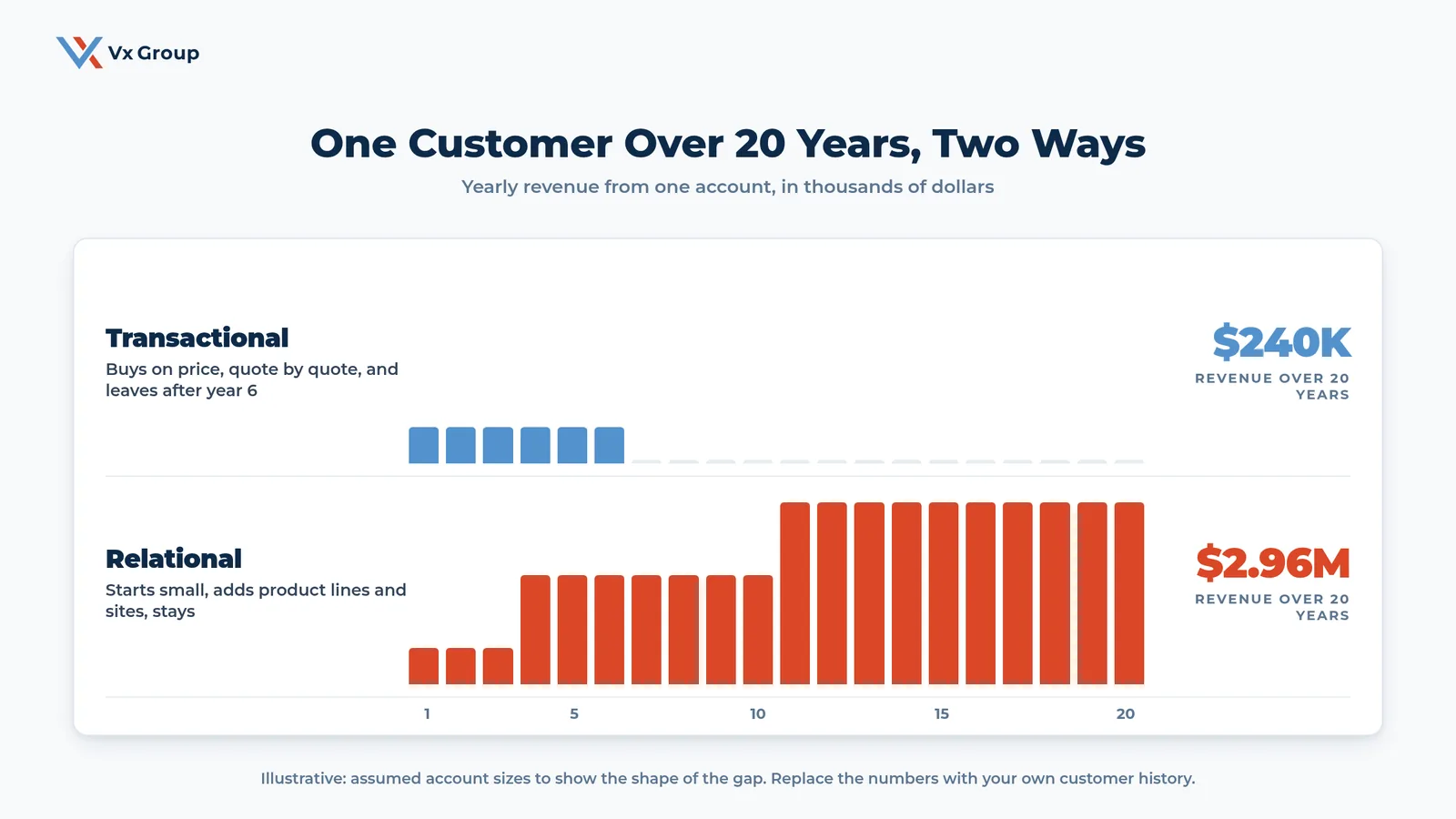
In the chart, both customers start with a $40,000-a-year order. The transactional customer buys on price, gets re-bid every time, and leaves after year 6. The relational customer adds product lines and sites. By year 4 the account is worth $120,000 a year, and by year 11 it’s worth $200,000 a year.
The table adds margin and profit. We assumed an 18% gross margin on accounts that are re-bid every time and 26% on accounts where you aren’t. Swap in your own numbers.
| Measure | Transactional account | Relational account |
|---|---|---|
| Years as a customer | 6 | 20 |
| Yearly revenue | $40,000 flat | $40,000 in years 1 to 3, $120,000 in years 4 to 10, $200,000 in years 11 to 20 |
| Total revenue | $240,000 | $2,960,000 |
| Assumed gross margin | 18% | 26% |
| Gross profit over the relationship | $43,200 | $769,600 |
| Selling effort | A new quote every time | More time in years 1 to 3, then a review rhythm |
The relational account produces about 18 times the gross profit. It also costs more selling time in the first three years. That up-front cost is why many companies never start. The payback is long, and a quarter-by-quarter view never shows it.
This is the idea behind Generational Customers™. A customer who stays for twenty years is an asset, and it needs to be managed like one. We explain the risk side in what a generational customer is.
What happens when your lead salesperson leaves?
When a relationship lives in one person’s head, that person’s departure puts the account at risk. The customer loses their main contact, your pricing history disappears with that person’s inbox, and a competitor often calls within days.
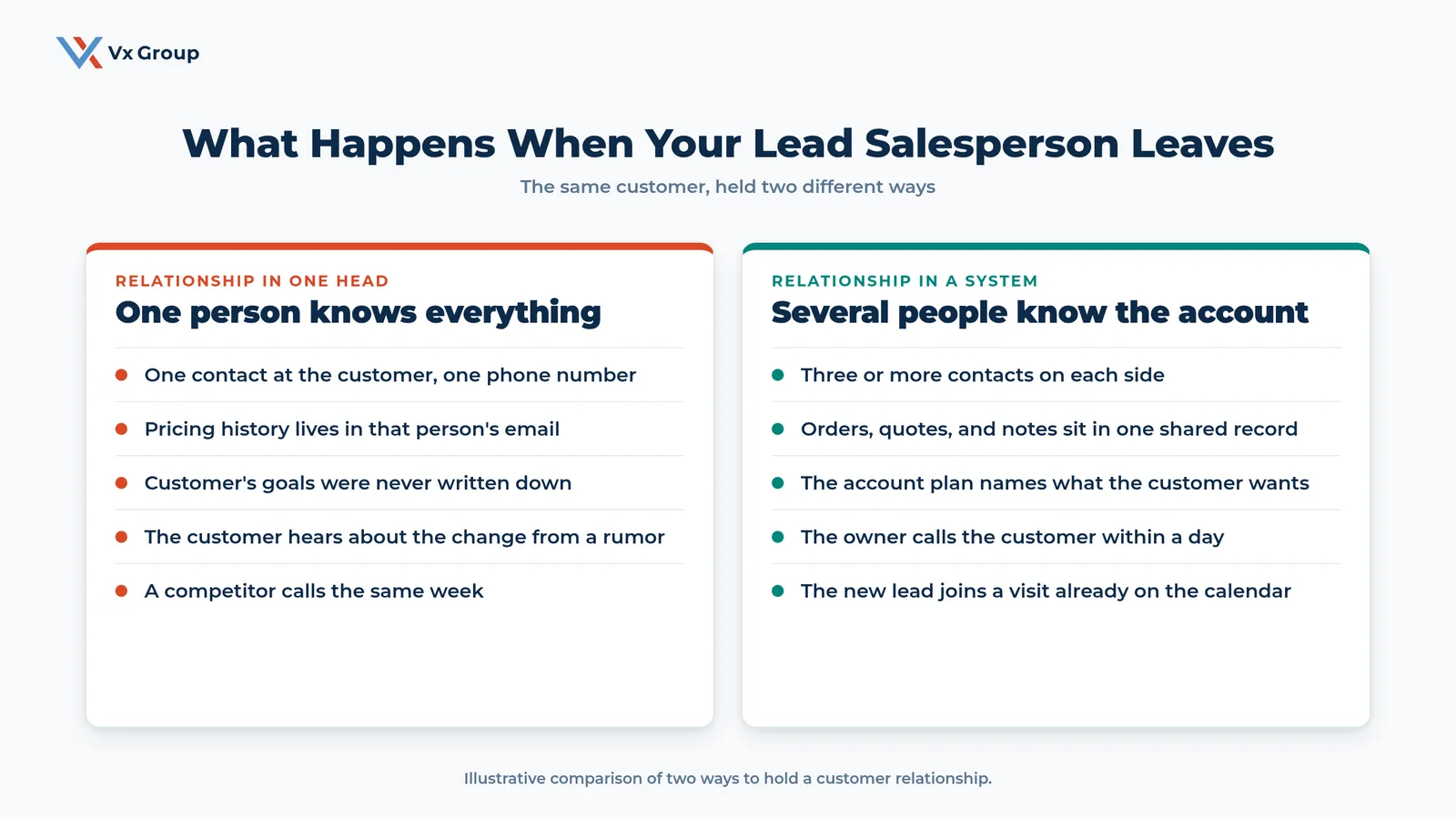
The left card shows a customer held by one person. The right card shows the same customer held by several people and a shared record. When the lead leaves, the second company makes a phone call and the first company makes a rescue plan.
We’ve written about this in detail in founder-dependent sales. The short version is that the owner often is the lead salesperson, so the risk is also an owner risk. If you’re out for two months, who calls your top ten accounts?
Customer concentration makes it worse. If three customers make up half your revenue and one person knows all three, the company has a single point of failure. Customer concentration risk explains how to measure it.
Systems protect the people side of selling. A shared record and several contacts per account keep the relationship in place while people change roles, retire, or move on. (Your salespeople will be fine with this, by the way. Good ones want a backup who knows the account.)
How do you run transactional and relational selling in one company?
Run both by sorting customers into groups and giving each group its own owner, its own pace, and its own measure. Spot orders need speed. Relationship accounts need attention. Treating them the same way wastes the second group’s potential and the first group’s time.
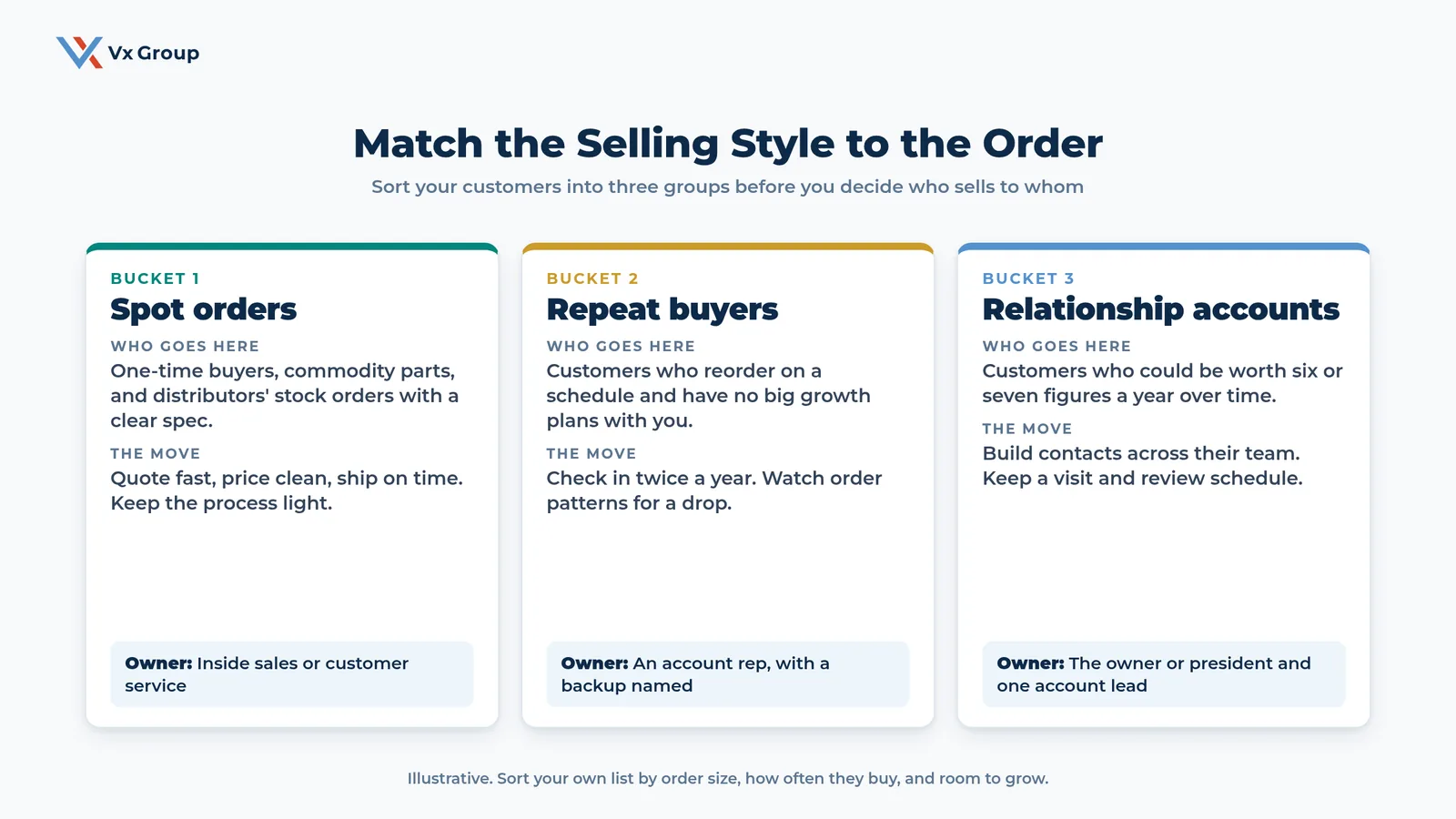
The graphic shows three groups. Spot orders go to inside sales or customer service with a light process. Repeat buyers go to an account rep with a named backup. Relationship accounts go to the owner or president plus one account lead.
Split your customer list into the three groups
Take your top 50 customers by revenue. Mark each as a spot buyer, a repeat buyer, or a relationship account. Use order size, how often they buy, and room to grow. Expect most customers in the first two groups and perhaps ten to fifteen in the third.
Match your people to the groups
Your fastest quoter belongs on spot orders. Your best listener belongs on relationship accounts. Many companies do the opposite. They put senior people on the biggest quotes and leave no time for the customers who need a conversation.
Pay people for the behavior you want
Compensation drives behavior. A plan that pays only on new orders pushes everyone toward transactional selling. If you want relationship work done, the plan has to reward it. Our guide to a sales compensation plan for long sales cycles covers how.
How do you turn a relationship into a system?
A relationship system is a small set of habits that keep an account healthy no matter who is on the team. It has four parts: more than one contact, a shared record, a review rhythm, and a written account plan. None of them needs new software.
Add a second and third contact on both sides
For each relationship account, name at least three people at the customer. Name at least two people on your side. Aim for different roles: buyer, engineer, plant lead, finance, leadership. Write the names in one place.
Keep one shared record for each account
Use your CRM or a shared document. Put in order history, quotes, key dates, what the customer cares about, and notes from the last three conversations. The test is simple. Could a new account lead read the record and sound informed on their first call?
Set a review rhythm and keep it
Meet with each relationship account on a schedule, once a quarter or twice a year. Our post on running a quarterly business review customers want to attend gives a format. Put the dates on the calendar a year out.
Write a one-page account plan
State what the customer wants, what you’d like to grow, who owns each contact, and the next three actions. A plan this size gets used. For the longer version, see key account management for B2B manufacturers.
Hand off accounts on purpose
When a salesperson takes on a new role, introduce the new lead in person, with the old lead in the room. Plan the handoff over weeks. Our sales onboarding article covers how to bring a new person up to speed on long-cycle accounts.
How can you tell which style your company runs today?
Most companies sell transactionally by default, and the relationships they have came about by accident. Check your own habits with the questions below. Answer them for your top ten accounts.
- Can two or more people on your team describe what each account wants to buy next?
- Is there a written plan for each account?
- Does each account have a review date on the calendar?
- Do you know three or more contacts at each account by name and role?
- When did you last learn something new about their business that had nothing to do with an open quote?
- If your lead salesperson left tomorrow, who would call each account, and what would they say?
If you answered “no” or “I’m not sure” to more than two, you’re selling transactionally to accounts that deserve more. That’s fixable, and it usually takes a few months.
Also look at how you handle price. Companies that run relational selling well can raise prices without losing the customer, because the customer knows what they get. Our post on announcing a price increase without losing the relationship shows how that conversation goes.
What are the common mistakes in transactional and relational selling?
Most mistakes come from using one style on every customer. The four below show up most often in the companies we work with.
- Treating every customer like a spot order. The team quotes the $2 million customer the same way it quotes a one-time buyer, and the account never grows.
- Building a relationship with a customer who only buys on price. Weeks of lunches and plant visits produce no loyalty from a buyer whose job is to find the cheapest quote. Spend that time elsewhere.
- Keeping relationships informal. The owner knows everyone and writes nothing down. It works until the owner is unavailable.
- Measuring only orders. If the scoreboard shows quotes sent and orders won, nobody sees the quiet account that stopped calling.
A fifth mistake is waiting for a perfect system. Start with your top ten accounts and one shared page for each. Improve it from there.
Where should a manufacturer start with this?
Start with a list of your top ten customers and the people who own each relationship. That one page shows how much of your business depends on one head, and it tells you where to begin.
This week:
- Pull revenue by customer for the last three years and mark the top fifteen.
- Write the name of your main contact at each, and the name of the person on your team who owns the relationship.
- Mark any account where one person is the only link.
- For each of those accounts, add a second internal contact and book a visit or call in the next 60 days.
- Choose which customers move into the relational group, and who owns each.
If you’d like a second set of eyes on the list, we do this sort of work with owners every week. For related reading, see building relationships with customers in B2B manufacturing and account-based selling vs volume selling.
Ready to grow?
Bring your top ten customer list and we’ll look at where the relationships sit today.
FAQs
About the Author: Jacob Camhi
