

B2B Public Relations for Manufacturers: A Guide for Owners
B2B public relations is the work of getting the right people to know, trust, and recommend your company through coverage you earn. For a manufacturer, that means trade press, owner bylines, customer stories, and industry events, all aimed at the ten or so people who send you work. Start small and keep it steady.
TL;DR
- B2B public relations for a manufacturer means earning attention from a short list of buyers, referral sources, partners, and editors. The work starts with a list of names, and press release blasts have no part in it.
- Write down ten names first. Every PR move after that gets judged by whether it reaches one of them.
- Four channels work for owner-led manufacturers: customer stories, owner bylines, trade press, and association or event visibility.
- Start with customer stories. They take the least effort and keep the message in your hands.
- Buyers and AI assistants both check what is public about you before the first call, so fix the basic facts on your own website too.
- Plan on about 90 days of steady work, a few hours a week, before you can tell which channel to repeat.
In this guide:
- What B2B public relations means for a manufacturer
- Why it matters before the first call
- The ten people to reach
- The four channels that work
- How to get trade press coverage
- How to write an owner byline
- How to turn customer stories into coverage
- How to use associations and industry events
- What your own website should say
- A 90-day plan
- Cost, time, and who should do the work
- How to measure it
- Common mistakes
- Where to start this week
We hear the same line on first calls more than almost any other: “We’re better than our competitors. Nobody knows it.”
Usually it’s true. The shop has run clean for 30 years. The quality record is strong. The customers who have stayed a decade would vouch for the company without being asked. Meanwhile a competitor with half the capability has a better website, a feature in the trade magazine, and a seat on the association board.
We call this the best-kept-secret syndrome. An excellent company looks smaller than it is, and the right buyers never get a reason to pick up the phone. Public relations is the fix for it, as long as you point it at the right people.
This guide is for owners and presidents of privately held manufacturers, roughly $5M to $50M in revenue. It shows how to do the work without an agency retainer or a pile of press releases nobody reads. Most of it takes a few hours a week.
What is B2B public relations for a manufacturer?
B2B public relations is the practice of earning attention from the people who influence your sales. That includes buyers, the advisors and peers who refer you, distributors and reps, and the editors who decide what your industry reads. The attention is earned through stories, expertise, and visible results, and nobody pays for the placement.
Most of the content you will find on this topic is written for agencies selling retainers, or for software companies chasing tech reporters. A manufacturer with 80 employees and a 12-month sales cycle has a different job. You need the right ten people to know your name when it comes up.
Defined Term: B2B public relations.
Earning attention and trust from the buyers, referral sources, partners, and editors who influence your sales. For a manufacturer, the main tools are customer stories, owner bylines, trade press coverage, and visibility at industry associations and events.
Public relations works alongside the rest of your marketing. Advertising buys attention for as long as the money lasts. Earned attention carries more weight because someone else chose to say it. A buyer who reads a trade article about your plant gives it more credit than the same claim in your ad.
It also supports the work you already do on brand. Our guide to B2B brand authority covers how a company builds a reputation over time. Our article on B2B brand strategy covers what the brand should say. PR is how that message reaches people outside your own audience.
Why does B2B public relations matter before the first call?
B2B public relations matters because buyers research you before they ever contact you. A purchasing manager, an engineer, or a banker who hears your name will look you up. What they find in that first ten minutes shapes whether the call happens at all.
Think about the last time you checked out a supplier or an advisor. You searched the name, skimmed the website, and looked for anything written about them by someone else. Your buyers do the same thing.
Your own website only tells one side. Third-party mentions tell the buyer that someone else thought you were worth writing about. That includes a trade article, a customer quote, a speaker listing, and a byline under the owner’s name.
AI assistants add a second reader. When a buyer asks an AI tool to compare suppliers, the tool pulls from public pages, and some of those pages are written by other people. We can’t see exactly which sources any tool picks. We do know that several clear, consistent, public mentions give the tool more to work with. A company with a thin website and nothing else gives it very little. Our articles on how AI finds, reads, and compares you and how to run an AI visibility audit go into the details.
There’s a second payoff that owners notice quickly. Public work makes your sales team’s job easier. A salesperson who can send a prospect a customer story or an article gets a warmer reply than one who sends a capabilities deck.
Who are the ten people who should know your company?
The ten people are the buyers, referral sources, partners, editors, and industry leaders whose opinion of you affects your next three years of sales. Writing the list down is the first step in any B2B PR effort. Every later move gets judged by whether it reaches someone on it.
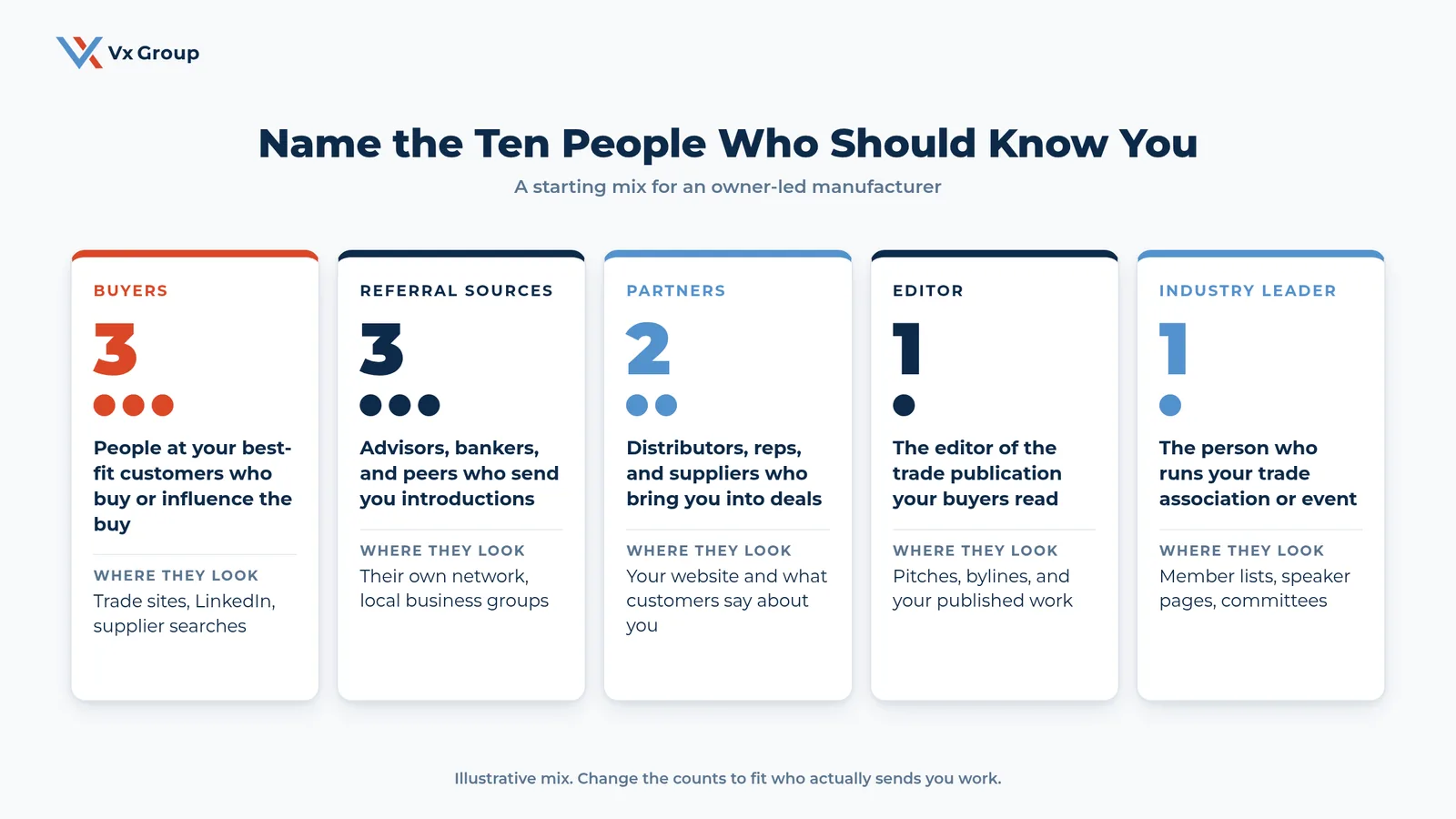
The graphic above shows a starting mix: three buyers, three referral sources, two partners, one editor, and one industry leader. The counts are illustrative. A company that gets most of its work through distributors should shift the mix toward partners. A company that sells to a handful of large OEMs should put more buyers on the list.
Write the list with real names
Open a spreadsheet and type ten names. Use real people, with a company and a title. “Purchasing managers at aerospace suppliers” is a category, so keep going until you have names. If you can only name six, that tells you something about how well your company knows its own market.
Include people you already know and a few you don’t. A banker who finances your best customers belongs on the list even if you’ve never met. So does the editor of the magazine your buyers read.
Note where each person looks for information
For each name, write one line on how they find suppliers. Some read a specific trade magazine. Some ask their peers. Some go straight to a search bar. Add what they care about most too (lead time? quality record? a partner who actually picks up the phone?). This line decides which channel you use for that person later.
Check what each person finds when they search your company
Spend 20 minutes searching your company name the way each person would. Write down what comes up on the first page. Look for old addresses, missing product lines, a stale news page, or a competitor’s name in your results. The gaps become your first to-do list.
The table below shows how one list might look. Your own list will be different.
| Person | Where they look | What they should find |
|---|---|---|
| Buyer at a best-fit customer | Search, LinkedIn, trade sites | A clear website and a customer story in their industry |
| Banker or advisor who refers you | Their own network | An owner who is easy to describe in one sentence |
| Distributor or rep | Your website and customer comments | Current product lines and proof you support partners |
| Trade magazine editor | Pitches and past bylines | A short, specific story idea with data behind it |
| Association leader | Member lists and speaker pages | An owner willing to share what has worked |
Which B2B public relations channels work for owner-led manufacturers?
Four channels work for owner-led manufacturers: customer stories, owner bylines, trade press coverage, and association or event visibility. Each reaches a different part of your list, and each takes a different amount of effort. Pick one to start and add the next after the first one produces something.
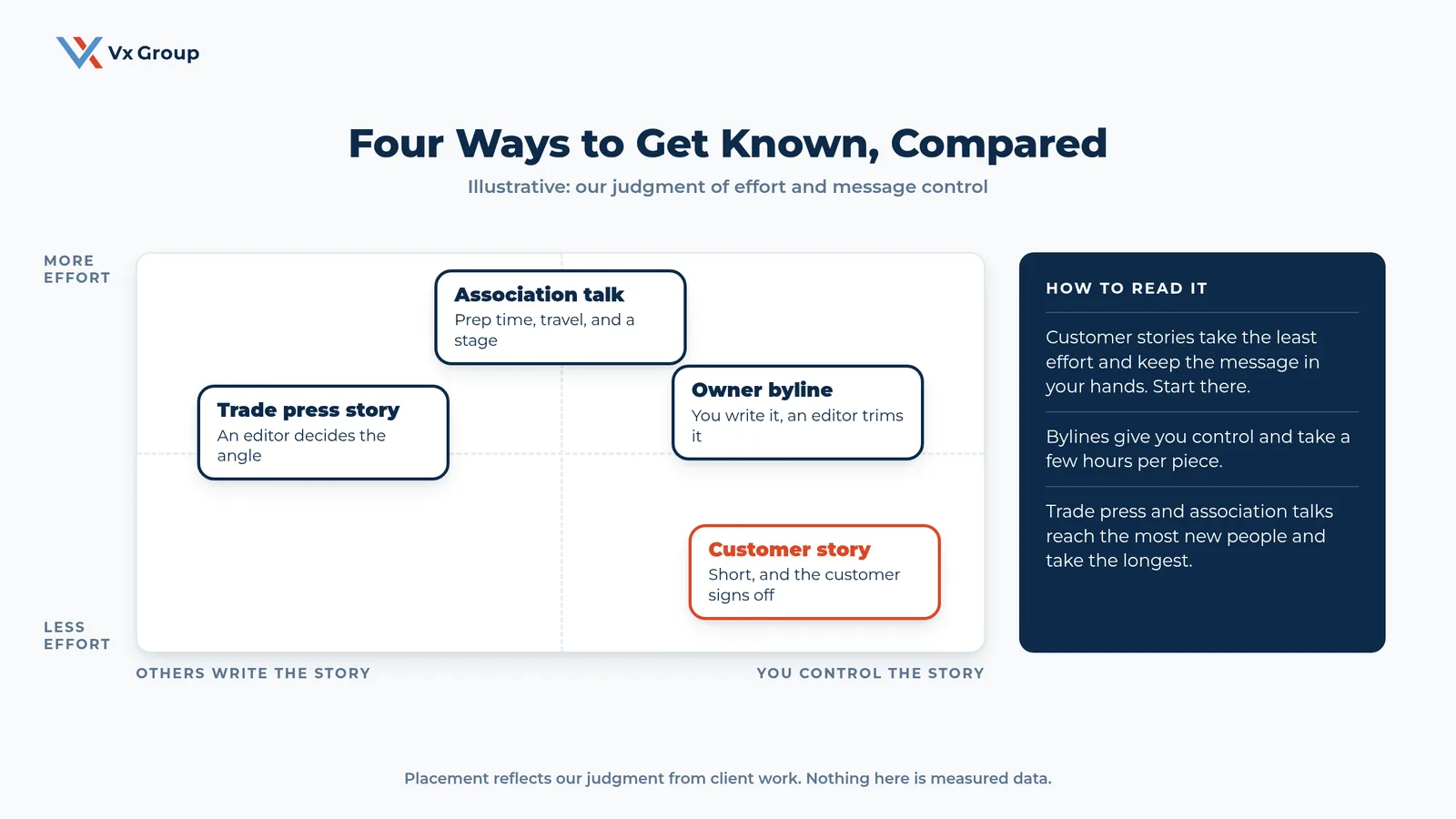
The chart above is our judgment from client work, so treat it as a guide. Customer stories take the least effort, and you control what they say. Owner bylines take a few hours per piece and also leave the message with you. Trade press stories and association talks reach the most new people, but an editor or a program committee decides the angle, and both take longer.
Pick customer stories first
A customer story needs a willing customer and a few hours of your time. You already have the raw material. The customer story section below walks through the steps.
Add an owner byline second
A byline is an article under your name. It shows buyers how you think, and it gives editors something to run. The owner byline section below covers how to write one.
Pitch trade press third
Once you have a story and a byline, you have something to send an editor. The trade press section above covers the pitch.
Add association work last
Speaking and committee work take the most time and pay off slowly. Start once the first three channels are running.
How do you get a trade publication to cover your company?
To get a trade publication to cover your company, send one editor a short, specific story idea with data or a named customer behind it. Be useful to that editor before you ask for anything. Editors at small trade magazines are often short on time and short on good material. They respond to a clear point from someone who knows the industry.
Find the one editor your buyers read
Look at your list and ask which publication your buyers actually read. Pick one. Find the name of the editor who covers your area and read the last six months of what they’ve published. You’ll see what they cover, how long the pieces run, and who they quote.
Send a pitch an editor can answer in one line
Keep the pitch under 150 words. Open with the point, add one fact, and name who can be interviewed. A working outline looks like this:
- Subject line: The topic in plain words, such as “What lead times are doing to small fabricators.”
- First line: The point of the story, in one sentence.
- Second paragraph: One fact or number from your own operation that supports it.
- Third paragraph: Who is available to talk, and when.
- Close: A thank-you and nothing else.
Skip the attached press release. Editors want a reason to call you, and a short note gives them one.
Offer data from your own work
Editors like numbers they can’t get anywhere else. You have them: lead times, scrap rates, how long quotes take, what your customers ask for most. Pull one number you’re comfortable sharing and build the pitch around it. Check it with your customer first if it touches their business.
Help the editor before you ask for anything
Answer a question on short notice. Send a useful link. Introduce the editor to a customer with a good story. Editors remember who helped, and that is usually what turns a pitch into a yes on the third try.
Ready to grow?
Bring us your list of ten names and we will help you pick the channels that fit your company.
How do you write an owner byline that gets published?
An owner byline that gets published covers one problem your buyers have and shows one real example from your shop. It ends with something a reader can do on Monday. Keep it between 600 and 900 words. Editors run pieces that teach, and they pass on pieces that read as an ad.
Choose one problem your buyers raise again and again
Think about the questions customers ask in your quotes and your plant tours. Pick the one you answer most often. A topic that comes up in real conversations will interest other readers too.
Write the example before the advice
Open with a short, true story from your own work. A rush order that nearly shipped wrong, a design change that saved a customer money, a lesson from a failed run. The story gives the piece credibility. The advice then comes from experience.
End with three things the reader can do
Close with a short list of steps. Make each one small enough to start this week. A reader who finishes the article and tries one step will remember who wrote it.
Hand the draft to someone who isn't in the plant
Ask a friend outside your industry, or a salesperson who has never read it, to mark any sentence they don’t follow. Fix those sentences. Editors can usually tell when an owner wrote the piece and when someone forwarded a brochure.
Our article on industrial content marketing covers how to keep a steady stream of useful material coming.
How do you turn customer stories into B2B press?
To turn a customer story into B2B press, write a short account of a real problem you solved for a named customer. Get the customer to approve it in writing. Then offer it to the trade publication that customer’s industry reads. The same story can run on your website, in your sales emails, and in a pitch.
Field Notes:
A composite of a pattern we see. A mid-sized fabricator has served the same OEM customer for 15 years. The owner has never written about it because “that’s just what we do.” When a sales lead finally asks the customer for a story, the customer agrees in one phone call. They suggest two changes. The finished page goes on the website and into every quote. A prospect later mentions it on a first call. The owner’s reaction is always some version of “why didn’t we do this sooner?” Details are changed, and this example is illustrative.
Ask the customer for permission with a small request
Call the contact and ask whether you can write a short account of the work. Say what it will be used for, and promise they will see it before anyone else does. Most customers say yes to a short, clear request. Some companies have a policy against it, and you should accept that without pressure.
Write the story in five parts
Use the same outline every time. The table below shows it.
| Part | What to write | Who approves it |
|---|---|---|
| The situation | What the customer was trying to do and what was in the way | Customer |
| What you did | The work, in plain words, without jargon | Your team |
| The result | One number or fact the customer is comfortable sharing | Customer |
| A quote | One or two sentences from the customer, in their words | Customer |
| What’s next | The ongoing relationship, in one line | Both |
Get the approval in writing
Send the finished page to the customer contact and ask for a reply that says “approved.” Keep that email. If the customer’s legal team needs to review, give them time and do not publish early.
Reuse the story in three places
Put it on your website and add it to your next quote package. Offer it to the editor on your list as a possible feature. Our guide to your top 10 customers as a growth strategy explains why these long relationships are worth the attention.
How should an owner use associations and industry events for PR?
An owner should use associations and industry events to be seen as someone who shares what works. Join the committee, offer to speak or sit on a panel, and answer questions in the member forum. Over a year or two, the people who run your industry begin to know your name and send people your way.
This works best when it’s steady. A single talk gets forgotten. A committee seat that runs three years makes you a familiar face.
Pick one association where your buyers or partners are members
Choose the group where most of your ten people already show up. Join it and read the member list. If the group has a committee on a topic you know well, ask to join.
Offer a short talk built on your own work
Program committees need speakers with real experience. Send a two-line proposal with a title, the problem it covers, and one example. A talk built on a customer story or a byline you already wrote saves you the prep.
Follow up with the people you met
After any event, send three short notes within a week to people on your list. Mention something from your conversation. A short, specific note keeps the contact alive. Our guide to trade show marketing covers the show floor itself.
What should your own website say to support B2B public relations?
Your own website should state the basic facts about your company clearly and in text. That means what you make, who you serve, where you are, how long you’ve been in business, your certifications, and who to call. Anyone who reads about you elsewhere will check your site next, and so will AI tools. If the facts are thin or out of date, the coverage you earn has nowhere good to send people.
Write a plain facts page
Make one page with the company name, locations, products or services, industries served, certifications, year founded, and a contact name. Write it in sentences and put the facts in text. Don’t leave them locked in an image or a PDF.
Add a page for press and speaking
Create a short page with a two-line company description and a headshot of the owner. Add three topics the owner can speak on and a contact email. An editor who wants a quote should be able to find what they need in one minute.
Link to the coverage you earn
Add a “In the news” or “Customer stories” section and keep it current. Our guides to SEO for manufacturing companies and B2B website redesign cover what to fix on the site itself.
What does a 90-day B2B public relations plan look like?
A 90-day B2B public relations plan spends the first month building the list and fixing the facts. The second month goes to writing and pitching. The third month goes to publishing and reviewing. It needs a few hours a week from one owner or one person the owner trusts.
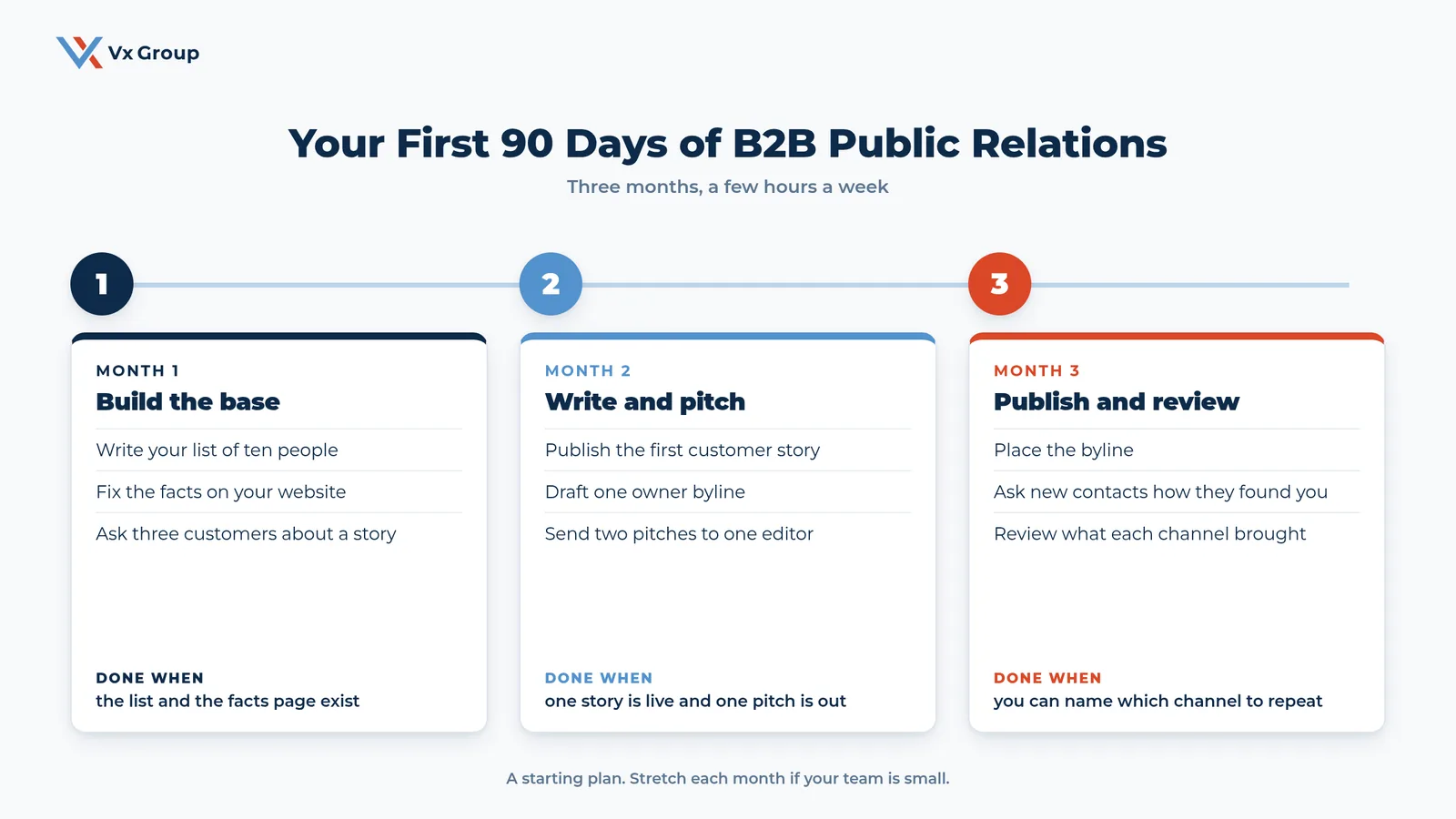
The graphic above lays out the three months. Month one ends when your list of ten names and your facts page exist. Month two ends when one customer story is live and one pitch is out. Month three ends when you can name the channel to repeat.
Block the time on the calendar
Put two one-hour blocks on the calendar each week for 12 weeks. Name them for the task, such as “customer story draft” or “editor pitch.” Work that has no time blocked usually doesn’t happen.
Name one person to own it
One person should be responsible for the work, and the owner can do part of it. That could be a marketing lead, an operations manager, or a sales leader. Give that person the list and a monthly check-in with you.
Review at day 90
At day 90, look at what each channel produced. Which conversations started because of a story, an article, or an event? Keep the channel that produced the most useful contacts and drop the one that produced none. Our article on how owners build authority by sharing what they know covers how to keep it going after that.
How much does B2B public relations cost, and who should do the work?
B2B public relations costs staff time if you do it in-house, and a monthly fee if you hire an agency or consultant. Many owner-led manufacturers start in-house with a part-time owner and one helper, then bring in outside help for writing or pitching once they know what works.
| Option | Who does the work | Cost shape | Best fit |
|---|---|---|---|
| In-house | Owner plus one marketing or sales person | Staff time, a few hours a week | Companies starting out with a short list |
| Agency or consultant | Outside team writes and pitches | Monthly fee that varies by scope and agency | Companies with a clear list and no time |
| Mix | Owner supplies stories and facts, outside help edits and pitches | Part-time fee plus staff time | Companies past the first 90 days |
Ask any agency for a written scope
If you hire help, ask for the deliverables in writing: how many pieces, how many pitches, and what reports you’ll get. Ask who will do the work and how often you’ll talk. Many agency pages are written to sell retainers, so compare at least two before you sign.
Ask what happens to the work if you stop
Find out who owns the articles and the media contacts if the contract ends. Keep copies of everything published in your name.
Our article on what a manufacturing marketing agency should do for you covers what to expect from outside help.
How do you measure whether B2B public relations is working?
To measure B2B public relations, count how many people on your list now know you. Count how many new conversations mention your coverage, and how new contacts say they found you. Impressions and page views are easy to count and tell you little. A short, steady record of real conversations tells you much more.
| What to track | How to count it | How often |
|---|---|---|
| People on your list who know you | Mark each name “met,” “warm,” or “unknown” | Every quarter |
| New conversations that mention a story or article | Add a field to your CRM or sales notes | Each new lead |
| How new contacts found you | Ask on the first call and write the answer down | Each new lead |
| Pieces published or placed | Count stories, bylines, and talks | Every quarter |
| Referrals from the people on your list | Count introductions and note who made them | Every quarter |
Add "how did you hear about us" to every first call
Ask the question out loud and write down the answer in the buyer’s words. After two quarters you’ll see patterns that no dashboard shows.
Read the list again every quarter
Once a quarter, open the list of ten and update it. Move people from “unknown” to “met” when it’s true. Replace names that no longer matter. The list shows whether your PR is reaching the people it was built for.
What mistakes do owners make with B2B public relations?
The most common mistakes are sending press releases to a long list, paying for placement without knowing who will read it, announcing everything, and quitting after one quiet month. Each one wastes time and teaches editors to ignore you.
Skip the mass press release
A release sent to a hundred outlets usually gets ignored. A short note to one editor who covers your area has a better chance, and it costs less.
Check who reads it before you pay for it
Paid placements and “sponsored” features can have a place. Ask who will read it and whether those people are on your list. If the answer is vague, pass.
Announce news that matters to buyers
A new hire, a new forklift, or an anniversary rarely matters to a buyer. A new capability that cuts lead time, a certification a customer needs, or a result a customer approved will get attention. Pick the news a buyer would repeat to a colleague.
Give it a full 90 days
One quiet month tells you nothing. PR builds slowly, and the first real result is often a conversation that mentions an article you published weeks ago. Stay with the plan to day 90 before you judge it.
Where should an owner start with B2B public relations this week?
Start with the list of ten names. Spend an hour this week writing them down, then add a line on where each one looks for information. That list tells you which channel to pick and which editor to pitch.
Then pick your longest-running customer and call them. Ask if you can write a short story about the work you’ve done together. That one call starts the first customer story, and it gives you something real to send an editor, post on your website, and hand to your sales team.
To begin, you need a short list of people, one good story, and a few hours a week for 90 days. An agency and a press list can wait. Our articles on founder-dependent sales and the generational customer explain why the relationships behind that list are worth protecting.
Ready to grow?
Share your list of ten names and we will help you build the first 90 days around the people who send you work.
FAQs
About the Author: Jacob Camhi
