

Supplier Evaluation: The Criteria Buyers and Their AI Check First

Supplier evaluation is the process a buyer uses to score suppliers on price, lead time, quality, certifications, references, and risk before choosing one. Buyers now hand that scoring to AI tools. The tools read your quote and your website. The supplier with the clearest facts that can be checked usually ranks first.
TL;DR
- Supplier evaluation scores each supplier against weighted criteria such as price, lead time, certifications, references, and specs, then ranks them.
- Buyers who use AI at work now run quotes through an assistant that applies the same criteria to every supplier in the same way.
- The AI ranks the quote that is easiest to check and defend. In our sample comparison, a $14,200 quote beats an $11,800 quote because it states every fact in text.
- An owner sits on both sides of this process. You evaluate your own material and component suppliers, and your customers evaluate you.
- You can build a five-criterion scorecard in an afternoon, weight it to 100 points, and use it on suppliers and on your own last quote.
- Relationships still decide close calls. A buyer who trusts you calls to check what the AI said.
What this guide covers
- What is supplier evaluation?
- Why does supplier evaluation matter to an owner on both sides of the table?
- What criteria do buyers use to evaluate suppliers?
- How do you build a supplier evaluation scorecard?
- How does a buyer’s AI evaluate suppliers?
- How do you use AI to evaluate your own suppliers?
- How do you score your own company as a supplier?
- How often should you evaluate suppliers?
- What mistakes do evaluators make?
- Where should an owner start this week?
Somewhere in your pipeline, a buyer you have not met is scoring you against two competitors. Nobody called you for a reference. The buyer loaded three quotes into an AI assistant and asked which supplier looked safest.
Most of what ranks for this topic explains supplier evaluation to the buyer. The guides cover scorecards, review cycles, and software. Few show the supplier what the scorecard looks like from the other side. Few speak to an owner who is on both sides at once.
This guide does both. It lists the criteria a buyer applies and shows how to build a scorecard. Then it shows what changes when AI does the first round of scoring. The problem is the invisible scorecard. A ranking happens before anyone calls you, and it uses only what you wrote down.
What is supplier evaluation?
Supplier evaluation is the process of scoring suppliers against set criteria to decide whom to buy from, whom to keep, and whom to replace. It runs at three points. The first is before the first order. The second is when quotes come in. The third is on a schedule after the work begins.
Defined Term: Supplier evaluation.
The structured scoring of a supplier against weighted criteria such as price, delivery, quality, certifications, references, and risk. A buyer uses the score to compare suppliers, to choose one, and to review how a chosen supplier performs over time.
The ranking guides on this topic come from a professional procurement body, a reference encyclopedia, procurement software vendors, and a career site. Most of them agree on the same list of criteria. They treat evaluation as a loop of scoring, reviewing, and improving. One vendor guide also separates evaluation from the scorecard. The evaluation is the judgment. The scorecard is the sheet that records it.
That distinction helps in practice. A scorecard gives two people the same sheet to fill in, so they reach the same answer. Without one, a purchase depends on whoever remembers the last delivery.
| Point in time | What the buyer is deciding | What the buyer looks at |
|---|---|---|
| Before the first order | Whether a supplier is worth asking for a quote | Website, certifications, references, capacity |
| When quotes arrive | Which supplier gets the order | Price detail, lead time, terms, specs, risk |
| After work begins | Whether to keep, coach, or replace the supplier | On-time delivery, quality, responsiveness |
In each row, a buyer can work from memory or from written facts. AI makes written facts the default. An AI has no memory of your last delivery. It has your documents and whatever it can find about you.
Why does supplier evaluation matter to an owner on both sides of the table?
Supplier evaluation matters twice to the owner of a manufacturer. Poor scoring of your own suppliers raises your costs and delays your shipments. A poor showing on your customers’ scorecards loses you quotes you never hear about. Both problems come from the same gap: no written facts that a buyer can check.
You buy steel, resin, castings, packaging, freight, and software. Each of those suppliers affects your lead time and your quality. When a supplier slips, your customer feels it and holds you responsible.
You also sell. Your customers run the same kind of scoring on you, and a growing share of them let AI do the first pass. A July 2026 Semrush survey of 519 B2B buyers who use AI at work found that 92% say AI shaped their shortlist and 83% say it shaped their final pick. We cover those figures and what they mean for your quotes in our guide to AI in procurement.
Owners of private manufacturers tend to know their suppliers personally. That works while the owner makes every purchase and every sale. It stops working when a buyer at another company has never met you. It also stops working when a new purchasing hire has never met your supplier. A written scorecard puts what you know on paper where other people can use it.
The same goes for your sales team. Our guide to the B2B buying committee maps the people who score a deal at the buyer. Several of them will now run a scorecard of their own.
What criteria do buyers use to evaluate suppliers?
Buyers evaluate suppliers on eight groups of criteria: price and total cost, delivery and lead time, quality, capacity, certifications and compliance, financial and operating risk, communication, and references. On a custom manufactured part, the first five usually carry the most weight.
The table below shows each group, the question a buyer asks, and where a buyer’s AI finds the answer. Most suppliers overlook the right-hand column.
| Criterion | The question a buyer asks | Where a buyer’s AI looks |
|---|---|---|
| Price and total cost | What is included, and what will it cost me over a year? | The quote, price line items, payment terms |
| Delivery and lead time | When will it arrive, and how often is the date kept? | The quote, your website, reviews, references |
| Quality | How often are parts rejected? | Quality pages, certifications, references |
| Capacity | Can this supplier handle my volume and a surge? | Website equipment lists, case descriptions |
| Certifications and compliance | Is every claim current and checkable? | Certificates, directories, your site |
| Financial and operating risk | Will this supplier still be here in two years? | News, filings, years in business, ownership |
| Communication | How quickly and clearly does the supplier respond? | Email response, call notes, reviews |
| References | Who else trusts this supplier with similar work? | Named customers, case pages |
Much of the evaluation depends on documents you control. Price, delivery, certifications, capacity, and references all appear in your quote and on your website. A buyer’s AI reads both.
Choose the five criteria that matter for this purchase
Start with five criteria. People skip a scorecard with eight rows. They use one with five. For a custom part, the strongest five are usually price detail, lead time with a start point, certifications, named references, and specs in plain text.
For a commodity item, swap in on-time delivery history and total cost. For a safety-critical part, give certifications the biggest weight. Write the reason for each choice in one line. Then the next person knows why the sheet looks the way it does.
Match each criterion to a document you can check
Next to each criterion, write the document that proves it. Price lives in the quote, lead time in the quote or the order confirmation, certifications in the certificate, and references in a call. If a criterion has no document behind it, the score rests on opinion. Find the document or drop the criterion.
This step also shows how your own company looks from outside. If you cannot name the document that proves your own lead time, a buyer’s AI cannot find one either.
How do you build a supplier evaluation scorecard?
Build a supplier evaluation scorecard in five steps: pick five criteria, weight them to 100 points, define what a full score looks like for each, score from documents, and set a pass line. The sheet fits on one page. One person can build it in an afternoon.
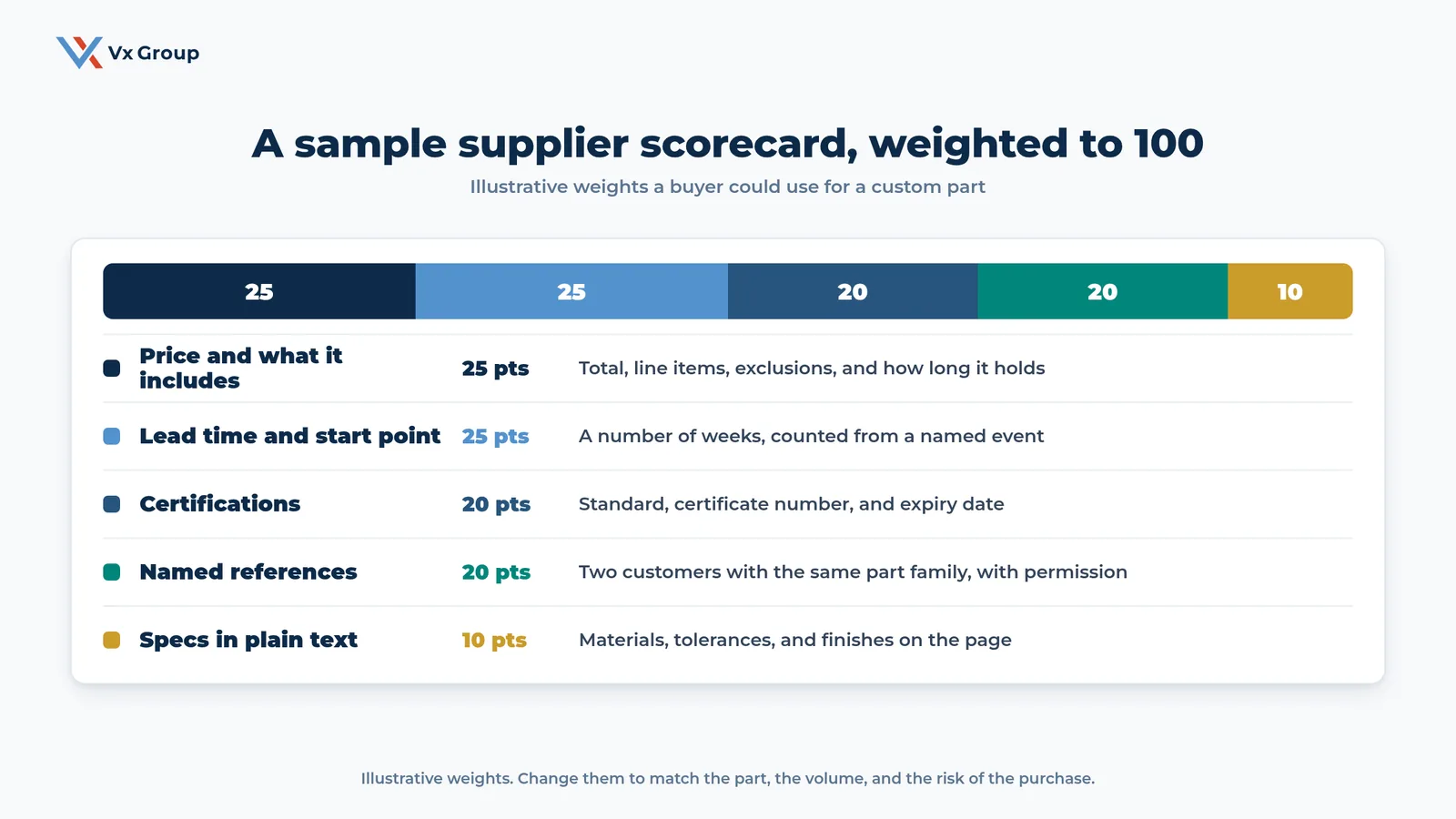
Weight the criteria so they add up to 100
Give every criterion a number of points, and make the total 100. Weights force you to decide what matters most. In the sample above, price detail and lead time carry 25 points each, certifications and references carry 20 each, and specs carry 10.
One vendor guide weights on-time delivery heaviest in its own sample. That fits a buyer whose problem is late parts. A buyer whose problem is quality escapes would weight differently. Set your weights from the failure that costs you the most. Write them down before you look at any quote, so a favorite supplier cannot tilt the sheet.
Write what a full score looks like for each row
For each criterion, write one sentence describing a full score, a half score, and a zero. For lead time, a full score is a number of weeks counted from a named event. A half score is a number with no start point. A zero is a range or the word “soon.”
These descriptions turn the sheet into a test. Two people reading the same quote should land within a few points of each other. If they do not, rewrite the description until they do.
Score from the documents, with the quote open
Fill in the sheet with the quote and the certificates in front of you. Score what is written. Where a fact is missing, score it zero and note the question you would need answered. A gap on the page is a gap in the evidence, and the score should show it.
A buyer’s AI also scores from documents. It has no side conversation where a salesperson fills in the blanks.
Set a pass line and a follow-up rule
Pick a pass line, such as 70 of 100. A supplier below it needs a written answer to each missing item before it can win an order. A supplier above it moves on to a reference call.
The pass line stops a low price from saving a thin quote. It also gives your sales team a target. Your customers apply their own version of the same rule to you.
Record the score and the date
Save each sheet with the date, the part, the people who scored it, and the final number. A year later, compare the score you gave a supplier at quote time with how that supplier did. That shows whether your weights were right.
Here is the sheet filled in for three suppliers on the same part. The scores are illustrative.
| Criterion (points) | Supplier A | Supplier B | Supplier C |
|---|---|---|---|
| Price and what it includes (25) | 22 | 5 | 12 |
| Lead time and start point (25) | 22 | 5 | 12 |
| Certifications (20) | 20 | 0 | 10 |
| Named references (20) | 20 | 0 | 10 |
| Specs in plain text (10) | 10 | 5 | 10 |
| Total (100) | 94 | 15 | 54 |
Supplier B has the lowest price and the lowest score. The next section shows why a buyer’s AI reaches the same ranking.
Ready to grow?
Bring your last lost quote and we will score it against these five criteria, so you can see what a buyer’s AI found missing.
How does a buyer's AI evaluate suppliers?
A buyer’s AI reads every document it is given. It pulls out the price, lead time, certifications, references, and specs. It compares them against each other and against the project requirements. It ranks the supplier whose claims are easiest to check, and it flags every gap.
A buyer gives the AI the request for quote, the specs, the quotes, and a budget. Then the buyer asks questions such as “Compare these three quotes” or “Which supplier is the safest choice?” The AI has no history with any supplier and no reason to favor one. It applies the same test to each document.
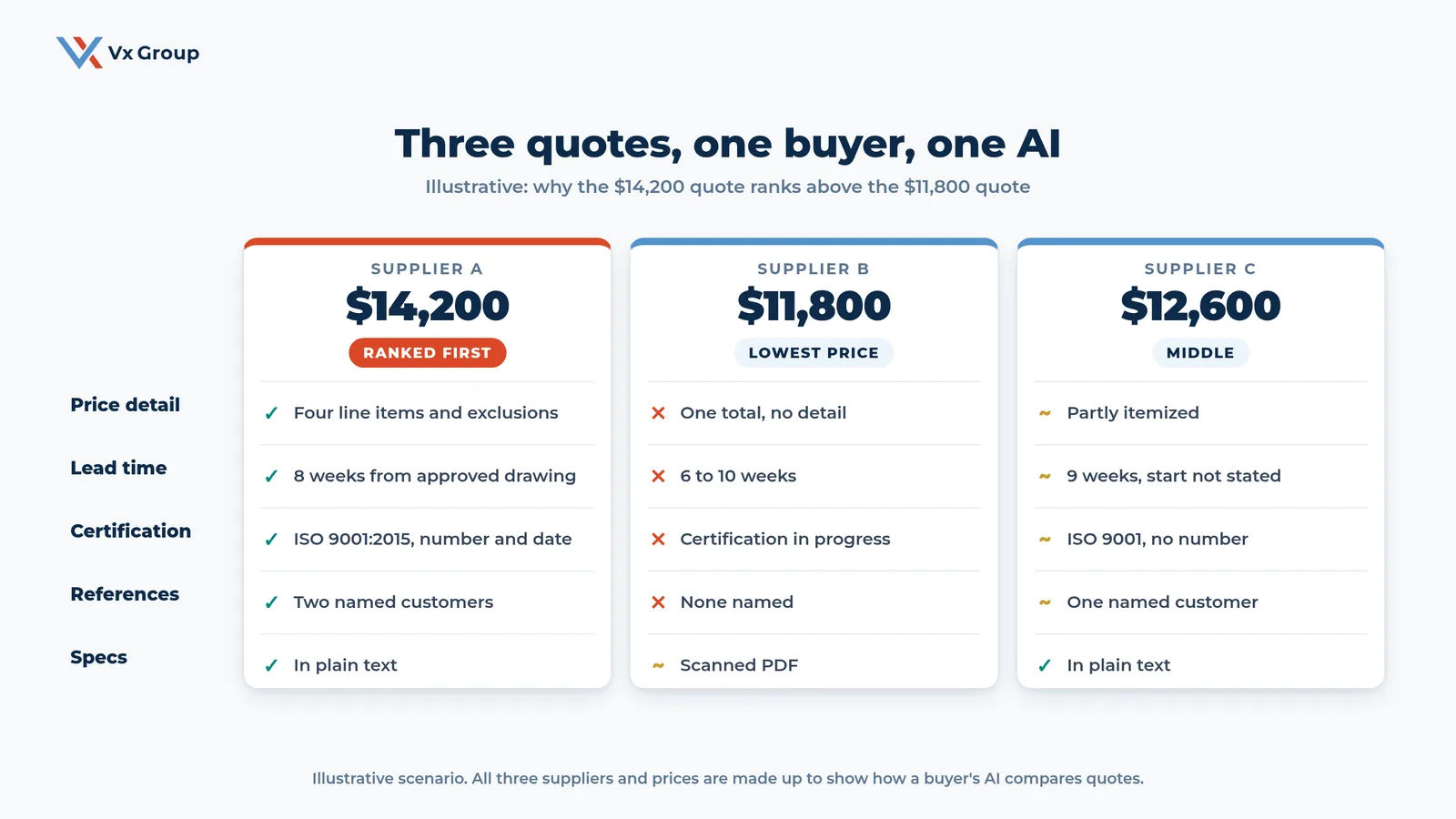
In the example above, Supplier A quotes $14,200. Supplier B quotes $11,800, which is $2,400 less. A buyer who reads only the price would pick B. The AI ranks A first for four reasons:
- A explains its price. Four line items and a list of exclusions let the AI say what the buyer gets for the extra $2,400.
- A commits to a date. Eight weeks from approved drawing is a number a scheduler can use. B’s range of six to ten weeks looks like a risk.
- A’s certification can be checked. A buyer can check an ISO 9001:2015 certificate with a number and a date. “Certification in progress” cannot be checked.
- A offers two named references. B offers none, so the AI has nothing to confirm.
Field Notes:
Illustrative scenario with no real client behind it. A buyer at an equipment maker asks an AI to compare three quotes for a custom enclosure. The AI says quote one is the only one whose claims the buyer can check. It flags the lowest quote’s certification as an open risk. It lists three questions the buyer should ask before awarding the order. The buyer walks into the next call holding questions the AI wrote about the gaps in your quote.
The AI also writes the buyer’s follow-up questions. If your quote leaves a gap, the buyer arrives at your next call with a question about it. Our guide to the B2B buying process shows how that first round changes the sales cycle.
Give the AI a price it can explain
Write the total, the line items, what the price excludes, and how long it holds. Add two sentences on why the price is higher than a lower bid. When the AI has a reason in your own words, it uses it. When it has no reason, it makes one up. The made-up reason rarely helps you.
Put lead time in weeks and name the start point
“Eight weeks from approved drawing” gives the AI a figure and a clock. If lead time depends on material availability, name the material and the date you will confirm the number. A stated condition looks better than a wide range.
State certifications with the standard, number, and date
Write “ISO 9001:2015, certificate number, issued by, expires” on the quote and on your website. When a buyer’s AI finds the same details on both pages, it treats the claim as confirmed. Our guide to PDF SEO covers how to move specs and certificates out of scanned catalogs and into text.
How do you use AI to evaluate your own suppliers?
Use AI as a second reader on the same scorecard. Give it the request for quote, the specs, the quotes, and your weights. Ask it to score each supplier and list what is missing. Treat its answer as a draft. A person should check it against the documents and a reference call.
Before you paste anything into a public AI tool, check your policy on customer pricing, drawings, and contract terms. Set a rule for your team and write it down.
Load the same package for every supplier
Give the AI the same set of documents for each supplier: the request for quote, your specs, the supplier’s quote, and your scorecard with its weights. The same package keeps the comparison fair. If one supplier sent a ten-page quote and another sent three lines, the AI will show the difference. So will your scorecard.
Ask for a score and the evidence behind it
Use prompts that make the AI point to the document. Here are four that work:
- “Score each quote on this scorecard and quote the line that supports each score.”
- “List every fact a buyer would need that is missing from each quote.”
- “Which commitments in each quote can be checked against a date or a number?”
- “Write the five questions I should ask each supplier before I decide.”
The first prompt matters most. A score with no supporting line is an opinion, and you can check a score that quotes the page.
Check the AI's answer against a phone call
Pick up the phone for the top two suppliers. Ask each of their references one question: “Did this supplier hit the date they quoted?” An AI can read a document. It cannot tell you whether a supplier answers the phone on a bad Friday. The call settles what the document leaves open. Our guide to top customers as a growth strategy explains why your best accounts make your best references.
Keep your own judgment on the close calls
When two suppliers land within a few points of each other, use the score to start a conversation. The decision stays with you. Relationships carry weight in these cases. Look at how a supplier handled the last problem, who picks up the phone, and whether the owner returns your call. Our guide to sales cycle stages describes how the same buyer-supplier trust builds over a long cycle.
How do you score your own company as a supplier?
Score your own company by running your last three quotes through the same scorecard. Keep the quote open and use the AI as a second reader. Where a fact is missing from the quote, score it zero. The result shows what a buyer’s AI saw. It also lists the fixes in order of weight.
Pull your last three lost quotes
Choose three quotes you lost. Include at least one where you thought you were the best fit. Write down the date you sent each one, the date you heard back, and the winner if you know it. If you know the buyer, ask what mattered in the decision.
Score each quote with the quote open
Use the five criteria and the weights from the scorecard above. Score only what is written on the page. A lead time of “six to eight weeks” scores zero on the start point. “Available on request” under references scores zero.
Ask an AI to compare you with a competitor
Open a fresh AI chat. Paste your quote and a competitor’s public information, such as the pages on their website, and ask: “Which supplier is the safer choice for this part, and why?” Save the answer. It shows what a buyer’s AI could say about you. Our guide to an AI visibility audit walks through a 10-minute version of this test.
Fix the heaviest gap first
List every zero and sort by points. A missing start point on lead time costs 10 or more points on this scorecard. Fix it before a spec that is already half done. Fix the quote template first, because every future quote gets the change. Our guide to the sales follow-up email shows how to send the page-one summary right after the first meeting.
Use the bands below to read your total.
| Score | What it usually means | First move |
|---|---|---|
| 85 to 100 | Your quotes are easy to verify | Spot check once a quarter |
| 60 to 84 | Most facts are there, a few are vague | Fix the two heaviest gaps in the template |
| 40 to 59 | A buyer’s AI has to guess at several facts | Rewrite page one of the quote and post certifications in text |
| Below 40 | The quote is hard to defend to a committee | Rebuild the quote template, then re-score your last three |
Treat these bands as a rough guide. Set your own once you have scored a dozen quotes and compared the scores with the orders you won and lost.
Check the places a buyer looks before the quote
Buyers evaluate suppliers before they ask for a quote. Your website, your distributor pages, and your directory listings all feed that first look. Our guides on SEO for manufacturing companies and LLM SEO cover what those pages need to state, and our guide to how to rank in ChatGPT adds a ten-prompt scorecard for the buyers who start there.
How often should you evaluate suppliers?
Evaluate a new supplier at quote time and after the first three orders. Evaluate your top suppliers every quarter. Evaluate everyone else once a year. A supplier of a part on your critical path needs the most frequent review, because a failure there stops your own shipments.
| Supplier type | When to evaluate | What to review |
|---|---|---|
| New supplier | At quote time and after the first three orders | The quote, then on-time delivery and quality on real orders |
| Top suppliers on your critical path | Every quarter | On-time delivery, rejected parts, responsiveness, any change in ownership |
| Other regular suppliers | Once a year | A short check of price, delivery, and certification dates |
| A supplier with a recent problem | Monthly until it clears | The specific problem and the fix |
Keep the review short. A quarterly review should take 30 minutes per supplier and end with one written decision: keep, coach, or replace.
Set a reminder for expiry dates. Certificates and insurance documents lapse. A lapse found by your customer’s audit costs more than one found by your own calendar.
Review your own company on the same schedule. Re-score your last five quotes once a quarter, and note whether the numbers move after you change the template.
What mistakes do evaluators make?
Most mistakes come from scoring on memory and on price alone. These seven appear most often:
- Choosing weights after seeing the quotes. Weights set afterward tend to favor the supplier you already prefer.
- Using too many criteria. A sheet with fifteen rows gets skipped. Five to eight rows get used.
- Scoring on price alone. A low price with a vague lead time and no references often costs more by the time the part arrives.
- Accepting claims without documents. “Certification in progress” and “references on request” deserve a zero until a document exists.
- Skipping the reference call. A call takes ten minutes and settles what the paper cannot.
- Never re-scoring. A supplier’s score at quote time says little about its delivery a year later.
- Forgetting to score yourself. Your customers evaluate you the way you evaluate your suppliers, and your own quote deserves the same test.
Each mistake has a one-line fix. Each fix is a small habit.
Where should an owner start this week?
Pull your last quote and read page one as a buyer’s AI would. Check each of the five criteria: price with line items, lead time with a start point, certifications with numbers, two named references, and specs in text. Write down every fact that is missing or vague.
Then build the scorecard on one page. Choose five criteria, weight them to 100, and write what a full score looks like. Then score your top two suppliers from their documents. The first scorecard will be rough. It will still show you more than memory does.
Supplier evaluation will keep moving toward AI. The suppliers who do best will state their facts so clearly that a score takes five minutes. Relationships still matter. A buyer who trusts you calls to check what the AI said. Clear documents decide which suppliers get that call.
Ready to grow?
Bring a recent quote and we will score it with you and mark the first three fixes for your quote template.
FAQs
About the Author: Jacob Camhi
