

Sales Follow-Up Email: What to Send After the First Meeting

The best sales follow-up email after a first meeting goes out the same day and does three things. It repeats what you heard in the buyer’s own words. It proposes the next step. It attaches one document the buyer can forward to colleagues. A second email 24 to 48 hours later asks two short questions. This guide gives you seven templates, with the timing for each.
TL;DR
- Send the first follow-up within hours of the call. It carries a summary in the buyer’s words and one document (we call it the Traveler) that the buyer can forward.
- Send a second email 24 to 48 hours later with two more questions, framed as a request to refine the document.
- Paste your own call transcript into AI and ask which questions you missed. It takes about 10 seconds and gives you better questions for email two.
- After a quote or proposal, every follow-up adds something new: a reference, a lead time, an answer. A bare “checking in” adds nothing.
- Buyers increasingly paste what you send into an AI assistant. Write every email so the summary still makes sense when it is read out of context.
Most follow-up emails fail for the same reason. They say “just checking in,” “circling back,” or “wanted to make sure you got my last note,” and they give the buyer nothing to use. The buyer has no reason to answer, so they don’t.
A good follow-up email moves the sale forward. It gives the buyer something to forward, something to correct, or something to decide. The seven emails below do that at seven points after the first meeting. Each one has a template you can edit and send.
What should a sales follow-up email do after the first meeting?
A sales follow-up email after the first meeting should prove you listened, make the next step obvious, and give the buyer something they can pass to the other people involved in the decision. When it does all three, the buyer has a reason to reply.
Strong follow-ups share a short list of parts. Use this table as a checklist before you press send:
| Part of the email | What it does | Example |
|---|---|---|
| Subject line | Names the topic and the meeting, so it is easy to find later | “Summary of our call on the Dayton line, plus next steps” |
| Their words | Shows you listened and lets them correct you | “You said late deliveries cost you a full shift each time.” |
| One next step | Gives the buyer a single action with a date | “Can we hold 30 minutes on Thursday to walk through it?” |
| One attachment | Gives the buyer something to forward | A one-page summary of scope, price basis, and how you work |
| A real question | Invites a reply that moves the deal | “Who else will want to see this before a decision?” |
Keep the email short enough to read on a phone. Three to five short paragraphs is plenty, because the attachment carries the detail.
Defined Term: Traveler.
A single living document that goes with the deal from the first follow-up to sign-off. It holds scope, what is out of scope, how pricing works, how your team works, and answers to the questions the buying committee is likely to ask. You send it after the first call as version one and update it at each step.
Buyers now often run your email through AI. Before they forward your note to a colleague, they may paste it into an AI assistant and ask for a summary. A follow-up that names the problem, the proposed solution, and the next step in plain sentences still reads well in that summary. A vague one comes back as “the vendor wants to schedule another call.”
The same goes for what AI does with your website. Our guide to LLM SEO covers how AI systems find and compare suppliers. The same habits help in your inbox: specific details, plain words, and facts stated in text.
How do you check what you missed before you write the email?
Before you write the follow-up, paste your own call transcript into an AI assistant and ask which questions you should have asked and did not. It takes about 10 seconds, and the answer gives you the content for your second email.
Most sellers replay the call from memory. Memory keeps the parts they liked and drops the parts that went by fast. A transcript has no such bias. An AI reading it will notice that the buyer mentioned a second plant once and you never followed up. It will also notice if nobody asked who signs off.
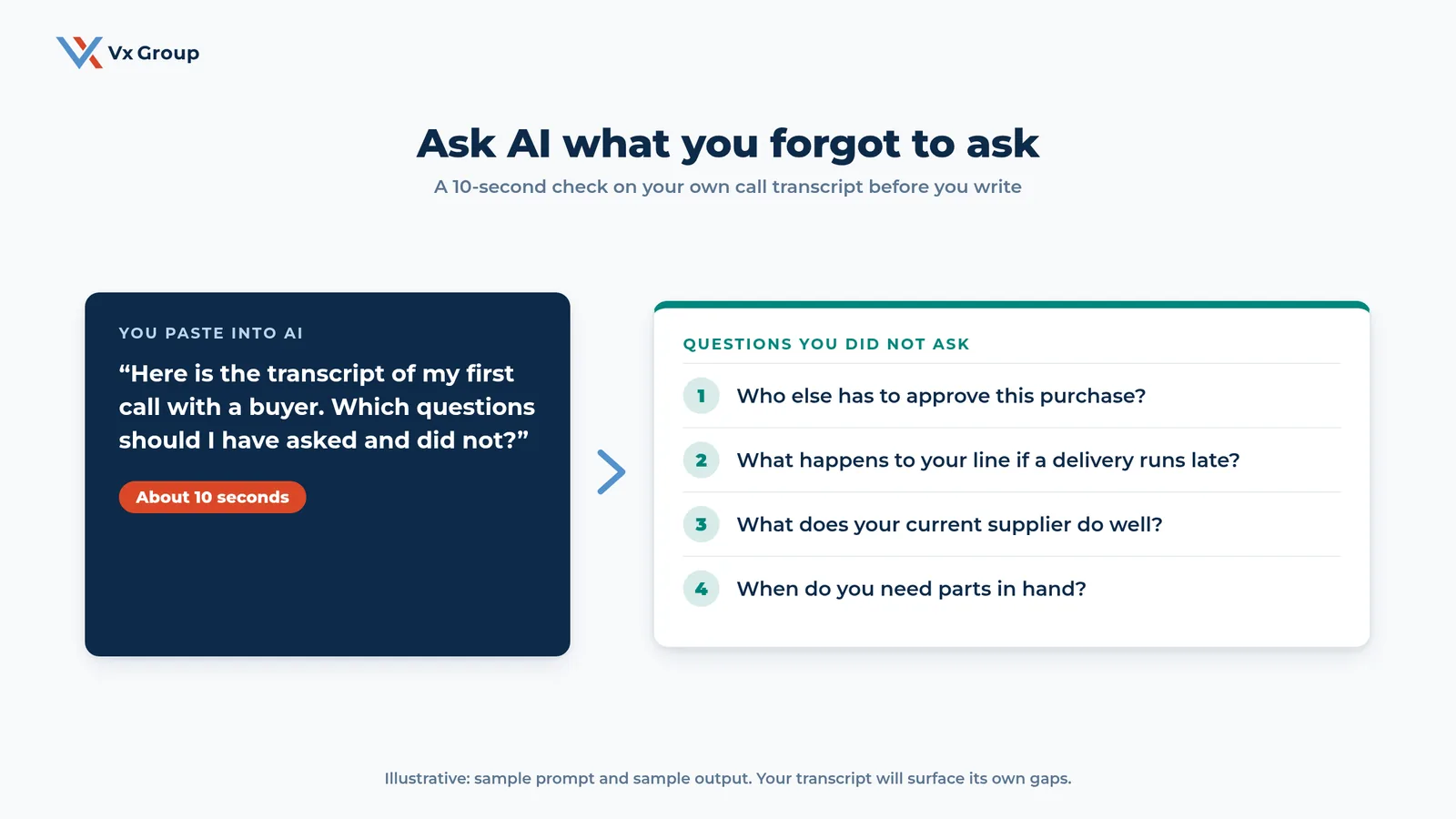
Paste the transcript and ask for the gaps
Use a prompt like this one: “Here is the transcript of my first call with a buyer. List the questions I should have asked and did not. Group them by topic: decision process, timing, risk, and current supplier.”
Remove anything confidential first, and check your company’s rules on AI tools before you paste a recording. If you do not record calls, write down your notes within an hour of the call and paste those.
Pick the two questions that matter most
The AI will give you a long list. Choose two. Pick the questions whose answers would change your proposal. Examples are who else approves the purchase, what happens when a delivery runs late, or what the buyer’s current supplier does well.
Those two questions become the body of email two. Everything else goes in your notes for the next meeting.
When should you send each sales follow-up email?
Send the summary within hours of the call, the two-question email 24 to 48 hours after that, and the updated document when the buyer replies. Speed matters most on the first email. The buyer remembers the conversation best right after it ends.
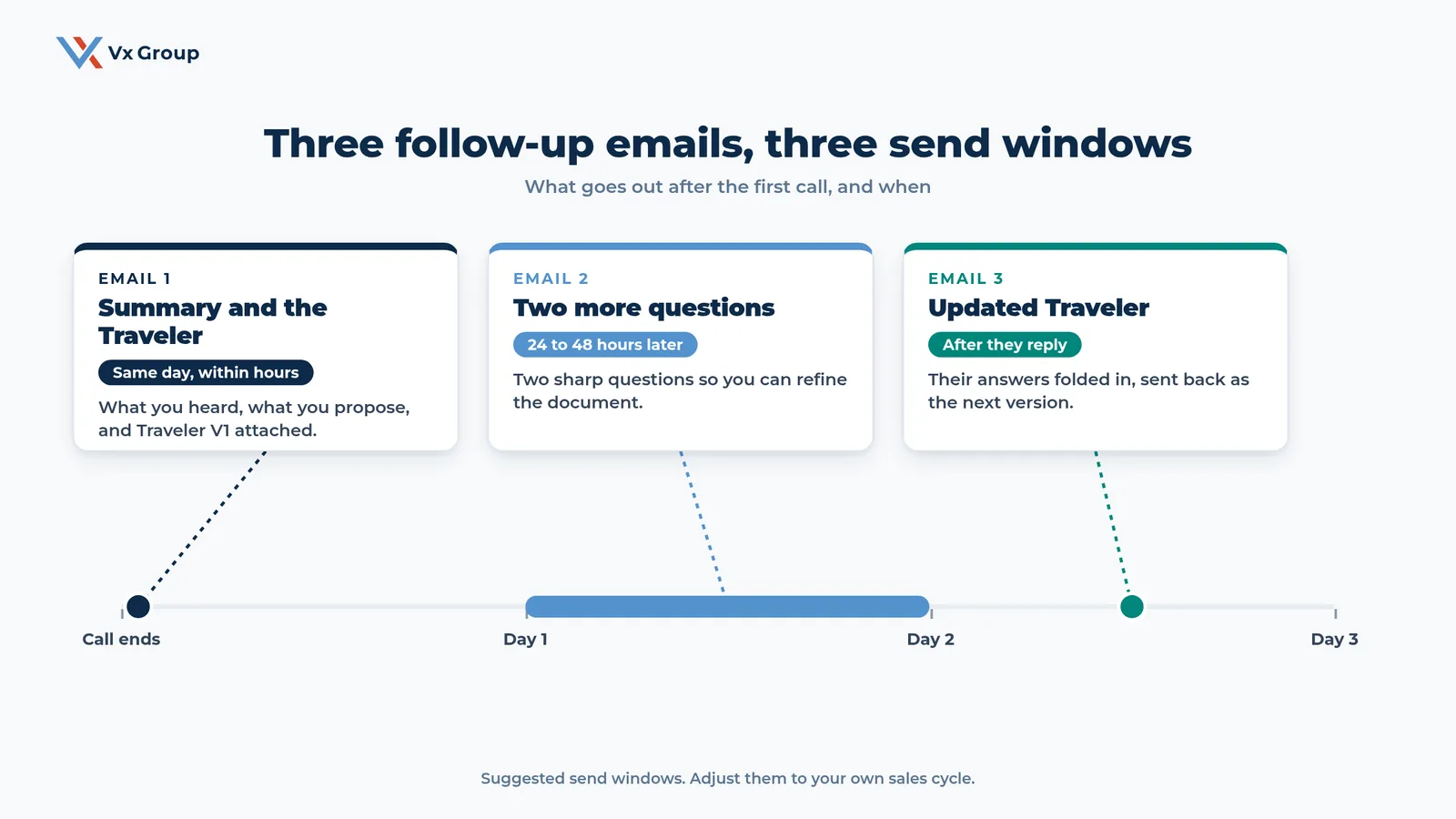
Use this table to plan the full sequence after a first meeting. The windows are suggestions, so stretch them to match the length of your own sales cycle.
| Send | Purpose | Attachment | |
|---|---|---|---|
| 1. Summary and Traveler V1 | Same day | Confirm what you heard and propose next steps | Traveler V1 |
| 2. Two more questions | 24 to 48 hours later | Gather what you missed | None |
| 3. Updated Traveler | Within a day of their reply | Show their answers in the document | Traveler V2 |
| 4. Quote or proposal follow-up | 2 to 3 business days after sending | Answer questions before they stall | Reference or spec |
| 5. Second-contact email | When a new person appears | Bring the committee in | Traveler, current version |
| 6. Quiet-thread email | 7 to 10 days of silence | Restart with something new | One new fact |
| 7. Close-the-loop email | After several touches | Get a yes, a no, or a new date | None |
Sales cycles in relationship-driven B2B can run many months. The sequence repeats at each stage. Our guide to sales cycle stages shows where these emails fit in a complex deal.
1. What should the first follow-up email say after the intro call?
The first follow-up email should summarize what you heard in the buyer’s words, state what you propose, and attach Traveler V1. Send it the same day, while the buyer still remembers the call.
Subject: Summary of our call, plus what I would suggest next
Hi [First name],
Thank you for the time today. Here is what I heard, so you can correct anything I got wrong.
[Company] makes [product] for [customer type]. The biggest problem right now is [problem in their words], and it costs you [consequence they named]. You want [outcome] by [date].
Based on that, I would suggest [one-sentence proposal]. The attached document holds the scope, what is outside the scope, how pricing works, and how we would work together. It also answers the questions I expect your team to ask. Feel free to forward it to anyone who will weigh in.
Can we find 30 minutes on [day] to walk through it? If someone else should be on that call, tell me who and I will include them.
[Name]
Send it the same day
Write the email while the call is fresh, and send it within hours. The buyer sees how your company handles commitments. The summary also arrives while the conversation is still fresh in their mind.
Put their words in the summary
Quote the buyer’s own phrases for the problem and the consequence. A buyer who reads “late deliveries cost you a full shift each time” in their own words trusts that you listened. If you got it wrong, they correct you fast. That saves a month of misunderstanding.
Field Notes:
In our own sales process at Vx Group, the document that travels with the deal matters more than the proposal. The buyer reads it, forwards it, and asks AI to summarize it. It answers questions before anyone asks them, so we need fewer follow-up meetings to cover the same ground.
2. What should the second follow-up email ask 24 to 48 hours later?
The second follow-up email asks two short questions, framed as a request to help you refine the document. It goes out 24 to 48 hours after the first one. It gives the buyer an easy reason to reply.
Subject: Two more questions so I can refine the document
Hi [First name],
I have been through my notes from our call and the document I sent. Two questions will help me tighten it before we meet:
1. [Question about the decision process, such as who else needs to be comfortable with this before it moves forward?]
2. [Question about risk or timing, such as what would make a delivery date impossible to miss?]A short reply is fine. I will fold your answers into the next version.
[Name]
Choose questions the buyer can answer in one line
A question that takes ten minutes to answer will sit in the inbox. Questions about people, dates, and consequences get quick answers because the buyer knows them already. Save the open-ended strategy questions for the meeting.
Keep it to two questions
Two is enough. Three starts to feel like a form. The transcript check from earlier will usually give you more than two, so pick the ones that would change your proposal and keep the rest for the next call.
Ready to grow?
See how this applies to your own pipeline.
3. How do you send an updated document after the buyer replies?
Send the updated Traveler within a day of the buyer’s reply, with a short note naming what changed. This email shows that their answers shaped the proposal. It moves the deal forward without a meeting.
Subject: Updated version with your answers included
Hi [First name],
Thank you for the quick answers. I added them to the document: [one line on change one] and [one line on change two].
The changes are marked on page [X]. If anything still looks off, send me a line and I will correct it before we meet on [day].
[Name]
Name what changed
List the changes in the email so the buyer does not have to hunt for them. A buyer who sees that you changed the delivery terms because of their answer can tell you listened.
Update the same document every time
Keep one document alive through the whole deal. Version one goes out after the first call, version two after their reply, and a final version before sign-off. Colleagues who join late read the latest version and catch up without a meeting.
4. How do you follow up on a quote or proposal without nagging?
To follow up on a quote, send an email that adds something new and asks one answerable question. A quote follow-up email works when it helps the buyer decide. Good examples are a reference, a lead-time detail, or a plain explanation of how you built the price.
Subject: Question on the quote for [project]
Hi [First name],
I wanted to check one thing on the quote I sent on [date]. [Question about a specific line item or assumption, such as does the delivery date in section two match what your line needs?]
One more thing that may help: [new fact, such as a customer with a similar application who is willing to talk, or the lead time you can hold for 30 days].
If it is easier to talk through, I have time on [day] or [day].
[Name]
Add one new fact to every quote follow-up
Each message after the quote should carry something the buyer did not have before. That could be a reference customer, a shipping window, a certification status, or an answer to a question their team raised. When there is nothing new, wait.
Explain your price in the email
A buyer who sees a number with no explanation may ask an AI assistant to judge it, and the AI will guess. Spend two sentences on what sets the price: material, tolerance, volume, or service level. With that context, the buyer does not have to make up a reason.
5. How do you write a follow-up email that brings a second decision-maker in?
When a new person appears in the deal, send a short email to that person that sums up the context in two sentences and attaches the current Traveler. Larger B2B deals involve several people. The person who took your first call rarely makes the decision alone.
Subject: [Colleague] suggested I send you this
Hi [New contact],
[Colleague] asked me to share where things stand on [project]. In two sentences: [problem in their words] and [what you propose].
The attached document holds the details, including scope, pricing basis, and the questions your team is likely to ask. Please tell me what is missing for your side.
[Name]
Ask what the new person cares about
Each person on a buying committee reads your material for a different reason. Finance wants the price basis. Operations wants the delivery terms. Engineering wants the specs. End the email by asking what they need to see, then update the document to answer it.
Our guide to the B2B buying committee maps the roles that can slow or stop a deal and shows how to reach each one.
6. What do you send when the buyer goes quiet?
When a buyer goes quiet for 7 to 10 days, send one short email built around a single new fact, a small ask, and an easy way to say “later.” Silence in a long cycle usually means the buyer is busy or waiting on someone else.
Subject: One update on [project]
Hi [First name],
A quick update that may matter for your timing: [new fact, such as a change in lead time, a material price move, or a delivery slot that opened up].
If the project has moved to a different time frame, tell me when to check back and I will put it on my calendar.
[Name]
Give them an easy way to reply
The ask in this email is a date. A buyer who is not ready can reply “try me in January” in five seconds. That reply is useful. It tells you where the deal stands and when to reach out next.
Space the touches and vary them
Do not send the same message twice. Change the content each time: one email with a new fact, the next with a reference, the next with a short question. Spread them over a few weeks so the buyer still hears from you but does not feel pushed.
7. How do you close the loop when a deal stalls?
The close-the-loop email asks for a clear answer: yes, no, or a new date. It works after several touches. A polite request for a decision gets replies that “just checking in” never does.
Subject: Should I close the file on [project]?
Hi [First name],
I have sent a few notes on [project] and understand that timing or priorities may have changed. I would rather know where things stand than keep filling your inbox.
Could you let me know which of these is closest?
1. We want to move forward. Let’s talk on [date].
2. The timing changed. Check back in [month].
3. We went a different direction.Any of the three is fine, and I appreciate your time either way.
[Name]
Offer three clear choices
A numbered list of choices lets the buyer reply with a single digit. It makes answering easy and shows respect for their time. Buyers who ignored earlier notes often answer this one.
Keep the relationship intact
If the answer is no, thank them and ask if you may stay in touch. In relationship-driven B2B, today’s no often becomes a yes in a year, and the buyer remembers who handled it well.
What mistakes make a sales follow-up email get ignored?
Follow-up emails get ignored when they ask for time and give nothing back. They also get ignored when the ask is buried or the note looks like every other vendor’s note. These are the mistakes we see most often:
- Sending nothing for days. The first email loses power with every day that passes after the call.
- Writing “just checking in.” The phrase tells the buyer you have nothing to add.
- Attaching a full deck. A 30-slide deck has no clear reading path, and buyers skip it.
- Asking three questions or more. Long lists feel like homework, so replies stall.
- Hiding the price basis. An unexplained number invites a guess from the buyer or from an AI assistant.
- Writing for one reader. Your email will be forwarded. Make sure it makes sense to someone who missed the call.
- Following up from memory. Notes and transcripts catch details that memory drops.
How do you keep follow-up consistent across your team?
Keep the templates, the Traveler, and the send windows in one shared place, and make every salesperson use them. When follow-up lives in one person’s habits, quality drops as soon as that person is busy or leaves.
This matters most for owners who still carry key relationships personally. Our piece on founder-dependent sales explains why growth stalls when one person holds every relationship. Our sales playbook guide shows how to write down the steps so the whole team can run them. If follow-up emails are slipping, the cause is often earlier in the process. Our guide to sales pipeline management shows how to run a pipeline that does not live in one person’s head.
Three small habits keep the system working:
- Save the seven templates in your CRM or shared drive with the send windows next to each.
- Keep one Traveler per deal, named by customer and version.
- Review one lost deal each month and ask which follow-up email was missing, late, or vague.
Many sales teams now also use AI to draft and check follow-ups. That works well for spotting gaps and tightening the wording. Our guide to AI in sales covers where it helps and where the relationship still has to come from a person.
Send the first one today
Take your most recent first meeting, open the transcript or your notes, and write email one using the template above. Send it today, then schedule email two for tomorrow or the day after. The whole sequence takes less time than the call that started it. It gives the buyer something worth answering.
Ready to grow?
Bring one live deal and see how the follow-up sequence fits your sales process.
FAQs
About the Author: David Tisdale
