

The B2B Buying Committee: Mapping Everyone Who’s Involved In The Deal

A B2B buying committee is the group of people inside a customer’s company who evaluate, approve, or can block a purchase. In a long-cycle industrial sale it usually includes an economic buyer, a technical evaluator, a day-to-day user, procurement, and a quiet skeptic. Mapping each seat and its owner on your team keeps late-stage deals alive.
TL;DR
- A buying committee is every person who can approve or stop a purchase. In a twelve-month industrial sale, your first contact is rarely the person who makes the final call.
- Five seats show up again and again: the economic buyer, the technical evaluator, the day-to-day user, procurement, and the quiet skeptic. Each one is measured on something different.
- Deals go quiet in month eight when the people who can say no never heard your case. A deal map shows who you have met and who you have not.
- Find out who is in the room by asking your first contact three plain questions, then confirm what you hear through a second person.
- Put one named person on your team next to every seat, and review the map every two weeks while a deal is open.
- Reach the economic buyer through your champion, with the champion’s help and with a reason that serves the buyer.
In this guide
- What a B2B buying committee is
- Who sits on a long-cycle buying committee
- Why deals stall in month eight
- How to find out who is in the room
- What each person is measured on
- How to assign relationship owners on your team
- How to reach the economic buyer
- How committee size changes with the deal
- Common buying committee mistakes
- Where to start this week
Most owners of a $5 million to $50 million manufacturer have lost a deal they thought they were winning. The meetings went well, the quote was competitive, the champion on the customer side kept saying the right things. Then the answer came back as a polite no, or no answer at all, and nobody on the team could say why.
The usual cause is the single-threaded deal. One or two people on your team know one or two people at the customer, and everyone else who has a say in the decision is a stranger. Those strangers get a vote on a purchase they never heard you argue for.
This guide is written for owners and sales leaders of manufacturers and distributors with long sales cycles. It covers who sits on a buying committee, how to find out who is really in the room, what each person cares about, and how to give every seat a named owner on your own team.
What is a B2B buying committee?
A B2B buying committee is the set of people at a customer who take part in a purchase decision, whether they approve it, evaluate it, use the result, or can stop it. The size depends on the price, the risk, and how many departments the purchase touches. Gartner’s research on B2B software purchases puts the typical group at six to ten people, and a custom industrial purchase with real money behind it often draws a room of similar size.
Defined Term: Buying committee.
Everyone inside a customer’s company who has a say in a purchase. Some hold formal authority, such as a budget or a signature. Others hold informal authority, such as the power to raise a safety concern or slow a vendor review.
Other names for the same group include buying group and buying center. Researchers sometimes split them into formal roles, such as initiator, influencer, decider, buyer, user, and gatekeeper. Those labels help in a textbook. On a live deal, the more useful question is simpler: who can say yes, who can say no, and have we talked to each of them?
The committee exists because a purchase in a mid-sized company touches many jobs. A new machine affects the plant floor, the maintenance crew, the finance team, the quality group, and the person who signs the check. Each of them carries a different risk if the choice goes wrong, so each of them gets a voice.
Long sales cycles make the room larger over time. In a twelve-month sale, people join the conversation in month four, month seven, and month ten. The group you met at the first meeting is a partial picture of the group that makes the final call.
Who sits on a long-cycle buying committee?
Five seats show up in most long-cycle industrial purchases: the economic buyer who controls the money, the technical evaluator who checks the fit, the day-to-day user who lives with the result, procurement who handles terms and vendor risk, and the quiet skeptic who can sink the deal late. One person can hold more than one seat in a smaller company, and a larger company may split a seat across several people.
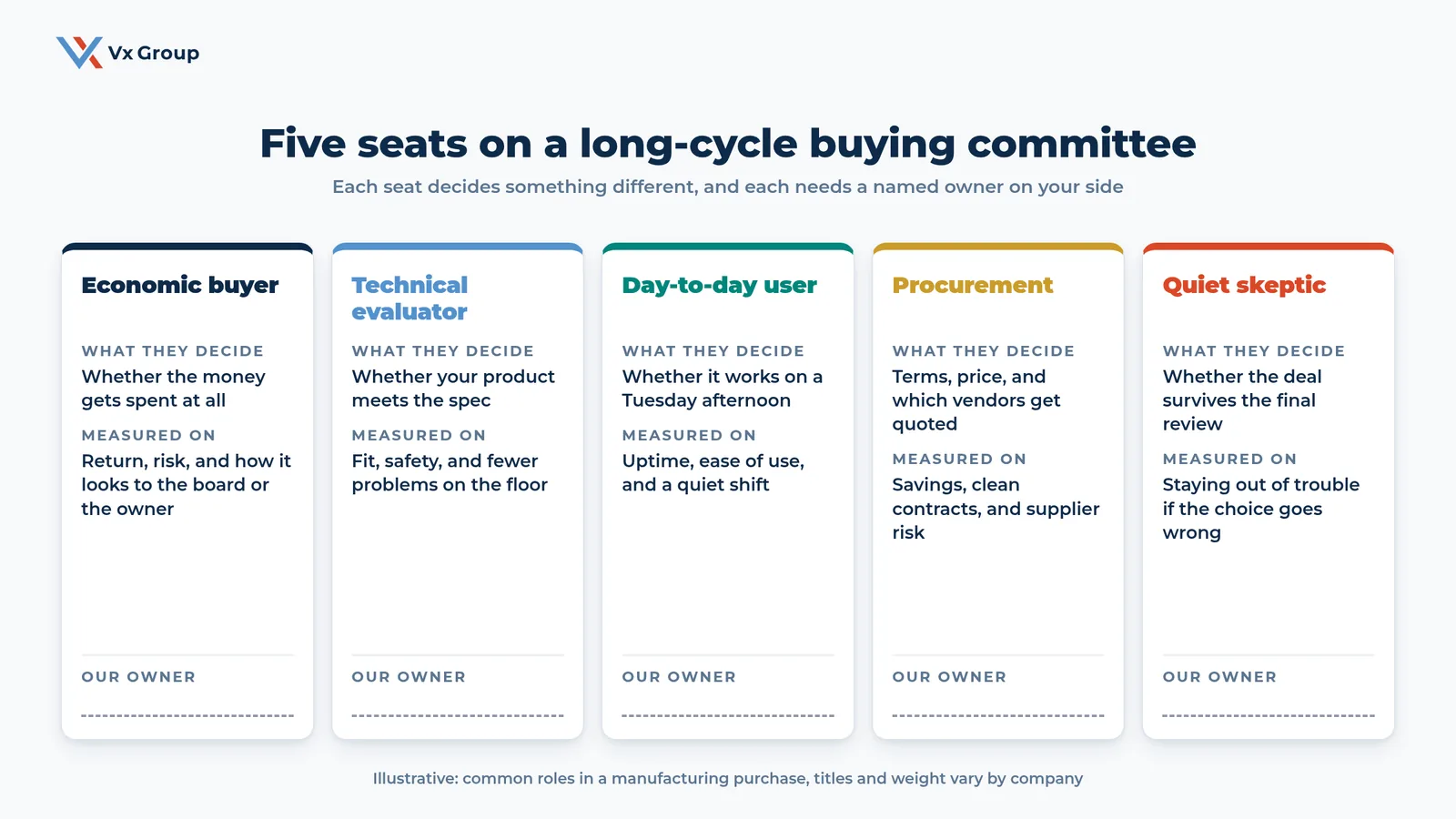
| Seat | Typical titles in a manufacturer | What they decide | What they are measured on | What they need from you |
|---|---|---|---|---|
| Economic buyer | Owner, president, VP of operations, CFO | Whether the money gets spent | Return, risk, and cash | A plain case for the payback and the downside |
| Technical evaluator | Engineer, quality manager, maintenance lead | Whether the product meets the spec | Fit, safety, and fewer problems | Data, samples, and a direct line to your technical people |
| Day-to-day user | Plant manager, line supervisor, buyer-planner | Whether it works in daily use | Uptime, ease of use, a quiet shift | A visit, a trial, and honest answers about the learning curve |
| Procurement | Purchasing manager, supply chain lead | Terms, price, and which vendors get quoted | Savings, clean contracts, supplier risk | A clear quote, references, and flexibility on terms |
| Quiet skeptic | Anyone with a stake in the status quo, often a long-tenured manager | Whether the deal survives the last review | Staying out of trouble if the choice goes wrong | A reason to feel safe, and a chance to be heard early |
The titles change from company to company. A distributor owner may hold the economic buyer and procurement seats alone. A manufacturer with 300 people may have a purchasing team and a separate quality group that each hold a veto. Use the table as a checklist, and fit it to the company in front of you.
Find the economic buyer by following the budget
Ask who owns the budget line for this purchase, and who has to sign when it crosses a dollar threshold. The person who signs and the person who recommends are often different people. In an owner-led customer, the economic buyer is frequently the owner or president, even on a purchase that looks like an operations decision.
Ask the technical evaluator what would make them say no
Technical evaluators respond well to a direct question: what would make this a bad fit for your operation? The answer gives you the real spec, which is often longer than the written one. It also shows you what they fear, which tells you what proof to bring.
Spend a morning with the day-to-day user
Visit the plant, and ask the people who will live with your product what their day looks like now. Users rarely sign anything, and their opinion travels. A maintenance lead who tells the VP of operations “this will give us trouble” can end a deal that the whole leadership team liked.
Meet procurement before the quote goes out
Procurement often appears late, holding a template and a list of requirements. A short conversation before you quote tells you what format they need, which terms they push on, and what vendor review you have to clear. It also builds a relationship with a seat that most sellers meet only when the price is under pressure.
Draw out the quiet skeptic early
The quiet skeptic rarely announces the role. This is the manager who liked the old supplier, the engineer who built the current process, or the executive who was burned by a vendor before. Listen for the person who asks a careful question in the meeting and stays silent afterward. Invite that person to a one-on-one call, ask what concerns them, and write the concern down in the deal notes.
Why do deals stall in month eight?
Deals stall in month eight when the people who can say no learn about the purchase for the first time, after your champion has already told the team it is nearly done. The late review turns up questions nobody prepared for, and your champion has no answers because you never gave them any. The deal goes quiet while the customer works through objections you cannot see.
Here is a worked example, a composite of patterns we see with details changed. A manufacturer of industrial fasteners spent eight months on a custom supply program with a regional equipment builder. The sales leader had two strong relationships: the plant manager, who liked the product, and the maintenance lead, who supplied the spec. The quote was competitive and both contacts said the deal was moving.
In month eight the deal went silent. A follow-up call to the plant manager turned up the reason. The VP of operations had asked the controller to review the commitment, the purchasing manager had asked for two more vendor quotes, and the quality manager had raised a concern about incoming inspection. Nobody on the seller’s team had met any of those four beyond an email or two, and the owner of the buying company was a fifth stranger. Two of seven seats had a relationship with the seller. Five people who could say no had never heard the case.
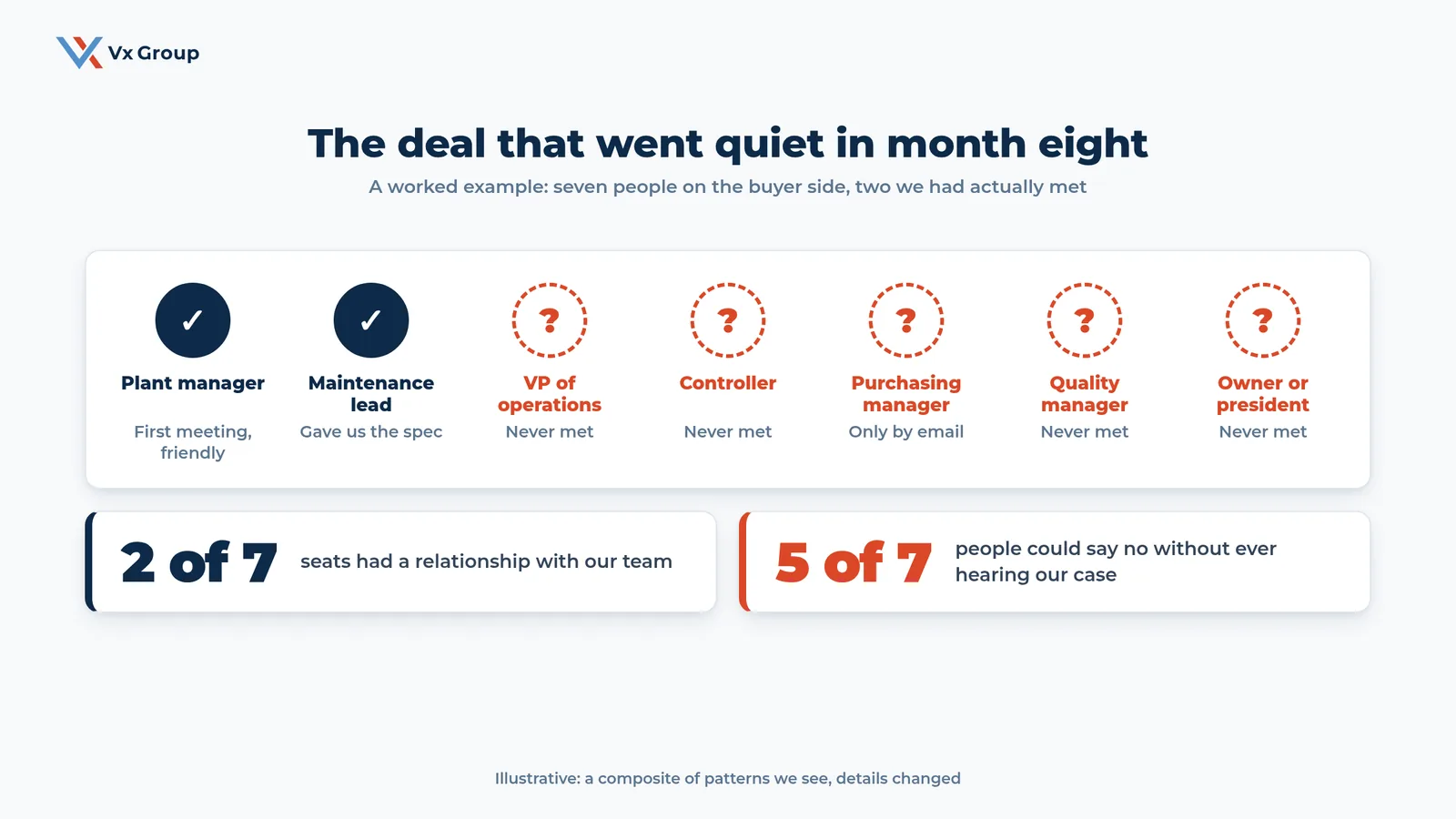
The shape is common. A friendly first contact makes the deal feel healthy, and the CRM shows an open opportunity with a good probability. Nothing in the CRM shows the gap, because most CRMs track the deal and leave out the people around it.
The gap costs more as the deal gets bigger. A long-cycle sale represents months of engineering time, quoting effort, and sample runs. When it ends in silence, the loss includes all of that work as well as the order. The same pattern also hits existing customers: when your main contact retires or changes jobs, you find out how many other seats you ever covered. The piece on founder-dependent sales describes the same single-thread risk on the selling side.
The pattern has a name worth using with your team: the single-threaded deal. A deal is single-threaded when one relationship holds the whole weight. Every conversation, every update, and every promise flows through one person on each side.
Ready to grow?
We help owners map the relationships inside their open deals, so the quiet months have fewer surprises.
How do you find out who is actually in the room?
You find out who is in the room by asking your first contact three plain questions, checking the answers with a second person, and updating the map after every conversation. Most buyers will tell you how the decision works if you ask them directly and respectfully. They rarely volunteer it, because from their side nobody has asked.
Ask your first contact three questions in the first meeting
Use these, in your own words, in the first or second conversation:
- Who else will want to weigh in before this is approved?
- Who signs when it reaches the final step, and what do they usually look at?
- Has your company made a purchase like this before, and who was involved?
The third question tends to produce the best answer. People describe the last purchase in detail, including who slowed it down. That story is a rough map of the committee you are about to meet.
Confirm the answers through a second person
A single contact describes the committee from where they sit, and that view is incomplete. When you reach a second person, ask the same questions and compare. Differences are useful. If the plant manager says four people are involved and the purchasing manager says seven, the gap shows you where to look next.
Read the paper trail for names you have not met
Check the request for quote, the email copy lines, the meeting invitations, and the signature blocks. Names that show up in copy lines are people who are following the deal. A name that appears once in a forwarded thread, such as a controller or a quality manager, is a seat you have not covered. Add each new name to the deal map the day you see it.
Ask for a site visit that includes more than one department
A visit to the customer’s plant lets you meet people who would never join a video call. Ask your contact to include the maintenance lead, the person who runs the line, and anyone from quality. Offer to bring one of your technical people, since the engineer on your side will have the easiest conversation with the engineer on theirs.
Ask the champion to draw the committee
Hand your champion a blank sheet and ask them to sketch who is involved and how each person tends to lean. People who will not give you a list often enjoy drawing the picture. Ask where the power sits, who has changed their mind in the past, and who tends to ask the last question. Treat the sketch as a first draft and revise it as you learn more.
Write the deal map in one place the whole team can see
Keep one page per open deal with five columns: seat, name, role in the decision, last real conversation, and the owner on your team. Mark any seat you have not met. A shared, visible map beats a map that lives in one salesperson’s head, and it is the first thing a new team member needs when a deal changes hands. The guide to fixing CRM adoption covers how to get a team to keep records like this current.
What is each person on the committee measured on?
Each person on the committee is measured on something specific, and they weigh your proposal against that measure. The owner looks at return and risk. The engineer looks at fit. The user looks at the daily experience. Procurement looks at savings and supplier risk. A seller who speaks to all five in the same language will persuade the person who most resembles the seller.
A useful habit is to write a one-line scorecard for each seat. The line states what that person gets praised for, and what gets them in trouble. If you cannot write the line, you do not know the person well enough yet.
Write the one-line scorecard for every seat
Use this format for each person on the map: “[Name] is judged on [measure] and worries about [risk].” For the economic buyer it might read, “The owner is judged on cash and customer retention and worries about a supply gap during the changeover.” The sentence turns a title into a conversation you can have.
Bring one proof point for each seat
Prepare a single piece of evidence that speaks to each person’s measure. The economic buyer gets a payback estimate with the assumptions written out. The technical evaluator gets test data or a sample. The user gets a reference call with a peer at another plant. Procurement gets two customer references and a clear statement of terms. The skeptic gets a story of a similar customer who had the same concern and what happened.
Send the right document to the right seat
A single 30-page proposal goes unread by most of the room. Split it. A one-page summary with the payback goes to the owner. A technical appendix goes to the engineer. A short onboarding plan goes to the user. A terms sheet goes to procurement. Every person finds the part that answers their question without hunting for it.
Ask each seat what a good outcome looks like in a year
Close each conversation with the same question: a year from now, what would make this purchase look like a good decision to you? People tell you the thing they will be judged on. Write the answer in the deal notes and use the language back to them in the next conversation.
The approach connects to how you sell in general. The article on consultative selling covers the habit of asking before pitching, and the committee gives that habit a map to work from.
How do you assign relationship owners on your own team?
Assign a named person on your team to every seat on the committee, and pair each one with a peer at the customer where possible. A relationship owner is responsible for the next real conversation with that person, for recording what was learned, and for flagging any change. Without names, the seats that matter most go uncovered because everyone assumes someone else has them.
Put a name next to every seat on the deal map
Review the map and write one owner beside each seat. Leave no seat blank. If a seat has no owner, the deal has a hole, and you decide on the spot who will fill it. Owners can hold several seats, but no person should hold more than three or four across an open deal.
Pair peers across the table
Match people by role where you can. Your engineer talks to their engineer, your operations lead talks to their plant manager, and your owner or senior leader talks to their economic buyer. Peer conversations carry more trust and reveal more. In owner-led companies, the pairing that most often goes missing is the owner of the selling company meeting the owner of the buying company.
Hold a 20-minute deal review every two weeks
Gather the people who own seats on the deal and walk the map. For each seat, ask three things: when did we last talk, what did we learn, and what is the next conversation? Mark any seat that has gone quiet for 30 days. A short, regular review catches the silent seat while there is still time to act.
Plan for the day your champion leaves
Champions change jobs, retire, and get reassigned. Ask yourself what happens to the deal if your main contact is gone next Monday. If the answer is that it stalls, you have a single-threaded deal. Build a second and third relationship now, using the pairings above. The principles in how to build an infinite team apply to the customer side of the table as well as your own.
Record each conversation in the same place
After every call, write three lines in the deal record: who you spoke with, what you learned about how they decide, and what changes on the map. Keep the notes where the next owner will look. The habit gives the company a memory of the account that does not depend on one person.
How do you reach the economic buyer without going around your champion?
Reach the economic buyer through your champion, with the champion’s help and with a reason that serves the buyer’s own measure. Going around a champion damages the relationship that got you this far. Asking your champion to make the introduction, and explaining what you will cover, usually earns their support, because it makes them look well prepared.
Ask your champion for the introduction in plain terms
Say it directly: “Before this goes to final review, I would like a short conversation with the person who signs. I want to hear what they will look at, so we cover it in the proposal. Can you set that up, and would you join us?” Offering to include the champion keeps them in the loop and protects the relationship.
Give the economic buyer a reason to take the meeting
Executives answer to a measure of their own. Offer 20 minutes on a topic they care about, such as the risk to supply during the changeover or the payback timing. Send two or three questions in advance. A meeting with a clear purpose and a short agenda gets a yes more often than a request to “touch base.”
Bring your own senior person
An owner meets an owner, and a president meets a president. Send the most senior person on your team who has a reason to be there. Peer rank tells the buyer that the deal matters to your company, and it gives the conversation a level of candor that a sales rep cannot match.
Use a customer or a peer as the bridge when the door stays closed
If the champion cannot arrange the meeting, look for another route. A shared customer, a supplier you both use, or an industry association event can create an honest introduction. A site visit by your technical leader can also lead to a conversation that reaches the executive level. Use any of these routes openly and without pressure.
How does buying committee size change with the deal?
Committee size follows the price and the risk. A repeat order for a catalog part involves one or two people, a custom engineered product draws several departments, a capital purchase pulls in finance and the owner, and a long-term supply agreement or distributor relationship brings the widest room. Match the amount of mapping to the stakes of the deal.
| Type of deal | Who is usually involved | How much mapping it needs |
|---|---|---|
| Repeat order for a standard part | The buyer-planner, sometimes a plant manager | A name and a phone number |
| New product or spec change | Engineering, quality, purchasing, the plant manager | A full seat map for the technical and user seats |
| Custom engineered product | Engineering, operations, quality, purchasing, finance | A full map with owners and a biweekly review |
| Capital equipment | All of the above plus the owner or president | A full map, an executive introduction, and a site visit |
| Long-term supply or distribution agreement | Operations, purchasing, finance, legal, the owner | A full map, a named executive pair, and a written plan for turnover |
The table is a rule of thumb from patterns across the companies we work with, and your own deals will show their own shape. Look back at your last five lost deals and your last five won deals, and write down who was involved in each. The comparison often shows which seats you tend to miss.
The same discipline helps in the stages that come before the committee forms. Our guide to B2B sales cycle stages shows where the room tends to grow, and the B2B sales funnel piece covers how a long-cycle funnel differs from a short one.
Existing customers have committees as well. A renewal or an expansion goes through a version of the same group, and a customer who has bought from you for years can still lose touch with the new people in the room. The write-up on account expansion describes how to find growth inside a current account, and the committee map shows you which seats you need to cover to get it.
Field Notes:
A distributor owner we will call Mark (a composite of patterns we see, with details changed) told us his team lost two large programs in one year, both at the final review. We asked him to list the people involved on the buyer side for each. He named three people for the first deal and two for the second. When we asked who was in the final review, he did not know. He spent a month calling the customers’ purchasing and operations leaders, found that each had raised a concern his team never heard, and built a one-page deal map that his sales leader now reviews every two weeks. The next large program closed after a review where every seat had already met someone from his company.
What are the most common buying committee mistakes?
The most common mistakes are treating the first contact as the decision maker, meeting procurement only at quote time, ignoring the skeptic, and keeping the deal map in one person’s head. Each one is easy to fix once a team sees it, and each tends to show up in the same place: the silence in month eight.
- Treating the champion as the decision maker. A champion supports your deal and rarely holds the final vote. Ask who signs, and meet that person.
- Meeting procurement last. Procurement shapes terms and vendor risk. An early conversation removes surprises from the quote stage.
- Skipping the user. People who live with the product influence the people who sign. Visit them.
- Leaving the skeptic alone. A concern that goes unheard in month three returns as a veto in month eight.
- Sending one proposal to everyone. Different seats need different documents.
- Keeping the map in one head. If the person who knows the deal is out for a week, the deal should still move.
- Mapping once and never updating. People join, leave, and change their minds. Update the map after every conversation.
- Counting emails as relationships. A relationship exists when you have had a real conversation with the person in the last 90 days.
A written deal map with named owners and a short review fixes most of these, and it costs a few hours a month.
Where should you start this week?
Pick your three largest open deals, and draw the buying committee for each on one page. Write down every person you know about, mark the seats you have not met, and put a name from your team next to each. This takes an afternoon, and it usually shows you the weakest deal in the pipeline before the customer does.
Then pick one empty seat on each map and book a conversation with it in the next two weeks. Ask your champion for the introduction using the plain language above. Put a 20-minute deal review on the calendar every other week, and bring the maps.
If you want a second set of eyes on the relationships inside your open deals, we are glad to look at one with you.
Ready to grow?
Bring your three biggest open deals, and we will walk through who is in each room and who on your team owns each seat.
FAQs
About the Author: David Tisdale
