

The B2B Buying Process When the Buyer’s AI Does the First Round

The B2B buying process is the set of steps a company follows to find, compare, and choose a supplier. When the buyer brings an AI into those steps, the research, the shortlist, and the first quote comparison all happen before anyone calls you. Suppliers keep the deal by being easy to find, asking what the buyer already found, and sending quotes built to compare.
TL;DR
- The B2B buying process runs through five stages: find suppliers, build a shortlist, compare quotes, talk and verify, and decide. A buyer who uses AI moves through the first three before a salesperson hears about the project.
- A July 2026 Semrush survey of 519 B2B buyers who use AI at work found that 92% say AI shaped their shortlist and 83% say it shaped their final pick.
- The company overview that a salesperson once delivered on the intro call is usually finished before the call is booked, so the first conversation has a different job.
- Every extra meeting gives the buyer more time to compare you with other suppliers, and the buyer’s notetaker records every word of each one.
- Relationships still decide close calls. Four moves keep them in the deal: be easy to find, ask what the buyer found, send a quote built to compare, and give the buyer people to call.
- An owner can map the process against the last five deals in an afternoon and fix the first gap that week.
What this guide covers
- What is the B2B buying process?
- How does the B2B buying process work in a long-cycle sale?
- How does AI change the B2B buying process?
- Where does the buyer’s AI first meet your company?
- What should the first call do when the overview is already done?
- Why does every extra meeting matter more now?
- How do you send a quote built to compare?
- How does the buying committee fit in when every member has an AI?
- Why do relationships still win?
- How do you map your own buying process?
- What mistakes do suppliers make?
- Where should an owner start this week?
A buyer you have never met may already have a short list with your name on it, or with a competitor’s name where yours should be. Nobody called you. The buyer asked an AI assistant who makes the part, read a summary, and moved on to the next stage.
That is the first round of the modern B2B buying process, and it happens out of your sight. This guide is about that hidden first round. The buyer finishes a comparison before you have a chance to start a relationship.
This guide is for owners and presidents of private manufacturers and industrial B2B companies with long sales cycles and customers who stay for decades. It lays out the stages buyers move through and shows where AI changed each one. It also gives you specific things to build, send, and ask at each stage.
What is the B2B buying process?
The B2B buying process is the sequence of steps a business follows to decide what to buy and who to buy it from. The textbook versions list stages such as problem recognition, information search, evaluation, and purchase. For a manufacturer selling a custom part or a long-term supply agreement, five stages describe what happens.
Defined Term: B2B buying process.
The steps a buying organization follows to find, shortlist, compare, verify, and select a supplier. The process usually involves several people, several weeks or months, and a set of documents the buyer reads before and between conversations.
Most of the guides that rank for this topic are written for marketers or sales teams. They describe the stages and then recommend content for each one. Many of them also use the term B2B buyer journey for the same ground. The two phrases overlap heavily. The process describes the steps. The journey covers what the buyer does and feels between those steps. That includes loops back to an earlier stage when a new question comes up.
Most of those guides assume the buyer reads your pages, forms an opinion, and then contacts you. That order is changing. The buyer now does a lot before contacting anyone.
| Stage | What the buyer is trying to do | The documents involved |
|---|---|---|
| 1. Find suppliers | Learn who makes the part or provides the service | Search results, directories, trade articles, peer advice |
| 2. Build a shortlist | Narrow the field to two or three names | Websites, product pages, company overviews |
| 3. Compare quotes | Line up price, lead time, terms, and risk | Quotes, proposals, specs, past quotes from other suppliers |
| 4. Talk and verify | Test the claims with calls, visits, and references | Meetings, samples, reference calls |
| 5. Decide | Pick a supplier and defend the choice internally | A summary for the boss or committee |
How does the B2B buying process work in a long-cycle sale?
In a long-cycle sale, the five stages stretch across months and involve several people who join and leave the process at different points. Stage three and stage four often repeat, because a quote raises a question, the question leads to a meeting, and the meeting leads to a revised quote.
Two other Vx Group guides cover the people and the pace in depth. Our guide to the B2B buying committee maps the roles that review a deal and what each role is measured on. Our guide to sales cycle stages describes the same deal from the seller’s side, from qualifying the relationship to earning the commitment.
This guide focuses on one thing neither of them covers: what happens at each stage when the buyer brings an AI along.
Write down the five stages for your most common sale
Take your most common type of deal and fill in the five stages as a buyer would describe them. Use the buyer’s words. For stage one, write the actual phrase a buyer would type into a search box or an AI assistant. For stage five, write who the buyer has to convince and what that person asks.
A one-page version is enough. The page gives you a shared map for the rest of this guide.
Mark the stages where you currently have no presence
For each stage, mark whether your company has something in it today. Stage one needs pages and outside listings that name you. Stage two needs a clear company overview. Stage three needs a quote that stands on its own. Stage four needs people available to talk and references ready to call. Stage five needs a short summary the buyer can forward.
Most companies find that stages four and five are well covered by their salespeople and that stages one through three rely on whatever happened to be published years ago.
How does AI change the B2B buying process?
AI moves the first three stages ahead of your first conversation and compresses them into minutes. A buyer gives an AI assistant the request for quote, the specs, quotes from past suppliers, and the budget, then asks it to find suppliers, compare them, and recommend one.
The numbers show how common this has become. A July 2026 Semrush survey of 519 B2B buyers who use AI at work found that 92% say AI shaped their shortlist and 83% say it shaped their final pick. Those figures describe buyers who already use AI at work, a subset of all buyers. The subset is large enough to plan around.
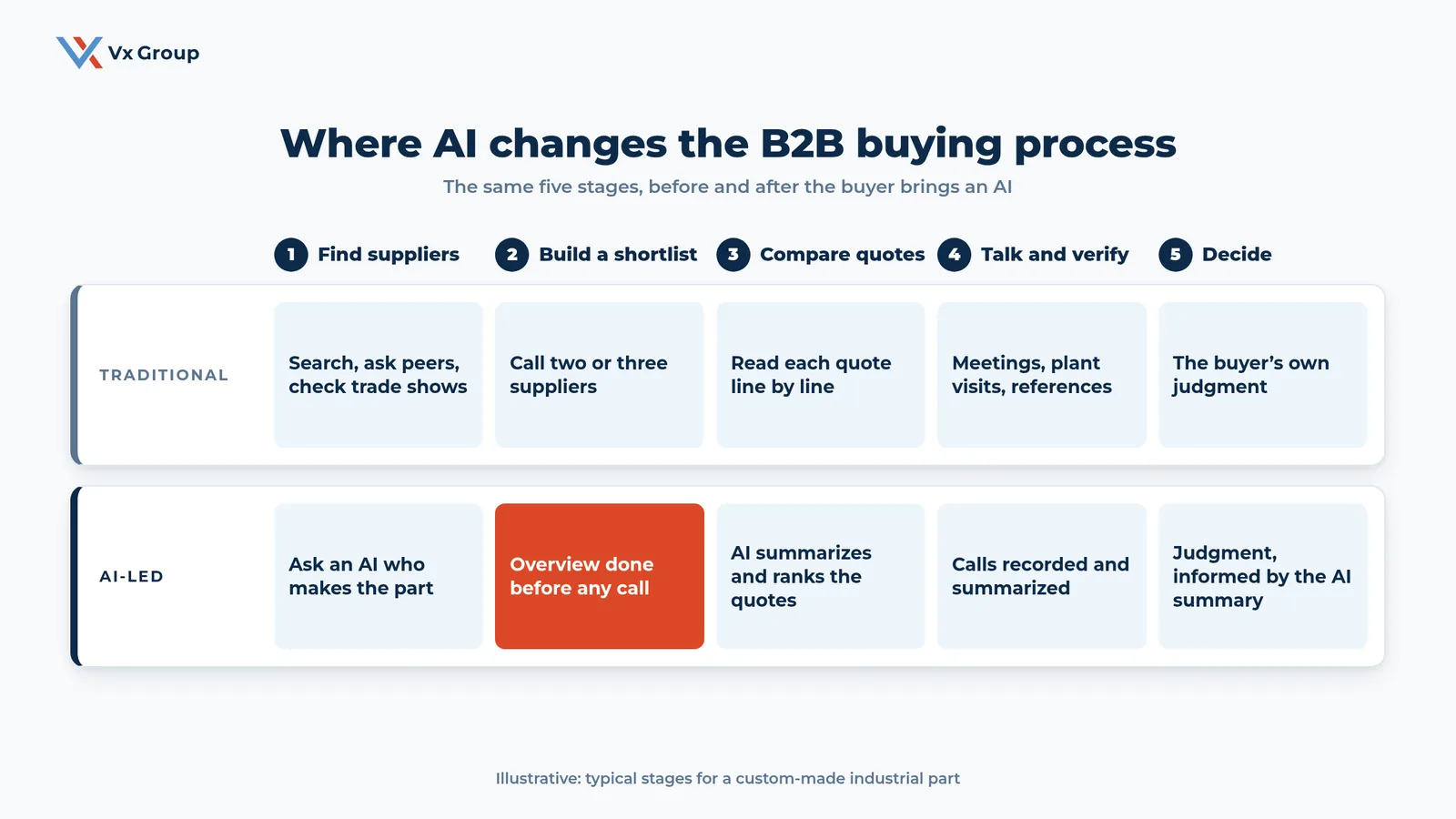
The table below walks through each stage and shows what changes.
| Stage | Traditional buying | AI-led buying |
|---|---|---|
| 1. Find suppliers | The buyer searches, asks peers, and checks trade shows | The buyer asks an AI who makes the part and gets a short list |
| 2. Build a shortlist | The buyer calls two or three suppliers and reads their pages | The overview is done before any call |
| 3. Compare quotes | The buyer reads each quote line by line | The AI summarizes the quotes and ranks them |
| 4. Talk and verify | Meetings, plant visits, and reference calls | The same, with calls recorded and summarized by a notetaker |
| 5. Decide | The buyer’s own judgment | The buyer’s judgment, informed by the AI’s summary |
Defined Term: AI-led buying.
A buying process in which the buyer uses an AI assistant to find suppliers, read their documents, compare quotes, and prepare a recommendation, and then uses meetings to check what the AI reported. The supplier usually cannot see the prompts or the answers.
Notice what stays the same. The buyer still makes the decision, still talks to people, and still wants to trust the company on the other side of the table. AI changes the order of events and the amount of information the buyer holds when you first speak.
It also changes what the buyer asks. The buyer arrives with an overview of your company, a list of questions the AI suggested, and often a ranking. Your job on the first call shifts from introducing yourself to finding out what the buyer already believes.
Run your last five won deals through the AI lane
Pick five deals you won in the past year. For each one, write down the date of the first contact, the date of the first quote, and the number of meetings before the order. Then ask the buyer, if you have the relationship, one plain question: “Did you use an AI tool at any point when you were looking at suppliers?”
Write the answers in one shared document. After five or six conversations you will see which stages your buyers hand to AI, which gives you real information about your own market.
Ask your sales team what buyers have said about AI
At the next sales meeting, ask each person whether a buyer has mentioned ChatGPT, Copilot, or another AI tool in the past three months. Capture the quotes. A line such as “the buyer said the AI had us as the second choice” tells you more than any survey.
Where does the buyer's AI first meet your company?
The buyer’s AI first meets your company in stage one, when the buyer asks it who makes the part. It meets you again in stage two, when it reads whatever it can find about you to build a shortlist. In both stages the AI works only from public material: your website, directories, trade articles, distributor pages, and anything else that names you.
Our guide to AI in procurement covers what a buyer’s AI does with a quote once it has one. The two stages before the quote follow different rules, because the AI is working from the open web.
Write the prompts a buyer would type about your product
List ten questions a buyer might ask an AI assistant when looking for what you make. Include the material, the tolerance, the volume, the location, the certification, and the industry. Write them in plain language: “Who makes a stainless steel housing that survives washdown, with ISO 9001 certification, in the Midwest?”
Run each prompt in at least two assistants. Mark whether your company appears, whether the description is correct, and which competitors appear beside you. Our guide to how to rank in ChatGPT includes a ten-prompt scorecard you can adapt, and our guide to an AI visibility audit covers a monthly routine for repeating the check.
Make your pages state the facts a shortlist needs
An AI building a shortlist looks for what you make, what you hold in tolerance, which industries you serve, where you ship, and which certifications you carry. State each one in plain text on a page a buyer could land on. Our guides on SEO for manufacturing companies and LLM SEO describe the pages that matter most. Specs locked inside catalog files are a frequent gap, and our guide to PDF SEO shows how to fix them page by page.
Make outside sources agree with your own pages
Check your distributor listings, directory profiles, and association pages. When an old catalog says one thing and your site says another, the AI has to pick between them, and it may blend both. Send each outside source a one-page fact sheet with the correct details and log the date you sent it.
Ready to grow?
Bring the ten prompts and your last lost deal, and we will mark where in the buying process a buyer’s AI skipped you.
What should the first call do when the overview is already done?
The first call should find out what the buyer already believes about you and fill in what the AI left out. The overview a salesperson once delivered is usually finished by then, so the call has time for the buyer’s real situation.
Open with a question about what the buyer found
Start with one sentence: “What have you looked at so far, and what did it tell you?” The answer shows which of your facts the buyer holds, which ones are wrong, and which competitors the AI placed next to you. It also tells the buyer you are comfortable being compared, which builds trust early.
Write the answer down in the same shared document you used for the last five deals. Over a quarter it becomes a record of what AI says about your company in your buyers’ words.
Skip the company overview and ask about the project
Spend the first ten minutes on the buyer’s project: what it is for, who else is involved, what the deadline is, and what went wrong with the last supplier. Those details never appear in an AI summary, and they decide whether your quote fits.
A useful list of five questions to prepare:
- What is this part or service for, and what happens if it fails?
- Who else will weigh in on the decision?
- What happened with the last supplier you used for this?
- What would make you choose a higher price?
- When do you need to decide?
Assume a notetaker is recording
Many buyers now use meeting tools that record, transcribe, and summarize every call. Say only what you can stand behind in writing. A casual “we can probably do five weeks” becomes a line item in the buyer’s summary. State commitments in plain words that read well when taken out of the conversation.
Field Notes:
Illustrative scenario with no real client behind it. A sales leader at a custom enclosure maker opens a first call with the usual company overview. The buyer interrupts to say the AI already summarized the company, ranked it second of three, and flagged a missing certification. The sales leader drops the overview, asks what the AI said about the certification, and learns the certificate was on a page the AI could not read. The call turns into a working session on the buyer’s project, and a corrected fact sheet goes out that afternoon.
Why does every extra meeting matter more now?
Every extra meeting gives the buyer more time to compare you with other suppliers, and the buyer’s AI can run that comparison in minutes. In the traditional process, a meeting added to the relationship. In AI-led buying, a meeting adds to the relationship and also adds days during which the buyer can ask an AI about your competitors.
That changes how to treat the calendar. A meeting still has real value, since trust forms between people. The point is to make sure each meeting moves the buyer forward.
Count the meetings in your last five won deals
Using the five deals from earlier, count the meetings between first contact and the order. Write the purpose of each one. Some will have a clear purpose, such as a plant tour or a reference call. Others will turn out to be check-ins with no new information.
Give every meeting a purpose and an output
Before each meeting, write one sentence naming what the buyer will know afterward that they did not know before. After the meeting, send a short summary the buyer can forward. A meeting with no purpose adds time and gives the buyer more room to compare.
| Meeting | Purpose | Output sent afterward |
|---|---|---|
| First call | Learn what the buyer found and what the project needs | A one-page summary of the project and your commitments |
| Technical review | Settle specs and tolerances with the engineers | A spec sheet in text with agreed values |
| Plant visit or reference call | Let the buyer verify claims directly | A list of what was shown and who can confirm it |
| Final review | Answer the last open questions from the committee | A revised quote with changes marked |
Our guide to the sales follow-up email covers what to send after the first meeting, including a summary a buyer can forward or paste into an assistant.
How do you send a quote built to compare?
A quote built to compare puts five things in plain text on page one: the buyer’s problem, the total price with line items, the lead time with a start point, certifications with numbers, and named references. A buyer’s AI compares quotes by lining up those facts. A quote that states them clearly is easy to rank and easy to defend.
The detailed version of this work sits in our guide to AI in procurement. The short version for this stage of the buying process has three parts.
Put the buyer's problem at the top in the buyer's words
Copy the language from the request for quote or from your call notes. If the buyer wrote “a replacement housing that survives washdown,” use that phrase. An AI summarizing your quote carries your wording into its summary, and the buyer recognizes the problem as theirs.
State price, lead time, and proof in text
Write the total, the line items, and what the price excludes. Give lead time as a number with a start point, such as “six weeks from approved drawing.” List each certification with its standard, number, and expiry date. Name two references with permission.
Use this checklist before any quote goes out:
- The buyer’s problem appears on page one in their words.
- The total price and its line items appear in text.
- The lead time is a number with a stated start point.
- Each certification has a standard, a number, and a date.
- Two references are named, with permission.
- The summary sits in the body of the email, with the full PDF attached.
Explain a higher price in two sentences
When your price is above the others, the AI sees a gap and looks for a reason. Give it one in two sentences, such as what extra tool life or one fewer operation at the buyer’s plant is worth. A reason the AI can quote protects you better than silence.
How does the buying committee fit in when every member has an AI?
Every member of a buying committee can run a separate AI comparison with different questions, so a quote now gets read several times from several angles. The finance reader asks about price and payment terms. The operations reader asks about lead time and capacity. The technical reader asks about specs and tolerances. The owner or executive asks which supplier is safest.
| Committee role | A prompt this person might type | What your quote needs to answer |
|---|---|---|
| Finance | “Which quote has the lowest total cost over a year?” | Line items, payment terms, freight, and warranty |
| Operations | “Which supplier gives the most reliable delivery?” | A lead time with a start point and a capacity statement |
| Technical | “Do the specs meet our tolerances?” | Specs in text with agreed values |
| Executive | “Which supplier is the safest choice?” | Certifications with numbers and named references |
Our guide to the B2B buying committee explains how to find out who sits on the committee and how to reach the person with final authority without going around your champion.
Write one page for each reader on the committee
For each role, write a short paragraph on page one of your quote or in your follow-up summary that answers that role’s most likely prompt. Keep each paragraph to three or four sentences with numbers in it. A quote with four short, clear answers survives four separate AI summaries.
Share one plan with the whole committee
A mutual action plan is a shared document that lists each step from evaluation to signed order, with an owner and a date for each. Our guide to the mutual action plan shows how to build one. Sending the same plan to every committee member keeps every reader’s summary on the same timeline.
Why do relationships still win?
Relationships still win because a buyer who trusts you calls to check what the AI said, and a buyer who has never heard of you has only the AI’s version. An AI ranks documents, and a buyer still wants a supplier who answers the phone, fixes a problem on a Saturday, and remembers the buyer’s last project.
Relationship-driven suppliers often have customers who have stayed for twenty years. Those customers are the strongest proof an AI can find and the strongest voices a buyer can call.
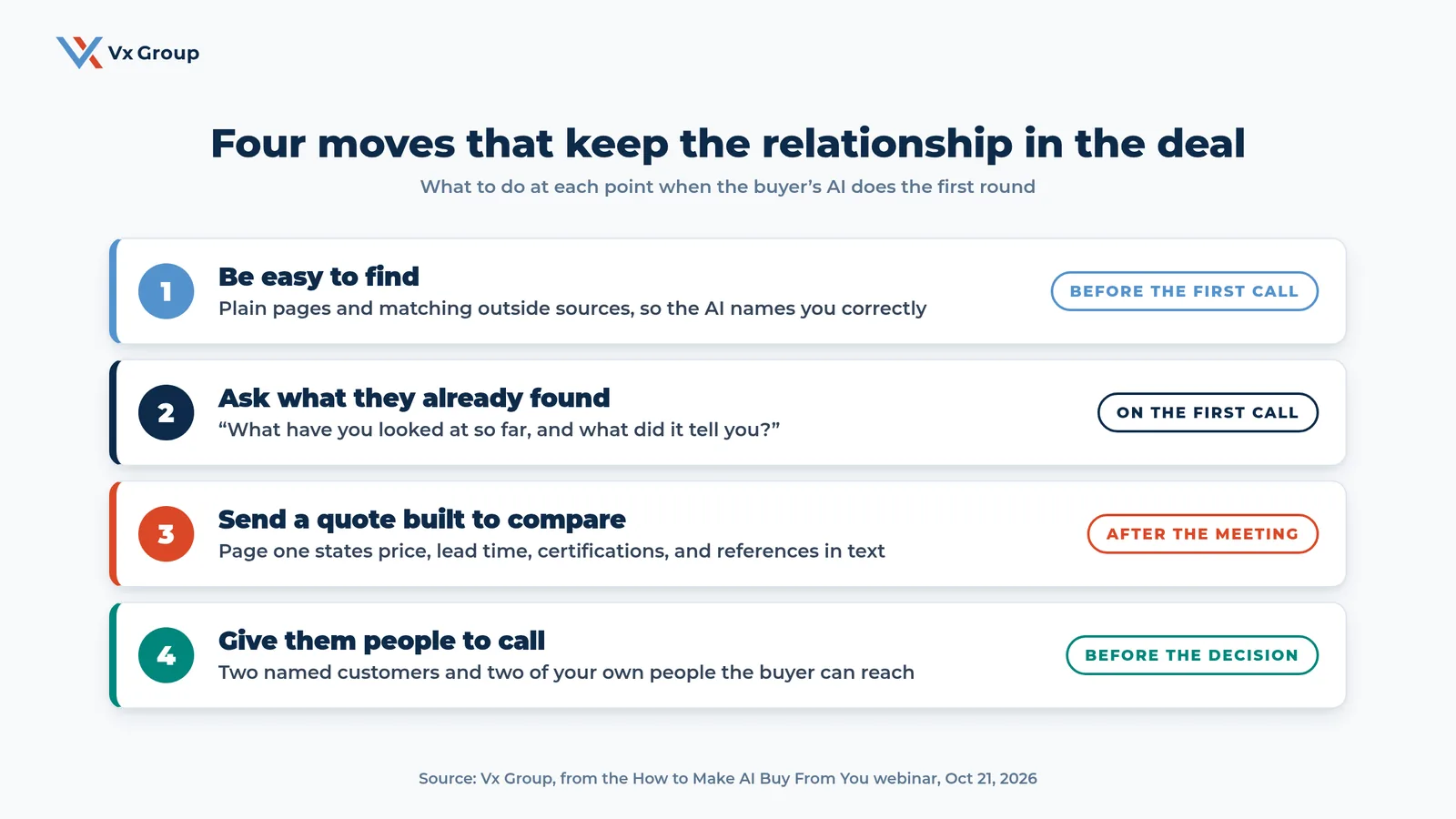
Each of the four moves in the graphic maps to a stage in the process. Being easy to find covers stages one and two. Asking what the buyer found covers the start of stage four. A quote built to compare covers stage three. People to call cover stages four and five.
Name two customers a buyer can call
Pick two customers whose situation resembles a typical buyer’s: a similar part, a similar volume, a similar industry. Ask each for permission to share their name and a contact. Write a one-line description of the work you did together. Update the pair every quarter so the references stay current.
Name two of your own people the buyer can reach
Give the buyer a direct line to someone in engineering and someone in operations, along with your salesperson. A buyer who can reach the plant manager before signing starts to trust the company in a way no document produces. Our guide to top customers as a growth strategy explains why your best accounts make your best references.
Treat the AI summary as a conversation starter
When a buyer mentions what the AI said, thank them and ask for more. If the AI got something wrong, correct it politely and send the right information in writing. If the AI got something right that you did not expect, learn from it. Either way, the buyer sees a supplier who responds to specifics.
How do you map your own buying process?
Map it by listing the five stages in a table, then filling in what the buyer asks an AI at each stage, what the AI can find about you, and who on your team owns the fix. A single afternoon with the owner, the sales leader, and the marketing lead produces a map you can act on.
| Stage | What the buyer asks an AI | What the AI can find about you today | Owner | Fix |
|---|---|---|---|---|
| 1. Find suppliers | “Who makes this part near me?” | Your website, directories, trade articles | Marketing lead | Pages that name what you make and where |
| 2. Build a shortlist | “Summarize these three companies.” | Your overview and product pages | Marketing lead | A plain company overview with proof |
| 3. Compare quotes | “Compare these quotes.” | Your quote | Sales leader | A page-one summary in text |
| 4. Talk and verify | “What should I ask each supplier?” | Everything above | Sales leader | A first-call question and named references |
| 5. Decide | “Which supplier is the safest choice?” | Certifications, references, delivery history | Owner | A forwardable summary and people to call |
Fill in the table with real answers from buyers
Copy the table into a document. Use your list of ten prompts, your five won deals, and the buyer answers from your sales team to complete each row. Mark each cell green if the AI would find a clear answer, yellow if the answer is partial, and orange if there is nothing.
Pick the first fix and assign a date
Choose the orange cell closest to the front of the process, since stage one gaps affect every later stage. Assign one owner and a date within two weeks. A named owner with a date is what gets a fix finished.
What mistakes do suppliers make in the AI-led buying process?
The common mistakes come from treating the first round as someone else’s problem. These seven show up most often:
- Waiting for buyers to mention AI. Most buyers will not volunteer it. Ask them.
- Delivering the same overview on every first call. The buyer has already read a summary. Ask about the project.
- Adding meetings with no purpose. Each one gives the buyer more time to compare.
- Sending a quote with the proof on page six. The AI summary of page one decides how the rest gets read.
- Leaving outside sources out of date. Old distributor pages and directory listings conflict with your site.
- Hiding references behind “available on request.” The buyer has to take an extra step, and the AI has nothing to verify.
- Writing for the AI and forgetting the person. The reader at the end of the process is still a buyer who wants to trust someone.
Where should an owner start this week?
Start with the table in the previous section. Write the five stages for your most common sale, fill in the prompts, and mark each cell. That takes an afternoon, and it shows which stage needs attention first.
Then do three things before the end of the week:
- Run your ten prompts in two AI assistants and save the answers.
- Add “What have you looked at so far?” to the script for every first call.
- Rewrite page one of your quote template to state the five facts in text.
The buying process has the same steps as before. Buyers still search, compare, verify, and decide. AI now does the early work. Suppliers do well when their pages and quotes answer the buyer’s questions and their people are easy to call. Relationships close the deal. Clear documents keep your company on the shortlist long enough to get the call.
Ready to grow?
Bring one recent deal and we will map each stage of the buying process against what a buyer’s AI would have found.
FAQs
About the Author: David Tisdale
