

B2B Brand Strategy: How to Build a Brand That Actually Drives Revenue

a B2B brand strategy is the documented plan for how your company is positioned, what it stands for, and how it shows up everywhere a buyer encounters you. For relationship-driven companies, it is the system that makes buyers recognize you, trust you faster, and choose you before a competitor ever gets a meeting.
TL;DR
- A B2B brand strategy is a documented plan for positioning, messaging, proof, and presence. A logo is the smallest piece of it.
- Brand drives revenue by shortening the trust-building part of a long sales cycle.
- Most lower-middle-market B2B Companies are a “best kept secret”: widely respected by a few customers and unknown to everyone else.
- The four layers of a real brand strategy are positioning, messaging, proof, and visible presence.
- Brand equity compounds the same way trust does, through hundreds of consistent touches over time.
- You measure brand by pipeline influence and win rates, the numbers that move revenue.
- Building one starts with clarity about where you already win, then making that obvious to everyone else.
Why most B2B companies treat brand as decoration instead of growth
Most B2B companies treat brand as decoration: a logo, a color palette, a website refresh that gets approved and forgotten. That is the villain in this story, and it costs more revenue than any underperforming ad campaign ever will.
Here is what happens when lower middle-market companies underinvest in brand. The work is excellent and the customers who know them stay for decades, so the reputation inside a narrow circle is sterling. Outside that circle, almost no one has heard of them. They look smaller than they are, their proposals make them look interchangeable with any supplier, and their digital presence makes a $40M company look like a $4M one.
That gap between how good a company is and how good it looks is where deals quietly die. A buyer comparing three suppliers does not have time to discover that the quiet one is the best one. They go with the company that looks like it belongs in the room.
Brand strategy closes that gap. Done well, it makes a company’s real strength obvious before the first conversation, so the first conversation begins with credibility already in place.
Defined term: The “best kept secret” problem
A company that has earned a strong reputation with a small group of customers but has almost no presence in the wider market. It serves iconic clients and looks anonymous to everyone else. The problem is self-inflicted and fixable through deliberate brand and digital investment.
What is a B2B brand strategy?
A B2B brand strategy is the documented decision about how your company is positioned in the market, what it promises, who it serves best, and how that promise shows up across every touchpoint a buyer meets. It governs your messaging, your proof, your sales materials, and your digital presence so they all tell one coherent story.
A useful way to separate the terms: your brand is the reputation you have in a buyer’s mind, and your brand strategy is the plan for shaping that reputation on purpose. Logos and color are the smallest, most visible layer of that plan. The decisions underneath them carry far more weight.
For a relationship-driven B2B company, the strategy answers four questions in order. Who do we serve better than anyone else? What do we stand for that competitors cannot easily claim? How do we say it so a busy buyer remembers it? And where does that message need to appear so the right people actually see it?
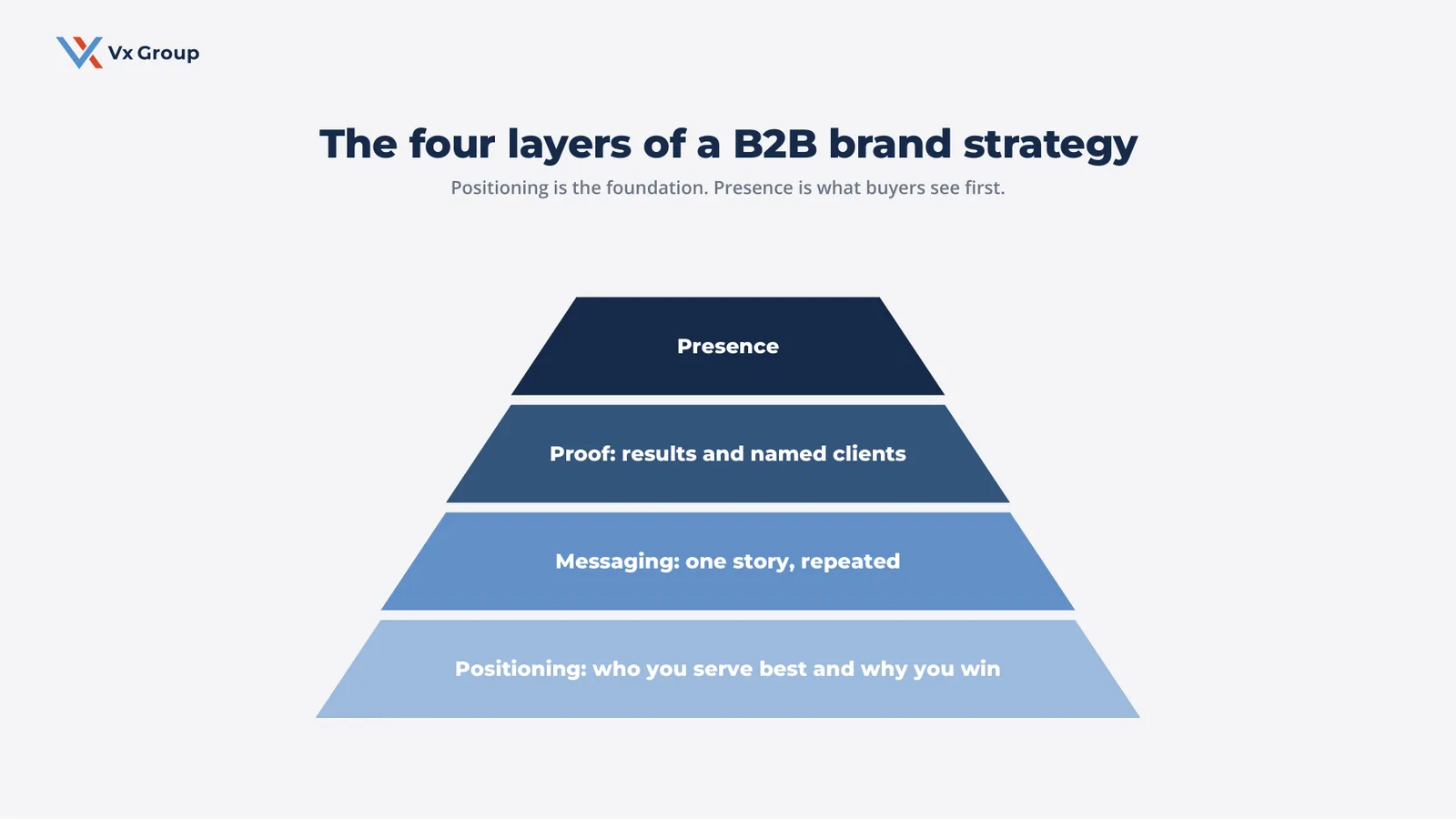
When those four layers line up, every part of the company gets easier to run. Sales conversations start warmer. Proposals win on value, with less pressure to discount. Trade show conversations have a hook. Hiring improves because good people want to work somewhere that looks like it is going somewhere.
Defined term: Brand equity
The accumulated trust, recognition, and preference a company has earned in the market. It is an asset that compounds with consistent investment and erodes with neglect. In B2B, brand equity often shows up as shorter sales cycles and higher win rates among buyers who already recognize you.
How does brand strategy actually drive revenue?
Brand strategy drives revenue by removing friction from the most expensive part of a B2B sale: the time it takes a buyer to trust you enough to act. In long-cycle, high-value relationships, trust is the real bottleneck, and a strong brand pays that cost down before the sales conversation even begins.
Think about how a complex B2B purchase moves. A buyer becomes aware of a problem, starts looking for options, builds a shortlist, evaluates, and finally commits. At every step, a recognized and credible brand advances the buyer further with less effort from your team.
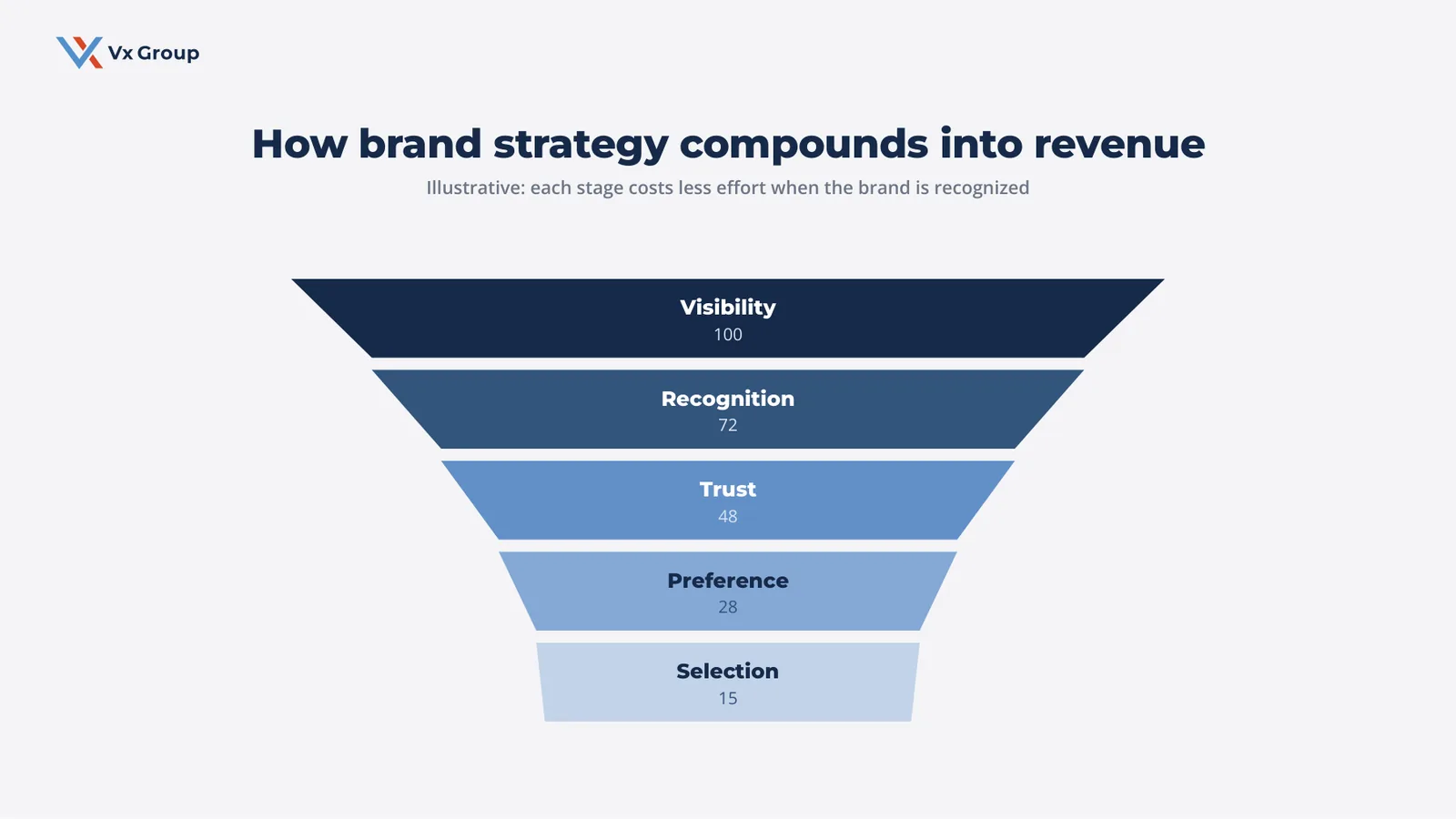
A buyer who already recognizes your name puts you on the shortlist without being sold. A buyer who understands what you stand for shortlists you for the right reasons. A buyer who has seen consistent proof of your work needs fewer reference calls to feel safe. Each of those is a cost your competitors are still paying in full while you are not.
Brand shortens the trust-building part of the sales cycle
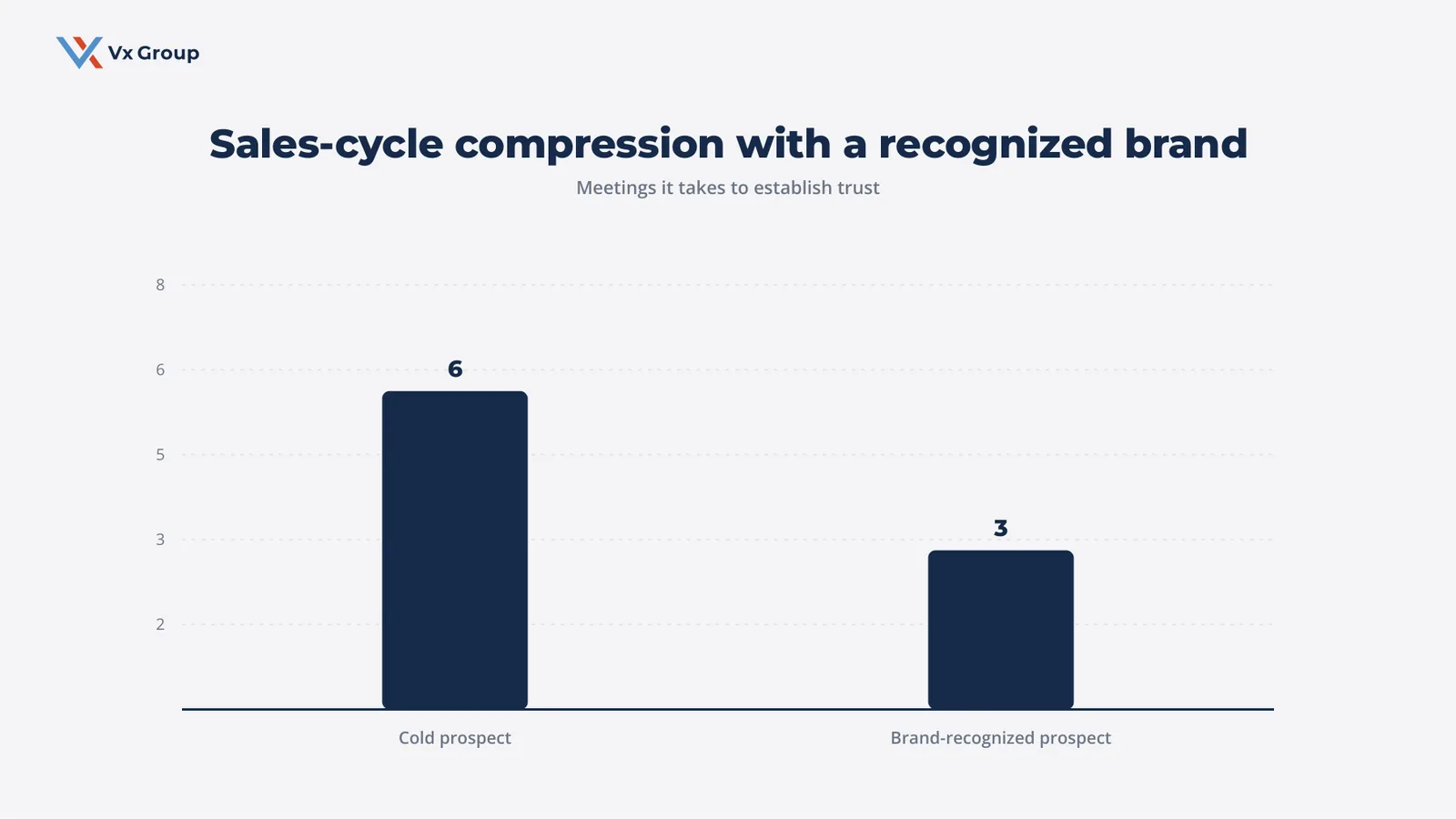
Brand shortens the trust-building part of the sales cycle because recognition and credibility arrive before your salesperson does. A founder-led sale that used to take six meetings to establish trust can take three when the buyer walks in already believing you are serious, capable, and established.
That compression has a direct revenue effect. Shorter cycles mean more deals closed per quarter with the same team. Higher trust at the start means less discounting at the end, because the conversation is about fit and value once your legitimacy is already assumed.
Brand reduces price sensitivity
Brand reduces price sensitivity because buyers pay more for certainty. When two suppliers can do the work, the one that looks more credible and established wins the business at a better margin, because the buyer is paying to lower their own risk.
A company that looks like a commodity competes on price by default. A company with a clear point of view and visible proof competes on value, and value buyers are far less likely to grind every dollar in a negotiation.
What are the components of a B2B brand strategy?
A complete B2B brand strategy has four working components: positioning, messaging, proof, and presence. Positioning is the foundation, and presence is the most visible layer. Companies that skip the foundation and start with the visible layer end up with a prettier version of the same confusion.
The table below shows what each component does and the failure mode when a company ignores it.
| Component | What it decides | What breaks without it |
|---|---|---|
| Positioning | Who you serve best and why you win | You sound like every competitor; you compete on price |
| Messaging | How you say it so buyers remember | Sales reps each tell a different story |
| Proof | The evidence that backs the claim | Buyers need many reference calls before trusting you |
| Presence | Where and how the brand shows up | You look smaller than you are and get overlooked |
Positioning: who you serve best and why you win
Positioning is the decision about which customers you serve better than anyone else and the specific reason you win with them. It is the foundation of the brand because every other choice flows from it. Strong positioning comes from studying where a company already wins. The answer lives in the existing book of business.
The most common positioning mistake in the lower middle market is trying to appeal to everyone. A company that serves a few iconic customers extremely well will often describe itself in the broadest possible terms on its website, erasing the very specificity that makes it valuable. The buyers who would be a perfect fit cannot tell that the company is built for them.
Messaging: how you say it so buyers remember
Messaging is the language that carries your positioning into the market in words a busy buyer remembers and repeats. Good messaging gives your whole company one story to tell, so the founder, the sales team, and the website all sound like the same company.
When messaging is undocumented, every salesperson improvises. One sells on quality, another on price, a third on relationships. Buyers hear three different companies and trust none of them fully. A documented message turns scattered pitches into a consistent, repeatable story.
Proof: the evidence behind the claim
Proof is the evidence that makes your positioning believable: case studies, named clients, results, certifications, and the specifics of work you have actually done. In B2B, proof carries more weight than any clever tagline, because the buyer is making a high-stakes decision and wants concrete reasons to feel safe.
Many excellent companies hide their best proof. They have served iconic customers for twenty years and never written a single case study. That proof exists only in the founder’s head and dies the moment that founder is not in the room.
Presence: where and how the brand shows up
Presence is the sum of every place a buyer encounters your brand: your website, your proposals, your trade show booth, your sales decks, your LinkedIn, your email signature. Presence is where the “best kept secret” problem lives or dies, because a company that looks small in these moments will be treated as small regardless of how good the work is.
Presence is also the layer most companies fix first and worst. They redesign the logo, leave the positioning vague, and wonder why a nicer website did not change anything. A polished presence built on a weak foundation just makes the confusion look more expensive.
Ready to grow?
Build a B2B brand that earns trust before the first sales call, instead of decoration nobody remembers.
Why does B2B brand strategy work differently than B2C or SaaS?
B2B brand strategy works differently because the buying decision is slower, higher-stakes, more rational, and made by a buying group of several people. The tactics that move a consumer or a self-serve SaaS signup do not transfer to a relationship that takes twelve months to close and twenty years to mature.
In a consumer purchase, brand often works through emotion and impulse at the moment of decision. In a complex B2B sale, brand works through accumulated credibility across a long evaluation, where several people have to agree and each one is protecting their own reputation by recommending a safe choice.
This is why borrowing a SaaS growth playbook is a mistake for a legacy industrial or services company.
High-velocity tactics optimized for short cycles and individual buyers produce a lot of activity and very few relationships. A relationship-driven company needs a brand that builds trust patiently across many touches with everyone in the buying group, the same way its sales actually work.
Defined term: Trust compounding
The way credibility builds through many small, consistent interactions over time. Every proposal, plant tour, and follow-up either strengthens or strains the relationship. Brand strategy is what keeps those touches consistent, so trust builds in one direction over time.
How do you measure B2B brand strategy?
You measure B2B brand strategy by its effect on pipeline and revenue. Awareness surveys and social media metrics rarely tell you anything a buyer acts on. The questions worth answering are whether buyers arrive warmer, whether deals close faster, and whether you win more of the deals you compete for.
The metrics that matter most are practical. Win rate among qualified opportunities tells you whether your positioning and proof are working. Sales cycle length tells you whether brand is shortening the trust-building phase. Inbound and referral quality tells you whether the right buyers recognize you. Average deal size and discount levels tell you whether brand is reducing price sensitivity.
Vanity metrics are the trap here. Impressions, follower counts, and website traffic feel like progress and rarely correlate with revenue for a relationship-driven company. A brand strategy that lifts win rate by ten points is worth more than one that doubles a metric no buyer ever acts on.
Field Notes: The quiet manufacturer that looked like a vendor
A precision components manufacturer in the upper Midwest had served two iconic customers for over fifteen years. The work was flawless. The reputation inside those two accounts was untouchable. Outside them, the company was invisible, and a dangerous share of revenue sat inside relationships that lived entirely in the founder’s head.
The problem was never the quality of the work. It was that every new prospect started from zero, because nothing about how the company showed up signaled the caliber of who it already served. Proposals looked like a small shop’s. The website had not changed in a decade. The founder was the only person who could tell the story.
The fix started with clarity, long before any design work. Naming the specific customers they served best, documenting the proof that already existed, and rebuilding how the company presented itself to match the work. The first measurable change was prospects arriving in sales conversations already treating the company as a serious, established partner.
How do you build a B2B brand strategy?
You build a B2B brand strategy by starting with clarity about where you already win, then making that strength obvious through positioning, messaging, proof, and presence in that order. The work is sequential, because a polished presence built on unclear positioning just amplifies the wrong message.
The first move is to study your best relationships. Rank your accounts by relationship quality and long-term value, looking past current revenue, and find the pattern your best customers share. That pattern is the raw material for your positioning, because it shows who you are genuinely built to serve.
From there, the sequence is straightforward to describe and demanding to execute. Document the positioning. Write the message once, so the whole company can repeat it. Gather and publish the proof that has been hiding in the founder’s head. Then, and only then, rebuild the visible presence so it matches the strength underneath.
The discipline that separates a brand strategy that works from one that gathers dust is consistency over time. A company that commits to one clear story and tells it everywhere for two years will build more brand equity than one that reinvents itself every quarter chasing the latest tactic.
Conclusion: brand is the first trust deposit
For a relationship-driven B2B company, brand strategy is the system that makes your real strength visible before the first conversation. It protects the relationships that built the business, scales them, and gives every new prospect a reason to trust you faster.
The companies that win the next decade in the lower middle market will be the ones that stop treating brand as decoration and start treating it as the first deposit in every relationship they want to build. Clarity first, then consistency, then compounding.
If your company is excellent at the work and quietly invisible in the market, that gap is the most fixable problem you have.
Ready to grow?
Make your brand the first trust deposit in every deal, not an afterthought bolted on at the end.
FAQs
About the Author: Jacob Camhi
