

B2B Fractional CMO: When to Hire One, When to Wait, and When to Just Fix the Role

A fractional CMO is a senior marketing executive who works part-time or project-based across a handful of client companies. Hire one when execution capacity already exists and the missing piece is strategic direction. Wait, fix the role, or hire full-time when the real gap is ownership, process, or data, because a fractional hire dropped into that gap ends up doing operational work no one scoped.
TL;DR
- A fractional CMO provides senior marketing strategy and judgment on a part-time basis, at a fraction of a full-time executive’s salary.
- The role fits companies that already have execution capacity (a marketing coordinator, an agency, a demand gen hire) but no one setting the strategic direction.
- It does not fix a marketing function with no owner, no defined ICP, or no working handoff between sales and marketing. Hiring into that gap just adds a strategist with nothing to direct.
- A useful decision framework runs on three variables: revenue stage, whether execution capacity already exists, and how long the strategic gap has been open.
- A well-structured engagement has a written 90-day scope, a fixed cadence, and named deliverables, all spelled out before the first invoice.
- Watch for engagement drift: rising hours, vague deliverables, and no written plan are signs the arrangement has slid into informal full-time work.
- Costs run in ranges tied to hours and scope. Ask about the drivers before comparing quotes.
Most companies that call us about a fractional CMO have already decided on the title. What they have not decided is what the person will actually do once they start. That gap between the title and the job is where a fractional engagement quietly goes wrong.
Here is the pattern we see most often. A company’s marketing function has no clear owner, no repeatable process, and no data anyone trusts. Leadership hires a fractional CMO to bring order to it. Within a few weeks, the fractional CMO is running the email calendar, proofing landing pages, and chasing down a website update, because no one else will.
The strategic work they were hired to do sits untouched, and six months in, the company concludes that fractional CMOs “don’t work,” when the real issue was hiring a strategist into a role with no one underneath them to execute. By week three, the fractional CMO was quietly running day-to-day operations that no one else had claimed.
This guide walks through what a fractional CMO is built to do, the gap the role fixes well, the gap it usually cannot fix, a framework for deciding whether your company needs one now, later, or not at all, how to structure and staff the engagement once you commit, and what it should cost.
What Is a B2B Fractional CMO, and How Does the Role Differ From an Agency, a Consultant, and a Full-Time CMO?
A fractional CMO is a senior marketing executive who splits their time across several client companies, typically working a fixed number of hours or days per month for each. They hold the CMO title and decision authority within that scope, and stay engaged long enough to see strategy through to execution results, usually six months to two years.
The title shows up under a few different names depending on the market: fractional CMO, part-time CMO, and outsourced CMO all describe roughly the same arrangement. “Interim CMO” is a distinct variation worth separating out: an interim CMO typically works closer to full-time hours on a fixed-term basis for one company, usually bridging a gap between a departed full-time executive and a permanent replacement.
A fractional CMO usually serves several client companies at the same time on a fixed part-time schedule. If a recruiter or candidate uses “interim” and “fractional” interchangeably, ask directly which arrangement they mean before you scope the engagement.
Defined Term: Fractional CMO
A fractional CMO is a part-time or project-based senior marketing executive who sets strategic direction, owns marketing decisions within an agreed scope, and typically serves several client companies at once on a fixed weekly or monthly schedule.
The confusion usually comes from mixing the fractional CMO up with three roles that sound similar but do different work.
How a fractional CMO differs from a marketing agency
An agency is staffed to execute: they run campaigns, build creative, manage ad spend, or produce content against a brief someone else wrote. A fractional CMO writes the brief. Many fractional CMO engagements end up directing one or more agencies, setting the strategy and messaging the agency then executes against. Confusing the two roles is how a company ends up paying an agency retainer for output with no one setting direction, or paying a fractional CMO to do agency-level execution work.
How a fractional CMO differs from an independent marketing consultant
A consultant typically delivers a defined project: a positioning study, a go-to-market plan, a competitive analysis, then leaves. A fractional CMO holds ongoing decision authority and stays through implementation. The consultant hands you a plan. The fractional CMO owns getting it built, tested, and adjusted over months, and usually carries the CMO title internally with staff, budget, or vendors reporting to them within scope.
How a fractional CMO differs from a full-time CMO
A full-time CMO is dedicated to one company, usually carries a full executive salary and equity package, and is available at the pace the business needs day to day. A fractional CMO works a fixed number of hours a week across multiple clients, which caps how much day-to-day availability they can offer. Companies that need someone in every internal meeting, managing a large internal team, or available on short notice most days are describing a full-time hire, even if they are using the word “fractional” to describe the search.
The cost difference is real but easy to overstate on its own. A full-time CMO’s total compensation, salary, bonus, equity, and benefits combined, typically runs well into six figures annually at companies in the $25M to $100M range. A fractional CMO’s fee, scaled to the same set of hours, is a fraction of that number, which is where the appeal comes from.
The tradeoff is availability and depth of ownership: a full-time CMO can build and manage an internal team day to day in a way a person working ten or fifteen hours a week cannot. Neither arrangement is better in the abstract. Each fits a different combination of company size, growth pace, and how much senior marketing bandwidth the business actually needs this year.
What Gap Does a Fractional CMO Fix Well?
A fractional CMO fixes the gap between having marketing execution capacity and having marketing strategy. This is the classic fit: a company already has someone running email, social, or a website, sometimes an agency, sometimes an internal coordinator, but no one senior enough to decide what that execution should be aiming at.
Companies in this position tend to share a few traits:
- Revenue is established enough to have a real go-to-market motion, usually somewhere in the $10M to $75M range, though the pattern holds outside that band too.
- Someone is already producing marketing output. The missing piece is direction.
- Sales has opinions about what marketing should be doing, and marketing has no senior voice in the room to respond to them.
- Leadership has tried to set marketing strategy themselves, on top of running the company, and it keeps sliding to the bottom of the list.
In this setup, a fractional CMO’s judgment is the product. They bring pattern recognition from other B2B companies, set a positioning and channel strategy, and direct the people already doing the work toward a plan that connects to revenue.
The company gets senior strategic leadership at a fraction of the cost, and often without the full-time need, of a permanent executive hire. Building a business growth operating system requires exactly this kind of ownership: someone senior enough to set the system’s direction and keep it connected to revenue, and a fractional CMO can fill that seat on a schedule that fits the budget.
A useful gut check before hiring: list what marketing activity is happening right now, this week, without anyone senior directing it. If that list is long (email sends, ad campaigns, content, a website in progress) and no one owns whether it’s aimed at the right buyers, that’s the gap a fractional CMO is built to close: hands are already on the work, and what’s missing is someone senior enough to point them.
What Gap Can a Fractional CMO Usually Not Fix, and Often Hides?
A fractional CMO usually cannot fix a marketing function that has no owner, no defined process, and no data. Hiring one into that gap adds a strategist with nothing to direct, and the engagement quietly turns into the fractional CMO doing operational work they were never scoped for.
Three specific versions of this show up constantly.
No one owns day-to-day execution. If there is no coordinator, no internal marketer, and no agency running the calendar, the fractional CMO becomes that person by default. Strategy gets written and then sits, because the only senior marketing resource in the building is busy building landing pages.
The ideal customer profile and positioning were never defined. A fractional CMO can sharpen positioning that already has a rough shape. They cannot invent an ideal customer profile from scratch while also running a full strategic engagement on the hours they were scoped for. Companies that skip this step end up paying a fractional CMO’s rate for foundational work that should have happened, and been budgeted, before the search started.
Sales and marketing have no working handoff. If leads generated by marketing disappear into a sales process with no defined stage, no lead definition, and no feedback loop, a fractional CMO can design the handoff on paper. Someone still has to build and maintain it operationally, and if no one owns that build, the handoff stays broken regardless of how good the strategy looks in a deck.
Field Notes:
A composite pattern we see often: a $30M industrial distributor hires a fractional CMO after a slow year, expecting a turnaround in two quarters. Marketing at the company is one part-time coordinator posting to social media with no strategy behind it. The fractional CMO spends the first ninety days writing the brand’s positioning, building a content calendar, and, because no one else will, personally proofing every email before it sends. A year in, leadership is frustrated that “the fractional CMO thing didn’t work.” The actual problem was never the strategy. It was that the company hired a strategist into a role that needed an operator first, and never budgeted for both.
Ready to grow?
If you are not sure whether your gap is strategic or operational, that diagnosis is worth getting right before you sign a fractional CMO contract.
How Do You Decide: Hire Fractional, Wait, Fix the Role First, or Hire Full-Time?
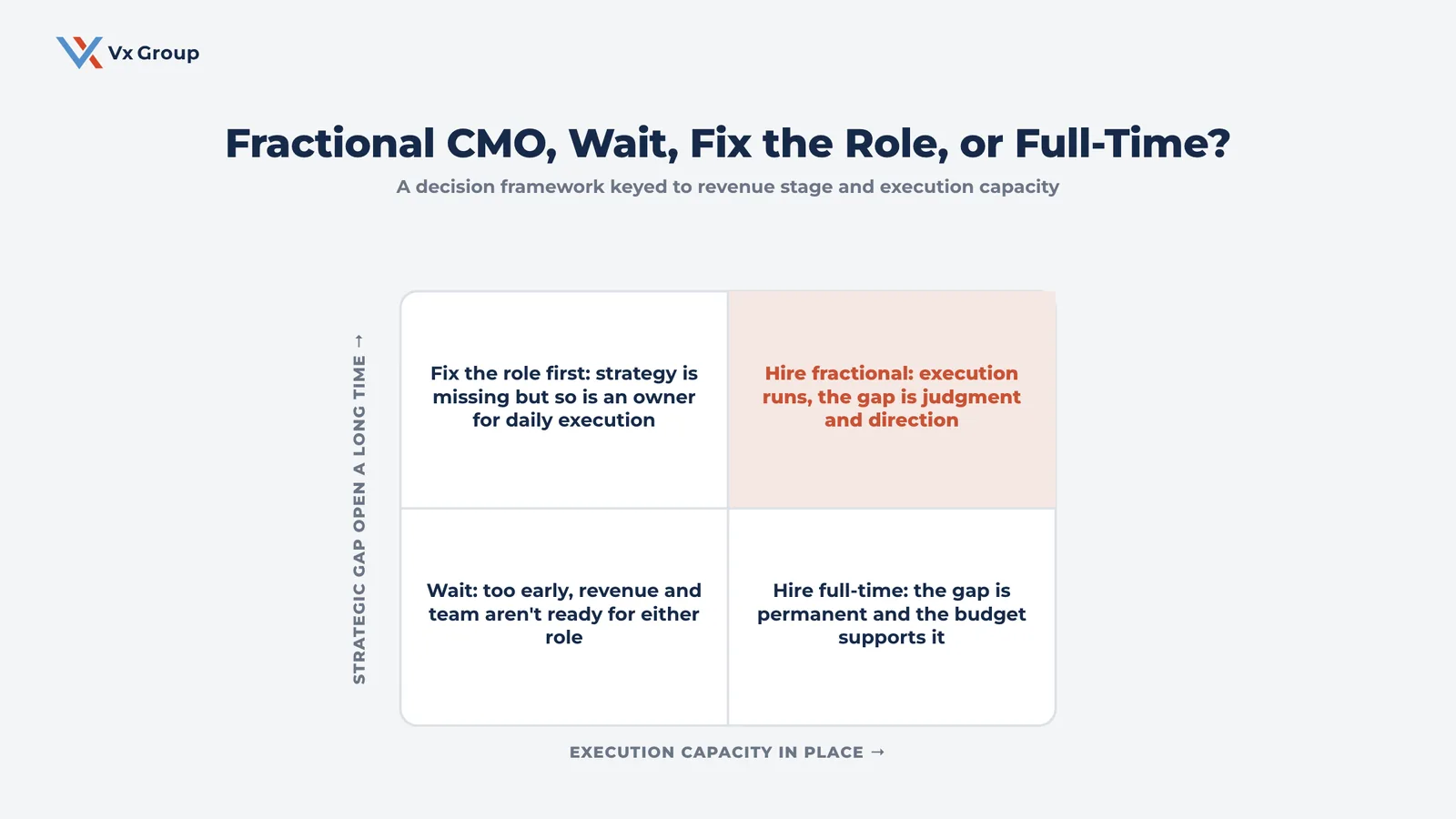
The decision runs on three variables: your revenue stage, whether execution capacity already exists inside the company, and how long the strategic gap has been open. Run your situation against the table below before you start interviewing candidates.
| Situation | Revenue stage | Execution capacity in place? | How long the gap has been open | Recommended path |
|---|---|---|---|---|
| Strategy is missing, but so is anyone to execute it | Under $10M, or early in a new go-to-market motion | No | Any length | Fix the role first. Hire or assign an execution owner before adding a strategist with nothing to direct. |
| Revenue and team are still forming | Under $5M | No | Recently opened | Wait. Neither a fractional nor a full-time CMO fits yet. Focus budget on product-market fit and a first sales motion. |
| Execution runs, but no one senior is setting direction | $10M to $75M | Yes | 6 months to 2 years | Hire fractional. This is the classic fit: senior judgment applied to capacity that already exists. |
| The strategic gap is permanent and the budget supports it | $50M+ or scaling fast | Yes | 2+ years, or growing fast enough that a fractional’s hours cap the pace | Hire full-time. The role has outgrown a part-time arrangement. |
A few notes on reading this table. Revenue thresholds are directional. A $40M company with almost no marketing infrastructure often needs to fix the execution gap before a fractional CMO can be useful, regardless of revenue. And a fast-growing $20M company sometimes outgrows fractional hours within a year, a sign to convert the role to full-time before the pace of growth outstrips what a part-time schedule can support.
Apply the framework honestly
This kind of framework only works when it’s applied honestly. It’s common for leadership to want the “hire fractional” answer regardless of what the other two variables say, because it feels lower-risk than a full-time search or a slower fix-the-role-first path. That instinct is worth naming out loud in the room before the framework gets used to justify a decision that was already made. Building a B2B growth strategy from scratch usually surfaces the same tension: the honest answer to “what do we need right now” takes more discipline to arrive at than the answer that’s easiest to hire for.
A short exercise helps here. Before you post the job or call a recruiter, write down, in one sentence each: who currently executes marketing work day to day, how long the company has operated without senior strategic direction, and what changes for the business if that direction doesn’t arrive for another six months. If the answer to the first question is “no one,” fix that first. If the answer to the third question is “not much,” you may be able to wait. If both answers point to real, standing capacity with a real cost to further delay, the fractional path is worth pursuing.
How Do You Structure a Fractional CMO Engagement So It Works?
A fractional CMO engagement works when the scope, cadence, and deliverables are written down before the first invoice, and it drifts when they are left implicit. The contract structure differs meaningfully from a full-time hire, and treating it like an informal advisory relationship is where most engagements go sideways.
Write the 90-day scope
Before the engagement starts, put a written scope in place covering the first 90 days on their own. Name the two or three priorities the fractional CMO will address first (commonly: positioning, a channel strategy, or a specific campaign), and name what is explicitly out of scope, especially day-to-day execution tasks that belong to someone else. A 90-day scope gives both sides a checkpoint to renegotiate before assumptions calcify into unpaid extra work.
Set the cadence and deliverables
Set a fixed weekly or biweekly cadence (hours per week, standing meeting, response-time expectations) and attach real deliverables to each phase: a positioning document, a channel plan, a reporting dashboard, a hiring plan for the execution role the fractional CMO will eventually hand off to. Concrete documents and decisions at each phase are what separates a fractional CMO engagement from an informal advisory retainer.
Put the right terms in the contract
A fractional CMO contract should specify hours or days per month, a notice period for either side to end the engagement, and how the relationship transitions if the company later hires full-time (many fractional CMOs will help recruit and onboard their own full-time replacement, which is worth writing in explicitly). Unlike a full-time hire, there is no equity, no benefits package, and usually no non-compete restricting the fractional CMO from serving other clients, since serving multiple clients is the model.
How Do You Vet and Select a Fractional CMO Candidate?
Vet a fractional CMO candidate on evidence of judgment applied to a business like yours. A polished deck of past client logos tells you who they’ve worked with, but the credentials that actually matter are specific and checkable: a work sample tied to your industry, a clear account of how they measure their own success, and at least one reference who can speak to what the engagement actually looked like month to month.
Ask for a work sample tied to your industry
Ask a candidate to walk through one real strategic decision they made for a past client in a similar industry or company size, including what data or judgment drove the call and what happened after. A candidate who can only speak in generalities about “driving growth” or “building brand awareness” hasn’t shown you enough to evaluate. A candidate who can describe a specific positioning change, why they made it, and what moved afterward has given you something concrete to judge.
Check how they define success for the engagement
Ask the candidate to propose, in the first interview, what they would consider a successful first 90 days. A strong candidate answers with something specific: a completed positioning document, a defined ICP, a channel test with early read-through data. A vague answer here (more visibility, better alignment) is a preview of how the engagement will be measured later, which is to say, it won’t be.
Call a past client reference directly
A written testimonial confirms the relationship ended well. A phone call with a past client tells you how the engagement actually ran: whether hours stayed within scope, whether deliverables arrived on schedule, and whether the client had to pull the fractional CMO back into operational work the way our Field Notes example above did. Ask the reference directly whether the scope held or drifted over the course of the engagement.
Ready to grow?
If you’re evaluating fractional CMO candidates and want a second set of eyes on the shortlist, we’re glad to help.
What Are the Red Flags That a Fractional Engagement Is Drifting Into Disguised Full-Time Work?
The clearest sign of drift is a rising hour count with no corresponding change in the contract. A fractional CMO scoped for ten hours a week who is regularly working twenty five, with no renegotiated scope or pay, has slid into informal full-time work without the pay, benefits, or accountability structure that would normally come with it.
Watch for these patterns specifically:
- Hours creep without a contract update. The original scope said ten hours a week. Six months in, invoices show twenty, and no one has revisited the agreement.
- Deliverables turn into activity updates. Early deliverables were documents and decisions. Later status updates are lists of tasks completed, with no reference back to the original strategic plan.
- No one can name what the fractional CMO owns this quarter. If you ask three people inside the company what the fractional CMO is accountable for right now and get three different answers, the scope has gone soft.
- The 90-day plan has not been revisited since it was written. A living engagement gets a new plan every quarter. A stalled one is still running against a document from a year ago.
- The fractional CMO has become the default owner of tasks no one else wants. Proofing emails, managing a website vendor, or chasing a contractor are signs the operational gap identified earlier in this guide never got filled, and the fractional CMO absorbed it instead.
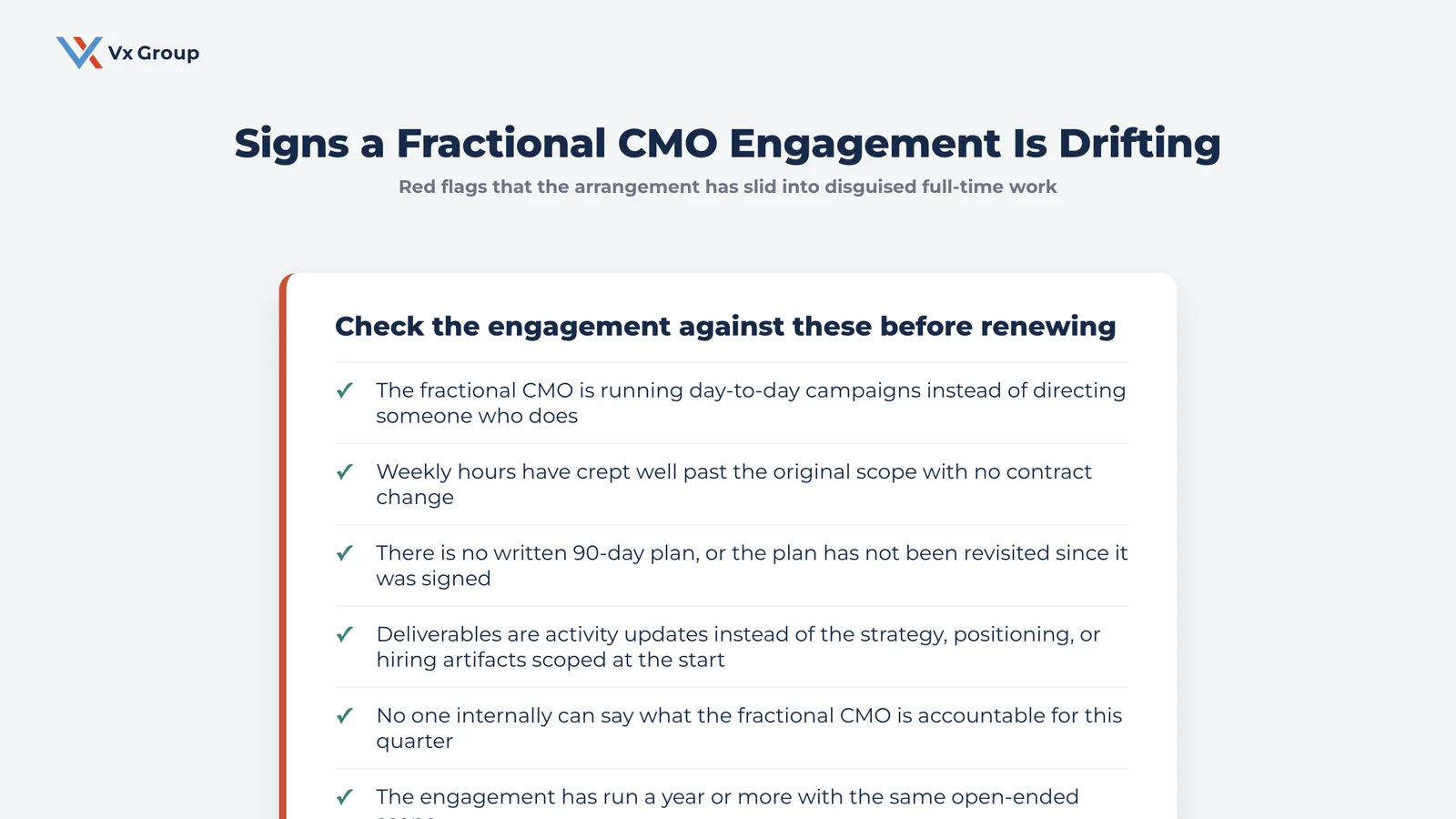
If more than one or two of these show up, the fix is usually a scope reset: a new 90-day plan, a renegotiated hour count, and an honest conversation about whether the company actually needs a full-time hire now. Letting the drift continue is how a fractional engagement quietly becomes the most expensive way to hire someone part-time.
What Does a Fractional CMO Cost, and What Drives the Range?
Fractional CMO fees are typically structured as an hourly or day rate, multiplied by a set number of hours or days committed per month. Published ranges across the market commonly run from roughly $150 to $400 per hour, or a few thousand to the low tens of thousands of dollars per month depending on scope. Treat any single number you see quoted as a starting point for comparison: the drivers below matter more than the headline figure.
Fees also commonly exclude the costs of the work itself. Ad spend, software subscriptions, contractor or agency fees, and design or content production are usually billed separately from the fractional CMO’s own rate. When comparing two proposals, ask what’s included in the quoted number and what gets billed on top of it, since a lower headline rate with a longer list of pass-through costs can end up costing more in total.
What drives the range:
- Scope of authority. A fractional CMO with decision authority over budget and hiring commands a higher rate than one providing advisory input only.
- Hours committed per month. More hours per month lowers the effective hourly rate in some arrangements and raises the total monthly cost in others. Ask which model you’re being quoted.
- Industry and company complexity. A multi-product B2B company selling into several verticals requires more strategic complexity than a single-product company with one buyer persona, and pricing usually reflects that.
- Track record and specialization. A fractional CMO with a specific track record in your industry or company size typically prices at a premium over a generalist.
- Geography and market. Rates in major metro markets tend to run higher than rates for fractional CMOs based in smaller markets, even for comparable scope.
The comparison that matters across candidates is less about the hourly rate on its own and more about what that rate includes. A lower hourly rate paired with a vague scope is often a worse deal than a higher rate paired with a clearly bounded 90-day plan and named deliverables.
The Bottom Line on Hiring a Fractional CMO
A fractional CMO is a strong fit when execution capacity already exists and the missing piece is senior strategic judgment. The role is the wrong fix when the real problem is an unowned marketing function, an undefined ICP, or a broken handoff between sales and marketing. Those gaps simply get absorbed by the fractional hire, who ends up doing operational work while the strategic question that justified the hire stays open.
Run your situation through the decision framework before you start a search: revenue stage, existing execution capacity, and how long the gap has been open will tell you whether the right move is fractional, full-time, fixing the role first, or waiting. If you decide fractional is the right call, put the 90-day scope, cadence, and deliverables in writing before the engagement starts, and revisit them on a schedule so the arrangement stays anchored to real deliverables and doesn’t quietly drift into unstructured full-time work.
Vx Group works with owner-led B2B companies through the Measured in Millions® methodology to diagnose this kind of role and structure question early, while it’s still cheap to fix.
Ready to grow?
If you want a second opinion on a fractional CMO proposal, or help deciding whether fractional is even the right call, send us the details and we’ll walk through it with you.
—
About Vx Group Team: This guide was prepared by the Vx Group Team, drawing on work by Vx Group helping owner-led B2B companies diagnose growth roles, structure, and strategy through the Measured in Millions® methodology.
Related reading:
- What Is B2B Growth Consulting?
- What Is a Business Growth Operating System?
- Building a B2B Growth Strategy From Scratch
- Ideal Customer Profile Template
- Why B2B Companies Grow by Accident
FAQs
About the Author: Jacob Camhi
