
How to Choose a B2B Branding Agency That Helps You Sell

A B2B branding agency helps a company decide how buyers should see it, then builds the messaging, website, and sales materials that show it. A good one starts with your sales team and your best customers. It judges its own work by what your reps can use next week and what buyers say back to you.
TL;DR
- A B2B branding agency should change how buyers judge you before the first call. A logo and a color palette are the smallest part of that job.
- Buyers were about 61% through their buying process when they first contacted a seller. Then 77% bought from the vendor they ranked first (6sense 2025 Buyer Experience Report).
- A good engagement hands your team five things. They are a one-sentence positioning, a proof page, a website message brief, proposal templates, and a 90-day rollout plan.
- Judge an agency by its first questions. If it asks about your sales team and your top accounts, it is working on the right problem.
- Published agency price guides run from about $25,000 for a visual refresh to $150,000 or more for a full rebrand. Get three quotes with the same scope.
- Measure the work by what happens in sales: win rate, proposal quality, first-meeting conversion, and how often reps use the new message.
Most owners who call us about branding describe the same moment. A good meeting goes well. The prospect goes back to the office and opens your website. The company on the screen looks smaller than the one that sat across the table.
We call this the best-kept-secret problem, and it is self-inflicted. The work is excellent, but the first impression says otherwise. Then the quote goes to a competitor who sounds bigger and clearer, and whose work is about the same.
This guide is for the owner or president of a privately held B2B company who is thinking about hiring a branding agency. It covers what the work should produce and how to compare agencies. It also covers cost, timing, and how to tell whether the work paid off.
Vx Group does brand and website work, so weigh our view with that in mind. We wrote the guide so it still helps if you hire someone else.
What the guide covers:
- What a B2B branding agency does
- Why brand matters before your sales team gets a call
- How branding differs from brand strategy, design, and marketing
- What an engagement should produce
- When you need an agency, and when to wait
- How to judge an agency
- Questions to ask before you sign
- Red flags in a proposal
- How a project runs, phase by phase
- What it costs
- Agency, in-house hire, or fractional help
- How to measure the result
- Where to start this week
What does a B2B branding agency actually do?
A B2B branding agency works out what your company should stand for with buyers. Then it turns that into words, pages, and tools your team can use. The work covers positioning, messaging, proof, website direction, and sales materials. Visual identity is one piece of it.
Defined Term: Brand positioning.
A short, written statement of who you serve, what you do for them, and why they should pick you. Your reps should be able to say it out loud in a first meeting.
Agencies fall into two camps. Design shops start with the look and treat the message as something to fill in later. Strategy-led agencies start with the buyer and the sale, then design to match.
For an owner-led B2B company, the second camp is the one worth hiring. Your buyers are engineers, plant managers, procurement leads, and executives. They compare suppliers on trust and proof, and a handsome logo does little for them.
A solid engagement usually covers these areas:
- Research. Interviews with your sales team, your best customers, and a few people who chose a competitor.
- Positioning. The written statement above, plus the reasons behind it.
- Messaging. How you describe each product line or service to each buyer type.
- Proof. Customer results, certifications, and references organized so a buyer can check them fast.
- Website direction. What each key page must say and show.
- Sales tools. Proposal and deck templates that match the quality of the work.
Our guide on B2B brand strategy goes deeper on the thinking behind these pieces. This guide focuses on how to pick and manage the agency that does the work.
Why does brand matter before your sales team gets a call?
Brand matters because buyers form a shortlist before they talk to you. The first impression your company makes happens on a website, in a search result, or in an AI answer, with no salesperson in the room.
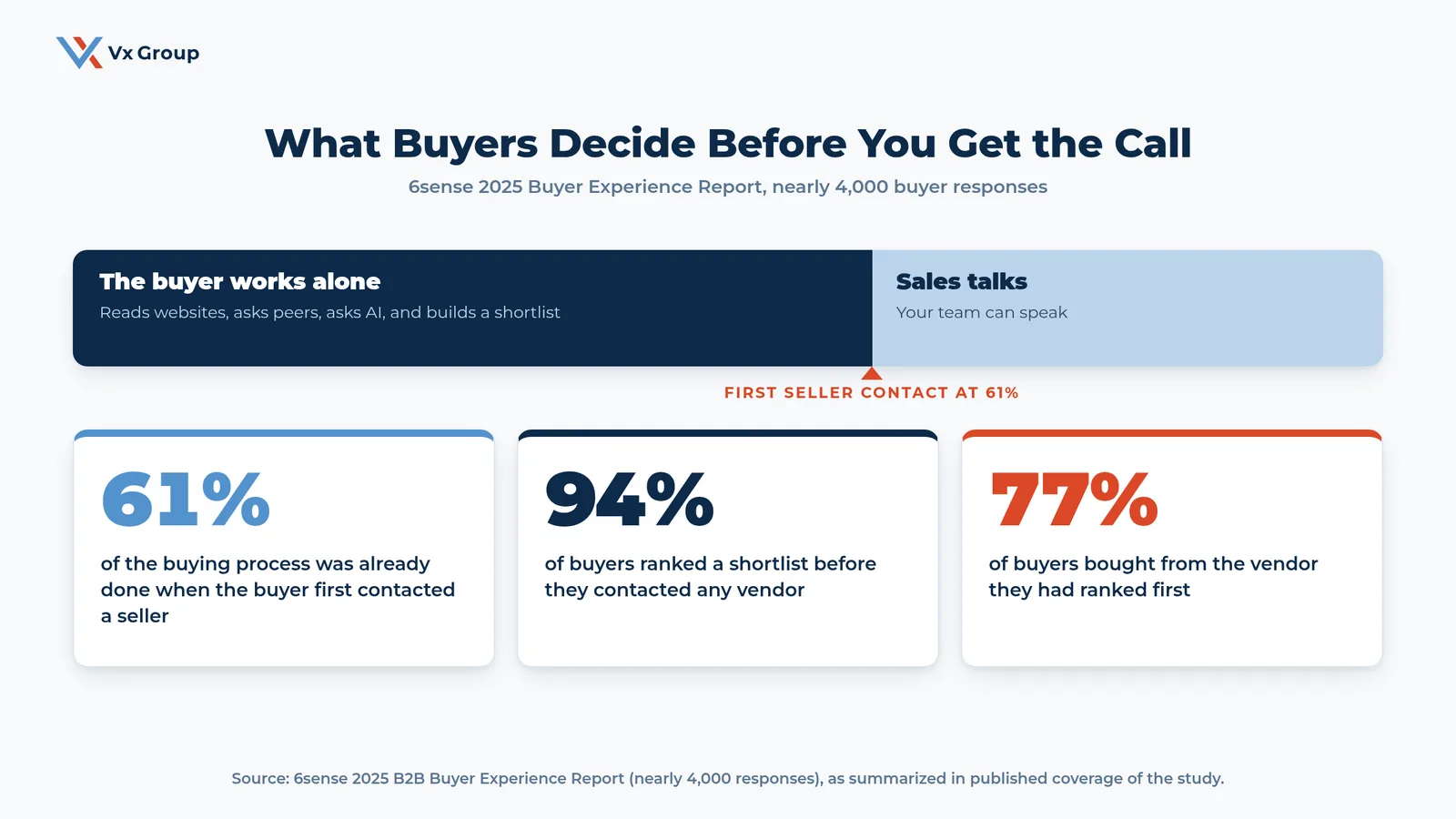
The 6sense 2025 Buyer Experience Report surveyed nearly 4,000 buyers. It found that buyers were about 61% through their buying process when they first contacted a seller. Some 94% had ranked a shortlist before reaching out to any vendor. They went on to buy from the vendor they ranked first 77% of the time.
Most of the buying process runs without you. By the time your rep gets a call, the buyer has already read what you publish and decided where you sit on the list.
Brand is what you control during that early period. It shows up in how clearly your site says what you do and how easy your proof is to find. It also decides whether your company looks like it belongs on a shortlist of five.
A large buying group adds to the problem. Several people check you out on their own, and each one forms a view. Our guides on the B2B buying committee and the B2B buying process show who those people are and what each one looks for.
Field Notes:
Owners tell us the same thing in different words. They win when a prospect meets the team and they lose when the prospect only sees the website. The fix starts with saying clearly what the company does and who it does it for.
How is a branding agency different from a brand strategy firm, a design shop, or a marketing agency?
A branding agency decides and shapes how you are seen. A design shop makes things look good, a marketing agency runs campaigns, and a brand strategy firm focuses on the thinking with little production. Many agencies blend two or three of these, so ask what they do in-house.
Use the table below to compare the five engagement types owners usually see in proposals.
| Engagement type | What you get | Typical timeline | Best fit |
|---|---|---|---|
| Positioning only | Research, a positioning statement, core messages | 8 to 12 weeks | A company with a good look and a fuzzy message |
| Positioning plus messaging | Positioning, messaging by buyer, a proof page | 10 to 16 weeks | A sales team that explains the company five different ways |
| Brand refresh | Positioning, messaging, updated logo and visual system | 3 to 5 months | A dated look and an unclear message |
| Full rebrand with website | Everything above plus a rebuilt website | 4 to 8 months | A merger, new ownership, or a new market |
| Brand and sales tools | Positioning, proposal and deck templates, rep training | 3 to 5 months | A strong website and a weak first meeting |
Timelines come from the ranges agencies publish and from what we see on projects. Real projects run shorter or longer with scope and with how fast your team gives feedback.
Start with the cheapest option that fixes your actual problem. If your reps explain the company five different ways, positioning plus messaging is the fix. A full rebrand adds cost and time that the problem may never need.
The brand modernization guide covers how to tell when a refresh is warranted. The B2B website redesign guide covers the website piece on its own.
What should a B2B branding engagement produce?
A B2B branding engagement should produce five things your team can use right away. Ask for each one by name in the proposal, with a due date.
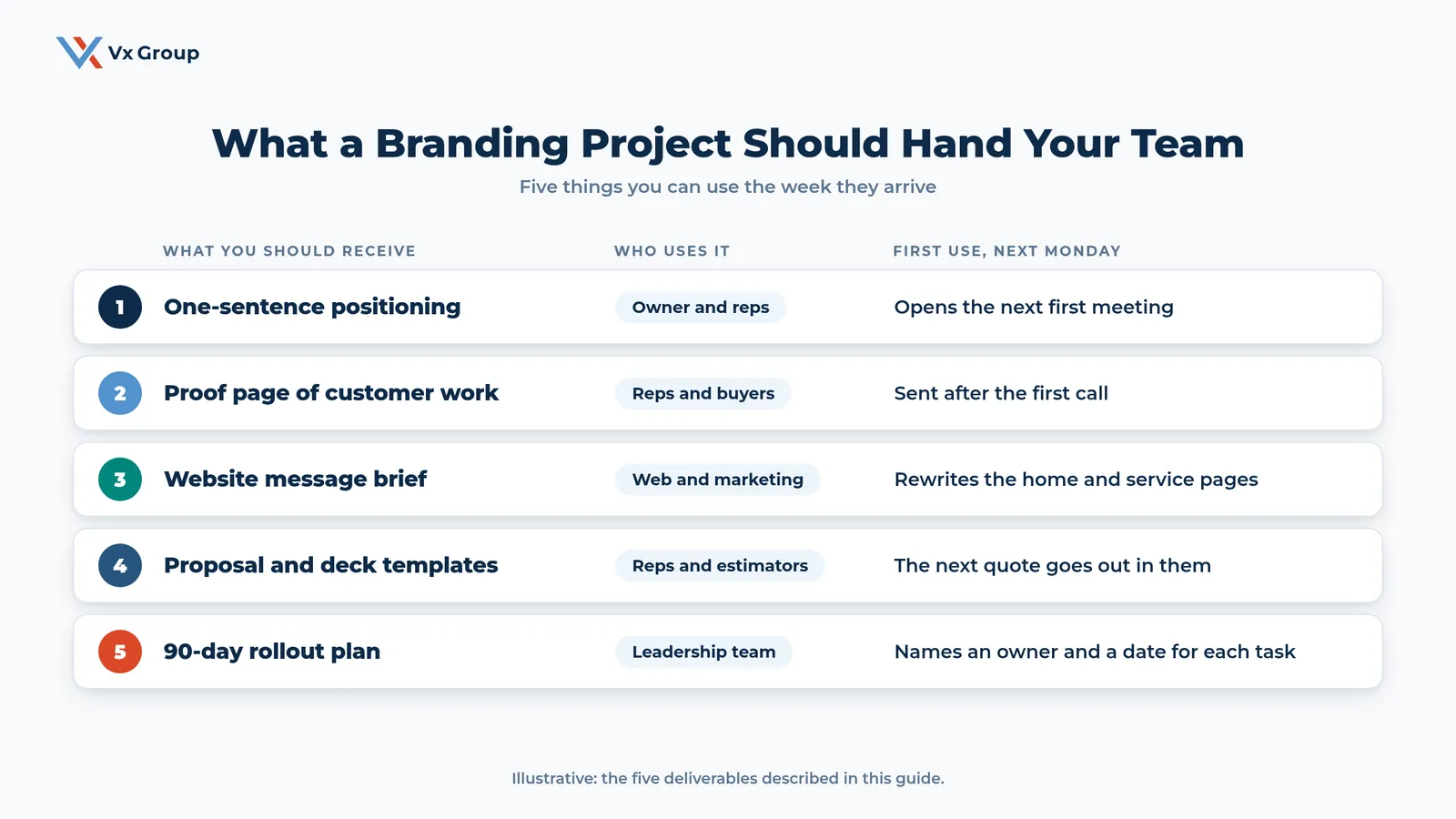
The graphic lists the five deliverables, who uses each one, and the first way to use it. If a deliverable has no user and no first use, it is probably decoration.
Get a positioning statement your reps can say out loud
The positioning should fit in one or two sentences and name the buyer, the problem, and your edge. Test it before you sign off. Ask two reps to say it in their own words. If they stumble, the sentence is too long or too abstract.
Ask for a proof page built from real customer work
A proof page collects results, named customers where allowed, certifications, lead times, and references on one page. Buyers and their AI tools look for these facts first. Put them in plain text so a person and a machine can both read them.
Ask for a website message brief for every key page
The brief tells your web team what each page must say, in what order, and what proof sits beside each claim. It covers the home page, each service or product page, and the about page. Without it, a new design carries the same old message.
Ask for proposal and deck templates your team will use
Proposals are where many owners see brand fall apart. The work is excellent, then a rushed document goes out with a different look and a vague summary. Templates fix that. They also give your reps a faster way to respond to a request for quote.
Ask for a 90-day rollout plan with owners and dates
A rollout plan lists every task after launch, who owns it, and when it is due. The agency should include rep training and a review at day 90. A brand without a rollout plan tends to sit in a shared folder.
When does a company need a B2B branding agency?
You need a branding agency when the way buyers see you no longer matches the company you have become. The signs show up in sales conversations, bid results, and website feedback before they show up in revenue.
Look for these signals:
- Reps apologize for the website or send prospects a PDF instead.
- You lose quotes to competitors you believe are weaker.
- Each rep describes the company a different way.
- A merger, a new owner, or a new product line left you with a message that no longer fits.
- Prospects say, after a meeting, that they did not know you made that.
- Your best customers are surprised by what else you offer.
- A leadership change, such as a second-generation owner, is changing the company’s direction.
Two or three of these signs together make a strong case. One alone may point to a smaller fix, such as a message rewrite or a better proof page.
For owner-led companies, the trigger is often growth. The company has outgrown the story it told when it was smaller. The brand still describes a shop of twenty people, and the company now has a hundred. Our guide on B2B brand authority covers how to close that gap on a modest budget.
Ready to grow?
Find out whether your brand is helping or hurting the first meeting.
When should you wait before hiring a branding agency?
Wait when the problem sits somewhere other than brand. An agency cannot fix an unclear offer, a shaky sales process, or a customer base that depends on one or two accounts.
Hold off if any of these describe you:
- You have not decided who your best customers are or which markets you want.
- Your sales process changes with each rep, and nothing is written down.
- Revenue is concentrated in a few accounts, and the plan is to protect them first.
- You want a new logo because the old one feels tired, and nothing else has changed.
- You cannot name one person who will own the project and give feedback in two days.
In these cases, a growth plan or a go-to-market review should come first. The B2B go-to-market strategy guide lays out how to decide who you sell to and how. A branding agency can then put words and design around a decision that has already been made.
How do you judge a B2B branding agency before you hire?
Judge an agency by how it works and what it asks, then check its past work for results. Ask the same questions of every agency on your list and put the answers side by side.
Use the scorecard below. Each row is a question, what a good answer sounds like, and a sign to worry about.
| Question | A good answer | A warning sign |
|---|---|---|
| Who do you want to talk to first? | Your sales team and your top customers | The marketing team only |
| How do you judge your own work? | Win rate, proposal quality, rep use | Awards and impressions |
| Who does the work? | Named people with a role on your project | “Our team” with no names |
| What will we have at day 90? | A list of deliverables with owners | A brand book |
| Can we talk to a past client? | Two or three references, named | Only a polished case study |
| How do you handle disagreement? | A defined approval step and rounds | Open-ended revisions |
| What do you need from us? | Hours, people, and dates | “Just your trust” |
Each answer tells you something about the agency’s habits. The best sign is curiosity about your sales process. An agency that asks to sit in on a customer call is studying how you sell.
Start with the questions an agency asks you
In the first two calls, count how many questions the agency asks about your sales team, your top customers, and the deals you lost. Three or more good questions is a strong sign. Zero means the agency already has a template.
Read the portfolio for outcomes
Most agency portfolios show pretty pages. Ask what changed in the client’s business afterward. A good agency can name a result, such as shorter quotes, larger deals, or more inbound from the right accounts. Ask how they know.
Check whether the agency has worked in your kind of company
Industrial and manufacturing buyers read differently from software buyers. They look for specs, lead times, certifications, and references. An agency that has only worked with software companies may build a site that suits that world and confuses yours.
Talk to two past clients about the handoff
The handoff is where projects succeed or stall. Ask a past client what they received at the end, whether their team used it, and what they would change. Their answers tell you more than the portfolio does.
What questions should you ask a B2B branding agency before you sign?
Ask questions that make the agency describe its process, its people, and its limits. The answers go into your contract, so write them down.
Ask about the process
- Who will interview our sales team and customers, and how many interviews are included?
- What will you deliver at the end of each phase?
- How do you test positioning before we sign off on it?
- How many rounds of feedback are included, and what happens after that?
- How do you work with our current website team or developer?
Ask about people and price
- Who exactly works on our project, and how much of their time do we get?
- What is included in the price, and what costs extra?
- What do you need from our team each week?
- What happens if we change the scope halfway?
Ask about life after launch
- What does the day-90 review cover?
- Will you train our reps on the new message?
- What do we own when the project ends, including files and templates?
A good agency answers these without hesitation. A weak one answers in general terms and promises to cover the details later. Get the details in writing before you sign.
What are the red flags in a branding agency proposal?
Red flags in a proposal point to a design-first agency, a vague scope, or a team that will hand your project to someone junior. Spot them early and ask about each one.
Watch for these:
- No research phase. The proposal jumps from kickoff to logo concepts.
- No sales team involvement. Interviews cover marketing and leadership only.
- A price with no scope. The number is round, and the deliverables are a short list of nouns.
- Unlimited revisions. That tends to mean a long project with no decision point.
- A pitch deck from a senior partner and a project run by someone you have not met.
- Case studies with no numbers. Every result is “increased awareness.”
- A rebrand recommended before the agency has talked to a customer.
One red flag is a question to ask. Three is a reason to move on.
How does a B2B branding project run, phase by phase?
A B2B branding project runs in five phases: listen, decide, say it, build, and roll out. Most owner-led companies see the first working message in the first six weeks and a full rollout in four to five months.
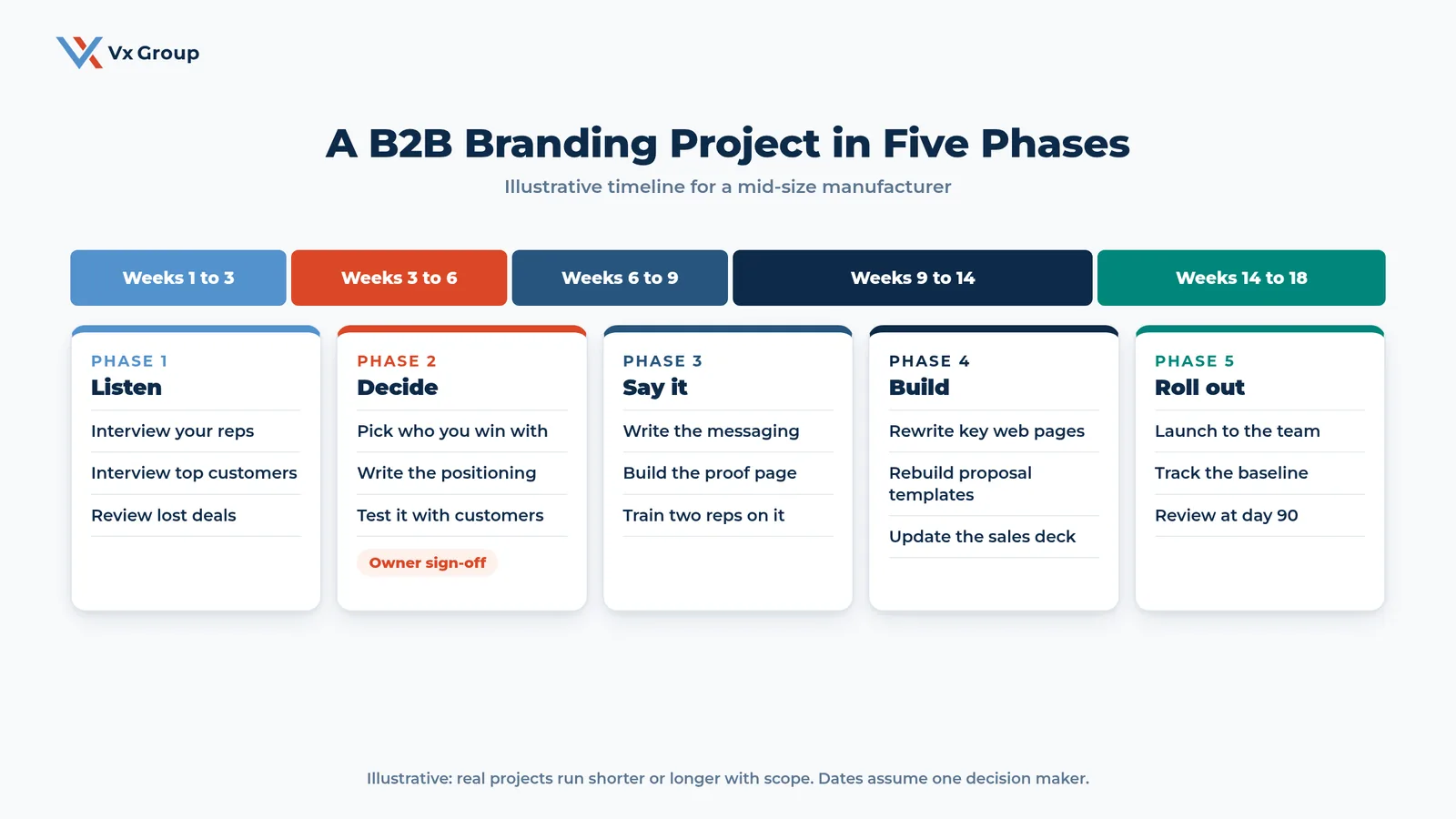
The graphic shows an illustrative 18-week plan. Real projects run shorter or longer, and the timing depends on how fast your team gives feedback.
Plan three weeks to listen
The agency interviews your reps, your top customers, and a few people who chose a competitor. It also reviews lost deals. You should see a short summary of what they heard before anyone writes a word of positioning.
Plan three more weeks to decide
The agency picks who you win with and writes the positioning. This is the point where the owner signs off. Take the time to test the statement with two customers and two reps.
Plan three weeks to say it
The agency writes the messaging for each buyer type and builds the proof page. Two of your reps should try the new message on live calls and report back.
Plan five weeks to build
The agency rewrites key web pages, rebuilds proposal templates, and updates the sales deck. Your web team should be in the room, and the message brief from phase three guides every page.
Plan four weeks to roll out and set a baseline
The agency launches the work to your team, trains reps, and records the starting numbers. Write down your current win rate, average quote response time, and first-meeting conversion before launch. You need them for the day-90 review.
What does a B2B branding agency cost?
Published agency price guides run from about $25,000 for a visual refresh to $150,000 or more for a full rebrand. Those guides disagree with each other, and many are sales material, so treat them as rough bands.
In the guides we reviewed in November 2026, ranges fell roughly like this:
- Visual refresh only: about $25,000 to $75,000.
- Positioning plus visual refresh: about $75,000 to $150,000, over 12 to 16 weeks.
- Full rebrand with website and sales tools: about $150,000 to $350,000, over six to eight months.
Strategy-only projects can come in well below these figures. Positioning projects are commonly quoted at 8 to 20 weeks.
These factors move the price:
- How many products, markets, or buyer types you have
- How many interviews and research hours are included
- Whether the website rebuild is in scope
- How many people on your side need to approve each step
- The agency’s size and where the work is done
Ask for three quotes with the same scope written out. Compare them line by line. The cheapest quote often leaves out the research and the rollout, which are the two phases that make the work stick.
Size the budget against what one new or larger account is worth to you. Say a new customer is worth several hundred thousand dollars over its life. A clear message that helps you win one more per year can then cover the project.
Should you hire an agency, build an in-house team, or use a fractional marketer?
Hire an agency when you need a defined project with a start and end. Build in-house when brand work will be steady and constant. Use a fractional marketer when you want senior judgment without a full-time salary.
| Option | Strength | Watch for |
|---|---|---|
| Branding agency | A fixed project, a full team, fast progress | Handoff gaps at the end |
| In-house hire | Daily presence and company knowledge | One person’s range and a long ramp-up |
| Fractional marketer | Senior judgment at part-time cost | Limited hours for production work |
Many owner-led companies combine two. An agency builds the positioning and tools, then a part-time or in-house person keeps the work going.
Our guides on the B2B fractional CMO and the B2B marketing consultant compare those paths in more detail. If you are also weighing a broader marketing partner, read what a manufacturing marketing agency should do for you.
How do you measure whether branding work paid off?
Measure the work by what happens in sales, using numbers you recorded before launch. Brand takes time to show in revenue, so track a mix of early signs and later results.
Track these five numbers:
- Rep use. How many reps use the new positioning in first meetings? Ask them, and listen to a few calls.
- First-meeting conversion. What share of first meetings turn into a second meeting or a quote request?
- Proposal win rate. Compare quotes sent in the 90 days before launch to quotes sent in the 90 days after.
- Inbound quality. What share of new inquiries match the customers you want to win?
- Sales cycle length. Track days from first contact to quote and from quote to decision.
Early signs show up first. Reps use the message within a few weeks. Win rate and cycle length take two to three quarters for most long-cycle companies, because deals started before launch are still in the pipeline.
Ask the agency to set up this scorecard in phase one and review it with you at day 90. An agency that welcomes the scorecard is confident in the work.
Where should an owner start this week?
Start with three steps that cost nothing and make any agency conversation better.
- Write down your last five lost quotes. Note who won and what the buyer said about the decision.
- Ask two reps to describe the company in one sentence. Compare the answers. The gap between them is the size of the positioning problem.
- Open your website as a buyer would. Check whether specs, lead times, certifications, and references are easy to find in text.
Bring those three pages to your first agency call. A good agency will want to see them.
Pick the agency that starts with your sales team
Look for the agency that wants to meet your reps and your best customers before it draws anything. It is starting with how you win business.
Pick two or three agencies, ask each the questions in this guide, and compare the answers side by side. Then pick the one whose proposal names five deliverables your team can use the week they arrive.
Ready to grow?
Bring us your last five lost quotes and we will show you what buyers see first.
FAQs
About the Author: Jacob Camhi
