

Channel Partner Onboarding: A 90-Day Plan for Manufacturers

Channel partner onboarding is the first 90 days after a distributor, dealer, or rep signs with you. Its job is to get the partner to a first quote and a first order. A good plan names an owner on each side and trains two people. It adds a joint customer call and ends with a review of what both sides promised.
TL;DR
- Onboarding starts at the signature and runs 90 days. It ends when the partner has sent a quote and taken an order, or you both agree to stop.
- Week 1: name one owner on each side and hold a kickoff meeting.
- Weeks 2 to 4: train two named people and check that they can configure and quote a product with no help from you.
- Weeks 4 to 8: join the partner’s first customer call and prepare for it together.
- Weeks 8 to 12: get the first registered opportunity and the first quote out the door.
- Day 90: review the commitments both sides made, then keep, adjust, or reduce the relationship.
- The “first quote with no help” test is the best early sign that a partner will produce.
Most manufacturers can describe the day a partner signed. Few can describe the first 90 days after it. A distributor gets a login, a price list, and a welcome email. Then nobody calls for three months.
That is how a company ends up with 40 partners and six that sell anything. The agreement was fine. The partner never learned how to sell the product. It never met anyone on your team. It never saw a reason to put your line ahead of the other lines it already sells.
This guide is for owners and presidents of privately held manufacturers with roughly $5M to $50M in revenue. It gives you a 90-day plan you can start with your next partner, with a named output and an owner for each step.
What is channel partner onboarding for a manufacturer?
Channel partner onboarding is the process a manufacturer uses to turn a newly signed distributor, dealer, or rep into a partner that sells its products. It covers introductions, training, a first joint sales call, a first order, and a review. It starts on the day the agreement is signed.
Defined Term: Channel partner onboarding.
A time-boxed plan, usually 90 days, in which a manufacturer and a new channel partner train people, meet customers together, and reach a first quote and a first order, with a named owner and a due date for each step.
Onboarding differs from recruiting and from enablement. Recruiting finds and signs the partner. Partner enablement is the ongoing training, quoting help, and deal support a partner receives for as long as it sells your line. Onboarding is the first stretch of that work, with a fixed end date.
The partner types matter less than the plan. A distributor, a dealer, and a rep each need the same five things in the same order. The training content changes by partner type, and the sequence stays the same.
Why do most new channel partners never produce?
Most new channel partners never produce because nobody on the manufacturer’s side owns the first 90 days. The partner receives access and then waits. Meanwhile its own sales people are busy with lines they already know, and your line stays at the bottom of the list.
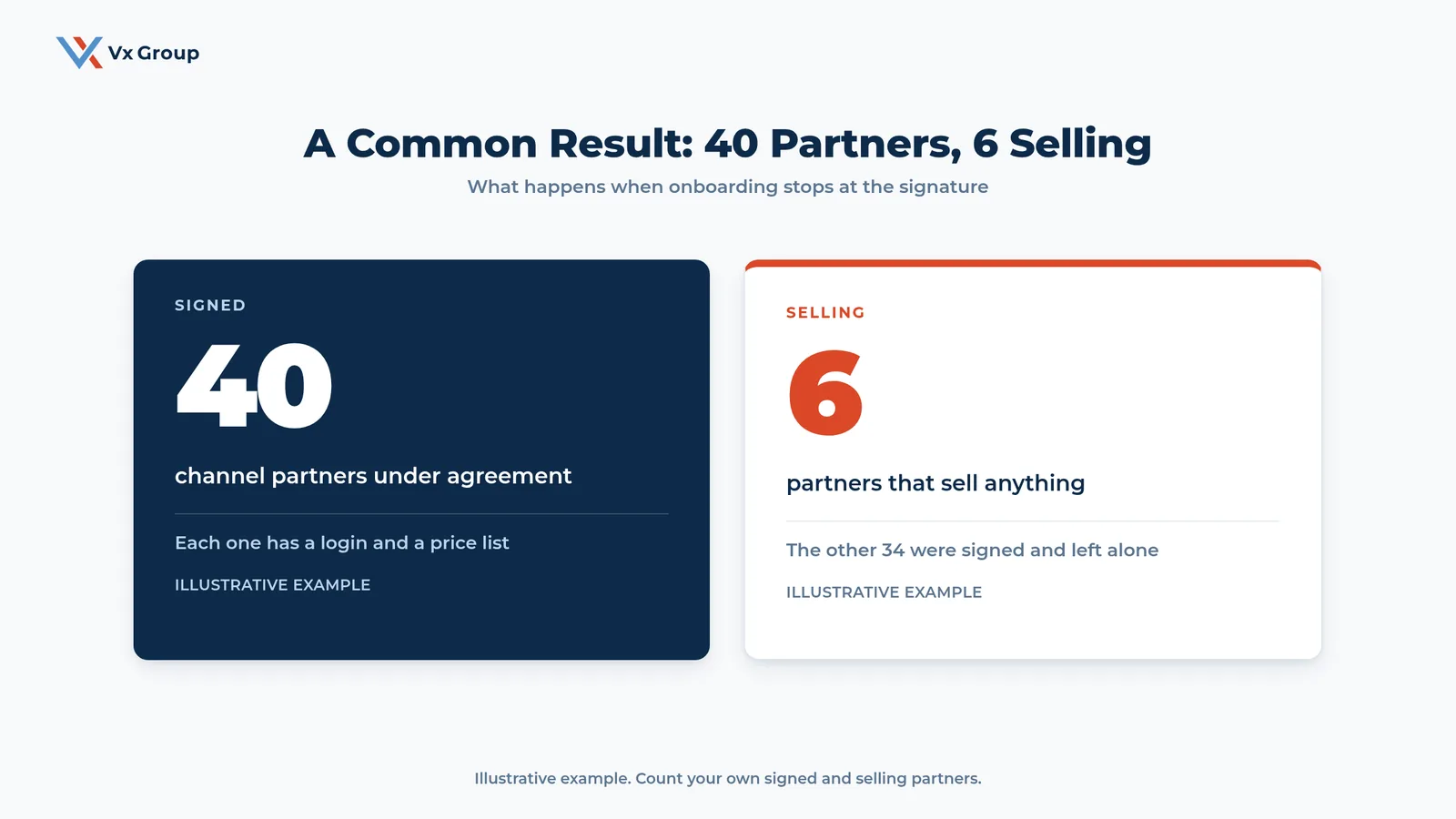
The graphic shows an illustrative result: 40 partners under agreement and six that sell anything. Your own counts will differ. The pattern is common enough to check. Count the partners you signed in the last three years, then count the ones that sent a quote in the last 12 months.
Three causes show up again and again:
- No named owner. The partner has a general sales email and no person to call with a question.
- No proof of ability. Nobody checked whether the partner’s people can configure and price your product.
- No first win. The partner has no reason to believe your line produces income, because it has not earned any yet.
A manufacturer that sells through distributors and dealers usually gives up the day-to-day customer contact. That makes the first 90 days more important. It is the one stretch when you can still meet the partner’s people, hear their questions, and shape how they sell.
What does a 90-day channel partner onboarding plan look like?
A 90-day channel partner onboarding plan has five steps. They are a kickoff in week 1, training in weeks 2 to 4, a joint customer call in weeks 4 to 8, a first registered deal and quote in weeks 8 to 12, and a review on day 90. Each step has one owner and one named output.
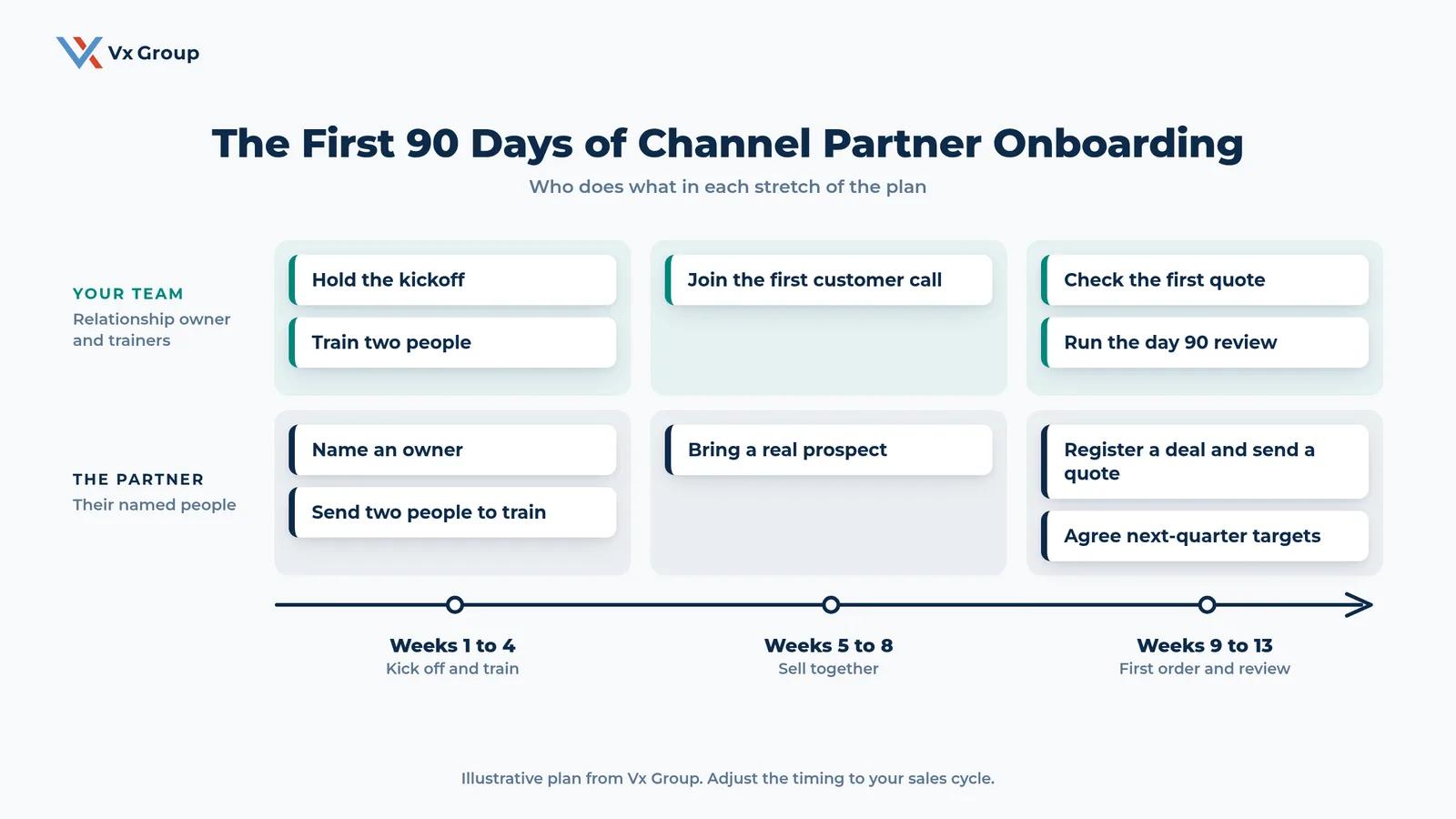
The timeline shows what your team does and what the partner does in each stretch. In weeks 1 to 4, you hold the kickoff and train two people while the partner names an owner and sends them. In weeks 5 to 8, you join a real customer call. In weeks 9 to 13, the partner registers a deal and sends a quote, and both sides hold the review.
The table below turns the same plan into milestones, owners, and the proof that each one happened.
Use the milestone table to assign every step an owner
| Window | Milestone | Your owner | Partner owner | Proof it happened |
|---|---|---|---|---|
| Week 1 | Kickoff meeting held | Relationship owner | Partner’s named owner | Date held and notes sent in 24 hours |
| Weeks 2 to 4 | Two people trained | Training lead | Two named sales people | Names and training dates on file |
| Weeks 2 to 4 | First quote with no help | Training lead | Either trained person | A correct quote the partner built alone |
| Weeks 4 to 8 | First joint customer call | Relationship owner | Partner’s sales person | Call held and debrief sent in 24 hours |
| Weeks 8 to 12 | First registered opportunity | Relationship owner | Partner’s sales person | Deal entered in your system |
| Weeks 8 to 12 | First quote sent to a customer | Application engineer | Partner’s sales person | Quote checked and sent |
| Day 90 | Review held | Owner or president | Partner’s owner | Written next-quarter targets |
Print the table and fill in real names before the kickoff. A blank cell is a step that will be skipped.
Step 1. What should happen in week 1 of channel partner onboarding?
In week 1, a manufacturer should name one relationship owner on each side, hold a kickoff meeting, and send a one-page welcome pack. These three actions give the partner a person to call, a shared plan, and a short list of what to do next.
Name one relationship owner on each side
Pick one person at your company who owns the partner for the full 90 days. That person answers questions, schedules training, and joins the first customer call. Choose someone who will still be there in 90 days, such as a sales manager or regional manager.
Ask the partner for the same. The partner’s owner is usually a branch manager or the person who signed the agreement. Write both names at the top of the milestone table.
Hold the kickoff meeting in person or on video
Hold the kickoff within five business days of signing. Bring the people who will do the work on both sides. Cover four topics: what each side promised in the agreement, the 90-day plan, who trains first, and how the partner will quote.
Keep the meeting under 90 minutes. End by agreeing on dates for training and for the first joint customer call. Send the notes the same day.
Send a one-page welcome pack
The welcome pack lists the two owners and the training dates. It says where to find price lists and product data, and who answers quote questions. One page is enough. A long binder tells the partner that onboarding is a chore.
Our guide to what a channel partner is covers the partner types if your team needs a shared definition before the kickoff.
Step 2. How do you train a new channel partner in weeks 2 to 4?
To train a new channel partner in weeks 2 to 4, train two named people. Teach them to configure and quote your most common products. Then check that each can build a correct quote with no help from you. Two people give the partner a backup if one leaves.
Train two named people the partner picks
A whole-team webinar reaches many people and changes the behavior of almost none. Ask the partner to name two sales people. Choose people who already talk to the customers you want.
Teach the products that make up most of your orders first. Add the rest after the first quote. A new partner who knows five products well sells more than one who has seen fifty.
Run the first quote with no help test
The test is simple. Give each trained person a real customer request. Ask them to configure the product, price it, and write the quote with no help from you. Then check the quote against your own.
Defined Term: First quote with no help test.
A check in which a partner’s trained sales person builds a correct, priced quote for a real or realistic customer request with no help from the manufacturer. Passing it shows the partner can sell the product without calling your team for each order.
The test predicts production better than attendance at training. A person who sat through a session may still need you on the phone for every quote. A person who passed the test can sell on a Tuesday afternoon with nobody from your team in the room.
Fix each gap before week 5
If a quote has an error, find where it came from. A wrong option, a missed accessory, and an old price list are three different problems with three different fixes. Fix the cause, then run the test again.
Aim to have both people through the test by the end of week 4. If one of them cannot pass by week 6, ask the partner to name a replacement.
Ready to grow?
Bring your list of signed partners and we will help you pick the ones worth a full 90-day plan.
Step 3. How do you run the first joint customer call in weeks 4 to 8?
To run the first joint customer call, pick a real prospect the partner already knows and prepare the call together. Have your relationship owner or an application engineer join it. The call shows the customer that the manufacturer stands behind the partner.
Pick a prospect the partner already knows
Ask the partner for a customer or prospect with a real need for your product. A warm contact makes a better first call than a cold lead. The partner should lead the call, because the customer’s relationship is with the partner.
Do not pick your biggest account for the first call. Choose a mid-size opportunity where a mistake is cheap and the learning is real.
Prepare the call together for 30 minutes
Meet with the partner’s sales person the day before. Agree on who opens, who answers technical questions, and what you want from the customer at the end. Write down the customer’s likely questions and who answers each.
A short script helps. Use three lines: “Here is what we heard you need. Here is how our product fits. Here is the next step we suggest.” Keep it that plain.
Send a debrief within 24 hours
After the call, send the partner a short note. Cover what the customer asked, what you promised, and what happens next. Add one thing the partner did well. Partners repeat what you praise.
The debrief also gives you early information. If customers keep asking the same question, add it to the training.
Step 4. How do you get the first registered opportunity and quote in weeks 8 to 12?
To get the first registered opportunity and quote in weeks 8 to 12, ask the partner to register a real deal in your system. Review the quote before it goes out, then follow the deal through to an order. The first order is the proof that onboarding worked.
Ask the partner to register the deal
A registered opportunity is a deal the partner tells you about in writing. You can then protect its position and help win it. Our guide to deal registration explains how to set up the process. Keep the form to a handful of fields: customer, product, size, timing, and who is involved.
Registration protects the partner and shows you the pipeline. It also tells you whether the partner trusts you enough to share real deals.
Review the first quote before it goes out
For the first two or three quotes, have your application engineer or sales manager check each one before it reaches the customer. Review it for options, accessories, lead time, and price. Return the review within one business day.
Stop the review after the partner has sent three quotes in a row with no errors. At that point the partner can quote alone.
Follow the deal to the first order
Check in every week on each registered deal. Ask what the customer said and what the partner needs from you. Offer a sample, a site visit, or a call with an engineer if it helps.
When the first order arrives, tell your whole team. Thank the partner’s people by name. A first order is the moment a partner decides that your line is worth the effort.
Step 5. What should a day 90 review cover?
A day 90 review compares what each side promised at the kickoff with what happened. It covers training, quotes, registered deals, orders, and your own response times. The review ends with a decision to keep, adjust, or reduce the relationship.
Pull the numbers before the meeting
Collect the six numbers from the scorecard in the next section. Add the partner’s quote count and order count. Add your own record: how fast you answered questions and how many promises you kept.
Send the numbers to the partner two days ahead. A partner that sees the numbers before the meeting arrives ready to talk about them.
Compare the results with the commitments from both sides
Ask four questions in order. Did the partner do what it promised? Did we do what we promised? What got in the way? What do we both change for the next quarter?
Include your own side in the review. If the partner waited a week for answers to quote questions, say so and fix it. A review that blames only the partner teaches the partner to avoid the next one.
Decide to keep, adjust, or reduce
Sort the partner into one of three groups. Keep the partners that passed the quote test, registered deals, and took orders. Adjust the plan for partners that made progress but need more training or a different focus. Reduce the effort for partners that did little in 90 days despite your help.
Reducing effort moves the partner to a lower tier of attention and keeps the agreement in place. Our guide to distributor management covers how to rank and tier a network.
Which numbers show that channel partner onboarding is working?
Six numbers show whether channel partner onboarding is working. They are the kickoff date, two people trained, the first quote with no help, the first registered deal, the first order, and the day 90 review. Track each one by partner, with a date and an owner.
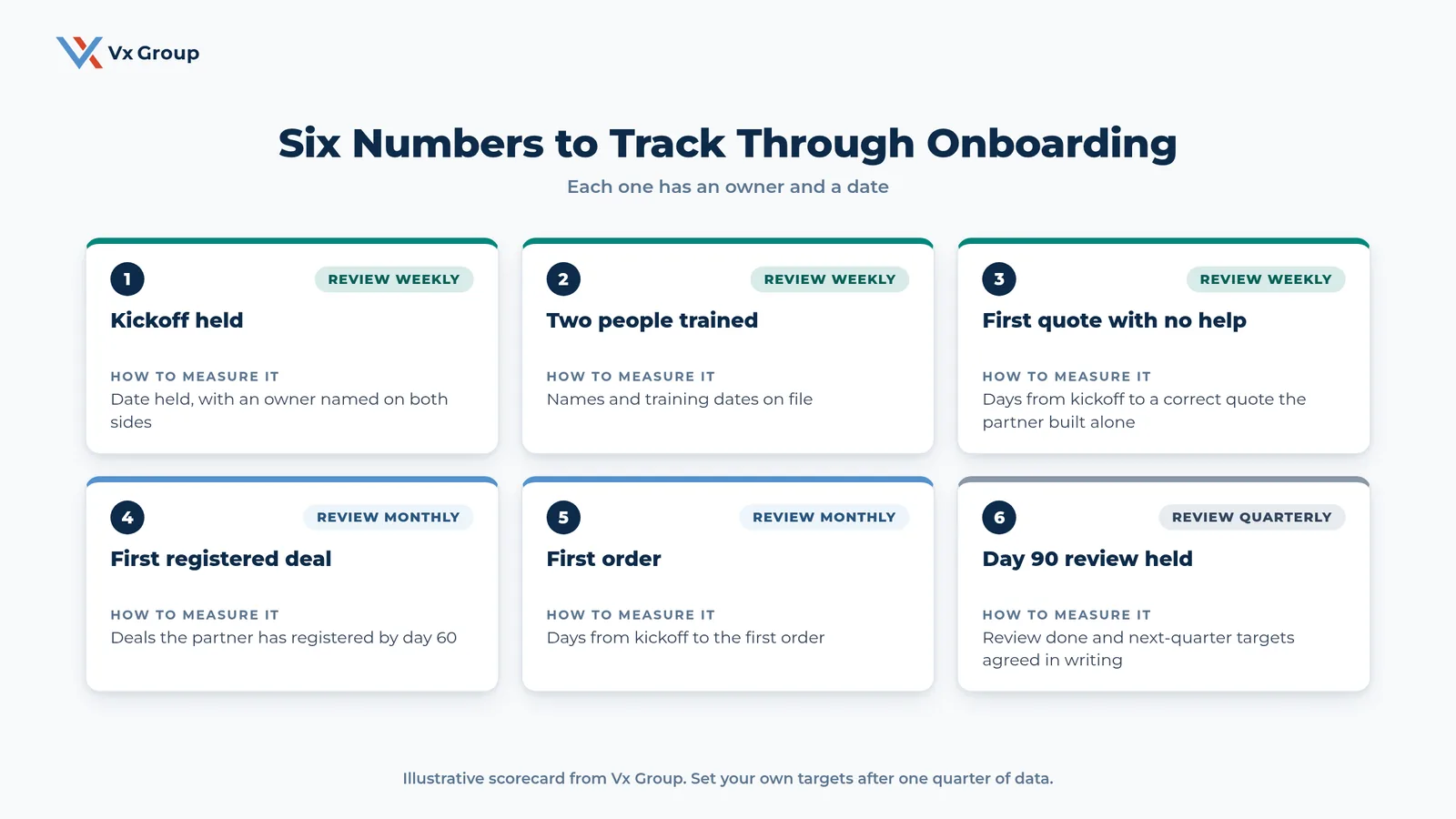
The scorecard lists the six numbers and how often to review each. The first three are checked weekly during the first month. The registered deal and the first order are checked monthly. The day 90 review is held once a quarter after that.
Set targets after you have a quarter of data. A target set before you know your own sales cycle is a guess. Here is how to read the numbers:
- Days to first quote with no help. A short number means the training works. A long number means the products or the price list are too hard to learn.
- Days to first order. This number depends on your sales cycle. A partner selling a custom machine takes longer than one selling filters.
- Partners that reach a first order by day 90. Divide that count by the partners you onboarded. Track the ratio each quarter.
Keep the scorecard on one page. If you cannot read it in a minute, it will not get used.
How does onboarding differ for distributors, dealers, and reps?
Onboarding differs for distributors, dealers, and reps in what you teach first and what counts as the first win. The five steps stay the same. A distributor needs product and stocking knowledge, a dealer needs setup and service training, and a rep needs application knowledge.
| Partner type | Train first | First win to aim for |
|---|---|---|
| Distributor | Product range, part numbers, stocking program | First stocking order or first quote to an end customer |
| Dealer | Setup, installation, and service | First installed unit or first service call |
| Manufacturer’s rep | Applications and customer problems | First qualified opportunity from a customer you named |
Distributor onboarding often needs a stocking decision in the first 30 days. Agree on which items the distributor will carry and how you will help sell them through. Your distributor agreement sets the legal terms, and the plan sets the work.
Dealers need hands-on practice. Plan a visit or a plant tour in the first 60 days. Our guide to dealer engagement covers what keeps a dealer active after onboarding ends.
Reps need to understand your customer’s problem before they learn your catalog. Spend the training on the five applications that win most often.
How many channel partners should a manufacturer start with?
A manufacturer should start with as many channel partners as it can onboard at the same time with a named owner for each. For many manufacturers in the $5M to $50M range, that means two to five partners, and the number can grow as the plan proves itself.
Each partner takes real hours in the first 90 days. Plan on a kickoff, training, a joint call, quote reviews, and a review meeting. One relationship owner can usually carry a few partners at once before the quality of attention drops.
Start with fewer partners than feels right. Run the plan, measure it, and fix what breaks. Then add the next group. A manufacturer that signs 20 partners in one quarter and onboards none of them ends up with the problem this guide describes.
Match your partner count to your channel plan. Our guide to building a channel partner program covers how many tiers and partners fit a company your size.
What mistakes make channel partner onboarding fail?
Channel partner onboarding fails when a manufacturer skips the owner, trains too many people, delays the first customer call, or skips the review. These mistakes explain many of the partners that sign and then go quiet.
- Skipping the named owner. A partner with no person to call stops calling.
- Training a whole team at once. Large sessions feel productive and leave nobody able to quote alone.
- Waiting to join a customer call. The longer the partner waits, the less the line feels like a priority.
- Holding no review. Without a date to compare promises, a slow start becomes the normal pace.
- Sending leads to every partner. Give leads to the partners that passed the quote test. Others will waste them.
- Ignoring channel conflict. Two new partners chasing the same account in the first month damage trust fast. Our guide to channel conflict covers how to write the rules first.
Where should an owner start with channel partner onboarding this week?
An owner should start this week by listing every partner signed in the last three years. Mark which ones have sent a quote in the last 12 months. Then pick the next partner to sign or the best of the quiet ones, and fill in the milestone table with real names.
- Count signed partners and partners that quoted. Write both numbers down.
- Name your relationship owner. Pick one person for each partner.
- Fill in the milestone table with real names and dates.
- Book the kickoff within five business days.
- Pick the first two products you will teach and write the first quote test.
Channel marketing programs and a full distribution strategy matter, and both work better when partners already know how to sell.
Ready to grow?
Talk through your partner list with us and leave with a 90-day plan for the next one.
FAQs
About the Author: David Tisdale
