

Deal Registration for Manufacturers and Channel Partners

Deal registration is a process that lets a distributor, rep or dealer tell you about a specific sale before they quote it. You confirm it and protect it, usually with price protection, a set period of exclusivity and sales support. A good program takes five minutes to fill out, gets an answer in two business days and rewards the partner who found the deal.
TL;DR
- Deal registration protects the partner who found a deal from other partners and from your own sales team. In return, you see the deal early.
- Most programs fail because they are built for the manufacturer’s forecast. The form is long, approval is slow and the reward is thin, so partners register late or skip it.
- Step 1: decide what registration grants (price protection, exclusivity, deal support) and write it down by partner tier.
- Step 2: use a five-field form that takes under five minutes.
- Step 3: promise an approval time, such as two business days, and keep it.
- Step 4: set the registration window and a renewal rule for long projects.
- Step 5: track registration rate, days to register, approval turnaround and the win rate gap.
A distributor calls your sales manager on a Thursday. They found a plant that needs 40 of your units and they want to know if anyone else is working it. Your manager says, “Send me an email.” The email goes out Friday. Nothing comes back until the following Wednesday.
By then the distributor has quoted the job, and so has another distributor you also sell through. Now you have two partners, one buyer and a price fight you started yourself.
We see this pattern in manufacturers that sell through distributors, reps and dealers. The program exists on paper. Partners don’t use it. The owner has no clear view of what the channel is working on.
This guide is for owners and presidents of privately held manufacturers, roughly $5M to $50M in revenue, who sell at least part of their product through partners. It covers how to build a deal registration program in five steps. It also shows how to measure whether partners use it.
What is deal registration, and what does it protect?
Deal registration is a formal way for a channel partner to claim a specific sales opportunity with a manufacturer. The partner submits the buyer, the product and the timing. The manufacturer approves it and agrees to protect the deal for a set period. People also call it deal reg, partner deal registration or a deal registration program.
Defined Term: Deal registration.
A short record a partner files with a manufacturer for one specific opportunity. If approved, it gives the partner protection on that deal, such as price protection or exclusivity, for a set time.
A registration protects three things:
- The partner’s work. A distributor who spent three weeks with a plant engineer does not want a second distributor to walk in with a lower price.
- Your margin. Without protection, partners cut price against each other to win the same deal. You pay for it in lower margin.
- Your relationship with the buyer. A buyer who gets two quotes for the same product from two of your partners starts to wonder who they are dealing with.
Search results for this topic come mostly from software and IT channel programs. Those programs run through partner portals and registration forms built for large vendors. A manufacturer with a handful of distributors and a few dozen reps needs something simpler. You need a short form, a clear rule and a person who answers quickly.
Deal registration is closely tied to channel conflict, where partners and your own team compete for the same account. We cover that in our guide to channel conflict. Registration is the main tool for keeping that conflict small.
Why do partners skip deal registration programs?
Partners skip deal registration when it costs them more than it gives them. A long form, a slow answer and a thin reward teach partners that registering is a chore. They register at the quote stage or not at all, and you lose sight of the deals you built the program to see.
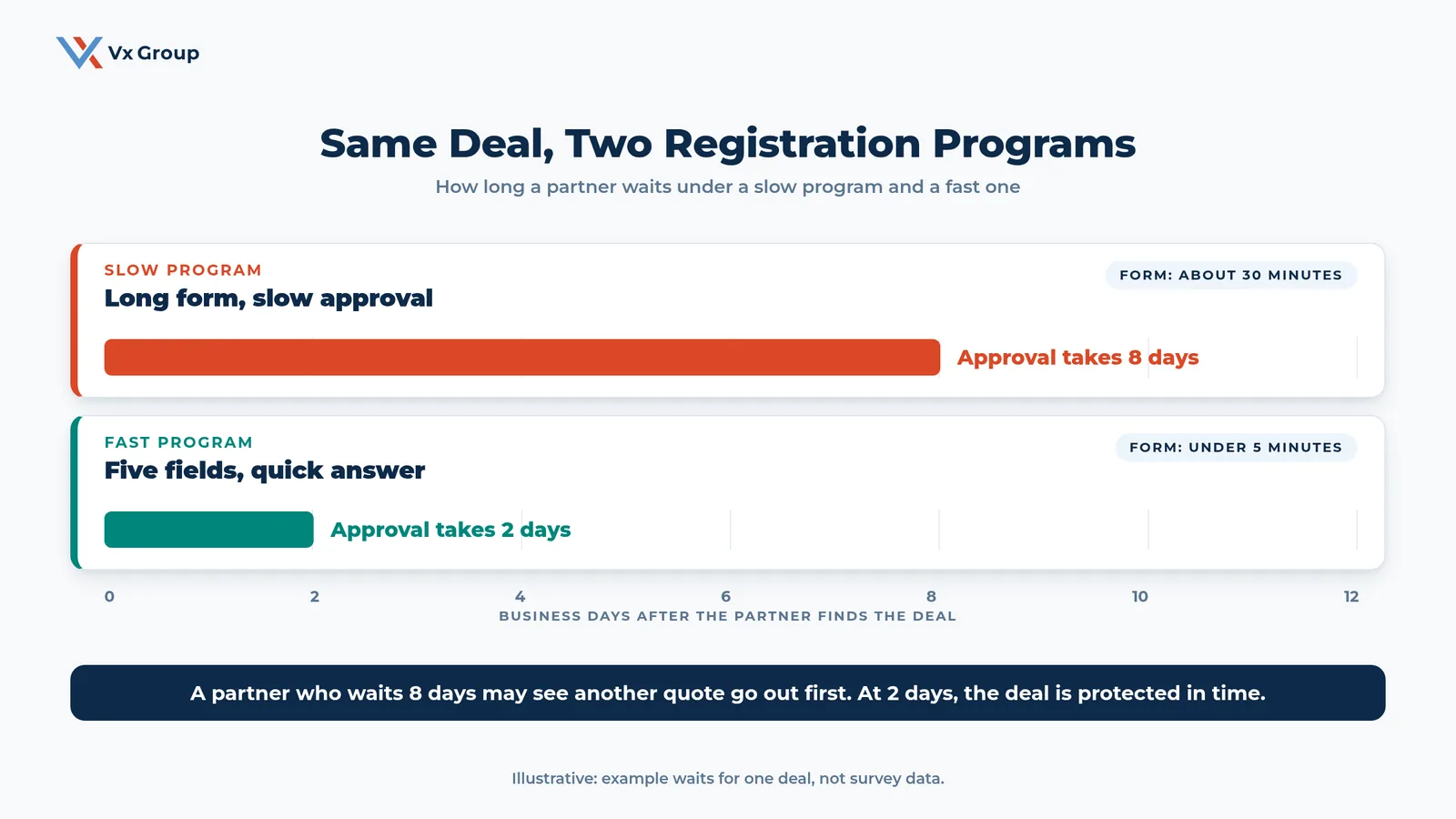
The graphic compares two programs on the same deal. In the slow program, the form takes about 30 minutes and approval takes 8 business days. In the fast program, the form takes under 5 minutes and approval takes 2 business days. The numbers are examples. They do not come from a survey.
The cause is usually who designed the program. The manufacturer wanted “forecast visibility,” so the form asks for everything a CRM would hold. Pipeline stage, competitors, budget, decision makers and a project summary all end up on the form. The partner, who is paid on the sale, sees 30 minutes of typing with no guarantee of an answer.
Four things push partners away:
- A long form. Every extra field is a reason to wait until the deal is nearly won.
- A slow answer. A partner who waits a week for approval has already been undercut once and won’t wait again.
- A thin reward. If approval changes nothing about price, support or lead protection, there is nothing to register for.
- Unclear rules. When partners can’t tell what registration grants or how long it lasts, they assume the worst.
Fix those four and registration rises without a mandate. The five steps below fix them in order.
How do you decide what deal registration grants a partner?
Step one is to decide what an approved registration gives the partner and write it down. Partners register when the reward is clear and worth the effort. The grant should be specific enough that a partner can say what they get before they fill out the form.
Choose from three possible grants
Most manufacturers offer some mix of these three:
- Price protection. The partner gets a better price or a guaranteed margin on this deal, and no other partner can quote below it.
- Lead exclusivity. No other partner, and no one on your own team, can work this buyer on this opportunity for a set period.
- Deal support. The partner gets help with the deal, such as an engineer on a site visit, samples, a custom quote or a joint call with the buyer.
Pick the ones you can deliver every time. A grant you can’t honor does more damage than no grant. If your sales team will not stay out of a registered account, don’t promise exclusivity.
Set the grant by partner tier
Different partners earn different protection. A distributor who stocks your product and trains their staff should get more than a dealer who orders twice a year. The table below shows one way to set it. Change the numbers to fit your margins and your sales cycle.
| Partner tier | Price protection | Exclusivity window | Deal support |
|---|---|---|---|
| Strategic distributor | Best registered price, held for the full window | 120 days | Engineer, samples and joint calls |
| Active distributor | Standard registered price | 90 days | Quote help and samples |
| Occasional dealer | Standard price, no extra discount | 60 days | Quote help on request |
Write the table into your partner agreement or your program guide. Partners should see it before they register. For how this fits into the wider partner relationship, see our guides to the channel partner program and the distributor agreement.
Ready to grow?
If your partners register late or skip it, we can help you find out why and rebuild the program around how they actually sell.
How do you build a deal registration form that takes under five minutes?
Step two is to cut the form down to the questions that change a decision. A deal registration form should take under five minutes. Five fields cover what you need to approve the deal, protect it and match it to the right support.
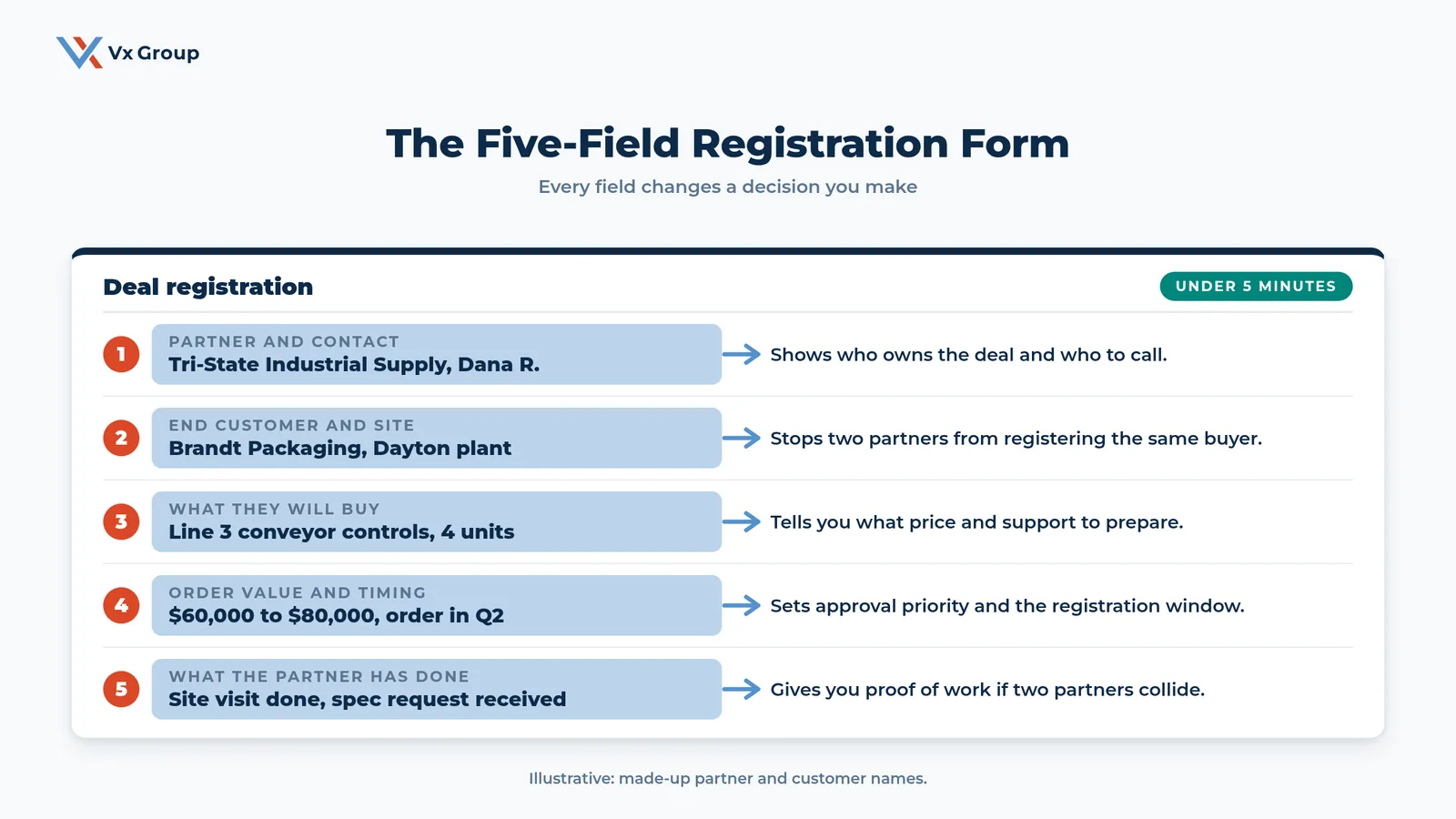
The graphic shows the five fields with made-up example entries. Each field is paired with the decision it supports. Partner and contact tells you who owns the deal. End customer and site stops two partners from claiming the same buyer. What they will buy tells you what price and support to prepare. Order value and timing sets approval priority and the window. What the partner has done gives you proof of work if two partners collide.
Ask the five questions
Use these five fields, in this order:
- Partner and contact. Company name and the person who owns the deal.
- End customer and site. The buyer’s company name and the plant or location.
- What they will buy. Product line and rough quantity.
- Order value and timing. A range and the quarter the order is expected.
- What the partner has done. One line, such as “site visit complete” or “spec request received.”
Cut every field that does not change a decision
For each field on your current form, ask what you do differently depending on the answer. If the answer is nothing, remove the field. Common fields to drop include a full project description, a list of competitors, budget approval status and a decision maker map. You can learn those things on the first joint call.
Put the form where partners already work. A short web form, an email template or a form inside your order system all work. A partner portal with a separate login adds a barrier.
How fast should you approve a deal registration?
Step three is to set an approval time and keep it. Approval speed is the biggest driver of partner adoption. Two business days is a workable promise for most manufacturers. A partner who gets a yes in two days registers the next deal at first contact.
Put the turnaround in writing
State the promise on the form and in the program guide: “You will hear from us within two business days.” Track it every week. If you miss it, the partner learns that registration is optional for you too.
Name the approver and a backup
One person owns approvals. A second person covers when the first is traveling or out. Without a named owner, registrations sit in a shared inbox that everyone assumes someone else is watching.
Decide what a conflict looks like
Most registrations are clear. A few land on a buyer another partner already registered. Write the rule before it happens: the first complete registration wins, unless the earlier one has expired. When two arrive within a day, the partner with more documented work on the deal wins. Tell both partners the outcome and the reason.
Your own team needs a rule too. If a salesperson is already working that buyer, the registration still goes through your approver. Partners need to see that the rules apply to your people as well. Our guide to channel sales strategy covers how to set that up.
How long should a deal registration last, and how do you renew it?
Step four is to set the registration window and a renewal rule. The window is the length of time a registration protects the deal. Match it to the length of your sales cycle. A window that is too short expires before the deal closes. A window that is too long lets partners park registrations and block others.
Set the window by sales cycle
A simple rule is to set the window at about the length of your typical sales cycle, plus 30 days. If your orders close in 60 days, a 90 day window works. If your engineered jobs take six to nine months, use 180 days for those product lines. Different product lines can have different windows.
Write the renewal rule for long projects
Long projects need a way to renew. Allow one renewal, and ask for proof of activity: a meeting, a quote revision, a site visit or a spec update. Without that rule, partners register once and wait. With it, the registration stays tied to real work.
Decide what happens when a registered deal closes late or changes
Say what happens in three cases: the deal grows, the deal moves to a different product and the buyer goes quiet. Most manufacturers handle these with a short note from the partner and a quick check by the approver. Keep the process light. A heavy change process sends partners back to registering at the last minute.
Registration also shapes how you pay partners for effort. If you fund partner marketing or promotions, see how market development funds can reward registered deals. For how partners are trained to run these deals, see our guide to partner enablement.
How do you measure whether partners use deal registration?
Step five is to track four numbers every month. Registration rate, days to register, approval turnaround and the win rate gap show whether partners trust the program. Track each one by partner and by tier, because an average across all partners hides the ones who stopped registering.
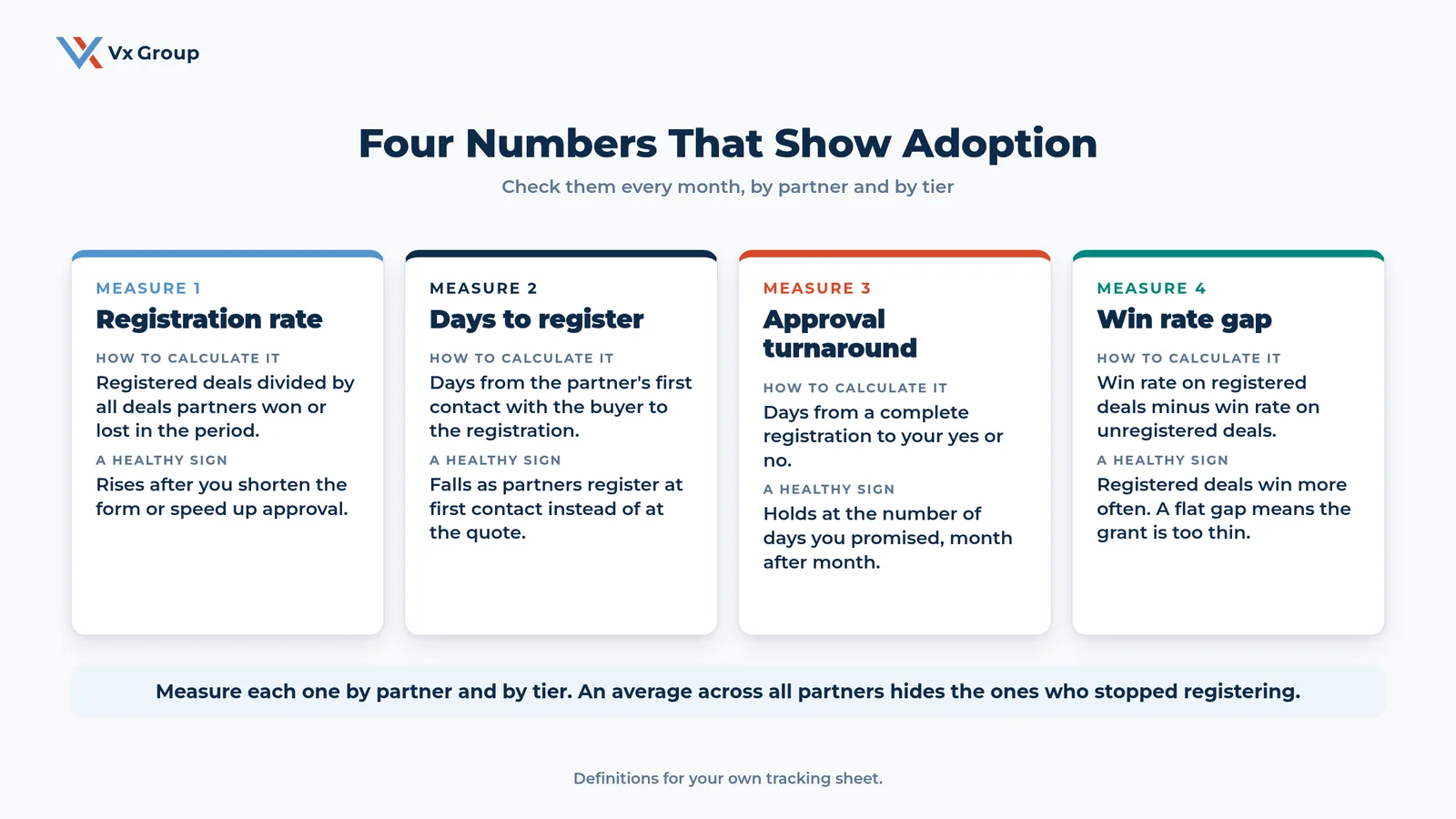
The graphic lists the four measures with how to calculate each one and what a healthy program shows. Registration rate is registered deals divided by all deals partners won or lost. Days to register is the time from first contact with the buyer to the registration. Approval turnaround is the time from a complete registration to your answer. The win rate gap compares win rates on registered and unregistered deals.
Track the registration rate
Divide the deals partners registered by all the deals partners won or lost in the same period. Ask partners to report unregistered wins and losses. You can also pull orders from your order system and compare them with the registrations on file. A rising rate after you shorten the form tells you the change worked.
Track the days from first contact to registration
Ask partners for the date they first spoke with the buyer. Compare it with the registration date. A short gap means partners register early. A long gap means they register at the quote or the order. If the gap is long, the form or the answer time is still a problem.
Track approval turnaround
Count the days from a complete registration to your yes or no. You control this number, and the partner does not. If it drifts above what you promised, fix it before looking at partner behavior.
Compare win rates on registered and unregistered deals
Subtract the win rate on unregistered deals from the win rate on registered ones. Registered deals should win more often, because partners who register tend to be the ones doing real work and getting real support. If the gap is flat, the grant may be too thin to matter.
What mistakes sink a deal registration program?
Deal registration programs fail in predictable ways. Most come from design choices made for the manufacturer’s convenience. Check your program against this list.
- Asking for too much. Each extra field slows partners down. Keep to five.
- Answering slowly. Missing the promised turnaround once or twice is enough for partners to stop trusting it.
- Promising what you can’t deliver. Exclusivity means your own sales team stays out too.
- Using registration as a forecast tool only. If partners sense that the point is to report to you, they report less. Visibility follows from a program that protects them.
- Skipping the conflict rule. The first time two partners collide with no written rule, you lose one of them.
- Never reviewing the data. A program that nobody measures goes stale in a year. Review the four numbers monthly.
How do you launch a deal registration program in 30 days?
You can launch a simple program in 30 days if you keep it small. Start with your top five to ten partners, and add the rest after the first month.
| Week | What to do | Output |
|---|---|---|
| Week 1 | Decide the grants and the tier table | One-page program guide |
| Week 2 | Build the five-field form and name the approver and backup | Live form and approval owner |
| Week 3 | Walk your top partners through the program on a call | Partner feedback and edits |
| Week 4 | Open registration and start tracking the four measures | First weekly turnaround report |
Run the first call with partners as a conversation. Ask what would make them register at first contact. Their answers will tell you which grant matters most and which field they hate. For how to keep partners engaged after launch, see our guide to distributor management.
Where should an owner start this week?
Start by reading the last five registrations you received, or the last five deals your partners told you about informally. Time how long each took from first contact to your answer. That number shows you where the program stands today, and it costs nothing to find out.
Then pick the single biggest barrier. For most manufacturers it is the approval time. Promise a two business day answer, name an approver and a backup, and tell your top partners. That one change often does more than a new form or a new portal.
Deal registration works best when it sits inside a clear channel strategy. If you are still deciding how your partners fit together, start with our overview of B2B channel strategy and our guide to what a channel partner is.
Ready to grow?
Bring us your partner agreement and your current form, and we will show you where partners are dropping off.
FAQs
About the Author: Jacob Camhi
