

Channel Marketing Programs: What Manufacturers Should Build for Distributors and Reps

A channel marketing program is the set of tools, plans, and routines a manufacturer gives its distributors and reps so they can sell its products. A working program has five parts: partner tiers, a short kit of ready-to-use assets, joint planning with the partners who matter most, one owner at the factory, and measures of partner activity.
TL;DR
- Most channel marketing programs go unused. The manufacturer builds a portal, a catalog, and a logo kit, and partner salespeople keep selling whichever line is easiest to quote.
- Build the program in five steps: tier your partners, give them a short asset kit, plan jointly with your Core partners, name one owner, and measure partner activity.
- Tier partners on two measures: the revenue they produce or could produce, and how well they know your company.
- Keep the asset kit to about seven pieces that a partner salesperson can find and use in under five minutes.
- Measure the program by what partners do with it: joint calls, quotes, trained salespeople, and new end customers.
Most manufacturers that sell through distributors and reps have built some version of a channel marketing program. There is a partner portal, a product catalog, a folder of logo files, and a co-op claim form. Ask the regional manager how many partner salespeople used any of it last quarter, and the honest answer is usually a handful.
Partner salespeople carry dozens of lines, sometimes hundreds. They sell the products that are easiest to explain, quote, and stand behind, and they call the manufacturers whose people they know. A program built around the manufacturer’s catalog and logo misses both of those facts, so it gets built and announced, then ignored.
Most of what you will find online about channel marketing programs is written for software companies selling through resellers, with partner portals, deal registration, and automated campaign tools at the center. A manufacturer’s channel works differently. The distributor’s salesperson is standing in a plant or at a parts counter, and the program has to work from a phone, an email, and a relationship with someone at your factory.
This guide is for owners and sales leaders at manufacturers that already sell through a channel. If you are still deciding how distributors, reps, and direct sales should fit together, start with our guide to channel marketing for manufacturers and distributors. This article picks up from there and covers the program itself: what goes in it, which partners get what, who runs it, and how to tell whether partners are using it.
What is a channel marketing program?
A channel marketing program is the packaged, year-round support a manufacturer gives the distributors and reps who sell its products. It spells out which partners get which level of help, which sales and marketing assets they receive, how the two companies plan together, how co-op money gets spent, and how the manufacturer measures the result.
Defined Term: Channel marketing program.
The defined set of partner tiers, sales and marketing assets, joint planning routines, funding rules, and measures a manufacturer uses to help distributors and reps sell its products, managed by one owner at the manufacturer.
Four related terms get mixed up often. They describe different pieces of the same channel, and each one has its own guide:
| Term | What it covers | Where to read more |
|---|---|---|
| Channel marketing program | The support and marketing a manufacturer runs for its partners: tiers, assets, joint plans, co-op funds, and measures | This article |
| Channel partner program | The business terms of the partnership: discounts, territories, tiers, minimums, and agreements | How to Build a Channel Partner Program |
| Channel partner marketing | The broader practice of marketing with and through partners | Channel Partner Marketing |
| Through-channel marketing | Marketing the partner runs to its own customers with the manufacturer’s content and funds | Step 2 below |
In practice, the partner program sets the deal and the marketing program decides whether partners act on it. A generous discount structure with no program behind it tends to produce partners who carry your line and rarely lead with it.
Why do most channel marketing programs go unused?
Most channel marketing programs go unused because they are built around what the manufacturer wants to say. They come in the format the manufacturer finds easiest to produce, and every partner gets the same thing. A partner salesperson has a few minutes for your line in a busy day. The program has to fit inside those minutes.
The same five patterns show up in most channels:
- The assets are built for the catalog. A complete catalog serves the manufacturer’s product managers. A partner salesperson needs one page that says which problem your product solves and for whom.
- Every partner gets the same program. Your largest distributor and a rep firm that placed two orders last year receive the same portal login and the same newsletter.
- The portal requires a login. Partner salespeople work from email, their phone, and their own ERP system. A portal behind a password is one more system they will skip.
- Nobody at the factory owns it. Marketing builds the assets, channel sales managers own the partner relationships, and the program falls between them.
- Success is counted by output. The program reports how many assets were produced and how many portal logins occurred, and nobody checks whether partners quoted more of your product.
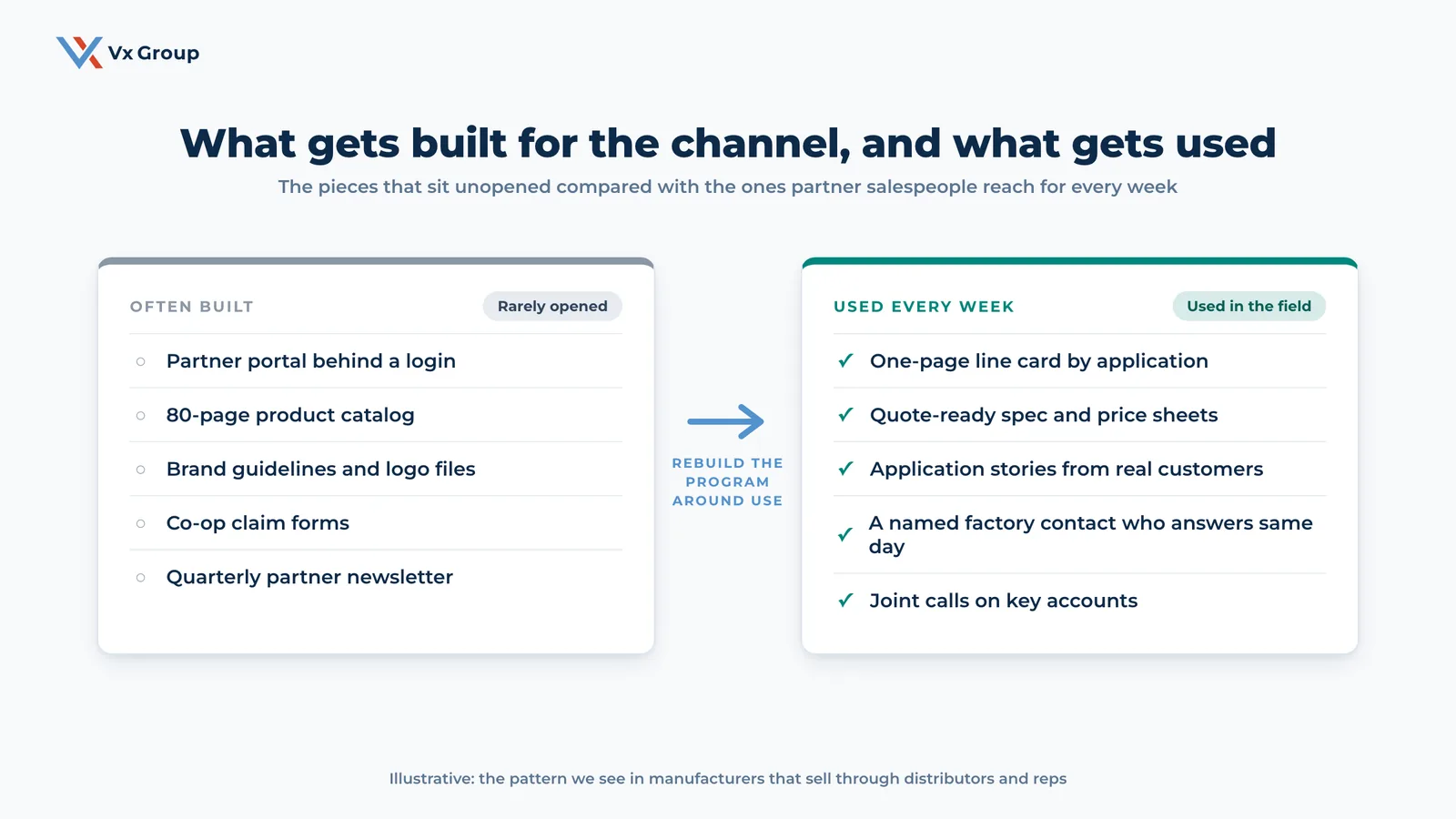
Each of these is fixable with work a manufacturer already knows how to do. The five steps below rebuild the program around the partners who sell the most and the people at those partners who do the selling.
Step 1. How do you segment distributors and reps for a channel marketing program?
Segment partners on two measures: the revenue they produce or could produce for you, and how well they know your company. Then sort them into four tiers. Each tier gets a different level of program support. Most manufacturers find that a small group of partners deserves most of the program’s time and money.
Rank every partner by revenue and territory potential
Export three years of sales by partner from your ERP. Add a column for territory potential: the share of your target market inside that partner’s territory, or a simple high, medium, or low call from the regional manager who covers it.
Sort by current revenue first. Then flag every partner with high potential and low current revenue. A program can change the numbers fastest with those partners.
Score how well each partner knows you
Give each partner a relationship score using four yes-or-no questions:
- Do people at the partner, beyond the owner and the purchasing desk, know someone at your company by name?
- Have you made a joint call on an end customer together in the last six months?
- Can their outside salespeople describe your top three applications without looking them up?
- Do they call your factory contact before quoting a competitor’s product?
Score the partner 1 for zero yes answers and 5 for four. The score takes a regional manager about two minutes per partner, and it is usually the first time anyone has written it down. Our guide to distributor management covers ranking a distributor network by relationship quality in more depth.
Sort partners into four tiers
Use the revenue ranking and the relationship score together:
- Core: high revenue or high potential, with a strong relationship. These partners get the most support and a written joint plan.
- Growth: high potential with a weak relationship. The work here is building the relationship through training, ride-alongs, and a named regional manager.
- Maintain: steady revenue in a limited territory. They get the full asset kit and a yearly check-in.
- Self-serve: low revenue and low potential. They get access to the kit and support from inside sales.
Write down what each tier receives
Put the tiers on one page with what each one gets: the joint plan, the factory contact, visits, co-op or market development funds, training, and the asset kit. The matrix below is a starting point.
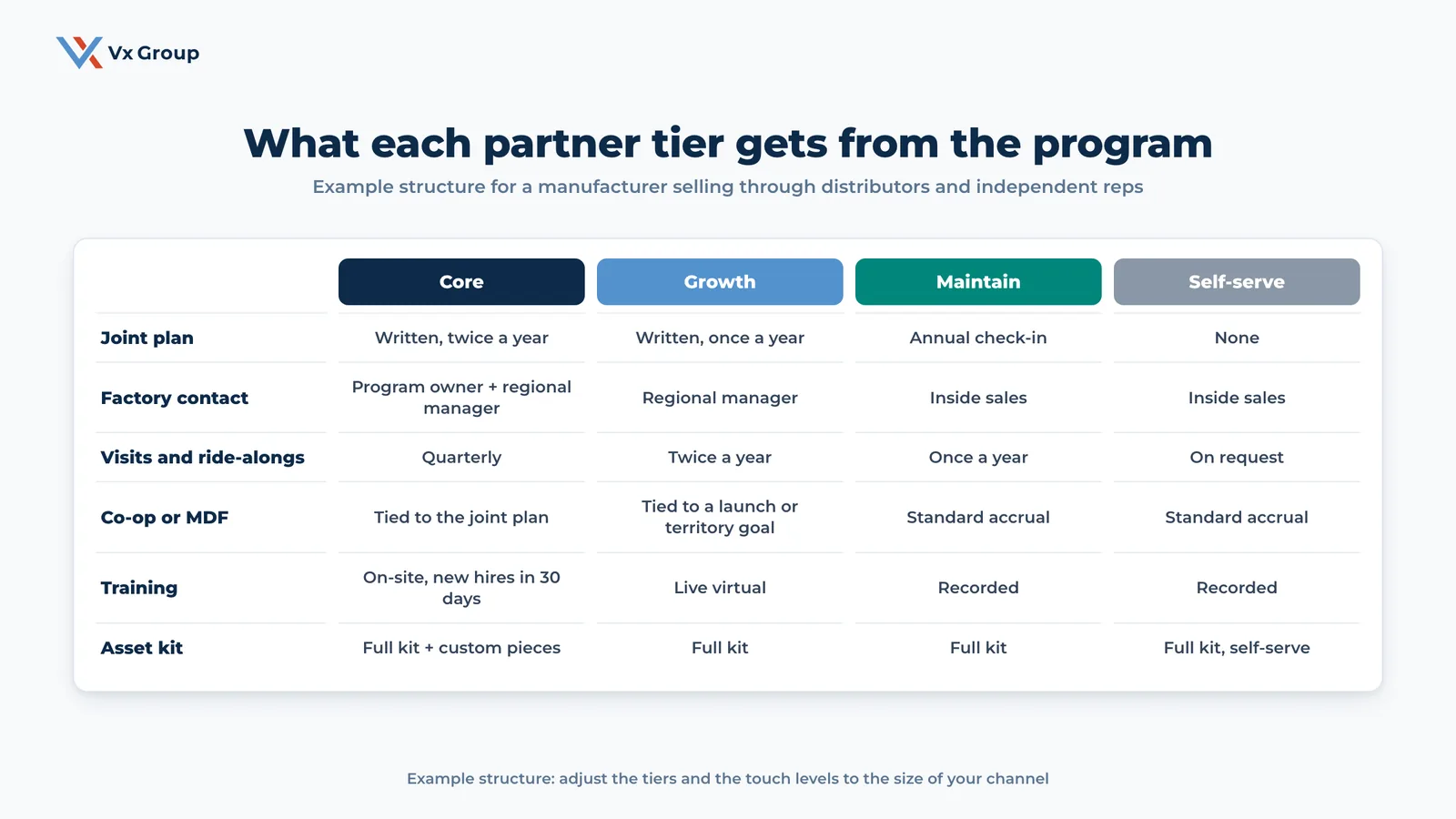
Adjust the touch levels to the size of your team. A manufacturer with two regional managers cannot visit forty Core partners every quarter, so keep the Core tier small enough to serve well.
Re-tier partners twice a year
Partners change. A Growth partner that hired two new salespeople and started quoting your line in spring may be a Core partner by fall. Re-score every partner twice a year, and share the tier criteria with your partners so each one knows what it takes to move up.
Step 2. What assets should a channel marketing program give partners?
Give partners a kit of about seven assets that a partner salesperson can find and use in under five minutes, built from what partner salespeople say they used last quarter. A short kit that gets used will sell more of your product than a large library that sits in a portal.
Ask ten partner salespeople what they used last quarter
Before building anything, call ten outside salespeople at your Core and Growth partners and ask three questions:
- What did you send a customer about our product last quarter?
- What did you wish you had in front of a customer?
- What did we send you that you never opened?
Write down their answers word for word. The calls take about two days, and they keep you from spending a year building assets nobody asked for.
Build the seven-piece kit
Most manufacturers can cover what partner salespeople need with seven assets:
| Asset | What it is | When partners use it |
|---|---|---|
| One-page line card by application | Which problem each product solves, for which industry, with one proof point | The first conversation with an end customer |
| Spec and price sheets | Current specs, list prices, lead times, and part numbers in one file | Quoting |
| Application stories | Three to five short stories from real end customers, sorted by industry | When a customer asks who else uses the product |
| Product data for partner catalogs | Clean images, specs, and attributes in the format the partner’s ERP and website need | Loading your line into their systems |
| Short product training | A 15-minute recorded walkthrough, plus a live session for new partner salespeople | Onboarding a new partner salesperson |
| Co-brandable email and web content | Two or three ready-to-send emails and one web page the partner can put its name on | Through-channel campaigns |
| Trade show and counter kit | A small display, samples, and a one-page handout | Local shows, open houses, and walk-in counters |
Write application stories a partner can retell in two minutes
Partner salespeople repeat stories they can remember. Write each application story in four short parts:
- The customer: industry, size, and the role that brought you in, with the customer’s name if they have agreed to it.
- The problem: what was costing them money or time, in their words.
- What changed: the product, how it was applied, and who from the partner and the factory was involved.
- The result: one number the customer would confirm, such as hours of downtime saved or a longer replacement interval.
Keep each story under 200 words, and include the partner’s role whenever a partner was involved. Partners share the stories that make them look good to their own customers.
Make every asset usable in under five minutes
Every asset should open on a phone, carry the partner’s name where that makes sense, and be editable without design software. Send assets the way partners already work: by email, as a shared folder link, and as data loaded into their catalog. A portal can hold the master copies, as long as partners can get everything without logging in.
Load your product data into each partner's systems
For many distributors, the most useful thing a manufacturer can send is clean product data. Distributors sell from their own ERP and e-commerce catalogs, and a line with missing images, incomplete specs, or outdated part numbers is harder to find and harder to quote. Ask each Core partner what format their catalog team needs, and deliver it on their schedule.
Run through-channel campaigns with Core partners
Through-channel marketing puts your content in front of the partner’s customers under the partner’s name.
Defined Term: Through-channel marketing.
Marketing a partner runs to its own customers using the manufacturer’s content, and often the manufacturer’s co-op or market development funds. The partner’s name and customer relationships carry the message, and the manufacturer supplies the material and some of the money.
Start with two campaigns a year per Core partner, each tied to a target industry from the joint plan in Step 3. A distributor’s email to its own customer list carries more weight than anything you could send those customers directly. The distributor already holds the relationship.
Retire what nobody uses
Every six months, list each asset with how often partners requested or downloaded it and whether any partner salesperson mentioned it. Cut or rebuild anything that went unused for two review cycles. A smaller kit is easier to keep current, and accurate specs, prices, and lead times matter more to a partner salesperson than a polished brochure.
Ready to grow?
We help manufacturers build channel programs around the partners and relationships that already sell the most, with an owner and a scorecard both sides can see.
Step 3. How do you run joint planning with your most important partners?
Run joint planning by meeting each Core partner twice a year to write a one-page plan with named target accounts, three actions, who does what, and the numbers both companies will check. Joint planning ties your assets and your co-op money to accounts the partner is already working. That is where the program starts to show up in revenue.
Hold a 90-minute planning meeting twice a year
Invite the partner’s owner or branch manager, their outside sales lead, your regional manager, and your program owner. Use the same agenda every time:
- Last six months (20 minutes): sales of your line against the last plan, by product family.
- Their market (20 minutes): which end customers are growing, which are at risk, and which competitors are winning.
- Target accounts (25 minutes): ten end customers where your line should be growing.
- Actions and support (20 minutes): what each company will do, and which assets or funds support it.
- Numbers and dates (5 minutes): what both sides will check at the next quarterly call.
Write a one-page joint plan
Keep the plan to one page so both sides actually reread it before the quarterly check-in. It needs five sections:
- Target accounts: the ten end customers, with the partner salesperson who owns each one.
- Three actions: for example, a joint call on each of the top five accounts, one through-channel email campaign, and one lunch-and-learn at the partner’s branch.
- Owners on both sides: a name at the partner and a name at your company for every action.
- Funding: the co-op or market development funds committed to each action.
- Numbers: quotes, new end-customer accounts, and revenue on your line for the next six months.
Tie co-op and market development funds to the plan
Defined Term: Market development funds (MDF).
Money a manufacturer sets aside to pay for marketing a partner runs to sell the manufacturer’s products, such as local events, advertising, or customer training. Co-op funds work in a similar way and usually accrue as a share of each partner’s purchases.
Approve funds against actions in the joint plan first. Requests that fall outside the plan go through a short standard form with a clear dollar limit. Put both rules in your distributor agreement so partners know them before the first request. Funds tied to named accounts and named actions are much easier to measure than funds spent on whatever the partner proposes at the end of the quarter. Partners usually prefer the clarity.
Hold a 30-minute check-in each quarter
Between planning meetings, hold one quarterly call on the plan’s numbers and make at least one joint call on a target account. Joint calls are where partner salespeople learn your product well enough to sell it on their own, and where end customers meet someone from the factory. Our guide to dealer engagement covers how to keep that contact going between plans.
Step 4. Who should own a channel marketing program?
One named person at the manufacturer should own the channel marketing program: the tiers, the asset kit, the joint planning calendar, the funds, and the scorecard. In a smaller manufacturer, that is often the sales leader or a marketing manager who spends about half their time on the channel.
Channel sales managers and regional managers own the relationships with individual channel partners. The program owner makes sure each of those relationships has a working program behind it, and the two roles meet every month.
Write the owner's job in five lines
- Sets the tier criteria and re-tiers every partner twice a year.
- Builds and maintains the asset kit, and retires what goes unused.
- Keeps the joint planning calendar and attends every Core partner planning meeting.
- Manages co-op and market development funds against the joint plans.
- Reports the partner scorecard to leadership every quarter.
Meet monthly with the people who hold partner relationships
Hold a 45-minute monthly meeting between the program owner and the regional or channel sales managers. Review which partners moved up or down on the scorecard, which joint plan actions are behind, and what partners asked for that the kit does not cover yet. Our guide to channel sales strategy covers the regional managers’ side of that relationship.
Give the owner a budget and a calendar
Write the program budget in three lines: the asset kit, covering production and updates; funds, covering co-op and market development money; and people’s time, covering training, visits, and planning meetings. Then put the year’s planning meetings, re-tiering dates, and asset reviews on one calendar in January. That keeps the program going through the busy months.
Make partner onboarding part of the owner's job
New partners and new partner salespeople need the program most and get it least. Give the owner responsibility for a simple partner onboarding routine: the kit, a training session within 30 days, a named factory contact, and a first joint call within the first quarter. The habits a partner forms with your line usually take shape in those first 90 days.
Step 5. How do you measure a channel marketing program?
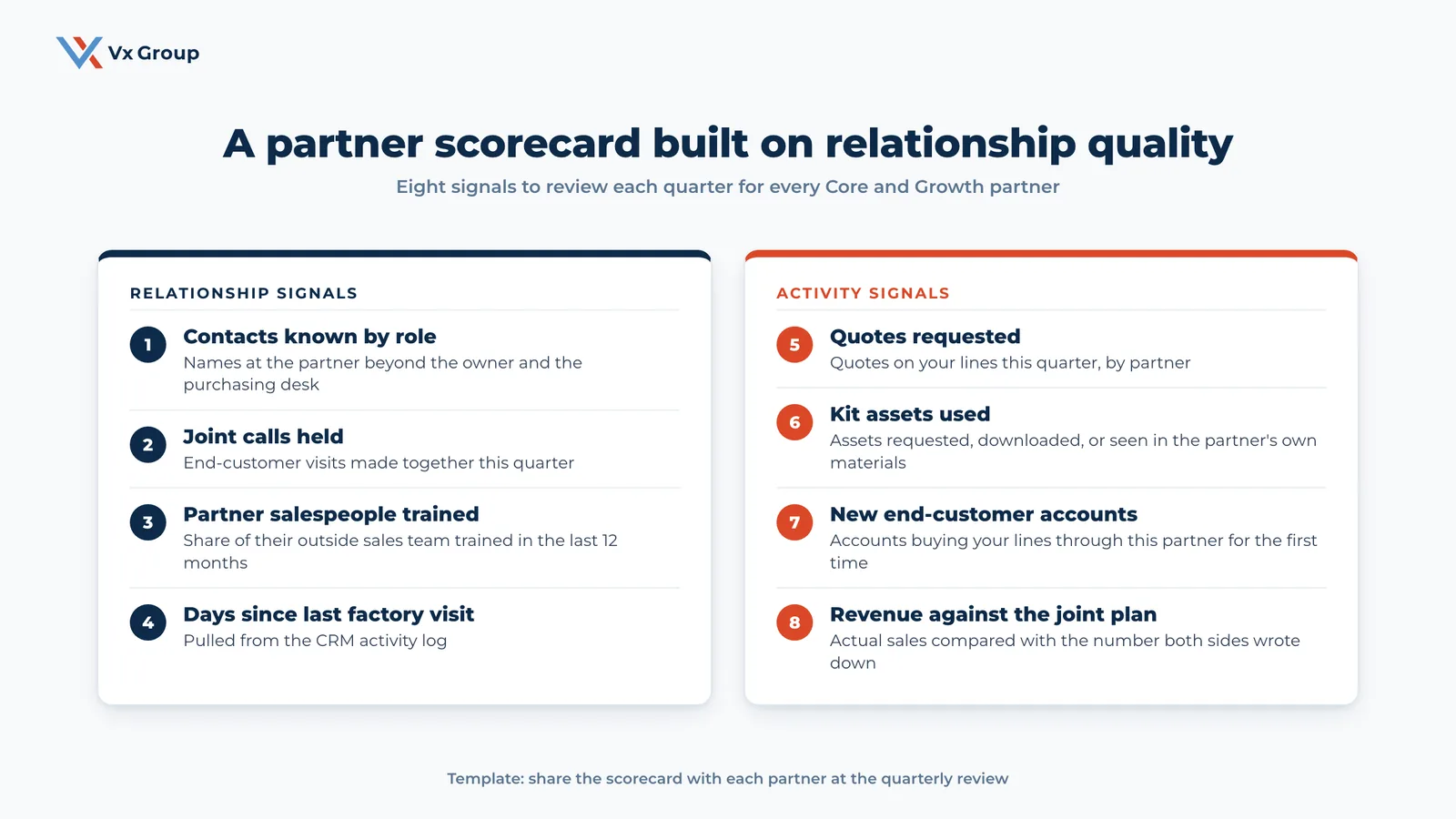
Measure a channel marketing program by what partners do with it, tracked by partner and by tier. Relationship signals usually move first. These are contacts known, joint calls, trained salespeople, and factory visits. Activity signals follow: quotes, assets used, new end customers, and revenue against plan. Partners who know the manufacturer best tend to sell the most.
Track four relationship signals for every Core and Growth partner
- Contacts known by role: the people at the partner, beyond the owner and purchasing, who know someone at your company by name.
- Joint calls held: end-customer visits made together this quarter.
- Partner salespeople trained: the share of their outside sales team trained on your line in the last 12 months.
- Days since the last factory visit: pulled from the CRM activity log.
These four are the earliest warning you will get. A partner whose contacts have shrunk to one buyer, with no joint calls in two quarters, is usually a partner whose quotes are about to fall.
Track four activity signals by partner and by tier
- Quotes requested on your lines this quarter.
- Kit assets used: assets requested, downloaded, or seen in the partner’s own materials.
- New end-customer accounts buying your line through this partner for the first time.
- Revenue against the joint plan: actual sales compared with the number both sides wrote down.
Report the totals by tier as well. If the Growth tier’s relationship signals rise for two quarters and its quotes follow, the program is doing its job.
Record a baseline before the program changes
Before the first joint planning meeting, record all eight signals for every Core and Growth partner as they stand today. Without a baseline, the first quarterly review turns into an argument about whether anything moved. A spreadsheet with one row per partner and one column per signal is enough for the first year.
Run a quarterly program review
Hold a 60-minute program review each quarter with the program owner, the sales leader, and the regional managers. Cover the scorecard by tier, the partners that moved up or down, asset usage, funds spent against results, and one change for next quarter.
Ask partners directly once a year
Once a year, ask your Core and Growth partners five questions, by phone or in a short survey:
- Which of our assets did your salespeople use this year?
- What do you need from us that you do not have?
- How fast does our factory respond when you call?
- What did a competing manufacturer do better than we did this year?
- What should we stop sending you?
Over the life of a partner relationship, a distributor whose salespeople know your products and your people adds far more revenue than any single campaign. The scorecard and the annual conversation are how you keep track of that value year after year.
What does a channel marketing program look like in the first year?
A first-year channel marketing program moves from ranking partners to running joint plans in about two quarters, and shows up in quotes and new end-customer accounts in the second half of the year. A realistic first year looks like this:
| Quarter | Program work | What you should see |
|---|---|---|
| Q1 | Rank and tier every partner; interview ten partner salespeople; name the program owner | A tier list and a short list of what partners actually need |
| Q2 | Build the seven-piece kit; load product data for Core partners; hold the first joint planning meetings | A written joint plan for every Core partner |
| Q3 | Quarterly check-ins and joint calls; first scorecard review; retire unused assets | More joint calls and trained partner salespeople |
| Q4 | Second planning meetings; re-tier partners; set next year’s budget from the scorecard | Rising quotes from Core and Growth partners |
Revenue follows the relationship signals by a quarter or two, and longer for products with long specification cycles. Give the program a full year before you judge it on revenue, and judge it on the relationship and activity signals in the meantime.
What are the most common channel marketing program mistakes?
The most common channel marketing program mistakes come from building for the manufacturer’s convenience and measuring what was produced.
- Building the portal first. A portal is a storage choice. Start with the ten partner interviews and the seven-piece kit, and decide later where to store them.
- Funding co-op with no plan attached. Co-op money spent on whatever a partner proposes at quarter end is hard to measure and easy to waste.
- Giving every partner the same program. Treating a top distributor and a two-order rep firm the same way underserves the first and overspends on the second.
- Measuring downloads and logins. Activity inside your own systems says little about whether partners quoted more of your product.
- Leaving the program without an owner. When marketing and channel sales share it, neither team runs it.
- Training once at signing. Partner salespeople turn over, and a partner trained three years ago may have nobody left who knows your line. Train new partner salespeople within 30 days of their start date.
Where to start this quarter
Start with the ranking. Export three years of sales by partner, add the four-question relationship score, and sort your partners into the four tiers. Then call ten partner salespeople at your Core and Growth partners and ask what they used last quarter.
Those two pieces of work take about two weeks. They tell you which partners the program is for and what belongs in the kit, which is most of what a manufacturer needs to know before spending anything on assets.
Ready to grow?
If your channel program gets built and then ignored, start with a conversation about your channel growth strategy and the partners who already sell the most.
Related posts
- Channel Marketing for Manufacturers and Distributors
- How to Manage a Distributor Network That Keeps Selling
- How to Build a Channel Partner Program That Actually Drives Sales
FAQs
About the Author: David Tisdale
