

Product Distribution Guide for B2B Manufacturers
Product distribution is how a manufacturer’s product gets from the plant to the buyer. A manufacturer can sell direct, through distributors, through dealers, or through sales reps. Each model sets who stocks the product, who serves the buyer, and who keeps the customer relationship. The right choice depends on the product, the order size, and how much service the buyer needs.
TL;DR
- Product distribution is the path your product takes to the buyer. Four models cover most manufacturers: direct, distributor, dealer, and rep.
- Match the model to the product. Order size, order frequency, and the amount of setup or service the buyer needs usually point to one model.
- The model you pick decides who holds the customer relationship. Distributors usually hold the most, and direct sales keep all of it with you.
- Most manufacturers use two or more models. Write territory and account rules before the second one starts.
- Choose partners by who they already sell to, how many of their people know your line, and what sales data they will share.
- A channel keeps growing only if you meet the partner’s people on a schedule, train them, and review results every quarter.
- Start this week with a one-page list of every product line, the model it sells through, and the end customers you can name.
Many manufacturers never chose their distribution. A distributor called in 2009, a rep offered to cover the Southeast, and a large customer asked for direct pricing. Each decision made sense at the time. Fifteen years later the company sells through five different arrangements and nobody wrote down why.
That pattern costs money in ways that are hard to see. Prices conflict across channels. Partners compete for the same account. The owner cannot name the end customers behind half the revenue.
This guide is for owners and presidents of privately held manufacturers with roughly $5M to $50M in revenue. It explains the main distribution models, how to match each one to a product, what each one costs, and how to keep the relationships healthy after the agreement is signed.
What is product distribution for a manufacturer?
Product distribution for a manufacturer is the set of arrangements that move a finished product to the people who use it. It covers who sells the product, who stores it, who ships it, who invoices the buyer, and who answers the phone when something goes wrong. Retail and logistics articles use the same phrase for shelf placement and freight. For a B2B manufacturer, it describes sales relationships.
Defined Term: Product distribution.
The arrangements a manufacturer uses to get a product to its buyers, including who sells it, stocks it, ships it, invoices for it, and supports it after the sale.
Distribution and sales are linked, but they are separate decisions. Sales is how you win an order. Distribution is the path the order and the product follow after you win it. A manufacturer can sell well and still distribute badly, which shows up as late deliveries, price disputes, and customers who do not know who to call.
Distribution also decides how much you learn about your market. A company that sells direct sees every order. A company that sells through a distributor sees the distributor’s order and little else.
Defined Term: Distribution model.
A repeatable way of selling and delivering a product, such as direct sales, a distributor, a dealer, or a sales rep. Each model sets a different split of work, margin, and customer contact between the manufacturer and the partner.
Why does product distribution matter to an owner-led manufacturer?
Product distribution matters to an owner because it controls three things the owner cares about: margin, customer knowledge, and how easily the company runs without the owner. Each distribution model shifts those three in a different direction, so the choice shapes the business for years.
- Margin. Every partner takes a share of the sale price. The share is worth paying when the partner does work you would otherwise pay for yourself.
- Customer knowledge. The party that invoices the buyer sees the orders, the reorder pattern, and the first signs that a customer is leaving.
- Owner dependence. Channels that run on the owner’s personal phone calls stop growing when the owner is busy or away.
Buyers of the business look at the same things. A company with documented partner relationships, written agreements, and known end customers is easier to understand and easier to value. A company that depends on one distributor and an unwritten handshake raises questions in the first meeting.
What are the main product distribution models?
The four main product distribution models for a B2B manufacturer are direct sales, distributors, dealers, and manufacturer’s reps. They differ in who owns the inventory, who invoices the buyer, and who holds the relationship. This table compares them side by side.
| Model | Who stocks the product | Who invoices the buyer | Who holds the customer relationship | Best fit |
|---|---|---|---|---|
| Direct | You | You | You | Large, custom, or technical orders |
| Distributor | The distributor | The distributor | Mostly the distributor | Standard products bought often |
| Dealer | The dealer | The dealer | Shared with the dealer | Products that need setup or service |
| Manufacturer’s rep | You | You | Shared, mostly you | Products sold by application knowledge |
Our guides to what a distributor is and what a channel partner is cover the partner types in more detail. The sections below explain when each model fits.
Choose direct when each order pays for the sales time it takes
Direct sales means your own people quote, sell, ship, and invoice. It fits products with large orders, long design phases, or custom specifications. A buyer who spends six months choosing a custom machine wants to talk to the maker.
You keep the full price and the full customer record. You also carry the full cost of the sales team, the travel, and the receivables. A direct model works when the average order is large enough to cover those costs with room left over.
Choose a distributor when buyers need stock close by
A distributor buys your product, stores it, and resells it. It fits standard products that buyers reorder often and want delivered fast. Think of fittings, filters, fasteners, and wear parts.
The distributor carries inventory and credit risk, so you ship in larger lots to fewer accounts. In return you give up part of the margin and most of the day-to-day customer contact.
Choose a dealer when the product needs setup or service
A dealer sells, installs, trains, and services equipment in a local market. It fits machines, systems, and vehicles that need a trained person on site. The buyer often values the dealer’s service as much as your product.
Dealers usually carry a smaller number of brands than distributors. That gives you more attention from each one. It also makes each dealer more important, because losing one can leave a territory empty. Our guide to dealer network strategy covers how to build and manage that channel.
Choose a rep when the sale depends on application knowledge
A manufacturer’s rep is an independent sales person or firm that sells your product for a commission. The rep does not own inventory. You build, ship, and invoice.
Reps fit products where the sale depends on knowing the buyer’s application, such as engineered components. They also help when you want coverage in a new region without hiring. The rep’s loyalty is split across several lines, so your product competes for attention.
How do you match a distribution model to a product?
You match a distribution model to a product by asking two questions about the product: how large and how frequent the orders are, and how much setup or service the buyer needs. The answers place the product in one of four groups. Each group points to a starting model.
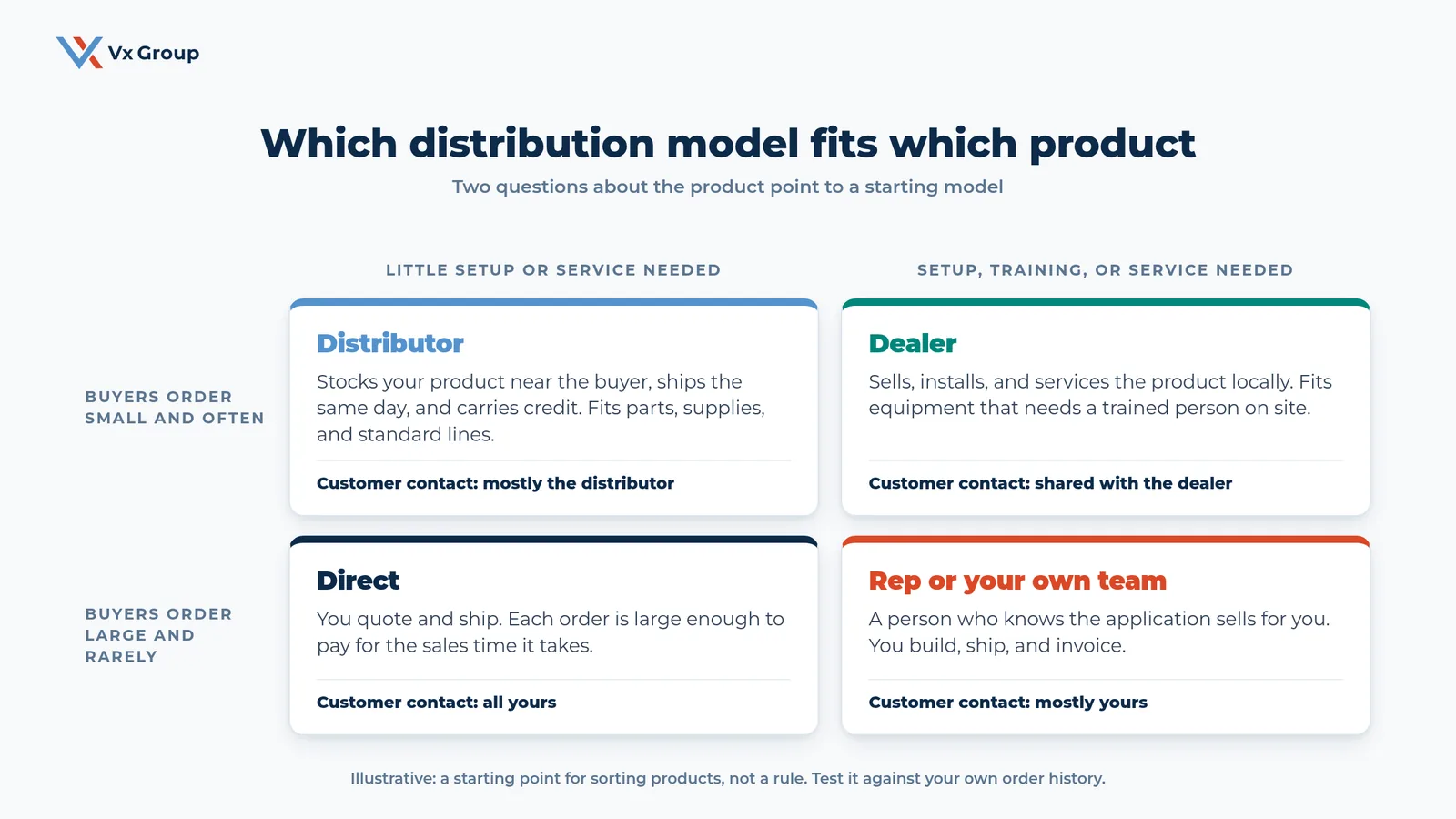
The grid above puts small, frequent orders with little service in the distributor box. Small, frequent orders that need service go to a dealer. Large, rare orders with little service fit direct sales. Large, rare orders that need service fit a rep or your own application team. Treat it as a starting point and test it against your order history.
Sort each product line by order size and order frequency
Open your last 12 months of orders. For each product line, write the average order value and the number of orders per customer per year. A line with many small reorders behaves like a distributor product. A line with a few large orders behaves like a direct or rep product.
Do this by product line and ignore the company average. Most manufacturers find that one plant makes products that belong in three different models.
Rate how much setup and service each line needs
Score each product line from one to three. A one means the buyer opens the box and uses it. A three means the buyer needs installation, training, or ongoing service. Lines that score a three need a partner with trained people nearby, or your own team.
Ask your customer service team which products generate the most calls. Those lines carry hidden service work that a distributor may not be able to handle.
Test the match against what you sell today
Compare your sorted list with how each line sells now. Mark every line where the current model differs from the fit. Some of those gaps are fine, because a long-standing partner may sell a mismatched line well. Others explain problems you already know about, such as a technical product sitting unsold on a distributor’s shelf.
You do not need to move anything yet. The list shows where to look first.
Ready to grow?
Share how your products reach buyers today and we will help you build a plan that protects the relationships behind your sales.
What does each product distribution model cost you?
Each product distribution model costs you margin, sales effort, or both. A partner takes margin in exchange for work it does for you. A direct model keeps the margin and adds the cost of doing that work yourself. The right question is which cost buys the most for each product.
The table below shows an illustrative $100 product to make the trade concrete. The percentages are examples. Your agreements and your costs will differ.
| Model | Illustrative price you receive | Work you still do | Work the partner does |
|---|---|---|---|
| Direct | $100 | Selling, shipping, invoicing, service | None |
| Distributor | $70 | Supplying product, training, joint planning | Stocking, selling, delivery, credit |
| Dealer | $75 | Supplying product, training, warranty support | Selling, installing, local service |
| Rep | $100, less a commission of about $8 to $10 | Shipping, invoicing, support | Selling in the territory |
Read the table by the work each party does. A distributor’s $30 covers a warehouse, a sales team, delivery trucks, and the risk that a customer does not pay. Replacing all of that with your own staff usually costs more than $30 per sale at small order sizes.
The comparison changes at large order sizes. A $200,000 machine sold through a partner that takes 25 percent gives up $50,000. The same sale made direct may cost far less in sales time. That is why large, custom products lean direct and small, frequent products lean on partners.
Add up the work you would take back if the partner left
List every task a partner does for you: warehousing, local selling, delivery, invoicing, credit, installation, and first-line support. Next to each task, write who on your team would do it and what that person would cost for a year.
Most owners find that the list is longer than they expected. A distributor in a small market may do the work of three people on your payroll, spread across thousands of small orders.
Compare the models at your own order sizes
Pick one product line and run the numbers two ways. First, price a year of selling it through a partner, using the discount you give today. Second, price a year of selling it direct, using the sales hours, shipping, and receivables it would take.
Small orders favor the partner, because your cost per order stays high when the orders are small. Large orders favor direct, because one sale carries the sales time. The break-even point differs for every company, so the exercise is worth doing with your own figures.
Include the cost of losing contact with the buyer
The last cost is the hardest to price. A partner that holds the customer record can move that customer to a competitor’s line. A manufacturer that knows its end customers keeps options. Weigh that against the margin you save, and use the written rules in the later sections to reduce the risk.
Our guide to distributor pricing strategy explains how to set discounts that protect your margin and the partner’s.
Who owns the customer in each distribution model?
The party that invoices the buyer usually holds the customer relationship. In a direct or rep model, that is you. In a distributor or dealer model, it is the partner. This matters because the owner of the relationship holds the order history, the contact names, and the early signs of a change in demand.
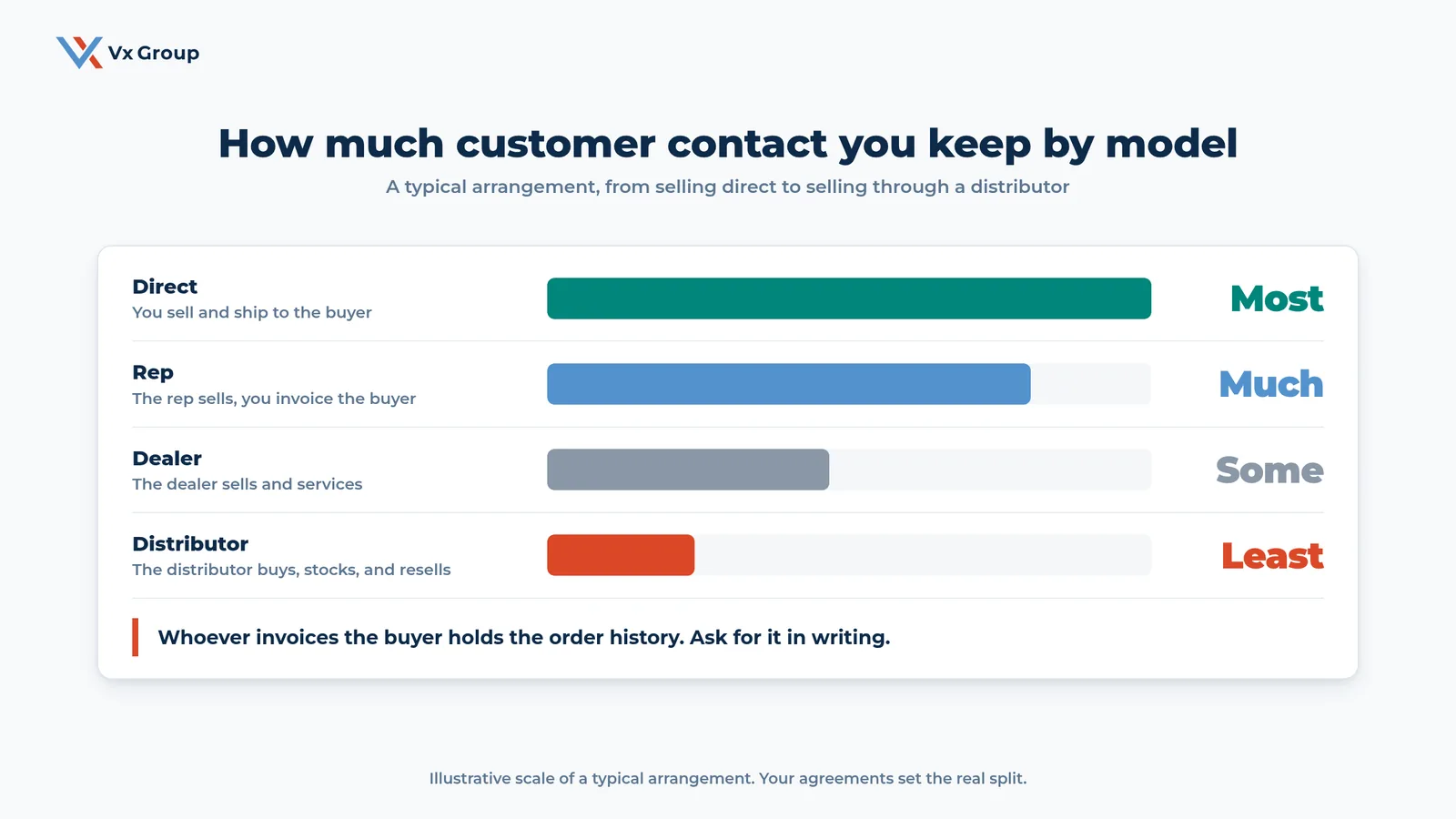
The chart shows a typical arrangement on an illustrative scale. A manufacturer keeps the most contact when it sells direct, much of it with a rep, some with a dealer, and the least with a distributor. Your own agreements set the actual split.
Many owners accept this loss of contact without thinking about it. The distributor sells well, so the owner assumes the relationship is healthy. Then the distributor adds a competing line, or the buyer retires, and the owner learns that nobody at the plant knows the end customer.
Ask for sales reports in writing
Add a reporting clause to every distributor and dealer agreement. Ask for monthly sales by customer name and product line. Many partners will agree if you explain that the data helps you plan production and support them better.
If the agreement is old and silent on reports, ask anyway. A partner that refuses to share any customer data is telling you something about the relationship.
Meet the end customers with the partner present
Ask each major partner to introduce you to its five largest buyers of your product. Offer to join a visit or a call. Position it as support for the partner’s sale, which it is.
A manufacturer that knows its end customers can answer a technical question in an hour, spot a buyer in trouble early, and win the order back if a partner changes. Our guide to distributor management covers how to build these contacts into a routine.
How do you run more than one distribution model at once?
Most manufacturers run more than one distribution model, so the task is to give each one a clear lane. You run several models by writing down which products, territories, and accounts belong to each. Without written lanes, partners meet on the same account, and each one sees the other as a price problem.
A common mix is direct sales to your largest accounts, distributors for standard products in regional markets, and reps in territories you do not cover. That mix works when everyone knows the boundaries.
Write the account and territory rules before the second channel signs
Put three things on one page: which accounts stay with you, which territories belong to which partner, and what happens when a buyer in one lane calls another. Share the page with every partner.
Add a short process for disputes. A partner who finds out you sold direct into its customer will assume the worst. A written rule gives you something to point to. Our guide to managing channel conflict covers rules of engagement in detail.
Set one price floor that every channel can see
Choose a minimum price or a discount range for each product line and apply it across channels. Partners can sell above the floor. They cannot see a competing channel selling below it.
Price gaps between channels cause more partner complaints than almost anything else. A floor settles most of them before they start.
Field Notes:
Consider an illustrative case. A maker of industrial hose fittings sells to plants through four regional distributors and to two large customers direct. One distributor learns that a direct customer pays 8 percent less than it does. It stops stocking the line within a quarter. The owner had never written down which accounts were direct or why the price differed. A one-page rules document would have shown the direct accounts were national contracts that no distributor could serve, and the distributor would have had a reason to stay.
How do you choose a distributor or dealer for your product?
You choose a distributor or dealer by checking three things: who it already sells to, how many of its people can explain your product, and what sales data it will share. A partner that scores well on all three can grow your line. A partner that scores well on only its size will take your product and leave it in the warehouse.
Check who the partner already sells to
Ask for a list of the partner’s top customers by industry. Compare it with the buyers you want. A distributor with strong relationships in food processing will help a food-grade product and may do little for a mining product.
Call two of its customers. Ask what they buy from the partner and why. The answers show whether the partner is trusted and whether your product fits what it sells.
Count how many people at the partner know your line
A partner with one person who understands your product has one point of failure. Ask how many sales people have sold your line in the past year. Ask who answers technical questions.
Plan to train at least three people at each major partner. Our guide to partner enablement explains how to build that training.
Ask what sales data the partner will share
Raise the reporting request before you sign. A partner that agrees to monthly customer-level reports is treating you as a real supplier. A partner that offers only total dollars is protecting its customer list from you.
Visit the partner before you sign
Spend half a day at the partner’s warehouse, branch, or showroom. Look at how your competitors’ products are stocked and displayed. Watch how the counter staff talk to buyers. Ask to see a recent order for a product like yours and follow it through shipping and billing.
A visit shows things a sales presentation hides, such as stock that sits too long, delivery that runs late, or a team that turns over every year. Bring your technical lead if the product needs explaining. The partner’s reaction to your questions tells you how it will treat your line.
Then read the agreement closely. Territory, exclusivity, termination, and data rights should all be in writing. Our guide to the distributor agreement lists what to settle before signing.
How do you keep a distribution channel growing after the agreement is signed?
You keep a distribution channel growing by meeting the partner’s people on a schedule, training them on your product, and reviewing results every quarter. Partners sell what they know and what pays them well. A channel that gets attention grows. A channel that gets only invoices drifts toward whatever the partner finds easier to sell.
Set a contact schedule for every major partner
Assign one person on your side to each major partner. Set a monthly call and a visit twice a year. Meet at least two people at each partner beyond your usual buyer.
Write the schedule down and track whether it happens. Contact tends to fade when the owner’s calendar fills, and the relationship thins quietly.
Train partner sales people on the products that need explaining
Run a short product session at each partner every year. Cover the application, the three questions buyers ask, and the two competitors the partner meets most often. Leave behind a one-page guide with specifications and common mistakes.
Fund joint marketing with rules attached
Many manufacturers offer marketing money to partners. Funds work when you attach a plan and a result to each one. Our guide to market development funds explains how to set that up.
Review results by partner every quarter
Compare each partner’s sales by product line, by end customer, and against the same quarter last year. Look for lines that stalled and customers that disappeared. The review turns a vague feeling about a distributor into facts you can discuss with them. A formal channel partner program gives the review a structure.
Decide what to do with a partner that stops selling
Every channel has a partner that slows down. Sales fall for two quarters, calls go unanswered, or a competing line takes the shelf space. Check the facts first. Compare the partner’s sales with its market, because a weak territory looks the same as a weak partner on a first read.
If the partner is the problem, tell the owner directly and set a 90-day target for the product lines in question. If sales do not recover, plan the exit with care. Find the replacement before you give notice, check the agreement for termination terms, and protect the end customers so they hear from you first.
Revisit the product match every two years
Products change, and so do buyers. A line that needed service five years ago may now be easy to install, and a distributor can carry it. A line that sold in small lots may now sell in large ones to a few buyers. Repeat the order-size and service sort every two years, and move a product line when the numbers say it belongs somewhere else.
What mistakes do manufacturers make with product distribution?
The most common mistakes in product distribution come from choosing a channel by habit. Each one is easy to spot once you look for it, and each one is cheaper to fix early.
- Selling every product through every channel. Technical products sit on distributor shelves because nobody checked the fit.
- Letting the channel set the price. A partner that sets resale prices alone will cut them to win, and your other channels will feel it.
- Depending on one partner contact. One buyer or one rep holds the relationship. When that person leaves, the relationship goes with them.
- Skipping the written rules. Territory, accounts, and pricing live in the owner’s memory.
- Signing without data rights. Without sales reports, you cannot see which customers buy your product.
- Adding partners to fill a gap. A new distributor in an old territory starts a conflict. Check how the current partner is doing first.
- Ignoring small partners. A small distributor with a strong local reputation can outsell a large one in its area.
Our guides to distribution strategy and B2B channel strategy cover how to decide how many partners you need and where they belong.
Where should an owner start with product distribution this week?
An owner should start with a one-page list of every product line, the model it sells through, and the end customers behind it. The blanks on that page show where the distribution is working and where it runs on habit. It takes about two hours and needs no agreement changes.
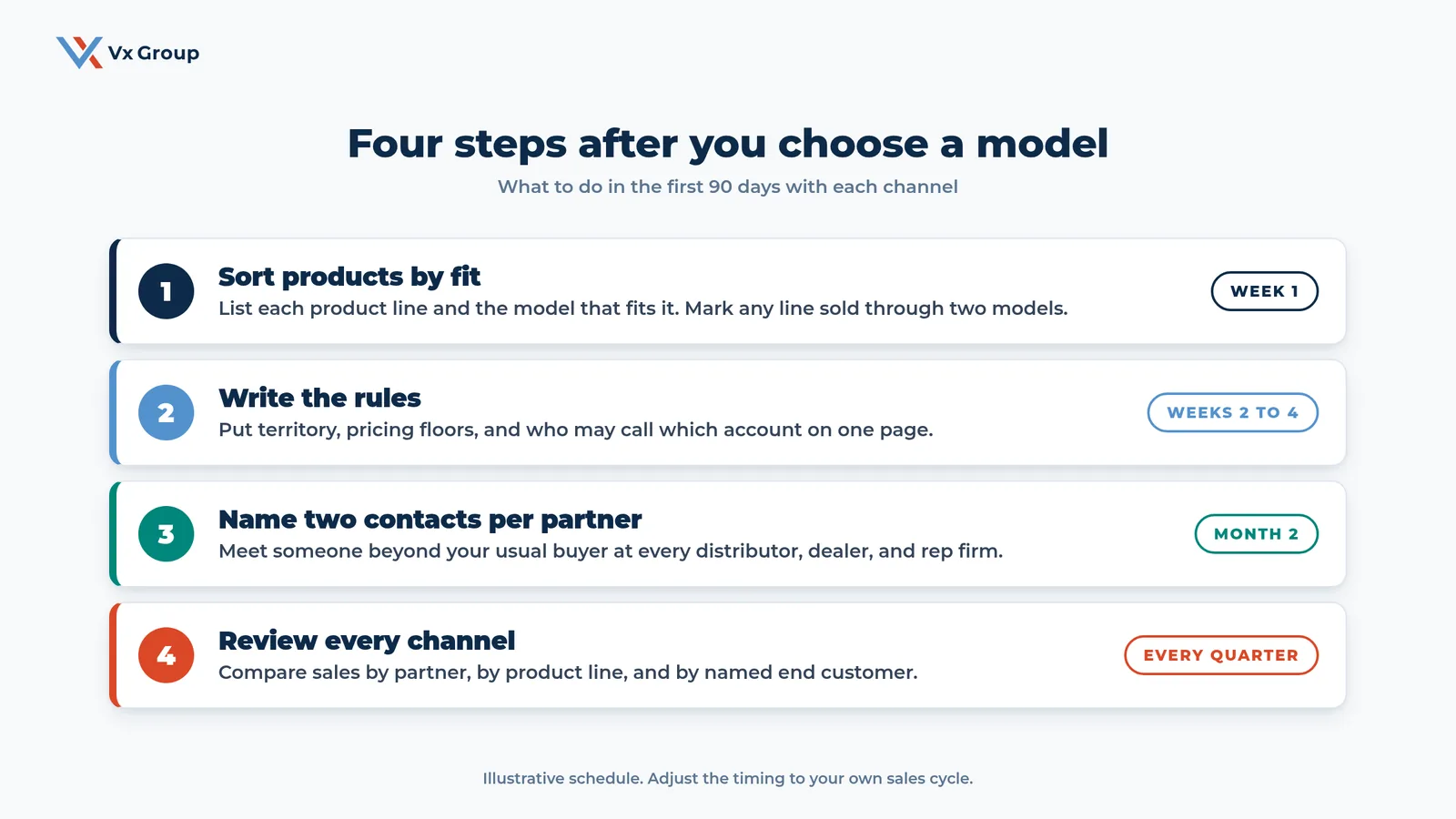
The steps above give a 90-day order of work. Sort the products in week one, write the rules in weeks two to four, name two contacts at each partner by month two, and start a quarterly review after that.
For each product line, write the annual revenue, the model, the main partner contact, and the top three end customers you can name. Mark every blank. Then pick the line with the most revenue and the most blanks, and call that partner’s owner or branch leader for a 30-minute meeting.
Bring one question: what would make us a better supplier to you? The answer will point to the first change worth making.
Ready to grow?
Send us your product list and the channels you use, and we will help you see where the relationships are strong and where they are thin.
FAQs
About the Author: David Tisdale
