

How to Build a Channel Partner Program That Actually Drives Sales

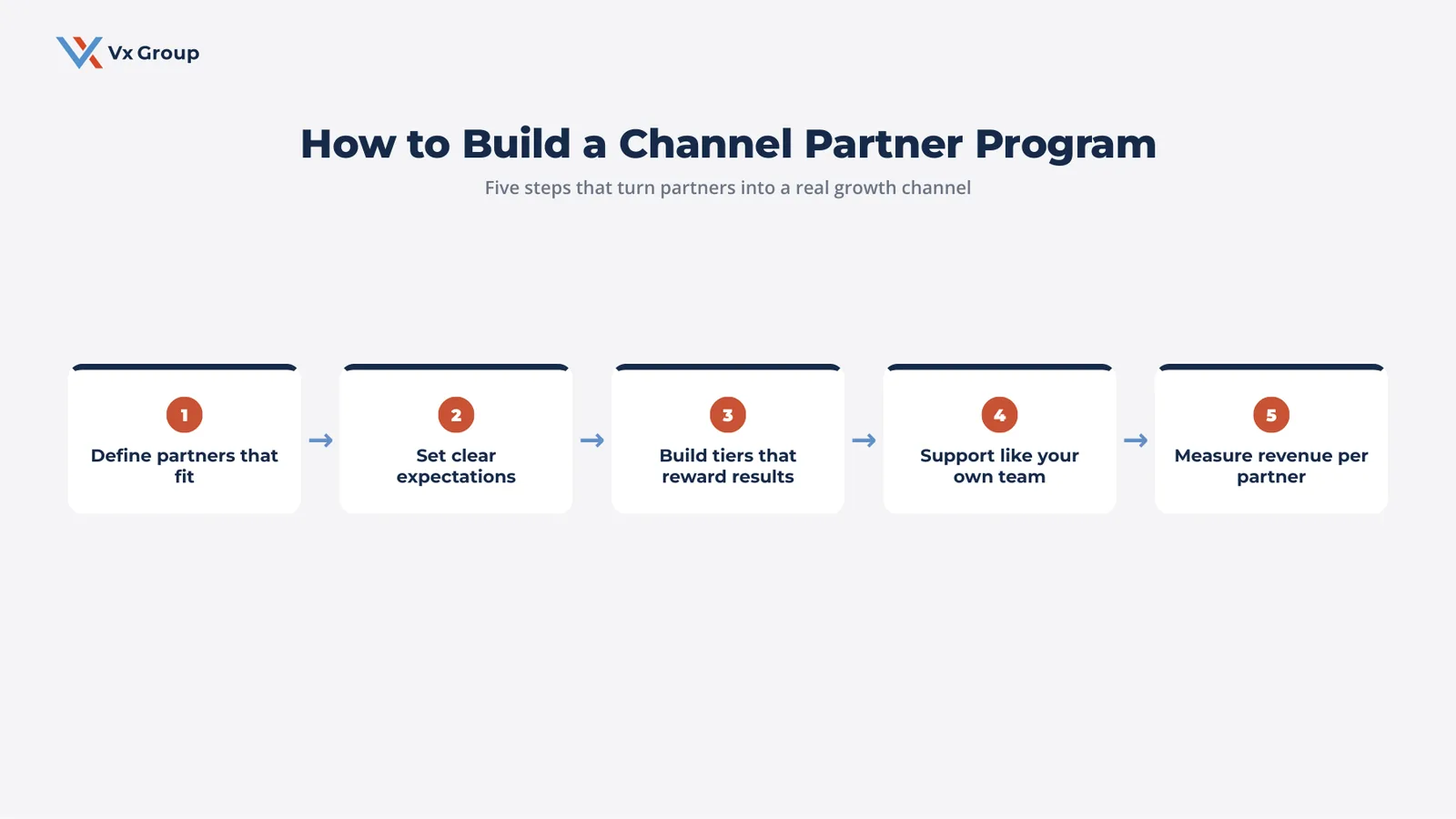
A channel partner program is a structured system for recruiting, supporting, and rewarding outside companies that sell or refer your products. To build one that produces results, define which partners fit your business, set clear performance expectations, give partners real support, and measure revenue per partner. The program works only when the relationship behind it is strong.
TL;DR
- Relationship quality shapes outcomes far more than the number of partners you sign.
- Recruit fewer partners who fit your ideal customer base, then invest in them deeply.
- Set written expectations on both sides before anyone signs.
- Support partners like an extension of your team rather than a one-time transaction.
- Measure revenue per active partner rather than counting signed logos.
Most channel partner program advice was written for enterprise software vendors with tiered certification tracks, co-op marketing budgets, and dedicated partner portals. That model does not fit a $20M manufacturer or a regional distributor trying to grow through a network of reps, resellers, or referral partners.
The villain here is complexity for its own sake. Owner-led B2B companies copy the enterprise playbook, build an elaborate program with five partner tiers and a points system, and then watch it collect dust because no real relationship sits underneath it. A partner is only as valuable as the relationship behind the agreement. Build that relationship first, and the structure has something real to hold up. A program with no relationship underneath it produces paperwork and little else.
Here is how relationship-driven B2B companies build a channel partner program that produces revenue instead of paperwork. A partner program functions as one route to market inside the company’s broader B2B growth strategy, and the partners you recruit and develop should map to the same priority markets and ideal customers your direct team pursues.
Defined term: Channel partner program
A channel partner program is the documented set of expectations, support, and incentives that govern how third-party companies sell, resell, or refer your products and services. It turns informal partner relationships into a repeatable growth channel.
1. Define what kind of partner actually fits your business
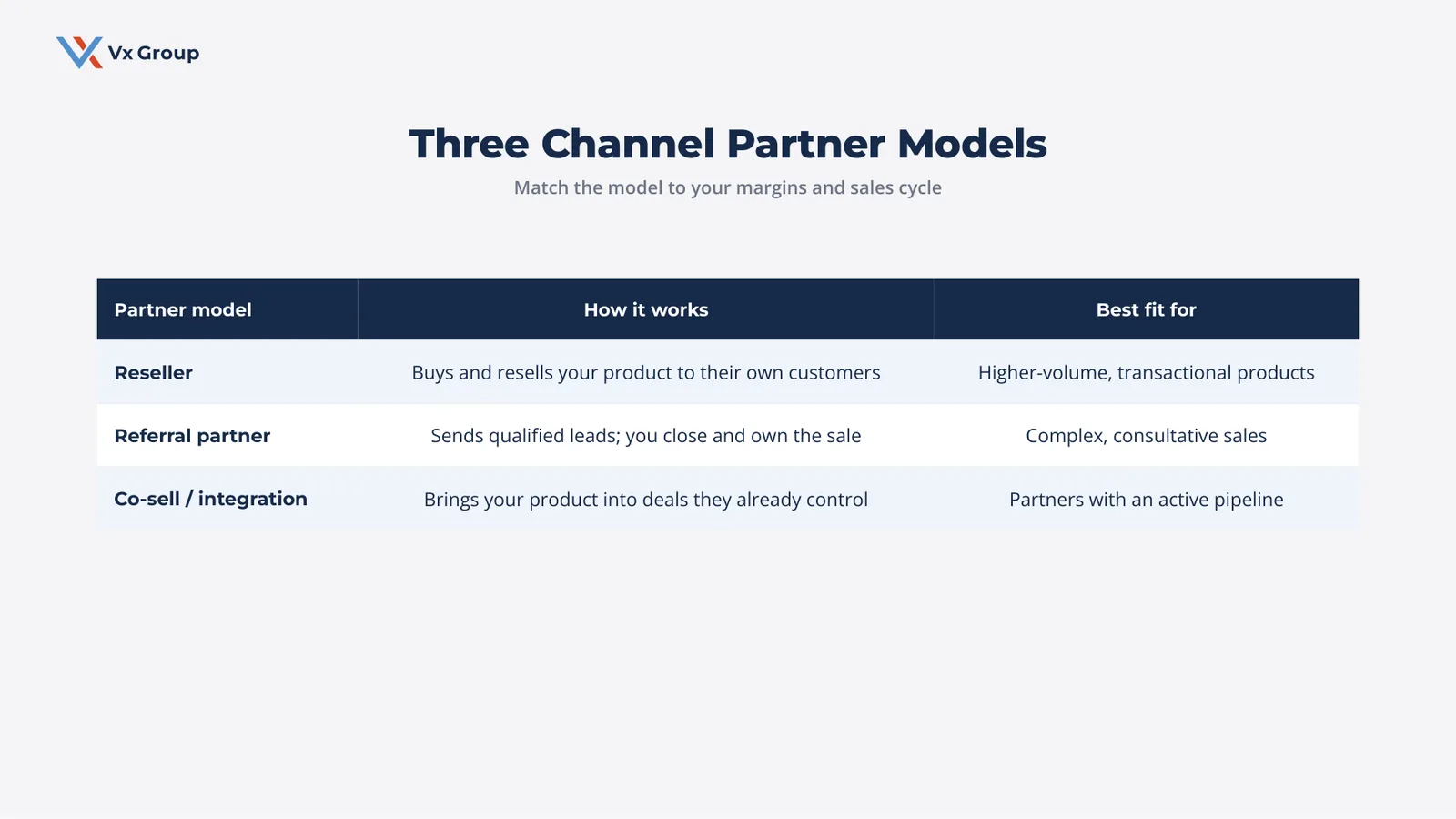
Start by deciding which partner type matches how you sell and who you serve. The three most common models for lower-middle-market B2B companies are resellers who buy and resell your product, referral partners who send you qualified leads, and integration or co-sell partners who bring your offering into deals they already control.
Pick the model that fits your margins and your sales cycle. A manufacturer with a complex, consultative sale rarely benefits from a high-volume reseller network. That same manufacturer often grows faster through a small group of referral partners who already hold trust with the right buyers.
Match partners to your ideal customer base
The best partners already serve the customers you want. Before recruiting anyone, look at your strongest existing accounts and ask who else those buyers trust. A partner who sits next to your ideal customer brings warm access that cold outreach cannot buy.
Resist the urge to sign every company that expresses interest. Ten partners who serve your exact market will outproduce fifty who signed up for a discount and never sold a thing. The principles that make channel sales strategy effective, partner selection before partner count and relationship investment before coverage, apply directly to program design.
The five questions that tell you if a partner is worth signing
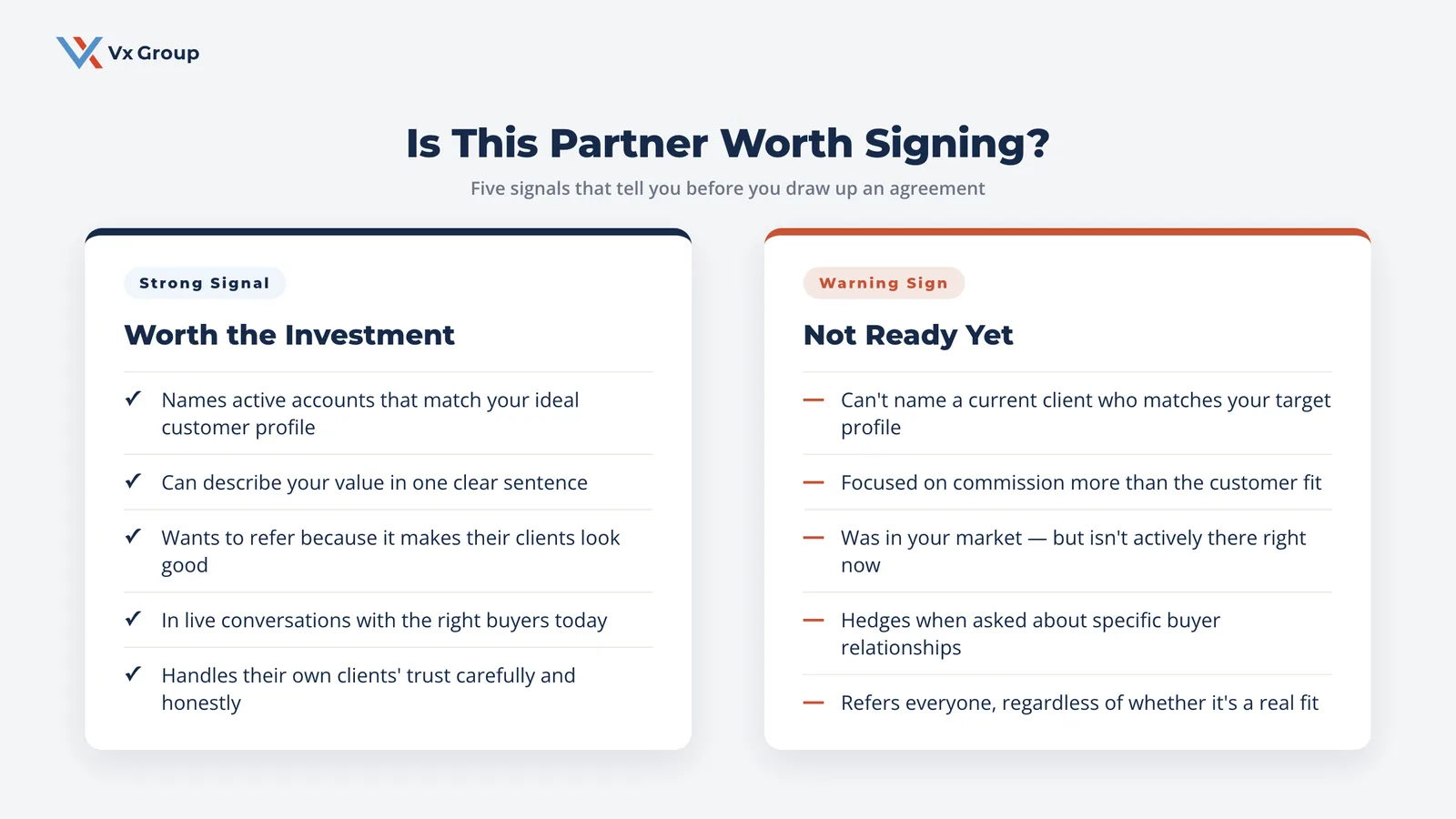
Before you recruit any partner, answer these five questions. A candidate who cannot satisfy all five probably is not ready, and signing them anyway builds an inactive roster rather than a working program.
Do they already serve your ideal buyer?
Ask who their top five accounts are and whether those companies match your target profile. If they cannot name a single account that looks like your ideal customer, they will not find you warm introductions; they will sign the agreement and go back to what they were already doing.
Can they describe what you sell in one sentence?
Curiosity and genuine engagement matter more than technical product knowledge at this stage. Partners who want to understand how you win are very different from partners who nod along and hope deals materialize.
Do they have a reason to refer you beyond the commission?
Ask directly why they want to work with you. If the answer centers on the referral fee, the relationship will be thin. The partners who produce consistently do so because referring you makes them look good to their own clients, with the incentive playing a secondary role.
Are they in active conversations with the right buyers right now?
A partner who used to serve your market, or who plans to, is a different risk from one in live client conversations today. Ask what deals they are working on and what problems their customers are raising. The answer tells you how quickly they can produce a first introduction, and whether they actually know the buyers they claim to know.
Do they handle their own clients’ trust carefully?
This is harder to assess in a first conversation but matters enormously over time. Ask how they handle a referral that turns out not to be a fit. Ask who they send clients to for work they cannot take on. Partners who are honest and deliberate with their own clients’ trust will treat yours the same way.
Run every serious candidate through these five questions before you draw up an agreement. The ones who answer confidently and specifically are the ones worth the investment. The ones who hedge or generalize are telling you something.
2. Set clear expectations on both sides before anyone signs
Write down what each side owes the other. Most channel programs fail because expectations live in someone’s head, and six months later the partner and the vendor remember the deal differently.
A workable partner agreement covers four things in plain language: what the partner is expected to do, what you will provide in return, how partners get paid and when, and what happens when a partner stops performing. Keep it short enough that a busy owner will actually read it.
Name the performance bar in real numbers
Vague expectations produce vague results. Replace “actively promote our products” with a specific target: two qualified introductions per quarter, or a minimum annual sales volume that keeps a partner active. Partners respect clear bars because they can plan against them.
State the consequence too. If a partner produces nothing for a year, the agreement should explain how they move to inactive status. This protects your time and keeps your active partner list honest.
The eight clauses that prevent most partner disputes
Most channel agreements fail not because they are legally flawed but because they omit the operating details. Here are the eight clauses that prevent the conversations that quietly kill programs.
- The performance standard. Name the minimum activity that keeps a partner active: for example, two qualified introductions per quarter, or $X in referred revenue per year. If the bar is not in writing, you will have an uncomfortable conversation twelve months in and no ground to stand on.
- What counts as a qualified introduction. Define this before any deals come in. A workable definition for most B2B companies: the contact is a decision-maker or strong influencer, the company matches your ICP, and the partner has had an actual conversation with them about your product. An email to a cold contact does not count.
- Deal registration. If a partner introduces you to a prospect, what protects their commission if your direct team encounters the same company independently? A simple deal-registration process (the partner logs the introduction within 10 business days) protects both sides and prevents the disputes that damage relationships.
- Payment terms. Specify when commission pays out: at contract signing, at first invoice, or at cash receipt. For a manufacturer with 60-day payment cycles, these differences matter in practice. Ambiguity here creates resentment.
- What you will actually provide. List the specific deliverables: named point of contact, response time for partner inquiries (e.g., same business day), current pricing sheet, sales deck, product samples. “Reasonable support” is not a deliverable. Specifics create accountability on your side.
- Exclusivity terms, or the explicit absence of them. Most lower-middle-market companies are not in a position to demand exclusivity. If the partner sells competing products, acknowledge that and define any restrictions clearly. Silence on this point creates assumptions that lead to conflict.
- Inactive status and reactivation. Define what happens when a partner goes twelve months without producing despite outreach from your side: they move to inactive, commission rate may adjust, the relationship can be reactivated if they demonstrate renewed activity within a defined window. This clause protects your active list from becoming a graveyard.
- The exit clause. How either party terminates the agreement, how long deals already in progress are protected after termination, and how commission is handled on deals that close after the agreement ends. This sounds like a detail until you need it.
Keep the agreement short enough that a busy owner will actually read it; two to three pages covers all eight of these points in plain language. Shared clarity about what both sides are committed to is the whole point.
Defined term: Partner tier
A partner tier is a level within your program that carries its own expectations and rewards. Most lower-middle-market companies need only two or three tiers, such as referral, active reseller, and strategic partner. More tiers add administrative weight without adding revenue.
3. Build partner tiers that reward real results
Structure your tiers around what partners actually deliver. A simple, durable structure has an entry level for new or low-volume partners, a middle level for proven performers, and a top level for the small group of partners generating most of the program’s revenue, who deserve priority support.
Each tier should carry a tangible difference in what the partner earns and what you provide. A top-tier partner might receive better margins, early access to new products, joint planning sessions, and a direct line to your team. An entry-tier partner earns those benefits by performing, which gives them a reason to grow with you.
Keep the climb visible and earnable
Partners disengage when advancement feels arbitrary. Show them exactly what moves them from one tier to the next, whether that is a revenue threshold, a number of closed deals, or a certification they complete. A visible path turns a flat partner list into a group of companies working to grow their stake in your business.
A concrete tier structure for manufacturers and distributors
Here is what a working three-tier structure looks like for a manufacturer or distributor with a $50K–$500K average deal size. Adjust the revenue thresholds to your business; the structure is what matters.
| Tier | Activity threshold | Commission rate | What you provide |
|---|---|---|---|
| Referral (entry) | Fewer than 2 qualified introductions per quarter, or under $100K/year in referred revenue | 5–8% of first-year revenue | Shared point of contact, standard sales materials, access to pricing |
| Active (middle) | 2–5 qualified introductions per quarter, or $100K–$500K/year in referred revenue | 8–12% of first-year revenue | Dedicated point of contact, monthly pipeline review, early product news, invitation to partner events |
| Strategic (top) | 5+ qualified introductions per quarter, or $500K+/year in referred revenue | 12–15% of first-year revenue, renewal commissions | Executive access, co-marketing budget, quarterly joint business review, input on product roadmap and pricing |
A few things to note about this structure. Every partner starts at the entry tier, including strong ones. Second, the jump from entry to active should feel genuinely worth earning: dedicated contact and monthly pipeline reviews are real advantages that partners notice. Third, your strategic tier will likely contain two to five partners rather than twenty. The economics of this tier only work if the relationship justifies the investment.
If you have fifteen partners and none of them have reached the active tier after twelve months, the problem is not the tier structure. The problem is recruitment criteria or enablement. Fix those before adding more partners or changing the incentives.
Ready to grow?
Build a channel partner program partners actually want to be in, instead of one that quietly stalls.
4. Support partners like an extension of your own team
Give partners the tools, training, and responsiveness they need to sell on your behalf. A signed agreement is a starting line. What keeps a partner selling is the experience of working with you after the ink dries.
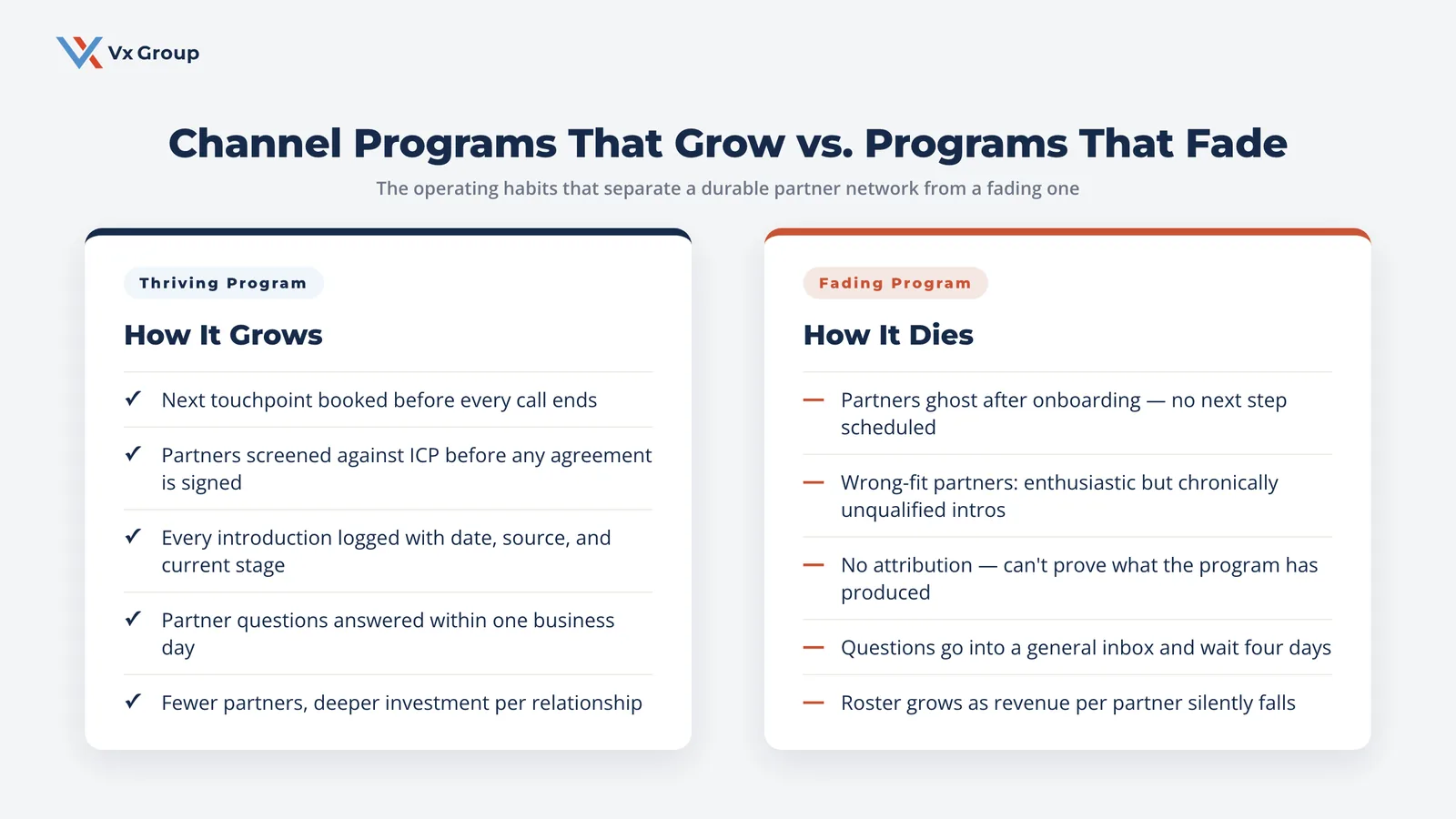
At minimum, equip partners with current sales materials, clear pricing, product training, and one named contact who answers fast. Many programs stall because a partner sends a question into a general inbox, waits four days, and quietly goes back to selling something easier.
Treat onboarding as the moment the relationship forms
The first ninety days set the tone for the entire partnership. Walk new partners through your product, your ideal customer, and your sales process the same way you would onboard a new hire. Partners who understand how you win bring you better-fit deals and waste less of everyone’s time.
A ninety-day onboarding schedule that actually works
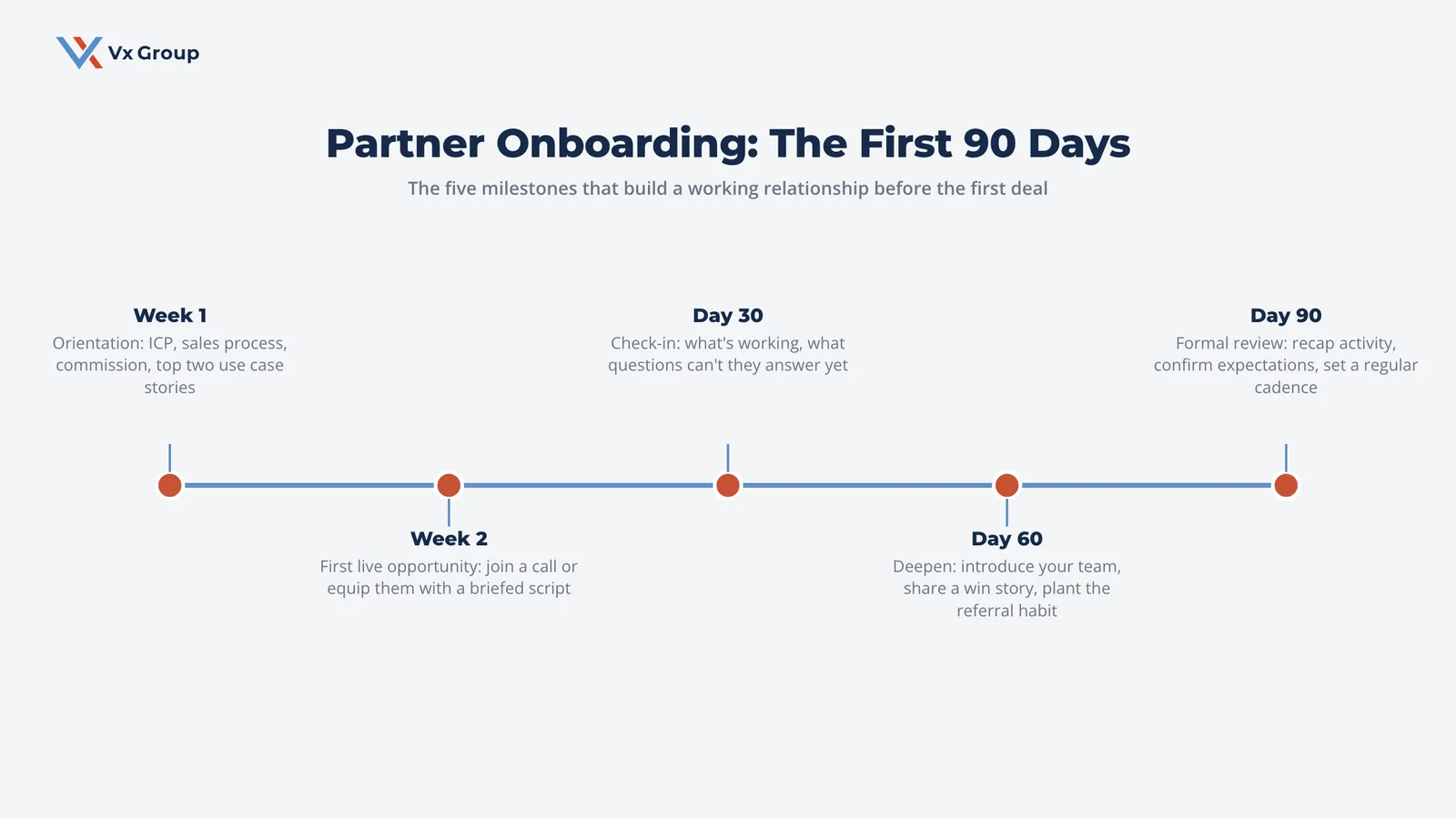
Onboarding should not be a one-time call and a folder of PDFs. Here is a schedule that builds a working relationship before the ninety-day mark.
Week 1: Orientation
Meet with the partner and the two or three people on their team who will actually be making introductions. Cover four things: who your ideal customer is and who is not a fit, your sales process from introduction to close, how deal registration and commissions work, and the one or two use cases where you win most often. End the meeting by sending them a one-page reference sheet: your ICP, your two best use case stories, your point of contact, and the deal registration process. This is the document they reach for when a name comes up in conversation.
Week 2: First live opportunity
Identify one account already in their pipeline that matches your target profile and ask to be introduced or to join a call. This does not need to be a perfect opportunity. The goal is to demonstrate what a real introduction looks like, and to give the partner the experience of working with you before they have any reason to trust you. One live interaction in week two does more to build confidence than three more onboarding calls.
Day 30: First check-in
Ask what they have heard in the market since you last talked. What questions have come up that they couldn’t answer? What deals in their current pipeline could be worth discussing? Adjust your talking points and materials based on what they’re actually encountering. The partner who feels heard at day thirty is the one who calls you first when a deal comes up at day sixty.
Day 60: Relationship deepening
Introduce them to at least one other person on your team, ideally your technical lead or a senior account person. Share a recent customer win story with enough specificity that they can borrow it in their own conversations. This is also the moment to plant the referral habit early: ask who in their network, specifically, they think could benefit from an introduction. Keep it a natural conversation about their relationships rather than a formal ask.
Day 90: First formal review
Review all activity from the first ninety days. Note introductions made, where each stands in your pipeline, and what either side could have done differently. Confirm expectations are still aligned. Agree on a regular schedule going forward. Quarterly is the minimum; monthly is better in the first year. The partner who receives a structured ninety-day review knows they are in a program being managed with intention. That signal alone separates you from most of the partners they work with.
Defined term: Partner enablement
Partner enablement is the ongoing work of giving partners the knowledge, materials, and support to sell your product confidently. Strong enablement makes partner performance repeatable instead of dependent on one motivated individual.
Stay in front of partners between deals
Relationships cool when contact only happens around a transaction. A quarterly check-in, a short partner update, or a quick call to share a new use case keeps you top of mind. Partners send deals to the companies they think about, and they think about the companies that stay in touch.
5. Measure whether the program actually produces revenue
Track revenue per active partner as your primary metric. Logo counts and signed agreements feel like progress, yet they tell you nothing about whether the program produces sales.
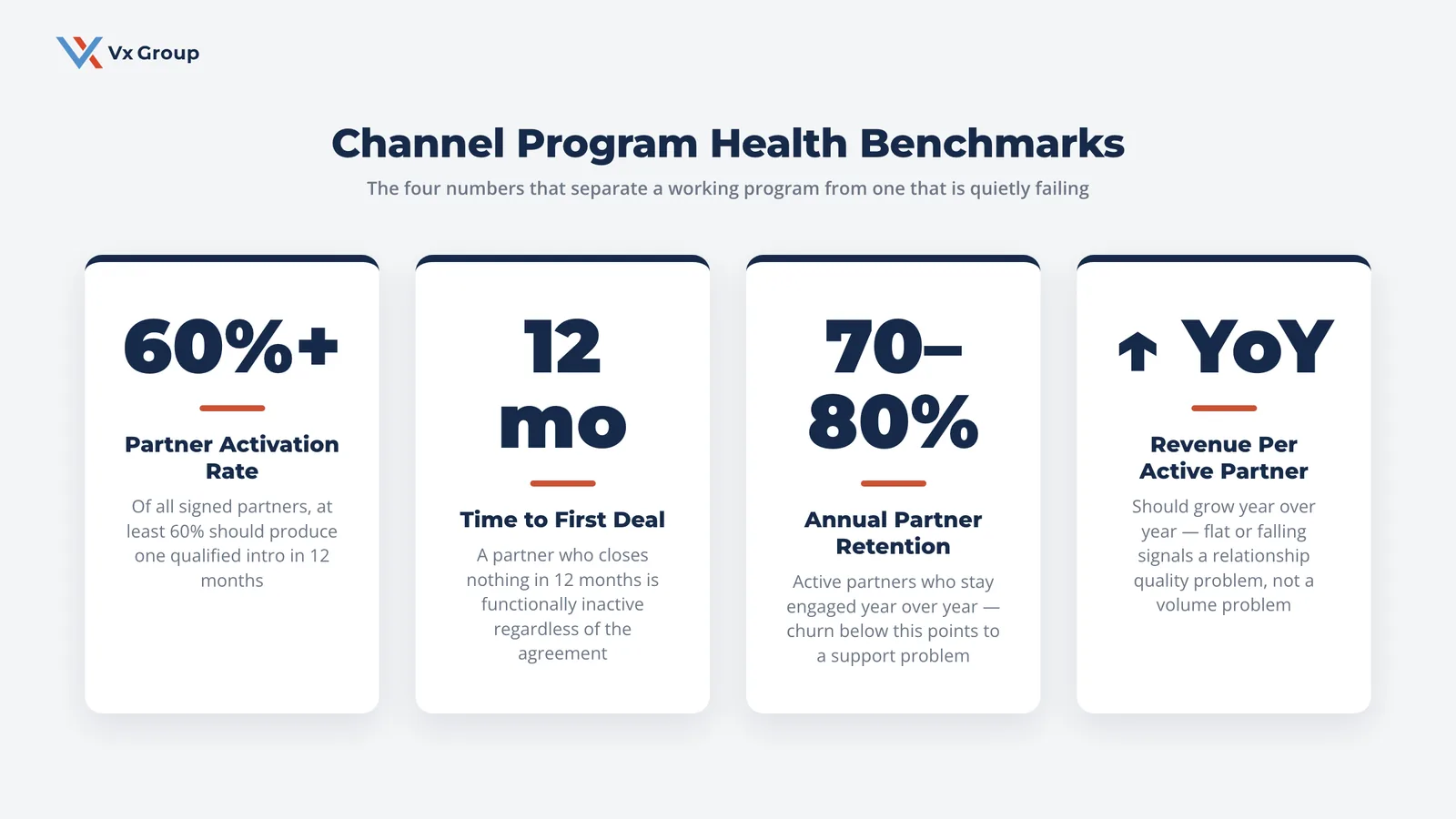
Watch a small set of numbers that reveal real health: revenue generated per active partner, the share of partners who are actually producing, average time from partner signing to first closed deal, and partner retention year over year. These four numbers tell you whether you have a growth channel or a list of names.
Prune the program on a schedule
Review your partner roster at least once a year. Partners who have produced nothing despite real support are not assets, and carrying them inflates your numbers while draining your attention. Moving inactive partners off the active list keeps your focus on the relationships that pay back the investment.
What healthy program numbers actually look like
The four metrics named above are the right ones to track. Here are the benchmarks that distinguish a healthy program from one that is quietly failing.
Partner activation rate: aim for 60% or higher. Of all partners who have signed your agreement, what percentage produced at least one qualified introduction in the last twelve months? If that number is below 50%, your recruitment is outrunning your enablement. The answer is almost always the same: deeper investment in the partners already in your program.
Revenue per active partner: the direction matters more than the absolute value. Divide total partner-sourced revenue by the number of partners who produced at least one deal. If this number is growing year over year, the program is deepening. If it is flat, you have a relationship quality problem: partners are referring at the same depth they were a year ago. If it is falling, you have added partners who are diluting the average without adding proportional revenue.
Time to first deal: twelve months is the benchmark. For most B2B companies with a three-to-six-month sales cycle, a partner who signs and produces no closed introduction within twelve months is functionally inactive regardless of what your agreement says. If partners consistently take longer than twelve months to produce a first deal, the onboarding is failing: they are leaving week one without the confidence or direction to act.
Partner retention: aim to keep 70–80% of active partners year over year. Churn below that level almost always traces to a support or communication problem: partners stopped referring because working with you became slower or more complicated than working with someone else. Faster response times and more consistent contact are what actually bring partners back.
If your program is consistently below these benchmarks, the answer is the same every time: fewer partners, deeper investment per relationship. A program with eight active partners and a 75% retention rate is outperforming a program with forty partners and a 20% activation rate in almost every real respect.
A channel partner program is a living relationship system. The companies that grow through partners are the ones that treat each partner as a long-term relationship worth protecting, supported by a structure simple enough to actually run.
Ready to grow?
Build a channel partner program designed around the relationships that produce revenue.
The four ways channel programs fail, and the early warning signs
Most channel programs do not fail dramatically. They fade. Introductions slow down, check-ins stop happening, the partner list grows without growing revenue. Here are the four patterns that show up most often, and what to do when you spot them early.
The ghost partner problem
You sign a partner, do a strong onboarding call, send the materials, and then ninety days later realize you have heard nothing. The partner redirected their attention to other priorities. This is the most common failure in channel programs and the most preventable. Book the next specific touchpoint before the onboarding call ends. A partner who leaves week one without a scheduled reason to talk to you again is a partner who will not talk to you again. Make the next interaction concrete and dated before you hang up.
The wrong partner problem
You recruited partners who liked the idea of the relationship but whose customers do not match your target profile. They refer enthusiastically but the introductions are unqualified: wrong size, wrong industry, wrong decision-maker level. This is the most expensive mistake in channel programs because it burns time on both sides and produces friction without revenue. The fix is stricter upfront qualification. The five questions in step one are the filter. Applying them before any agreement is signed is what separates a partner network from a list of optimistic conversations.
The competing priority problem
Your partner also sells a product that competes with yours in certain situations, and when a deal comes up they default to the easier relationship, usually the one they have known longest. You will rarely know this is happening. The partner made the same rational choice every busy salesperson makes: do the thing that takes less effort. Becoming the easier, more present relationship is what keeps partners referring to you. Partners refer to the companies that respond fast, make them look good, and stay in touch between deals. If your competitors are winning on that dimension, that is the lever to pull.
The no-attribution problem
Your program has been running for two years and no one can confidently say how much revenue it has sourced. No deal registration, no consistent tracking, no way to make the case internally that the program is worth continuing, or to identify which partners deserve more investment. This problem compounds over time: without clear attribution, you cannot reward the right partners, cannot make the case to leadership, and cannot see the failure patterns early enough to fix them.
The fix requires almost no technology. A shared spreadsheet that tracks each introduction (partner name, prospect company, introduction date, current stage, close date if won) is enough to run a program properly at most lower-middle-market company sizes. The discipline of recording every introduction forces the clarity that everything else depends on. Start there before you consider any CRM integration or partner portal.
FAQs
About the Author: Jacob Camhi
