
Trade Show Booth Staff Training for Manufacturers

Trade show booth staff training teaches your team who to talk to, what to say, how to end a conversation that will not go anywhere, and how to write down a next step for every conversation that will. The best training is short and practical: a one-page brief, three opening lines, a polite exit, a note card, and a daily huddle.
TL;DR
- Booth staff decide whether a show pays off. They need a plan before they stand in the aisle.
- Step one is a one-page booth brief that names the accounts you want to see and defines a qualified conversation.
- Step two is three opening lines that find out who a visitor is without sounding like an interview.
- Step three is a polite exit. It protects your best hours on the floor.
- Step four is a capture standard: every real conversation ends with a written next step and one owner.
- Step five is a 20-minute huddle each show day. Add a role-play session before you travel.
- Technical people can do this well. They only need a job to do besides answering questions.
Picture your best applications engineer at the booth on day one. They know the product better than anyone in the company. A visitor walks up and asks about a spec. Twenty minutes later, your engineer has given a free lesson on tolerances and has no idea who the visitor was, what they buy, or whether they will ever call.
Nobody did anything wrong here. The engineer answered the question. The booth just had no plan for what happens before and after the answer.
We see this pattern often with owner-led manufacturers. The company spends real money on the space, the shipping, the travel, and the hotel rooms. Then it sends smart people to stand in the aisle with no brief. They default to what they know, which is answering product questions for whoever wanders up.
This article is for owners and presidents of privately held manufacturers, roughly $5M to $50M in revenue. It fits companies that exhibit at a few shows a year and want the team to bring back real conversations. It walks through five training steps you can hand to a team, a role-play session, and a way to tell whether the training worked.
What should trade show booth staff training cover?
Trade show booth staff training should cover five things: who the team is there to meet, how to open a conversation, how to end one that is not a fit, how to record what happened, and how the team checks in each day. Product knowledge matters, but your people already have it.
Defined Term: Booth staff training.
The short preparation that gives each person on the booth a clear job, a set of opening lines, a way to end a conversation politely, and a standard for writing down next steps. It sits on top of the product knowledge they already have.
Here is the full list in one place, with what each step produces:
| Step | What your team learns | What you hand them |
|---|---|---|
| 1. Booth brief | Who we want to meet and what qualified means | A one-page printed brief |
| 2. Opening lines | How to find out who a visitor is | Three lines to say out loud |
| 3. Polite exit | How to end a conversation and keep the day | An exit line and a handoff line |
| 4. Capture standard | What to write down and who owns it | A note card |
| 5. Daily huddle | How to adjust each day | A 20-minute agenda |
The rest of this article takes each step in order. Plan on two to three hours of total preparation, split between writing the brief and a role-play session before you travel.
How do you write a one-page booth brief?
Write a one-page booth brief that names who is coming, which accounts you want to see, what a qualified conversation looks like, what you are showing, and who covers what. The sales lead writes it, prints it, and reads it aloud to the team on the first morning of the show.
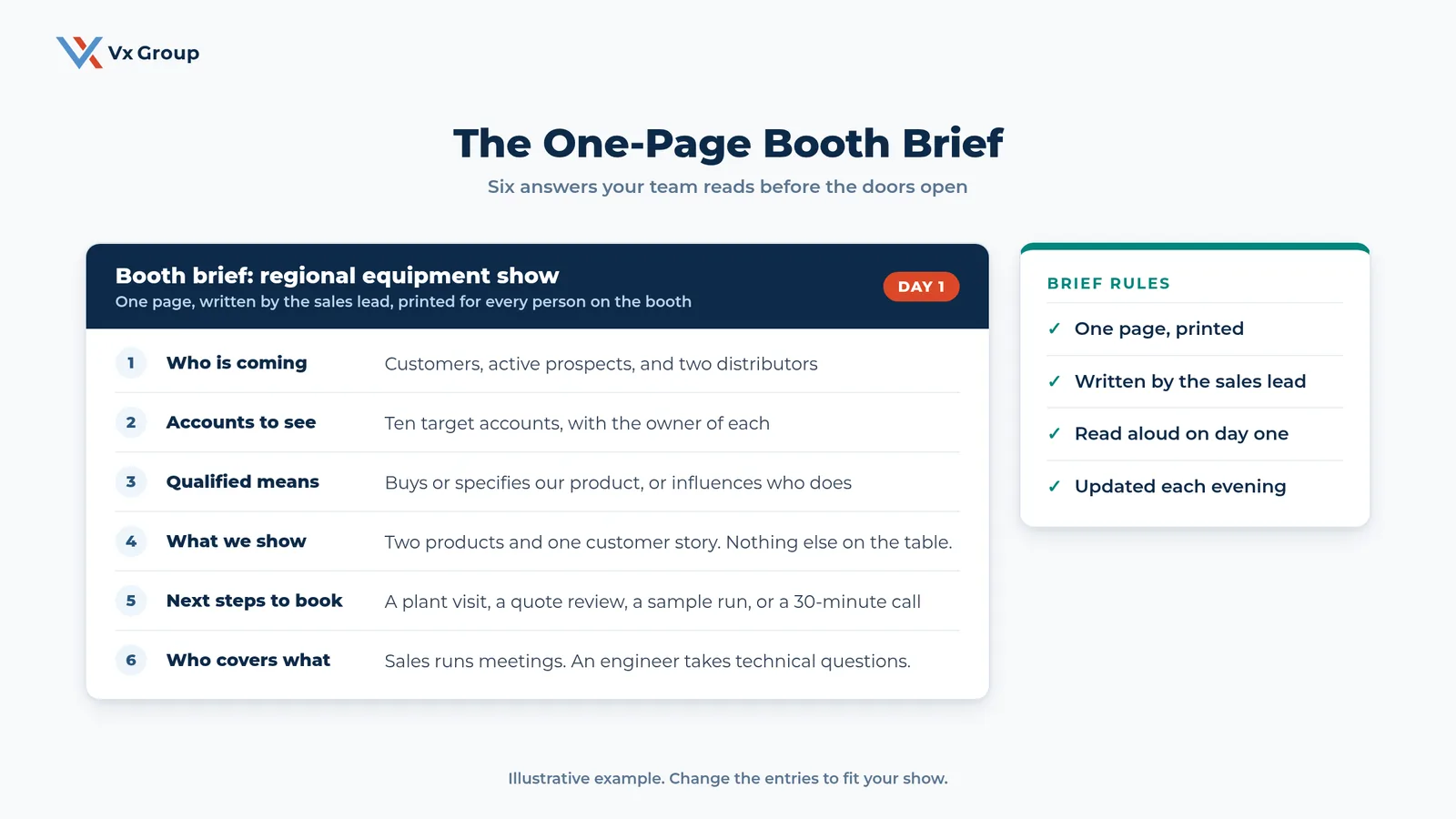
The example above shows six entries. Each one answers a question your team would otherwise guess at. A brief takes about an hour to write the first time and about fifteen minutes once you have a template.
Name the accounts you want to see
List the ten or fifteen accounts that matter most at this show. Put the name of the person who owns each account next to it. If you know a buyer from that account is attending, say so.
This list changes how the team spends the day. A booth team without a list talks to whoever stops. A team with a list watches the aisle for a few specific badges and walks over to say hello.
Define what a qualified conversation means
Write one sentence that tells the team who counts as a qualified visitor. A good definition is short: someone who buys or specifies what we make, or someone who influences a person who does.
Add one line for each type of visitor you want to meet. A distributor, a current customer, an engineer at a target account, and a purchasing manager may each get a different next step. Name that next step on the brief.
Choose two products and one customer story
Pick two products to show and one customer story to tell. Everything else stays in the case. A crowded booth gives staff too many places to wander, and visitors do not know where to look.
The customer story helps the whole team say the same thing. It should be about a real problem a customer had, what you did, and what changed. Keep it to about thirty seconds out loud.
List the next steps you can book at the show
Write down the next steps your team may offer: a plant visit, a quote review, a sample run, a 30-minute call. Put a date range next to each. Staff who know what they can offer will offer it. Staff who do not know will say “someone will follow up,” and nobody does.
Our article on trade show booth ideas covers how to set up the booth itself. The brief covers the people inside it.
How do you script opening lines that qualify without sounding like an interview?
Give each person three opening lines to use in the first thirty seconds. Each line should be a simple question about the visitor’s own situation, such as what brought them to the show or where they use your kind of product today. The answer tells you whether to keep talking.
The goal is to learn who you are talking to. A question like “What do you do?” can feel like a badge scan with words. A question about their work feels like interest, because it is.
Here are three lines your team can adapt to your own products:
- “What are you looking to solve at the show this year?”
- “Where do you use [your product type] today?”
- “Who else on your team looks at this with you?”
The first line tells you what they came for. The second tells you whether they are a current user, a prospect, or a student. The third tells you about the buying group and whether you are speaking with the right person.
Say these out loud before the show. A line that looks fine on paper can sound stiff when spoken. Let each person change the wording until it sounds like them.
Match the opening line to the visitor
Visitors show up in a few common types, and each calls for a slightly different start. Use the table as a starting point and adjust for your own market.
| Visitor | What you notice | Opening line | Where it goes |
|---|---|---|---|
| Current customer | They greet someone by name | “Good to see you. What is coming up at your plant?” | Keep talking, then log it |
| Target account buyer | Badge matches the brief list | “What are you looking to solve this year?” | Keep talking, aim for a booked step |
| Technical visitor | Asks a spec question first | “Where would you use it?” | Hand off to the engineer if they fit |
| Browser | Looks at the products, no questions | “What brought you to the show?” | Decide in two minutes |
A table like this fits on the back of the booth brief. Staff can glance at it between conversations.
Teach the team to ask one follow-up question
After the opening answer, the next move is one follow-up question. Good follow-ups are plain: “How long have you used that?” or “What happens when it fails?” Keep them short and let the visitor talk.
People who sell for a living learn this early. Engineers and operations leaders often learn it from you. Ten minutes of practice helps. Our guide to consultative selling covers how to ask questions that help a buyer think through the problem.
Keep the product answer for the second minute
Answer the product question after you know who is asking. A visitor who is a target account buyer gets a full answer and a next step. A student gets a short answer and a brochure.
Staff often feel they must answer right away, because answering feels helpful. A quick “Happy to get into that. Tell me a little about where you would use it first” costs two seconds and changes the whole conversation.
Ready to grow?
Bring the show list and the team roster and we will help you build a booth brief and a training plan your people will use.
How do you train staff to end a conversation that is not a fit?
Train staff to end an unqualified conversation within a few minutes using a short, kind line, so they are free for the next visitor. This is the skill almost nobody teaches, and it protects the busiest hours of the show for the visitors who matter most.
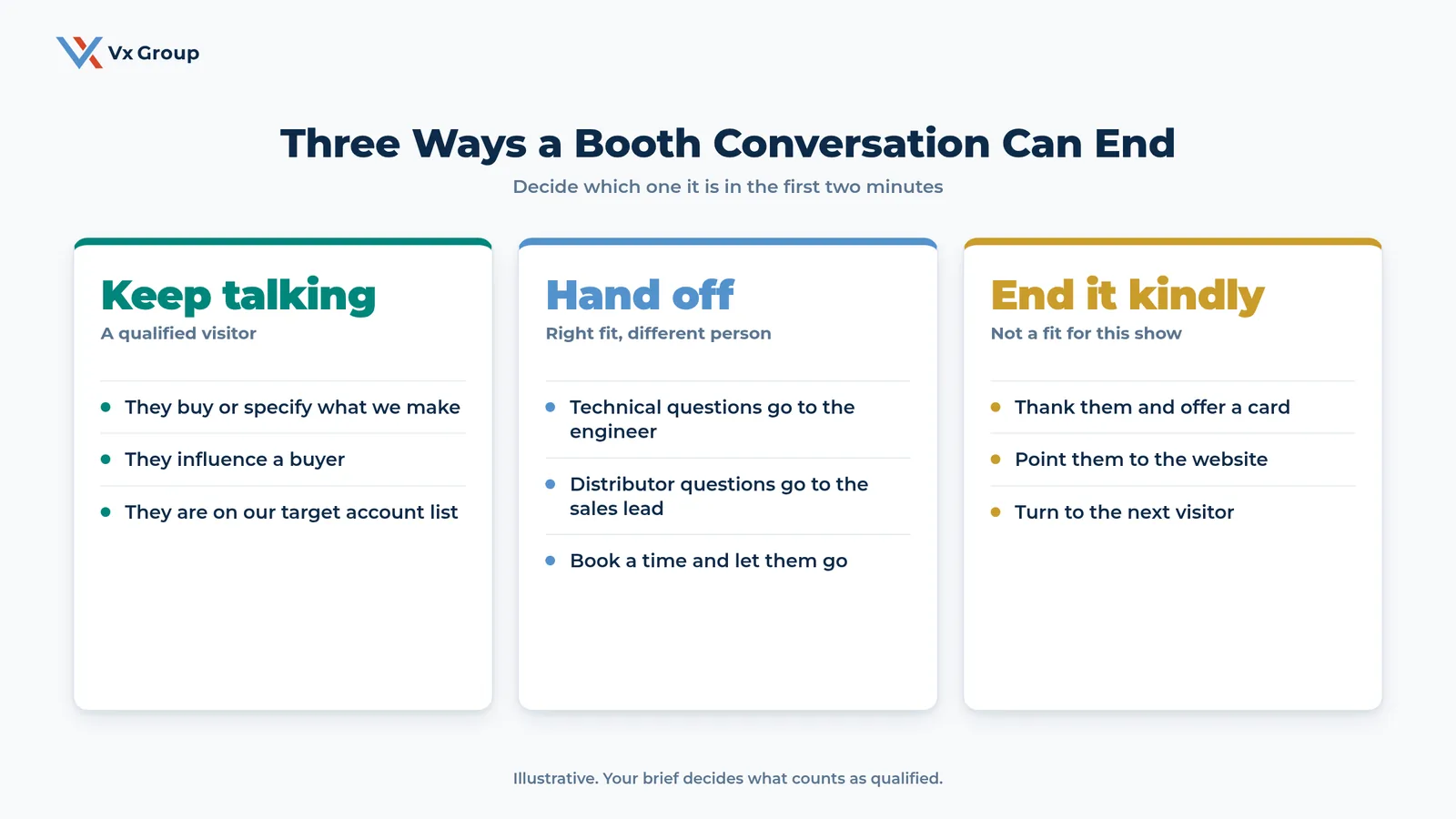
The graphic above shows the three ways a conversation can end: keep talking, hand off, or end it kindly. Staff decide which one in the first two minutes, using the definition on the booth brief.
Many people find ending a conversation harder than starting one. They worry about seeming rude. A scripted exit line takes that worry away because the words are already chosen.
Write an exit line the team can say without feeling rude
Give each person one exit line. Here is a version you can adapt:
“I don’t want to take more of your time than this deserves. Our website has what you need to get started, and here is my card. Thanks for stopping by.”
It is honest, it is warm, and it gives the visitor something to do. Say it with a smile and a handshake, then turn toward the aisle.
Some visitors keep talking after the exit line. That is fine. Say thank you again and take one step toward the next person who is waiting. Most visitors take the hint.
Write a handoff line for questions someone else answers better
A handoff line sends a visitor to a colleague. For example: “Priya on our engineering team can answer that better than I can. Let me introduce you.” Name the person and walk the visitor over.
Handoffs keep the visitor from waiting and keep your best answerer on the right question. They also teach the team that nobody has to know everything.
Watch for the visitors who never leave
Some visitors stay for twenty minutes and talk about nothing in particular. Every booth gets a few. Agree before the show on a signal a teammate can use. Walking over with a question or offering a coffee gives the person a way out.
Do not scold anyone who gets caught in a long chat. Use the huddle to talk about how to move on faster next time.
How do you set a standard for capturing every conversation?
Set one rule: every real conversation ends with a written note that names a next step and one owner. Use a simple note card, on paper or in your CRM, with five fields. If a conversation has no next step, the card says so and says why.
The note is where the training pays off. A conversation with no record is a conversation you cannot follow up. Our article on how to measure trade show effectiveness explains why follow-up is the number that matters most.
The five fields on the card are:
- Who: the name, the company, and whether they are a current customer, a prospect, or new to you.
- What they need: one sentence in their words.
- Next step: the single action you agreed on.
- Owner: the one person on your team who will do it.
- Date: the day the next step will happen.
Write the note before the next conversation starts
Memory fades fast on a show floor. Two minutes at the capture desk keeps the detail. Tell staff to write the card as soon as the visitor leaves, before they start the next conversation.
Assign one person at a time to the capture desk and rotate them. That person helps colleagues write cards and checks that the fields are filled in.
Give every next step one owner
A shared next step has no owner. If two people say they will follow up, neither does. Put one name on every card.
Pick the owner on the spot, in front of the visitor if you can. “Mike will call you Thursday” is a better handoff than “someone will be in touch.”
Get the cards into your CRM by the end of show day
The card only helps if the rest of the team can see it. Set a rule that every card is in your CRM by the end of the day. If you use paper, someone enters them each evening.
Our guide to sales follow-up emails helps with what to send in the first week after the show.
How do you run a daily huddle during the show?
Run a 20-minute huddle each show day, split into three short check-ins: ten minutes before the doors open, five minutes at midday, and five minutes after the show closes. The team reads the day’s list, adjusts as the day goes on, and reviews every note card before they leave.
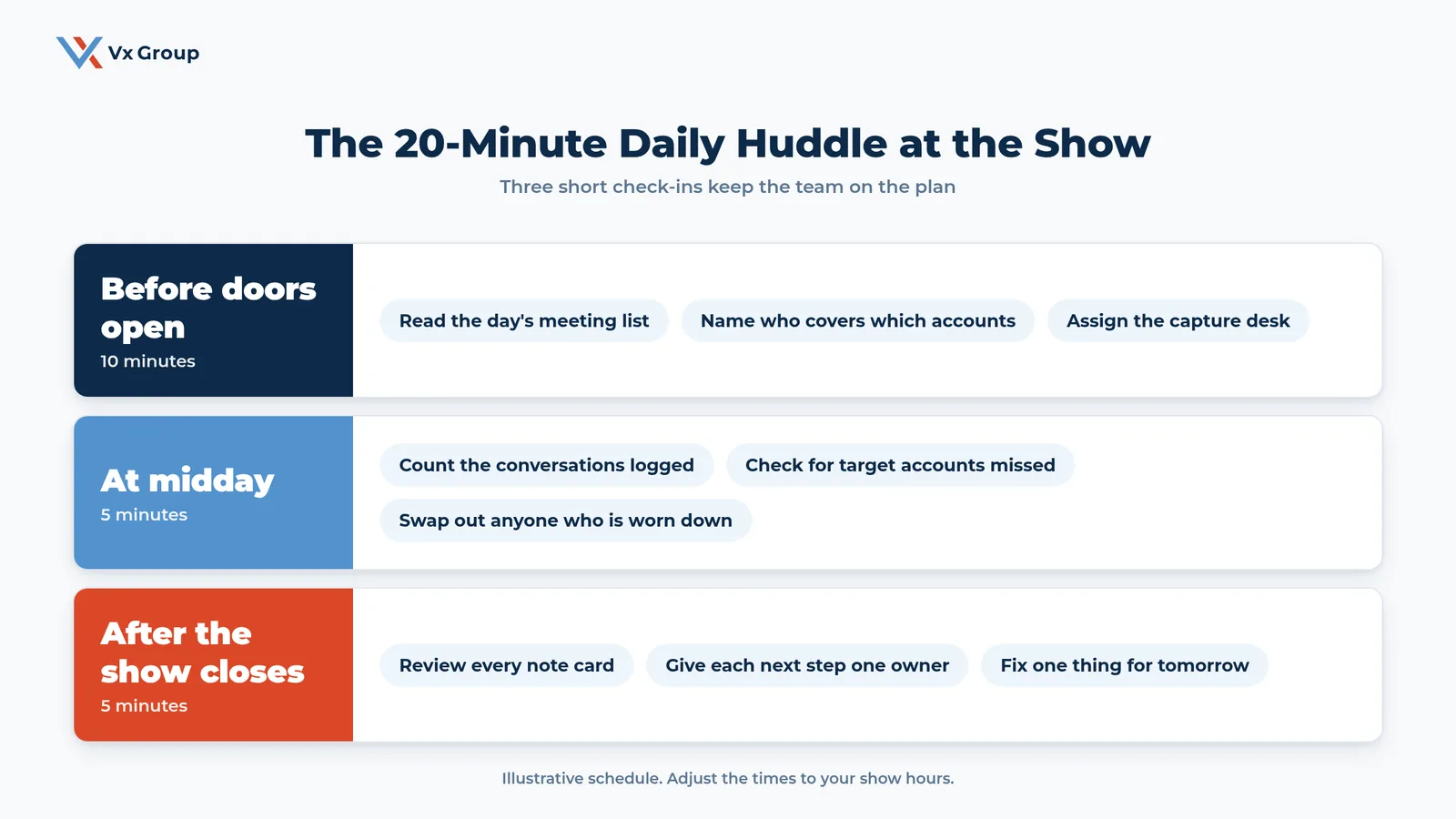
The schedule above shows what each check-in covers. The sales lead runs it, and everyone on the booth attends. It is short on purpose, because nobody wants a long meeting between show hours.
Open the day by reading the meeting list
Before the doors open, read the day’s list of accounts and scheduled meetings. Say who covers which accounts. Assign the capture desk. Ask each person if they have a question about the brief.
This takes ten minutes and sets the day. People who know their job in the first hour act differently from people who figure it out at noon.
Check in at midday
At midday, count how many conversations were logged. Check whether any target accounts have come by. If not, ask whether someone should go find them. Notice who is tired and give them a break.
This check catches problems early. If the card count is low, the team may be getting stuck in long conversations. If a key account has not shown up, you can send a message while there is still time to meet.
Review every card after the show closes
After the show closes, read every card out loud or pass them around. Give each next step an owner if it does not have one. Pick one thing to fix for tomorrow, such as moving the capture desk or changing an opening line.
One fix per day is enough. Small changes add up across a three-day show, and the team feels the booth improving as they go.
How do you run a role-play session before the show?
Run a 45-minute role-play session about a week before you travel. Pair people up, give each pair a short scenario, and have them practice the opening line, the follow-up question, the exit or handoff, and the note card. Rotate roles so everyone plays the visitor at least once.
Role-play feels awkward the first time. It also finds problems that a briefing never will, like an opening line that sounds odd out loud.
Use these four scenarios:
- A current customer walks up and asks about a delivery date.
- A buyer from a target account asks for a price on a product you carry.
- A student asks detailed questions and wants a sample.
- A visitor keeps talking and the next person is waiting.
For each scenario, one person plays the visitor and one plays booth staff. A third person watches and writes down one thing that worked and one thing to change. Run each scenario for about five minutes, then switch.
At the end, ask the group what felt hardest. The answer is usually the exit. Spend the last ten minutes on that one.
Invite your engineers and operations people. Some will say “I’m not a salesperson,” and that is fine. They need a job to do on the booth, and this gives them one.
What mistakes do manufacturers make when training booth staff?
The most common mistakes are sending staff with no brief, training only the sales team, skipping the exit line, and measuring the show by badge scans. Each one is easy to fix with the steps above.
- No brief. Without it, the team defaults to answering questions for whoever walks up.
- Training only the sales team. Engineers and operations leaders often talk to the most interesting visitors, so they need the same training.
- No exit line. Staff get stuck in long, friendly conversations and miss the visitors on the list.
- No capture standard. Good conversations vanish by Monday.
- Too many products. A crowded booth gives staff and visitors too much to talk about.
- One long training session. A single two-hour lecture fades by the time the show starts. A short briefing and a role-play session work better.
Each fix costs a few hours of preparation and no extra budget. Our guide to trade show budgets shows how much a show costs once travel, shipping, and staff time are counted, which is a good reason to prepare the team.
How do you tell whether the training worked?
Compare your next show with your last one on four numbers. Count the qualified conversations your team logged and the target accounts you met. Then count the cards with a next step and an owner, and the next steps that happened within two weeks. The cards give you everything you need to count.
Badge scans tell you how busy the booth was. The cards tell you which relationships started. Our article on trade show metrics covers these measures in more detail, and our piece on trade show ROI explains how to connect them to revenue.
Review the numbers with the team within two weeks of the show. Share what went well and pick one change for the next show. Teams that see their own results tend to keep the habits.
If you are still deciding which shows to attend, our guide on whether B2B trade shows are worth it can help you choose. For the wider picture of how events fit into your growth plan, see our article on B2B event marketing.
Where should you start?
Start with the brief. Before your next show, write the one-page booth brief, hold a 45-minute role-play session, and bring a stack of note cards. That is about three hours of work for a team that will spend days on the floor.
Then run the daily huddle at the show and review the cards after. Next time, you will have a record of what worked and a team that knows its job.
If you want help, Vx Group works with owner-led manufacturers on how their people show up at shows and what happens after.
Ready to grow?
Bring your show calendar and your team list and we will help you build a plan.
FAQs
About the Author: Jacob Camhi
