

Partner Enablement: Giving Channel Partners a Reason to Sell You

Partner enablement is everything a manufacturer gives a distributor or rep so they can sell and support its product easily. That means training on the product and its uses, help building correct quotes, support on live deals, and materials that show the product to customers. It works when a partner can quote your product without calling you.
TL;DR
- Partner enablement covers four things: product and application training, quoting and configuration support, deal support, and marketing material with lead flow.
- Most programs count portal logins and training-day attendance. Those numbers measure activity. A program can score well on them while partners still call the factory for every quote.
- Write one response-time promise for each kind of partner request, name the person who owns it, and report how often you keep it.
- Tier enablement by what each partner sells. Occasional sellers get a self-serve kit. Steady sellers get a quarterly session and quote checks. The largest sellers get named factory contacts.
- Four numbers show whether enablement worked: people trained and current, quote accuracy, time to first quote for a new partner, and deal support answered inside your promise.
- A channel partner training platform is one line in the budget. The bigger cost is the factory time behind it.
- Review enablement once a year. Pull the four numbers by tier, ask partners what they used, drop what nobody touched, and reset the promises.
What this guide covers
- What is partner enablement?
- Why does partner enablement matter to an owner who sells through distributors and reps?
- What does partner enablement cover?
- How do you set response-time commitments partners can hold you to?
- How do you tier enablement by partner value?
- What should a new partner receive in the first 30 days?
- How do you measure whether partner enablement worked?
- How much does a channel partner training platform cost?
- What does the annual enablement review cover?
- What mistakes make partner enablement fail?
- Where should an owner start this week?
A distributor’s inside salesperson has forty product lines on a price list. A customer is on the phone and needs a quote by end of day. Yours is one of the forty. If they can quote your product in ten minutes, you get the quote. If they have to call your factory and wait for a callback, the customer gets a quote on a line that answered faster.
Most manufacturers think they have this covered. They have a partner portal, a library of PDFs, and a training day each spring. Then they judge the program by logins and attendees. We call this the activity illusion. The dashboard looks busy, and the partner still phones the factory to ask which option changes the price.
This guide shows the owner of a private manufacturer how to build enablement so a partner can quote alone. It covers the four kinds of enablement, response-time promises, tiers, the four numbers that show it worked, platform cost, and the annual review. It builds on our guides to channel sales strategy and to building a channel partner program.
What is partner enablement?
Partner enablement is the work of giving distributors, reps, and resellers the knowledge, tools, and support to sell and service your product without calling you. It starts when a partner signs. It continues as long as the partner sells your line.
Defined term. Partner enablement.
Everything a manufacturer gives a channel partner so it can sell and support the product easily. It covers product and application training, quoting and configuration support, deal support, and marketing material with lead flow.
The top-ranking pages for this term mostly come from software vendors. They tend to define enablement around a platform, meaning a portal with courses, content, and deal tools. That fits a technology company whose partners sell software. A manufacturer with distributors and reps needs application knowledge, configuration help, honest lead times, and a person at the factory who answers the phone.
Partner enablement also differs from sales enablement in who it serves. Sales enablement helps your own salespeople. They work for you, sit in your CRM, and attend your meetings. Partner enablement helps people who work for another company and carry other lines. You have no say over their time, so your product has to be the easiest one on their list to sell.
Why does partner enablement matter to an owner who sells through distributors and reps?
Partner enablement matters because a partner sells the easiest line first. Partners carry many lines. The ones that answer fast, quote cleanly, and bring a factory expert to a hard job get the partner’s attention. The rest sit on the line card.
An owner feels this in four places:
- Revenue depends on people you may never meet. The partner’s salesperson decides what the customer hears about your product. Your own team may never be on the call.
- Every factory call costs two people time. Your engineer stops work to answer, and the partner loses time on the deal. Some partners stop calling and quote a competitor instead.
- A slow start tends to stay slow. A new partner who cannot quote in the first month rarely quotes much in the sixth.
- Knowledge leaves with people. When the one partner salesperson who understood your product moves on, the account goes quiet.
Many owners carry the key partner relationships personally. That works while the owner answers every call. It stops working when the partner’s staff changes, when your own sales lead is on vacation, or when the channel grows past what one person can cover. Enablement writes down what the owner knows so partner salespeople can use it. Systems protect the relationships here, because the relationship no longer depends on one phone number.
Our guide on what a channel partner is defines the partner types. Enablement helps any of them sell more.
What does partner enablement cover?
Partner enablement covers four categories: product and application training, quoting and configuration support, deal support, and marketing material with lead flow. Each one lets a partner do one specific thing alone.
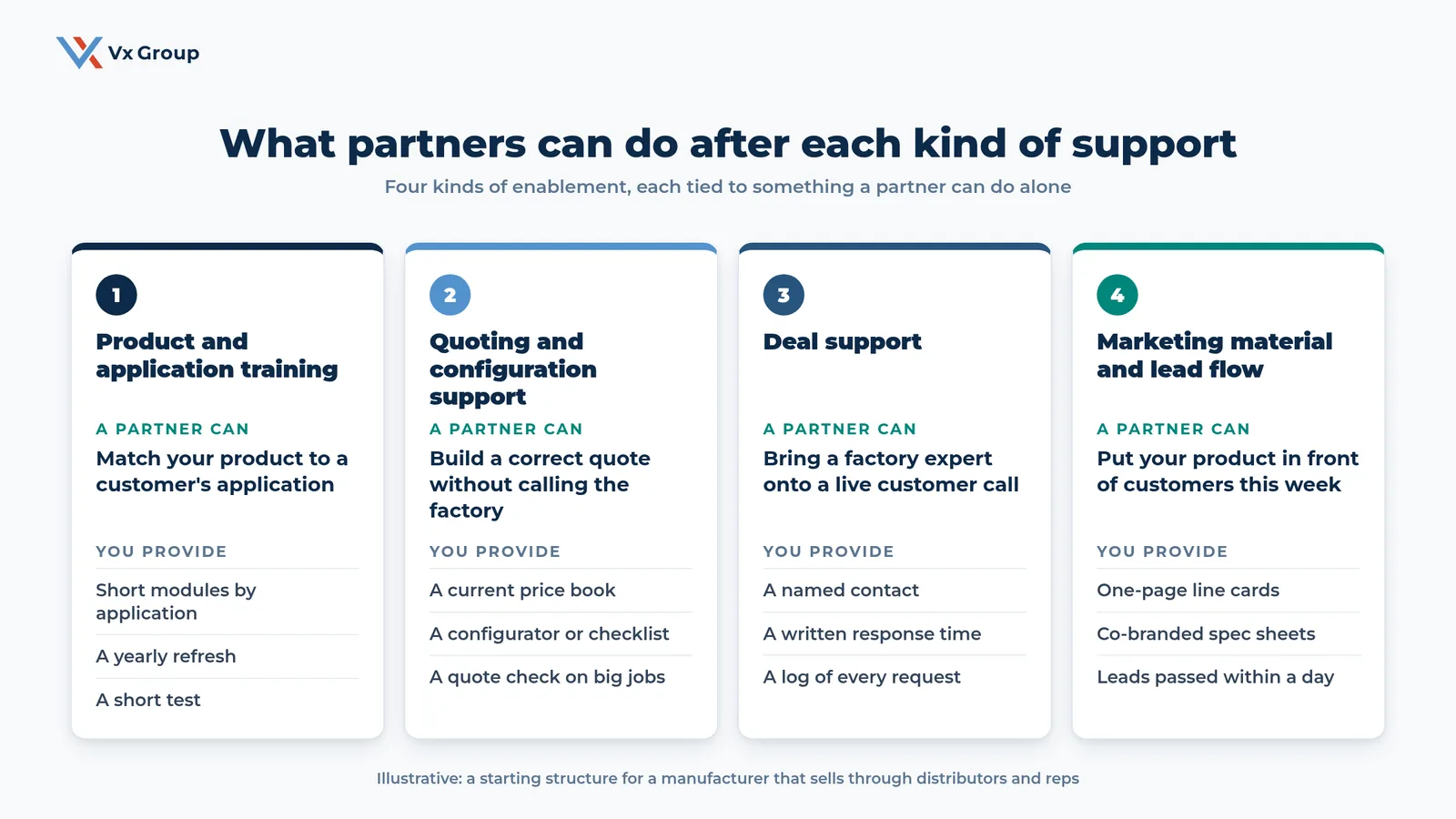
The graphic pairs each category with what the partner can then do. Training lets a partner match your product to a customer’s application. Quoting support lets a partner build a correct quote. Deal support brings a factory expert onto a live call. Marketing material shows your product to customers this week.
Build product and application training around the customer's job
Organize training by application. A partner’s salesperson meets a customer who needs to move a thick slurry at a set flow rate. The product series number means little to that customer. List your eight to twelve most common applications and build one 15-minute module for each.
Every module holds four things: the customer’s problem in the customer’s words, the three questions that qualify the job, the product that fits, and the two products that look similar but fit worse. End each module with a five-question test. Update the modules once a year. Add one whenever a new application starts to show up in quotes.
Give partners a way to quote without calling you
Pull the last 50 partner calls and emails and sort them by question. The five questions that come up most become your quoting kit. The kit holds a current price book, a one-page checklist of the options that change price or lead time, and a worked example for each of your three most common orders.
Add a quote check for large jobs. A partner emails the draft quote, and an engineer replies by the next business day with corrections. Each correction shows a gap in the kit. Fix the kit and the same question stops coming.
Staff deal support with named people and one request form
Deal support is factory help on a live customer deal. That can be an application engineer on a call, a custom quote, a sample, a site visit, or a comparison against a competing product. Give partners one form or one email address for every request. Name the person who owns each type.
Log every request with its date and the date of the answer. The log feeds the response-time numbers later in this guide. It also shows which partners ask for the most help.
Hand partners materials they can send today
Build one-page line cards by application, co-branded spec sheets, photos, and short stories from real customers. Add an email template a partner can send to a customer in two minutes. Put specs in text a partner can copy into a quote. An 80-page PDF catalog slows every search.
Lead flow belongs in this category too. When a customer asks about your product on your website or at a trade show booth, pass the lead to the right partner within one business day. Attach the contact’s history. Our guides to channel marketing for manufacturers and distributors and market development funds cover the funding and campaigns that go with these materials.
How do you set response-time commitments partners can hold you to?
Set response-time commitments by writing one promise for each kind of partner request, naming the person who owns it, and reporting how often you keep it. Speed of your answer matters to partners more than any single document, because the customer is waiting.
Write one promise for each type of request
Start from the request types in your log. The table below shows an example set of promises. The times are starting points only. Set yours from the staff you have. Promise only what the team can deliver every week.
| Request type | Example promise | Owner |
|---|---|---|
| Price or availability check | Same business day | Customer service |
| Quote check on a configured product | Next business day | Application engineer |
| Application question | Within 2 business days | Application engineer |
| Custom or special request | Written reply in 3 business days with a date for the full answer | Product manager |
| Lead passed to a partner | Within 1 business day | Marketing |
Name an owner and a backup for each promise
Write a person’s name beside every promise. Add a backup name for vacations and trade shows. A promise owned by a department tends to go unanswered, because everyone in the department assumes a colleague has it. Put the promises and names on one page and send it to every partner.
Log every request and report the result each month
Record each request with the date received and the date answered. Once a month, count the requests answered inside the promise and divide by all requests. Share the number with your team. Share it with partners each quarter. A promise you break without saying so teaches partners to stop asking.
Ready to grow?
Bring your partner list and your last twenty partner questions, and we will help you sort them into the four categories and set your first response promises.
How do you tier enablement by partner value?
Tier enablement by what each partner sells. Give the largest sellers the most factory time. Give occasional sellers a self-serve kit. Tiers keep a small enablement team from spreading its time evenly across every partner when a handful carry most of the revenue.
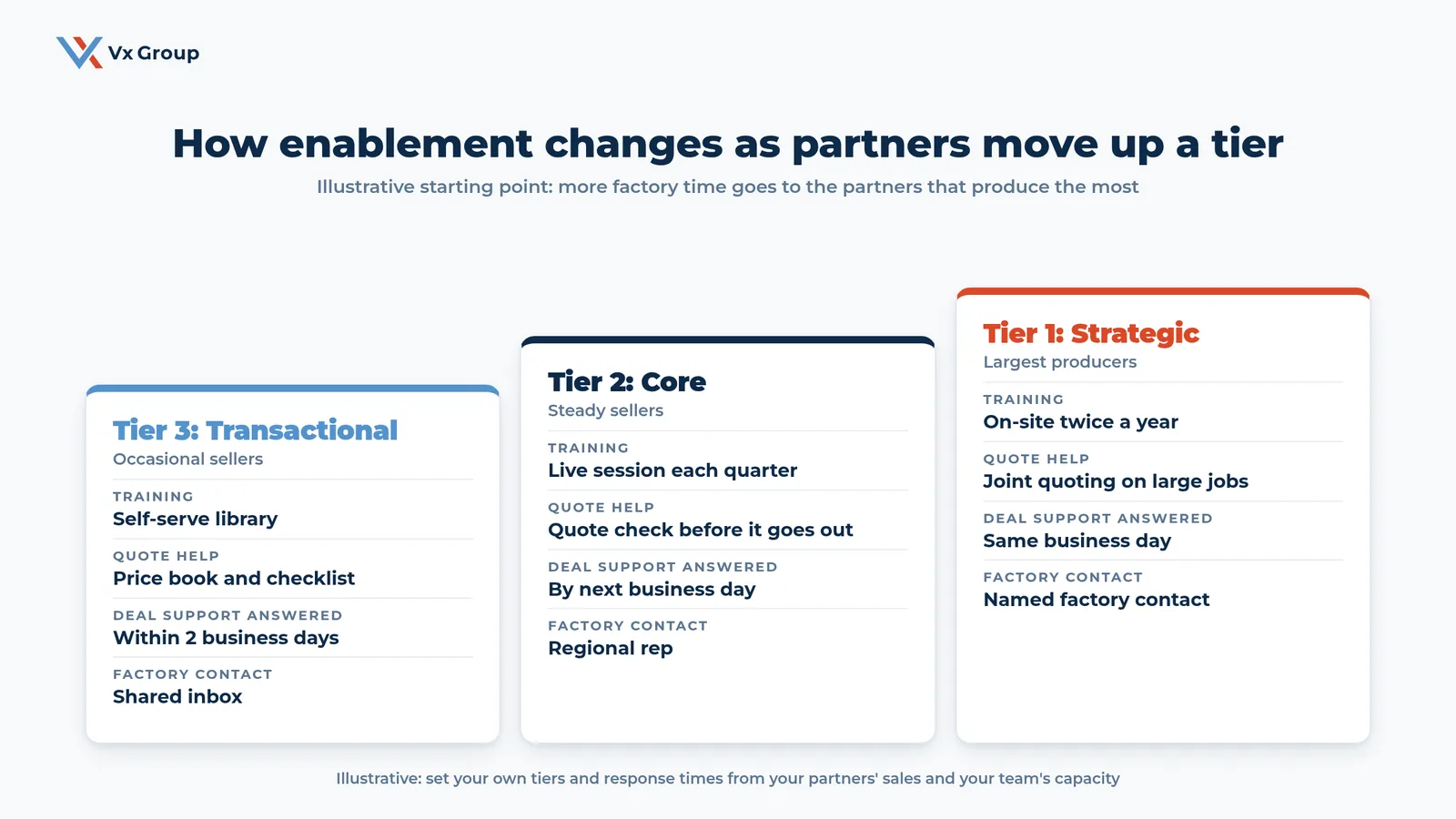
In the staircase above, each step up adds factory time. Transactional partners get a self-serve kit and a two-business-day answer. Core partners add a quarterly live session and a next-day answer. Strategic partners add on-site training and a same-day answer.
Rank partners by what they produce and what they could produce
List every active partner with its sales of your product over the last 12 months. Add a second column for what the partner could sell, using its total sales in your category if you can learn it. Sort by the first column and draw lines where the sales drop sharply. Most channels fall into three groups. Your own sales report shows how steep the drop is.
Assign enablement to each tier in one table
Write the package for each tier on one page. The table below is an example. It follows the staircase and adds marketing support.
| Tier | Training | Quote support | Deal support answered | Factory contact | Marketing |
|---|---|---|---|---|---|
| Strategic | On-site twice a year, plus the quarterly session | Joint quoting on large jobs | Same business day | Named factory contact | Joint account plan, co-branded campaigns |
| Core | Live session each quarter | Quote check before it goes out | By next business day | Regional rep | Line cards and co-branded sheets |
| Transactional | Self-serve library | Price book and checklist | Within 2 business days | Shared inbox | Standard line cards |
Move partners between tiers on a set date
Review tiers once a year on a set date, using rules the partners can read. A partner that moves up gets the next tier’s package right away. A partner that moves down gets a conversation first. Our guide to distributor management covers how to run that talk and the scorecard behind it.
What should a new partner receive in the first 30 days?
A new partner should get a price book, a named contact, and the first training modules in the first week. They should send a first correct quote within 30 days. The first month sets the habit of calling you or quoting alone.
| Week | What the factory provides | What the partner can do afterward |
|---|---|---|
| Week 1 | Signed agreement, price book, named contact, product test access | Find a price and a contact without asking |
| Week 2 | The first two application modules and a live call with an engineer | Qualify a job in the two top applications |
| Week 3 | Review of a practice quote | Build a quote that needs no correction |
| Week 4 | A joint call on a real customer opportunity | Send a first live quote |
Time the gap between the signed agreement and the first correct quote. That number is the third measure in the next section.
How do you measure whether partner enablement worked?
Measure partner enablement by counting what partners can do. Four numbers cover it: people trained and current, quote accuracy, time to first quote, and deal support answered on time. None of them comes from the portal.
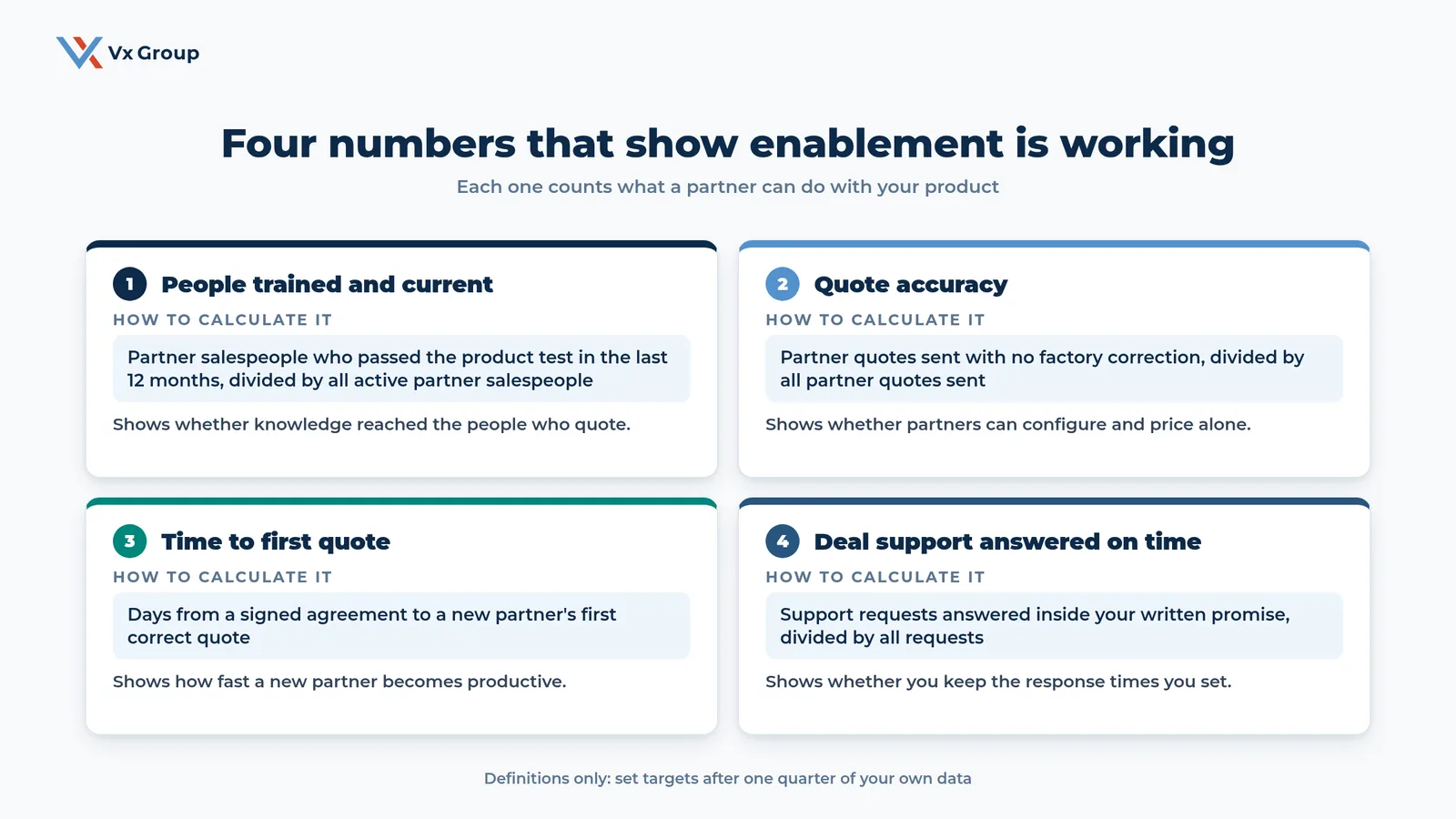
The graphic gives the formula for each number. Together they show whether knowledge reached the people who quote, whether their quotes come out right, how fast a new partner starts selling, and whether you keep your own promises.
Count the people who are trained and current
Divide the partner salespeople who passed the product test in the last 12 months by all active partner salespeople. Count only people who passed. Attendance at a training day says who sat in the room. The test result says who can quote.
Sample quote accuracy every month
Pull ten partner quotes each month. Mark each one as sent with no factory correction, or as corrected. Divide the first group by ten. Ten quotes take about an hour to review and give you a trend. Each corrected quote shows you a question to add to the quoting kit.
Time the first quote of every new partner
Record the number of days from the signed agreement to the partner’s first correct quote. The 30-day goal in the last section is a target. Your own history gives the real starting point, so use it.
Report deal support answered on time
Take the log from the response-time promises and divide the requests answered inside the promise by all requests. Report it by tier. A same-day promise to strategic partners is harder to keep than a two-day promise to transactional ones.
Set a baseline for one quarter before setting targets
Collect the four numbers for one full quarter before you set a target for any of them. The first quarter’s numbers will likely look worse than you expect. They give you the starting point for the first annual review.
Field notes.
Example only, with no real client behind it. A manufacturer of industrial filtration products sells through 38 distributors. Its portal shows 1,900 logins in a quarter. The spring training day drew 60 people. The owner pulls ten partner quotes at random and finds that six needed a correction from the factory. The last three new partners took between 90 and 140 days to send a first quote. The team replaces the PDF library with eight application modules and a one-page configuration checklist. They promise same-day answers on price checks and start logging every partner request. The owner now reads the four numbers before each Monday sales meeting.
How much does a channel partner training platform cost?
Vendors rarely publish prices for channel partner training platforms. Quotes vary with the number of partner users, the features, and the contract length. The useful answer is a way to price your own case. The biggest line in that budget is usually your own people.
Start with the tools you already own
A manufacturer with a few dozen partners can run all four categories before buying anything. A shared folder holds the price book and line cards. Recorded video calls hold the modules. A free quiz form holds the product tests. A shared inbox with a log handles deal support. Show that partners use the modules before you pay for a place to host them.
Price a platform by partner users and features
When you do shop, ask each vendor for a quote built the same way. These questions let you compare quotes:
- How many partner users does the price include, and what does each added user cost?
- Is the price per user, per partner company, or a flat annual fee?
- What do setup, content loading, and training cost on top?
- Does it connect to your CRM and your quoting tool?
- How long is the contract, and what does it cost to leave?
- What does the price become at twice the number of users?
Budget the people cost first
A platform with no one to write modules and answer requests is an empty library. Estimate the weekly hours your application engineers, customer service team, and marketing lead will spend on modules, quote checks, and deal support. Multiply by their loaded hourly cost. That figure usually exceeds the software fee. Compare it to the value of the partner sales you expect.
What does the annual enablement review cover?
The annual enablement review has four steps: the four numbers by tier, a talk with partners about what they used, a list of what to drop, and a reset of tiers and promises. Run it once a year at a set time, with the owner or president in the room.
Pull the four numbers by tier
Show people trained and current, quote accuracy, time to first quote, and on-time deal support for each of the three tiers. Compare each with last year. A tier where the numbers fell is where to look first.
Ask ten partners what they used
Call ten partners across the tiers and ask one question: “Which three things from us did you use in the last quarter?” Their answers show which materials belong in the kit. Note the items nobody names.
Drop what nobody used
List every module, sheet, and form. Mark the ones no partner named and the logs show nobody opened. Drop them. A smaller kit is easier to keep current, and partners trust a kit with no outdated pages.
Reset tiers and promises, then tell partners what changed
Move partners between tiers using the rules you published. Update the response promises to match your staffing. Send partners a one-page summary of what changed and why. Our guide to channel conflict explains why partners react badly to changes in how you treat them that they were not told about.
What mistakes make partner enablement fail?
Partner enablement fails for seven common reasons:
- Measuring logins and attendance. These count activity. A partner can log in daily and still call the factory for every quote.
- Organizing training by catalog. Partners meet customer applications. Training that follows your product numbers follows the wrong order.
- Promising response times the team cannot keep. One missed promise costs more trust than a longer promise that you keep.
- Giving every partner the same package. The largest sellers get too little attention. The occasional sellers get more than they use.
- Treating enablement as a launch event. A training day in spring is forgotten by summer. Modules need a yearly update.
- Burying specs in a PDF catalog. A partner short on time quotes the line whose specs are easy to find. Our PDF SEO guide shows how to put specs where people can search them.
- Setting prices that partners cannot defend. Enablement cannot fix a margin that leaves the partner nothing. Our guide to distributor pricing strategy covers the margin side.
Where should an owner start this week?
Start by pulling the last 50 questions your partners asked and sorting them into the four categories. The sorted list shows which category costs you the most calls. Build that one first.
Next, write the response-time promises for your three most common request types and put a name beside each one. Then pick your top application and build its first 15-minute module, with the test at the end.
Within a month you will have a quoting kit draft, three promises with owners, and one module. That is enough to start measuring. The first quarter of numbers will show you what to build next.
The partners who sell the most of your product are the ones who find it easiest to sell. Enablement makes your product easy to sell on purpose. For the wider channel decisions around it, see our guide to B2B channel strategy.
Ready to grow?
Bring your partner list and your last quarter of partner questions, and we will map your first enablement kit and response promises with you.
FAQs
About the Author: David Tisdale
