

What Is a Channel Partner? Types, Roles, and Why the Relationship Matters

A channel partner is a company that sells, resells, or delivers your product to end customers through its own relationships, extending your reach without you owning the customer contact. Common types include resellers, distributors, value-added resellers (VARs), referral partners, and strategic alliances, each trading a share of margin for reach you cannot build alone.
TL;DR
- A channel partner sells, resells, or delivers your product to its own customers, in exchange for margin, fees, or services revenue.
- The five main types are resellers, distributors, VARs, referral/affiliate partners, and strategic alliances.
- A channel partner differs from a direct sales rep because the partner owns the customer relationship.
- Channel partners make money through margin, referral fees, or services revenue, sometimes all three at once.
- The relationship works when you actively protect the partner’s ownership of their own customer.
Most companies that build a channel partner program run it like a distribution pipe. They sign enough partners, ship enough product through them, and expect growth to follow on its own. That approach produces a roster of partners who list your product on a data sheet and only sell it when a customer asks for it by name. The partners who move real volume are the ones a company develops the same way it develops a top house account: with attention, a fair deal, and a real relationship.
The pattern shows up the same way across industries. A manufacturer signs forty dealers at a trade show and calls it a channel strategy. Two years later, five of those dealers account for most of the revenue, and the other thirty-five have quietly stopped mentioning the product to their customers. The company blames the product or the market. The actual cause is almost always simpler: the five dealers that produce got a real relationship, and the other thirty-five got a price list and an annual email.
Defined Term: Channel partner.
A company that sells, resells, or delivers your product or service to its own customers through its own established relationships, in exchange for margin, a fee, or both. It operates as its own independent business, with its own customer base, staff, and priorities.
What are the main types of channel partners?
The five main types of channel partners are resellers, distributors, value-added resellers (VARs), referral or affiliate partners, and strategic alliance partners, and each fits a different sales motion and margin structure.
1. Reseller channel partners
A reseller buys your product and resells it under its own account, usually at a set discount off list price. It decides how to price, package, and present the product to its own customer base, and it carries the inventory risk. Common when the reseller already has an established customer base that trusts its recommendations. Example: an industrial equipment dealer that resells your components alongside its own machines, bundling both into a single quote.
2. Distributor channel partners
A distributor buys your product in volume, warehouses it, and resells it to a network of smaller resellers or dealers. Distributors add reach, inventory management, and local logistics a company would otherwise have to build itself, often across a region or country you do not have staff in. Example: a regional distributor that carries your product line to hundreds of independent dealers you would never reach one by one.
3. Value-added resellers (VAR)
A VAR resells your product bundled with its own services, integration work, or complementary products. It is selling a finished outcome for the customer, built around your product as one component of a larger package, and it usually owns the technical relationship with the end user. Example: a systems integrator that wraps your software into a larger automation package for a plant, handling installation and support directly.
4. Referrals or affiliate partners
A referral or affiliate partner introduces qualified buyers to you in exchange for a fee or commission when the deal closes, without handling the sale or delivery itself. This is the lightest-weight partner type to set up and the easiest to end, which also makes it the easiest for a partner to walk away from if the relationship goes cold. Example: a consultant who works inside your target accounts and refers you in when the timing is right, staying involved as a trusted advisor through the sale.
5. Strategic alliances
A strategic alliance is a deeper, often non-transactional partnership between two companies that serve the same customer base, built around joint go-to-market activity, co-selling, or shared product roadmaps. Neither company resells the other’s product outright; the value comes from shared access to accounts and credibility each company has already earned. Example: two vendors who serve the same manufacturing plants agreeing to introduce each other into new accounts and co-present at industry events.
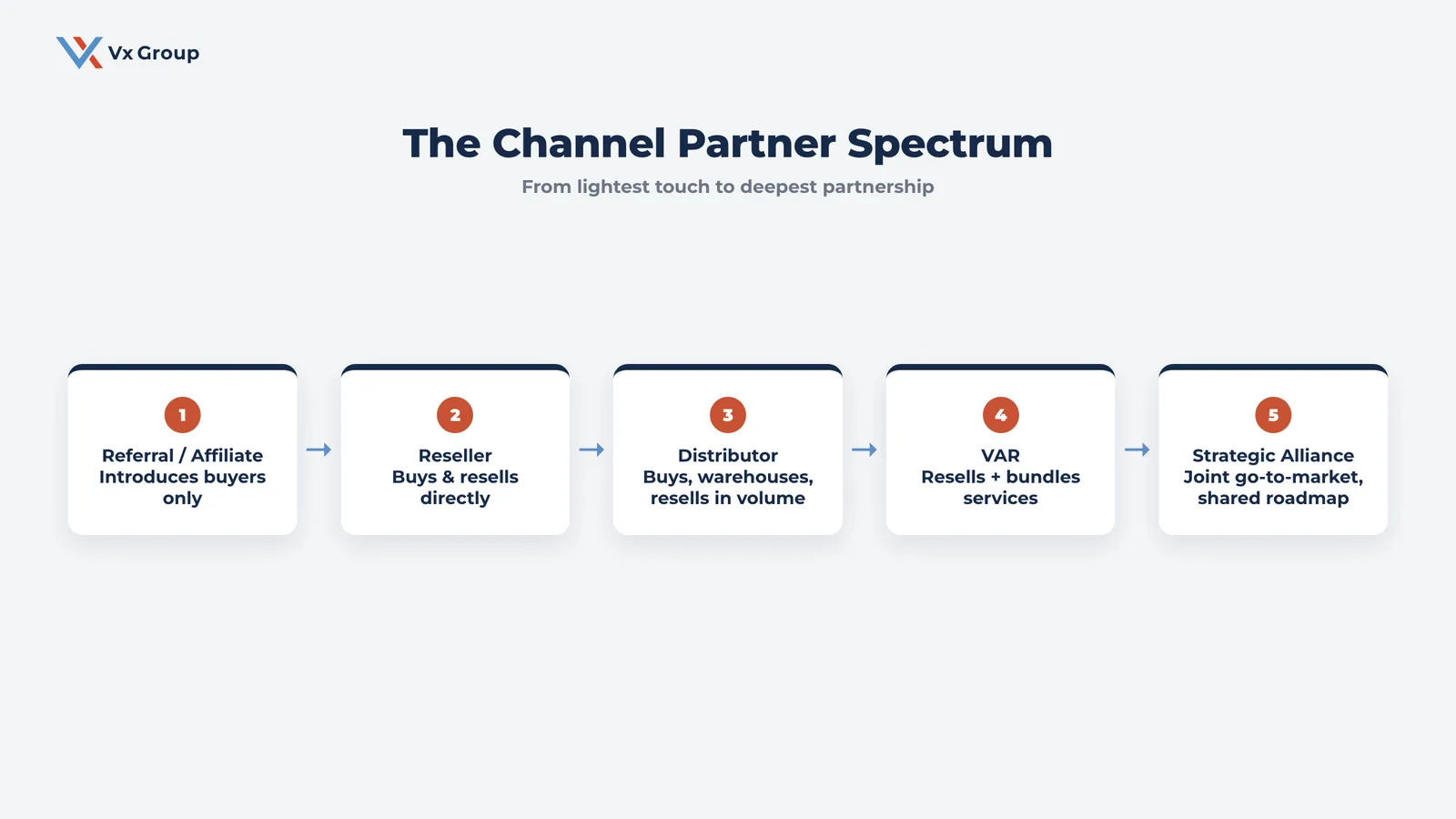
Most established B2B companies do not pick one type and stop there. A manufacturer might run distributors for its core product line, add a handful of VARs for the accounts that need heavier integration work, and layer in a small referral network of consultants who touch its target accounts before a formal sales process even starts. Each type serves a different reach problem, and treating the channel as a single program with one set of rules is usually the first mistake, before the relationship even gets tested.
The types also shift over the life of the relationship. A referral partner who keeps sending well-qualified deals often earns a formal reseller agreement once the volume justifies it. A VAR that starts wrapping in more of its own intellectual property around your product can graduate into something closer to a strategic alliance, adding joint marketing and a shared roadmap conversation on top of the original resale contract. Reviewing which partners have outgrown their current agreement on a set annual schedule is one of the simpler ways to keep the best relationships current with the value they have actually built.
The table below lines up the five types against who owns the customer and how each one gets paid, which is usually the fastest way to see which type fits a given growth plan.
| Type | Who owns the customer | How it typically gets paid |
|---|---|---|
| Reseller | The reseller | Margin on resale |
| Distributor | The dealer network below it | Margin, often at volume-based tiers |
| VAR | The VAR, through the bundled service | Product margin plus services revenue |
| Referral / affiliate | You | A flat fee or percentage of the deal |
| Strategic alliance | Shared or each company’s own | Indirect, through new pipeline each side generates |
For manufacturers and distributors building this out at scale, see Channel Marketing for Manufacturers and Distributors. For a deeper breakdown of how to build a full partner program around these five types, see Channel Partner Marketing: How to Drive Revenue Through Partners.
How is a channel partner different from a direct sales rep?
A channel partner owns the relationship with its own customer and works for itself, while a direct sales rep works for you and sells inside a relationship your company owns. That single difference changes how much control you have, how the economics work, and how much reach you can add without hiring.
| Direct sales rep | Channel partner | |
|---|---|---|
| Employment | On your payroll | Runs their own company |
| Customer relationship | You own it | The partner owns it |
| Reach | Limited to the team you can hire and manage | Extended through relationships you did not have to build |
| Cost | Salary, benefits, and a quota | Margin, referral fee, or services revenue |
| Product focus | Sells only your product, full time | Splits attention across their own product or service line |
| Ramp time | Weeks to months, with training you control | Immediate, if the partner already has the trust of the account |
Neither model is better in the abstract. A direct sales team gives you control and focus: you set the process, you own the pipeline data, and you can redirect that person’s time the day priorities change. A channel partner gives you reach into relationships that would otherwise take years to build on your own, at the cost of that same control. You cannot dictate a partner’s daily priorities the way you can an employee’s, and you are always competing for a share of that partner’s attention against every other line they carry.
Weighing direct vs. channel?
See how the two models compare for your sales cycle, margin structure, and growth stage.
Most relationship-driven B2B companies with a long sales cycle end up running both. A direct team covers the accounts large enough to justify dedicated attention and the strategic relationships the company wants to own outright. A partner network covers the reach a direct team cannot economically cover: geographies, industries, or customer segments where someone else already has the trust that would take years to build from scratch.
The cost comparison usually favors the channel more than founders expect. Hiring, training, and carrying a direct rep in a new territory can take a year or more before that person produces meaningful revenue, and the company absorbs the full cost the entire time. A channel partner in that same territory is often already selling to the exact accounts a direct hire would spend a year trying to meet. The tradeoff is that the partner’s attention has to be earned and re-earned continuously, where an employee’s attention comes with the job.
How do channel partners make money?
Channel partners make money three main ways: margin on resale, a referral or finder’s fee, and revenue from the services they wrap around your product. Most partner programs use one of these as the primary structure and layer the others on top.
1. Margin on resales
The partner buys at a discount off list price, or gets a set percentage back, and keeps the difference when it resells. A common structure might set a distributor’s discount at 30 to 40 percent off list, with a smaller reseller below them earning 15 to 20 percent. Those figures vary widely by industry, and the structure matters more than the specific number. This is the standard model for resellers and distributors.
2. Referral or finder’s fees
The partner gets paid a flat fee or a percentage of the deal, commonly somewhere between 5 and 20 percent of first-year contract value, for introducing a qualified buyer, without ever touching the product itself. This is the model for referral and affiliate partners.
3. Service Revenue
The partner charges the end customer separately for installation, integration, training, or support wrapped around your product. VARs and strategic alliance partners often earn more from services than from the product margin itself, which is part of why they invest more heavily in the customer relationship than a pure reseller does.
What are rebates and co-marketing funds (MDF)?
Many programs add volume rebates or marketing development funds (MDF) on top of the base structure, paid when a partner hits a target or invests in joint marketing activity like a co-branded event or a case study.
Defined Term: Marketing development funds (MDF).
Money a company sets aside for its channel partners to spend on joint marketing activity, such as local advertising, trade show presence, or co-branded content, usually calculated as a percentage of the partner’s purchase volume.
The mistake companies make here is designing the incentive around what is easiest to track, like units sold, without connecting it to what actually builds a durable partnership: the customer’s ongoing trust in that partner. A margin structure that only rewards volume trains partners to discount to hit a threshold, while a structure that also rewards renewal, referral, and expansion behavior builds a partner who protects your product long after the first sale.
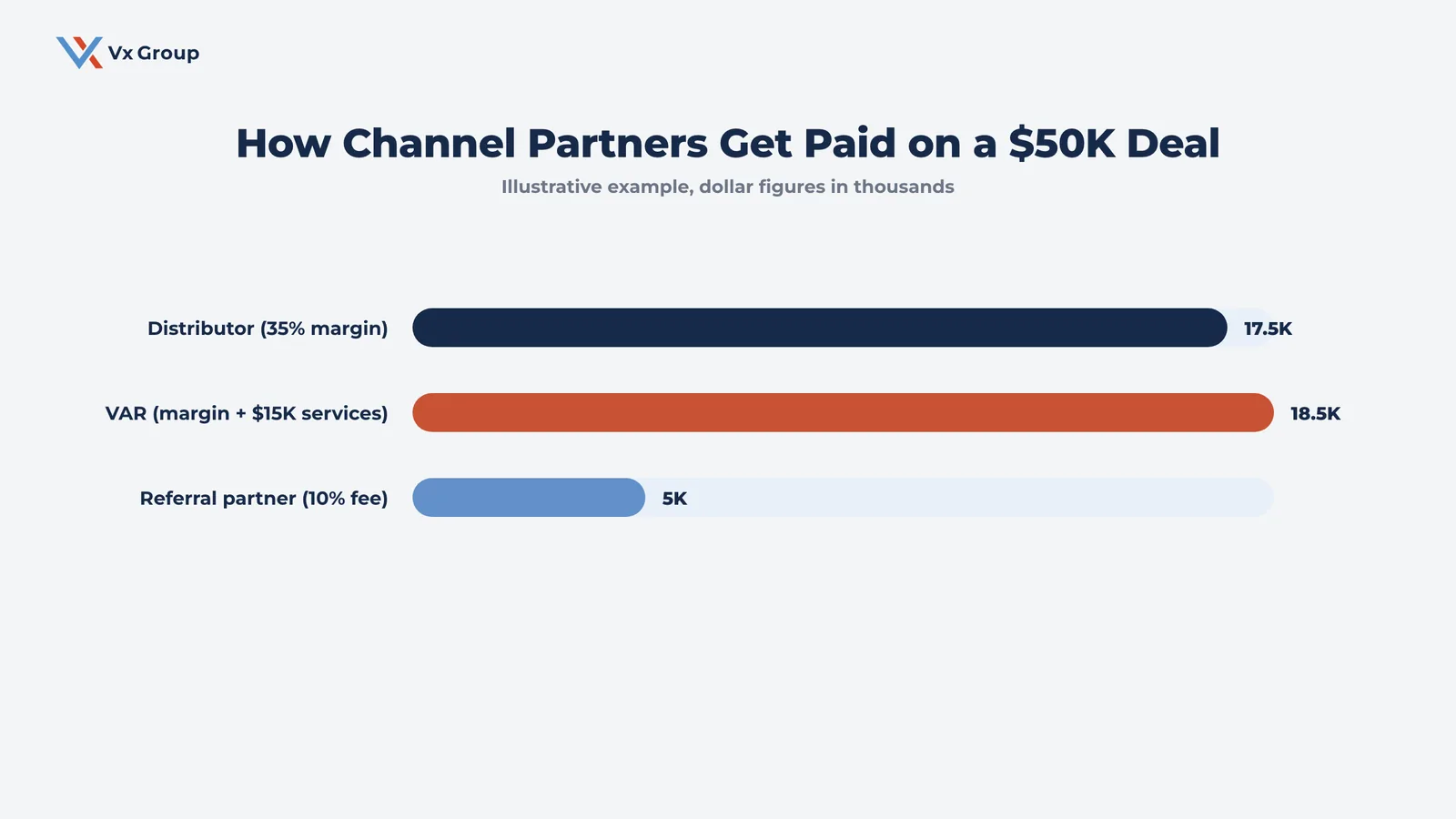
Here is roughly how the economics play out for a $50,000 deal, using illustrative figures to show the structure: a distributor buying at a 35 percent discount nets about $17,500 on the resale. A VAR earning a smaller 7 percent product margin (about $3,500) but bundling in $15,000 of integration work ends up with roughly $18,500 in total revenue, more than the distributor made, even though the product margin alone looked thinner. A referral partner earning a 10 percent finder’s fee walks away with $5,000 for a single warm introduction. None of these numbers are universal, but they show why a partner will always gravitate toward whichever line in its portfolio produces the best return for the least effort.
What makes a channel partner relationship work?
A channel partner relationship works when the economics are fair, the communication is regular, and the partner never has reason to worry that you will go around them to reach their customer directly. Weaken any one of those and the partner quietly deprioritizes your product for something easier to sell.
- A fair, transparent margin. The partner needs to make enough on the deal to justify the time. If a competitor’s line pays better for the same effort, that is what gets the partner’s attention.
- A real communication cadence. Quarterly business reviews, joint planning, and non-selling check-ins keep the relationship active. A partner who only hears from you when a renewal is due starts treating the relationship as transactional, the same way any neglected account would.
- Shared visibility into the account. Both sides should know what is happening in the relationship: what the customer needs next, what is at risk, and what is coming up for renewal or expansion. Without that visibility, both sides end up managing the same account from two different, incomplete pictures.
- Protected customer ownership. A partner needs confidence you will not use their introduction to build a direct relationship and cut them out later. One instance of that happening ends the trust for good, and it travels fast through a partner network, since most partners talk to each other. A single documented case of a company bypassing a partner will circulate through an industry’s partner community faster than any case study the company publishes about itself.
- A named owner on your side. Partner relationships that depend on whichever account manager happens to answer the phone fall apart the moment that person changes roles. The relationship needs to live in a system the company owns and everyone on the team can see.
None of this requires elaborate infrastructure. A shared spreadsheet with the partner’s account history, next planned touch, and open items can outperform an expensive portal that nobody logs into, as long as someone owns keeping it current. What actually matters is whether the relationship survives a staffing change on either side, which is the real test of whether a channel partner program runs as a system or simply as a habit that happens to work while the same two people stay in their jobs.
A short set of warning signs tends to show up well before a channel partner relationship actually collapses:
- The partner’s orders start arriving later in the quarter, a sign they are prioritizing something else early on.
- Quarterly reviews get shortened, rescheduled, or skipped entirely.
- A partner starts asking pointed questions about a competitor’s program terms.
- The same partner contact stops responding to non-selling outreach, such as a check-in that is not tied to an active deal.
Field Notes:
A distributor we worked with had carried a manufacturer’s product line for over a decade, built entirely on the relationship between one long-tenured account manager and the distributor’s owner. When that account manager retired, the manufacturer had no record of the account history, no documented cadence, and no other contact the distributor trusted. Orders slowed for two full quarters while a new rep rebuilt trust from zero, a gap that a shared, system-owned relationship would have prevented.
This is the same failure mode covered in B2B Channel Strategy: How to Grow Through Distributors and Partners: a channel built entirely on one person’s memory, with no system the company owns to fall back on.
Where this leaves your channel strategy
Go back to the manufacturer with forty dealers from a signed trade show list. The five dealers producing real revenue were never a mystery once someone looked closely: they had a named contact on the manufacturer’s side, a regular cadence, and clear economics that made the product worth prioritizing. The other thirty-five had a login to a partner portal and an email address on a distribution list. The fix was never about finding better dealers. It was about running the same kind of relationship for all forty that the top five already had.
A channel partner extends your reach into relationships you would spend years building on your own. The types differ and the economics differ, but the deciding factor is consistent: partners who sense they are a genuine priority keep selling, and partners who sense they are an afterthought find something else to sell instead.
Ready to grow?
See how a channel partner program should look for a business with your sales cycle and margin structure.
FAQs
About the Author: Jacob Camhi
