

What Belongs in a Distributor Agreement (and What Usually Gets Left Out)

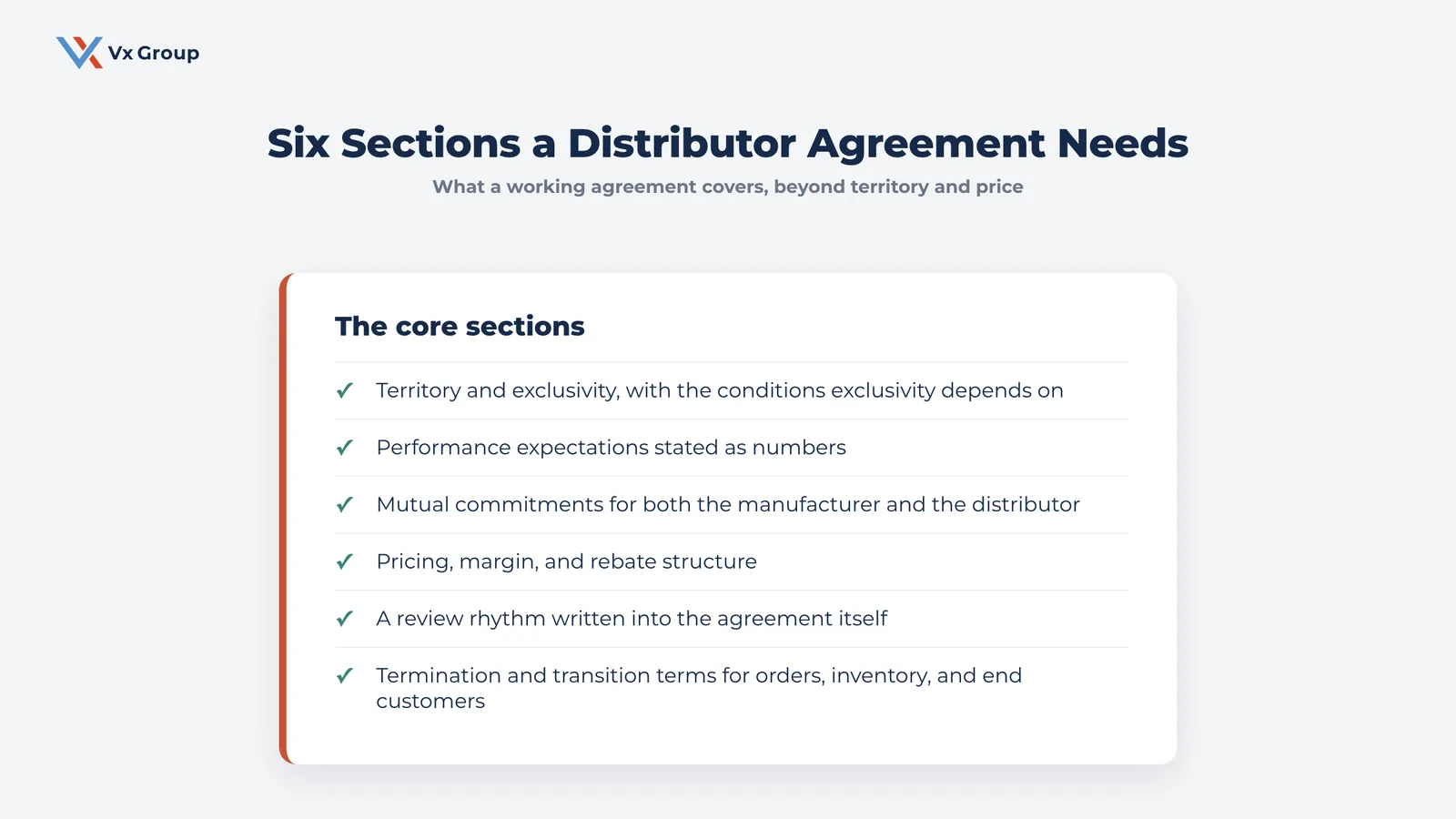
A distributor agreement needs six things to actually run a relationship: a territory and exclusivity section with a stated condition, performance expectations written as numbers, a two-column list of mutual commitments, a pricing and rebate structure, a review rhythm built into the contract, and a termination process that names what happens to open orders, inventory, and end customers.
TL;DR
- Most distributor agreements protect the manufacturer in a dispute and say almost nothing about how the relationship should run day to day.
- This article offers operational guidance for what to ask your attorney to build in. It does not constitute legal advice.
- Territory and exclusivity need a map plus a stated condition that keeps the exclusivity active.
- Performance belongs in measurable numbers on a schedule, specific enough to replace words like “best efforts.”
- Commitments run in two columns: what the manufacturer owes the distributor, and what the distributor owes back.
- Pricing, margin, and rebate structure need to show the math, including what triggers each rebate step.
- The review date belongs in the contract text itself, written in as a term both sides are bound to keep.
Pull up the distributor agreement most manufacturers actually have on file and it reads the same way almost every time. Territory, defined. Pricing, attached as an exhibit. Termination, thirty or sixty days’ notice. Somewhere in the middle sits a paragraph on indemnification that a lawyer added years ago to protect the company if something ever went wrong, and little else has changed since. It was probably drafted once, during onboarding, by whoever had a template handy, and it has not been opened since the ink dried.
What is missing is any description of how the relationship is supposed to work while things are going right. The agreement covers what happens in a dispute and stays silent on the calls, the reporting, the reviews, and the numbers either side is expected to hit. It sits in a drawer until someone reaches for it, and by the time someone reaches for it, the relationship the document was supposed to govern has already come apart. A contract that only gets opened during a dispute missed its chance to prevent one.
That gap is why Distributor Management covers a written standard for how a strong distributor relationship behaves, and this article covers the document that makes parts of that standard enforceable. The two work together. The standard sets the behavior day to day. The agreement puts the six sections below in writing, so the behavior has a paper trail when it matters.
A note on scope, before you go further:
The sections below describe what a distributor agreement should cover from a commercial and operational standpoint, written for the people who will run the relationship. This is not legal advice. Distributor agreements carry state franchise and termination law, antitrust exposure around exclusivity and pricing, and export or data terms that vary by product and territory. A qualified, licensed attorney should draft and review the actual contract before either side signs it, and nothing in this article is meant to be copied into a real agreement as finished contract language.
Step 1: Write the territory and exclusivity section
Territory is usually the one section every distributor agreement gets right in isolation and wrong in context. The map is clear. What is missing is the condition that keeps the map current.
Define the territory in terms that hold up later
A territory clause needs a specific boundary, defined by states, zip codes, named accounts, or a product line, specific enough that two people read it the same way two years from now. If the distributor’s coverage is limited to one vertical inside the region, say so in the same sentence as the boundary, so the scope is never left to memory.
Tie exclusivity to a performance condition
Exclusivity granted with no strings attached becomes a liability the moment performance drops, because the manufacturer ends up defending a territory the distributor has stopped working. Write exclusivity as conditional: tied to a minimum volume, a minimum number of active accounts, or a call frequency, reviewed on the same schedule as the performance numbers in Step 2. State what happens when the distributor stops hitting the condition, whether that is a cure period, a shift to non-exclusive status, or a defined path to adding a second distributor in the territory.
State what happens when territory changes
Territories change. A distributor gets acquired, a manufacturer opens a new product line, a named account moves its headquarters across a state line. The agreement should name a process for adjusting territory, such as a written amendment, a defined notice period, or a joint review, so the parties are not negotiating from scratch every time the map needs to move.
Defined term: exclusivity
The exclusive right to sell in a defined territory or to a defined set of accounts, granted to one distributor and withheld from any other, including the manufacturer’s own direct sales team.
Step 2: Set performance expectations in numbers
The most common failure point in a distributor agreement is the phrase “best efforts.” It sounds like a commitment. The phrase gives either side room to argue about what it meant once the relationship gets tested, because no one can measure it and no one can enforce it.
Replace adjective language with a number and a date
Every performance expectation in the agreement should read as a number attached to a time period: a minimum annual purchase volume by product line, a minimum number of new accounts opened per quarter, a required inventory level, a maximum lead time on quote turnaround. A number written into the agreement holds up when the relationship gets tested later, in a way a description never does.
Set the numbers at a level both sides can defend
A number pulled out of the air during contract drafting invites disputes later, so the numbers in this section should trace back to a planning conversation both sides already had. If Distribution Strategy work already set volume expectations by territory or tier, carry those numbers into the agreement directly, since inventing a fresh set for the contract only creates two versions of the same target. The distributor should recognize the number on the page as the same one discussed in planning, which is what makes the target feel like a shared commitment the distributor helped set.
Build in a consequence for underperformance
Most agreements only describe what happens if the distributor exceeds targets: better pricing, more territory, a bigger rebate. Fewer describe what happens if the distributor falls short for two consecutive periods. Write both directions into the agreement, so the consequence of falling short is a known process the parties agreed to in advance, established before either side needs it.
Step 3: List mutual commitments in two columns
This is the section most distributor agreements skip entirely, and it is the section that turns a one-sided document into a working one.
Write the manufacturer's column first
Before listing what the distributor owes, list what the manufacturer commits to providing: quote turnaround time, lead time on standard orders, technical support response windows, marketing development funds, training, and a named point of contact. A distributor evaluating the relationship reads this column to see what they can actually count on.
Write the distributor's column against the same categories
The distributor’s commitments should answer to those same categories: minimum stocking levels, loss and complaint reporting timelines, territory coverage activity, use of the manufacturer’s brand standards, and participation in the review meetings set out in Step 5. Mirroring the categories on both sides makes the trade legible at a glance and spares a reader from hunting through separate sections to compare what each party actually owes.
Keep both columns visible in the same section
The two-column format matters as much as the content. When manufacturer commitments and distributor commitments sit in separate parts of the document, or when the manufacturer’s obligations are scattered across marketing side letters while the distributor’s obligations sit in the main body, the agreement reads as one-directional, whatever the fine print actually says. Put both columns side by side, in the same section, so anyone reading the contract sees the full trade in one place.
Defined term: mutual commitments
The specific, measurable obligations each party owes the other under the agreement, written as parallel lists so neither side’s duties read as an afterthought to the other’s.
Ready to grow?
If your current distributor agreement is missing a mutual commitments section, or covers only what the distributor owes, that gap is usually the fastest one to fix and worth a conversation before your next renewal.
Step 4: Detail pricing, margin, and rebate structure
Pricing sections are rarely missing from a distributor agreement. What is usually missing is the math behind the rebate, and the math is where most disputes start.
Show the price list and the logic behind it
State the base price structure, how often it can change, and the notice period required before a price change takes effect. A distributor who first learns about a price increase from an invoice, after the notice period the contract promised has already lapsed, starts questioning the rest of the agreement along with it.
Define margin protection in specific terms
If the agreement includes any margin protection, such as price holds on open quotes, most-favored-distributor pricing, or protection against a direct sale undercutting the distributor in their own territory, name the mechanism and the trigger that activates it. Vague language like “reasonable protection” resolves nothing once a dispute actually happens, because both sides can read “reasonable” to mean whatever helps their position.
Write the rebate structure as a table
Rebate structures buried in narrative paragraphs are the hardest clause for either side to reference quickly, and the section most likely to get misquoted in a heated conversation. Lay out the rebate tiers, the volume thresholds that trigger each tier, the calculation period, and the payment timeline in a table inside the agreement itself. If the rebate depends on hitting the performance numbers from Step 2, cross-reference that section directly, so no one has to reconcile two different sets of numbers by hand.
Step 5: Build the review rhythm into the agreement itself
A review cadence that exists only as a verbal understanding disappears the first time either side gets busy. Writing it into the contract is what keeps it alive past the first quarter.
Name the frequency and the format
State how often the parties meet, quarterly is common for most distributor relationships and monthly for newer or higher-risk territories, along with who attends and what gets reviewed at each meeting: performance against the Step 2 numbers, inventory position, open issues, and territory or exclusivity status from Step 1.
Attach consequences to the review
A review meeting only functions as a management tool when it connects directly to the sections it is reviewing. Tie the review explicitly to the rest of the agreement: a missed performance number reviewed for two consecutive periods triggers the process named in Step 2, a territory condition reviewed and confirmed extends exclusivity for another period, and so on down the line.
Put the review date on the calendar in the contract
A written review clause with no actual date attached to it rarely gets acted on in practice. Name the first review date and the recurrence pattern directly in the agreement text, as a binding term, so the commitment survives well past the signing meeting.
Step 6: Cover termination and transition in full
Termination clauses are usually the most detailed section of a distributor agreement, and usually the section that covers the least of what a manufacturer actually needs the day after.
Set the notice period and the cause for termination
State the standard notice period for termination without cause, and separately, the conditions that allow termination with shorter notice or immediate effect: failure to meet performance numbers for a defined stretch, breach of exclusivity terms, or insolvency. Some states have their own distributor and dealer termination statutes that override contract language regardless of what the agreement says, which is one more reason this section needs attorney review before it gets finalized.
Name what happens to open orders and inventory
The agreement should state, in specific terms, what happens to orders already placed and inventory already on the distributor’s shelves at termination: whether the manufacturer repurchases unsold inventory, at what price, on what timeline, and who fulfills orders already in the pipeline. Leaving this section vague turns a termination that should take thirty days into a six-month dispute over a warehouse full of product.
Name what happens to end customers
The end customers a distributor served during the relationship stay in business after the agreement ends. State who is responsible for warranty claims, service, and support on equipment already sold, and how the manufacturer communicates the transition to those end customers if the distributor relationship is ending. A Dealer Network Strategy built around long product lifecycles needs this section more than most, since warranty and service obligations can outlast the distributor relationship itself by years.
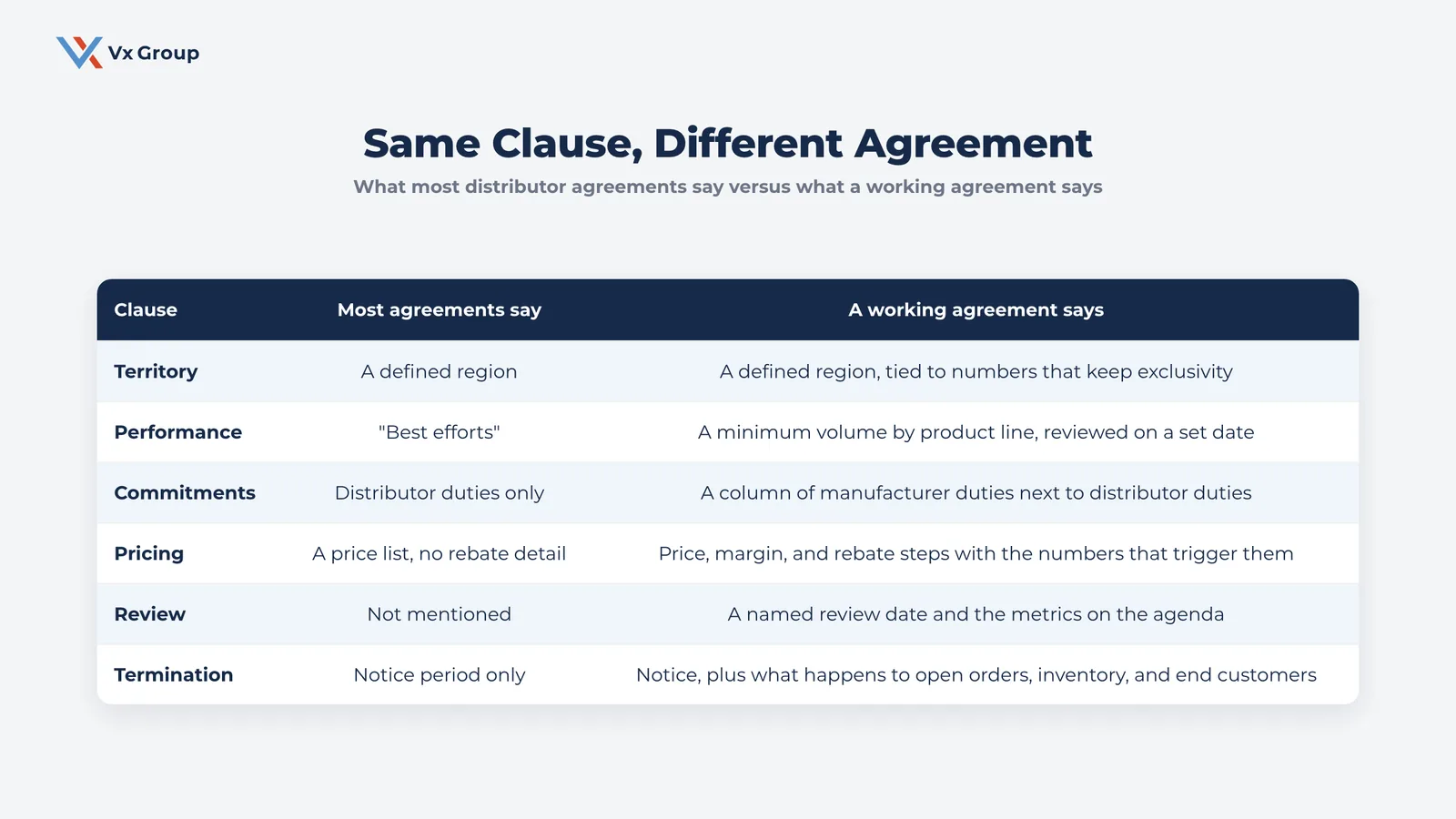
None of the six sections above requires a page count. A working distributor agreement is often shorter than the one it replaces, once the boilerplate gets trimmed to make room for the sections that actually get used. Below is how the six sections above typically compare to what shows up in the agreements companies already have signed and filed away.
| Clause | Most agreements say | A working agreement says |
|---|---|---|
| Territory | A defined region on a map | A defined region, tied to the numbers that keep exclusivity active |
| Performance | “Best efforts” | A minimum volume by product line, reviewed on a set date |
| Commitments | Distributor duties only | A column of manufacturer duties next to a column of distributor duties |
| Pricing | A price list, no rebate detail | Price, margin protection, and rebate tiers with the numbers that trigger them |
| Review | Not mentioned | A named review date, attendees, and the metrics on the agenda |
| Termination | A notice period | Notice, plus what happens to open orders, inventory, and end customers |
What if a distributor will not agree to written performance numbers?
A distributor pushing back on written performance numbers is usually reacting to how a specific number got set without their input. Bring the numbers back to the shared planning conversation described in Step 2, show the distributor how the number connects to the exclusivity and rebate terms they already want, and keep the conversation centered on the math both sides can verify.
If a distributor still will not agree to any measurable standard after that conversation, that itself is useful information. Measured in Millions® treats a distributor’s willingness to commit to specific, written numbers as an early signal of whether the relationship can scale, since a distributor unwilling to put numbers on paper is rarely investing in the territory at the level a growing manufacturer needs from a long-term partner.
Building this agreement well also depends on decisions made earlier in the channel, including how many distributors cover a territory and how a manufacturer resolves conflict between a direct sales team and a distributor selling into the same account. Getting the Channel Sales Management structure settled before the agreement is drafted saves a rewrite six months later, once the first conflict surfaces.
Put the six sections to work
A distributor agreement earns its place in the relationship when someone opens it for a reason other than a dispute: to check the review date, confirm a rebate tier, or look up the territory condition before a renewal conversation. That only happens when the six sections above are actually in the document, in language specific enough to use without a lawyer standing next to the reader. Most manufacturers already have the raw material for these six sections somewhere: a spreadsheet with volume targets, an email thread on rebate tiers, a verbal understanding about who covers a warranty claim after a distributor exits. The work is less about inventing new terms and more about pulling what already exists into one document, in writing, where both sides can find it.
None of this replaces legal counsel, and the guidance here is not a substitute for one. It covers what the agreement should say from a business and operating standpoint. A qualified attorney still needs to draft and review the contract itself, because the legal exposure around exclusivity, termination, and antitrust varies by state and by product, and that review stays a required step no matter how complete the operational sections are.
Ready to grow?
Bring your current distributor agreement to the conversation and we will walk through what it covers against the six sections above before you send it back to counsel.
About the author: David Tisdale advises manufacturers and distributors on channel structure, distributor relationships, and the Measured in Millions® growth system at Vx Group. His work focuses on turning informal channel arrangements into documented, measurable relationships that hold up as companies scale.
Related reading:
FAQs
About the Author: David Tisdale
