

What Is a Distributor? A Guide for Manufacturers

A distributor is a company that buys products from a manufacturer, stores them, and resells them to customers. It takes ownership of the goods, carries the inventory, and usually holds the relationship with the buyer. A manufacturer sells through distributors to reach more customers without hiring a larger sales team.
TL;DR
- A distributor buys your product, stocks it, and resells it. A sales rep sells for you and never owns the goods.
- The distributor earns the gap between what it pays you and what it charges the customer. That gap pays for sales, warehouse space, credit, and delivery.
- A distributor usually owns the customer relationship. You gain reach and give up direct contact, pricing control, and customer data.
- Distributors come in several types: industrial, value-added, specialty, regional, and broadline. Match the type to how your product is bought.
- Choose a distributor by checking who it already sells to, how many people know your line, and what data it will share.
- A distributor relationship needs a written standard and a contact schedule. If it lives in one person’s head, it leaves when that person does.
Many manufacturers run a distributor channel for years without writing down what a distributor is supposed to do. The owner knows the names of three or four contacts. The distributor knows the owner’s phone number. Nobody knows who the end customers are.
That arrangement works until a contact retires, a distributor adds a competing line, or a large customer asks who it should call for help. Then the owner finds out how much of the relationship was never written down.
This guide is for owners and presidents of privately held manufacturers with roughly $5M to $50M in revenue. It explains what a distributor is, how a distributor makes money, and how it differs from a wholesaler, a dealer, and a sales rep. It also covers how to choose one and how to keep the relationship healthy.
What is a distributor in manufacturing?
A distributor in manufacturing is an independent business that buys finished products from a manufacturer and resells them to customers in a defined market. The distributor pays for the goods, holds them in its own warehouse, sets its own selling price, and handles delivery and billing. The manufacturer sells in larger volumes to fewer buyers.
Defined Term: Distributor.
An independent company that buys products from a manufacturer, takes ownership of them, stores them, and resells them to customers. The distributor earns its income from the difference between its buying price and its selling price.
Most distributors serve a territory, an industry, or both. A regional industrial distributor might sell fasteners, bearings, and hydraulic parts to every plant within 100 miles. A specialty distributor might sell only electrical components to contractors.
Some distributors carry hundreds of brands. Others carry a handful and know each one well. Either way, the distributor is a customer of yours first. It buys from you, and then it sells to someone else.
That order matters. A distributor decides what to stock, which brands to recommend, and how hard to push yours. Its salespeople have a long line card, so your product competes for their time.
How does a distributor work with a manufacturer?
A distributor works with a manufacturer by placing purchase orders, receiving product, stocking it, and selling it to the end customer. The manufacturer invoices the distributor. The distributor invoices the customer. Product, money, and customer information each move along different paths, and the customer information path is the one most manufacturers lose track of.
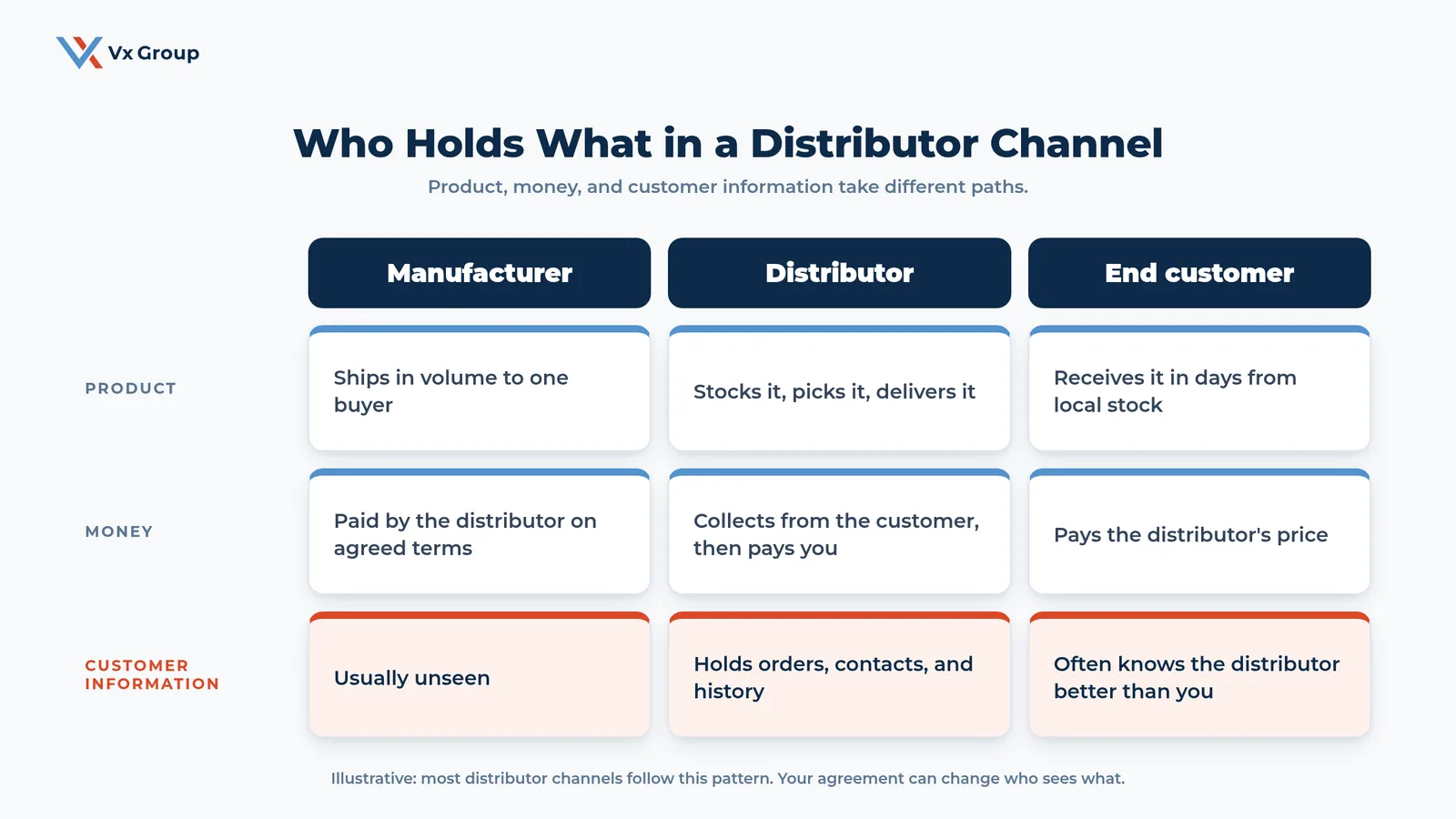
The graphic above follows three things through the channel. Product moves from the manufacturer to the distributor to the customer. Money moves the other way. Customer information stays mostly with the distributor, which knows who bought, how often, and what else they buy.
Here is how a typical order moves:
- A customer calls the distributor with a need.
- The distributor checks stock and quotes a price.
- The customer places the order, and the distributor ships from its own shelf.
- The distributor reorders from you when stock runs low.
- You ship to the distributor and invoice it on agreed terms.
You usually see step 5 and nothing else. That is why many manufacturers can tell you what each distributor bought last year and cannot tell you what any customer bought.
How does a distributor make money?
A distributor makes money on the difference between the price it pays a manufacturer and the price it charges a customer. That gap, called the distributor margin, pays for the sales team, warehouse, inventory, credit risk, delivery, and profit. A distributor that cannot earn enough margin on a line will stop pushing it.
Here is a simple example. The numbers are made up to show the idea.
| Step | Example amount | Who keeps it |
|---|---|---|
| Customer’s price for the part | $100 | Paid to the distributor |
| Distributor’s price from the manufacturer | $65 | Paid to the manufacturer |
| Distributor margin | $35 | Covers sales, stock, credit, delivery, and profit |
In the example, the manufacturer earns $65 and the distributor keeps $35. The distributor still has to pay for the warehouse and the truck. After those costs, its profit on the sale may be a small share of the $35.
Owners often see the $35 and feel the distributor takes too much. A better question is what it would cost you to reach that same customer. A salesperson, a vehicle, insurance, a credit department, and a stockroom all cost money before the first order arrives.
Distributors also watch how fast an item sells. A product that sits on the shelf ties up their cash. Fast-moving items with good margin get attention, and slow items get dropped. Our guide to distributor pricing strategy covers how to set discounts that keep distributors interested without giving away your margin.
What is the difference between a distributor, a wholesaler, a dealer, and a sales rep?
A distributor buys from a manufacturer under an ongoing relationship and resells to business customers. A wholesaler buys in volume and sells to retailers or other resellers. A dealer sells to end users, often under one brand. A sales rep sells for a manufacturer on commission and never owns the goods. The table below compares all four.
| Seller type | Owns the goods? | Who holds the customer | Typical fit |
|---|---|---|---|
| Distributor | Yes, buys and stocks | Usually the distributor | Products that need stock, credit, and local service |
| Wholesaler | Yes, buys in bulk | The retailer or reseller it supplies | Standard goods sold in large volume |
| Dealer | Often yes | The dealer, for the end user | Equipment and branded lines with service needs |
| Sales rep or agent | No, the manufacturer ships and bills | Shared with the manufacturer | Technical products that need factory involvement |
The words overlap in daily use, and many companies mix them up. A business that calls itself a distributor may act as a dealer, and a wholesaler may behave like a distributor. What matters is what the contract says: who owns the goods, who sets the price, and who owns the customer.
If your channel includes more than one of these, write down which role each partner plays. Our guide to what a channel partner is explains the wider group of partners. Our guide to dealer engagement covers the dealer side.
What types of distributors do manufacturers work with?
Manufacturers work with five common types of distributors: industrial, value-added, specialty, regional, and broadline. Each type sells differently. The right one depends on how technical your product is, how fast it ships, and how much service the buyer expects after the sale.
- Industrial distributors sell maintenance, repair, and production supplies to plants and shops. They win on availability and local service.
- Value-added distributors add work before delivery, such as kitting, light assembly, programming, or installation. They suit products that need setup.
- Specialty distributors focus on one product family or one industry. Their salespeople know the application and can advise on it.
- Regional distributors cover a defined territory and know the buyers in it. They suit manufacturers that want strong coverage in a few markets.
- Broadline distributors carry thousands of items across many categories. They offer reach and convenience, and your brand competes with many others on the same page.
Many manufacturers use more than one type. A specialty distributor may handle the technical accounts while a broadline distributor handles high-volume reorders. That works when each partner knows its lane. It causes friction when two partners quote the same customer. Our guide to channel conflict covers how to set the rules.
Why do manufacturers sell through distributors?
Manufacturers sell through distributors to reach more customers, ship faster, and avoid building a large sales and warehouse operation. A distributor already has the trucks, the credit terms, and the relationships. For a company with 20 to 200 employees, that reach would take years and a lot of cash to build alone.
The most common reasons are:
- Reach. A distributor with 15 salespeople covers a territory you could not cover with two.
- Local stock. Buyers want parts in days. A distributor stocks near the customer.
- Credit and collections. The distributor carries the risk when a small customer pays late.
- Smaller orders. You ship full pallets to one buyer instead of single boxes to hundreds.
- Service. Many distributors handle returns, basic support, and delivery.
Each of these benefits has a matching cost.
Ready to grow?
Bring your distributor list and your top ten end customers. We will help you see which relationships you hold directly and which sit with someone else.
What does a manufacturer give up when it sells through a distributor?
A manufacturer gives up direct contact with the customer, control over the selling price, and most of the customer data. The distributor decides how your product is presented, what it costs on the street, and which buyers hear about it. Those three losses are what the channel costs a manufacturer.
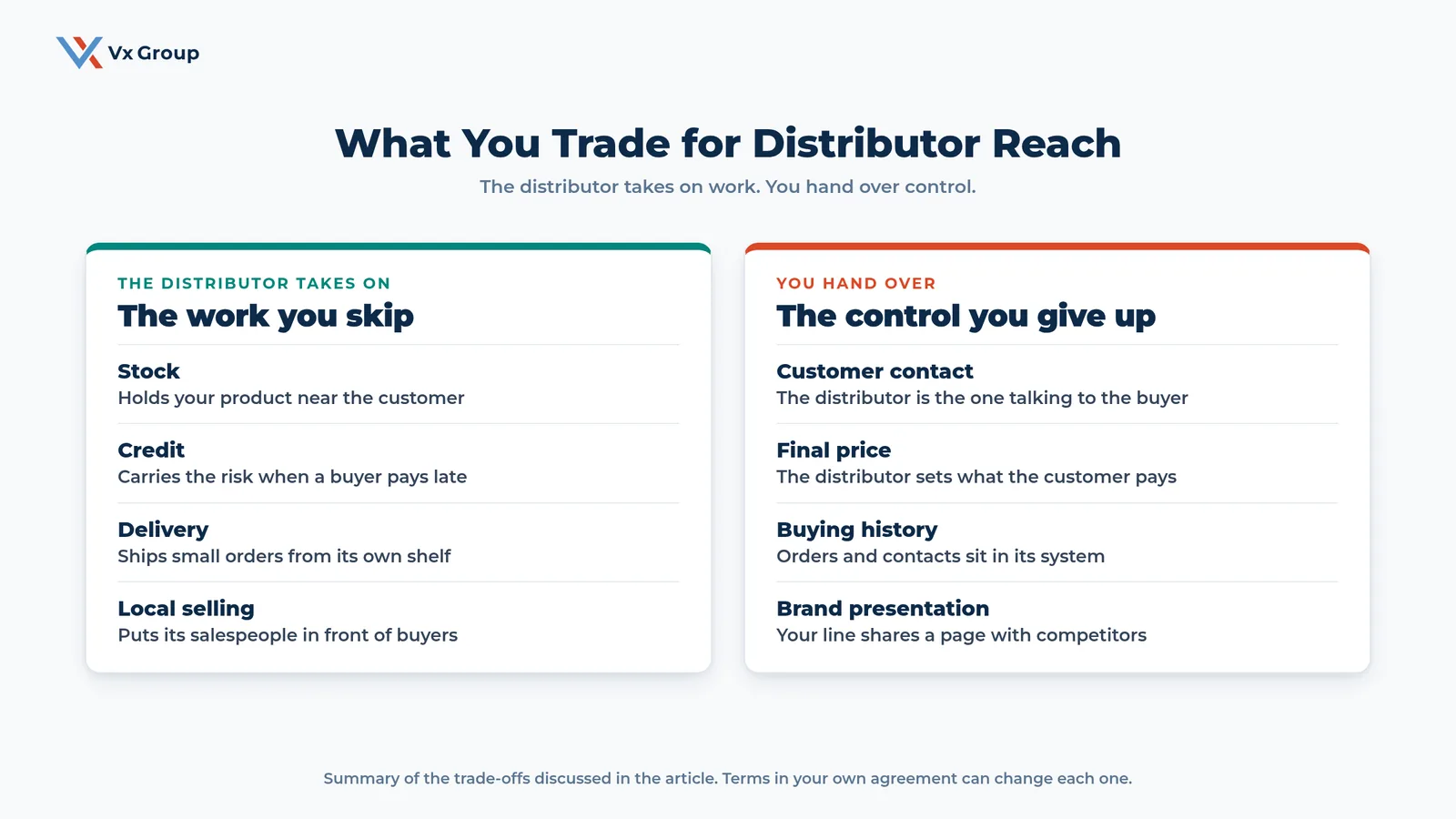
The graphic above shows the trade. On the left, the distributor takes on stock, credit, delivery, and local selling. On the right, the manufacturer hands over customer contact, final pricing, and the buying history.
The loss of customer data is the one owners notice last. If a distributor sells your product to 200 plants, you may not know the name of one. When you want to announce a new product, you cannot call those plants. When a large customer switches distributors, you may not hear about it until your orders drop.
Price control is the second loss. You set the price to the distributor. The distributor sets the price to the customer. A distributor that discounts heavily to win a deal can pull your brand down in that market.
Brand presentation is the third. Your product sits next to competing lines in the distributor’s catalog and on its website. The distributor’s rep may describe your product in a sentence while you would spend ten minutes on it.
Distributors still make sense for most manufacturers. The agreement and the relationship need to cover these three areas on purpose.
How do you choose a distributor?
Choose a distributor by checking who it already sells to, how well its team knows your product, and how much it will share with you. A strong distributor sells to your target customers, has people who can explain your product, and agrees to share order data. Check these five things before you sign.
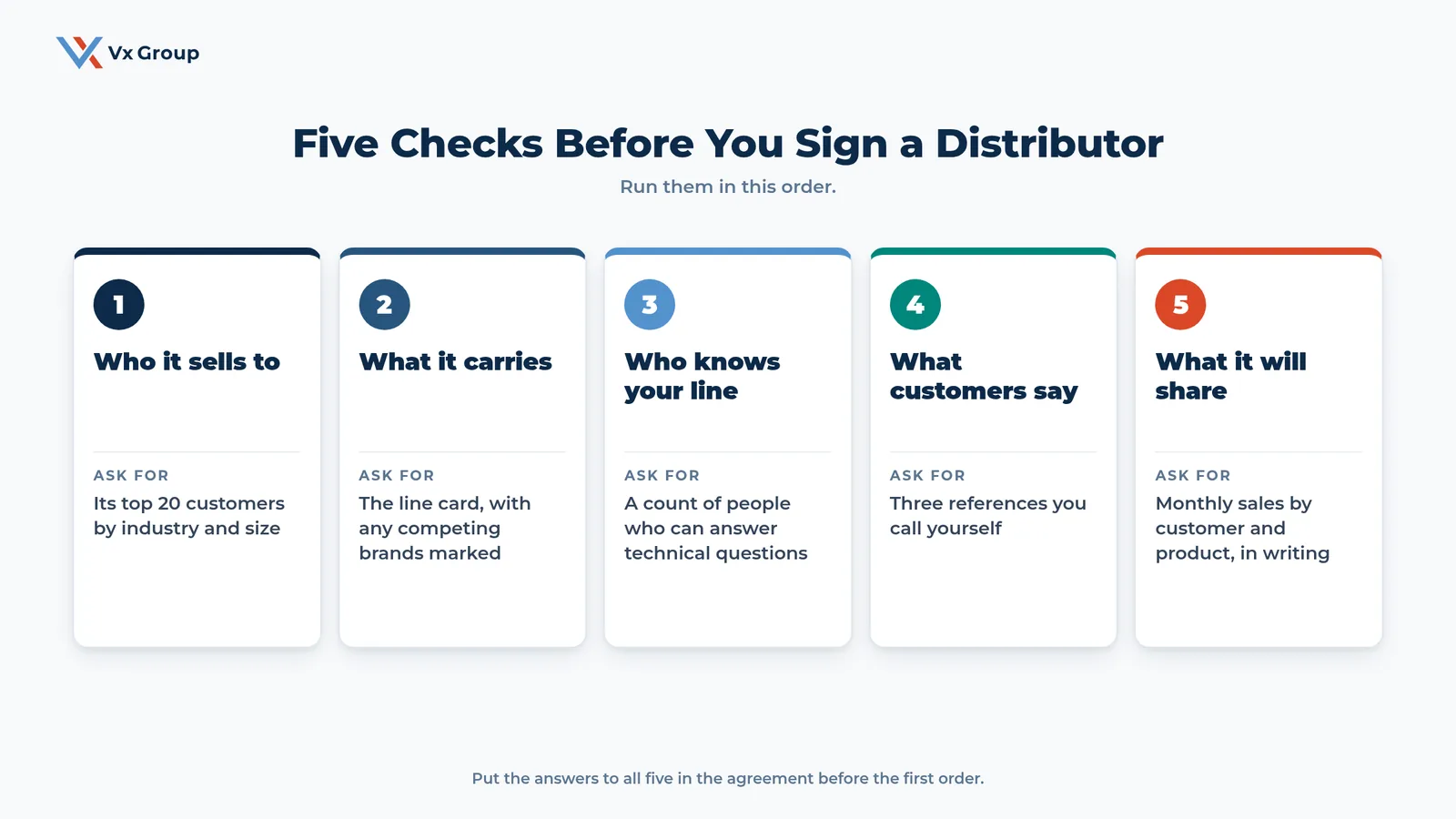
The graphic above lists the five checks in order. The sections below explain how to run each one.
Check who the distributor already sells to
Ask for a list of the distributor’s top 20 customers by industry and size. Your target buyer should appear on it. A distributor with strong relationships in your market can open doors on day one. A distributor with none will spend a year learning where to start.
Read the line card for competing brands
A line card lists the brands a distributor carries. Look for direct competitors of yours. A distributor can carry a competing line and still sell yours well, but you need to know how the distributor plans to handle that choice. Ask which line it leads with when a customer has no preference.
Count the people who can explain your product
Ask how many salespeople and inside staff could answer a technical question about your line. Product knowledge sells in industrial markets. A distributor with two trained people sells more than one with twenty who have never opened your catalog.
Call three of the distributor's customers
Ask the distributor for three references and call them. Ask what the distributor does well, how fast it responds, and what goes wrong. Customers will tell you in five minutes what a sales presentation leaves out.
Agree on data sharing before you sign
Decide what the distributor will report and how often. At a minimum, ask for monthly sales by customer and by product, inventory on hand, and a short note on lost deals. Put it in the agreement. Asking after the relationship starts is much harder.
What should the relationship look like after you sign?
After you sign, the relationship needs a written standard, a contact schedule, and a yearly review. The standard says what a good distributor does for you. The schedule makes sure someone talks to the distributor when there is no order to chase. The review checks results against the plan.
Our guide to distributor management covers the full routine. These are the parts to put in place first:
- Rank every distributor on two scores. Score revenue and score relationship quality. A distributor with high revenue and a weak relationship is the one that can leave and take sales with it.
- Name one owner for each distributor. One person at your company is responsible for the relationship. A second person knows the account well enough to cover.
- Schedule contact with no order to chase. A call every month or two to ask how things are going. Distributors notice which suppliers call only when sales are down.
- Run a yearly review. Meet with the distributor’s owner or branch leader, share your results, and agree on goals for next year.
- Keep a shared contact record. Write down who you know at each distributor and who they know at their top accounts. Store it somewhere other than one person’s inbox.
A distributor that hears from you regularly sells more of your product. The reason is simple. The salesperson thinks of your line when a customer asks for something, because they know your name.
What does a distributor agreement cover?
A distributor agreement is the written contract that sets the rules between a manufacturer and a distributor. It covers territory, pricing, terms of payment, performance targets, data sharing, and how either side can end the relationship. A clear agreement prevents most of the disputes that damage a channel.
The points that matter most to an owner are:
- Territory. The geography or customer group the distributor covers, and whether it is exclusive.
- Pricing and discounts. The price list, the discount, and any rules on how the distributor resells.
- Performance. Minimum purchases or sales targets, and what happens when the distributor misses them.
- Data. The reports the distributor owes you and how often.
- Ending the agreement. Notice periods, how remaining stock is handled, and who keeps the customer relationships.
Our guide to what belongs in a distributor agreement goes through each clause and flags what usually gets left out. Have an attorney review any contract before you sign it. A distributor agreement can also be limited by state law in some places.
What does this look like in practice?
Field Notes:
This example is a composite built from patterns common among mid-market manufacturers. A maker of industrial components with about $20M in revenue sold through eight distributors for 15 years. One distributor, run by a long-time friend of the owner, produced about a third of sales. The owner dealt with one buyer there.
The buyer retired, and the distributor was sold to a larger company. The new management dropped half of the manufacturer’s line within six months. The owner had never met anyone else at the distributor and could not name a single end customer.
The manufacturer spent the next two years rebuilding the channel. It started with a contact record at every distributor, a named owner for each one, and a standard monthly sales report in every agreement.
The company in the example did several things right for 15 years. The relationship was warm and the sales were steady. The weakness was that all of it depended on one person on the other side, and nothing was written down on the manufacturer’s side either.
Founder-dependent relationships follow the same pattern inside a company. Our guide to founder-dependent sales covers what happens when one person holds every key relationship.
What mistakes do manufacturers make with distributors?
Manufacturers make five common mistakes with distributors. They sign without data rights, depend on one contact, discount to win volume, ignore small distributors, and add partners without rules. Each mistake is common and fixable, and each one costs more the longer it waits.
- Signing without data rights. If the agreement does not require sales reports, the distributor owes you nothing. Ask for them now, even if the relationship is old.
- Depending on one contact. One buyer or one rep holds the relationship. Meet at least two more people at every distributor that matters.
- Discounting to win volume. Deep discounts bring orders and train the distributor to wait for the next discount.
- Ignoring small distributors. A small distributor with a strong local reputation can outsell a large one in its area. Judge each one by its results.
- Adding partners without rules. New distributors in an old territory create conflict. Write the territory rules before the second distributor signs.
Our guides to distribution strategy and B2B channel strategy cover how to decide how many partners you need and where they belong.
Where should an owner start this week?
Start with a one-page list of every distributor you sell through. For each one, write the annual revenue and the name of your main contact. Add two other people you know there. Then list the top three end customers you can name. The blanks on that page show where the relationship is thin.
Then pick the distributor with the highest revenue and the most blanks. Call the owner or branch leader and ask for a 30-minute meeting. Bring one question: what would make us a better supplier to you?
You do not need to change any agreement to start. A list and one honest conversation will show you which relationships are solid and which depend on luck. Our guide to the channel partner program covers how to build something larger once the basics are in place.
Ready to grow?
Share your distributor list and we will help you build a plan that protects the relationships behind your sales.
FAQs
About the Author: David Tisdale
