

How to Manage Channel Conflict Without Losing the Channel

Channel conflict is a disagreement between your direct sales team and your distributors, reps, or dealers over who owns a customer, a territory, or a deal. It comes in two forms: direct-versus-partner and partner-versus-partner. You manage it with written rules of engagement, deal registration, a named tiebreaker, fair compensation, and a post-mortem after every dispute.
TL;DR
- Channel conflict shows up when a large deal lands and two people with different assumptions are both in front of the same customer.
- Write a rules of engagement document that names your house accounts, defines territories, and lists exceptions in plain language.
- Build a deal registration process so first contact is provable and nobody has to argue about it.
- Name one person who breaks ties, and give that person a turnaround time.
- Pay your direct team so a partner-led win does not cost them anything.
- Run a short post-mortem after every dispute and update the rules.
Most manufacturers do not have a channel conflict problem until they have a very expensive one. For years everyone assumes they know which accounts are house accounts and which belong to the distributor. Then a $400,000 inquiry arrives. Your inside sales rep calls the buyer. The distributor’s rep calls the same buyer. The buyer forwards both emails to each of them with one question: “Who am I supposed to talk to?”
The cause of that moment is unwritten rules. Everybody carries a private version of the rules. The versions agree until real money is on the table. The owner of a $5-50M manufacturer usually finds out from a phone call. The distributor’s owner is annoyed and asks why your team went around them.
This guide gives five steps that put your rules in writing, so your team and your partners can read them. It also covers what channel conflict is, why it happens, and what it costs when nobody manages it.
What is channel conflict, and why does it happen?
Channel conflict is a dispute between parties who sell your product over who gets to sell it, to whom, and at what price. It has two forms, and they need different fixes.
Defined Term: Direct-versus-partner conflict.
A dispute between your own sales team and a distributor, rep, or dealer over an account, a deal, or a customer relationship. Some sources call this vertical conflict.
Defined Term: Partner-versus-partner conflict.
A dispute between two partners who sell the same product, usually over overlapping territories, shared customers, or different prices quoted to the same buyer. Some sources call this horizontal conflict.
The glossaries and vendor blogs that rank for this topic agree on the common triggers. They list overlapping territories, direct sales into a partner’s account, price differences between channels, and unclear ownership of a customer. Most of them also agree that vertical conflict hurts trust faster than horizontal conflict. The partner feels the manufacturer chose a side.
For a privately held manufacturer, four triggers show up again and again:
- A big account that got bigger. A customer your direct team served as a $30,000 account now sends a $300,000 order. The distributor in that territory notices.
- A new hire who does not know the history. A sales rep joins, finds a prospect in the CRM with no owner, and calls.
- A website inquiry. A buyer fills out a form on your site, and the lead goes to whoever answers first.
- A price quoted two ways. A distributor and your direct team send different numbers to the same buyer. The distributor pricing strategy article covers how to prevent that one at the source.
The cost shows up in three places. Partners stop registering deals with you and start favoring a competitor’s line. Your direct team starts hiding deals to protect their numbers. And you lose something a channel cannot replace: a distributor owner who picks up the phone when you need a favor.
If you sell through distributors at all, you have this risk. Written rules or private assumptions will decide how it plays out. For the wider picture of how partners fit into growth, see our guide to B2B channel strategy.
1. How do you write a rules of engagement document that settles who owns what?
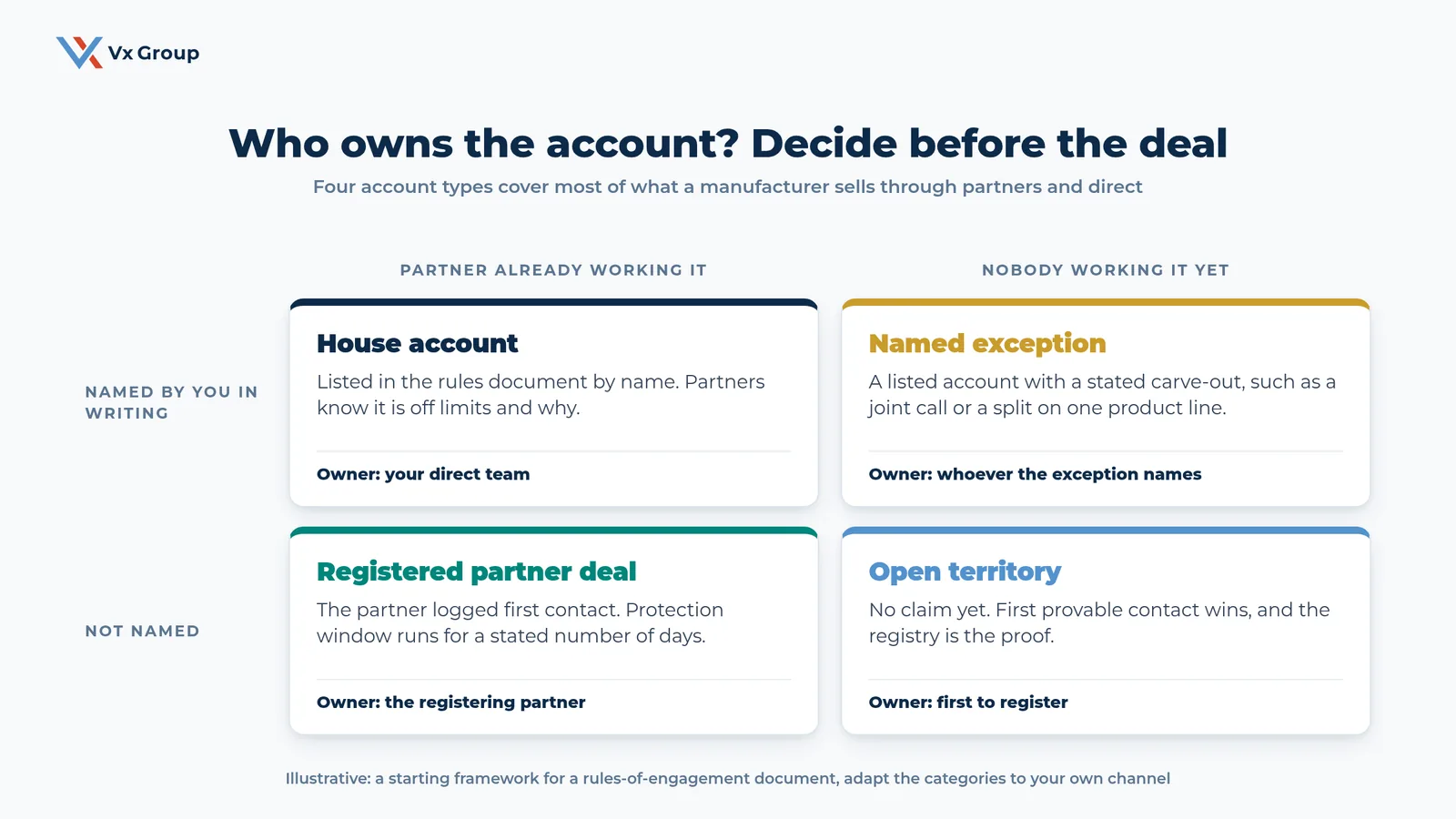
A rules of engagement document is a plain-language agreement. You share it with your direct team and every partner. It states which accounts are yours, which belong to partners, and what happens when a deal fits neither list. Write it before the dispute. After a dispute, every rule looks like it was written for someone’s benefit.
Defined Term: Rules of engagement.
A written policy that defines account ownership, territories, and the process for resolving overlap between a manufacturer’s direct sales team and its channel partners.
Keep it to two pages. A document longer than that gets filed and forgotten.
List your house accounts by name
A house account is a customer you serve directly and will not hand to a partner. Name each one in the document. A rule like “any account over $1 million” invites argument about whether an account crossed the line last quarter. A named list settles it.
Put the list in an appendix. Review it once a year. Tell partners why each account is on it. Most distributors accept a house account list when the reason is plain. One example is a customer that buys from you directly under a contract older than the partner relationship. Another is a national account that requires one point of contact.
Define each partner's territory in terms a salesperson can check
Use something both sides can verify: states, counties, or a named customer list. Avoid phrases such as “the Southeast region” with no boundary. If two partners share a territory, say so. Then say how they share it: by product line, by industry, or by account size.
Write the named exceptions into the document
Every channel has a few accounts that do not fit. A customer might buy locally from a distributor but also sign a corporate agreement with you. List these accounts, say who leads, and say who gets credit. Write each exception in Appendix C so it settles arguments. An exception kept in one person’s memory will cause an argument later.
Use language partners can read
Here is sample language you can adapt:
- House accounts: “The accounts listed in Appendix A are served directly by the manufacturer. Partners will be informed when an order from a house account ships into their territory.”
- Territories: “Each partner has first right to sell to any customer located in its assigned territory, as shown in Appendix B.”
- New opportunities: “A partner who registers an opportunity through the registration form holds that opportunity for 90 days. The manufacturer’s direct team will refer any inquiry from a registered account to that partner.”
- Escalation: “Disputes go to the Channel Lead, who will give a decision within three business days.”
The table below shows what the finished document should answer at a glance.
| Question | Where the answer lives | Who decides |
|---|---|---|
| Is this a house account? | Appendix A, named list | You |
| Which partner covers this location? | Appendix B, territory list | You |
| Did a partner already register this deal? | The registration log | The registry date |
| Is there a named exception? | Appendix C, exceptions list | You, in writing |
| What if none of these apply? | Escalation path | The Channel Lead |
Send the finished document to every partner with a short cover note from the owner. A note from the owner signals that the rules apply to everyone, including your own team. Your distributor agreement can reference the rules document, which keeps the contract short and lets you update the rules without reopening the agreement.
2. How do you build a deal registration process so first contact is provable?
A deal registration process lets a partner claim an opportunity before they close it. Then the question of who spoke to the customer first has a dated answer. Without it, you hear two stories and have no way to check either one.
Defined Term: Deal registration.
A formal process in which a partner reports a sales opportunity to the manufacturer, receives protection on it for a set period, and has first claim on the order if it closes.
The mechanics fit on one page.
Create a one-page registration form
Ask for the customer name, the location, the product line, the estimated order size, the name of the contact, and the date of the first conversation. Anything beyond that slows partners down and they stop using it.
Set a protection window and a renewal rule
Ninety days works for many manufacturers, and a long sales cycle may call for longer. State what the partner has to do to keep protection, such as logging one customer touch every 30 days. A registration with no activity expires, and the account returns to open territory.
Give one person the job of approving registrations
Pick a person on your team who answers within two business days. A registration that sits in an inbox for a week defeats the purpose, because the partner assumes it was approved and your direct rep assumes the account is open.
Keep the log somewhere everyone on your team can see it
A shared spreadsheet is fine to start. A field in your CRM is better. The rule your direct team follows is simple: before you contact a new prospect, check the log. If the account is registered, refer the inquiry to the partner.
Pay the partner on a registered deal that closes
Track360, a partner management vendor, says that once you approve a registration, you owe the partner the order. One broken promise travels through a distributor network faster than any announcement you make. If you approve a registration, honor it.
Registration also helps you in a less obvious way. Partners who register deals show you where your product is being considered. Your direct team never sees that data otherwise. Our guide on how to manage a distributor network covers how to read that pipeline.
Ready to grow?
See how the rules of engagement and registration process would work for your own channel.
3. How do you set an escalation path and name who breaks a tie?
An escalation path is a short, written route for any dispute the rules do not settle, ending with one named person who makes the call within a stated number of days. Even good rules leave gaps, and a gap with no decision-maker turns into a standoff.
Most manufacturers skip this step because the owner assumes they will be the tiebreaker. That works until the owner is traveling, or until the dispute involves the owner’s own relationship with a distributor.
Name a Channel Lead and a backup
The Channel Lead is a single person with authority to make the call. A vice president of sales or a general manager fits the role. Name a backup for the weeks when the lead is out. Put both names in the rules document.
Set a turnaround time and hold to it
Three business days is a reasonable standard. A decision that takes three weeks tells both parties the dispute is not a priority, and the customer is still waiting for a quote. If the customer is waiting, the turnaround is 24 hours.
Write a short decision rule for the lead to apply
Give the lead the order of questions to ask. Here is a version that fits most channels:
- Is the account on the house list? If yes, the direct team leads.
- Did a partner register the opportunity before the direct team made contact? If yes, the partner leads.
- Is there a named exception? If yes, follow the exception.
- If none of these apply, the party with the earliest documented contact leads, and the other party gets a stated share of credit.
Tell both sides the decision and the reason
Send a short written note to both parties with the decision and the one-sentence reason. The note builds a record of precedent, and over time those notes tell you which rules need rewriting.
Apply the rule the same way every time
Zinfi, a partner software vendor, notes that rules enforced selectively produce a perception of favoritism. One exception for your biggest distributor teaches every other distributor that the rules have a price. If an exception is warranted, write it into Appendix C and tell everyone.
4. How do you pay your direct team so a partner-led win does not cost them?
Compensation design means setting quota credit so your direct reps gain from a partner-led win, or at least lose nothing. Reps respond to how they are paid. If a partner-led win hurts their numbers, they will protect those numbers by working the account themselves.
This is the step owners underestimate most. A rules document can say “refer the account to the partner,” and a rep who loses commission on a referral will find a reason the account was never registered. If you also want to review the broader structure, our guide to a sales compensation plan for long sales cycles covers the plan design.
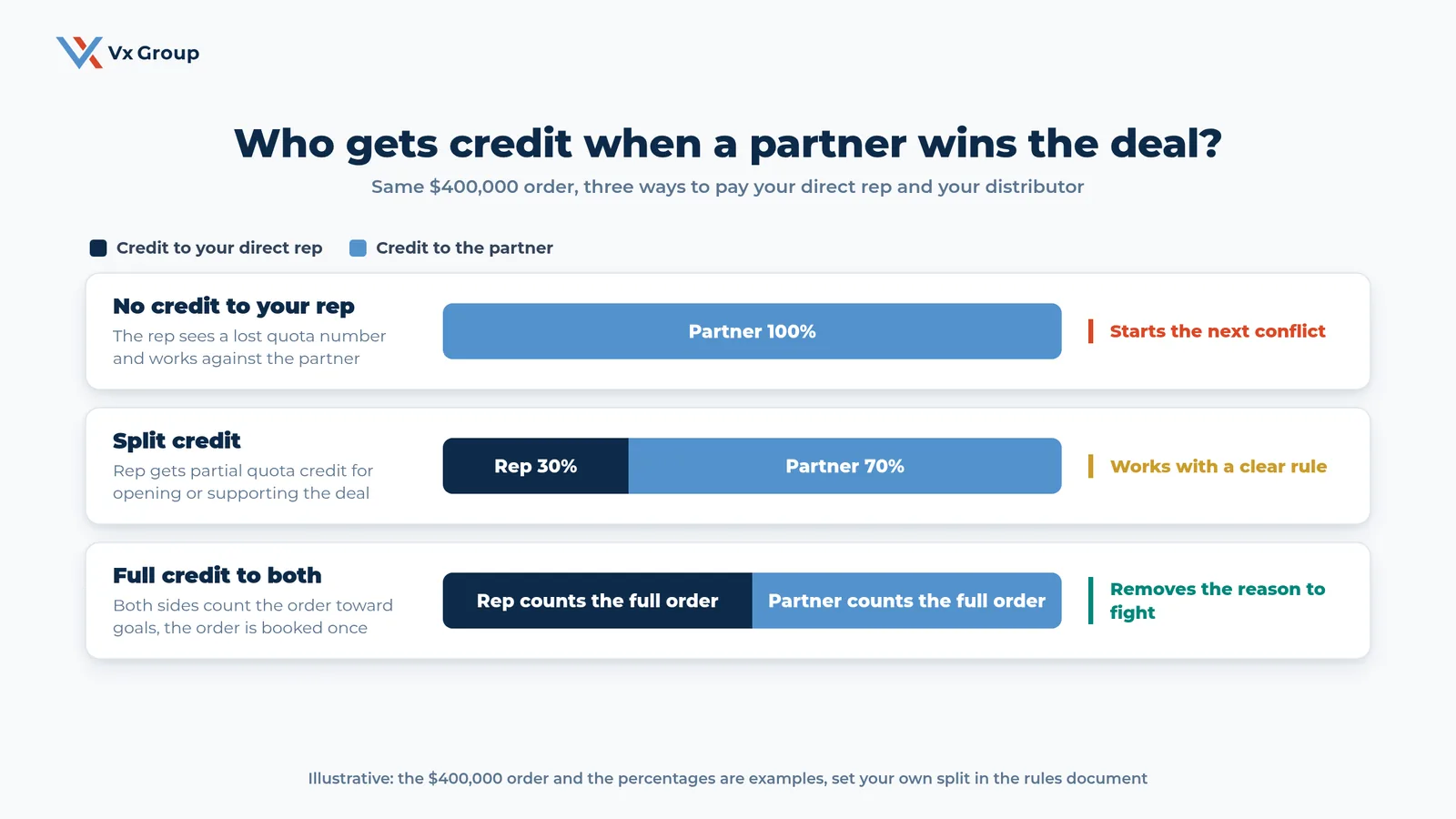
Choose one of three credit models
| Model | How it works | What to watch |
|---|---|---|
| No credit to the rep | The partner wins, the rep sees nothing | The rep works against the partner |
| Split credit | The rep gets a share of quota credit for opening or supporting the deal | The split must be written down, or the rep and partner argue about it |
| Full credit to both | Both count the order toward their goals, and the order is booked once | Works best when targets are about total channel revenue |
Split credit and full credit are the usual landing points. The right choice depends on whether your direct team’s job is to open doors for partners or to cover the same accounts.
Credit the rep for opening and supporting work
If a direct rep opens a relationship and hands it to a partner, pay for that. If a rep joins a customer call to support a partner, pay for that too. The goal is that a partner-led win is a good outcome for everyone in the room.
Set team goals that include channel revenue
When your sales leader carries a goal for total revenue by channel, the rep and the partner work toward the same goal. A goal tied to all revenue from a territory pays your team to cooperate. A goal tied only to direct sales pays them to compete with the partner.
Check partner incentives for the same problem
Partners react to incentives too. If your co-op or rebate program pays more for deals the partner originates, partners will chase originating credit. The market development funds article covers how to structure that money so it pays for work that produces sales.
Review credit each quarter with the numbers in front of you
Pull the list of partner-led wins from the past quarter, see how much credit each side received, and ask the direct team whether the model felt fair. If your reps tell you it does not, you will see the symptoms in the registration log within a few months.
5. How do you run a conflict post-mortem so each dispute improves the rules?
A conflict post-mortem is a 30-minute review held within two weeks of every resolved dispute. The Channel Lead, the direct rep, and the partner contact agree on what the rules missed and what to change. Each dispute shows a gap in the rules. The post-mortem is how you close it.
Hold the meeting within two weeks
Waiting a month lets each side settle on its own version of events. Keep the group small: the Channel Lead, the rep involved, and the partner contact if the partner is willing. If the partner prefers not to attend, ask for their view by phone beforehand.
Ask four questions in the same order each time
- What did each side believe the rule was?
- Which part of the document, if any, covered this?
- What would have settled it without escalation?
- What one change to the rules would prevent a repeat?
Write down one change and assign an owner
A post-mortem that produces ten action items produces none. Pick the one change that matters most, assign it to a person, and set a date. Update the rules document and send the revised version to partners with a one-line note explaining what changed.
Keep a running log of disputes
A simple table is enough: date, accounts involved, which rule applied, who decided, what changed. After a year, the log shows patterns. If four disputes involve website inquiries, you need a rule for website inquiries. If three involve the same partner, you have a conversation to have with that partner.
Field Notes:
Here is a composite drawn from the kinds of channel conversations we hear from owners. The details are changed and the numbers are illustrative. A regional distributor had carried a manufacturer’s line for eleven years. A $350,000 inquiry came in through the manufacturer’s website from a customer in the distributor’s territory. The manufacturer’s inside sales rep answered it. The distributor had been working that customer for months and had never logged it anywhere. The manufacturer had no registration process, and the distributor had never needed one. Both sides quoted the customer, with different prices. The customer picked the lower number. The distributor learned about it from the customer. Within a year, the distributor had moved most of its volume to a competitor’s line. The owner told us later that the order itself was small next to what followed. Eleven years of the distributor’s relationships in that territory moved to another line after one deal that nobody had assigned to anyone.
What are the common mistakes in managing channel conflict?
Five mistakes cause most of the damage, and each maps to one of the steps above.
- Waiting for the first dispute. The best time to write the rules is when nothing is wrong. After a dispute, every rule looks like a verdict.
- Writing rules only your team can see. Partners cannot follow a policy they have never read. Send the document and invite questions.
- Letting the biggest partner shape the exceptions. One distributor with outsized influence can turn a fair set of rules into a private deal. Write each exception down and share it.
- Leaving the tiebreaker unnamed. If everyone assumes the owner decides, disputes wait for the owner’s calendar.
- Skipping the post-mortem. The same dispute happens twice when the rules never change.
If you are rebuilding your channel from scratch or adding partners, our channel partner program guide and the channel sales strategy article cover the larger design. The distribution strategy piece covers how many partners you need in the first place, since a crowded territory produces conflict by itself.
Where should you start this week?
Start with the smallest piece you can finish in a week: the house account list. Open your CRM, pull every account your direct team serves, and mark the ones that sit inside a partner’s territory. That list shows you where your conflict risk is today, before a dispute makes it visible.
Next, write the one-page registration form and send it to your three largest partners. Ask them one question in the cover note: where have you felt crowded out by our direct team? Their answers will tell you which rules to write first.
Clear rules give you something a direct team cannot build alone. Partners register deals with you first, bring you opportunities, and pick up the phone. Owners who write the rules early keep that.
Ready to grow?
Bring one account where your direct team and a partner both claimed the deal, and we will help you write the rule that would have settled it.
FAQs
About the Author: David Tisdale
