

How to Build a B2B Go-to-Market Strategy

A B2B go-to-market strategy defines who you sell to, where you win, how you win, who owns each move, and how you measure progress. For relationship-driven B2B companies, the strategy has to fit a long sales cycle and a small buying committee. A SaaS-style playbook built for high-velocity, self-serve deals will not fit it. Get the five pieces right and every growth function points at the same target.
TL;DR
- A B2B go-to-market strategy is a system built from five parts: best-fit profile, priority segments, relationship motion, ownership, and metrics.
- Most B2B go-to-market strategies fail because they borrow a SaaS playbook built for a 30-day sales cycle and apply it to a 12-month one.
- The fix starts with your best existing accounts. They already show you where you win, long before a market-sizing spreadsheet would.
- A relationship-driven go-to-market motion measures relationship movement (trust, access, expansion) instead of activity (calls made, emails sent).
- Every component in this guide (profile, segment list, motion map, ownership chart, metric set) should exist as a document your leadership team can point to and argue with.
- New-account motion and expansion motion are different jobs. Assign them to different owners or you will get neither done well.
- A go-to-market strategy without a named owner for each stage stays a set of good intentions and never becomes a system.
Most B2B companies do not have a go-to-market strategy. They have a sales team, a marketing calendar, and a set of habits that formed by accident over a decade of doing whatever worked that quarter. Nobody planned it. It simply accumulated: a trade show here, a referral relationship there, a salesperson who happened to be good at one type of account.
That accumulation is the villain in this guide. It is the natural result of never sitting down to decide, on paper, who you serve best, where you win, and who owns making sure you keep winning there. Nobody sat down and decided to skip the exercise. They just never got around to it.
The other villain, more specific to 2026, is borrowing someone else’s playbook. Most of the go-to-market content available today was written for software companies with a 30-day sales cycle, a single decision-maker, and a product a buyer can try before they talk to a human.
That playbook does not transfer to a company with a 12-month cycle, a five-person buying committee, and a relationship that has to survive a decade of account turnover on both sides. Running the SaaS playbook against a relationship-driven sale wastes motion, burns trust, and produces the wrong kind of pipeline.
This guide builds a go-to-market strategy the way a relationship-driven B2B company actually needs one: as a system the leadership team can run themselves long after a consultant’s slide deck has been archived.
What is a B2B go-to-market strategy?
A B2B go-to-market strategy is the documented answer to five questions: who you serve best, where you win, how you win there, who owns each move, and how you know it is working. It functions as the operating system that every growth function (sales, marketing, customer success) runs on top of, well beyond the scope of any single campaign or product launch plan.
Defined Term: Go-to-market strategy: the documented system that connects a company’s best-fit customer profile, priority market segments, relationship motion, ownership structure, and success metrics into one coherent plan for how the business wins new and expanded revenue.
A go-to-market strategy is different from a marketing plan. The marketing plan is the executional layer: campaigns, content, channels, budget. The go-to-market strategy sits above it and decides who the marketing plan should be talking to and why. Skip the strategy and the marketing plan optimizes for activity instead of the right accounts.
It is also different from a broader growth strategy. A growth strategy covers the full range of how a company expands (pricing, product line, geography, acquisition). Go-to-market strategy is narrower: it governs how the offering actually reaches and lands with buyers. Companies building a growth strategy from the ground up should start with Building a B2B Growth Strategy From Scratch: The Complete Guide and treat this guide as the go-to-market layer inside it.
Why do most B2B go-to-market strategies fail?
Most B2B go-to-market strategies fail because they get built backward: channels and tactics get chosen first, and the question of who the company serves best never gets answered in writing. A team picks a target list based on firmographic filters (revenue band, employee count, industry code) instead of the pattern already visible in the accounts that stayed, expanded, and referred.
The strategy ends up optimized for accounts that look plausible on paper rather than accounts the company has already proven it can win and keep.
The second failure mode is copying a playbook built for a different sales motion. A demand-gen calendar built for a 30-day SaaS trial does not fit a 12-month capital-equipment sale with a five-person buying committee. The tactics (volume outbound, gated content, product-led trials) assume a buyer who can evaluate and decide alone, quickly.
A relationship-driven buyer cannot, and treating them like they can reads as a company that does not understand its own customer.
Why Most B2B Companies Grow By Accident (And What It Costs Them) covers the broader pattern behind this failure mode: growth that happens to a company instead of growth the company designed. A go-to-market strategy is the antidote at the level of who you sell to and how you reach them.
How is a B2B go-to-market strategy different from a SaaS go-to-market strategy?
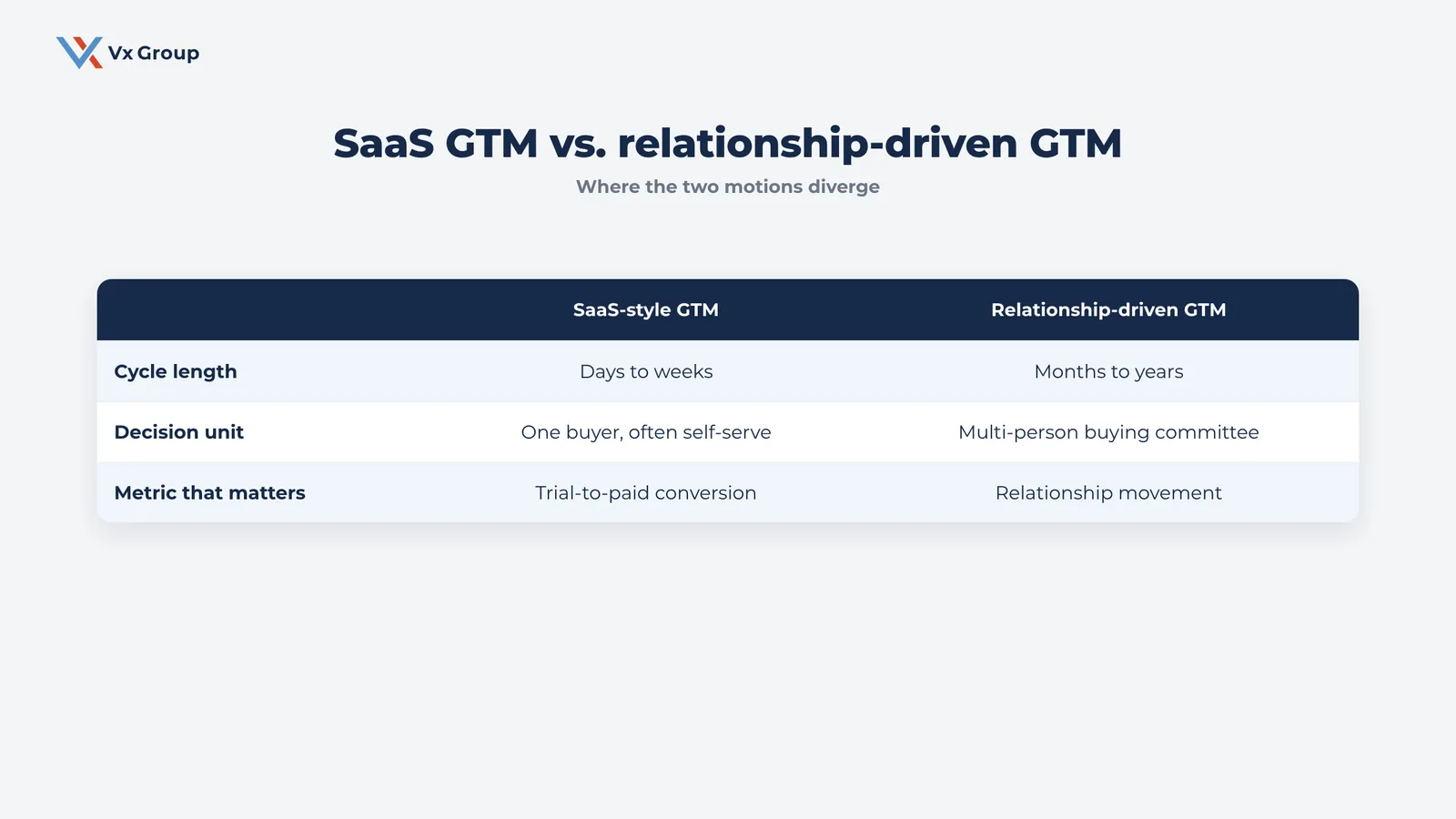
A relationship-driven B2B go-to-market strategy differs from a SaaS go-to-market strategy on three fronts: how long the cycle runs, how many people decide, and what gets measured along the way. A SaaS motion optimizes for velocity and volume. A relationship-driven motion optimizes for trust and account depth.
| SaaS-style GTM | Relationship-driven GTM | |
|---|---|---|
| Cycle length | Days to weeks; often self-serve or single-call close | Months to years; multiple touchpoints across a buying cycle |
| Decision unit | One buyer, sometimes with a card and no approval chain | A committee: technical evaluator, economic buyer, end user, sometimes a board or ownership group |
| The metric that matters | Trial-to-paid conversion, time-to-value, product qualified leads | Relationship movement: access gained, trust deposits made, expansion opportunity surfaced |
The practical consequence shows up in how each motion treats a “no.” In a SaaS motion, a no often means move to the next lead; the cost of a wrong guess is low. In a relationship-driven motion, a mishandled early conversation can close a door for years, because the buying committee remembers who showed up prepared and who showed up with a generic pitch. That asymmetry is the reason relationship-driven companies cannot afford to run a volume-first playbook. The cost of getting the first few interactions wrong is too high.
Who is your best-fit profile in a B2B go-to-market strategy?
Your best-fit profile in a B2B go-to-market strategy comes from the pattern in your best existing accounts. A market-sizing exercise will not surface it.
Pull your best twenty accounts and pattern-match them
Export the twenty accounts that generate the most revenue, expand the most reliably, and refer the most often. For each one, write down four things in a single row: the trigger that put them in-market, the buying committee that evaluated you, the objection that almost killed the deal, and how long they have stayed. Twenty rows is enough to see the pattern.
Name the specific trigger, not a firmographic filter
Replace any version of “companies with 50-500 employees” with the actual event that puts a prospect in-market, something like “a manufacturer whose key account just changed ownership and needs a new relationship built from scratch.” Pull this straight from the trigger column in your twenty rows. A trigger this specific is what a salesperson can actually listen for on a call.
Write the one-page profile and put it in front of every function
Turn the pattern into one page: the trigger, the buying committee composition, the most common objection, and the average tenure once won. Share it with sales, marketing, and customer success in the same meeting, and make it the first slide in every pipeline review going forward. A profile no one has seen is not a profile.
Cut the profile until it excludes something
If the draft profile describes 60% of your addressable market, it describes nothing. Narrow it until it names who is not a fit as clearly as who is. That exclusion is what lets a sales team stop chasing accounts that will take a year to lose.
Which market segments should a B2B go-to-market strategy prioritize?
A B2B go-to-market strategy should prioritize the market segments where the best-fit profile already concentrates, ranked by a documented rationale rather than gut feel.
Sort the market by the dimension your profile turns on
Take the trigger event, industry, or geography that showed up most often in your best-fit profile and use it to cut the total addressable market into segments. A profile built on ownership-change triggers sorts by industry and deal flow; a profile built on a technical trigger sorts by installed base or equipment type. Use whichever dimension the pattern actually turns on, not the dimension that is easiest to pull from a database.
Score every segment on three criteria
Build a simple table with one row per segment and three columns:
- Concentration: how many accounts in this segment match the best-fit profile closely.
- Access: how reachable the segment is through relationships, referrals, or channels the company already has, versus cold.
- Cycle economics: whether the segment’s typical deal size and sales cycle length justify the relationship investment required to win it.
Score each cell high, medium, or low. A segment does not need to win on all three to make the list, but a segment scoring low on all three should not be on it.
Rank the list and write the rationale next to every entry
Sort segments top to bottom by combined score, and write one sentence of rationale next to each one, including the ones you are deprioritizing. When a good lead shows up in a deprioritized segment later, that written rationale is what stops it from quietly pulling the whole team’s attention off the plan.
What relationship motion fits a long B2B sales cycle?
The relationship motion that fits a long B2B sales cycle is one built around sustained, sequenced trust-building rather than a single high-pressure pitch. A long cycle with a multi-person buying committee cannot be won in one meeting.
Map the five stages your deals actually move through
Write down the sequence a won deal in your twenty best accounts actually followed: the first credible touch (often a referral, a piece of content, or an event), the discovery conversation, the point the technical evaluator engaged, the point the economic buyer engaged, and the close. Most companies have never written this down. They just know it happens “sort of like that.”
Assign one job and one message to each stage
For each stage on the map, write a single sentence answering what that interaction needs to accomplish and for whom. The first touch earns fifteen more minutes, not a demo. The discovery conversation earns the right to see the account’s real situation, not a proposal. Running the closing pitch at the first-touch stage is the single most common motion failure in a long-cycle sale, and writing the job of each stage down is what stops it.
Build the motion map as a document sales can actually use
Turn the stage sequence and stage jobs into a single page: five boxes, one line of job description in each, one line of the message that fits it. Hand it to every salesperson working an account that matches the best-fit profile.
Defined Term: Field Notes
A mid-market manufacturer we worked with had every growth function (sales, marketing, and customer success) pointed at a different profile. Marketing ran campaigns for one type of buyer, sales chased whatever inbound arrived regardless of fit, and customer success measured renewals with no visibility into which accounts matched the pattern the company actually won on. Once the leadership team built a single best-fit profile and required every function to report against it, the pipeline shrank in volume and grew in quality within two quarters. Fewer deals, a shorter average cycle, and a materially higher win rate, because every function stopped spending motion on accounts that were never going to close.
Ready to grow?
See how the motion map applies to your own pipeline.
Who owns each stage of a B2B go-to-market strategy?
New-account acquisition and account expansion should have different owners inside a B2B go-to-market strategy, because they are different jobs that reward different skills.
Name who owns new-account motion
Assign new-account motion to a hunter-profile salesperson or a business development function, and measure them on qualified pipeline created against the best-fit profile, not total activity. Write their actual name next to the job in the chart, not just the title.
Name who owns expansion motion
Assign expansion motion to an account manager or customer success lead who already holds the relationship, and measure them on expansion revenue and relationship depth inside named accounts. This rewards a different skill than new-account hunting: noticing when a trusted relationship has room to grow, and knowing how to ask for more without damaging the trust that got you there.
Document the handoff point in writing
Write down the exact moment a new account closes and ownership formally transfers from the new-account owner to the expansion owner, including who sends the introduction and within how many days. Companies that assign both jobs to the same person, or to no one specifically, tend to lose the second job first, because expansion revenue is invisible until it stops happening.
How do you measure a B2B go-to-market strategy?
You measure a B2B go-to-market strategy by tracking relationship movement. Activity volume is the wrong number to watch. Activity metrics (calls dialed, emails sent, meetings booked) measure how busy a team is, not whether it is building anything that will still be worth something in eighteen months.
Define your four relationship-movement metrics
Write a one-line definition for each metric your team will track at the account level:
- Access gained: has the relationship reached the actual decision-maker, or is it still stuck with a single champion?
- Trust deposits made: specific, named moments where the account saw evidence the company understands their business (a tailored proposal, a referral made on their behalf, a problem solved before being asked).
- Expansion opportunity surfaced: whether an account relationship has produced a second conversation about a different need, the leading indicator of expansion revenue before it shows up on a renewal date.
- Pipeline fit rate: the percentage of active pipeline that matches the documented best-fit profile.
Put the metric set on the same agenda as the pipeline review
Add a standing line item to the weekly pipeline review where the team reports relationship-movement metrics for the top accounts, not just deal stage and close date. None of these require exotic tooling. They require a leadership team that agreed, in writing, to look at relationship quality instead of activity counts.
How do you build a B2B go-to-market strategy step by step?
Building a B2B go-to-market strategy step by step means producing the five components above, in order, and putting a name next to each one. Run this as the checklist for pulling everything you just built into one system:
- Write the best-fit profile. Pull ten to twenty of your best accounts and document the pattern: trigger, buying committee, objection, tenure.
- Rank the priority segments. Sort the addressable market by concentration, access, and cycle economics, and write the rationale next to each ranking.
- Map the relationship motion. Sequence the stages a long-cycle deal actually moves through, and write the job of each stage.
- Build the ownership chart. Name who owns new-account motion, who owns expansion motion, and where the handoff happens.
- Set the metric set. Choose the relationship-movement metrics the leadership team will actually review, and put them on the same weekly cadence as the pipeline review.
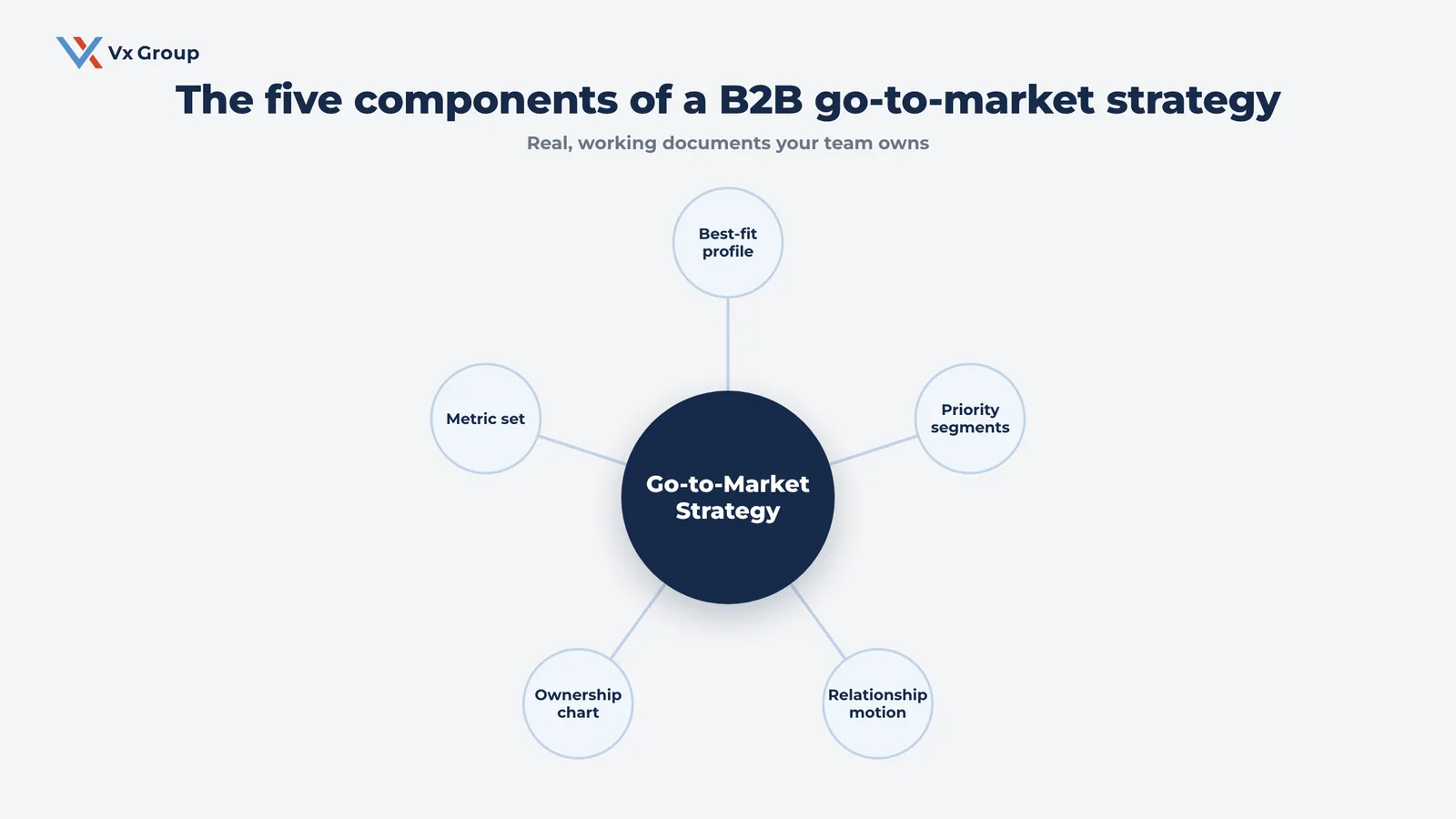
Each component should be a real document that the leadership team has seen, argued about, and signed off on. A go-to-market strategy that lives only in a deck from a planning offsite fades into a memory of a good conversation within a quarter.
FAQs
Building the strategy you can actually run
A B2B go-to-market strategy stays a living system, revisited every time the best-fit profile shifts, a segment stops performing, or an account manager leaves and takes undocumented relationship knowledge with them. The five components in this guide give a leadership team a shared, written answer to who you serve, where you win, how you win, who owns it, and how you know. That is the difference between a company that grows on purpose and one that grows by accident.
Ready to grow?
Vx Group builds the growth system that gets relationship-driven B2B companies found, chosen, and expanded.
Jacob Camhi is Vice President of Growth at Vx Group, where he works with lower-middle-market B2B companies on relationship-driven growth strategies.
Related posts
About the Author: Jacob Camhi
