

What a Manufacturing Marketing Agency Should Actually Do for You

A manufacturing marketing agency plans and runs the marketing that helps a manufacturer win and keep accounts: website, search, content, outreach, and trade show follow-up. A good one starts with the customers who already pay you, writes down how you win, and builds outreach your sales team will run.
TL;DR
- A manufacturing marketing agency should start with your current top accounts and the people you already know there. A logo refresh comes later, if at all.
- The average manufacturing sale takes about 130 days from first contact to close. The proposal stage is the longest at 45 days (Focus Digital Research Study, June 2026).
- Your website has to carry specs, lead times, certifications, and references in plain text, because buyers and their AI tools check those first.
- The first 90 days should end with an account map, a written “how we win” page, and fixed key pages. Add outreach your reps will run and three agreed numbers.
- Budget for a program that needs about a year to show up in revenue. Size it against what one new or expanded account is worth.
- Ask every agency who does the work, what they measure, and what they ask for first. The first request tells you most of what you need to know.
Most owners we talk to have already been through one agency that did not work out. The story is usually the same. A new logo, a new website that looks great, a list of leads that never turned into quotes, and a monthly report full of clicks.
We call the pattern random acts of marketing: a trade show here, a newsletter there, a retainer nobody can connect to a quote. It happens because the agency was never given a clear picture of how the company actually wins business.
This guide is for the owner or president of a manufacturer who is about to hire an agency. It also fits anyone thinking about firing the one they have. It covers what the work should include, what it costs, how long it takes, and the questions to ask before you sign.
Vx Group does this kind of work, so weigh our view with that in mind. We have tried to write the guide so it still helps if you hire someone else.
Here is what the guide covers:
- What a manufacturing marketing agency does
- Why manufacturers get burned
- How long a manufacturing sale takes
- The first 90 days of good agency work
- Agency, in-house hire, or fractional help
- Cost and timeline
- Questions to ask before you sign
- Red flags in a proposal
- How to measure the work
- Where to start this week
What does a manufacturing marketing agency actually do?
A manufacturing marketing agency is an outside team that handles some or all of a manufacturer’s marketing. That covers positioning, website, search visibility, content, outreach, events, and reporting. The best ones also help the owner decide which accounts deserve the effort in the first place.
Defined Term: Manufacturing marketing agency.
An outside firm that plans and runs marketing for industrial and manufacturing companies, ideally starting from the accounts and relationships that already produce the company’s revenue.
The table lists the jobs an agency can take on and who inside your company has to help. Every job needs someone on your side, which is why agency work fails when nobody on the team has time for it.
| Service | What you should get | Who on your side helps |
|---|---|---|
| Account mapping | A ranked list of current and target accounts | Owner, sales leader |
| Positioning and messaging | A short page on why customers pick you | Owner, top salespeople |
| Website and search | Pages for products, specs, industries, and proof | Engineering, quality |
| Content | Case stories, spec sheets, and answers to buyer questions | Sales, applications engineers |
| Outreach | Messages to named accounts that your reps send | Sales team |
| Trade shows and events | Meetings booked before the show and follow-up after | Sales, show staff |
| Reporting | Monthly numbers on meetings, quotes, and share of top accounts | Owner, sales leader |
Most agencies are strong in two or three of these rows. Ask which ones they will own and which ones they expect you to cover.
Why do so many manufacturers get burned by a marketing agency?
Manufacturers get burned when an agency starts with its own menu of services and fits the company into it. The usual result is activity that looks busy and cannot be tied to a quote. We see three versions of this again and again.
- The logo and website first agency. The first six months go to a visual refresh. The sales team gets nothing new to use.
- The lead list agency. It buys or scrapes a list, sends emails to strangers, and reports opens and clicks. A distributor principal who has bought from you for fifteen years is not on that list.
- The campaign-of-the-month agency. Each month brings a new theme, a new tactic, and a new report. Nothing builds on the month before.
All three share one habit. None of them asks to see your invoices by customer.
Field Notes:
A pattern we see often in owner-led manufacturers: three or four customers account for most of the revenue. Each of those customers has a dozen people who influence what gets bought. The company knows two of them. The agency’s work never reaches the other ten, because nobody asked who they were.
Marketing that ignores your best accounts leaves the most valuable relationships to chance. Our article on the generational customer explains why those accounts deserve a plan of their own.
Who is on the buying committee at a manufacturer, and what does each person check?
A manufacturer’s buying committee usually includes an engineer, a purchasing lead, a quality contact, an operations or plant lead, and an owner or executive. Each one checks something different, and a good agency builds a page or a proof point for every one of them.
The table lists what each role looks at and what helps. The details change by industry, so treat it as a starting list and add the roles you see in your own deals.
| Role | What they check | What helps them decide |
|---|---|---|
| Engineer | Whether the part or process meets the spec | Materials, tolerances, drawings, test data |
| Purchasing lead | Price, lead time, and terms | Clear lead times, quote turnaround, minimums |
| Quality contact | Certifications and process control | Certifications, audit history, inspection methods |
| Plant or operations lead | Whether delivery and support hold up | On-time record, named support contacts |
| Owner or executive | Whether you are a safe long-term partner | Customer references, years of work together, ownership stability |
Most agency work speaks to one of these people, usually purchasing. Ask the agency which of the five its plan reaches. Our guide to industrial B2B marketing goes deeper on how these buyers research a supplier.
How long is a manufacturing sales cycle, and what does that mean for an agency?
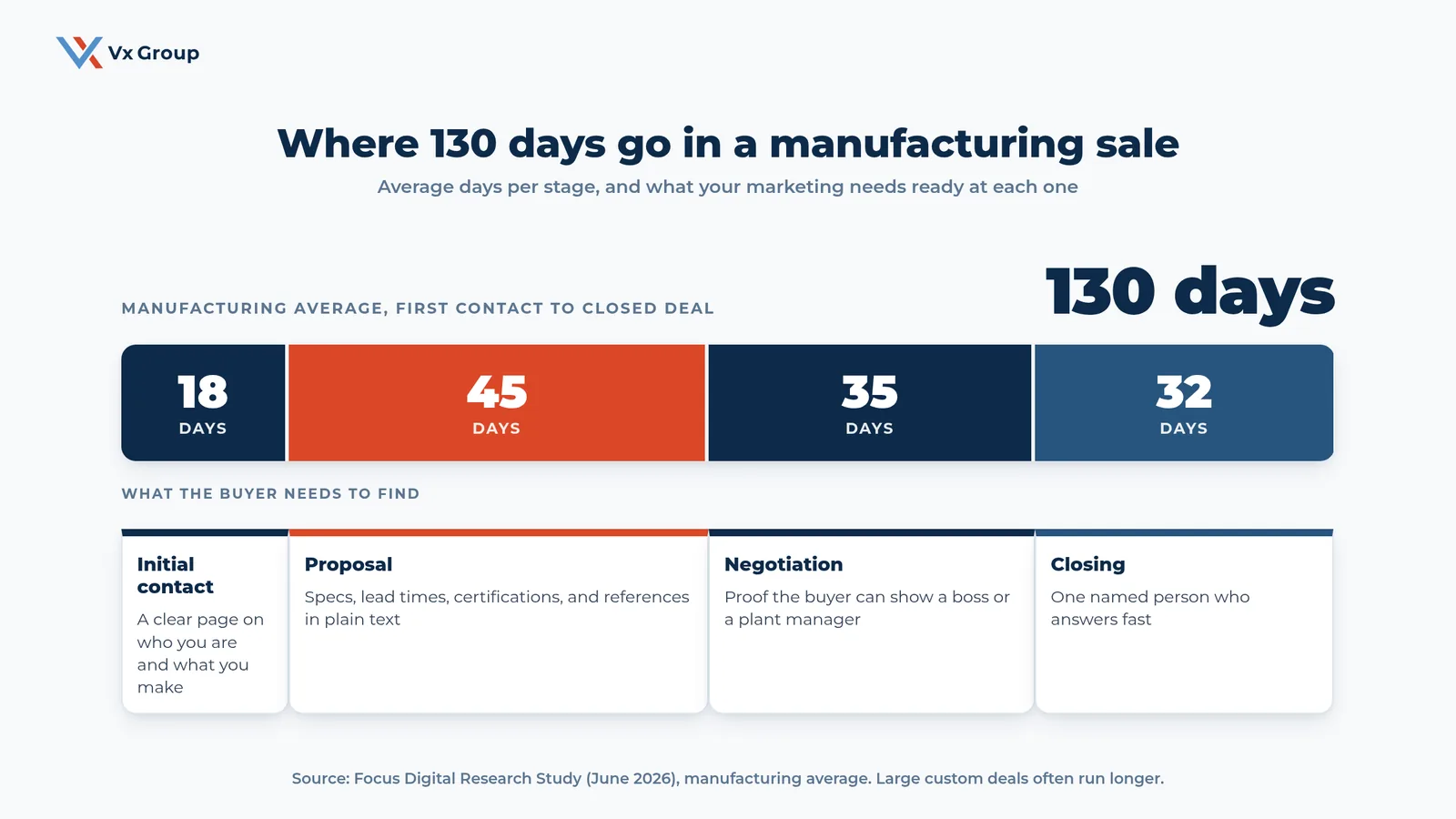
The average manufacturing sale takes about 130 days from first contact to close, according to a June 2026 Focus Digital Research Study of sales cycles by industry. The proposal stage is the longest at 45 days, followed by negotiation at 35 and closing at 32.
Initial contact takes the shortest time at 18 days. The graphic above shows the split and what a buyer needs to find at each stage.
Treat 130 days as a floor. The study averages many deal sizes, and large custom orders, new supplier approvals, and anything that needs a plant trial usually run longer. The point holds either way: most of the buying happens after the first conversation.
Judge every agency deliverable against the proposal stage
The proposal stage is where a buyer compares you with two or three other suppliers, often by reading your quote and checking your website. An agency that spends its budget on top-of-funnel awareness skips the stage that takes the most time.
Ask for a simple test. Pick any deliverable and ask, “What does this give a buyer who is reading our quote?” If the answer is vague, the work belongs lower on the list.
What should a manufacturing marketing agency do in the first 90 days?
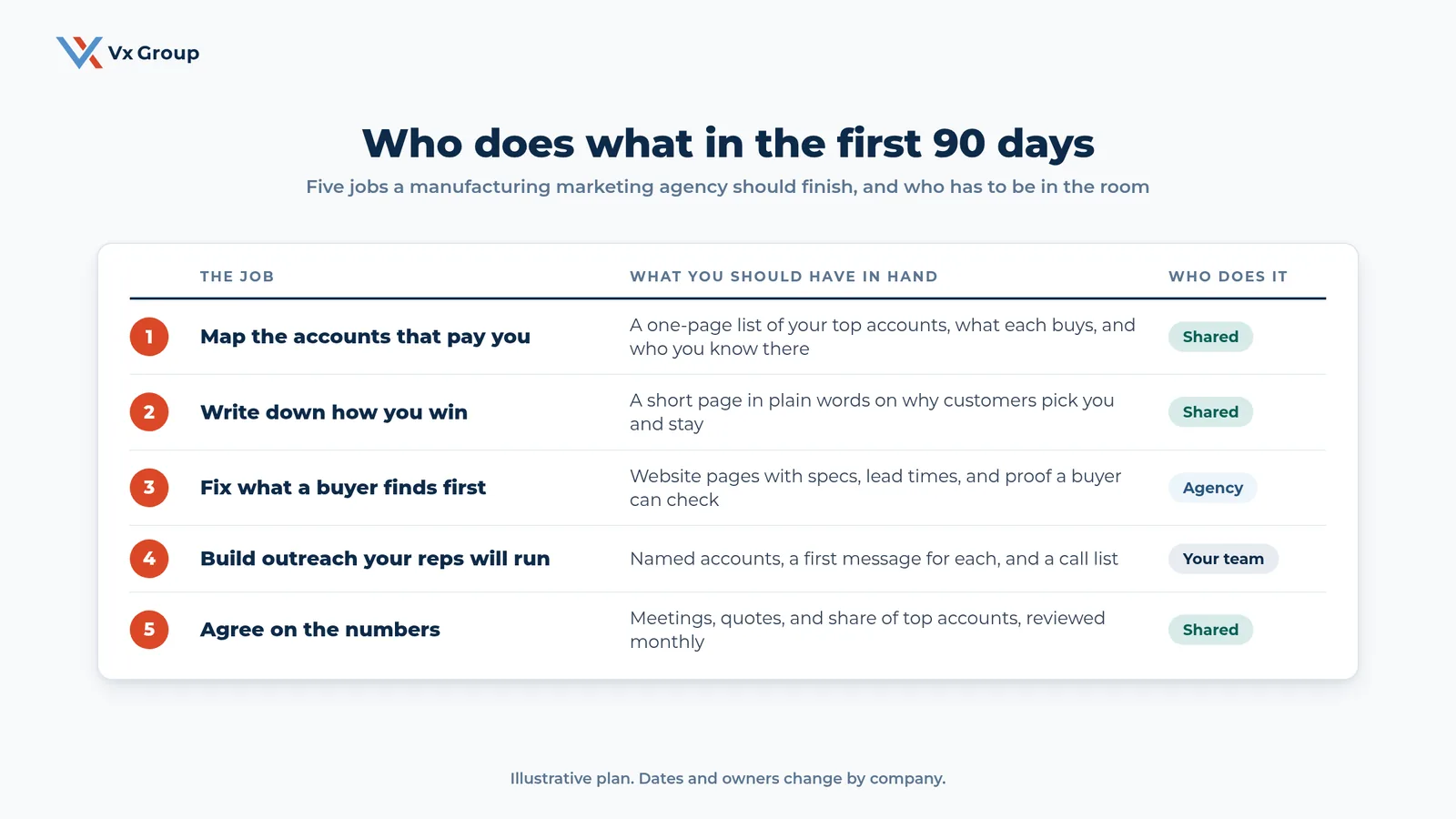
In the first 90 days, a manufacturing marketing agency should finish five jobs: map your accounts, write down how you win, fix the pages buyers check first, build outreach your reps will run, and agree on the numbers. Branding and campaigns come after that.
The graphic shows who owns each job. Three of the five are shared, because the agency cannot do them without your people. The sections below take them in order.
Map the accounts that already produce your revenue
Hand the agency your invoices for the last three years, sorted by customer. Ask them to build a one-page list of your top 25 to 40 accounts. Give it three columns: what each account buys, who you know there, and who you should know.
The list usually shows that a small group of accounts holds most of the revenue. That group gets the first dollars and the first hours. Our guide to account-based selling versus volume selling shows how to rank them.
Write down how you win
Sit down with your top salespeople and two long-time customers. Ask each customer why they started buying from you, and why they stay. Write the answers in plain words on one page.
You will hear things like fast quotes, an engineer who picks up the phone, and parts that arrive when promised. That page becomes the source for your website, your sales emails, and your trade show talking points. An agency that skips this step writes generic copy.
Fix the pages a buyer checks first
A buyer who is about to request a quote checks your site for specs, lead times, certifications, and references. Buyers also ask AI tools to summarize suppliers, and those tools read text. Put the facts in text on the page. A PDF or an image hides them from those tools.
Start with your five best-selling product or capability pages. For each one, add materials, tolerances, certifications, typical lead time, and one customer reference. Our guide to SEO for manufacturing companies covers the page details.
Build outreach your sales team will run
Outreach works when the people who own the relationships send it. The agency’s job is to write first messages for each named account, build the call list, and set the follow-up schedule. Your reps send, call, and report back.
Start with ten accounts. Give each a named owner on your team, one reason to reach out this month, and a date for follow-up. Our article on lead generation for manufacturers shows what to send and when.
Agree on three numbers before month two
Choose three numbers and put them on one page: meetings held with target accounts, quotes requested, and share of wallet at your top 10 accounts. Review them monthly with the agency, in the same meeting where you review the work.
Do not accept a report built on impressions and clicks. Those numbers move whether or not a single buyer picked up the phone.
Ready to grow?
Bring your invoice list and we will help you sketch the account map and the first 90 days for your company.
What should agency content look like for an industrial buyer?
Agency content for an industrial buyer should answer the questions a buyer asks while comparing suppliers. That means specs, applications, lead times, and proof from customers like them. Blog posts about general industry trends rarely help a buyer who is reading your quote.
Write an application story for each of your top five customers
An application story is a one-page account of a problem a customer had, what you made or did, and what changed. Use the customer’s words and, with permission, their name. Include the part, the material, the volume, and the result in numbers the customer agrees to share.
Five of these give your sales team something to attach to a quote. They also give the website pages buyers trust.
Publish a spec and lead time page for each product line
A spec page lists what you make in text: materials, size ranges, tolerances, certifications, and typical lead times. Buyers search for these details, and so do their AI tools. A page that carries the facts gets found and gets quoted. A page with a photo and a slogan does neither.
Answer the five questions your sales team hears most
Ask your reps for the five questions buyers ask before they request a quote. Write one plain page for each, in the voice of the person who answers it on the phone. These pages do the early work of a salesperson and give the agency real material to build on.
How does AI search change what a manufacturer's website has to do?
AI search tools now answer supplier questions for many buyers, so your website has to state its facts in plain text that a machine can read. The same facts help human buyers, so the work pays off twice.
A buyer who asks an AI tool for suppliers that make a certain part will get a short list built from pages the tool can read and trust. Specs locked in a PDF, a catalog image, or a slogan give it nothing to quote. Our AI visibility audit guide shows a 10-minute check you can run on your own company today.
Ask any agency how it handles this. A good answer includes text-based spec pages, consistent company details across the web, and a monthly check of how AI tools describe you.
What if your company sells through distributors and dealers?
If you sell through distributors or dealers, the agency has to work on two audiences: the end buyer and the channel partner who stands between you and that buyer. Many agencies only cover the end buyer and leave the dealer side unattended.
Ask how the agency will support your distributors with product pages, spec sheets, and training material. A dealer who cannot explain your product will sell the competitor’s instead. Our guide to dealer network strategy covers how to build that side of the program.
Should you hire an agency, build an in-house team, or bring in a fractional marketer?
Hire an agency when you need several skills at once and have an owner or sales leader who can direct the work. Hire in-house when you have steady marketing work for one person all year. Bring in a fractional or consulting lead when you need a plan and a manager before you add staff.
| Option | Best when | Watch for |
|---|---|---|
| In-house marketer | You have year-round work and a leader to manage them | One person rarely covers strategy, web, content, and events |
| Agency | You need several skills and someone inside owns the results | Work drifts to activity when no one inside owns the numbers |
| Fractional or consulting lead | You need a plan and a manager before adding staff | The plan still needs people to do the work |
Many manufacturers end up with a mix: a part-time lead who owns the plan, an agency for web and content, and a salesperson who owns outreach. Our guide to hiring a B2B marketing consultant covers when a consultant makes sense before an agency.
What does a manufacturing marketing agency cost, and how long until you see results?
Agency pricing varies widely. Pages from agencies that rank for this term describe narrow packages, such as managed search work, starting in the low thousands of dollars per month. They describe full programs that combine strategy, content, media, and sales support as six-figure yearly budgets. These are vendor figures, so treat them as a rough range and ask for a written scope.
On timing, one ranking agency says broader programs take six to twelve months to build momentum. That matches what we see when the sales cycle is long. Expect early signs such as meetings with target accounts in the first quarter, and expect revenue to follow later.
Size the budget against one account
Start with what a new or expanded account is worth to you. Here is an illustrative example using made-up numbers: a program costs $120,000 a year and your gross margin is 30%. The program needs to produce $400,000 in new or expanded sales to cover itself. For many manufacturers that is one mid-sized account.
Run the same math with your own numbers before you sign. If the agency cannot tell you how many accounts, quotes, or meetings the program should produce, ask them to build that estimate first.
Plan for a year, with a check at six months
Sign for a term long enough to see results, and write a review into the contract at month six. The review should look at meetings, quotes, and the share of top accounts you have reached. A contract with a short exit clause after that review protects you if the numbers have not moved.
What should you ask a manufacturing marketing agency before you sign?
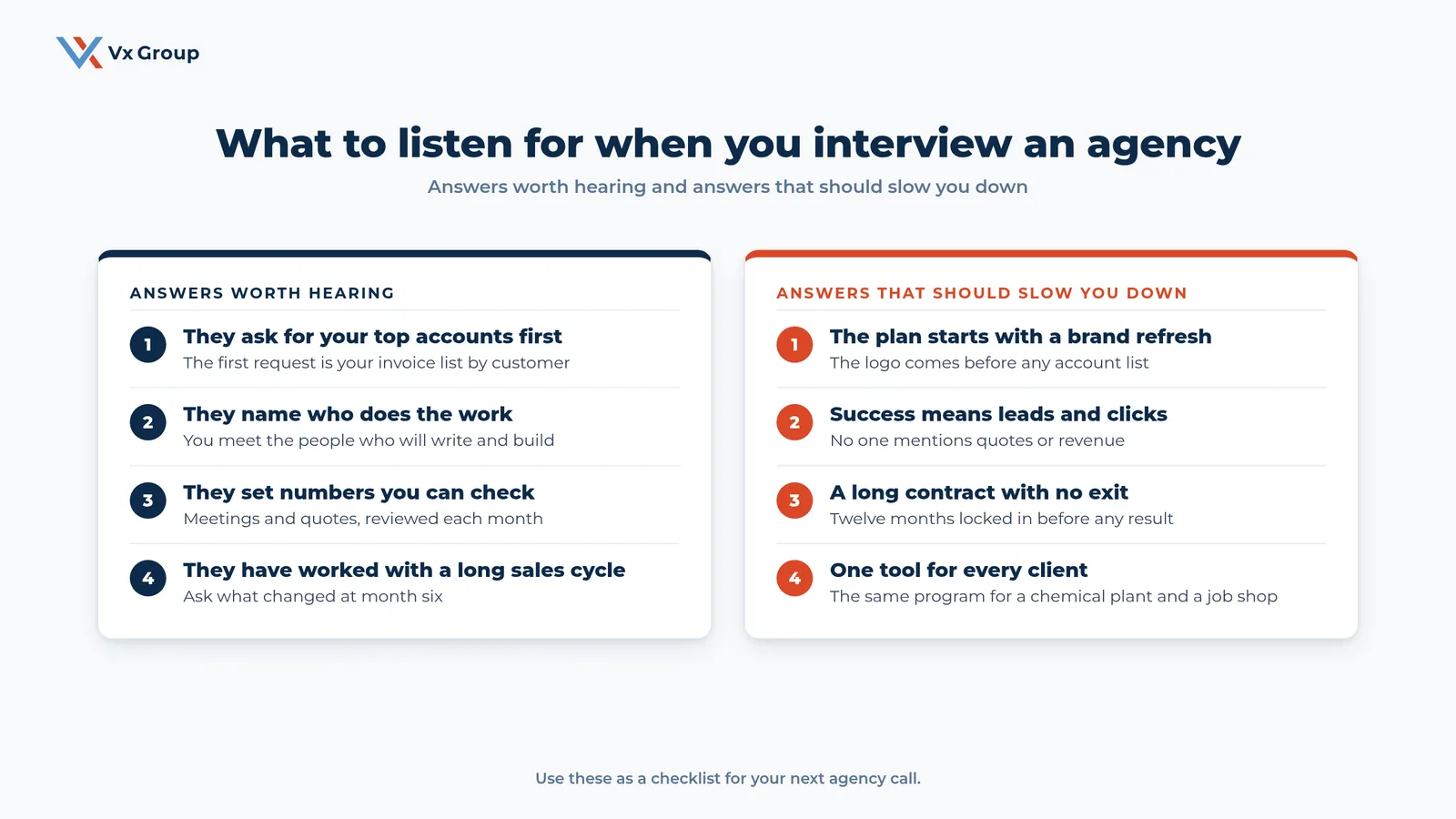
Ask a manufacturing marketing agency how it will learn your business, who will do the work, and what happens if the numbers do not move. The graphic shows answers worth hearing on the left and answers that should slow you down on the right.
The questions below are grouped by the decision they help you make. Use them on your next agency call.
Ask how the agency will learn your business
- What is the first thing you will ask us for? (A good answer is your invoice list by customer.)
- How will you decide which accounts get attention first?
- Who on our team will you need time with, and how many hours a month?
- What have you built for a company with a sales cycle longer than six months?
Ask who does the work and how it is measured
- Who will write, build, and manage our account? Can we meet them before signing?
- Which numbers will you report each month, and who checks them?
- How do you tie your work to quotes and revenue?
Ask what happens if the work stalls
- What is the review point, and what happens if the numbers have not moved by then?
- Who owns the website, the content, and the accounts after the contract ends?
- What do you need from our sales team to make outreach work?
Write down the answers and compare agencies side by side. The agency that asks you hard questions in return is usually the one that has done this before.
What red flags show up in a manufacturing marketing agency proposal?
The biggest red flag is a proposal that spends most of its pages on a new look and almost none on your accounts. Other flags show up in the scope, the measures, and the contract terms.
- Brand refresh before account work. A new logo and site may be right for you later. It should not be the first six months of spend.
- Success measured in leads and clicks. If the report never mentions quotes or revenue, the agency cannot show whether the work paid off.
- A twelve-month lock-in with no review. You carry the risk if the first quarter shows no movement.
- One program for every client. A chemical plant, a job shop, and a distributor sell in different ways.
- No named team. If you cannot meet the people who will do the work, you may be buying a sales team’s promises.
- A lead list as the main deliverable. Strangers on a list rarely turn into a twelve-month relationship.
If your company is working through a larger brand question, read our guide to brand modernization for B2B companies first. It helps you decide when a visual refresh earns a place in the plan.
How should you run the kickoff and the monthly meeting with an agency?
Run the kickoff with your sales leader in the room and the invoice list on the table. Hold a monthly meeting after that with the same short agenda every time. The routine keeps the agency’s work tied to the accounts that matter and gives you a record of what changed.
Hold a kickoff that includes your top salespeople
Invite the owner, the sales leader, and two or three of your best salespeople. Give the agency the account list, your last three years of quotes, and a list of the deals you lost with a line on why. Ask the agency to repeat back how it thinks you win.
If the agency’s summary sounds like any other manufacturer, send them back to listen again. A correct summary is the foundation for everything else.
Use the same four-item agenda every month
Keep the monthly meeting to 45 minutes and four items:
- The three numbers: meetings, quotes, and share of wallet at top accounts, against the baseline.
- What the sales team used from the agency this month, and what they ignored.
- What the agency learned from sales calls or customer replies.
- The next 30 days: which accounts, which messages, which pages.
Write down every decision and who owns it. After six months the notes show you whether the work is building on itself or starting over each month.
How do you measure a manufacturing marketing agency?
Measure a manufacturing marketing agency on meetings with target accounts, quotes requested, and share of wallet at your top accounts. Review the three numbers monthly and compare them to a baseline you set in the first 90 days.
Revenue arrives too late to steer by. A sale that closes in month ten started with a meeting in month three. The meeting count tells you much earlier whether the work is on track.
Add one qualitative check each quarter. Ask your sales team whether the agency’s work gave them something to use on a real call. Salespeople who say yes are a better sign than a rising traffic chart.
Our guide to the B2B marketing plan shows how to turn these measures into a yearly calendar.
Where should an owner start this week?
Start this week by pulling your invoices by customer for the last three years and sorting them by revenue. It takes an hour and tells you which accounts an agency should work on first.
- Day one: Export revenue by customer and mark your top 25 to 40 accounts.
- Day two: Write down who you know at each of the top ten, and who you do not.
- Day three: Ask two long-time customers why they buy from you, and write down their words.
- Day four: Check your five best product pages for specs, lead times, certifications, and one reference.
- Day five: Write the three numbers you want to track and the baseline for each.
Bring those five pages to any agency conversation. You will learn more from how the agency reacts to them than from any pitch deck. For a broader view of where this fits, see our guides to industrial marketing strategy and B2B brand strategy.
Pick the agency that starts with your best accounts
The right manufacturing marketing agency asks to see your invoices before it shows you a logo. It writes down how you win, fixes the pages buyers check, builds outreach your reps will run, and reports on meetings and quotes.
Owners who do the five-day exercise above can run an agency search in a few weeks. They go in with a clear scope and a way to check the results.
Ready to grow?
Share your top accounts and we will help you decide whether an agency, a hire, or a fractional lead fits your company.
FAQs
About the Author: Jacob Camhi
