

When an Owner-Led B2B Company Actually Needs a Marketing Consultant

A B2B marketing consultant is an outside advisor who studies how your company wins customers today, finds where growth is leaking, and gives your team a plan to fix it. An owner-led manufacturer or distributor needs one when growth has gone flat, nobody owns it, and the owner is making decisions without an outside view. Before that point, the money is better spent on work your own team can do this week.
TL;DR
- A B2B marketing consultant diagnoses how your company grows and hands your team a plan. An agency or a fractional CMO does different work, and mixing them up is the most expensive mistake in this category.
- Hire one when growth has flattened, no single person owns it, or a big decision (a new market, a rebrand, a senior hire) needs an outside view.
- Wait if your top accounts are unmapped, nobody will own the findings, or you want leads next month. Fix those first.
- A good first engagement opens with the growth model: which relationships carry the revenue, how new business arrives, and who owns each piece.
- Judge the work by decisions made and revenue signals, such as account conversations held and pipeline from existing customers, and treat activity counts as secondary.
- Ask every candidate what they would do in the first 30 days. The answer shows whether you are buying a diagnosis or a package.
In this guide
- What a B2B marketing consultant does
- How a consultant differs from an agency, a fractional CMO, and a hire
- When an owner-led company needs one
- When it is too early
- What B2B marketing consulting looks like start to finish
- What to ask before you hire
- How to judge the work
- Where to start this week
Most owners start this search the same way. Growth has been flat for a year or two, the usual fixes did not change it, and somebody suggests getting outside help. A search for “b2b marketing consultant” returns pages written by firms selling the engagement. They describe packages, deliverables, and monthly retainers, and they skip the question you actually have: do we need this, and what should happen first?
The villain in this story is the tactics-first engagement. A consultant opens with a content calendar, a paid campaign, or a new website before anyone has looked at how the company grows today. The activity is real. The revenue rarely follows, because nobody checked which relationships carry the business or who owns growth inside it. Vx Group calls the general pattern random acts of marketing, and an outside hire can produce it just as easily as an inside one.
This guide is written from the buyer’s side of the table. It covers what a consultant does, when hiring one makes sense, the cases where it is premature, and how to judge the work once it starts.
What does a B2B marketing consultant do for an owner-led company?
A B2B marketing consultant audits how your company wins and keeps customers, identifies what is limiting growth, and gives you a prioritized plan your team can carry out. The consultant advises. Your people, or other vendors, do the execution. In an owner-led company with $5 million to $50 million in revenue, the work usually centers on three questions: where does revenue come from today, what keeps it flat, and who will run the fix.
Defined Term: B2B marketing consultant.
An outside advisor engaged for a defined period to diagnose how a business generates demand and relationships, recommend where to invest, and hand over a plan the company’s own team can execute.
The work falls into five buckets, and a good engagement touches most of them:
- Revenue mapping. Which customers, channels, and referral sources produce the revenue, and how concentrated it is in a few relationships.
- Positioning and message. Whether your buyers can tell, in a few sentences, why they should pick you over a competitor they already know.
- Customer and prospect profile. A written description of the accounts that buy well, stay long, and grow, so the team can find more of them. The guide to what an ideal customer profile is covers how that document gets built.
- Sales and marketing handoffs. How interest becomes a conversation, a quote, and an order, and where the baton gets dropped.
- Plan and ownership. A short list of priorities with a named owner, a date, and a measure beside each.
The list has no menu of channels. A consultant who leads with channels is describing tools before the job is defined. The job is to understand why your company grows the way it does, and the tools come after.
A 40 to 60 word definition fits on a sticky note, and that is a fair test of any consultant you interview. If they cannot explain what they will do for you in plain language, the engagement will be harder to judge later.
How is a marketing consultant different from an agency, a fractional CMO, or an in-house hire?
A consultant sells diagnosis and a plan, a fractional CMO sells leadership of the marketing function on a part-time basis, an agency sells execution of campaigns and content, and an in-house hire gives you a full-time employee. These are four different purchases, and the most common regret among owners comes from buying one when they needed another.
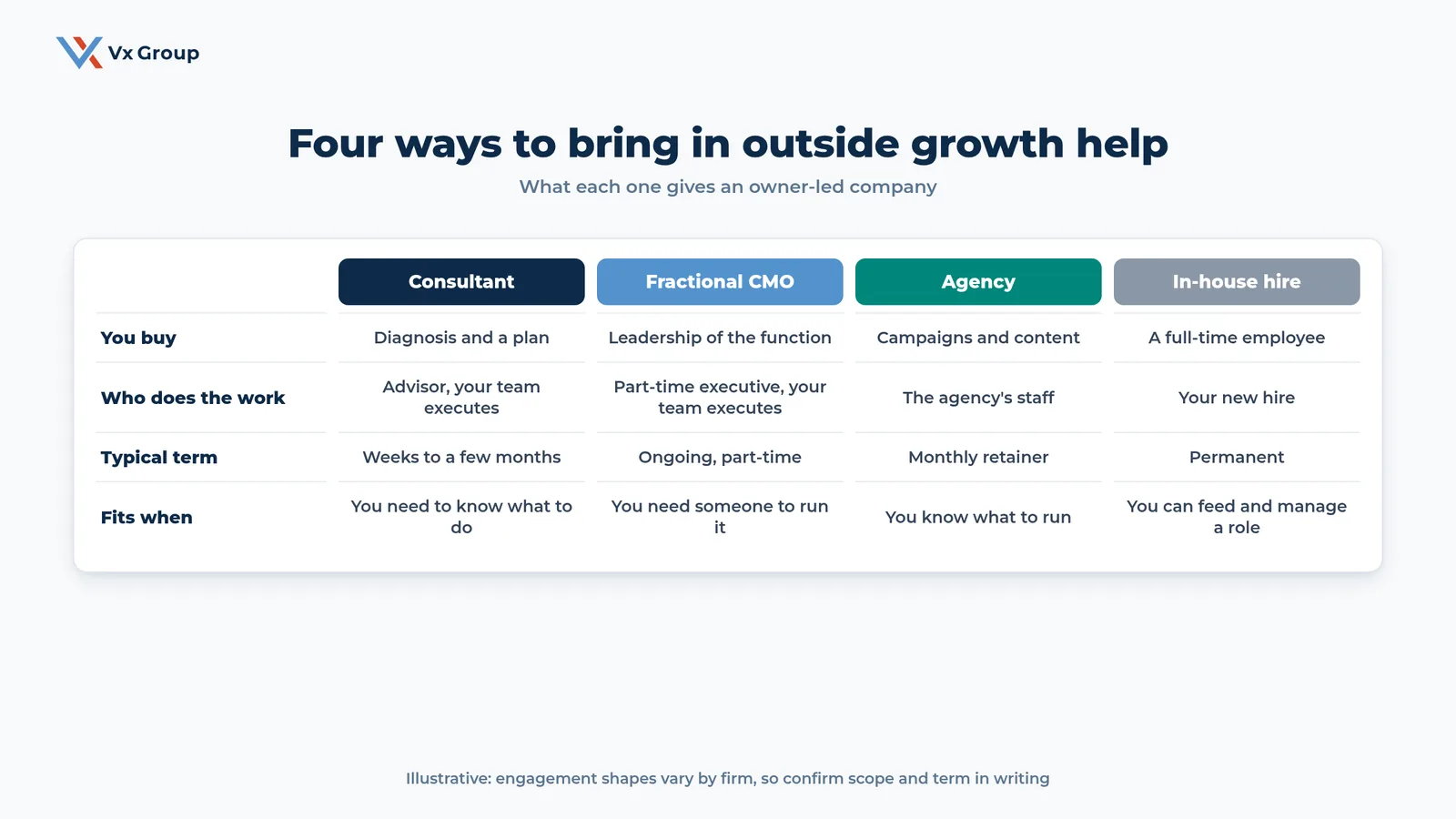
| Consultant | Fractional CMO | Agency | In-house hire | |
|---|---|---|---|---|
| What you buy | Diagnosis and a plan | Part-time leadership of the function | Campaigns, content, and production | A full-time employee |
| Who does the work | The advisor guides, your team executes | A part-time executive guides, your team executes | The agency’s staff | Your new hire |
| Typical term | Weeks to a few months | Ongoing, part-time | Monthly retainer, often a year | Permanent |
| Works best when | You need to know what to do | You need someone to run the function | You already know what to run | You can feed and manage a full role |
| Main risk | Findings that nobody carries out | Paying for leadership you cannot yet use | Activity aimed at the wrong target | A hire with no plan to execute |
Published price ranges differ widely. One hiring marketplace, marketerhire.com, lists consultants at roughly $3,000 to $12,000 a month and agencies at $5,000 to $25,000 a month. Its guide is written by a vendor with a stake in the answer, so use the figures as a rough benchmark and get quotes from several providers. Scope and term move the price more than the label does.
Match the purchase to the problem you can name
Write one sentence that finishes “We need help because…” If the sentence says “we do not know why growth stalled,” you need a consultant. If it says “we know the plan and nobody is running it,” you need a fractional leader, and the piece on when to hire a B2B fractional CMO covers that decision. If it says “we have a plan and need output,” you need an agency or a hire.
Check the sequence before you sign anything
Diagnosis comes before execution. An agency can run excellent campaigns against the wrong target and report strong activity the whole time. A consultant who diagnoses first gives the agency, or your team, the right target. In the owner-led companies we work with, the order of operations matters more than the choice of vendor.
Ask what happens after the findings arrive
Every consulting engagement ends with a handoff. Ask who receives it, how long they have, and what authority they hold. A plan with no owner on your side is a binder. The growth advisory model keeps an advisor involved after the plan lands so that someone checks the follow-through, and any consultant you hire should answer this question directly.
When does an owner-led company actually need a marketing consultant?
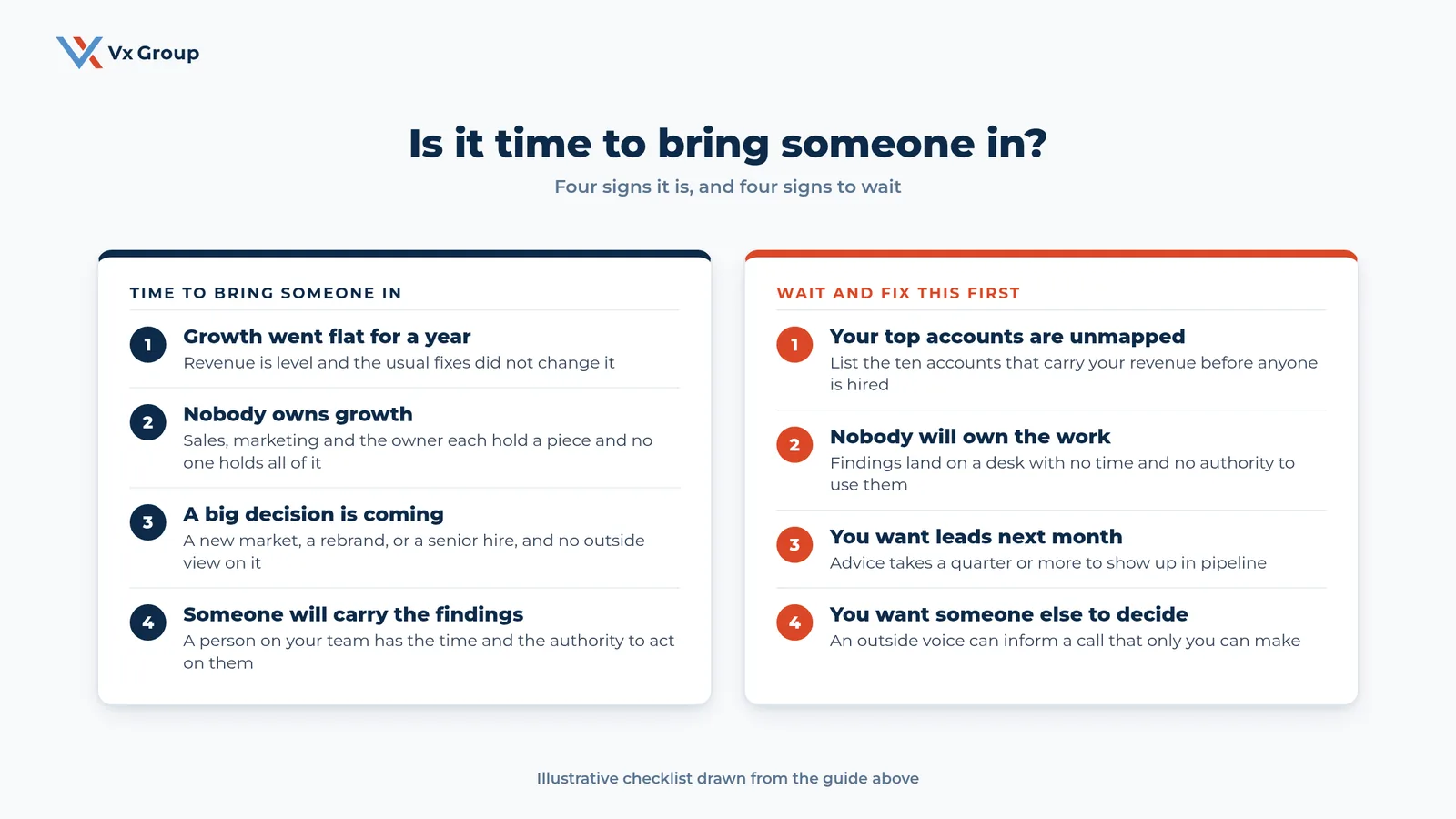
An owner-led company needs a marketing consultant when growth has stayed flat for a year or more, when no single person owns growth, or when a large decision such as a new market, a rebrand, or a senior sales hire needs an outside view. Those three conditions describe a company that has outgrown informal growth habits and has not yet built the system that replaces them.
Many owner-led companies grew for years on referrals, a few strong relationships, and the owner’s own reputation. That model works well until it stops. The company is too big for the owner to hold every relationship, and too young in its systems for the team to carry the load. The article on why B2B companies grow by accident describes that stage in detail, and why owner-led companies stall covers the revenue range where it tends to show up.
Look for the flat-year signal
Pull revenue by year for the last three years. If it is level or slipping while your costs and headcount rose, and the standard moves (a new rep, a trade show, a website refresh) changed little, you have a flat-year signal. The signal says the problem sits in how the company grows, and a single tactic will not fix it.
Find out who owns growth today
Ask your leadership team one question and have each person answer in writing: who is responsible for growth in this company? If you get three different answers, or the answer is “you,” growth has no owner. A consultant helps most when that gap is the problem, because the first task is to design the role, and an outside person can say things an internal peer cannot.
Check for a decision that needs a second opinion
A new market, a rebrand, a distribution change, or a senior sales hire each carry large cost and long consequences. An outside advisor who has watched the same decision play out in other companies gives you a reference you do not have. Hire for a defined question, set the end date at the start, and treat the answer as one input to your decision.
Confirm someone on your team will carry the findings
The best diagnosis fails if nobody acts on it. Before you sign, name the person who will receive the plan, give them time on their calendar for it, and confirm they have the authority to change how the team works. If you cannot name that person, you have found your first hire or your first reason to wait.
Ready to grow?
We start with a conversation about how your business actually grows today, before anyone proposes a scope.
When is it too early to hire a marketing consultant?
It is too early when your top accounts are unmapped, when nobody will own the findings, when you want leads next month, or when you are hoping an outsider will make a decision that belongs to you. In each case the money goes further if you fix the gap first, and a candid consultant will tell you so. This is the section no competing page will write, because the pages that rank are written by people who get paid when you sign.
List your ten most important accounts before you hire anyone
Open a spreadsheet and list the ten accounts that carry the most revenue. Next to each, write the relationship owner, the date of the last real conversation, and the year-over-year change in spend. This takes an afternoon, and it often shows the problem directly. Accounts with no owner and no recent conversation are the fastest-moving risk in the company. Our write-up on treating your top 10 customers as strategy shows the format.
Decide who will own the work before the work arrives
A consultant produces findings. Somebody inside has to turn them into new habits. If your sales leader is already at capacity and your marketing person is a coordinator with no authority over pricing or accounts, the findings will sit. Either free up that person first or plan to hire a fractional leader alongside the consultant.
Set the time horizon honestly
Advice shows up in pipeline after a quarter or more in a company with a long sales cycle. If you need orders next month, the answer is a direct push through your existing relationships: calls to your best customers, a reactivation list of accounts that went quiet, and a review of open quotes. A consultant cannot compress a long cycle, and promising to do so is a warning sign.
Keep the decision that belongs to you
Owners sometimes hire advisors to avoid a hard call, such as letting a long-tenured salesperson go or retiring a product line. A consultant can lay out the facts and the options. The call stays with you, and an outside voice who carries it out for you leaves the underlying problem in place.
Field Notes:
A distributor owner we will call Dan (a composite of patterns we see, with details changed) came in sure he needed a new website and a marketing agency. Two questions changed the conversation. We asked who owned his twelve biggest accounts and when each had last been visited. Four had no owner, and two had gone quiet for most of a year. He spent six weeks assigning owners and visiting those accounts himself before any outside engagement began. The website project came later, with a brief that reflected what those conversations had taught him.
What does B2B marketing consulting look like from start to finish?
B2B marketing consulting usually runs in four phases: a diagnostic that maps how the company grows, a plan that sets priorities and owners, a hands-on stretch where the consultant helps launch the first moves, and a review that checks results and resets the plan. The first phase decides everything that follows. A consultant who skips it is guessing, and you will pay for the guesses.
Here is a typical shape for an owner-led company with $10 million to $40 million in revenue. Lengths vary with the size of the team and the length of the sales cycle.
| Phase | What happens | What you hold at the end |
|---|---|---|
| 1. Diagnose | Interviews with leaders, sales, and a handful of customers; review of revenue by account and source | A written picture of how the company grows today |
| 2. Plan | Priorities ranked by revenue impact, with an owner and a measure for each | A one-page plan with named owners |
| 3. Launch | The consultant coaches the team through the first two or three moves | Early moves underway, with results to review |
| 4. Review | Results checked against the measures; plan reset | An updated plan and a decision on what happens next |
Buyers search both “marketing consultant” and “marketing consulting.” The two terms point at the same need, so the questions below apply to either.
Run the diagnostic in the order that matters
Start with revenue, then people, then channels. Revenue by account shows concentration and which relationships grew. Interviews with leaders show who believes they own growth and where the handoffs break. Channel review comes last, because by then you know what the channels need to deliver. A diagnostic that opens with channel audits has the order reversed.
Interview five customers before writing a word of strategy
Ask five of your best customers why they chose you, what nearly made them leave, and what they would tell a peer. Their words become your message and your profile of the accounts worth finding. A consultant who skips customer interviews is working from the owner’s opinion alone. Fifteen minutes with each customer gives you language no workshop can produce.
Rank the plan by revenue impact and effort
List every recommended move. Score each from one to five on likely revenue impact and on effort for your team. Start with the high-impact, low-effort items and put a name and a date beside each. A plan with twenty items and no ranking is a wish list. Five ranked moves with owners is a plan.
Set the review date at the start
Put a 90-day review on the calendar on day one. At the review, check each move against its measure and decide to continue, change, or stop it. Reviews are where a consultant earns the next phase or loses it, and a firm that resists a review date is asking for trust you have not yet had a chance to verify.
Fold the plan into a growth system your team owns
The end state is a company that runs the plan without the consultant in the room. That means a documented profile of your best accounts, a named owner for each key relationship, a short list of measures reviewed monthly, and a habit of revisiting the plan each quarter. The broader pattern is described in what a business growth operating system is, and the practical starting point for a plan is the B2B marketing plan guide.
What should you ask before you hire a B2B marketing consultant?
Ask what they would do in the first 30 days, who they have worked with that looks like your company, how they handle your team after the plan is delivered, and what they would advise you to skip spending money on. The answers show whether you are buying a diagnosis or a package, and whether the person has worked inside companies with your sales cycle and your relationships.
Ask for the first 30 days in detail
A strong answer names who they will interview, what data they will request, and what you will see at the end of the month. A weak answer describes deliverables in the abstract, such as a “go-to-market roadmap,” with no mention of your customers or your numbers. Ask for a sample table of contents from a past diagnostic, with the client name removed.
Ask who they have helped that resembles you
You want experience with owner-led companies that sell through relationships, run long cycles, and keep customers for years. A consultant whose background is high-velocity software or consumer brands will bring habits that do not transfer. The playbook for a 12-month sales cycle with a buying committee differs from the playbook for a self-serve product, and the difference decides outcomes.
Ask how they work with your people
A consultant who works around your team creates a plan nobody believes in. Ask how often they will meet your sales leader, whether they join customer calls, and whether they build the plan alongside the team. Plans that the team helped write get carried out at a much higher rate.
Ask what they would advise you to skip
A good consultant protects your budget. Ask what they would skip: a website rebuild before the profile is written, a trade show without a follow-up plan, a paid campaign with no owner for the leads. A candidate with no list of things to skip is selling.
Ask how they feel about a review date and an exit
Request a defined scope, a 90-day review, and a clear way to end the engagement. Firms that value the relationship accept all three. A long minimum term with no review is a sign the firm expects the work to be hard to measure.
Check the references against the claims
Ask for two past clients, and ask each one what changed in the company after the engagement ended. Listen for decisions and habits that stuck. A client who can only describe a document received a deliverable, and a client who describes new habits received an outcome.
How do you judge whether the consulting work is working?
Judge consulting work by the decisions it produced and the revenue signals that follow: ownership assigned for key accounts, conversations held with the accounts that matter, pipeline that comes from existing customers, and a plan the team uses without prompting. Activity counts such as posts published or emails sent are weak evidence on their own, since they measure how busy people are.
Defined Term: Activity illusion.
The belief that a busy team is a productive one. It shows up when a company measures dials, emails, and posts while the quality of its pipeline and relationships falls.
Track a short scorecard monthly during the engagement. Keep it to measures that connect to revenue:
- Key accounts with a named owner. The target is every one of your top ten.
- Real conversations with top accounts. Count conversations with decision-makers in the last 90 days, and ignore emails and invoices.
- Pipeline from existing customers. Dollar value of open quotes and expansions from current accounts.
- Share of plan items completed on time. Of the moves in the plan, how many hit their dates.
- Profile in use. Whether sales actually uses the written account profile to qualify prospects.
- Revenue by cohort. Whether the accounts you targeted are growing faster than the rest.
Compare results to the baseline you wrote down on day one
Capture each measure at the start. Without a baseline, any result can be described as progress. Put the starting numbers in the plan, and review them at 90 days.
Separate leading signals from lagging results
Revenue is a lagging result and can take two quarters or more to move in a long-cycle business. Account ownership, conversations held, and pipeline from current customers move first. Our piece on business leading indicators explains how to read those signals before revenue shows them.
Decide in advance what would make you stop
Write the stop condition into the plan: for example, if owners are still unassigned and the first two moves have yet to launch by day 60, you pause and talk. This protects both sides and keeps the engagement honest.
Keep your own people at the center
The strongest result of a consulting engagement is a team that runs the plan with confidence. If the work leaves your people more dependent on the consultant, something went wrong. If the work leaves them with a clear picture of how the company grows and a short list of owned priorities, it did its job.
Where should an owner start this week?
Start with the ten-account list, the three-person ownership question, and a single sentence naming the help you need. You can finish all three in a few days without spending anything, and each one improves whatever decision comes next. If the list reveals unowned accounts, assign owners and make the calls yourself. If the ownership question gets three different answers, you have defined the first job for an outside advisor.
Then talk to a few people. Interview one or two consultants about the first 30 days, and ask about the things they would advise you to skip. Compare how each one talks about your customers. The one who asks about your top accounts before talking about channels is working from the right order.
If you want a straight conversation about how your business grows today, and whether outside help would change anything, we are glad to have it. Sometimes the answer is that you should wait, and we will say so.
Ready to grow?
Bring your top ten accounts and your last three years of revenue, and we will talk through what you see.
So here is a question worth sitting with. If your two largest accounts called tomorrow and asked who at your company is responsible for their growth, would you have one name to give them? And if the answer is “me,” how long can that last as the company grows?
FAQs
About the Author: Eric Zoromski
