

How to Set a Distributor Pricing Strategy That Protects Margin

A distributor pricing strategy has to do three things at once: give the distributor a margin they can build a business on, hold a floor so your own channel stops competing on discount, and pay a rebate that rewards the behavior you actually want more of. Get those three right, and the rest is structure and enforcement.
TL;DR
- Price the distributor margin against what it’s actually buying: inventory risk, technical support, and demand creation.
- Build three or four pricing tiers with written, auditable criteria for moving a distributor up or down.
- Set the price floor as a percentage off list, and decide the enforcement steps before you need them.
- Design rebates around behavior, specifically product breadth, training currency, and registration timeliness, and cap the volume component.
- Put distributor-level margin data on a fixed annual review cycle, and reset tiers, rebates, and the floor against real numbers.
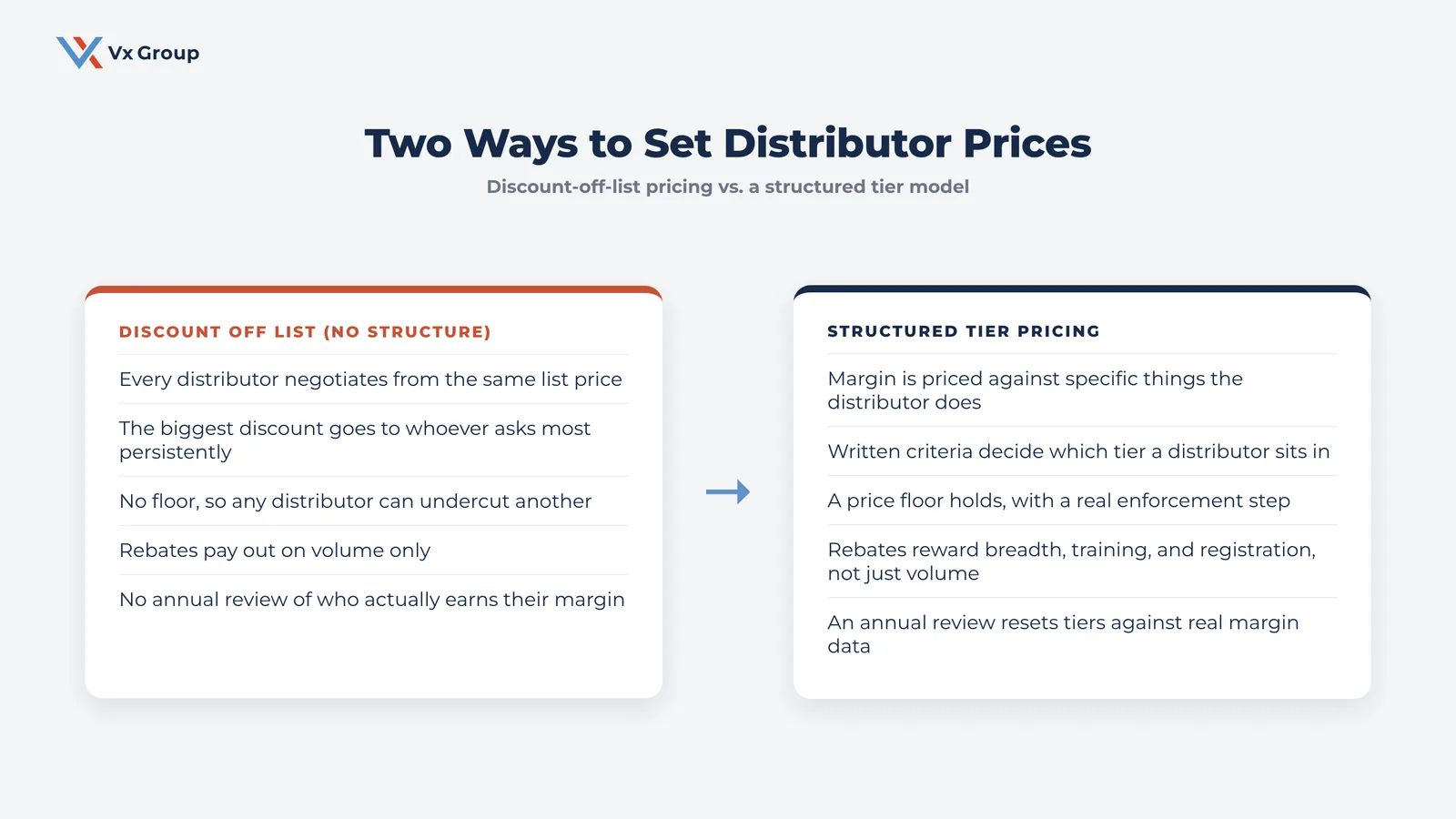
Most distributor pricing lives in one place: a discount percentage off list price, negotiated deal by deal. There’s no tier behind it, no written criteria, and no floor holding the bottom of the range. The biggest discount goes to whoever asks the most persistently, and every distributor in the network eventually learns the same lesson: ask hard enough, often enough, and the number moves.
That system trains the wrong behavior. A distributor who calls twice a year to renegotiate learns exactly as much from the process as a distributor who trained their whole sales team on the product line and carried inventory through a slow season. The company ends up subsidizing the loudest voice in the channel over the most productive one, and it usually takes a couple of bad years before anyone notices the pattern. By the time someone finally runs the numbers, the company has typically been training this behavior for years without meaning to.
This is really a piece of the broader discipline of channel sales management, the pricing, enablement, and relationship system a manufacturer runs across its whole distributor network. Pricing is the part of that system most companies never write down.
Five things build a durable structure in its place: a margin priced against something specific, a tier system with real criteria, a floor that holds, a rebate that rewards the right behavior, and an annual review that keeps the whole system anchored to real numbers. The five steps below build each part in order.
Step 1: Decide What the Distributor Margin Is Buying
A distributor’s margin should be priced against three things they actually provide the manufacturer: the inventory risk they carry, the technical support they deliver to end customers, and the demand they generate through their own sales effort. Price each one separately before you set a single blended number.
Price the inventory risk
Assign a specific margin point to inventory risk when a distributor is carrying stock, financing it, and absorbing the carrying cost and any obsolescence themselves. A distributor holding 90 days of stock on your product line is financing part of your balance sheet. A common starting point is 3 to 6 points of margin above a pure drop-ship or pass-through arrangement, adjusted for your own carrying cost and the product’s shelf life. Write the number down as its own line item. If a distributor later moves to a drop-ship model, that margin point should move with them. For a product with a short shelf life or fast-moving technology, weight this component even higher, since obsolescence risk falls almost entirely on the distributor holding the stock.
Price the technical support
If a distributor fields technical questions, handles installation, troubleshooting, or warranty triage on your behalf, that is a real cost they are absorbing for the manufacturer. Price it as its own component, typically 2 to 5 points of margin, scaled to the actual support burden. A distributor handling first-line technical support on complex equipment earns more here than one reselling a commodity SKU with no support obligation. Tie the number to a defined, auditable support scope: response time commitments, certification requirements, or a minimum number of trained technicians on staff.
Price the demand creation
Demand creation is the margin component most companies skip, and it should carry the most weight. A distributor who trains their own sales team on your product, stocks a showroom or demo unit, or brings a sourced opportunity to the table is generating revenue the manufacturer would not otherwise see. Price this as the largest single piece of the margin package, often 5 to 10 points, and reserve it for distributors who can show documented activity: a training log, a quoted opportunity, a joint sales call. A distributor who only fulfills orders a customer already decided to place has not earned this component.
Defined Term: Demand creation margin.
The portion of a distributor’s margin priced specifically against sales activity they generate themselves, such as training their own team, sourcing a bid, or running a joint call, documented through records the manufacturer can audit at renewal.
Step 2: Build the Tier Structure and the Criteria to Move Between Tiers
A workable distributor tier structure has three or four levels, each with a written, auditable criterion for entry and a documented path to move up or down. Publish the criteria to distributors directly, so a distributor knows exactly what moves them from one tier to the next.
Set three or four tiers
Three or four tiers is the range that holds up in practice. Two tiers leaves too little room to reward a genuinely stronger performer. Six or more tiers turns the program into a spreadsheet nobody can explain on a sales call, and distributors stop trusting a system they cannot describe back to you. Name the tiers something a distributor can say out loud, such as Authorized, Preferred, and Elite, and anchor every tier assignment to the written criteria below.
Write the criteria that move a distributor between tiers
Each tier needs two or three measurable entry criteria the distributor can track themselves: trailing 12-month purchase volume, a minimum number of trained and certified technicians, a documented marketing commitment, or a required inventory position. Set every threshold as a real number. “Preferred tier requires $400K in trailing 12-month purchases and two certified technicians” is a criterion you can audit at renewal. Write every tier requirement in that same form.
Publish the criteria and the review date
Send the tier criteria to each distributor in writing, along with the date you will review their position. A distributor who knows exactly what Elite tier requires has a business case for hitting it. A distributor who suspects the tier is assigned by relationship or tenure has little reason to invest in anything beyond the relationship itself.
Set a transition period for distributors already in the network
Do not flip every existing distributor into the new tier structure overnight. Give the network a defined transition window, 90 to 180 days is typical, to review the new criteria against their own numbers and see where they land. Distributors already meeting Elite criteria move immediately. Distributors below the criteria for their current pricing keep their existing terms through the transition window, with a clear date when the new criteria take over. This gives the whole network time to adjust while still moving everyone onto the same written system within a single sales cycle.
Example tier structure (illustrative; set your own thresholds against your own margin data)
| Tier | Trailing 12-Month Purchases | Required Criteria | List Discount |
|---|---|---|---|
| Authorized | Meets minimum order requirement | Signed distributor agreement, one trained contact | 20% off list |
| Preferred | $250K+ | Two certified technicians, documented marketing plan | 30% off list |
| Elite | $750K+ | Dedicated inventory position, quarterly business review, 90%+ on-time registration | 38% off list |
Ready to grow?
If your tier structure has turned into a spreadsheet nobody can defend on a call, we can help you rebuild it around criteria that hold up.
Step 3: Set the Price Floor and the Enforcement Mechanism
A price floor works only when it is written down as a specific number or percentage and paired with a defined consequence for breaking it. A floor with no enforcement step is a suggestion, and distributors treat it like one.
Set the floor as a percentage off list
Set the price floor as a fixed percentage off your list price. A percentage moves automatically when list price changes, so you are not renegotiating the floor every time you adjust the list. Pick the percentage based on the minimum margin a distributor needs to stay solvent on the product line, plus a buffer, and hold that number even under pressure from a strong negotiator.
Put the floor and its consequence in the distributor agreement
Write the floor and its consequence directly into the distributor agreement, in the same section that already covers termination and territory. A floor that lives only in an email or a verbal understanding from a sales call is difficult to enforce when a real dispute shows up. If your distributor agreement does not already define this clearly, see What Belongs in a Distributor Agreement for the clauses that hold up under pressure.
Define the enforcement steps before you need them
Decide the escalation sequence in advance, while it is still hypothetical. Waiting until a live dispute is underway means negotiating consequences with a distributor who is already defensive, which rarely produces a fair or consistent outcome.
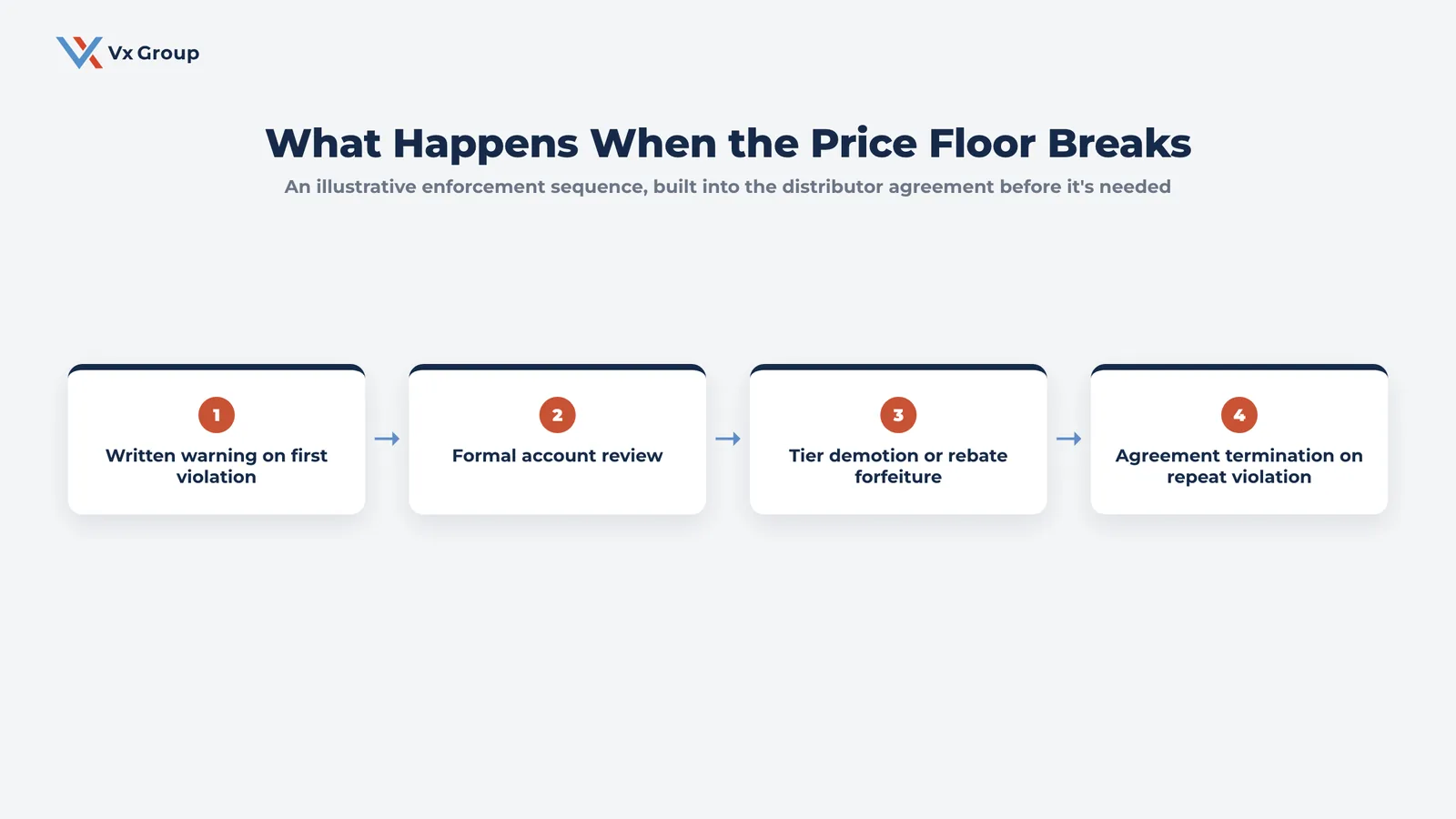
A workable sequence runs four steps: a written warning on the first violation, a formal account review if it happens again, tier demotion or forfeiture of the current rebate period on a third violation, and termination of the agreement for a distributor who will not hold the line. Put real days and real people against each step: who sends the warning, how many days the distributor has to respond, and who has the authority to approve termination. Apply the sequence the same way for every distributor, including the largest account in the network. A floor that bends for the biggest customer stops being a floor for anyone.
Get counsel to review the floor and any MAP policy before you enforce it
Caution:
A price floor and any minimum advertised price (MAP) policy carry real antitrust exposure under U.S. and state law, specifically the risk of resale price maintenance. Courts draw a fact-specific line between a unilaterally announced MAP policy, where a manufacturer enforces its own decision about who it sells to, and a negotiated or coordinated price floor, and that line is easy to cross without meaning to. Have a lawyer who handles antitrust and distribution law review your specific floor and MAP language, including how it is presented to distributors and how it is enforced, before you put either into practice. This section is a flag for counsel to review. It does not offer legal advice, and nothing here should be read as a legal conclusion.
Defined Term: Resale price maintenance (RPM): An agreement or understanding between a manufacturer and a distributor that sets or controls the price at which the distributor resells a product. RPM is the specific antitrust concern behind price floors and MAP policies, and it is the reason floor language needs legal review before it goes into a distributor agreement.
Step 4: Design Rebates on Distributor Behavior
A rebate program that pays out on volume alone rewards distributors simply for ordering more, whether or not they have done anything to grow the account. Tie a meaningful share of the rebate to product breadth, training currency, and registration timeliness, so volume sits alongside those factors as one input among several.
Set a product breadth requirement
Reward distributors who carry and actively sell the full product line. Set a minimum SKU count or a minimum percentage of the catalog represented in their trailing purchases, and pay a rebate point or two specifically against that threshold. A distributor stocking only the two or three best-selling SKUs is leaving the rest of the catalog to grow on its own, or not grow at all.
Set a training currency requirement
Require a fixed number of a distributor’s technicians or salespeople to hold current certification or product training, refreshed on a set cycle (annually is common), and pay a rebate point against it. Training currency is easy to verify: pull the certification records and check the date. A distributor whose only certified technician left the company eighteen months ago is selling on outdated knowledge, and the rebate should reflect that gap.
Set a registration timeliness requirement
Pay a rebate point for opportunities registered within a defined window (30 days from first contact is a common standard) before the deal closes. Timely registration gives the manufacturer real visibility into the pipeline distributors are building. A distributor who registers late gives up that visibility until the order lands.
Keep a volume component, sized correctly
Volume still belongs in the rebate program. It funds a real cost of doing business with a bigger partner. Cap it at roughly a third to a half of the total rebate pool, with the remainder allocated to the three behavior categories above, so a distributor cannot earn a full rebate by ordering more without doing anything else differently.
Example rebate structure (illustrative; weight to match your own priorities)
| Rebate Category | What It Rewards | Weight of Total Rebate | How It’s Verified |
|---|---|---|---|
| Volume | Trailing 12-month purchase growth | Up to 40% | Purchase history |
| Product breadth | Minimum SKU count or catalog percentage stocked | 20% | Purchase mix report |
| Training currency | Certified technicians on staff, refreshed annually | 20% | Certification records |
| Registration timeliness | Opportunities registered within 30 days of first contact | 20% | Registration log |
Step 5: Run the Annual Pricing Review With Real Margin Data
An annual pricing review pulls the actual margin realized by each distributor over the past year and resets tier placement, rebate weighting, and the floor against those real numbers. Assumptions made a year earlier rarely survive contact with a full year of actual purchase and payment data.
Pull real per-distributor margin data
Pull actual realized margin at the individual distributor level: trailing 12-month purchase volume, rebate dollars paid out, any floor violations, on-time payment history, and the specific criteria tied to their current tier. A channel-wide blended average hides which specific distributors are earning their tier and which are coasting on last year’s placement.
Reset tier placement against the criteria, every year
Run every distributor’s current-year numbers against the written tier criteria from Step 2, and move them up or down accordingly, even when it is an uncomfortable conversation. A tier that only ever moves upward stops functioning as a real incentive within a year or two, once distributors realize demotion never actually happens.
Share the review results with each distributor directly
Send each distributor their own numbers: current tier, the criteria they hit or missed, the rebate they earned, and where they would need to land to move up next year. A distributor who only hears the new price sees a black box. A distributor who sees the actual numbers behind the tier has a concrete target to work toward over the next 12 months. Schedule this alongside the annual business review already on the calendar with larger accounts, so the pricing conversation happens face to face as part of the relationship review.
Adjust the floor and rebate weights for the year ahead
Use the review to check whether the floor percentage and rebate weights still match current cost structure and strategic priorities. List prices move, input costs move, and a floor set two years ago against different numbers may no longer protect the margin it was built to protect. Publish any changes to distributors with enough lead time to plan around them, typically 60 to 90 days before the new terms take effect.
Putting the pricing structure to work
None of these five steps requires new software or a renegotiation of every existing contract on day one. Start with Step 1: price what the margin is actually buying, write the numbers down, and use them as the foundation for the tier structure, the floor, and the rebate program that follow. Loop legal counsel in early on the floor and MAP language, while the structure is still being built, so the enforcement mechanism is designed to hold up from the start. A distributor pricing strategy built this way holds up under legal review, survives a difficult conversation with a strong-performing partner, and gives every distributor in the network a clear, written reason to invest in growing the account.
Ready to grow?
We help manufacturers build the tier, floor, and rebate structure behind a distributor pricing strategy, and get it ready for legal review before it goes into the field.
FAQs
About the Author: David Tisdale
