

How to Build a B2B Marketing Plan That Drives Real Pipeline

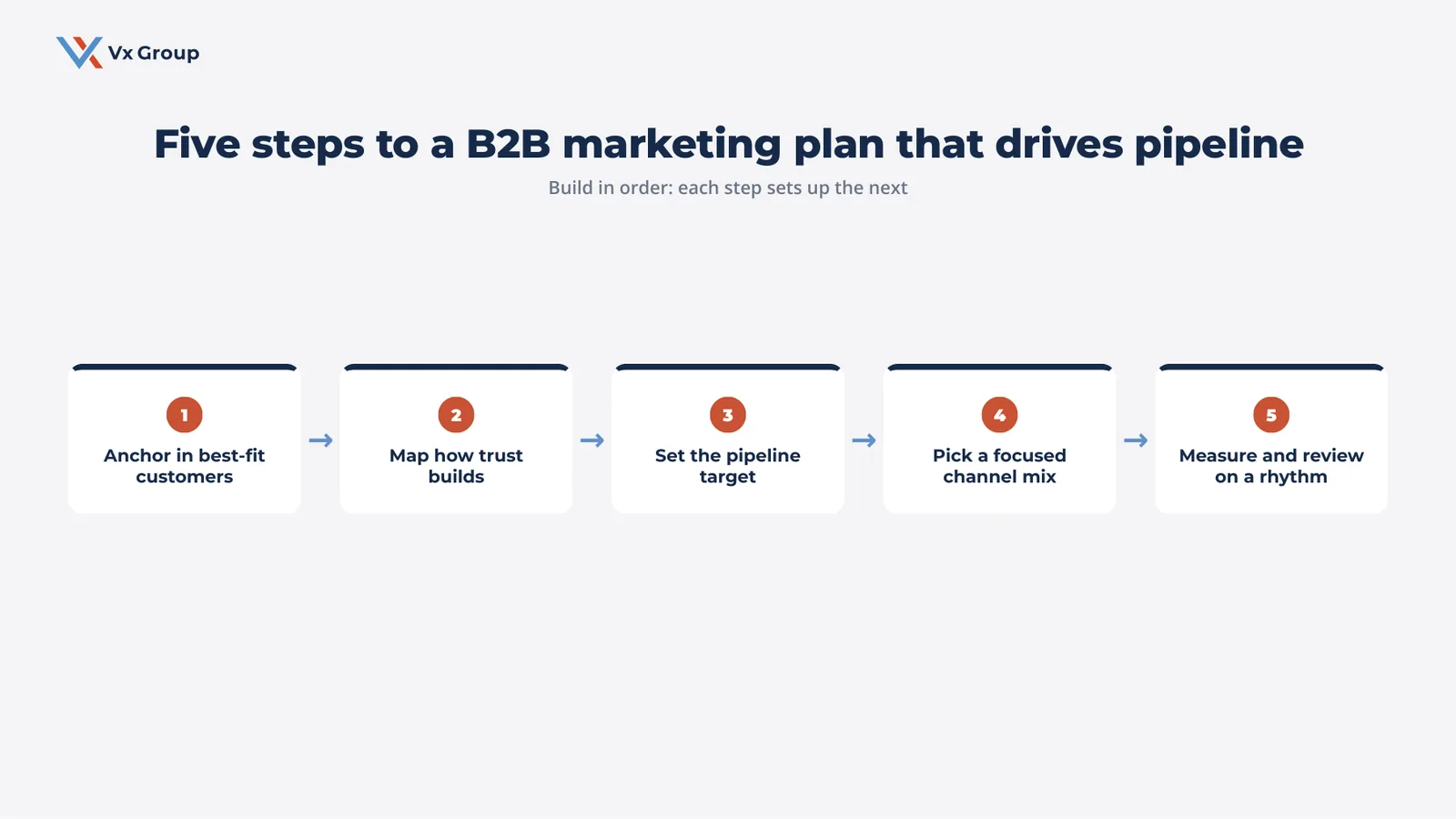
A B2B marketing plan that drives pipeline starts with your best-fit customers and how they actually buy, then works backward into goals, channels, and measurement. Most plans fail because they copy a generic channel checklist instead of matching the way trust builds across a long, relationship-driven sales cycle.
TL;DR
- Build the plan around your best customers and how they buy rather than a borrowed channel list.
- Set pipeline and revenue targets first, then choose channels that fit those numbers.
- Pick a focused set of channels you can run well instead of ten you run poorly.
- Tie every activity to a pipeline stage so you can see what is working.
- Document owners and a review rhythm so the plan survives contact with a busy quarter.
Most B2B marketing plans are a list of tactics with a budget attached. They name the channels, set a posting cadence, and call it strategy. That is the villain here: random acts of marketing dressed up as a plan, producing activity that never connects to revenue.
A plan that drives pipeline does something different. It treats marketing as the system that fills and accelerates the sales relationships that already build your business. Here is how to build one.
Defined Term: B2B marketing plan
A documented plan that connects marketing activity to pipeline and revenue goals for a business that sells to other businesses. For relationship-driven companies, it is built around how trust forms across a long sales cycle rather than around channel volume.
Step 1: Anchor the plan in your best-fit customers
Start by studying the customers you already serve well, because they tell you where your next revenue will come from. Before you choose a single channel, you need a clear picture of who buys, why they stay, and what they have in common.
Rank your accounts by relationship quality and lifetime value rather than last year’s revenue alone. The patterns you find, shared industry, company size, the problem you solve better than anyone, become the targeting criteria for the entire plan.
This is where most plans skip ahead and lose. They pick channels before they know who they are trying to reach, then wonder why the leads do not convert.
Defined term: best-fit customer
The type of customer your business serves better than competitors do, measured by retention, profitability, and long-term relationship value. The clearer this definition, the sharper every downstream marketing decision becomes.
Find the pattern your best accounts share
Look across your strongest relationships for the common thread. You are looking for the conditions that make a customer likely to stay for a decade, refer others, and expand their spend over time.
Write that profile down in plain language. It becomes the filter you hold every channel, message, and campaign against for the rest of the plan.
Step 2: Map how trust builds across your sales cycle
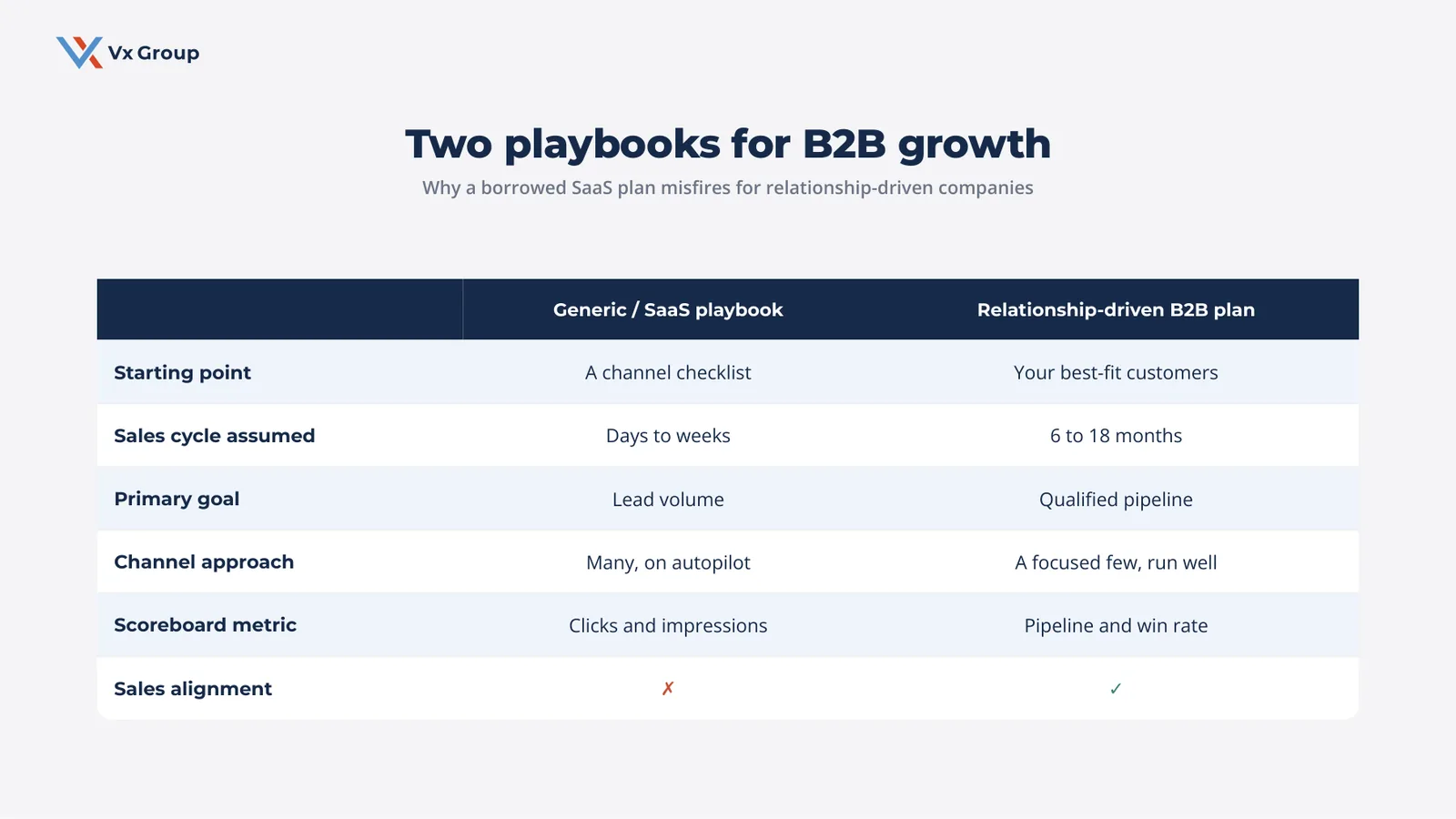
Map the real path a buyer takes from first contact to signed contract, because that path is where your marketing has to do its work. In legacy and relationship-driven B2B, that journey often runs six to eighteen months and involves several people inside the buying company.
Marketing tactics borrowed from short-cycle software companies assume a buyer who finds you, signs up, and converts in days. Your buyers do not behave that way, so a plan built on those assumptions misfires.
The contrast between the two playbooks is worth making explicit before you spend a dollar.
Defined term: relationship-driven B2B
A sales model where revenue depends on long-term, high-trust relationships rather than fast, transactional purchases. Sales cycles are long, deals are high-value, and buying decisions involve multiple stakeholders who need consistent reasons to trust you.
Once you can see the stages, you can see where buyers stall, where competitors get chosen, and where a well-placed piece of marketing actually moves a deal forward. That map is the backbone of the plan.
Step 3: Set pipeline targets, then back into channels
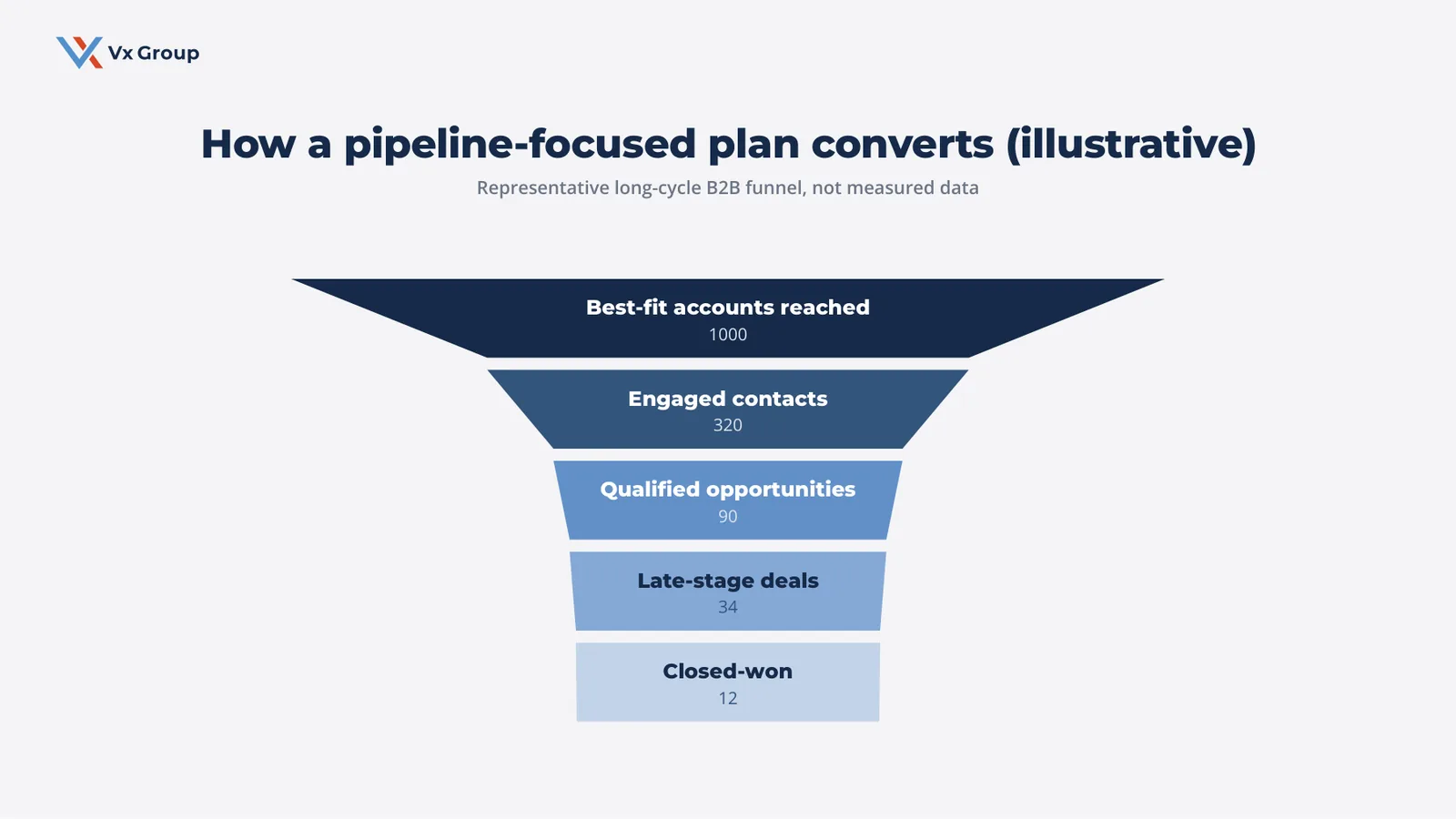
Decide what the plan must produce in pipeline and revenue before you choose how to produce it. A plan that drives pipeline starts with a number, then works backward into the activity required to hit it.
Begin with your revenue goal for the year. Work back through your average deal size, your close rate by stage, and your sales cycle length to find how much qualified pipeline marketing needs to create each quarter.
That math turns a vague ambition into a target you can manage. It also tells you, honestly, whether your current channel mix can carry the load or whether the plan needs more reach.
Defined term: pipeline target
The amount of qualified sales pipeline marketing must generate in a given period to support the revenue goal, calculated from deal size, win rate, and sales cycle length. It converts a revenue ambition into a number marketing can plan and measure against.
Tie the target to the buyer journey from Step 2. Each stage gets its own job, from creating awareness in your best-fit market to giving sales the materials that build trust in late-stage conversations.
Ready to grow?
Build a marketing plan that drives real pipeline, instead of a list of activities nobody ties to revenue.
Step 4: Pick a focused channel mix and a clear message
Choose a small set of channels you can run well, matched to how your best-fit buyers actually find and evaluate vendors. Five channels run with discipline beat fifteen run on autopilot.
For most relationship-driven B2B companies, the highest-return channels are the ones that build credibility over time. That usually means a strong website and content that answers buyer questions, a deliberate presence at the events your buyers attend, targeted outreach to named accounts, and referral and reputation work with existing customers.
Resist the pull to add channels because competitors use them. Every channel you add divides your attention and your budget, so each one has to earn its place against the customer profile from Step 1.
Your message matters as much as your channels. Lead with the specific problem you solve for your best-fit customers and the proof that you solve it, because credibility is the first thing a long-cycle buyer is testing for.
Defined term: channel mix
The specific set of marketing channels a company chooses to invest in, weighted by how well each one reaches its best-fit buyers. A focused mix concentrates budget where it builds trust fastest instead of spreading it thin across every available channel.
Step 5: Build measurement and a review rhythm around it
Tie every activity to a pipeline stage and a metric, then review the plan on a fixed schedule so it adapts to what you learn. A plan you write once and file away is just a document. A plan you review monthly becomes a system.
Measure what connects to revenue: qualified pipeline created, influenced deals, win rate, and relationship quality in your target accounts. Track activity metrics like traffic and impressions only as early signals, never as the scoreboard.
Set a monthly rhythm to review results with sales and marketing in the same room. The goal is one shared view of what is creating pipeline and what is not, so budget moves toward what works.
Field Notes
A regional industrial manufacturer came in with a marketing plan that listed nine channels and reported on impressions and email opens. Revenue had been flat for three years. When they rebuilt the plan around their fifteen best-fit accounts and cut to four channels tied to pipeline stages, the reporting got simpler and the conversations with sales got sharper. Within two quarters, marketing-sourced pipeline was something the leadership team could actually see and trust.
Document the whole plan in one place, assign an owner to each channel and goal, and keep it short enough that people use it. A plan that lives in everyone’s head dies the first busy quarter.
What makes a B2B marketing plan different from a general marketing plan?
A B2B marketing plan accounts for long sales cycles, high deal values, and buying committees, so it weights trust-building and sales alignment far more heavily than a consumer plan. The audience is small and specific, which means precision beats reach.
In B2B, marketing rarely closes the deal on its own. The plan has to hand qualified, well-informed relationships to sales and support them through months of evaluation, so marketing and sales planning cannot be separated.
How long should a B2B marketing plan cover?
Plan annually for direction and budget, but manage it in quarterly and monthly cycles. The annual view sets your pipeline target and channel strategy, while the shorter cycles let you adjust to what the market and your sales data are telling you.
A long sales cycle rewards patience. You are building credibility that pays off over quarters, so resist judging the plan on a few weeks of activity metrics.
Ready to grow?
Turn your marketing plan into pipeline your whole team can run, not a document in a drawer.
FAQs
About the Author: Beth Barbaglia
