

How To Build An Industrial Marketing Strategy That Scales

An industrial marketing strategy is the system a manufacturer or distributor uses to win long-cycle, high-value deals through trust and specification. It maps the buying committee, picks priority markets, and builds message and channel choices around the relationships that actually close industrial business.
TL;DR
- Industrial marketing strategy is a relationship discipline first and a demand discipline second. The buying committee is small, the cycle is long, and deals are won on trust and specification.
- Most industrial marketing content is written by agencies selling SEO and paid media retainers, so it treats the problem as a traffic problem. That playbook does not fit how industrial deals actually close.
- A working strategy starts with mapping the buying committee, then picks priority markets, then builds message architecture, then assigns ownership, and only then picks channels.
- Your existing relationships (top accounts, dealer network, referral sources) are almost always a faster path to revenue than new-account acquisition.
- Trade shows, content, and direct outreach all work for industrial marketers when they are built around relationship quality with real buying-committee members.
- Traffic and lead count are the wrong scoreboard. Track relationship pipeline value, specification wins, and dealer engagement instead.
- A 12-month plan sequences this work in quarters: foundation, priority markets and message, channel execution, and measurement and refinement.
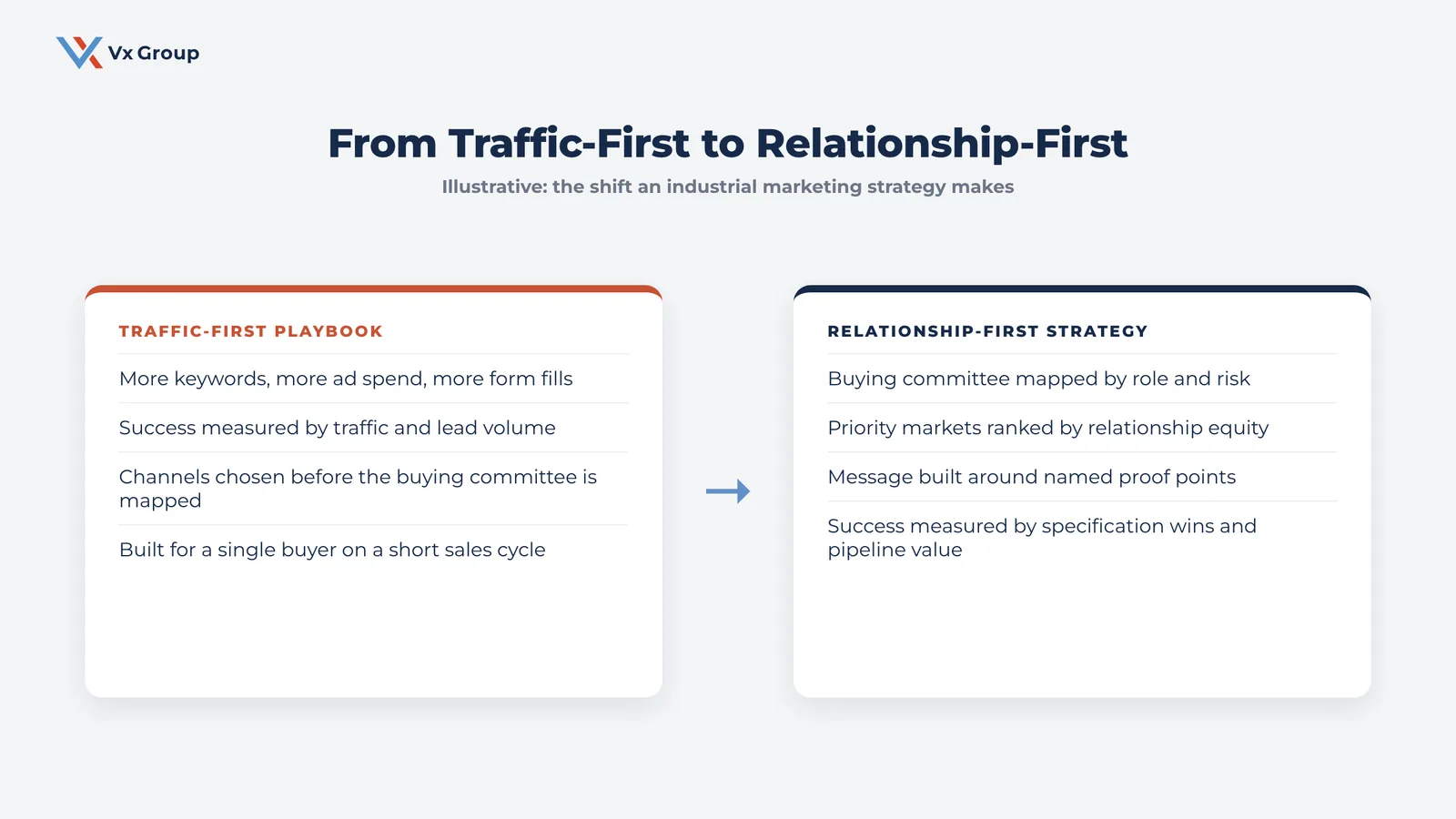
Most industrial marketing strategy content comes from agencies that sell SEO and paid media retainers. So it treats industrial marketing like a traffic problem: more keywords, more ad spend, more form fills. Manufacturers follow that playbook, watch the traffic numbers climb, and wonder why the sales pipeline looks the same as it did two years ago.
The villain here is the traffic-first playbook itself. It was built for software companies with short sales cycles and a single decision maker clicking “start free trial.” Industrial buying does not work that way. A capital equipment purchase or a new supplier relationship runs through a buying committee of five to twelve people, takes six to eighteen months, and gets decided on trust, specification, and risk built up over years of contact.
This guide lays out an industrial marketing strategy built for how these deals actually close: a system a manufacturer or distributor can run and own internally.
What is an industrial marketing strategy?
An industrial marketing strategy is a documented plan for how a manufacturer or distributor identifies its best-fit markets and accounts, builds visibility and trust with the people who decide on those accounts, and turns existing relationships into expanding revenue. It differs from a general B2B marketing plan because it is built around long sales cycles, small buying committees, and specification-based purchasing.
Defined Term: Specification-based buying (spec-in)
The process by which an industrial buyer names a specific supplier, part, or material inside an engineering drawing or purchasing standard before a project goes to bid. Once a company is “specified in,” competitors are effectively locked out of that project. Winning the spec is usually worth more than winning any single deal, because it recurs across every future project that uses the same drawing.
A working strategy answers four questions in order: which markets and accounts are worth pursuing, who on the buying committee needs to trust you, what message and proof earns that trust, and which channels put that message in front of the right people at the right time. Most companies skip straight to the fourth question. That is the first mistake.
The word “strategy” gets attached to a lot of activity that is really just a media plan. A calendar of trade shows, a content publishing schedule, and a paid search budget is a set of tactics. It becomes a strategy only once it is built on top of a documented answer to the first three questions. Without that foundation, a company can execute every tactic on the calendar flawlessly and still lose the specification decisions that determine its revenue, because the tactics were never aimed at the people and relationships that make those decisions.
Why does most industrial marketing content miss the point?
Most industrial marketing advice treats the problem as a visibility problem: rank higher, run more ads, capture more form fills. That advice comes from agencies whose business model depends on selling ongoing SEO and paid media retainers, so a traffic problem is the only problem they are equipped to diagnose.
This is the core case behind industrial B2B marketing: industrial buyers do not behave like software buyers. A plant engineer evaluating a new equipment supplier does not fill out a contact form and expect a callback in ten minutes. They ask a colleague who has used the equipment. They check whether the company showed up at the last trade show. They look at whether the sales rep understood their process on the plant floor or read from a script written by someone who has never set foot on one.
None of that shows up in a Google Analytics dashboard. A company can double its organic traffic and its paid lead volume while its actual win rate on specified projects stays flat, because the traffic metrics and the trust metrics are measuring two different things. An industrial marketing strategy has to start from the trust side, or it optimizes the wrong number for years without anyone noticing.
Ready to grow?
See how this framework applies to your own priority accounts.
What makes industrial marketing different from typical B2B marketing?
Industrial marketing is different because the buying committee is larger, the cycle is longer, and the purchase is decided on specification and risk built up over the relationship. A strategy borrowed from a short-cycle, single-buyer product category will consistently misallocate budget and attention.
| Factor | Product-led / SaaS marketing | Industrial marketing |
|---|---|---|
| Decision makers per deal | Usually 1 to 3 | Typically 5 to 12 across engineering, procurement, operations, and finance |
| Sales cycle | Days to a few months | 6 to 18+ months, sometimes years for capital equipment |
| Primary trust signal | Product reviews, free trial, self-serve data | Referrals, plant visits, trade show relationships, past performance |
| Switching cost | Low, often a credit card and a login | High, involves requalifying a new supplier through engineering and quality |
| What “winning” looks like | A signed subscription | Getting specified into the drawing or purchasing standard |
| Content that earns trust | Product comparisons, feature pages | Case studies with named plants, technical documentation, proof of process |
The practical effect of this table is that channel and message choices copied from a product-led playbook (retargeting ads, a free trial, a self-serve pricing page) waste budget in an industrial context. A company that specifies suppliers into drawings once every few years is not going to be moved by a limited-time discount banner. It is going to be moved by evidence that a company like theirs, with a plant like theirs, already trusted this supplier and it worked.
Field Notes
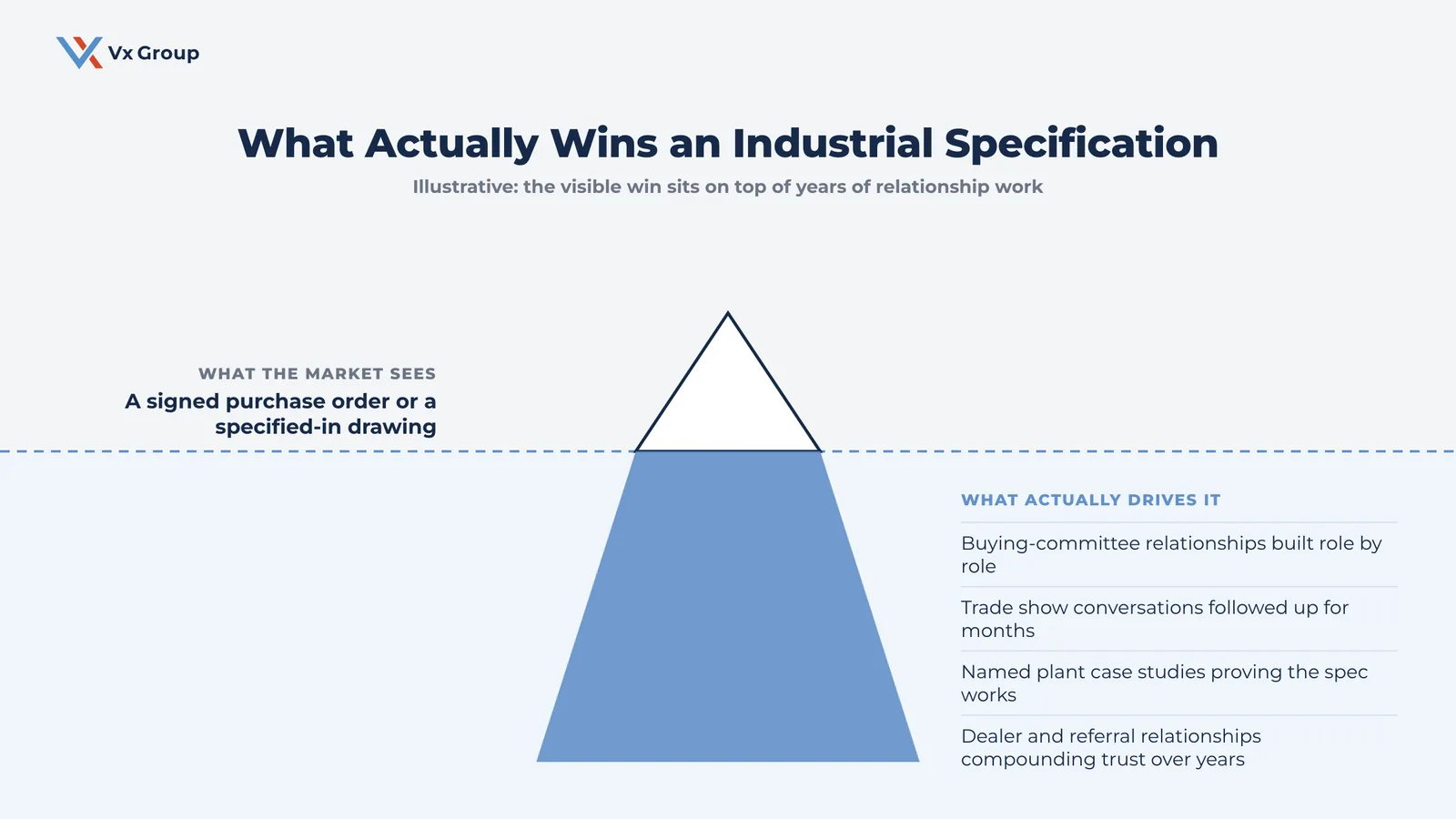
Across the manufacturers we have worked with, the gap almost always shows up first in the CRM. The marketing team can point to a healthy stream of inbound leads. Sales can point to a handful of accounts that actually closed in the last year, and every one of them traces back to a trade show conversation, a referral from an existing customer, or a plant visit. The marketing activity and the revenue are running on two separate tracks that were never actually connected.
How do you build an industrial marketing strategy step by step?
Building the strategy in the right order matters more than any individual tactic. Map the buying committee first, choose priority markets second, build the message third, assign ownership fourth, and only then pick channels. Reversing this order is the most common reason industrial marketing plans produce activity without pipeline.
Map the buying committee for every priority account
Write down, for each account or account type you are pursuing, every role that touches the purchase decision: the engineer who specifies the part, the procurement lead who negotiates terms, the plant manager who owns the risk of a bad supplier, and the finance leader who signs off on capital spend above a threshold.
For each role, answer three questions in a simple table: what does this person actually risk if the purchase goes wrong, what would change their mind, and what has your company given them to look at in the last twelve months. If the answer to the third question is “nothing,” that is your first gap to close, regardless of what your website traffic looks like.
A plant manager and a procurement lead on the same buying committee are often working from opposite risk calculations. The plant manager is protecting uptime and worrying about what happens if a new supplier’s part fails during a production run. The procurement lead is protecting a budget line and worrying about whether the new supplier can hold pricing over a multi-year contract. A single piece of marketing content built around “the best value in the industry” speaks to neither of them directly. A case study built around documented uptime with a named plant speaks to the first. A total-cost-of-ownership comparison speaks to the second. Mapping the committee is what tells a marketing team which of those two pieces to build first for a given account.
Choose your priority markets before you choose your channels
Rank the markets, verticals, or account types you could pursue by two factors: how well your company’s existing capabilities fit that market, and how much relationship equity you already have there through past projects, existing customers, or industry reputation. The market that scores highest on both factors is your priority market, and it should get the majority of your marketing budget and content before you expand into markets where you are starting from zero relationship equity.
A common mistake is chasing the market with the largest addressable spend, regardless of how little relationship equity the company has built there yet. A $40 million industrial equipment manufacturer with fifteen years of relationships in food and beverage processing plants will get more return from deepening that market than from a generic push into an adjacent vertical where nobody there has ever heard of them.
Defined Term: Priority market
A market segment or vertical ranked ahead of others because it combines strong capability fit with existing relationship equity, meaning the company can both deliver well and already has a documented right to be trusted there. Priority markets earn the majority of a company’s marketing budget before any expansion market does.
This ranking should be revisited annually. A company’s relationship equity shifts as key accounts change hands, as new plants open in adjacent verticals, and as trade show relationships deepen or fade. Re-ranking priority markets once a year, using the same two factors of capability fit and relationship equity, keeps the budget pointed at the accounts most likely to close today.
Build a message architecture around trust and specification proof
List your company’s actual proof points: named plants where your equipment or product is running, specific problems it has solved, certifications and standards it meets, and the tenure of the relationships you hold. Build every piece of content and every sales conversation around this proof. Generic feature claims that any competitor could make about their own product will not move a specification decision.
Defined Term: Message architecture
The documented hierarchy of proof points, claims, and language a company uses consistently across its website, sales conversations, trade show materials, and content, so that every buying-committee member hears the same story regardless of which channel they encountered it through.
This is also where B2B brand strategy and message architecture overlap: both live or die on proof a competitor cannot copy. The test for whether a piece of content belongs in your message architecture: could a competitor’s marketing team publish the exact same claim about their own company. If yes, it is generic and will not move a specification decision. If no, because it depends on your specific plant history, certifications, or named relationships, it belongs.
Turn your existing relationships into your growth engine
Before spending another dollar acquiring a new account, inventory the relationships you already have. Your top 10 existing customers, your dealer or distributor network, and the informal referral sources in your industry usually represent more untapped revenue than any list of net-new prospects, because the trust already exists and only needs to be expanded.
For a dealer network, this means segmenting dealers by relationship quality and growth potential, then building a consistent engagement rhythm (co-marketing support, joint account planning, regular check-ins) with the dealers who can actually grow with you. For direct accounts, it means assigning a named owner to protect and expand your top relationships, since revenue concentrated in a handful of long-standing accounts is exactly the asset most companies leave unmanaged while chasing new logos.
Assign clear ownership over each growth role
A strategy fails in execution when no single person owns priority-market research, message architecture, dealer engagement, or channel execution. Name an owner for each of these four areas explicitly, even if one person owns more than one, and review progress against each on a fixed cadence (monthly is typical). A plan with no named owner rarely gets executed.
In a smaller manufacturing company, one marketing lead might reasonably own all four areas alone. In a larger organization, ownership often splits across a marketing lead, a sales director who owns the buying-committee maps for the accounts their team calls on, and a channel manager who owns the dealer relationship. What matters is not how many people hold the four roles, but that each area has exactly one name attached to it. Shared ownership across a team with no single accountable person is the most common reason a well-designed strategy quietly stalls after the first quarter. Named ownership across these four roles is also what separates a real B2B growth engine from a marketing calendar.
Ready to grow?
Walk through how this sequence would apply to your own priority accounts and buying committees.
What channels actually work for industrial marketers?
Trade shows, technical content, direct account-based outreach, dealer and distributor co-marketing, and referral cultivation all work for industrial marketers, provided each is built around relationship depth with real buying-committee members. The channel mix matters less than whether every channel reinforces the same message architecture and feeds the same buying-committee map.
A useful test before adding any channel to the plan: name the specific buying-committee role it is meant to reach, and name what proof point from the message architecture it will carry. A trade show booth with no answer to either question is a cost center dressed up as a marketing activity. The same test applies to a content calendar, a paid campaign, or a dealer co-marketing kit. Channels earn a place in the plan by connecting to a specific role and a specific proof point.
| Channel | Best for | What “working” looks like |
|---|---|---|
| Trade shows | Building and deepening relationships with buying-committee members face to face | A documented list of who was met, what was discussed, and a follow-up plan for each conversation |
| Technical content (case studies, spec sheets, application notes) | Earning trust with engineers and procurement during evaluation | Content that names real plants, real problems solved, and real specifications met |
| Direct account-based outreach | Reaching specific priority accounts identified in your buying-committee map | Personalized outreach that references the account’s actual process or challenge |
| Dealer and distributor co-marketing | Extending reach through an existing trusted channel | Dealers actively using shared materials and reporting on relationship progress |
| Referral cultivation | Converting existing customer trust into new introductions | A defined, repeatable process for asking for and tracking referrals |
Industrial content marketing built around the proof points in your message architecture is one of the most efficient channels here, because a single strong case study can be reused across a trade show booth, a sales conversation, a dealer’s own materials, and a specification submission, all without rewriting it.
Paid search and paid social still have a role, but a narrow one: capturing buyers who are already searching for a specific part number, standard, or capability. Treat paid channels as a way to be present at the moment someone on the committee is already looking, and treat every other channel above as the work of getting to the point where they are looking for your company by name.
How do you measure whether an industrial marketing strategy is working?
An industrial marketing strategy is working when relationship pipeline value, specification wins, and dealer engagement are moving in the right direction. Website traffic and form fills are useful diagnostic signals, but they are not the scoreboard for a business that closes on trust and specification.
Defined Term: Relationship pipeline
The set of buying-committee relationships currently in some stage of trust-building toward a future purchase decision, tracked by account and by individual role such as engineer, procurement, or plant manager.
Track these instead of, or alongside, traditional marketing metrics:
- Specification wins: how many projects your company got specified into this quarter, and at what stage of the project those specifications happened.
- Relationship pipeline value: the estimated future revenue tied to buying-committee relationships currently being built, segmented by account and by how far along the trust-building process each relationship has progressed.
- Dealer engagement: how many dealers are actively using your marketing materials, requesting co-marketing support, or reporting relationship progress.
- Referral rate: how many new opportunities originated from an existing customer’s introduction in a given period.
- Trade show follow-through: the percentage of documented trade show contacts that received a specific, relevant follow-up within two weeks.
A company that tracks these five numbers alongside traffic will know within a quarter whether its marketing activity is actually building the relationships that close industrial deals, well before eighteen months of budget go into a pipeline that never materializes.
None of this means traffic and lead volume are worthless. A steady stream of inbound interest is still a useful signal that the message architecture is reaching people beyond the accounts already in direct contact with sales. The point is sequencing: traffic tells a company whether it is being found, while specification wins and relationship pipeline value tell it whether being found is turning into anything. A company that only tracks the first number can spend a full year improving a metric that has no relationship to its revenue.
Ready to grow?
Get a second set of eyes on your priority markets and buying-committee maps before you build the next 12 months around them.
What does a 12-month industrial marketing plan look like?
A 12-month industrial marketing plan sequences the work in four quarters: build the foundation, define priority markets and message, execute across channels, and measure and refine. Running these in parallel from month one, before the foundation is set, is the most common way a plan produces activity without results.
| Quarter | Focus | Key outputs |
|---|---|---|
| Q1 | Foundation | Buying-committee maps for top priority accounts, inventory of existing relationship equity, ownership assigned across the four growth roles |
| Q2 | Priority markets and message | Ranked priority markets, documented message architecture with named proof points, first wave of technical content |
| Q3 | Channel execution | Trade show plan tied to specific buying-committee targets, dealer co-marketing rhythm launched, direct account-based outreach to top priority accounts |
| Q4 | Measurement and refinement | Review specification wins, relationship pipeline value, and dealer engagement against Q1 baselines, adjust priority markets and channel mix for the next 12 months |
Every quarter builds on the one before it. A company that jumps to Q3 channel execution without doing the Q1 and Q2 work ends up running trade shows and content campaigns with no documented sense of which accounts or roles they are actually trying to reach, which is the exact traffic-first mistake this guide opened with.
Conclusion
An industrial marketing strategy that works is not a bigger version of a software company’s demand generation playbook. It is a system built around the buying committee, the priority markets, and the existing relationships that actually decide industrial purchases. Map the committee, choose the markets, build the message, assign the ownership, and only then pick the channels. Measure specification wins and relationship pipeline value as the real scoreboard.
Ready to grow?
About building an industrial marketing strategy your team can run and own.
FAQs
About the Author: Jacob Camhi
