

Industrial Sales for Manufacturers and Distributors
Industrial sales is selling products, parts, and services to manufacturers and other industrial buyers. Engineers, plant managers, and purchasing all weigh in, the first order can take a year or more, and a won account can last decades. Winning means mapping the buyers, splitting the work with distributors and reps, and growing share inside accounts you already serve.
TL;DR
- Industrial sales runs through a buying group: engineers, plant managers, purchasing, and an owner or executive. Each one judges you on something different.
- The spec-in stage is where most industrial deals are won. A part gets written into a design long before anyone asks for a quote.
- Most manufacturers we work with hold under 5% of the spend at their biggest potential accounts. The rest is open to the supplier that builds more relationships inside the account.
- Write down who does what at each stage: your direct sellers, your reps, and your distributors.
- Manage the whole account. A first part order is often the start of a multi-million-dollar relationship.
- Measure contacts per account, specs won, share of wallet, and reorder timing. Quote counts alone say little on a long cycle.
- Owners can start this week with a one-page map of their ten biggest accounts.
What this guide covers
- What industrial sales is and how it differs from other B2B sales
- How to map the buying group
- How to sell to engineers and plant managers
- How to manage a spec-in cycle
- How to split the work between direct sellers, reps, and distributors
- How to grow share inside accounts you already serve
- What to measure
- How to hire, pay, and train industrial sellers
- How AI helps with account research
- Mistakes that slow industrial sales
- Where to start this week
Most industrial companies grew on a few strong relationships. The owner knew the buyers, a few good reps carried the rest, and referrals filled the gaps. That works for a long time. Then it stops, because the people who hold the relationships are busy, the referrals dry up, and nobody knows who else to call.
We call this the referral ceiling. It shows up as scattered sales efforts. There is a trade show here and a cold email push there. A rep “owns” an account because nobody else has ever called on it. Each effort makes some noise, and none of them builds a system.
This guide is for owners, presidents, and sales leaders at privately held manufacturers and industrial distributors. It covers how industrial buyers decide, how to split the work with your channel, and how to grow the accounts you already have. Each section gives you something to build the same week.
What is industrial sales?
Industrial sales is the sale of products, components, materials, equipment, and services to businesses that make things or run plants. The buyer is a company with a design, a production line, or a maintenance budget. The seller is a manufacturer, a distributor, or a rep firm working for one.
Three things set it apart. Technical people sit on the buying side. The decision takes months, because a part has to be tested, approved, and written into a process. And once a supplier is approved, the customer tends to stay.
Defined Term: Spec-in.
The point where a buyer’s engineers write your product or material into a design, drawing, or approved supplier list. Spec-in usually happens before the first purchase order, and it often decides who gets the order.
Industrial sales covers several kinds of sellers. An inside seller handles quotes and reorders. An outside seller visits plants and works with engineers. A rep firm sells your line in a territory. A distributor stocks your product and sells it with others. Most manufacturers use a mix of all four.
How is industrial sales different from other B2B sales?
Industrial sales differs from short-cycle B2B sales in who decides, how long it takes, what proves your case, and what happens after the first order. The table below sets the two side by side.
| Short-cycle B2B sale | Industrial sale | |
|---|---|---|
| Who decides | One or two buyers | A group: engineering, operations, purchasing, and leadership |
| Time to first order | Days to weeks | Often six to eighteen months |
| What proves your case | A demo and a price | Samples, test data, references, and a site visit |
| Who sits in the middle | Usually nobody | Reps and distributors who own local relationships |
| After the first order | Renewal at the end of a term | Reorders for years, with room to add plants and parts |
The last row matters most. In a short-cycle sale, the first order is the prize. In industrial sales, the first order is the start of the account. A single part order can grow into a multi-million-dollar relationship if the supplier earns it.
That changes how an owner should look at the sales team. A rep who lands a small first order at a large plant has opened a door. The next question is who else at that plant knows you.
Tactics from software and other fast-moving markets do not carry over well. Volume outreach, automated sequences, and “growth hacks” were built for buyers who decide in a week. Our article on lead generation for manufacturers covers what works on a longer cycle.
Who sits in the buying group, and how do you map it?
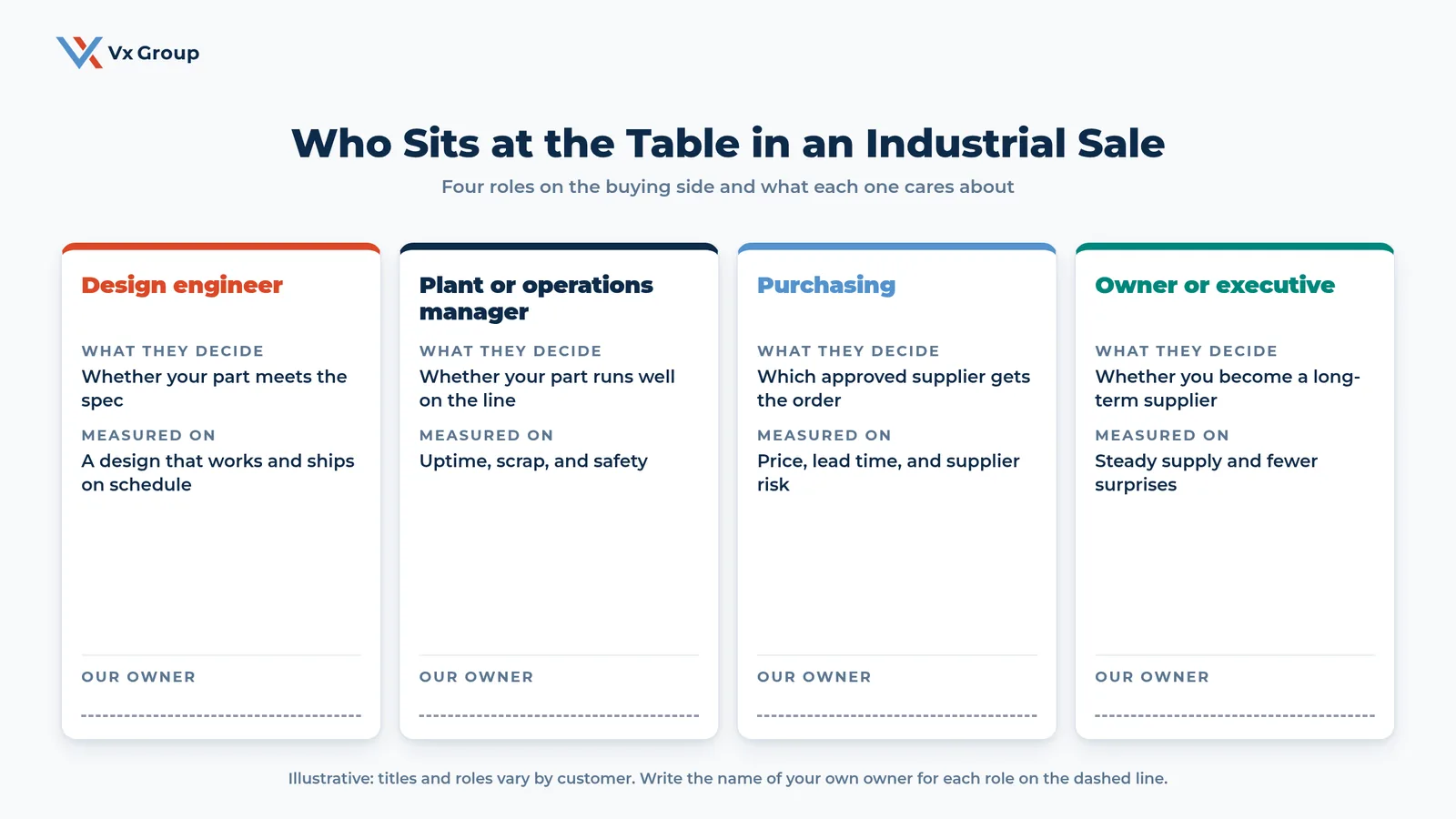
An industrial buying group usually has four roles: a design engineer, a plant or operations manager, a purchasing lead, and an owner or executive. Each role decides something different and is measured on something different. The graphic above lists all four, and the sections below show how to map them for your own accounts.
The design engineer decides whether your part meets the spec. The plant manager decides whether it runs well on the line. Purchasing decides which approved supplier gets the order. The owner or executive decides whether you become a long-term supplier. One person can hold two roles, especially at smaller customers.
Write the buying group on one page
Start with your ten biggest accounts and your ten biggest targets. For each one, make a one-page sheet with four boxes, one per role. Write a name in each box you can fill. Leave the rest empty.
The empty boxes are the useful part. They show where a deal depends on people you have never met. A sheet with one name on it describes an account that rests on a single relationship.
Name an owner for each role
Next to each name, write which person on your team owns that contact. This is usually the rep, the owner, or a technical lead. If nobody owns a box, assign one person this month.
Owners often find that they are the contact for half the boxes. That is a risk worth fixing. Our piece on founder-dependent sales shows why growth stalls when one person carries every relationship.
Learn what each role gets measured on
The engineer is measured on a design that works and ships on time. The plant manager is measured on uptime, scrap, and safety. Purchasing is measured on price, lead time, and supplier risk. The executive is measured on steady supply.
Ask each contact one question: what would make your next quarter easier? Write down the answer. Over time those answers become the core of every conversation, and they tell you what to say in each quote and each review.
Add a second contact at every key account
Pick one account this week and set a goal of one new contact there by the end of the month. An introduction from the current contact is the best route. A plant tour, a technical session, or a joint test is the next best.
Track the count. An account with three contacts across two roles is far safer than an account with one friendly buyer.
How do you sell to engineers and plant managers?
You sell to engineers and plant managers by answering their technical questions fully, in writing, before they have to ask twice. These buyers trust data, samples, and people who know the product. They distrust anything that sounds like a pitch.
Answer the technical question in writing
Collect the ten questions engineers ask most often. Write a short, plain answer to each one, with the data behind it. Keep the answers in one shared place so any rep can send them in minutes.
Include the numbers an engineer needs: tolerances, materials, certifications, lead times, and limits. If your catalog sits in a PDF that search tools cannot read, fix that too. Our article on PDF SEO explains why AI tools skip specs buried in catalog files.
Bring proof from similar jobs
An engineer wants to know that someone with a similar problem already used your product. Build a short sheet for each major application: the problem, what you supplied, the result, and a contact who agreed to talk.
Two named references beat ten logos. Ask your best customers for permission now, while the relationship is warm.
Offer a sample, a trial, or a site visit
Many industrial buyers will not commit until they see the part run. Make that step easy. Decide in advance what you will give away, how long a trial runs, and who follows up when it ends.
Write the follow-up date on the calendar before the sample ships. Trials without a follow-up date tend to fade.
Make the spec easy to copy
When an engineer likes your part, the next job is to get it into the drawing. Give them the exact part number, a CAD file if you have one, and the wording they can paste into a spec. The easier you make it, the more often your name ends up in the design.
How do you manage a spec-in cycle that runs a year or more?
A spec-in cycle needs a named owner, a short list of stages, and a clear signal at each stage. Without those, long deals sit in the pipeline for months and nobody knows which ones are alive. The stages below fit most industrial deals. Adjust the names to match how your customers talk.
| Stage | What happens | Signal that it is moving |
|---|---|---|
| Intro | You meet someone at the account | A second meeting is booked |
| Technical review | An engineer reviews your data | Written questions come back |
| Sample or trial | The part is tested | A test date and a named tester |
| Approval | The part joins the approved list | A written approval or vendor number |
| First order | A purchase order arrives | A PO number |
| Reorder | The part is ordered again | A second PO inside the expected window |
Review these stages every month with your sales leads. For each deal over a set size, ask what the buyer did since the last review. A buyer action is a question, a test, a new contact, or a date. If the only activity came from your side, the deal is probably stalled.
For a deeper look at how complex deals move, read our guide to sales cycle stages. For running the pipeline itself, see sales pipeline management.
Ready to grow?
Bring your top ten accounts and we will help you map who holds each relationship and where one person carries too much.
How should direct sellers, reps, and distributors split the work?
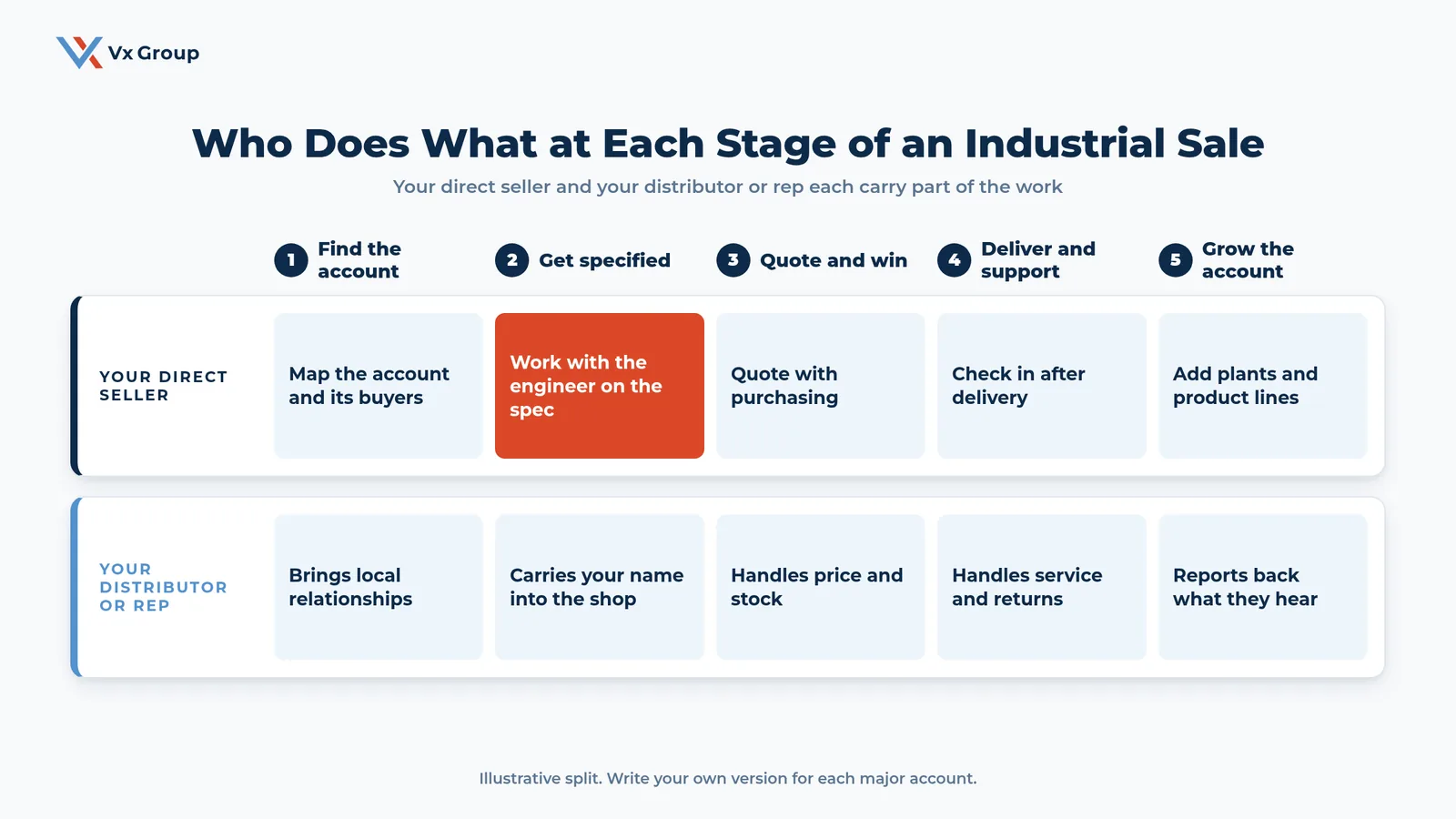
Direct sellers, reps, and distributors should split the work by stage, with each role owning the steps it is best placed to do. The graphic above shows one way to divide five stages. Most manufacturers do better when the split is written down than when each partner guesses.
Your direct seller usually owns the account map and the technical work with engineers. Your distributor or rep usually owns local relationships, stock, price, and service. The two overlap, and that overlap is where problems start.
Decide who owns the customer relationship
Pick one answer for each major account: your team, your partner, or both with a named lead. Write it down. When two parties each assume the other is calling, the customer ends up hearing from nobody.
For accounts where your product is specified by engineers, your team often needs to hold that relationship directly, even when a distributor fills the order. For commodity items, the distributor may own it.
Write the split for each stage
Take the five stages in the graphic and write who does what for your biggest accounts. Keep it to one page. Share it with your reps and distributors and ask them to correct it.
Their corrections will teach you things. A distributor may tell you which plants they cover best, or which buyers only take calls from local people.
Pay and recognize each role for its part
If your rep earns nothing on a spec that a distributor later fills, the rep has little reason to work on specs. Check how each role is paid against the work you want done. Our article on the sales compensation plan covers how to build pay for long cycles.
Meet your partners on a set schedule
Hold a call with each major distributor or rep every month and a visit every quarter. Bring account names and specific questions. Ask what they hear from the customer that you do not.
Our guides to dealer network strategy, distributor management, and channel sales strategy go deeper on each side of this.
How do you grow share inside accounts you already serve?
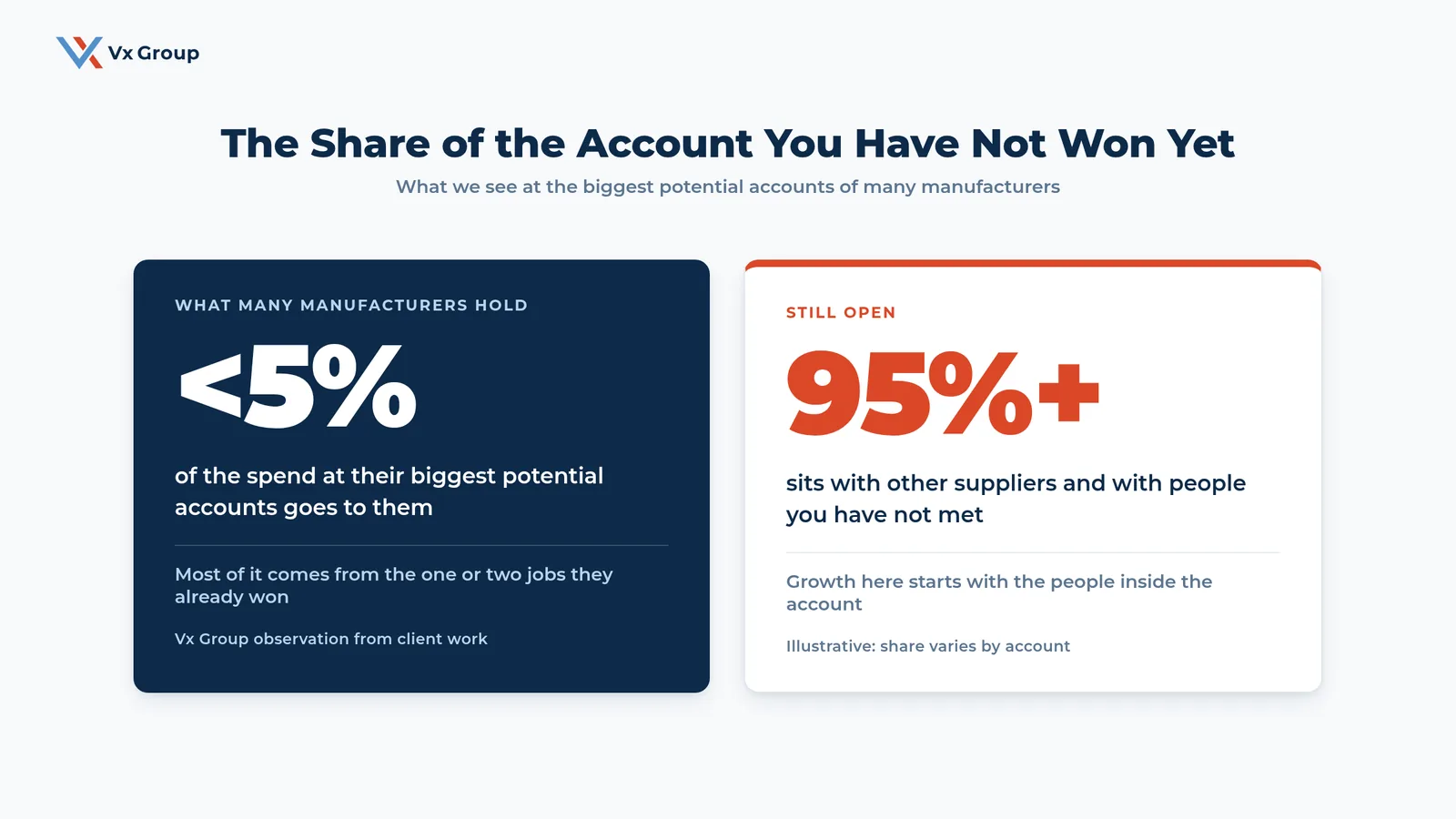
You grow share inside an existing account by finding every plant, product line, and decision maker you have not reached yet and building a plan for each. In our client work, many manufacturers hold under 5% of the spend at their biggest potential accounts. The graphic above shows the gap. Most of that spend is open to the supplier who shows up with the right person at the right time.
Defined Term: Wallet share.
The part of a customer’s total spend in your category that goes to you. A customer who buys $200,000 a year from you and $4 million a year in your category gives you 5% of their wallet.
Most companies wait for the next request for quote. The suppliers who grow get in front of the people inside the account, long before the next bid.
Rank accounts by what they could be worth
Make a list of your top twenty accounts. Next to each, write two numbers: what they buy from you today, and your best estimate of what they spend in your category in total. Customers will often share the second number if you ask in a review.
Rank by the gap. The accounts with the largest gap and a friendly contact come first.
Map every plant and product line
Large customers often run several plants and buy many parts. A supplier approved at one plant is not automatically approved at the next. For each top account, list every plant, every product line, and who buys at each. Mark the ones you serve and the ones you do not.
This list becomes your account plan. Our guide to account expansion shows how to turn it into a yearly plan, and account management strategy covers who runs it.
Treat the first part order as the start
A small first order from a large customer is a test of your delivery, quality, and service. Treat it that way. Call after delivery, ask what went well, and ask who else should know about your part.
We call a customer like this a Generational Customer™: an account that can stay for decades and grow into millions in revenue. It is also a risk when too much revenue sits in one or two of them. Our article on the Generational Customer explains both sides.
Hold a yearly review with each top account
Once a year, sit down with each top account and ask three questions. What did we do well? Where did we fall short? What changes are coming at your plants that we should plan for?
Write down the answers and share them with your team. These reviews often surface new projects months before a request for quote exists.
What should an industrial sales team measure?
An industrial sales team should measure contacts per account, specs won, share of wallet, and reorder timing. These numbers show whether relationships are growing. Call counts and quote counts show how busy the team is.
| Measure | What it tells you | How to track it |
|---|---|---|
| Contacts per top account | How many people know you | Count named contacts by role on each account sheet |
| Specs won | How often you get written into a design | Log each spec-in and the date |
| Share of wallet | How much of the account you hold | Review the top twenty accounts every quarter |
| Days from sample to approval | How fast your trials move | Time each trial from ship date to written approval |
| Reorder timing | Whether a customer is slowing down | Compare each reorder date with the expected date |
Reorder timing deserves a closer look. If a customer usually orders every six weeks and the last order came at ten, something has changed. A call that week can save the account.
Keep the dashboard small. Five measures that the team reads each month beat twenty that nobody opens. Our article on sales leadership covers how to run the weekly meetings around them.
How should you hire, pay, and train industrial sellers?
Hire industrial sellers who are curious about the customer’s process. Pay them for account growth as well as new orders. Train them on your product and on your customers’ plants. Technical depth can be taught. Interest in the customer’s problem is harder to teach.
Hire sellers who ask good questions
In interviews, ask a candidate to describe how they would learn a new customer’s plant. Listen for questions about the process, the people, and the problems. A candidate who goes straight to features will need more coaching.
Pay for the behavior you want
If pay rewards only new orders, reps will chase new orders and neglect the accounts that could grow. Add a share for growth in existing accounts and for new contacts added at top accounts. See our guide to the sales compensation plan for how to build it.
Train on the customer's plant
New sellers should spend time in your plant and in a customer’s plant in the first ninety days. They should see how your part is made and how it gets used. Our article on sales onboarding lays out a plan for a long cycle. The sales playbook guide helps you write down what your best seller does.
How can AI help industrial sales teams with account research?
AI can help an industrial sales team prepare for account work. It can summarize what a customer makes, where its plants are, and what has changed recently. It speeds up research, and the conversation with the buyer stays with your seller.
Three uses work well today:
- Summarize a customer’s public filings, press releases, and plant news before a visit.
- Draft a list of questions for an engineer based on the customer’s products.
- Turn rough notes from a plant visit into a clean account update.
Check every fact before a seller uses it. An AI summary can be wrong, and a wrong detail in front of an engineer costs trust. Buyers also use AI to compare suppliers, so your own specs and pages need to be clear and readable. Our articles on AI in sales and SEO for manufacturing companies cover both sides.
What mistakes slow down industrial sales?
Five mistakes slow down industrial sales more than any others. Each one is common, and each one can be fixed in a quarter.
- Waiting for the next request for quote. Suppliers who only respond to bids compete on price. Build relationships before the bid.
- Keeping every relationship with one person. If that person leaves, the account goes with them.
- Leaving the channel to guess. Reps and distributors do better work when the split is written down.
- Stopping at the first order. The first order opens the account. Plan the next plant and the next product line.
- Counting only quotes. Quotes show activity. Contacts, specs, and share of wallet show progress.
Field Notes:
Picture a mid-sized maker of industrial fasteners with one large customer plant that buys steadily. The owner and one longtime rep hold every contact there. When the rep retires, the customer’s purchasing lead calls the owner to ask who will cover the account. A simple account sheet, started two years earlier, would have named a second contact in engineering and one in operations. This example is illustrative, and the pattern is a common one.
What is the best way to start improving industrial sales this week?
The best first step is a one-page account map for your ten biggest accounts. It takes an afternoon and shows where you are exposed and where you can grow.
For each account, write the four buying roles and the names you know. Add who on your team owns each one and what share of the wallet you think you hold. Mark the empty boxes. Pick the three accounts with the most gaps and set one goal for each: one new contact by the end of the month.
Then share the map with your reps and distributors and ask what they would change. Their answers will tell you where the channel is strong and where it needs help.
Build the account map first
Industrial sales rewards suppliers who know more people inside each account and who treat the first order as the start. Map the buying group, write down the split with your channel, and track the numbers that show relationships growing.
Pick your top ten accounts, build the map, and review it with your team within thirty days.
Ready to grow?
Share your top accounts and we will help you build an industrial sales approach your team can run without the owner in every meeting.
FAQs
About the Author: Jacob Camhi
