

AI in Sales: What It Changes for Relationship-Driven B2B Companies

AI in sales speeds up everything it touches, the good behaviors and the bad ones. For relationship-driven B2B companies, the deciding factor is the sales architecture AI gets dropped into. On a transactional motion, AI accelerates spray-and-pray outreach and degrades trust faster than a human ever could. On a relationship-driven system, the same tools compound an existing advantage. The one thing AI cannot do, in either case, is build the relationship itself.
TL;DR
- AI in sales is a force multiplier. It accelerates whatever sales motion already exists, for better or worse.
- Transactional Architecture plus AI produces AI theater: faster, more personalized-sounding spam that still gets ignored.
- Compounding Architecture plus AI produces a real advantage: reps spend less time on research and drafting and more time on judgment, trust, and timing.
- AI is genuinely strong at research, summarization, drafting, and pipeline hygiene. It is weak at reading politics, earning trust, and making a relationship-level judgment call.
- The risk in B2B sales right now is not under-adoption. It is companies bolting AI onto a broken sales motion and calling the acceleration progress.
- A relationship-driven company should sequence AI adoption around its highest-value accounts before its highest-volume outreach.
- The companies that get this right treat AI as infrastructure that protects the relationship knowledge their people already hold.
What does AI actually do in a B2B sales process?
AI in sales touches four parts of the process today with real, measurable reliability: research, drafting, summarization, and pipeline hygiene. It does not yet reliably handle judgment, negotiation, or relationship navigation, which is exactly where B2B deals are won or lost.
Most vendor pitches blur this line on purpose. “AI-powered sales” gets used to describe everything from a chatbot that schedules demos to a model that supposedly predicts which accounts will churn. The accurate way to evaluate any AI sales tool is to ask which of these four jobs it is actually doing, and then ask whether that job was ever the bottleneck.
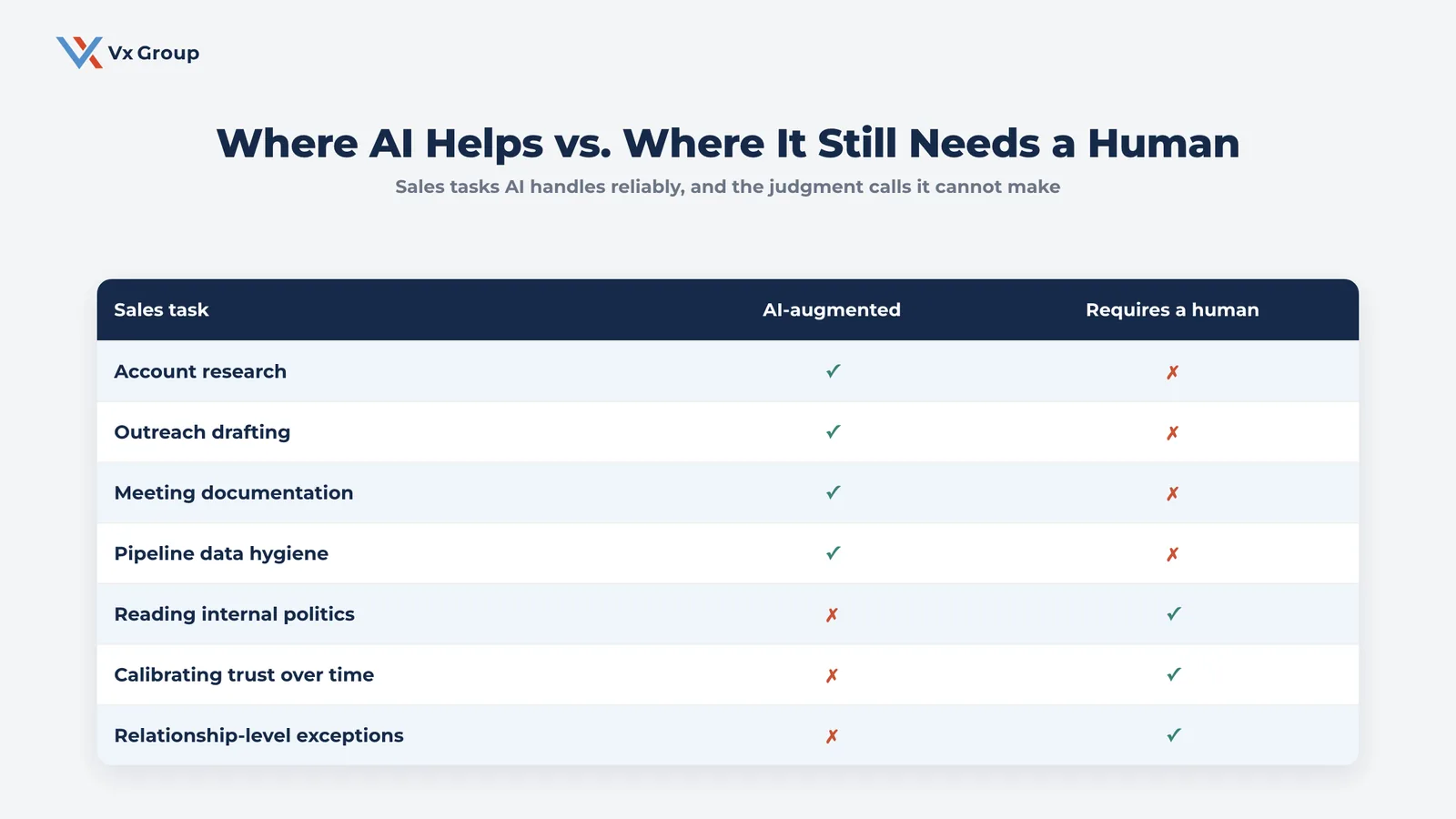
| Sales task | What AI does well | What still requires a human |
|---|---|---|
| Account research | Pulls company news, funding events, leadership changes, and public signals in seconds | Deciding which signal actually matters to this specific relationship |
| Outreach drafting | Generates a first-pass email or call script from a template and a few data points | Knowing the right tone for a 12-year relationship versus a first conversation |
| Call and meeting summarization | Transcribes and summarizes a call accurately, flags action items | Reading what was unsaid: hesitation, politics, a buyer protecting their own position |
| Pipeline hygiene | Flags stale deals, missing fields, and inconsistent stage data | Deciding whether a “stale” deal is actually dead or just moving at the customer’s pace |
Defined Term: AI theater
AI theater is the use of AI tools to produce the appearance of sophistication or scale in a sales process while leaving the underlying motion, and its underlying problems, unchanged. A company running AI theater sends more personalized-sounding emails to a worse list, faster, and calls that progress.
What is Transactional Architecture, and how does AI change it?
A Transactional Architecture is a sales motion built around volume: more leads, more outreach, more touches, with relationship depth treated as a byproduct rather than the goal. AI does not fix a Transactional Architecture. It accelerates it, which makes the underlying problem worse, faster.
A transactional sales team measures activity: calls made, emails sent, demos booked. When that team adds AI, the predictable result is more activity. AI-drafted sequences go out to bigger lists. AI-summarized calls get logged faster, so reps can move to the next call sooner. Every metric on the activity dashboard improves.
What does not improve is the win rate, the average deal size, or the account’s lifetime value, because none of those outcomes were ever a function of volume. They were always a function of fit and trust, and AI has no opinion about either one. A company running a Transactional Architecture that adopts AI typically sees outreach volume rise 3 to 5x in the first quarter (a directionally typical range based on what off-the-shelf sequencing and AI-drafting tools allow, rather than a measured benchmark for any single company) while reply rates on that outreach fall, because the recipients can tell. This is the same trap covered in Why “More Leads” Is Almost Never the Answer for B2B Companies: the constraint was never volume, so accelerating volume with AI cannot fix it.
Defined Term: Transactional Architecture
A Transactional Architecture treats every account interaction as a discrete event optimized for short-term conversion: a lead becomes a deal, a deal becomes a close, and the relationship resets at the next renewal or referral. It is the default architecture in most B2B sales organizations because it is the easiest to build a dashboard around.
What is Compounding Architecture, and how does AI change it?
A Compounding Architecture is a sales motion built around relationship depth over time, where every interaction either deepens trust with an account or it does not, and the company tracks that instead of tracking activity volume. AI inside a Compounding Architecture removes the busywork that used to eat the time a rep would otherwise spend on judgment and trust.
The mechanism is straightforward. A rep managing 40 named accounts in a Compounding Architecture spends a meaningful share of their week on tasks that have nothing to do with the relationship itself: pulling research before a call, drafting the first version of a follow-up email, writing up notes from the last conversation, updating the CRM. AI handles all four of those reliably. What that frees up is not more selling time in the volume sense. It is more time for the part of the job AI cannot do: reading the account’s actual situation, deciding what matters to bring up, and showing up prepared in a way that signals the relationship is taken seriously.
The compounding effect takes a few quarters of consistent behavior to show up. A rep who consistently shows up better prepared, because AI removed the prep friction, earns a different kind of trust than a rep who shows up with a faster-drafted generic pitch. The first behavior compounds. The second one does not, no matter how fast the drafting got.
Field Notes
A manufacturing client’s account managers were each carrying 25 to 30 named relationships, many of them 10-plus-year accounts. Before any AI tooling, prep for a single quarterly business review took close to two hours: pulling order history, checking for any service issues, drafting talking points. After standing up an AI-assisted prep workflow tied into their CRM, that same prep dropped to roughly 20 minutes. The account managers did not use the extra time to take on more accounts. They used it to actually read the account’s situation before walking in, which showed up within two quarters as longer review conversations and more proactive account expansion, the kind of conversation that used to get skipped because there was no time left to have it.
How does the same AI tool produce opposite results in these two architectures?
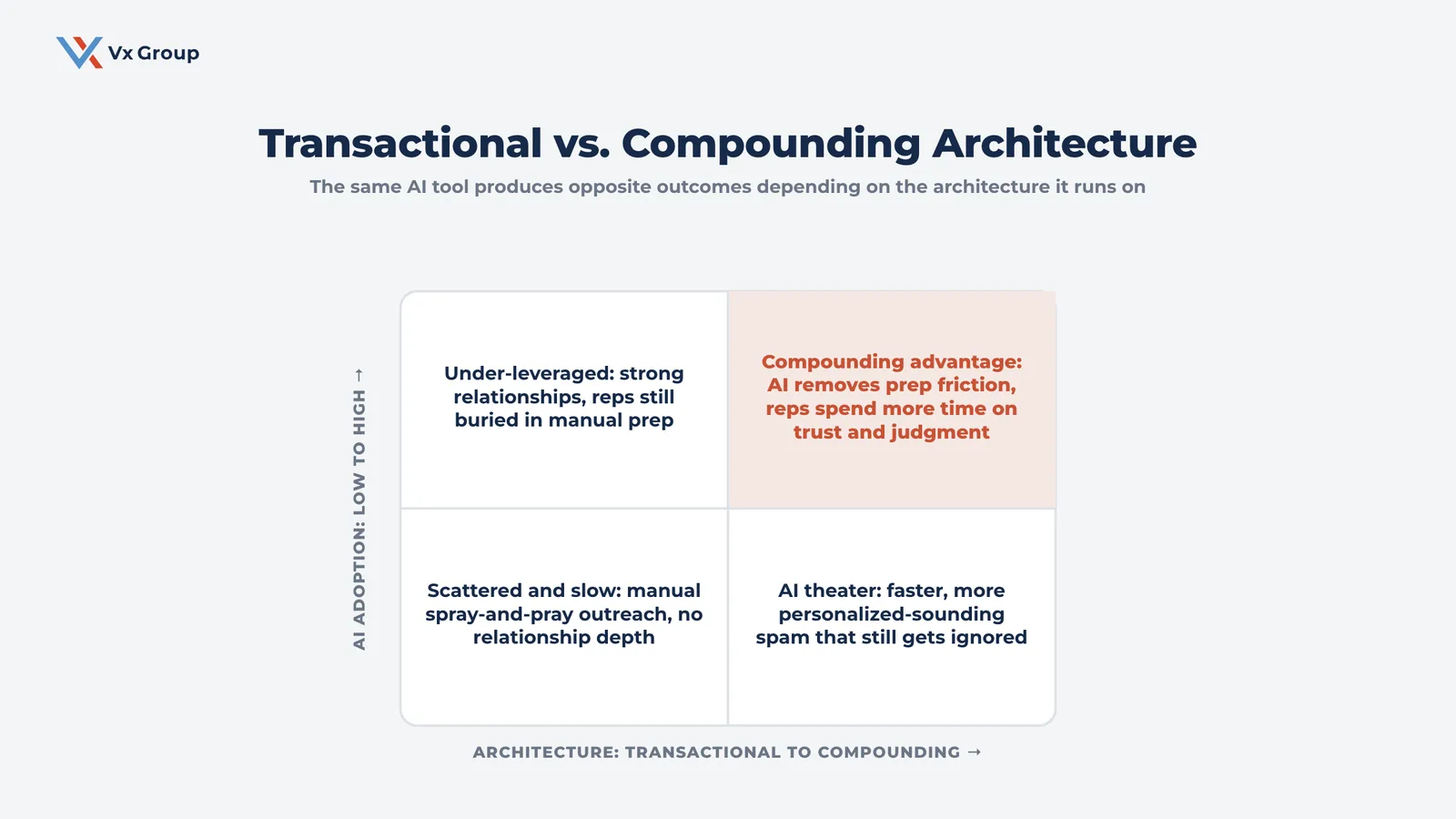
The same AI sales tool, deployed identically, produces compounding advantage in one architecture and accelerated decay in the other, because AI amplifies the existing motion rather than correcting it. This is the single most important thing for a relationship-driven B2B company to understand before buying any AI sales tool.
Consider an AI-drafted outreach sequence as the example, because it is the most commonly adopted AI sales tool today.
- In a Transactional Architecture, the sequence drafts a generic-feeling email to a list of 2,000 contacts with shallow segmentation. The volume goes up. The personalization is surface-level: a first name and a company name dropped into a template. Recipients who have seen this pattern before disengage faster than they would from an obviously generic email, because a half-personalized email reads as a more calculated version of spam.
- In a Compounding Architecture, the same drafting tool is pointed at 40 named accounts with real account history loaded in: last conversation, open issues, recent company news. The draft becomes a genuinely useful first pass that a rep edits in two minutes instead of writing from scratch in twenty. The volume does not change. The quality of every single touch goes up, because the rep had time to add the one detail that made it specific to that account.
The villain here is not AI. The villain is using AI to scale a motion that was never built around the relationship in the first place, then mistaking the resulting speed for progress.
Which parts of selling can AI actually improve right now?
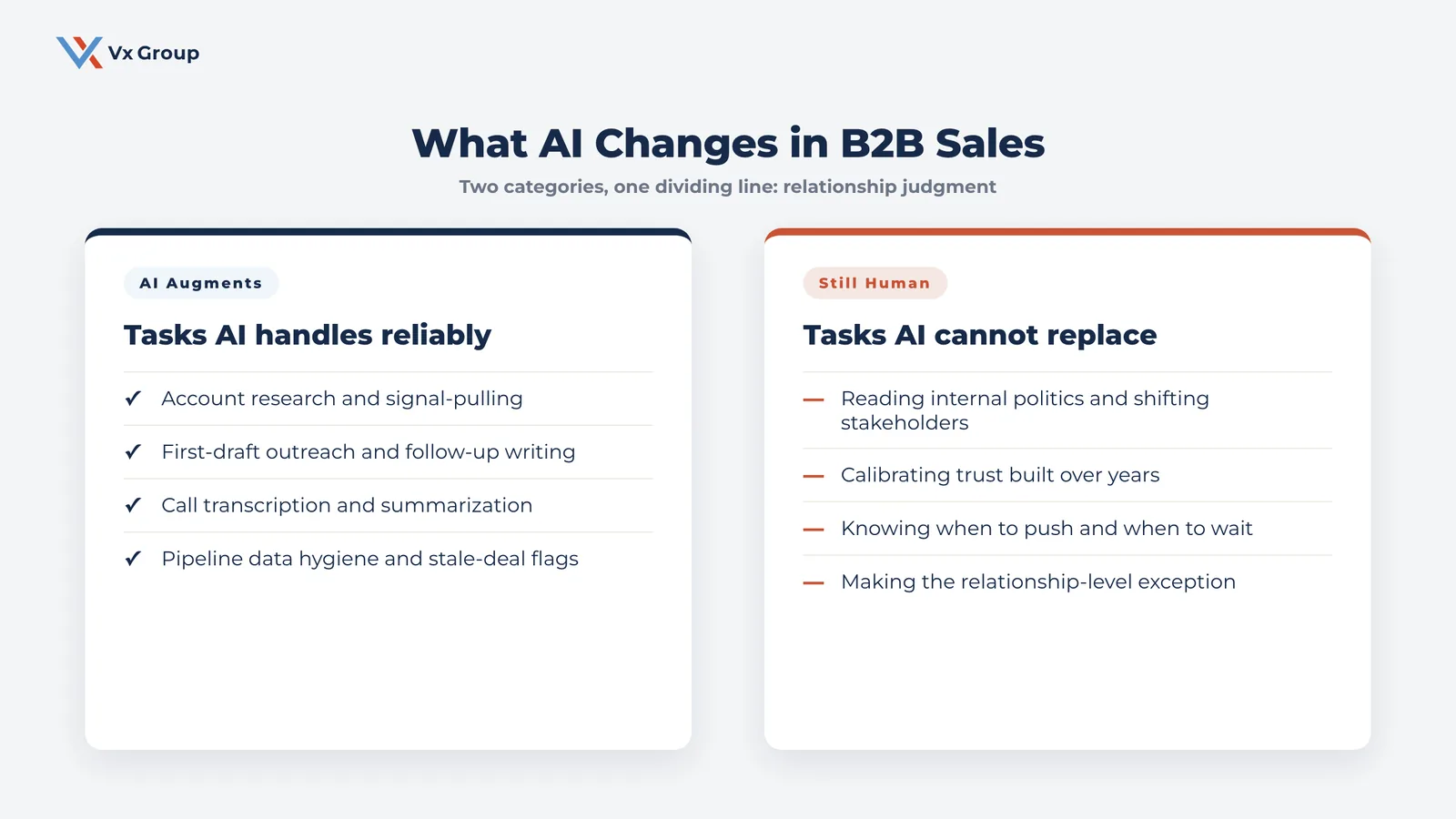
AI reliably improves four categories of sales work today: research synthesis, first-draft writing, meeting documentation, and data hygiene. Each one is a task that previously consumed real rep time without requiring relationship-level judgment, which makes each one a clean candidate for AI assistance.
- Research synthesis. Pulling together everything publicly knowable about an account before a call: recent news, leadership changes, hiring trends, public statements. AI compresses what used to be 30 to 45 minutes of manual digging into a few minutes of review.
- First-draft writing. Outreach emails, follow-up notes, proposal language, internal account summaries. The same first-pass discipline covered in Sales Prospecting: A Relationship-First Playbook for Mid-Market B2B Companies still applies to anything AI drafts. AI produces a usable starting point for almost any sales writing task. A rep still needs to edit it for accuracy and tone before it goes out.
- Meeting documentation. Call transcription, action-item extraction, and CRM note generation. This is one of the highest-confidence use cases because it is a transcription and summarization problem, which is squarely inside what current AI models do well.
- Pipeline data hygiene. Flagging stale opportunities, missing required fields, inconsistent stage definitions across reps, and deals that have not been touched in a defined window. This turns CRM cleanup from a quarterly fire drill into a continuous, low-effort process.
Which parts of selling still require a human, and why?
AI cannot reliably navigate internal politics, calibrate trust, or make a judgment call about timing, because none of those are language problems. They are relationship problems, and a model trained on text has no access to the relationship itself.
- Reading internal politics. Every B2B deal of any size involves more than one decision-maker, and those decision-makers rarely agree on priorities in public. Knowing which internal champion is losing influence, or which objection is really about budget ownership rather than the stated concern, requires a read on people that no transcript fully captures.
- Calibrating trust. A 12-year account and a brand-new prospect require entirely different tones, even for the same message. AI can be told this explicitly, but it has no felt sense of the relationship’s history the way the rep who lived it does.
- Knowing when to push and when to wait. Sales timing is often a judgment call about a buyer’s internal calendar, budget cycle, or personal schedule pressure that was never written down anywhere AI could read it.
- Making the relationship-level exception. Every long-standing account eventually needs a decision that breaks the standard playbook: a pricing exception, an off-cycle favor, a moment of flexibility that has nothing to do with the deal in front of you and everything to do with the next ten years of the relationship. That call belongs to a person who understands the account’s full history. A system optimizing for the current transaction has no way to weigh the next ten years of the relationship.
Defined Term: Relationship-level judgment
Relationship-level judgment is a decision made in the context of an account’s full history and future value rather than the immediate transaction in front of you. It is the category of decision-making AI cannot perform because it requires weighing things that were never written down anywhere a model could read them.
This is also the direct answer to the question reps ask most often once AI tools show up on their team. Will AI Replace Salespeople? An Honest Answer for B2B Leaders covers the rep-level version of this question in more depth. The short answer: relationship-driven B2B sales depends on judgment AI cannot perform, for exactly the reasons above.
What are the risks of adding AI to a sales process without fixing the architecture first?
The biggest risk of adding AI to a B2B sales process is not technical. It is that AI makes a flawed sales motion run faster and look more sophisticated, which delays the harder conversation about whether the motion itself needs to change.
- Outreach volume increases while quality decreases. Faster drafting tempts teams to widen the list instead of deepening the message, and recipients notice.
- Reps stop doing the thinking AI was supposed to free up time for. If a rep accepts every AI draft unedited, the time saved on writing never converts into time spent on judgment. It just becomes more emails sent.
- Automated flagging does not equal fixed data. An AI tool that flags stale deals is useful only if someone acts on the flag. Left unaddressed, automated flagging just produces a longer list of ignored alerts.
- Account knowledge stays trapped in one person’s head, just faster. AI tools that summarize a rep’s calls into that rep’s private notes do nothing to protect the company if that rep leaves. The knowledge has to land somewhere the company owns. A faster write-up that still lives only in one rep’s personal notes protects nothing.
- Leadership mistakes speed for strategy. A pipeline dashboard that shows more activity after an AI rollout can mask a flat or declining win rate for a full quarter or more before anyone asks why.
How should a relationship-driven B2B company start using AI in sales?
A relationship-driven B2B company should sequence AI adoption around its highest-value accounts before its highest-volume outreach, because that sequencing tests whether AI compounds advantage before it gets used to scale a motion that was never built around the relationship.
- Start with account research and call prep on your top accounts. This is the lowest-risk, highest-confidence use case, and it directly frees up time for the relationship-level work that matters most on the accounts that matter most.
- Add meeting documentation next. Transcription and note generation protect account knowledge immediately, which matters independent of any other AI rollout decision.
- Use pipeline hygiene flags as a forcing function rather than a static report. Assign someone to act on every flag within a set window. An unactioned flag is worse than no flag, because it creates the appearance of oversight without the substance.
- Only after the first three are working, expand AI-assisted drafting to broader outreach. By this point the team has a felt sense of what a good AI-assisted touch looks like on a relationship they know well, which is the only reliable check against AI theater creeping into volume outreach.
- Measure account depth. Track whether AI adoption is correlating with longer account tenure, more expansion conversations, and better-prepared meetings. Touches logged is the easiest number to point to and the least useful one for judging whether this is working.
Ready to grow?
Vx Group builds the growth system that gets relationship-driven B2B companies found, chosen, and expanded.
What does an AI-ready sales process look like in practice?
An AI-ready sales process is one where every account interaction already gets logged somewhere structured, every account has a documented history a rep can hand off, and the sales motion is organized around account depth rather than activity volume. AI adds the most value to a process that already has these three things in place, because AI can only work with the structure and data it is given. It is also the same foundation behind Customer Retention Strategies for Relationship-Driven B2B Companies.
- A CRM where account history is complete enough that a new rep could read it and understand the relationship’s last two years in ten minutes
- A defined cadence for account reviews that happens on a fixed schedule, independent of whether the account currently looks “at risk”
- A clear owner for every account, so AI-flagged research or summaries land with the person who can actually act on them
- A shared definition across the team of what a “quality touch” looks like, so faster drafting does not quietly become an excuse for shallower drafting
- A leadership team that reviews account depth and expansion metrics in the same meeting where activity metrics get reviewed, with equal weight given to both
Without this foundation, AI adoption tends to produce exactly the pattern described earlier under Transactional Architecture: more activity, faster, on top of the same underlying gaps.
How does AI change what “good” looks like for a sales rep?
AI changes the definition of a high-performing sales rep from someone who produces the most activity to someone who makes the best judgment calls with the time AI frees up. This is the shift that determines whether a company’s investment in AI sales tooling actually pays off.
For years, sales performance got measured largely on volume because volume was the thing a rep fully controlled and a manager could easily track: calls made, emails sent, demos booked. AI now performs a meaningful share of the work that used to generate that volume. A rep’s value increasingly comes from the part of the job AI still cannot do: which accounts get attention, what gets said, when to push, and when to make the exception that protects a long relationship.
Sales leaders who keep measuring activity after rolling out AI tools will see every number go up and learn nothing about whether the rollout actually worked, the same blind spot covered in Your Top 10 Customers Are a Growth Strategy. The leaders who shift to measuring account depth, expansion rate, and the quality of prepared conversations will see the real signal, even if it takes a quarter or two longer to show up.
Defined Term: Account depth. Account depth is a measure of how much of an account’s available relationship value a company has actually captured, spanning wallet share, breadth of contacts, tenure, and the account’s willingness to refer or expand. It is the metric a Compounding Architecture optimizes for, in contrast to the activity metrics a Transactional Architecture defaults to.
Account depth is closely tied to who owns the account day to day. What Account Management Actually Means in a relationship-driven B2B company is a useful companion read here: the account manager role is the one most directly affected by AI, since AI removes the prep and documentation work that used to crowd out the relationship work the role exists to do.
What does this mean for sales leaders building their AI roadmap right now?
Sales leaders building an AI roadmap should treat architecture as the prerequisite decision and tool selection as the secondary one, because the order those two decisions happen in determines whether AI compounds the company’s relationships or just accelerates whatever is already broken.
The practical roadmap looks different depending on where the company is starting:
| Starting point | First move | Common mistake to avoid |
|---|---|---|
| No AI tools yet, account data scattered | Centralize account history before adding any AI layer | Buying an AI tool to “fix” disorganized data instead of fixing the data first |
| Some AI tools live, mostly for outreach volume | Redirect the next AI budget toward top-account research and prep instead of more volume | Doubling outreach volume because the tool makes it easy, without checking reply quality |
| AI used heavily, win rate flat or declining | Audit whether AI-saved time is converting into judgment time or just more activity | Assuming the AI tool is underperforming when the architecture is the actual problem |
| Strong account depth already, exploring AI for the first time | Start with meeting documentation to protect existing relationship knowledge immediately | Waiting for a “bigger” AI initiative instead of capturing an easy, low-risk win first |
This is the same lens covered in Why Most B2B Companies Grow By Accident: ask what the existing architecture is actually optimizing for before adding anything new on top of it. AI does not change that question. It raises the stakes of getting the answer wrong.
What categories of AI sales tools exist, and how do they map to this framework?
Most AI sales tools fall into one of five categories, and each category maps cleanly onto either the “AI improves this” list or the “AI cannot replace this” list above. Knowing the category before evaluating the tool prevents most of the common buying mistakes.
- AI-assisted research tools. Pull account, contact, and company signal data automatically. Maps directly to research synthesis. Low risk, high confidence.
- AI drafting and sequencing tools. Generate outreach emails, call scripts, and follow-up sequences. Maps to first-draft writing, but is also the category most prone to producing AI theater if pointed at broad lists instead of named accounts.
- Conversation intelligence tools. Transcribe and summarize calls, extract action items, and surface talk-time and sentiment patterns. Maps to meeting documentation. One of the safest categories to adopt early, since it protects account knowledge rather than just accelerating outreach.
- AI-enhanced CRM and pipeline tools. Flag stale deals, score leads, and surface forecasting risk. Maps to pipeline hygiene. Useful only when paired with a clear owner who acts on the flags it generates.
- Fully automated outreach or “AI SDR” tools. Run entire outbound sequences with minimal human review, the same volume-over-fit tradeoff covered in Account-Based Selling vs. Volume Selling. This category sits furthest from relationship-level judgment and carries the highest risk of accelerating a Transactional Architecture without anyone noticing until the reply rate drops.
A relationship-driven B2B company evaluating any new AI sales tool should ask one question before anything else: which of these five categories is this, and does that category match a task that was actually a bottleneck. A tool that solves a problem the company did not have is not a win just because it is fast.
How AI fits into a relationship-driven growth plan
AI in sales amplifies whatever sales strategy already exists, which means the single most useful move available to most B2B companies right now is fixing the architecture AI will run on before picking the next tool. Companies built on transactional habits will get faster at the wrong things. Companies built around relationship depth will get a genuine compounding advantage, because the time AI frees up goes straight back into the part of selling that was always the actual differentiator: the judgment, the timing, and the trust that no model can manufacture.
Ready to grow?
Vx Group builds the growth system that gets relationship-driven B2B companies found, chosen, and expanded.
FAQs
About the Author: David Tisdale
