

Channel Sales Strategy: How Relationship-Driven B2B Companies Build Pipeline

A channel sales strategy is the plan for how a company grows revenue through third-party sellers, such as distributors, reps, dealers, agents, and VARs, instead of selling direct. For relationship-driven B2B companies, it works when partners are selected, developed, and held accountable as long-term relationships rather than transaction conduits.
TL;DR
- A channel sales strategy defines which partners sell for you, in which markets, and how you develop those relationships over time.
- Most channel programs stall because companies recruit partners by coverage and manage them by dashboard.
- Select partners on trust and fit before logos and territory.
- Build a relationship cadence: named contacts, a shared plan, and a regular review rhythm.
- Measure relationship quality and partner-sourced revenue, and have a plan for partners that go cold.
Most channel programs are built backward. A company signs as many partners as it can, hands them a price list and a logo, and waits for orders that never come at the volume anyone projected.
That is the villain here: treating channel partners as distribution coverage to collect rather than relationships to develop. It produces a long roster of inactive partners and a tiny handful who actually sell.
Relationship-driven manufacturers and distributors grow through the channel for the same reason they grow direct. Trust, consistency, and clarity about who does what. A channel sales strategy is how you make that repeatable across partners you do not employ.
Defined Term: Channel sales strategy (defined)
The documented plan for growing revenue through third-party sellers. It covers which markets the channel serves, how partners are selected and developed, what each side commits to, and how performance is measured over the life of the relationship.
This guide walks through how to build one, step by step, for a company whose growth depends on high-value, long-cycle relationships.
1. Decide where the channel fits in your growth before you recruit anyone
Start by deciding which parts of your growth the channel should own and which stay direct. A channel sales strategy that competes with your own direct team creates conflict and confusion before a single partner signs.
Map which markets and segments the channel should serve
List your priority markets, then decide where a partner reaches customers you cannot reach efficiently on your own. Geography, vertical specialization, and account size are the usual dividing lines.
The channel earns its place where partners already hold trust and local presence that would take you years to build. Keep direct what is core to your most valuable relationships.
A common split among manufacturers: keep your top 20 to 30 named accounts and any highly engineered, long-cycle deals direct, and route smaller, faster-moving, or geographically distant business through partners.
Set the rules of engagement up front
Record who sells to whom before partners start working deals. Three documents prevent most disputes: a named-accounts list that stays direct, a deal registration process so the first partner to bring an opportunity is protected on it, and a lead response standard such as contacting a registered lead within two business days.
Clear boundaries on accounts, territories, and lead ownership keep the disputes that quietly poison channel relationships from ever starting.
Defined Term: Channel conflict (defined)
Friction that occurs when a manufacturer’s direct sales team and its channel partners pursue the same customer, or when two partners pursue the same deal. Documented rules of engagement are the primary way to prevent it.
This early clarity connects directly to your broader B2B growth strategy, because the channel is one route to revenue among several, not a separate world. Companies with a documented B2B demand generation approach use channel sales as a market coverage layer, building pipeline from partners in segments where direct outreach alone takes years to gain traction.
2. Define what a good channel partner actually looks like
Define your ideal partner profile before you recruit, using the same discipline you would apply to your best direct customers. A partner that looks impressive on paper can still be wrong for a relationship-driven business.
The strongest channel partners share a pattern. They serve your priority markets, sell the way your buyers buy, and have the technical depth to represent a complex offering without misrepresenting it.
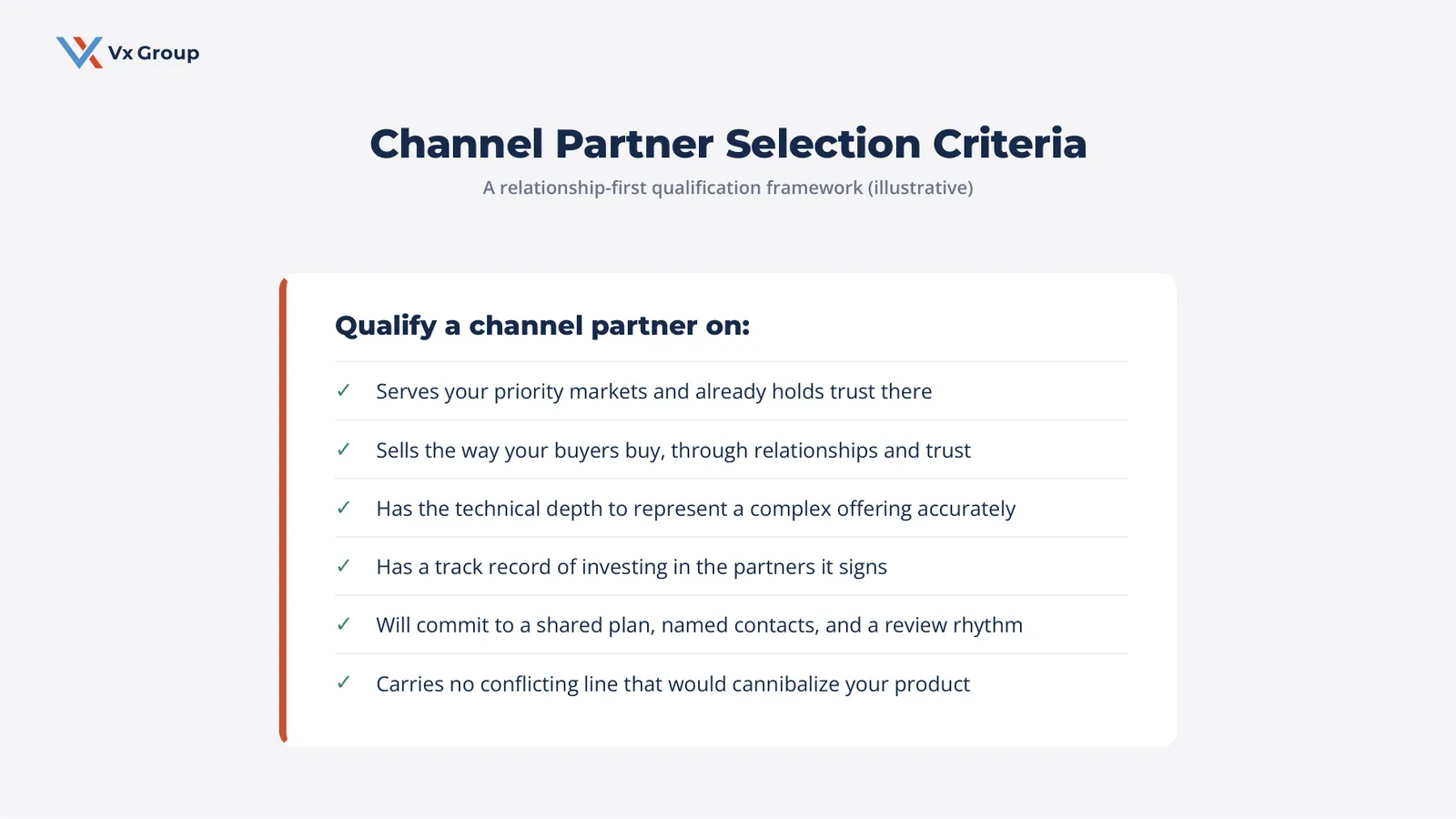
Just as important is how a partner treats its own relationships. A partner with a track record of investing in the lines it carries will invest in yours. A partner that collects logos and waits for inbound orders will leave your product on the shelf.
Screen for conflicting lines too. A partner that already sells a competing product rarely gives yours the attention your growth depends on.
3. Recruit partners as relationships, not as signatures
Recruit fewer partners and invest more in each one. A shorter list of committed partners almost always outperforms a long list of names who signed an agreement and moved on.
Treat recruitment as the start of a relationship you intend to keep for years. That means a real conversation about fit, shared goals, and what success looks like for both sides before any paperwork.
The companies that get this right resist the temptation to measure recruiting by partner count. Five partners who actively sell beat fifty who appear in a directory and never quote a deal.
If you are building or rebuilding a channel, start with three to five partners you can support well, prove the model with them, then add more only as fast as your enablement and review capacity can keep up.
This is the same principle that runs through channel partner marketing: the goal is depth of engagement with the right partners, not breadth of coverage for its own sake. The formal channel partner program that backs this strategy works the same way, producing consistent revenue from a tight roster of committed partners rather than a long list of inactive ones.
Ready to grow?
Build a channel sales strategy where partners actively sell you, instead of signing them and hoping.
4. Build a relationship development cadence that keeps partners engaged
Build a repeatable rhythm for developing each partner relationship after the agreement is signed. Most channel programs go quiet the moment onboarding ends, and partner attention drifts to whichever vendor stays present.
A development cadence keeps you present without depending on any one salesperson’s memory. It is the system that protects the human side of the relationship.
Give every partner a named contact and a shared plan
Assign a specific person to each partner relationship and build a simple joint plan with them. Named ownership signals that the partnership matters, and a shared plan turns good intentions into commitments both sides can track.
Keep the plan to a single page with five things: a 12-month revenue target, the 5 to 10 named target accounts you will pursue together, who owns each next step, the enablement or support the partner needs from you, and the dates of your next three reviews. Revisit it at every quarterly review and reset the numbers once a year.
Enable partners to represent you accurately
Equip partners with the materials, training, and support they need to sell a complex offering well. Partners who feel unsupported go quiet, and partners who feel equipped stay active.
Front-load enablement in the first 90 days. By day 30, every partner should have your core sales materials, current pricing, and a named technical contact for questions. By day 60, run live product and objection-handling training with their reps. By day 90, work at least one real opportunity together so the partner closes a first deal with you in the room. After that, refresh training whenever you launch a product and at least once a year.
Defined Term: Partner enablement (defined)
The materials, training, and ongoing support that allow a channel partner to find, win, and serve customers on your behalf. Strong enablement is what lets a third party represent your offering with the same accuracy your own team would.
Set a regular review rhythm
Match review frequency to how much revenue a partner carries, and put the dates on the calendar a year out so they actually happen. A practical tiered rhythm for most relationship-driven B2B companies looks like this:
- Strategic partners (your top 20 percent by revenue or potential): a 30 to 45 minute pipeline call every month, a 90 minute quarterly business review, and a half-day joint planning session once a year.
- Core partners (the steady middle): a pipeline call once a quarter plus one annual planning conversation.
- Long-tail partners: a check-in every six months, with a standing offer to step up the cadence whenever an active opportunity appears.
Every pipeline call covers the same four things: open opportunities and their next step, recent wins and losses, any friction on either side, and the two or three commitments each party owns before the next call. Keep a one-page running log per partner so nothing resets between conversations. A predictable rhythm catches problems early and keeps the relationship from going cold between orders.
5. Hold partners accountable on relationship quality, not just volume
Measure the channel on relationship quality and partner-sourced revenue rather than raw activity. Order volume alone tells you a partner is busy, not whether the relationship is healthy or growing.
Track partner-sourced and partner-influenced revenue, the number of partners who are actively selling, and how engaged each partner is in your joint plan. Define active plainly so everyone reads it the same way: a partner who quoted or placed an order in the last 90 days.
Watch a few numbers monthly. The share of channel revenue concentrated in your top three partners (above 60 percent is a concentration risk worth addressing), the percentage of signed partners who are active (in healthy programs most signed partners sell, so a roster of dormant names is the warning sign), and the time from partner signing to first deal (aim for under 90 days). These tell you where to invest more and where a relationship needs attention.
Accountability runs both ways. Partners commit to effort and shared goals, and you commit to support, responsiveness, and a fair deal. A scorecard that only measures the partner reads as one-sided and erodes trust.
For a deeper treatment of how this fits a complete channel approach, see our overview of B2B channel strategy.
6. Know what to do when a channel relationship goes cold
Have a plan for partners who stop selling before you decide whether to re-engage or part ways. Set a clear trigger: a partner who has not quoted or ordered in 90 days, or who has missed two consecutive reviews, is cold and needs a decision rather than another quarter of silence.
Start with a direct conversation about what changed. Sometimes a partner went quiet because enablement was thin, a competing line got more attention, or a key contact left.
When the relationship can be revived, run a focused 60-day reactivation plan: a refreshed joint plan, one specific opportunity to work together, and a check-in every two weeks until momentum returns. If there is still no quote or order after that window, part ways cleanly and protect the customer relationships that partner touched.
This is where many companies in legacy industries, including industrial B2B manufacturers, lose ground. They let dead partnerships linger on the books instead of redirecting that energy toward partners who will grow with them.
A channel sales strategy is a relationship system, not a coverage map
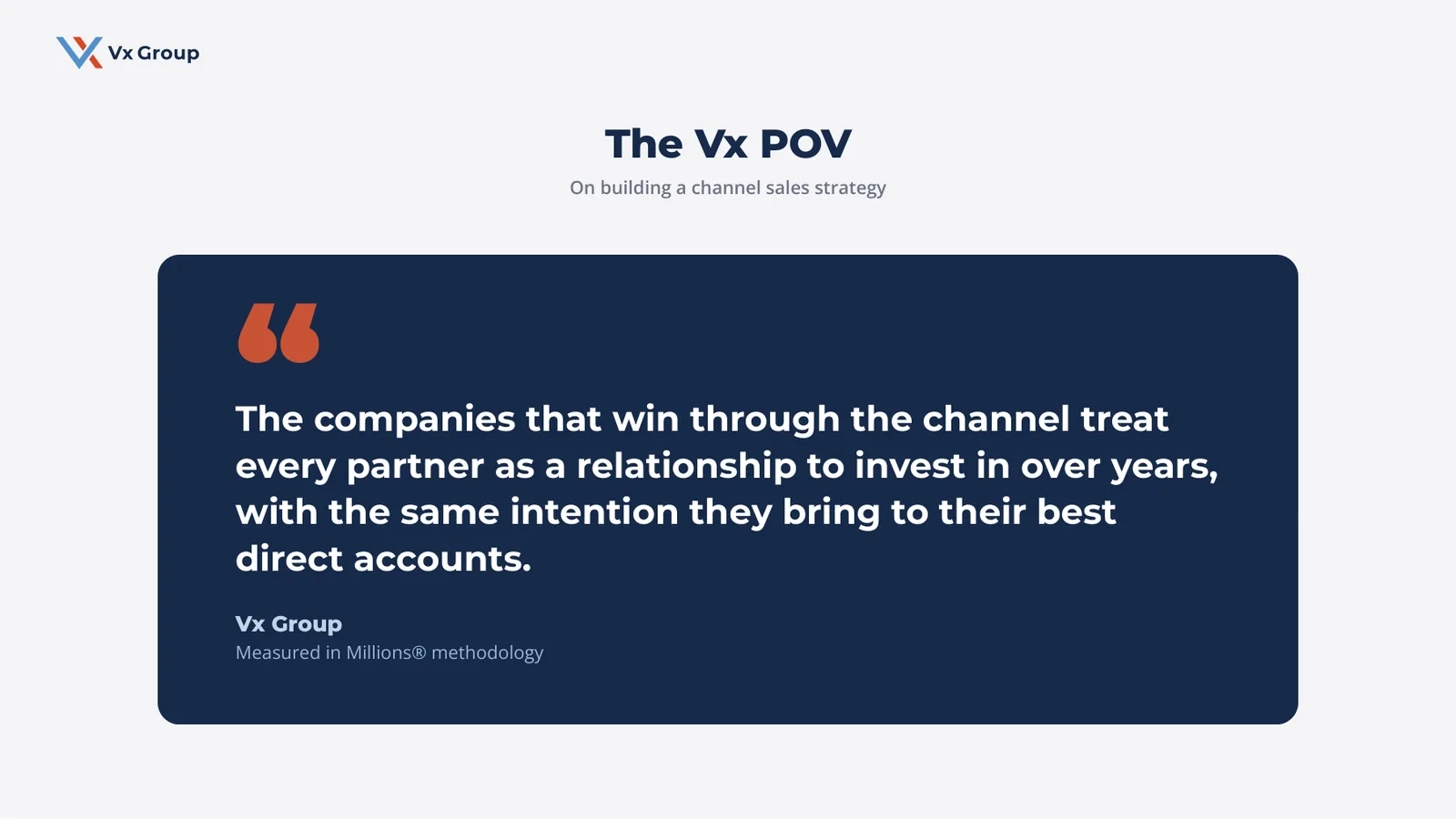
The companies that build durable channel pipeline do not win by signing the most partners. They win by selecting the right ones, developing each relationship with intention, and measuring what actually predicts growth.
That is the same discipline relationship-driven B2B companies already apply to their best direct accounts. A channel sales strategy simply extends it to the partners who sell on your behalf.
If your channel has become a long list of inactive partners and a few overworked relationships, the fix starts with clarity about who belongs on that list and how you develop them.
Ready to grow?
Turn your channel into a relationship system that produces, not a list of partners who forgot you.
FAQs
About the Author: David Tisdale
