

Sales Pipeline Management: How to Run a Pipeline That Doesn’t Live in One Person’s Head

Sales pipeline management is the practice of moving every B2B opportunity through documented stages, each with a clear owner and a planned rhythm of relationship development, so the whole team can see where revenue stands and what happens next. Done well, the pipeline lives in the system where the whole team can see it.
TL;DR
- A sales pipeline is a system of documented stages, defined ownership, and a planned rhythm of relationship development, which is more than a CRM with extra activity logged into it.
- When the pipeline lives in one rainmaker’s head, a single resignation can erase years of revenue visibility overnight.
- Stage changes should be tied to what the buyer actually did rather than to rep optimism, so the forecast actually means something.
- Pipeline visibility is the point: anyone on the team should be able to read the pipeline and know what to do next.
- The metrics worth tracking measure movement and relationship depth rather than how busy the team looks.
- A transferable pipeline becomes an asset, while a founder-dependent one stays a risk sitting on the balance sheet.
What is sales pipeline management?
Sales pipeline management is how a company keeps track of every active opportunity and moves it forward on purpose. Each deal sits in a documented stage. Each stage has an owner. Each move from one stage to the next happens because the buyer did something real, not because a seller felt good about a call.
Most teams already have something they call a pipeline. Usually it is a CRM with a list of deals, a set of percentages someone made up, and a forecast that lives mostly in the head of whoever sells the most. That arrangement looks like pipeline management while it behaves like a guess.
The difference between the two is structure. A managed pipeline gives the same answer no matter who you ask: where the deal is, who owns it, what the buyer last did, and what has to happen next. An unmanaged one gives you a different answer depending on who is in the room and how their week is going.
Defined Term: Sales pipeline
The set of specific, named opportunities a team is actively working, organized by the stage each one currently sits in. It tracks real deals in motion, which is what separates it from a sales funnel, the broader marketing view of how a large pool of leads narrows toward a few customers.
For relationship-driven B2B companies with long cycles and high-value accounts, this structure matters more than it does for high-velocity sellers. When a deal takes nine months and a customer stays for fifteen years, the cost of losing track of where things stand is enormous. A documented pipeline is how a company protects that value instead of trusting it to memory.
Why is a pipeline that lives in one person's head a liability?
A pipeline that depends on one rainmaker and a CRM nobody keeps current is the single most common growth risk we see in established B2B companies. It feels like strength while the rainmaker is there, and it stays fragile underneath the good quarter.
Here is what that fragility costs. You cannot forecast, because the only accurate version of the pipeline is in someone’s memory and updated by mood. You cannot coach new sellers, because there is no documented process for them to learn. You cannot plan capacity, because nobody can see what is really coming. And the day that person gives notice, the relationships and the revenue attached to them are at risk of leaving with them.
This is the same pattern behind why so many companies grow by accident rather than by design. The growth is real, but no one can explain how it happens or repeat it deliberately. A pipeline that only one person understands is that problem in its most expensive form.
Systems are what protect the human side of the business here. Documenting the pipeline does not strip the relationships of their warmth or hand them to a machine. It makes the knowledge that one person carries available to the team, so a vacation, a promotion, or a departure does not put millions of dollars in relationship value at risk.
Defined Term: Founder-dependent pipeline
A pipeline whose accuracy, momentum, and relationships all depend on one person. It cannot be forecast, coached, or transferred, and it disappears when that person does. The opposite is a transferable pipeline that any qualified team member can read and run.
What are the stages of a B2B sales pipeline?
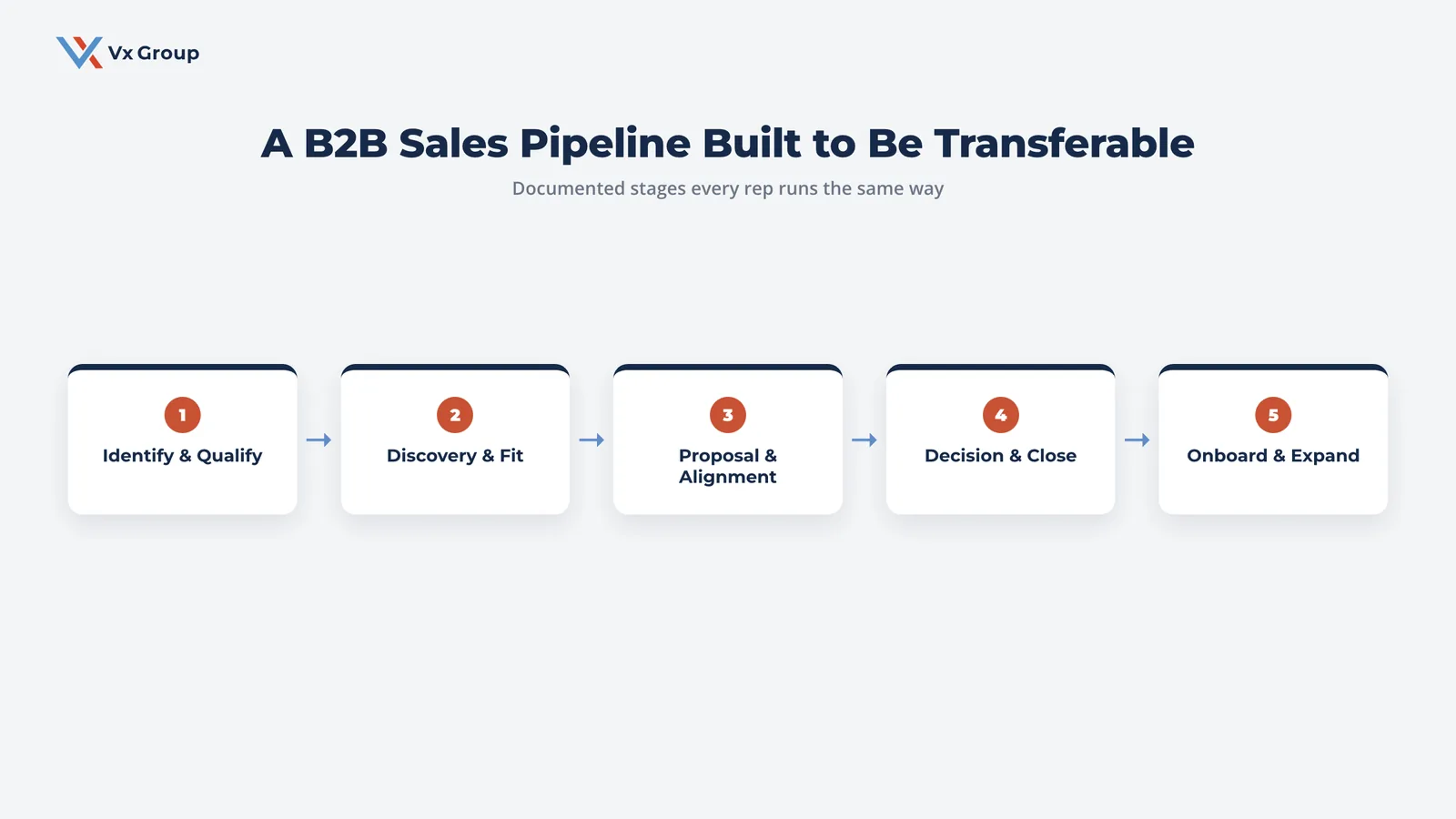
A B2B sales pipeline should have four to six stages, each tied to a decision the buyer makes. Fewer than four hides steps that matter. More than six creates busywork that reps quietly stop maintaining. The stages below work for most relationship-driven companies, and you should rename them to match the language your buyers actually use.
1. Identify and qualify
The opportunity enters the pipeline once you have confirmed there is a real need, a budget worth pursuing, and a reason to talk now. Qualifying out early is a feature of a healthy pipeline. A list stuffed with deals that will never close is just noise that makes your forecast lie to you.
2. Discovery and fit
You and the buyer work out whether what you do solves what they need. This is where relationship-driven selling earns its keep. The seller is learning the buyer’s situation in enough depth to know whether to keep going, and the buyer is deciding whether you understand their world well enough to trust you with it.
3. Proposal and alignment
You put a recommendation in front of the buyer and align on scope, terms, and the people who have to say yes. A deal that sits in this stage for months without movement is telling you something. Usually it is that a decision-maker you have not met yet has questions no one has answered.
4. Decision and close
The buyer makes the call and you formalize the agreement. A managed pipeline tracks not just whether the deal closed but why, so the team learns from both the wins and the losses instead of repeating them.
5. Onboard and expand
The relationship does not end at the signature. For companies whose customers stay for years, the most valuable part of the pipeline often sits here, in the expansion of accounts you already have. This is where account management does its real work, turning a closed deal into a growing relationship rather than a one-time transaction.
Defined Term: Pipeline stage
A defined step in the buying process with clear entry and exit criteria. A deal earns its place in a stage by meeting that stage’s criteria, and it advances only when the buyer takes the action that completes the stage. The criteria are what keep the pipeline honest.
The rule that holds all of this together is simple to state and hard to enforce: a deal moves forward only when the buyer does something that proves it should. A meeting booked, a decision-maker introduced, a requirement confirmed, a contract reviewed. These actions are the proof that a deal has genuinely advanced.
Who owns each stage of the pipeline?
Every stage in the pipeline needs one accountable owner, and the handoffs between owners need to be documented. Most pipelines do not break inside a stage. They break in the gaps between stages, where a deal is technically someone’s job and practically nobody’s.
In a small team, one seller may own a deal end to end. That still works, as long as the ownership is written down and the next steps live in the pipeline rather than in that seller’s head. In a larger team, ownership often shifts: a development rep qualifies, an account executive runs discovery through close, and an account manager takes the relationship from onboarding into expansion. Each handoff is a moment where a deal can stall or a relationship can cool, so each one deserves a defined trigger and a defined receiver.
Defined ownership is also what makes coaching possible. When you can see who owns which deals at which stages, you can see where a particular seller consistently gets stuck and help them there specifically, instead of offering generic advice about closing more.
Ready to grow?
To see how relationship-driven B2B teams assign pipeline ownership without turning their sellers into form-fillers.
How does relationship development fit into a sales pipeline?
The part of pipeline management that almost every team neglects is the planned rhythm of relationship development inside and alongside the pipeline. Most pipeline tools track the deal. Very few track the relationship that makes the deal possible, and even fewer track the relationships that are not attached to an open deal yet but will be.
Defined Term: Relationship development rhythm
A documented schedule of intentional touches with the people who matter to your business, mapped to where each relationship stands rather than whether there is an open deal. It keeps high-value relationships warm before they show up as pipeline, so opportunities arrive earlier and close faster.
For a company whose growth depends on a relatively small number of high-value relationships, this rhythm is where future pipeline is actually created. A quarterly check-in with a past customer, a planned follow-up after a trade show conversation, a deliberate touch with a referral source: these are not the deal, but they are the reason the deal will exist in twelve months. A pipeline that only counts active opportunities misses the work that fills it.
This is the most undervalued asset in B2B, and it is sitting in plain sight. Companies spend heavily to acquire new names while leaving their established relationships unmanaged and underdeveloped. The lifetime value concentrated in a company’s top ten relationships often exceeds the entire pipeline of new prospects. Managing those relationships with the same discipline you bring to open deals is usually the faster path to revenue.
How do you make a sales pipeline visible?
Pipeline visibility means anyone on the team can open the pipeline and understand where every deal sits, who owns it, what the buyer last did, and what has to happen next, without asking the person who built the relationship. That is the test. If the honest answer to “where does this deal stand” requires a specific human to be reachable, what you have is dependency rather than visibility.
Getting there takes three things. First, shared definitions, so that “discovery” means the same thing to every seller and the stage actually describes reality. Second, current data, which means stage changes are tied to buyer actions that are easy to log rather than subjective judgments that reps avoid entering. Third, a regular review where the team looks at the pipeline together and pressure-tests it, so the act of keeping it current becomes routine rather than a quarterly fire drill.
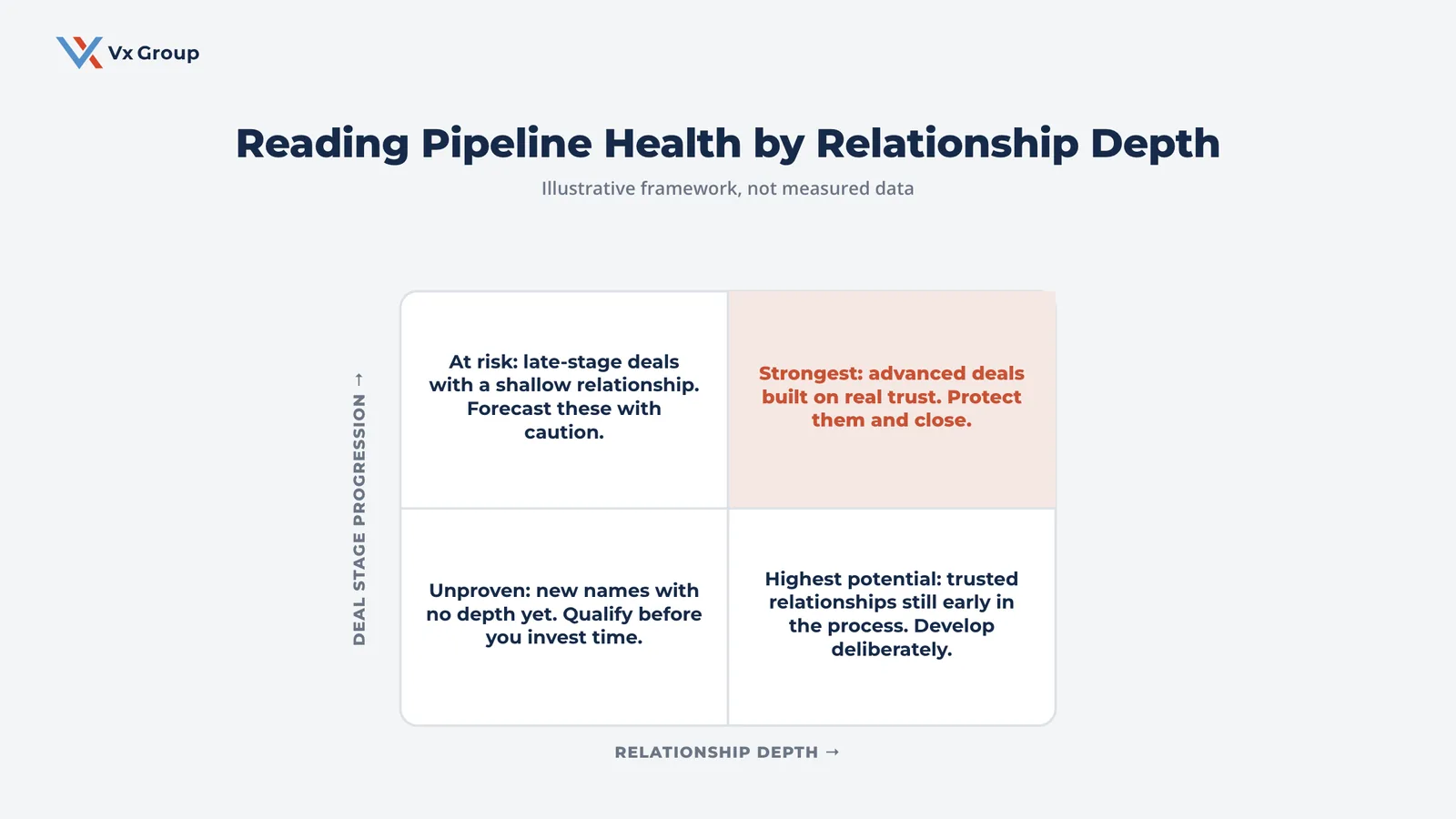
Reading pipeline health well means looking past the dollar value of a deal to the depth of the relationship underneath it. A large, late-stage opportunity with no real relationship behind it is more fragile than a smaller one rooted in years of trust. The framework below is one way to read that.
Visibility is also what connects sales to the rest of the business. When the pipeline is legible, marketing can see which relationships need air cover, finance can plan against a forecast that holds, and leadership can report up with confidence. A clear pipeline is part of how a company connects its growth activity to its actual strategy instead of running the two in separate silos.
Which sales pipeline metrics actually matter?
The metrics worth tracking measure whether deals are moving and whether relationships are deepening. The ones to drop measure how busy the team looks. Activity is easy to count and comforting to report, which is exactly why so many teams chase it and wonder why the forecast still misses.
| Track this | Not this |
|---|---|
| Stage conversion rate (how often deals advance from one stage to the next) | Total number of deals in the pipeline, regardless of quality |
| Average time a deal spends in each stage | Number of calls or emails logged per rep |
| Pipeline coverage against a realistic target | A single blended “win rate” with no stage detail |
| Age of each deal relative to your normal cycle | Activity dashboards that reward motion over progress |
| Forecast accuracy over the last several quarters | The size of the pipeline as a vanity number |
| Relationship depth on your highest-value accounts | Badge scans, list size, and other proxies for volume |
The point of the right metrics is to find where deals get stuck and where relationships are thin, so you can do something specific about it. A pipeline report that only says “we have a lot of deals” tells you nothing you can act on. One that says “deals stall for an average of seven weeks between proposal and decision” tells you exactly where to look.
Field Notes: when the pipeline walked out the door
A pattern we see often: a company with strong revenue and a long-tenured top seller who owns most of the important relationships. The pipeline in the CRM looks thin, because the real pipeline lives in that seller’s head and their notebook. Leadership knows this and tolerates it, because the numbers keep landing. Then the seller retires, or gets recruited, or simply takes a long leave. Within a quarter, the gaps appear. Deals that were “almost there” turn out to have been one relationship deep, and that relationship left. Renewals that everyone assumed were safe get competitive, because the person who maintained the trust is gone and no one knew what had been promised. Losing that seller means losing the only working copy of the pipeline. The companies that avoid this did one unglamorous thing early. They wrote the pipeline down while the rainmaker was still there, made the relationship history part of the system, and built a rhythm of shared review so the knowledge lived in more than one place. None of it reduced what their best seller contributed. It just meant the business owned the pipeline, rather than renting it from an individual.
How do you build a sales pipeline that transfers?
Building a transferable pipeline is a sequence, and you can start it this quarter without buying anything new. The sales pipeline process below is the order we use with relationship-driven B2B teams.
- Map the buying process you actually have. Document how your best deals really move, from first contact to expansion. Build the stages around the buyer’s decisions rather than your internal steps.
- Write entry and exit criteria for each stage. Define what has to be true for a deal to enter a stage and what buyer action moves it out. This is what stops the pipeline from drifting back into optimism.
- Assign one owner per stage and document the handoffs. Name who is accountable and what triggers each pass from one owner to the next.
- Capture the relationship, not just the deal. Record who the real relationships are, what has been promised, and when the next intentional touch should happen, so none of it depends on one memory.
- Set a recurring pipeline review. Make keeping the pipeline current a routine team habit rather than a scramble before a board meeting.
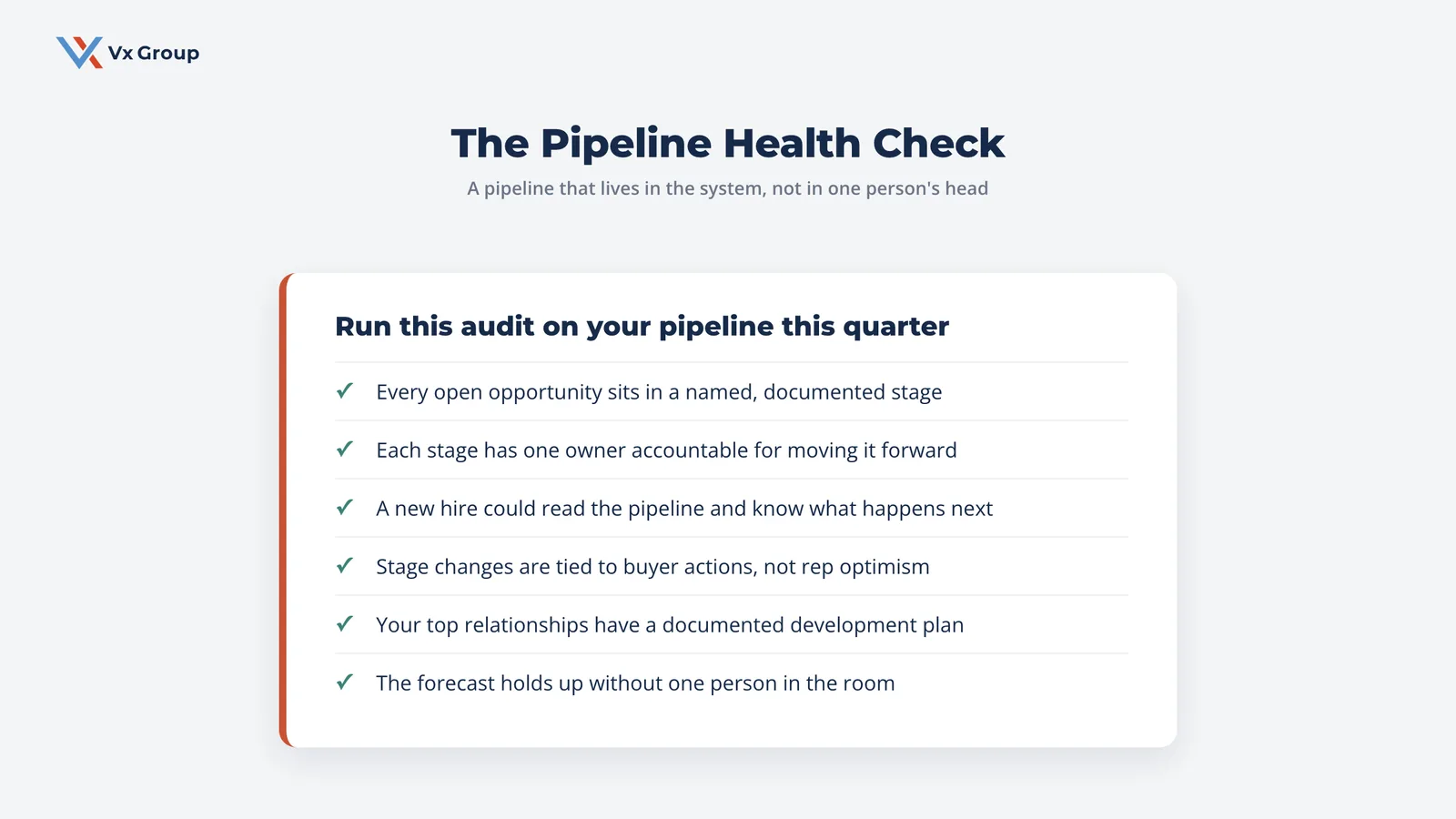
- Audit it honestly. Use the checklist below. If you cannot answer yes to every item, you have found your next improvement.
A pillar like this one is the foundation. The deeper mechanics of designing each stage for growth belong in a companion piece, How to Build a Scalable B2B Sales Pipeline, and the work of developing accounts after the close is the subject of What Account Management Actually Means. Both build on the same principle: the pipeline is an asset the company owns, documented well enough that any qualified person can run it.
Ready to grow?
If you want a working session on turning a founder-dependent pipeline into one your whole team can run.
Why does pipeline management break?
Even teams that build a real pipeline tend to break it in predictable ways. Watching for these keeps the system honest:
- Stages become storage. Deals pile up in a middle stage because no one enforces the exit criteria, and the pipeline slowly fills with opportunities that will never move.
- The forecast becomes a negotiation. Numbers get adjusted to match what leadership wants to hear, and the pipeline stops reflecting reality.
- The CRM becomes a chore. Reps see data entry as overhead rather than something that helps them, so they stop keeping it current and the pipeline goes stale.
- Relationships fall out of view. The team tracks open deals well but lets the high-value relationships without an active deal go quiet, starving the future pipeline.
- Ownership blurs at the handoffs. Deals stall in the gaps between sellers because no one defined who picks them up and when.
Most of these trace back to the same root. The pipeline was treated as a reporting tool to satisfy management rather than a working system that helps the team sell. Build it for the people doing the work, and they will keep it alive.
Where to start
If your pipeline lives mostly in one person’s head, you do not need a new platform. You need to write down how your deals actually move, give each stage an owner, tie every advance to something the buyer did, and put a regular review on the calendar. That sequence turns a fragile, founder-dependent pipeline into a transferable asset, and it is the difference between a company that hopes its numbers land and one that can see them coming.
A visible, predictable pipeline is one of the conditions that make durable growth possible in the first place.
FAQs
About the Author: David Tisdale
