

How to Build a Sales Compensation Plan for Long Sales Cycles

A sales compensation plan for a long cycle has to pay for the relationship work that happens during the eighteen months before a deal closes. That means a higher base, milestone payments tied to observable progress, a separate treatment for existing-account revenue, and a review cycle that lets you correct the plan without breaking trust.
TL;DR
- An annual quota with monthly commission, borrowed from a short-cycle business, pays nothing for a year of relationship work and everything in the month a deal lands. Reps respond by chasing whatever closes fastest.
- Decide what behavior you are paying for before you touch any numbers. Every plan element rewards something and quietly discourages something else.
- For a twelve-month cycle, start at roughly 65% base and 35% variable. Longer cycles need more of the pay guaranteed.
- Split the variable side so progress gets paid as it happens: milestone payments during the cycle, commission at close, and a separate component for protecting existing accounts.
- Decide explicitly how existing-account revenue is paid. That single choice determines whether anyone protects the base of the business.
- Publish the review cycle and the change protocol in advance. Mid-year changes made without a stated protocol cost more in trust than they save in dollars.
- Comp plans carry legal and payroll implications. Have counsel and your payroll provider review the final plan before it goes out.
Why do standard commission plans fail in long-cycle B2B?
Because they pay for a closing event in a business where the closing event is the last five percent of the work. A rep spends fourteen months getting a specification changed, surviving two budget cycles, and building trust with four people at a manufacturer, and receives compensation in exactly one month of that period.
The behavior this produces is rational and predictable. Reps prioritize whatever can close this quarter, which means small reorders, easy renewals, and transactional business. The two-year opportunity with a large account gets deprioritized every time it competes with something closeable, because the plan makes that the sensible choice. Then the company concludes its salespeople lack ambition, when the salespeople are simply following the compensation design.
Defined Term: Sales compensation plan.
The complete structure of how a salesperson earns, including base salary, variable components, what triggers each payment, how quota is set, how existing-account revenue is treated, and how team or channel-assisted deals are credited. The plan is a behavioral instruction set, and the team will follow it precisely.
There is a second failure that shows up in businesses with concentrated customer bases. When the plan pays only on new revenue, nobody has any financial reason to protect the accounts that already produce most of the money. A rep with a large existing book and a new-business-only plan is being paid to neglect the most valuable relationships in the company. That risk is the subject of customer concentration risk.
Step 1: Decide what behavior you are paying for
Write down the three behaviors you need from the sales team this year, in plain language, before you open a spreadsheet. Every subsequent decision follows from this list, and skipping it is why most plans end up rewarding activity nobody wanted.
Write the three behaviors in observable terms
Make them specific enough that you could tell whether they happened. “Grow revenue” fails that test. These pass:
- Add four new accounts above $100,000 in annual spend.
- Keep the top fifteen accounts at or above last year’s volume, with a documented relationship plan for each.
- Move eight opportunities into a specified stage with named decision makers identified.
Map each behavior to a plan element and name the side effect
Every element rewards something and discourages something else. Write both columns before choosing.
| Plan element | What it rewards | What it accidentally discourages |
|---|---|---|
| Commission on close only | Closing deals | Long-cycle pursuit work, and any account that will not close this year |
| New-business-only commission | Hunting new logos | Protecting and expanding existing accounts |
| Revenue-based commission with no margin gate | Volume | Price discipline, since discounting to win is free for the rep |
| Milestone payments during the cycle | Steady advancement of real opportunities | Nothing significant, provided milestones are observable and audited |
| Individual credit only | Personal ownership | Bringing in engineering or leadership help on a deal that needs it |
| Team-based pooling | Cooperation | Individual accountability if the pool is too large |
| Annual quota with monthly payout | Short-term closing activity | Any pursuit longer than one quarter |
Get the sales team's read before the plan is final
Show a draft to two experienced reps and ask one question: how would you make the most money under this plan? Their answer will surface the loophole and the perverse incentive in about ten minutes, which is considerably cheaper than discovering it in month seven.
Step 2: Set the base-to-variable split for the cycle you actually have
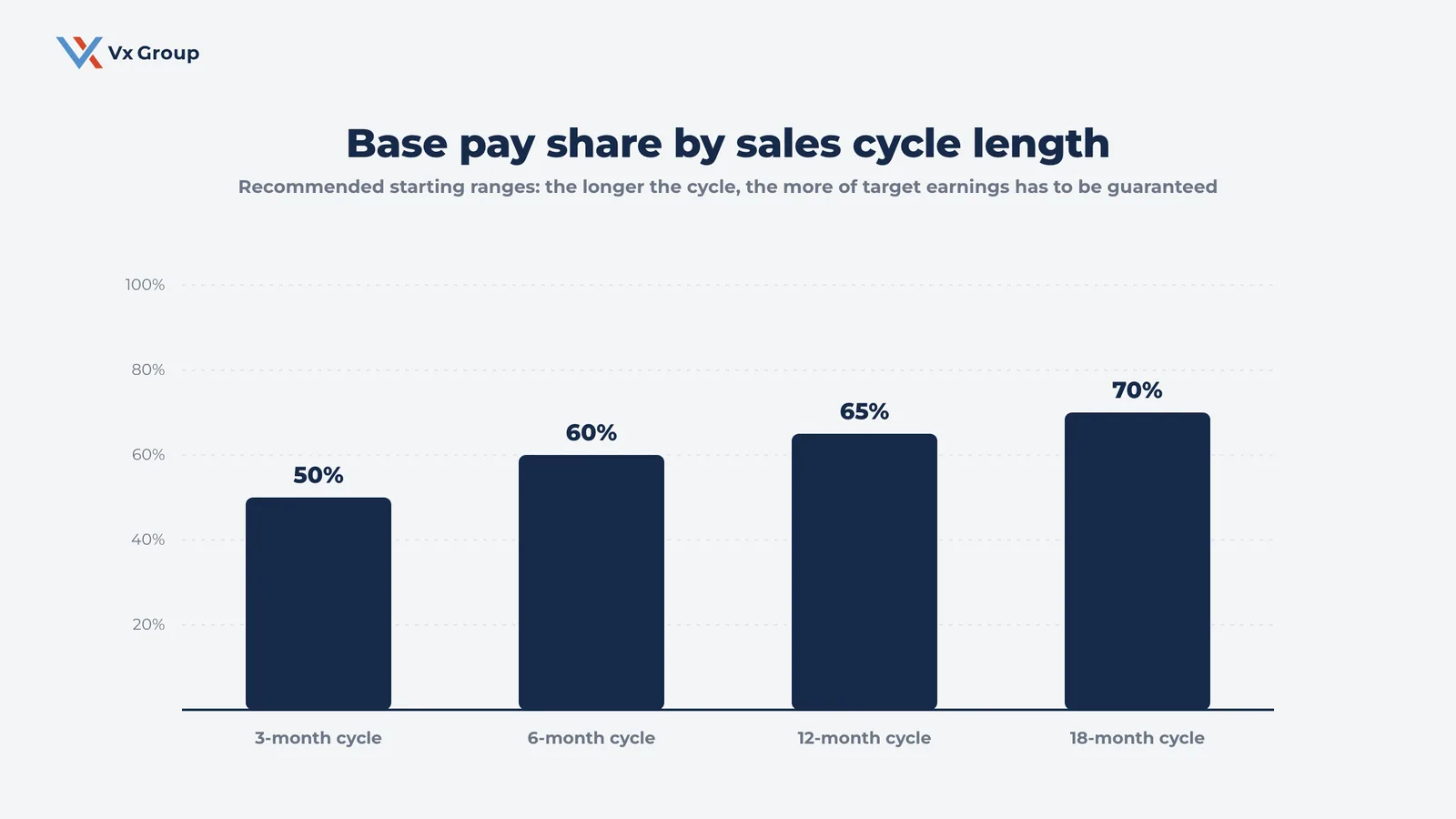
The longer the sales cycle, the more of target earnings has to be guaranteed. For a twelve-month cycle, start at roughly 65% base and 35% variable, and adjust for how much of the rep’s book is existing business.
Use cycle length as the primary input
A three-month cycle supports something close to a 50/50 split, because a rep can influence their own earnings inside a single quarter. At twelve months, a 50/50 split asks a salesperson to accept a year of income uncertainty over events largely outside their control in any given month. The predictable result is that you cannot hire experienced people, and the ones you do hire leave in year two, long before the ramp described in sales onboarding has had a chance to pay back.
Guaranteed pay in a long-cycle business is doing something specific: it funds the pursuit work. A rep cannot pay a mortgage with a pipeline, so the guaranteed portion carries them through the eighteen months during which the relationship gets built.
Adjust for the mix of existing and new business
A rep whose book is 80% existing accounts is doing different work from a rep opening new territory. Territory reps carrying mostly existing accounts can sit closer to 70% or 75% base with a variable component tied to retention and expansion. Reps opening genuinely new markets need a higher base still for the first two years, because their pipeline cannot mature faster than the market allows.
Set target earnings against the local market, then work backward
Decide what a good salesperson in your market and geography should earn at target, then split it. Setting the base first and adding variable on top tends to produce total target earnings that are uncompetitive, which shows up as an inability to hire. The role definitions that sit underneath this are covered in sales cycle stages.
Step 3: Design milestone payments so the year gets paid as it happens
Pay for observable progress during the cycle as well as at close. Milestone payments convert a twelve-month wait into a series of smaller earned events, which is what makes long-cycle pursuit financially survivable for a salesperson.
Choose milestones a third party could verify
Every milestone needs an observable trigger that a rep cannot self-declare. Workable examples:
- Qualified opportunity created. Named decision maker, confirmed budget authority, a stated timeline, and a documented technical requirement.
- Specification or trial secured. Your product named in a spec, or a paid trial, pilot, or sample order placed.
- Formal quote issued against a live project. A real project with a real timeline, evidenced in writing.
- Deal closed. The traditional commission event.
Pay a modest amount at the first three and the majority at close. Milestone payments recover through the eventual deal, and a portion of them functions as a cost you accept on opportunities that never land. Cap the number of milestone payments an individual can earn per quarter so the design cannot be gamed by opening thin opportunities.
Work through the numbers on a real example
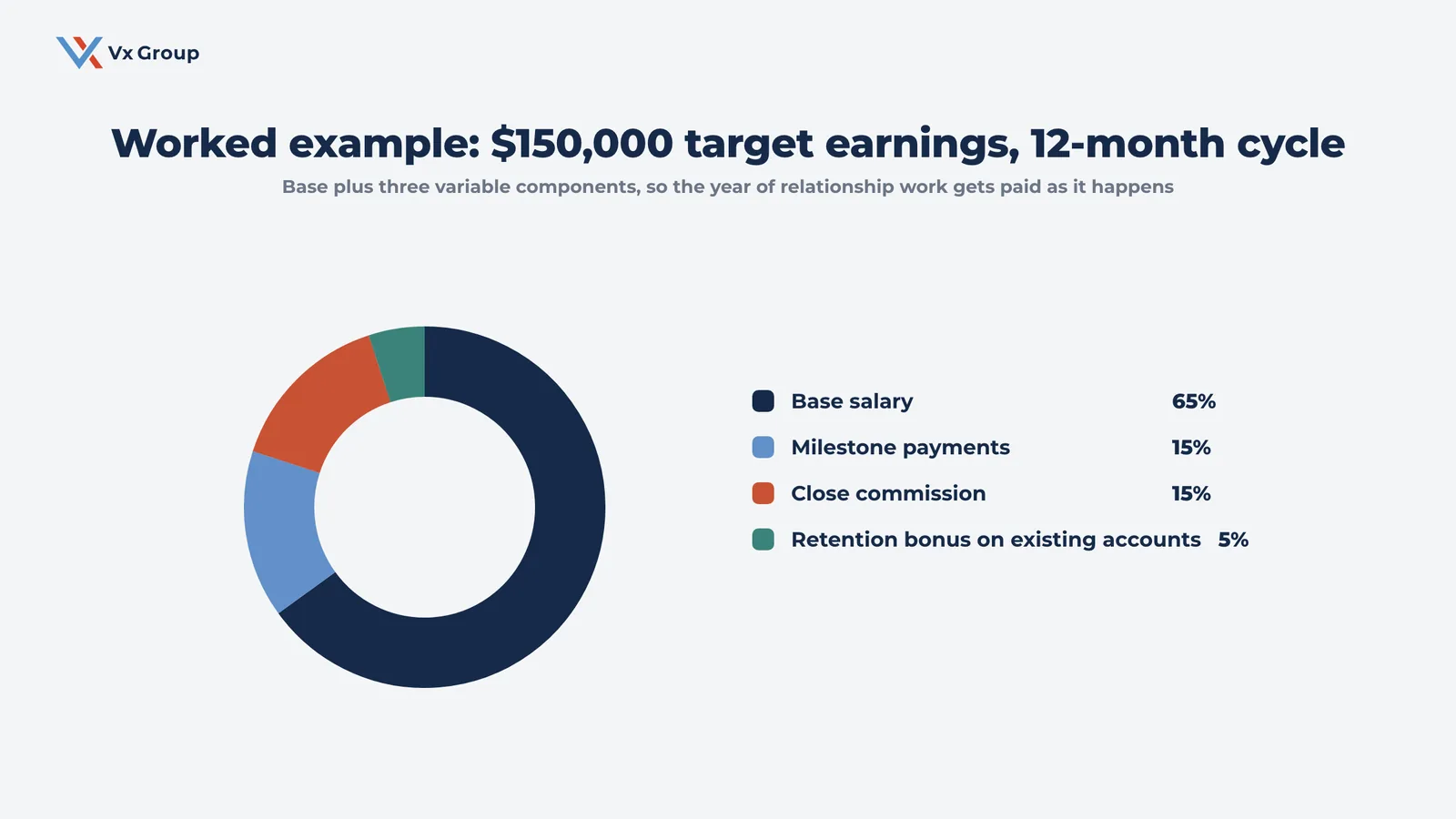
A worked plan for a manufacturer’s territory rep with a twelve-month cycle and $150,000 target earnings:
| Component | Amount at target | Trigger |
|---|---|---|
| Base salary | $97,500 | Paid semi-monthly |
| Milestone payments | $22,500 | $1,500 per qualified opportunity, $2,500 per specification or trial secured, capped at 3 of each per quarter |
| Close commission | $22,500 | 1.5% of booked value on new business, paid on invoice, with a margin floor below which the rate halves |
| Existing-account retention and growth | $7,500 | Paid at year end if the top fifteen accounts hold or exceed prior-year volume and each has a current relationship plan |
| Total target earnings | $150,000 | 65% guaranteed, 35% variable |
Three design choices in that table are worth naming. The margin floor removes the incentive to buy business with price. The milestone caps prevent opportunity inflation. The retention component makes protecting the existing book a paid activity rather than a favor.
Decide what happens when a deal dies after milestones are paid
Write the rule in advance. The workable approach in most long-cycle businesses is that milestone payments are earned and kept, since the work was genuinely done and the intelligence gathered has value. Clawbacks on milestone payments reintroduce exactly the uncertainty the milestones were designed to remove, and they generate more resentment than they recover in dollars.
Ready to grow?
We help manufacturers and distributors design comp plans that pay for the relationship work a long cycle requires.
Step 4: Decide how existing-account revenue is paid
Pay something on existing-account revenue, and make the trigger performance-based. This is the choice that determines whether anyone in the organization protects the base of the business, and companies get it wrong in both directions.
Understand both failure modes before you choose
Paying full commission on all repeat revenue creates an annuity. A rep with a mature book earns well by answering the phone, and the incentive to open anything new disappears. Paying nothing on existing revenue leaves your largest relationships unowned, which in a business where the top ten accounts carry most of the margin is the more expensive mistake. The reasoning behind that valuation is in top 10 customers as strategy.
Use a three-part structure
| Revenue type | How to pay it | Why |
|---|---|---|
| New account, first order | Full commission rate | The hardest work in the business |
| Growth within an existing account | Full or near-full rate on the incremental amount | Expansion is real selling and usually the cheapest revenue available |
| Flat repeat revenue | A retention component paid on holding the book, with a documented relationship plan required | Protects the base without creating an annuity |
Defining the incremental amount takes care. Use a trailing twelve-month baseline per account, recalculated annually, and write down how you will treat a price increase, since a rep should not earn expansion commission on a change they had no part in. The mechanics of growing inside existing accounts are covered in account expansion.
Set the relationship-plan requirement as a real gate
Tie the retention component to something documented: a current relationship plan for each major account, naming who decides, who influences, what is at risk, and what is planned for the year. It makes the payment contingent on work that has independent value, and it means the company owns the account knowledge.
Step 5: Handle team and channel-assisted deals
Write the credit rules for deals involving multiple people before the first conflict arrives. A plan that punishes a rep for bringing in help guarantees that help arrives too late.
Define split credit with a default
State the default: when two reps contribute materially to a deal, credit splits evenly unless both agree otherwise in writing before the close. A stated default resolves most of these situations without a manager arbitrating.
Pay full credit when engineering or leadership joins
Technical support and executive involvement should carry no cost to the rep’s commission. Any structure that makes a rep pay for help produces deals where nobody asks for it, which is the most expensive form of savings available.
Write the channel rules explicitly
When a deal comes through a distributor or partner in a territory a direct rep also covers, decide in advance how it is credited. Common workable approaches: the direct rep receives partial credit for partner-sourced business in their territory, full credit when they were materially involved, and a separate partner-development component for the reps whose job is growing the channel. Leaving this undefined is the origin of most channel conflict, as covered in channel sales strategy and distributor management.
Handle house accounts and inherited books openly
If certain accounts are house accounts, say so at hire, in writing, with the reasoning. Reps discovering after twelve months that their three largest accounts are excluded from commission is a trust event no amount of retroactive adjustment repairs.
Step 6: Set the review cycle and the change protocol
Publish the plan for a defined period, review it annually on a stated date, and write down the circumstances under which it can change mid-period. The protocol matters more than the specific terms, because the fear driving most comp-plan resentment is arbitrary change.
Commit to the plan for a full period
Set the plan for the year and hold it, including when a rep earns more than anyone expected. A plan capped or amended the month someone starts winning teaches the whole team that outperformance gets punished, and that lesson lasts for years.
Write the mid-year change conditions
Legitimate triggers are narrow and worth naming in advance: a territory change, a product line added or discontinued, an acquisition, or a clear error in the plan’s arithmetic. Write who approves a change, how much notice reps receive, and how in-flight deals are treated when terms shift.
Run the annual review from data
Bring three things to the annual review: actual earnings against target by rep, which behaviors the plan produced, and where reps found unintended paths to earnings. Ask each rep how they would earn the most under next year’s draft. Then decide, communicate the change with reasoning, and give at least thirty days notice before it takes effect.
Have counsel and payroll review the final plan
Compensation plans carry real legal and payroll exposure: commission timing and earned-wage rules vary by state, treatment at termination needs to be explicit, and draw arrangements can create recoverable-debt questions. Have employment counsel and your payroll provider review the final document before it goes to the team. This article is a design guide and is not legal advice.
Field Notes:
A specialty manufacturer with an eleven-month average cycle had a 50/50 plan and a monthly commission run. They had turned over four territory reps in three years, and the two who stayed had gradually converted their territories into reorder routes, because reorders paid this month and the eighteen-month projects paid maybe never. We moved them to 65/35, added $1,500 per qualified opportunity and $2,500 per secured specification, and put a year-end retention component on the top fifteen accounts. The first two quarters looked flat. By the fourth quarter, the two long-tenured reps had eleven active projects between them at the specification stage, which was more than the previous three years combined. One of them said the milestone payments were the first time the company had ever paid him for the part of the job that was actually hard.
Common sales compensation plan mistakes
- Borrowing a short-cycle structure. A plan designed for a ninety-day cycle applied to a twelve-month one pays nothing during the period when all the work happens.
- Setting the numbers before naming the behaviors. The spreadsheet then optimizes for whatever the formula happens to reward.
- No margin floor. Revenue-only commission makes discounting free for the rep and expensive for the company.
- Paying nothing on existing accounts. Your most valuable relationships end up as nobody’s paid responsibility.
- Paying full commission on all repeat revenue. Creates an annuity and ends new-business activity.
- Changing the plan when someone wins big. The most damaging thing a leadership team can do to sales trust, and it is remembered for years.
- Leaving splits and channel credit undefined. Guarantees conflict, and teaches reps to avoid asking for help.
- Hiding house-account exclusions until after hire. A trust event that no correction repairs.
- Skipping legal and payroll review. Commission timing and termination treatment are regulated, and the exposure is real.
- Never reviewing it. A plan written for a business that no longer exists keeps producing behavior that no longer fits.
Where to start
Take your current plan and answer one question in writing: if I were a rep on this plan, what would I do to make the most money next quarter? Write the honest answer. For most long-cycle businesses, the honest answer is “chase small reorders and ignore anything that closes after December,” and seeing it on paper settles the argument about whether the plan needs work.
Then price one milestone. Pick the single most important observable step in your sales process, decide what it is worth to have a rep produce one more of those per quarter, and add it to the plan as a payment. One element, one number. It is the smallest change that alters behavior, and the effect shows up in the pipeline within two quarters.
Pay for the work the cycle actually requires
A compensation plan is the clearest statement a company makes about what it values. In a business where deals take a year, a plan that pays only at close says the twelve months of relationship work carry no value, and the team hears that message accurately and adjusts.
Start with the honest answer to how a rep would maximize earnings under your current plan. Then price one milestone. Those two steps have moved more pipeline in the businesses we work with than any wholesale plan redesign, and they can be done before the next quarter starts.
Ready to grow?
We design compensation structures for long-cycle B2B sales teams, including the channel rules most plans leave undefined.
Subscribe to Insights → New articles on relationship-driven B2B growth, roughly weekly.
FAQs
About the Author: David Tisdale
