

How to Build B2B a Sales Playbook Your Team Can’t Live Without
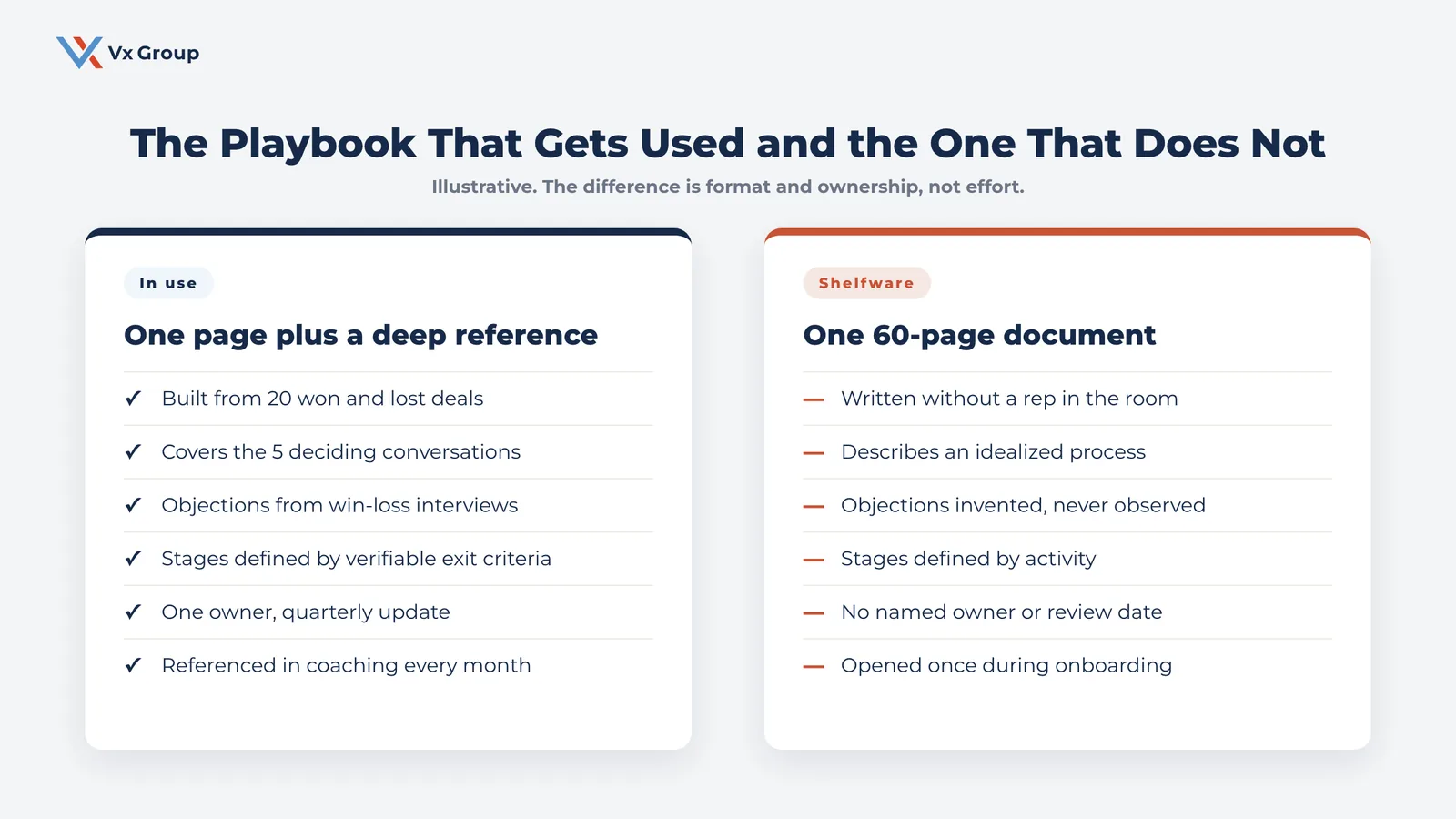
A sales playbook that gets used is two artifacts: a one-page quick reference a rep opens weekly, and a deeper reference behind it holding the discovery questions, objection responses, and stage criteria. Build it from the five conversations that actually decide your deals.
TL;DR
- Start from the five conversations that decide your deals. A process diagram is where playbooks go wrong.
- Write the disqualification criteria, and give the team explicit permission to walk away.
- Source your objection responses from real win-loss interviews. Invented objections produce invented answers.
- Define stages by exit criteria a manager can verify, so “qualified” means the same thing to everyone.
- Ship two artifacts: a one-page quick reference and a deeper reference. The one-pager is the part anyone will actually use.
Why do most sales playbooks end up as shelfware?
Because they document an idealized process, when what a rep needs is help with the conversation they are about to walk into. The typical playbook arrives as sixty pages from a consulting project, describing stages in language nobody on the team uses, complete with a funnel diagram and a set of best practices. It gets opened during onboarding, admired briefly, and never referenced again. The company concludes that playbooks do not work for their business.
What failed was the format. A rep about to walk into a plant tour does not need a process overview; they need the four questions that reveal whether this application is a fit, and the one thing to say when the maintenance manager mentions the competitor they have used for fifteen years. That is a page. It fits in a truck.
There is a second failure worth naming: playbooks written by people who do not sell. When the document is produced by marketing or an outside firm without a rep in the room, the language is wrong in a way experienced salespeople detect immediately, and once they decide the document does not understand their world they stop opening it permanently.
This guide builds the version that survives. Seven steps, each producing a section you can hand to a rep on Monday.
Defined Term: Sales playbook.
The written reference that holds a company’s repeatable sales knowledge: who to sell to, who to walk away from, what to ask, how to answer the objections that actually arrive, and what has to be true to move a deal forward. It exists as a short quick-reference plus a deeper document behind it.
Step 1: Which conversations should the playbook actually cover?
Build it around the five conversations that decide your deals, identified from your own closed-won and closed-lost history. Every section that follows hangs off those five, and anything that does not serve one of them stays out.
Identify your five deciding conversations
Pull twenty recent deals, ten won and ten lost, and map where each was actually decided. In most relationship-driven B2B businesses the list comes out close to this:
- The first substantive call. Where the rep either earns a second conversation or becomes a quote request.
- The technical or application review. Where fit is established or lost, frequently with someone the rep did not expect to matter.
- The internal champion conversation. Where the buyer decides whether to advocate for you inside their own company.
- The pricing conversation. Where a strong position holds and a weak one discounts.
- The final objection. The thing that surfaces at the end, usually risk-related, usually the same three or four every time.
Your five may differ, and they should. Derive them from your own deals, and the list will look like your business.
Write down what "good" looks like in each one
For each of the five, get your two best reps in a room and answer three questions: what does a good version of this conversation accomplish, what does the rep need to know going in, and what is the single most common way it goes wrong. Record the session. Their answers, in their words, are the raw material for everything downstream.
Cut everything that does not serve the five
This is the discipline that keeps the playbook short. Company history, a product catalog, the org chart, and a market overview are all things a rep can look up elsewhere. If a section does not help someone handle one of the five conversations better, it belongs in a different document.
Step 2: How do you write the ICP section so reps use it?
Write it as a qualification tool with explicit disqualification criteria, and give the team permission to walk away. An ICP section that only describes the ideal customer tells a rep nothing about the marginal opportunity in front of them, which is the only case where they actually need guidance.
State the profile in checkable terms
Vague profiles produce vague qualification. Compare:
| Vague | Checkable |
|---|---|
| Mid-market manufacturers | 50 to 500 employees, $20M to $200M revenue |
| Companies that value quality | Has a documented supplier quality process |
| Growing businesses | Added headcount or capacity in the last 18 months |
| Needs our capability | Runs an application in one of our four core categories |
A rep can verify the right column before the first call. If your profile needs sharpening first, the ideal customer profile template gives you the structure, and what is an ideal customer profile covers why most versions fail.
Write the disqualification list
The section reps actually value. Five to eight signals that this opportunity is worth declining, stated plainly:
- Buying on price alone with no interest in the application discussion
- No access to anyone beyond purchasing after two attempts
- Timeline requires a lead time you cannot meet without disrupting better customers
- Application sits outside your core categories and would require a custom build
- Volume below the threshold where the support cost makes sense
Then add the sentence that makes it real: walking away from one of these is a good decision and will not count against you. Without that line, reps read the list as advisory and pursue everything anyway, because the incentive structure rewards activity. This connects directly to the argument in why more leads is almost never the answer.
Add the three-question qualification test
Reduce the profile to three questions a rep can answer after one conversation. Something like: is the application in our categories, is there a named person beyond purchasing who will engage, and is there a real timeline attached to a real budget. Three yes answers means proceed. Two means proceed with caution and a named next step. One means decline politely and stay in touch.
Step 3: What discovery questions belong in the playbook?
The questions your best reps actually ask, transcribed from real calls, in the language your buyers use. Discovery questions written in a conference room sound like a survey, and buyers answer them like one.
Transcribe the questions from recorded calls
Record three calls from each of your top two reps, with permission. Pull the questions they actually asked. You will find they are shorter and blunter than anything a document would have produced, and that they ask far more follow-ups than they ask prepared questions.
Group what you find into three sets:
- Situation questions. What is running, what is it running on, how old, what changes are coming.
- Problem questions. What breaks, how often, what it costs when it does, who feels it.
- Consequence questions. What happens if this continues for another year, and who inside the company cares about that.
The third set is where a transactional conversation becomes a consultative one, and it is the set most reps skip. The full method is in consultative selling, and the contrast with the alternative is covered in transactional selling.
Include the follow-up prompts
The prepared question opens the door and the follow-up does the work. Three that belong in every playbook:
- “Can you give me an example of when that happened?”
- “What did that cost you, roughly?”
- “Who else feels that when it happens?”
That last one maps the buying committee without asking who the decision-makers are, which is a question that reliably produces a defensive answer.
Write the question you should never ask
Every business has one or two questions that damage credibility with an experienced buyer. In manufacturing it is often a generic budget question in the first call, or asking what keeps them up at night. Name them in the playbook and say why. Reps appreciate being told what to avoid at least as much as what to say.
Step 4: How do you build the objection section?
Source it from win-loss interviews so the objections are the ones buyers actually raise and the responses are ones that have actually worked. An objection section written from imagination trains your team to answer questions nobody is asking.
Collect the real objections first
Interview a dozen recent buyers, won and lost, and ask what nearly stopped them from choosing you. The list that comes back is usually shorter than expected and different from what the sales team reports. Common finding: the sales team believes it loses on price, and buyers describe a delivery-risk concern that was never resolved.
Where you have no win-loss data yet, start with a smaller version: ask your reps to log the actual objection on the next twenty deals, in the buyer’s words, before anyone writes a response.
Write each objection in the buyer's words
Structure each entry with four parts, and keep the whole thing to a short paragraph:
| Part | What goes here |
|---|---|
| The objection | Quoted word for word as a buyer actually says it |
| What it usually means | The underlying concern, which is frequently different |
| The response that has worked | A real answer from a rep who handled it, with the specifics |
| The proof | The reference, the data point, or the offer that settles it |
The third and fourth parts are what separate this from a script library. A rep can adapt a real answer. Nobody can deliver a written one convincingly.
Ready to grow?
We build playbooks with your reps in the room, from your own won and lost deals.
Handle the price objection honestly
Price deserves its own treatment because it is the objection most often misdiagnosed. Split it into three cases in the playbook: the buyer who cannot afford it (disqualify), the buyer using price as a negotiating tool (hold, and know your floor), and the buyer who has not seen enough value to justify the difference (return to discovery, because this is a diagnosis failure earlier in the process). Reps who can tell these apart stop discounting reflexively.
Step 5: How should the playbook define your sales stages?
Define each stage by exit criteria a manager can verify without taking the rep’s word for it. A stage defined by an activity (“had a meeting”) tells you nothing. A stage defined by what is now true about the buyer tells you whether the deal is real.
Write exit criteria a manager can check
| Stage | What must be TRUE to exit into the next stage |
|---|---|
| Qualified | Application confirmed in a core category, named contact beyond purchasing, timeline stated by the buyer |
| Discovery complete | Written problem statement in the buyer’s words, cost of the problem quantified, second contact engaged |
| Proposed | Specific configuration and price with the buyer, walked through live in a meeting |
| Validated | Buyer has confirmed budget and named the approval path, technical objection resolved |
| Committed | Verbal award or purchase order in process |
Every criterion is checkable by someone other than the rep. That is the whole test. If you need to expand this, sales cycle stages works through the logic in more depth, and sales pipeline management covers the review rhythm that enforces it.
Attach the expected duration to each stage
Give each stage a typical duration from your own history. A deal sitting in Discovery for three times the normal span is a signal available to any manager scanning the pipeline, and it converts stage definitions from bookkeeping into an early-warning system.
Name what happens when a deal stalls
Write the rule: a deal exceeding twice its expected stage duration gets reviewed, and the outcome is one of three things. Re-engage with a specific new approach, move it to a nurture status with a defined re-contact date, or close it out honestly. Pipelines stay credible only when the third option is genuinely available.
Step 6: What goes on the one-page quick reference?
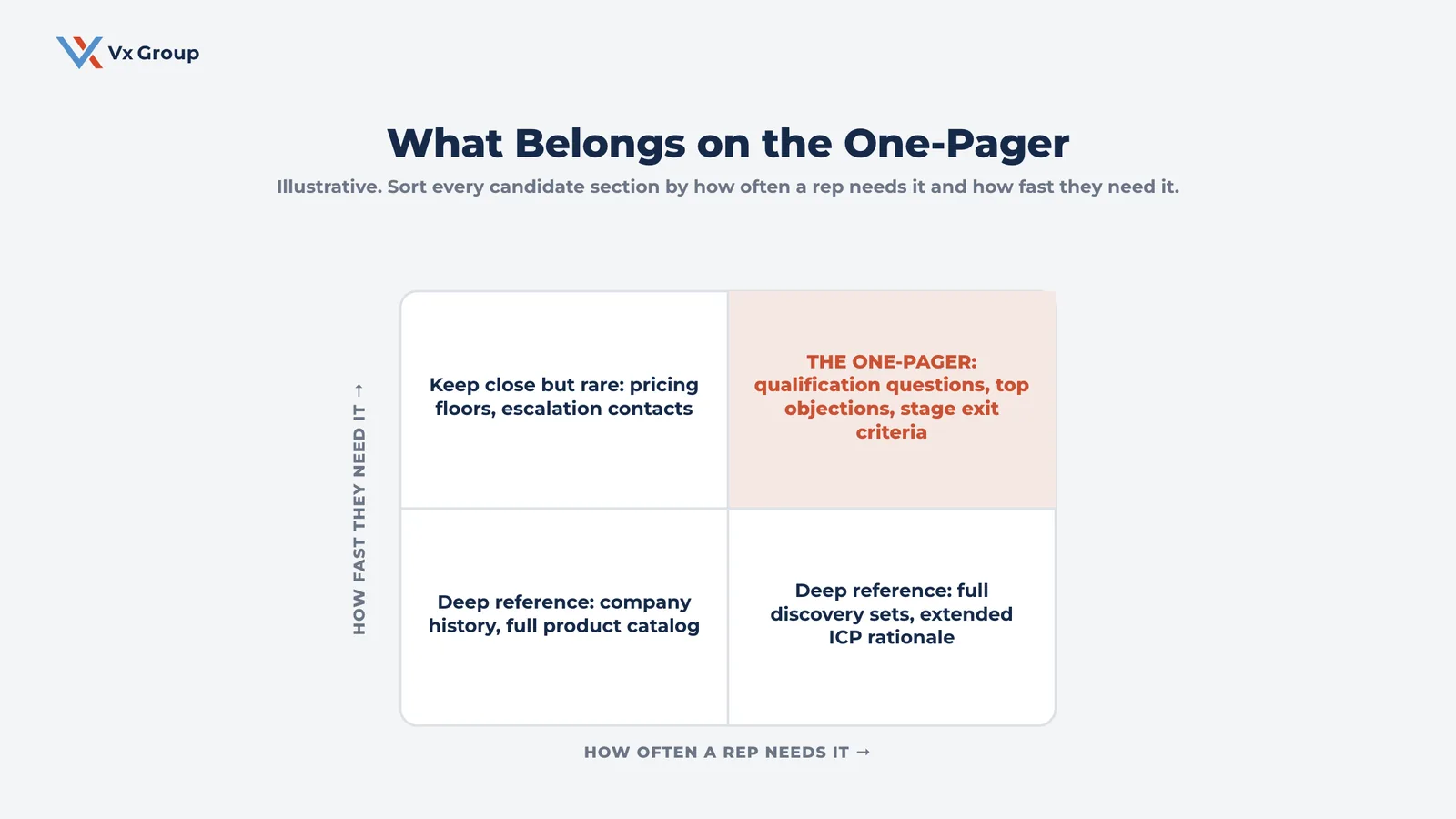
The five deciding conversations, the three qualification questions, the disqualification list, the top four objections with their responses, and the stage exit criteria. Everything else stays in the deeper document.
Build the two-artifact structure
This is the design decision that determines whether any of it gets used.
The quick reference. One page, front and back at most. Printed, laminated if your reps work in plants, and also a phone-readable file. It is a memory aid for someone about to walk into a conversation.
The deep reference. Ten to twenty pages, searchable, holding the full discovery question sets, all the objection entries, the extended ICP rationale, and the stage definitions with examples. It is a lookup document for preparation and for onboarding.
A single document tries to serve both jobs and serves neither, which is the structural reason sixty-page playbooks fail.
Design the quick reference for the moment of use
Lay it out in the order a conversation happens. Qualification at the top, discovery questions in the middle, objections at the bottom where a rep can find them fast under pressure. Use the reps’ own language. If a section needs a paragraph to explain, it belongs in the deep reference.
Test it with the newest person on the team
Hand the one-pager to your most recent hire before a real call and ask them afterward what they looked at, what they could not find, and what they needed that was missing. Two rounds of that produces a better document than any amount of internal review, and it doubles as a check on your onboarding.
Step 7: Who owns the playbook and how often does it change?
Name one owner and set a quarterly review, because a playbook without a maintenance rhythm is out of date within two quarters and abandoned within four. This is the step almost every company skips.
Assign a single named owner
One person, usually the sales leader. Their job is to hold the quarterly review, decide what changes, and keep the version current. Shared ownership means no ownership, and the document quietly rots.
Run the quarterly update in one hour
Four questions with the team:
- What objection came up this quarter that is not in the playbook?
- Which discovery question stopped working, and what replaced it?
- Did any stage criteria prove wrong in a real deal?
- What did we learn from the deals we lost?
Change what needs changing, note the date on the quick reference, and reissue. An hour a quarter keeps the whole thing alive.
Fold it into onboarding and coaching
The playbook is the backbone of ramping a new rep, and it earns its keep fastest there. Whoever builds the onboarding plan should be working from this document, and the monthly coaching conversation should reference it directly. A playbook that appears only in week one becomes historical; one that shows up in coaching stays current in practice as well as on paper. The same discipline that keeps customer relationships owned by the company, described in how to build an infinite team, applies to sales knowledge.
What does a working playbook change?
Three things, measurable inside two quarters.
New reps ramp faster. A documented set of discovery questions and real objection responses removes months of pattern-learning that would otherwise happen deal by deal.
Forecasts get more honest. Verifiable stage exit criteria mean “qualified” carries the same meaning across the team, which is the precondition for a forecast anyone trusts.
Losses become improvements. With a written objection section and a quarterly review, a lost deal has somewhere to go. Without one, the lesson stays with whoever lost it.
None of this requires software. It requires twenty deals reviewed, two reps in a room for an afternoon, a dozen buyer interviews, and one person who owns the document afterward.
Common sales playbook mistakes
- Writing it without a rep in the room. The language will be wrong and the team will know within a page.
- One long document. The quick reference and the deep reference do different jobs and need different formats.
- Inventing the objections. Use win-loss interviews, or at minimum log twenty real ones before writing responses.
- Defining stages by activity. A stage should describe what is now true about the buyer, as in “buyer confirmed budget and approval path.”
- Leaving out the disqualification criteria. The marginal opportunity is exactly where a rep needs guidance.
- No named owner. Quarterly review or the document is stale by month six.
- Treating it as an onboarding artifact. If it only appears in week one, it will not be current by the time it matters.
Where to start
Take twenty deals, ten won and ten lost, and map where each was actually decided. That afternoon produces your five deciding conversations, and everything else in this guide hangs off them.
Then write the one-page quick reference before the deep document. Working in that order forces the hard editing decisions early, and it means you have something usable in a week instead of a quarter.
Build the version they will open twice
The test of a sales playbook is whether a rep opens it a second time. That depends almost entirely on whether it holds the specific thing they need before a specific conversation, in language they recognize, on a page they can find it on.
Start with twenty deals and the five conversations. Write the one-pager first. Give it an owner and a review date. That sequence produces something a team uses on Monday, which is the only measure that matters.
Ready to grow?
Bring twenty deals and two reps, and we will build the first version with you in a day.
Subscribe to Insights → New articles on relationship-driven B2B growth, roughly weekly.
FAQs
About the Author: David Tisdale
