

Will AI Replace Salespeople? An Honest Answer for B2B Leaders

AI will not replace salespeople in relationship-driven B2B. It is already taking over the mechanical parts of the job: research, follow-up cadences, call summaries, and CRM hygiene. What it cannot do is build trust over a 12-month sales cycle. The role is changing, and the salespeople who lean into that shift will pull away from the ones who do not.
TL;DR
- AI replaces tasks inside the sales job while the job itself stays human.
- The mechanical layer (research, data entry, drafting, scheduling, summarizing) is going to AI fast.
- The trust layer (judgment, hard conversations, relationship capital built over years) stays human.
- In long-cycle, high-value B2B, the relationship is the product. AI cannot own it.
- Leaders should hand the busywork to AI and reinvest that time into fewer, deeper relationships.
Will AI replace salespeople?
No, but it will replace a large share of what salespeople do today. The honest answer for B2B leaders is that the question is framed wrong. Selling is really a stack of very different tasks, and AI is excellent at the bottom of that stack and useless at the top.
The villain here is the idea that selling is a mechanical function, a set of touches you can fully automate if you just buy enough software. That belief is what makes “AI will replace your sales team” sound credible. In transactional, high-velocity sales, there is some truth to it. In relationship-driven B2B, where one account can be worth millions over a decade, it falls apart.
Defined Term: The mechanical layer of selling
the repeatable, low-judgment tasks inside a sales role, such as prospect research, list building, data entry, meeting notes, and follow-up scheduling. This layer is what AI automates well.
What parts of sales will AI actually take over?
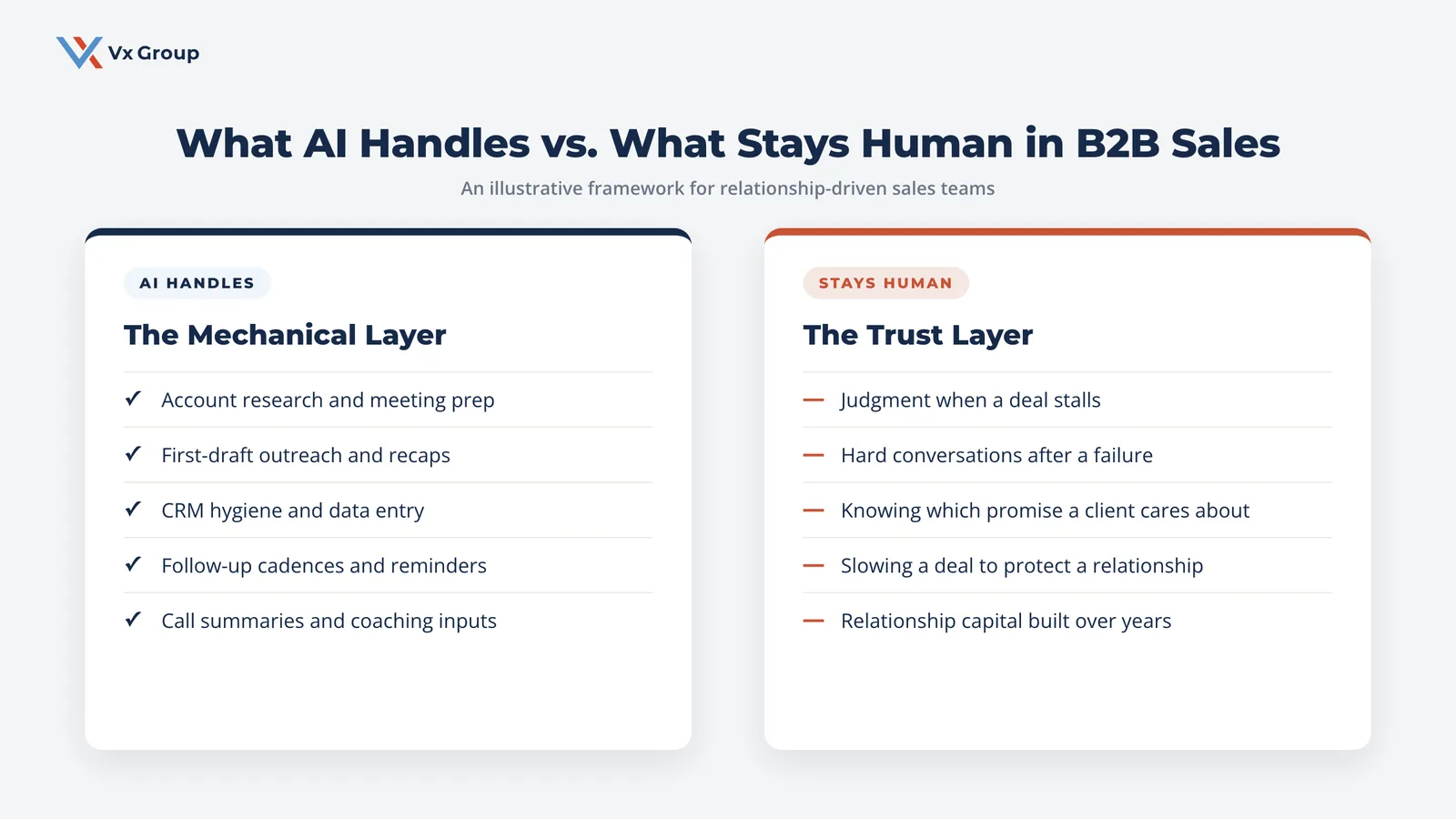
The parts that never needed a human in the first place. AI is already strong at the work that fills a rep’s calendar without building a single relationship:
- Research and account prep. Pulling company background, recent news, org charts, and buying signals before a meeting. A task that used to eat an hour now takes a minute.
- Drafting and personalization at volume. First-draft outreach, follow-up emails, and meeting recaps that a rep edits instead of writing from scratch.
- CRM hygiene. Logging activity, updating fields, and flagging stale opportunities. The administrative tax that reps quietly hate and routinely skip.
- Touch cadences and reminders. Knowing who to follow up with, when, and surfacing the next best action so nothing slips.
- Call summaries and coaching inputs. Transcribing conversations, extracting commitments, and giving managers a faithful record without the rep typing it up.
None of this is the relationship. It is the scaffolding around the relationship. Handing it to AI is the easiest growth decision a sales leader will make this year.
What can AI not do in B2B sales?
It cannot carry trust. Trust is the one thing a relationship-driven business runs on, and it is built through judgment, consistency, and showing up well when something goes wrong. Those are human acts.
A few examples of what stays firmly on the human side:
- Reading the room when a deal stalls and a buyer will not say why.
- Making a judgment call to slow a deal down because pushing would damage a relationship worth far more than this quarter.
- Sitting across from a customer after a delivery failure and rebuilding confidence.
- Knowing, from years of working together, which promise a client actually cares about.
AI can summarize a hard conversation. It cannot have one. The work that compounds trust over time cannot be automated, because the value is in the fact that a person did it.
Defined Term: Relationship capital
the accumulated trust, history, and goodwill between a seller and a buyer that makes future deals faster, larger, and more durable. It is earned over years and cannot be transferred to software.
Why won't AI replace relationship-driven B2B salespeople specifically?
Because the sales motion is fundamentally different from the one the “AI replaces sales” story is built on. The tactics that work for high-velocity, short-cycle, product-led growth do not transfer to companies with 12-month cycles, complex relationships, and customers who stay for 20 years. Borrowing the SaaS playbook here is a mistake, and assuming AI will automate this kind of selling is the same mistake in a new package.
In this world, the relationship is the asset. The lifetime value concentrated in a company’s top relationships often exceeds the entire pipeline of new prospects. You do not protect or grow that by automating the human out of it. You grow it by giving your best people more room to do the part only they can do. Companies that treat their most valuable accounts as a deliberate growth strategy already understand this. AI does not change the math. It sharpens it.
Ready to grow?
AI is reshaping the sales role, not removing it. Build the system that puts AI to work around your people.
How is the sales role changing instead?
The rep is moving from doing the work to directing it. The mechanical layer gets delegated to AI, and the salesperson becomes the person who decides what matters, where to spend human attention, and how to handle the moments that carry real weight.
That makes the role more strategic and more demanding. A rep who used to spend half the week on research and admin can spend that time in front of customers, deepening the relationships that actually move revenue. The job gets harder in the ways that matter and easier in the ways that never did. This is the same shift relationship-first teams already make when they replace scattered prospecting with a deliberate, relationship-led approach.
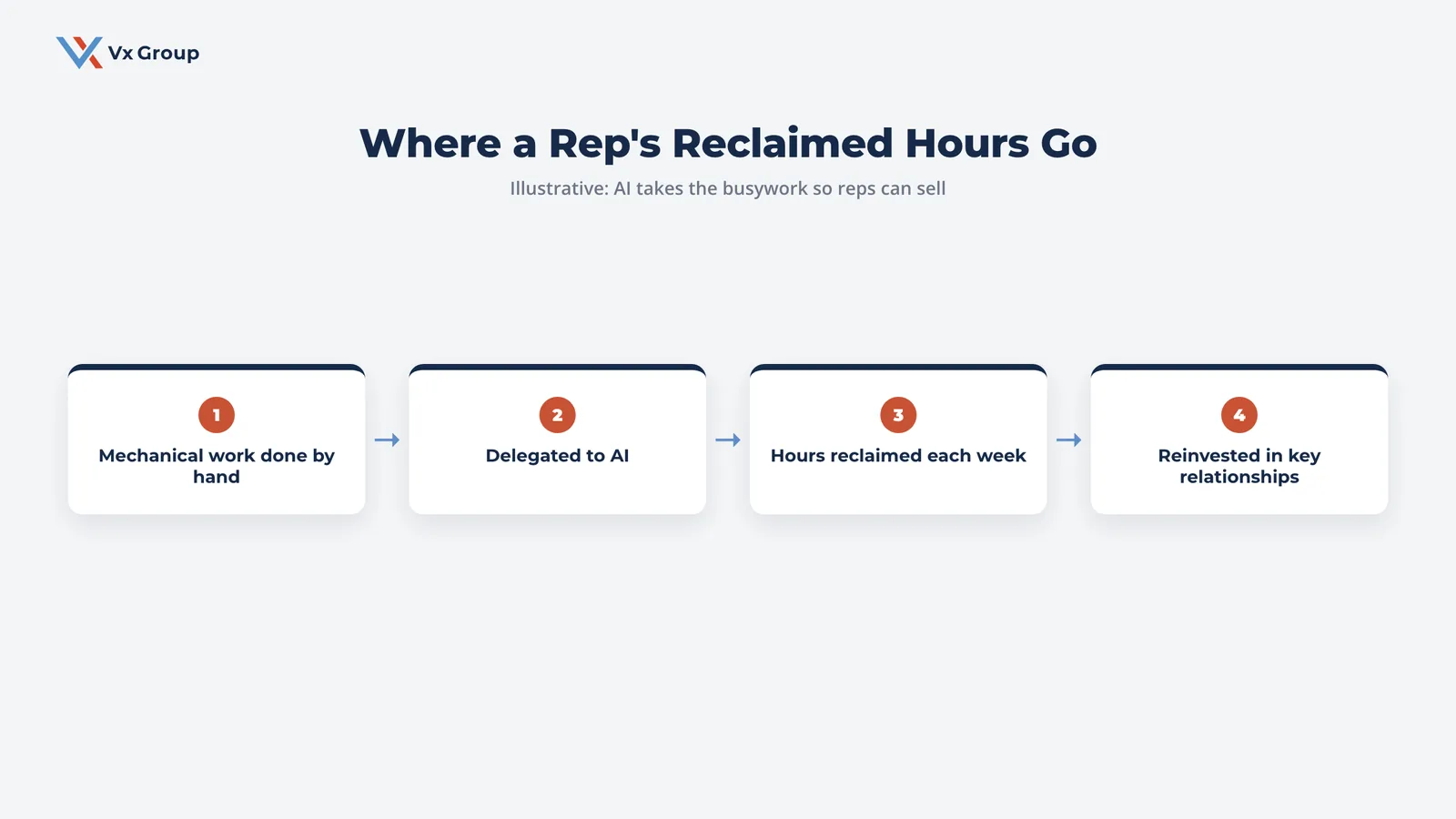
The real risk runs the other way. A rep who keeps doing the mechanical work by hand will fall behind a competitor’s rep who automates all of it and spends the reclaimed hours building relationships.
What should B2B sales leaders do now?
Stop asking whether AI will replace your team and start deciding what you want your team doing instead. Three moves:
- Automate the mechanical layer deliberately. Put AI on research, drafting, CRM hygiene, and follow-up scheduling. Measure the hours it gives back per rep.
- Reinvest that time into fewer, deeper relationships. The reclaimed hours are only valuable if they go toward the work that compounds trust rather than more low-quality outreach. Most companies grow by accident because they never make this choice on purpose, and that accidental growth quietly caps what a business can become.
- Build systems that protect relationship knowledge. When a company’s relationships live entirely in one person’s head, a single resignation can dissolve millions in value overnight. Systems make trustworthy behavior repeatable and protect the relationships that matter most. They support the human side of growth, and they become more important as AI handles more of the rest.
What this means for your sales team
The thing AI is actually coming for is the busywork that has been getting in the way of relationship-driven B2B sales. Leaders who see that clearly will use AI to free their best people for the work that builds trust, protects their most valuable accounts, and compounds over years. That is a better business, and it is built by people, with AI doing the parts that never needed a person.
If you want to work through what this looks like inside your own sales motion, we cover it live with other B2B leaders.
Ready to grow?
Put AI to work around your sales team without losing the relationships that win the deals.
FAQs
About the Author: Jacob Camhi
