

Why Companies Struggle to Connect Strategy and Growth

Companies struggle to connect strategy and growth because the strategy lives in an annual planning document while growth happens in daily decisions on the ground, with nothing linking the two. The plan describes where the business wants to go, the team runs on habit, and neither one reliably changes the other, so growth drifts away from the goal.
TL;DR
- Strategy and growth disconnect when the plan lives in a document and the team runs on instinct, with no system tying daily work to the goal.
- The gap usually shows up as a growth goal with no agreed path, or a plan that every leader in the room describes differently.
- Most stalled companies are working hard against a plan the team was never given a clear way to run.
- You close the gap with a documented growth system: who your best customers are, why they choose you, and who owns developing the next relationships.
- The fastest test: ask anyone on the team what they are working on this week and how it moves the growth goal. The quality of the answers tells you everything.
What does it mean to connect strategy and growth?
Connecting strategy and growth means anyone in the company can trace their daily work up to the growth goal, and trace the goal back down to the specific work that gets it there. Strategy sets the direction. Growth is the daily activity that either moves in that direction or wanders. When the two are connected, the plan and the work reinforce each other. When they are not, the company runs on momentum and hopes it points the right way.
Defined term: The strategy-to-growth gap
The space between a company’s stated plan and its day-to-day growth activity. The wider the gap, the more a company depends on luck, instinct, and a few key people to hit its goals, because nothing systematically connects what the team does each week to where leadership says the business is going.
Most relationship-driven B2B companies have plenty of one and very little of the other. They have a goal, often a confident one, and a team working hard every day. What they lack is the connective tissue between them.
Why does the gap form in the first place?
The gap forms because strategy and growth get built by different people, at different times, in formats that never meet. Leadership sets strategy in a planning session once or twice a year. The sales and operations teams generate growth every day in the field. The planning document and the daily reality rarely sit in the same room again until the next offsite.
In practice, the disconnect shows up in a few recognizable patterns:
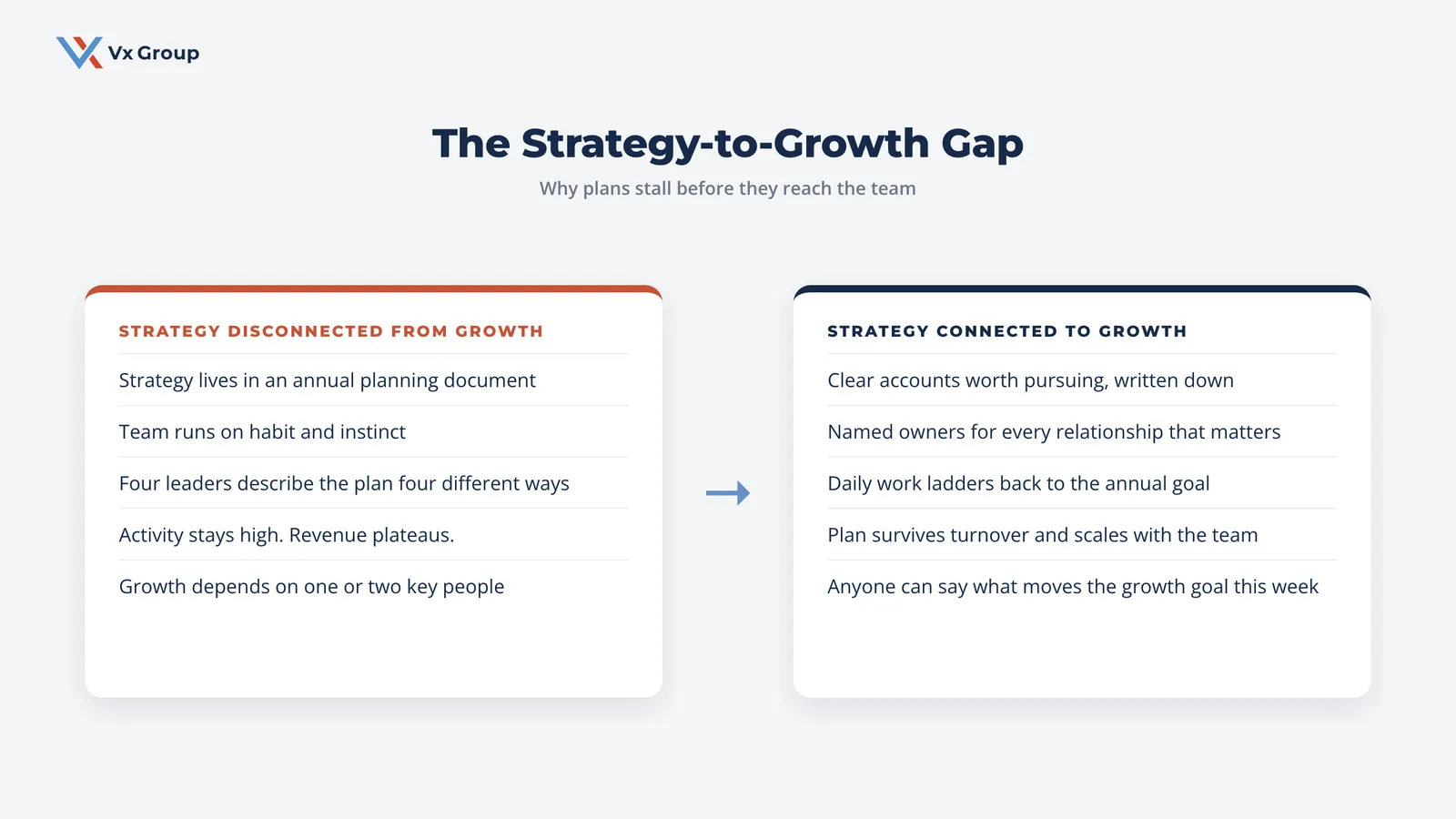
- A growth goal exists, but there is no agreed plan for how to reach it. Everyone nods at the number. No one owns the path.
- A plan exists, but each leader describes it differently. Ask three executives how the company grows and you get three answers.
- Growth is happening incidentally rather than on purpose. Revenue arrives, but no one can say which deliberate actions produced it.
- The whole goal quietly rests on one customer, one channel, or one rainmaker, and nobody has said so out loud.
Every one of these is a clarity problem. The company is working hard against a plan that was never translated into a system the team could actually run.
What does the disconnect cost a company?
The disconnect costs a company the one thing it cannot diagnose: a stall. Activity stays high, the team stays busy, and the revenue number stops moving. Because everyone is working, the instinct is to push for more activity, which deepens the problem.
Defined term: The activity illusion
Treating how busy the team is as evidence that growth is on track. Calls made, emails sent, and meetings booked feel like progress, but they only matter when they move real relationships toward real revenue. A company caught in the activity illusion mistakes motion for momentum.
The deeper cost is that growth stays fragile. When the link between strategy and daily work lives in a few people’s heads, the company cannot scale it, protect it, or hand it to anyone else. The plan is only as durable as the memory of the person carrying it.
Ready to grow?
Close the gap between the strategy on the wall and the growth your team actually executes.
How do you connect strategy to growth?
You connect strategy to growth by turning the plan into a documented system the whole team can run, then tying each person’s work to it. That system answers four questions clearly enough to act on: which customers are worth pursuing, why those customers choose you, how you develop the next tier of relationships, and who owns each part of that work. Once those answers are written down, the strategy stops being a statement of intent and becomes a set of moves the team makes every week.
Start with clarity before activity. Study the accounts you already win and keep, and name the pattern they share. That pattern is the real strategy, and it is usually already there in the customer base, waiting to be written down. From there, assign ownership for developing new relationships and deepening existing ones, and build a plan that respects how long trust actually takes to form in your market.
The honest checkpoint is simple. Look at your growth goal and ask whether your current system supports it, partially supports it, or does not support it at all. Most leadership teams have never asked the question that plainly, and the answer reorders their priorities fast. For the full build, see our guide on how to build a B2B growth strategy from scratch and the case for why so many companies grow by accident.
How do you know if your strategy and growth are actually connected?
You know they are connected when anyone on the team can answer two questions without hesitating: what are you working on this week, and how does it move the growth goal. Run that test across five people. If the answers line up and point to the same goal, the link is real. If they scatter, the strategy never made it out of the planning document.
Field Notes: the plan no one could repeat
A distribution company we worked with had a sharp, well-written growth plan and a leadership team that believed in it. When we asked four leaders how the company planned to hit its number, we got four versions. One described new markets, one described deeper penetration of existing accounts, one described a new product line, and one described hiring. Each answer was reasonable. None of them matched.
The plan itself was sound. It had simply never been translated into a shared system with named owners and a sequence the team could run. Once the company documented which accounts it was pursuing and who owned each relationship, the weekly work and the annual goal finally pointed in the same direction. The team’s effort stayed the same, and the new clarity was what moved the number.
Conclusion
A growth plan that lives in a document and a team that runs on instinct can coexist for years, right up until growth stalls and no one can explain why. The companies that break through are the ones that turn the plan into a system: clear on who they win, why, and who owns the next relationship, with every week of work laddering back to the goal. That is what it means to connect strategy and growth, and what gets a stalled company moving again is clarity about how the plan becomes weekly work. Start with the full B2B growth strategy hub to see how the pieces fit together.
Ready to grow?
Connect strategy to growth with a system your team runs every week, not a plan that stalls after the offsite.
FAQs
About the Author: Eric Zoromski
