

B2B SEO Strategy: How to Rank for the Terms That Actually Convert

A B2B SEO strategy is a plan built backward from a purchase decision: the terms a buying committee searches during an evaluation, the pages that answer each one, and a measurement window long enough to match a twelve-month sales cycle. Volume matters least in that sequence and gets the most attention.
TL;DR
- A keyword export sorted by volume produces traffic from people who will never buy. The twelve terms your buying committee searches during an actual purchase usually sit near the bottom of that same export.
- Score every candidate keyword on three things: volume, winnability, and proximity to a purchase decision. Proximity carries the most weight and is the only one most tools cannot measure for you.
- B2B buying committees run four to seven people. Each role searches differently, and a strategy that only serves the technical evaluator loses the deal at the finance stage.
- A term with 40 searches a month and clear purchase intent is worth more to a manufacturer than one with 8,000 searches and none.
- Answer engines now sit between your content and a meaningful share of buyers. The Princeton GEO study found citing sources lifted visibility by about 40% and adding statistics by about 37%, while keyword stuffing reduced it.
- Measure leading indicators quarterly and revenue annually. SEO judged on a ninety-day window in a business with a twelve-month cycle gets cancelled two quarters before it works.
Most B2B SEO programs are built from a single artifact: a keyword export sorted by monthly search volume. Somebody pulls a list, filters for terms above a threshold, hands the top thirty to a writer, and calls the result a strategy. Twelve months later the site has decent traffic, the sales team has heard nothing useful, and the terms a purchasing committee actually typed during a real evaluation last quarter appear nowhere on the site, because each of them had 90 searches a month and got filtered out on day one.
That volume-sorted export is the villain in this guide. It answers a question about search populations while you are trying to answer a question about eleven specific companies that might buy from you this year.
What is a B2B SEO strategy?
A B2B SEO strategy is a documented plan for earning visibility on the searches that occur inside a business purchase decision. It names the buying committee roles, the questions each role searches at each stage of the cycle, the page that answers each question, the priority order, and how success will be measured over a period long enough for a B2B deal to close.
Defined Term: B2B SEO strategy.
A plan that maps the search behavior of a buying committee across a full purchase cycle to a set of pages, prioritized by commercial impact and measured across the length of the sales cycle. It differs from a keyword list in that every term is attached to a role, a stage, and a page with an owner.
Three components make it a strategy instead of a list. First, every keyword is attached to a person: a plant engineer, a purchasing manager, a quality director, a CFO. Second, every keyword is attached to a stage: early problem awareness, solution comparison, supplier evaluation, or final validation. Third, every keyword has a page assigned and a priority score, so the sequence of work is decided in advance and does not get relitigated every month.
The reason this matters more in B2B than elsewhere is arithmetic. If your addressable market is four thousand companies and your average deal is two hundred thousand dollars, you need a handful of the right visitors per month. A page that brings three hundred unqualified visitors and a page that brings four engineers evaluating a real project are worth wildly different amounts, and only one of them shows up well in a traffic report.
The search plan is one input into a wider B2B go-to-market strategy, and it inherits its target list from there. Building it in isolation is how a company ends up ranking for terms its sales team has no interest in.
How is B2B SEO different from B2C and SaaS SEO?
B2B SEO targets a committee making one large, slow, risk-heavy decision. B2C SEO targets an individual making a fast, low-risk one. SaaS SEO sits in between, with short cycles, self-serve conversion, and free trials that let content prove itself in weeks.
| Dimension | B2C | SaaS | Relationship-driven B2B |
|---|---|---|---|
| Decision maker | One person | One or two, sometimes a small team | Committee of four to seven with veto power spread across roles |
| Cycle length | Minutes to days | Days to weeks | Six to eighteen months, occasionally longer |
| Search volume available | High | Moderate | Low, frequently under 100 per month for the terms that matter |
| Conversion event | Purchase | Trial or signup | An RFQ, a spec inclusion, or a first conversation |
| What content has to do | Persuade one person quickly | Demonstrate product value fast | De-risk a decision for people who will be blamed if it goes wrong |
| Measurement window | Weeks | One to two quarters | Four to eight quarters |
The last row causes the most damage. SaaS SEO advice is abundant, well-written, and built on a feedback loop that closes in six weeks. Applied to a manufacturer with a fourteen-month cycle, the same playbook produces a program that gets judged and cancelled long before the first influenced deal appears in the numbers. The playbook mismatch problem shows up across B2B growth work, and it is the same pattern described in industrial B2B marketing.
One structural advantage comes with the territory. Because B2B terms carry low volume, most competitors ignore them, and difficulty scores stay low for years. A manufacturer willing to write genuinely useful pages on narrow application questions can own a category of search that no large publisher will ever bother to contest.
How do you build a keyword map from the buying committee?
Start with the people, then the stages, then the searches. Write down every role that touches a purchase in your market, then the questions each role asks at each stage of the cycle, then find the search terms that match those questions. The keyword tool comes third.
List every role on the committee and what each one fears
Write the roster for a typical deal. For a manufacturer selling capital equipment, that usually includes a plant or process engineer, a maintenance lead, a quality or compliance manager, a purchasing manager, a plant manager, and a finance approver above a certain dollar threshold. For each one, write what they are personally exposed to if the decision goes badly: unplanned downtime, a failed audit, a budget overrun, a supplier who cannot support the install.
That exposure determines what they search. A quality manager evaluating equipment for a regulated process searches for validation requirements, documentation standards, and whether a given approach will pass an audit. Write those in their words. The profile work in what is an ideal customer profile and ideal customer profile template gives you the roster to start from.
Interview five customers about how they actually searched
Ask five recent customers what they actually typed during the evaluation, what they read, who else was in the room, and what finally made them comfortable. Fifteen minutes each, and the language they use goes straight onto your list.
This is the single highest-yield hour in keyword research for a B2B company, and almost nobody does it. Buyers describe their problem in operational language that no keyword tool suggests as a related term, because the volume is too low for the tool to surface it. The method for running these conversations systematically is in how to run B2B market research without a six-figure budget.
Map each question to a stage in the cycle
Sort the questions into four stages: problem recognition, approach comparison, supplier evaluation, and final validation. Then check the balance. Most B2B sites carry heavy coverage at the problem-recognition end, thin coverage of approach comparison, and nothing at all at supplier evaluation and validation, which are the two stages closest to a signature. The stage definitions in sales cycle stages line up with this map.
Add the common phrases your sales team hears on calls
Ask the two people who take the most inbound calls what prospects say in the first ninety seconds. Alternatively, use call recordings and transcripts as your main source of indisputable customer data.
Those phrases are search queries with the awkward phrasing intact, and they convert better than anything a tool will hand you. Keep them verbatim, including the ones that seem too specific to be worth a page. Specific is the point.
Run the tools last, to size and validate
Now open your keyword tool (SEMrush and Ahrefs are the two industry-standard keyword research platforms). Use it to check volume, difficulty, and to find variants you missed, and to catch the occasional high-volume term worth pursuing. The tool’s job at this stage is validation and sizing.
Ready to grow?
We build search strategies for companies with long cycles and small addressable markets, where volume-first keyword plans fail.
How do you rank keywords by deal impact?
Score every candidate on three dimensions: search volume, winnability, and proximity to a purchase decision. Sum the three, and work the list in descending order. Proximity is weighted highest because it is the only dimension tied directly to revenue.
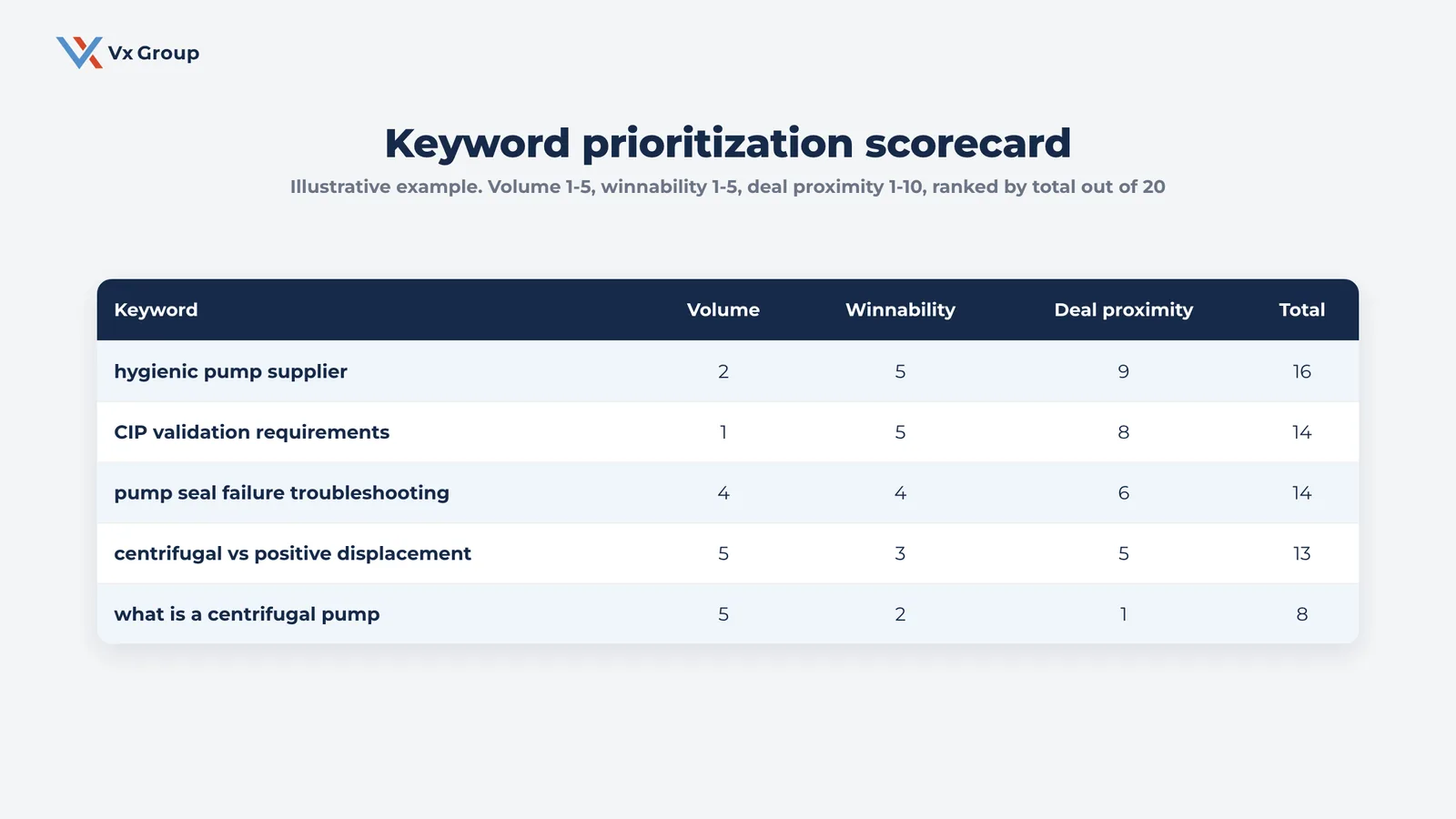
Score volume from 1 to 5, and cap its influence
Assign 1 to 5 based on monthly volume relative to your market. For most industrial categories: under 50 searches is a 1, 50 to 150 is a 2, 150 to 500 is a 3, 500 to 2,000 is a 4, and above 2,000 is a 5. Note the ceiling. Volume can contribute at most 5 points out of 20, which is deliberate, because a volume-led list is the thing this model exists to correct.
Score winnability from 1 to 5 using difficulty and your own authority
Winnability combines keyword difficulty with an honest read of your domain. A term at difficulty 15 where the top results are thin distributor pages scores a 5. A term at difficulty 45 where the first page is dominated by large publishers scores a 1. If your site has little authority, weight this dimension hard, because a technically perfect page that lands on the fourth page earns nothing.
Score deal proximity from 1 to 10
This is the judgment call, and it is where a person with sales knowledge beats any tool. Ask: if someone searched this term today, how close are they to a purchase decision?
- 9 to 10. Supplier-selection language: “supplier,” “manufacturer,” “quote,” “lead time,” a specific part or spec number.
- 7 to 8. Active evaluation of an approach for a live project, including validation and compliance questions.
- 5 to 6. Comparison of approaches with no supplier named yet.
- 3 to 4. Problem research with no project attached.
- 1 to 2. Definitional or educational curiosity, including students and job seekers.
Ask a salesperson to score this column. They will do it faster and better than a marketer, and the conversation itself usually surfaces three terms nobody had on the list.
Sum, sequence, and assign an owner
Total the three scores out of 20 and sort. Then work top down, with one page per term, an owner, and a date. Terms scoring 14 and above generally justify a page of real depth. Terms in the 10 to 13 range are worth a page when they fit an existing cluster. Below 10, leave them alone until the higher scores are covered.
The first pass through this exercise typically reorders a list dramatically. Terms that were ranked twenty-eighth by volume move into the top five, and the piece everyone was excited about because it had 6,000 monthly searches drops to the middle, since a purchase is nowhere near the person typing it.
How should you structure pillar and spoke clusters?
Build one pillar page for the broad term and a set of spoke pages that each answer one specific question, with every spoke linking to the pillar and the pillar linking to every spoke. The structure earns rankings for the narrow terms while accumulating authority on the broad one.
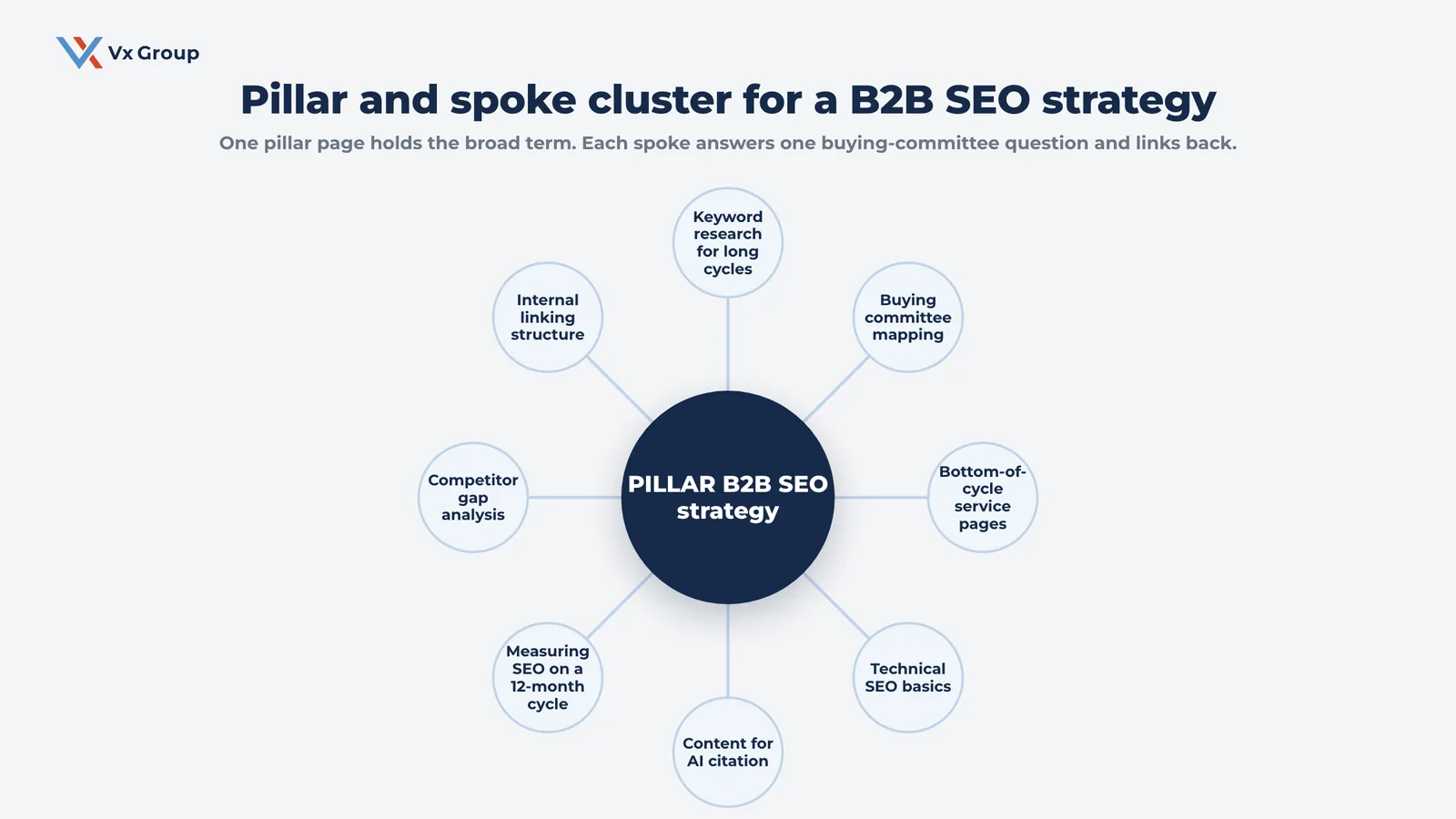
Write the pillar to be genuinely complete
The pillar covers the whole topic at a level that answers the broad question without requiring another page. Four thousand words is a reasonable floor for a serious pillar. It carries the definition, the comparisons, the process, the tables, and the questions, and it links out to spokes wherever a reader might want more depth.
Give every spoke exactly one job
Each spoke answers one question completely. A spoke that tries to cover three questions ranks for none of them, because the page never becomes the best available answer to any single query. One question, one page, answered in the first three sentences and then supported for the next fifteen hundred words.
Link with the term, in the direction of the money
Internal links carry two jobs: helping search engines understand which page owns which topic, and moving a reader toward a page that can produce an inquiry. Link with descriptive anchor text that includes the target term, from every spoke up to the pillar, between related spokes where a reader would genuinely want the connection, and from both into the service or capability page that handles the resulting inquiry.
That last link is the one companies forget. A cluster with no route into a commercial page produces readership and no inquiries, which is the most common way a technically sound content program fails to show up in revenue. The broader content architecture question is worked through in industrial content marketing.
Build one cluster completely before starting the next
Six half-built clusters lose to one finished cluster every time. Pick the cluster closest to a purchase decision, build the pillar and all its spokes, get the internal links in place, then move on. A finished cluster starts compounding as soon as the last spoke is linked.
What do you do about low-volume, high-intent terms?
Write the page anyway. In relationship-driven B2B, a term with 40 searches a month and unmistakable purchase intent is frequently the highest-value page on the site, and it will stay uncontested for years because everyone else filtered it out.
Run the arithmetic on a real example. A term gets 40 searches a month. You rank second and earn roughly a quarter of those clicks, so ten visitors a month, 120 a year. If one in twenty of those becomes a qualified inquiry, that is six inquiries. At a 25% win rate and a $200,000 average order, the page is associated with roughly $300,000 in orders. That page cost a day of writing.
Now the high-volume comparison. A term gets 8,000 searches a month, half of it students, job seekers, and researchers. You rank fifth, earn 400 visitors a month, and produce a good-looking traffic chart. The number of qualified inquiries is frequently zero, because nobody typing that term is buying anything.
Defined Term: Deal proximity.
How close a searcher is to an actual purchase decision when they type a query, scored 1 to 10. Supplier and spec language scores highest, definitional curiosity lowest. It is the dimension most keyword tools cannot measure and the one most correlated with revenue.
Three categories of low-volume term deserve immediate attention:
- Supplier and sourcing language. “[Product] supplier,” “[product] manufacturer,” “[spec] compliant supplier,” plus regional variants. Tiny volume, extraordinary intent.
- Specification and standard numbers. The exact standard, alloy, tolerance, or code your buyers must satisfy. Whoever explains it clearly gets the engineer’s trust before any sales conversation starts.
- Failure and troubleshooting queries. “[Component] failure causes,” “why does [problem] happen.” Someone with a live problem, an existing supplier who has let them down, and budget already approved.
How do you write content that AI answer engines will cite?
Structure each page so a passage can be lifted and stand alone, then give the engine reasons to trust it: cited sources, real numbers, named expertise, and clean heading structure. Answer engines now sit between your content and a meaningful share of buyers, and being cited there is a distinct outcome from ranking.
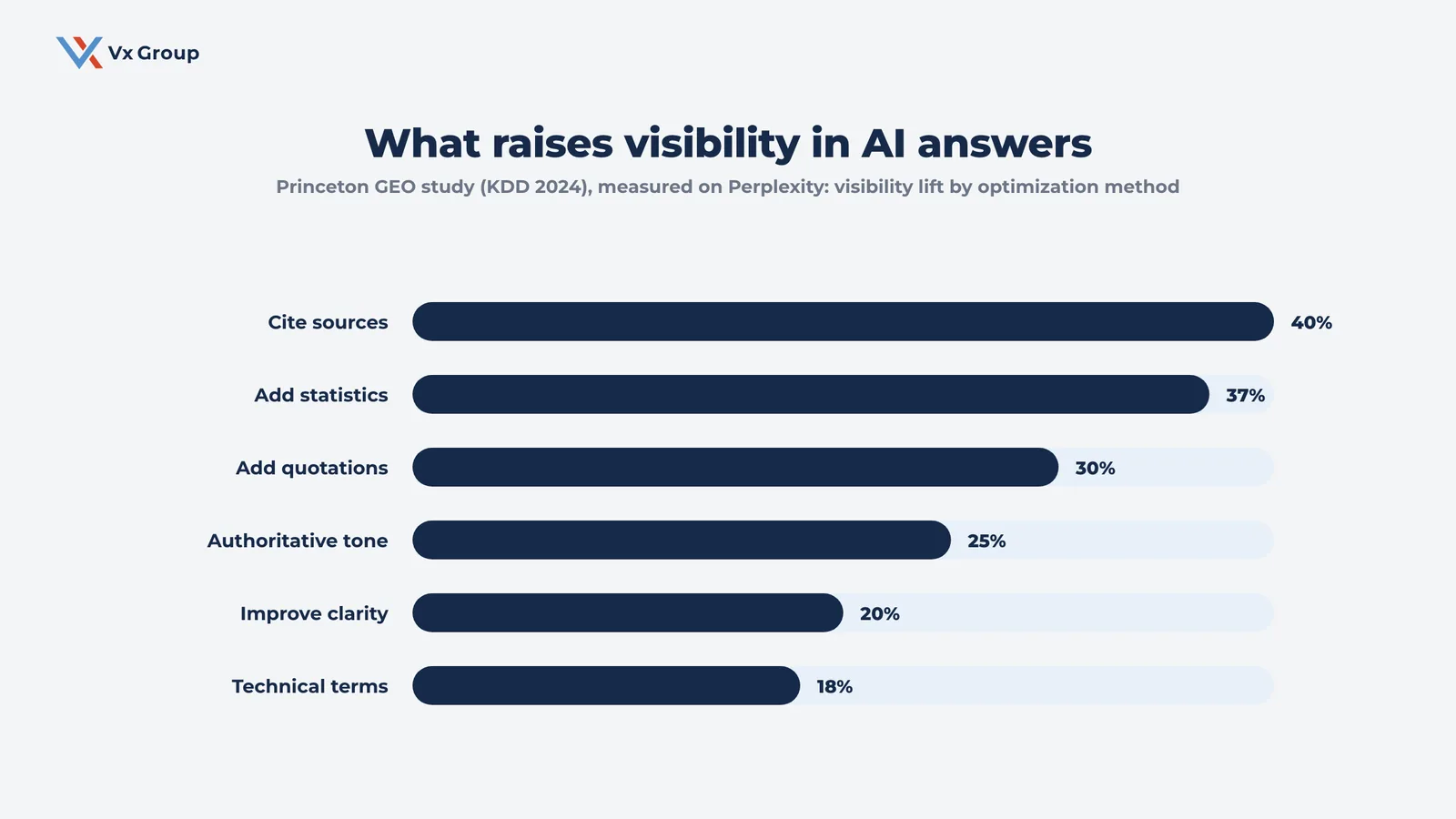
The Princeton GEO study (KDD 2024), measured on Perplexity, ranked nine methods by their effect on visibility in AI answers. Citing sources produced roughly a 40% lift, adding statistics about 37%, adding quotations about 30%, and an authoritative tone about 25%. Keyword stuffing moved visibility down by about 10%, which makes it one of the few tactics that now actively works against you.
Alongside that, analysis by AirOps of pages that large language models actually cite found consistent structural patterns: a single H1 with clean sequential heading order, far more list sections than ordinary search results carry, and lists or tables present in roughly 80% of ChatGPT citations. Information gain matters too. Pages that restate what an engine already knows get skipped in favor of pages that add something.
Phrase every heading as the question a buyer would ask
Write each H2 as the natural-language question someone would type or speak, then answer it in the first sentence underneath. “Pipeline stages” becomes “What are the stages of a B2B sales pipeline?” This is what makes an individual section extractable, and it is the highest-leverage structural change available on an existing page.
Put a self-contained answer in the first 40 to 60 words
Under every question heading, the first one to three sentences must answer it completely without depending on the paragraph before. That block is what gets quoted. Everything after it is support for the reader who keeps going.
Turn every series into a list or a table
Criteria, steps, comparisons, and categories all belong in structured form. Prose describing five options is far harder to extract than a table with five rows. Aim for several distinct list or table sections per page.
Add the numbers, the sources, and the named author
Cite where a figure came from. Use real numbers with dates. Attribute claims to named people with titles. Put a real author with relevant expertise on the page, and show when it was last updated. Each of those independently correlates with citation, and it is the point where a search program and thought leadership as a B2B growth strategy start reinforcing each other.
Ship an FAQ block in structured data
Take the five to eight questions buyers actually ask and publish them as FAQ structured data alongside a visible FAQ section. It is the most reliably extractable block on any page, and it maps directly onto the question-answering behavior of every answer engine.
Update the page on a schedule
Freshness is a live ranking and citation signal. Put the highest-value twenty pages on a review cycle, refresh the numbers, and show the update date. A page that has not been touched in three years loses to an equivalent page updated last month.
How do you measure B2B SEO across a twelve-month cycle?
Track leading indicators quarterly and revenue annually, and never judge the program on a window shorter than one sales cycle. The measurement design is what determines whether a working program survives long enough to work.
| Timeframe | What to measure | What it tells you |
|---|---|---|
| Month 1 to 3 | Pages shipped against plan, indexation, first impressions on target terms | Whether the program is actually executing |
| Month 3 to 6 | Rankings on target terms, impressions growth on high-proximity keywords, AI citation appearances | Whether the keyword selection was right |
| Month 6 to 12 | Qualified inquiries attributed to organic entry, quote requests, sales conversations referencing a page | Whether the content reaches buyers |
| Month 12 to 24 | Closed revenue where an organic page appeared anywhere in the path, cost per acquired customer | Whether the program pays |
| Ongoing | Sales-reported usage: pages the team sends to prospects | Whether the content helps close deals, which no analytics tool reports |
Two measures in that table get overlooked and deserve equal billing with rankings. First, ask your sales team which pages they send to prospects during a live deal. A page used in eleven active deals is doing more for revenue than a page with better traffic, and this information only exists in conversation. Second, track whether prospects reference your content unprompted on first calls. In long-cycle businesses that is the earliest honest signal that content is reaching a committee, and it usually appears months before attribution data does.
On attribution itself: accept that it will be imperfect. A fourteen-month purchase involving five people on four devices, with a phone call in the middle, will never attribute cleanly. Use first-touch and last-touch as boundaries, take the sales team’s account of what happened seriously, and make the annual judgment on the pattern rather than a single model’s output.
Field Notes:
A specialty equipment manufacturer came to us with 14,000 monthly organic visits and no inbound quotes worth having. Their top-performing page by traffic was a definitional article that ranked well and attracted mostly students. We rescored their keyword list with a salesperson in the room, and the terms that rose to the top were things like the compliance standard their buyers had to satisfy and three failure-mode queries tied to competitor equipment. They wrote seven pages against those terms over five months. Total traffic went down that year. Quote requests from organic search went from two per quarter to nine, and the compliance page ended up quoted in a purchasing committee’s internal memo, which a prospect forwarded to them by accident.
Common B2B SEO mistakes
- Building the plan from a volume-sorted export. The original sin, and the source of most of the others.
- No page for supplier-selection language. The highest-intent terms in the entire market go uncovered because their volume looks unimpressive.
- Writing for one committee role. Technical depth for the engineer and nothing that helps the finance approver or the quality manager say yes.
- Borrowing a SaaS playbook wholesale. Different cycle, different committee, different measurement window, same advice applied anyway.
- Half-built clusters. Six topics started, none finished, no internal linking, no authority accumulating anywhere.
- No route from content into a commercial page. Readers arrive, learn something, and leave with nowhere to go.
- Judging the program at ninety days. Guarantees cancellation in a business where the first influenced deal closes in month eleven.
- Ignoring answer engines. A meaningful share of buyer research now happens in an interface that cites sources, and unstructured pages do not get cited.
- Never updating anything. Freshness is a ranking and citation signal, and stale pages lose to maintained ones.
- No owner. A strategy without a named person and a date is a document, and documents do not rank.
Where to start
Take your current keyword list, open a spreadsheet, and add one column: deal proximity, scored 1 to 10. Do it with a salesperson in the room and give it forty-five minutes. That single column will reorder your content plan more than any other change available to you, and it costs nothing.
Then pick the highest-scoring term you have no page for and write that page this month. One page, phrased as the question a buyer asks, with a 40 to 60 word answer at the top, a table or two, the specific numbers, and a link into whichever service page handles the resulting inquiry. One page done properly will teach you more about what your market searches for than another quarter of planning.
Build the strategy around the decision
The companies that win at B2B search are the ones who know which twelve searches happen inside a real purchase decision in their market, and who have the best page in the world for each of them. Publishing volume has very little to do with it. That list of twelve is knowable. It comes from your sales team, five customer conversations, and an honest scoring exercise that takes an afternoon.
Add the deal proximity column, resequence the plan, and write the highest-scoring page you are missing. The traffic chart may look worse for a year. The quote requests are the number to watch.
Ready to grow?
We build and run search programs for relationship-driven B2B companies, from keyword scoring through publication and measurement.
Subscribe to Insights → New articles on relationship-driven B2B growth, roughly weekly.
FAQs
About the Author: Jacob Camhi
