

Business Growth Consultant: What They Do and How to Choose One

A business growth consultant helps a stalled B2B company find out why growth flattened and then builds a repeatable system to fix it. The strong ones leave the leadership team with a growth engine they own and can run. The weak ones hand over a slide deck and an invoice, then leave a dependency behind.
TL;DR
- A business growth consultant diagnoses why growth stalled, then installs a system the company can run on its own.
- Bring one in when growth has gone flat, revenue concentrates in a few accounts, or sales lives entirely in the founder’s head.
- A strong engagement produces a documented playbook, a defined ideal customer profile, and a team trained to run both.
- The biggest danger is the consultant who delivers a strategy deck and disappears, leaving you with theory and no capability.
- Choose for capability transfer, relevant industry experience, and a clear plan to make themselves unnecessary.
- Cold-cycle searchers: start by understanding the role before you ever take a sales call.
Most B2B companies that hire a growth consultant are not short on effort. They are short on clarity. They have a sales team working hard, a marketing budget being spent, and a founder pulling deals across the line by force of relationship. And the number at the bottom of the page has not moved in three years.
The villain in this story is the consultant who shows up, runs a few workshops, hands over a beautiful strategy deck, and leaves. Six months later the deck is in a shared drive nobody opens, the team is doing exactly what it did before, and the company is out a large fee with nothing it can actually operate. That outcome is common enough that it deserves a name and a plan to avoid it. This guide gives you both.
What does a (good) business growth consultant do?
A business growth consultant diagnoses why a company’s growth has stalled and then builds the system that gets it moving again. The work spans six areas: diagnosing the growth engine, clarifying which customers are worth pursuing, prioritizing markets, building the sales and relationship process, documenting the playbook, and handing all of it to the team to run.
The label gets used loosely, so it helps to be precise. A growth consultant is not a marketing agency that runs your ads. They are not a fractional VP who occupies a seat on your org chart. A real growth consultant works at the level of the system: how the company finds, wins, keeps, and expands its best relationships, and how to make that repeatable without depending on any single person.
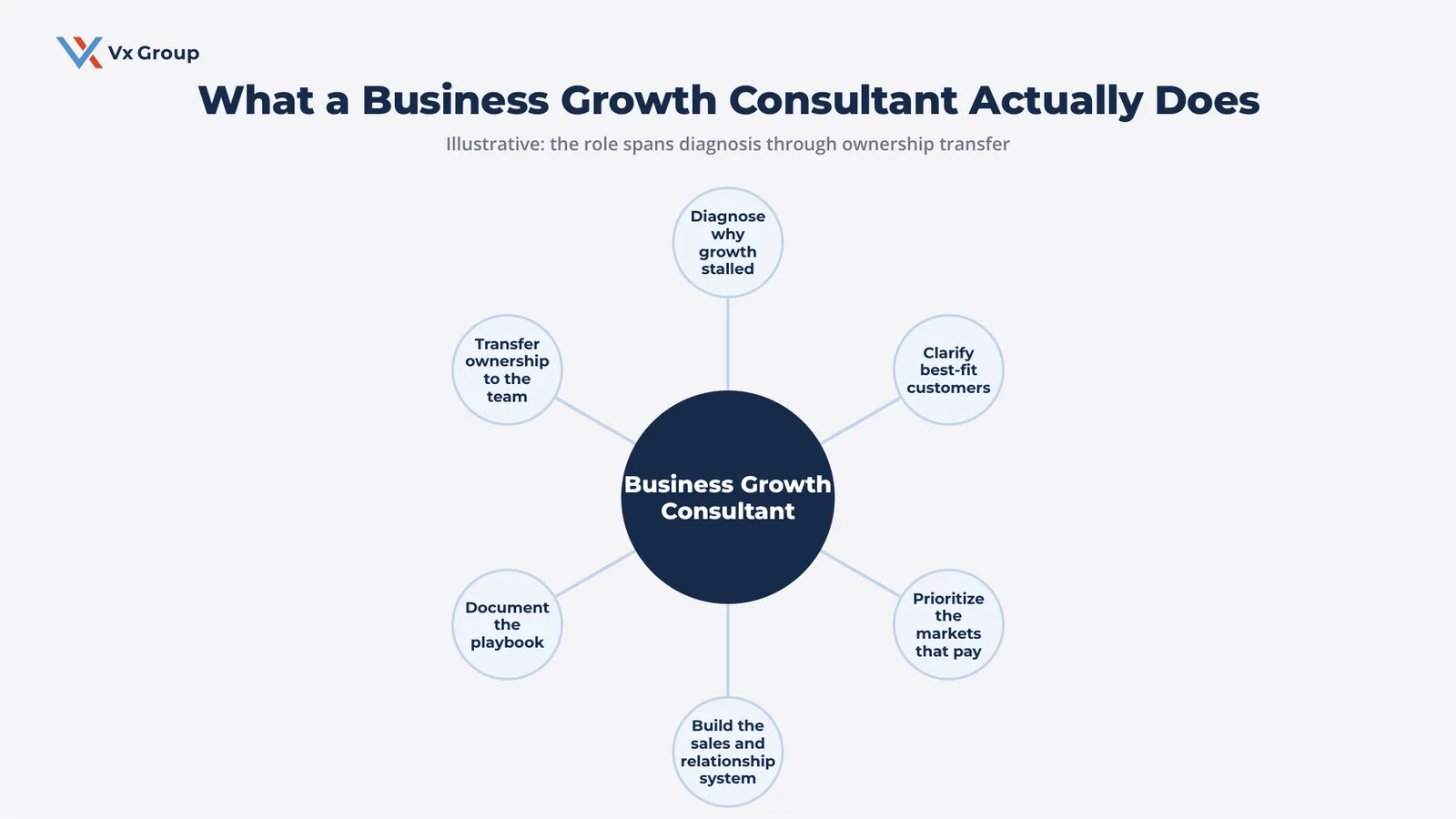
Defined term: Growth engine. The connected set of activities that turns a stranger into a long-term, high-value customer. For relationship-driven B2B companies it includes how you identify best-fit accounts, how trust is built over a long sales cycle, how knowledge moves between people, and how existing relationships expand. A growth consultant’s first job is to see your engine clearly before changing anything in it.
They diagnose before they prescribe
The first thing a strong consultant does is refuse to prescribe. They study the business before recommending a single tactic. That means looking at which customers actually generate profit, why those customers chose you, how revenue moves through the company, and where deals slow down or stall.
This matters because most stalled-growth problems are misdiagnosed from the inside. A founder feels the symptom, slow new-customer acquisition, and assumes the fix is more leads or a new website. The actual cause is often upstream: no clear definition of who the company sells to best, or a sales process that lives entirely in the founder’s memory. Treating the symptom wastes money. Diagnosing the cause is where the value starts. For the fuller picture of how this plays out, see Why Most B2B Companies Grow By Accident.
They install a system the team can run without them
The defining feature of a good growth consultant is that they work to become unnecessary. Their goal is to leave behind a system the leadership team owns and operates, so growth no longer depends on the consultant being in the room or the founder being on the call.
This is the line that separates an advisor from a crutch. The deliverable is capability, transferred into the company and documented so it survives a vacation, a hire, or a resignation.
How is a business growth consultant different from an agency or a fractional executive?
A growth consultant builds the strategy and system; an agency executes a channel; a fractional executive runs a function from inside. They solve different problems, and confusing them is a common and expensive mistake.
The clearest way to see the difference is side by side.
| Role | What they own | What they leave behind | Best when |
|---|---|---|---|
| Business growth consultant | The growth diagnosis, strategy, and the system to execute it | A documented, owned playbook plus a trained team | Growth has stalled and you need clarity and a repeatable system |
| Marketing agency | Execution of a channel (ads, SEO, content) | Campaigns and assets they continue to run | You already know your strategy and need a specific channel run well |
| Fractional executive | Day-to-day leadership of a function | Ongoing operations while they hold the seat | You need senior leadership but cannot yet hire it full-time |
| Sales trainer | Skills coaching for individual reps | Better-trained people | Your strategy is sound and the gap is individual rep skill |
A company that hires an agency when the real problem is strategy will get more activity and the same flat results. A company that hires a consultant when it actually needs hands-on execution will get a plan nobody has time to run. Naming what you actually need is the first selection decision, and it comes before you evaluate any individual provider.
Defined term: Capability transfer. The deliberate handover of skills, tools, and decision-making to the client’s team so they can run the system independently. It is the difference between buying a fish and being taught to fish. An engagement without capability transfer creates dependency by design.
What signals tell you it is time to bring one in?
Bring in a business growth consultant when growth has gone flat despite real effort, when too much revenue depends on too few relationships, or when the company’s sales engine cannot run without one or two specific people. These are structural problems, and structural problems rarely fix themselves.
Here are the signals worth watching for. If three or more describe your company, the problem is almost certainly systemic.
- Revenue has been flat or slowly declining for two or more years, even though the team is busy.
- A handful of “generational customers” make up most of your revenue, and you have no plan for what happens when one leaves.
- New-customer acquisition is inconsistent and unpredictable. Good months and bad months feel random.
- Sales depends on the founder or one or two key people. When they are out, deals stall.
- Marketing spend produces activity, leads, downloads, impressions, but you cannot connect it to revenue.
- You are excellent at the work but invisible in your market. Prospects who should know you do not.
- The company has a growth goal but no documented, agreed plan for hitting it.
Defined term: Generational customer
A long-standing account, often built over decades and through personal relationships, that contributes an outsized share of revenue. Generational customers are an asset and a risk at the same time. The risk is concentration: when the relationship lives in one person’s head and the account represents a large share of revenue, a single retirement or acquisition can put the business in jeopardy.
If these signals feel familiar, the underlying issue is usually the absence of a system rather than a lack of hustle. A consultant’s value is in building that system. Before you bring anyone in, it helps to understand what you are buying, which is the next and most important section.
What does a strong engagement actually produce?
A strong engagement produces three things you can hold and use after the consultant leaves: a clear diagnosis of your growth engine, a documented and repeatable playbook for finding and winning best-fit customers, and a team trained to run it. Anything less than all three leaves you exposed.
This is where buyers get hurt, so look closely at what sits above and below the waterline. The visible deliverable, a strategy presentation, is the tip. The value is everything beneath it.
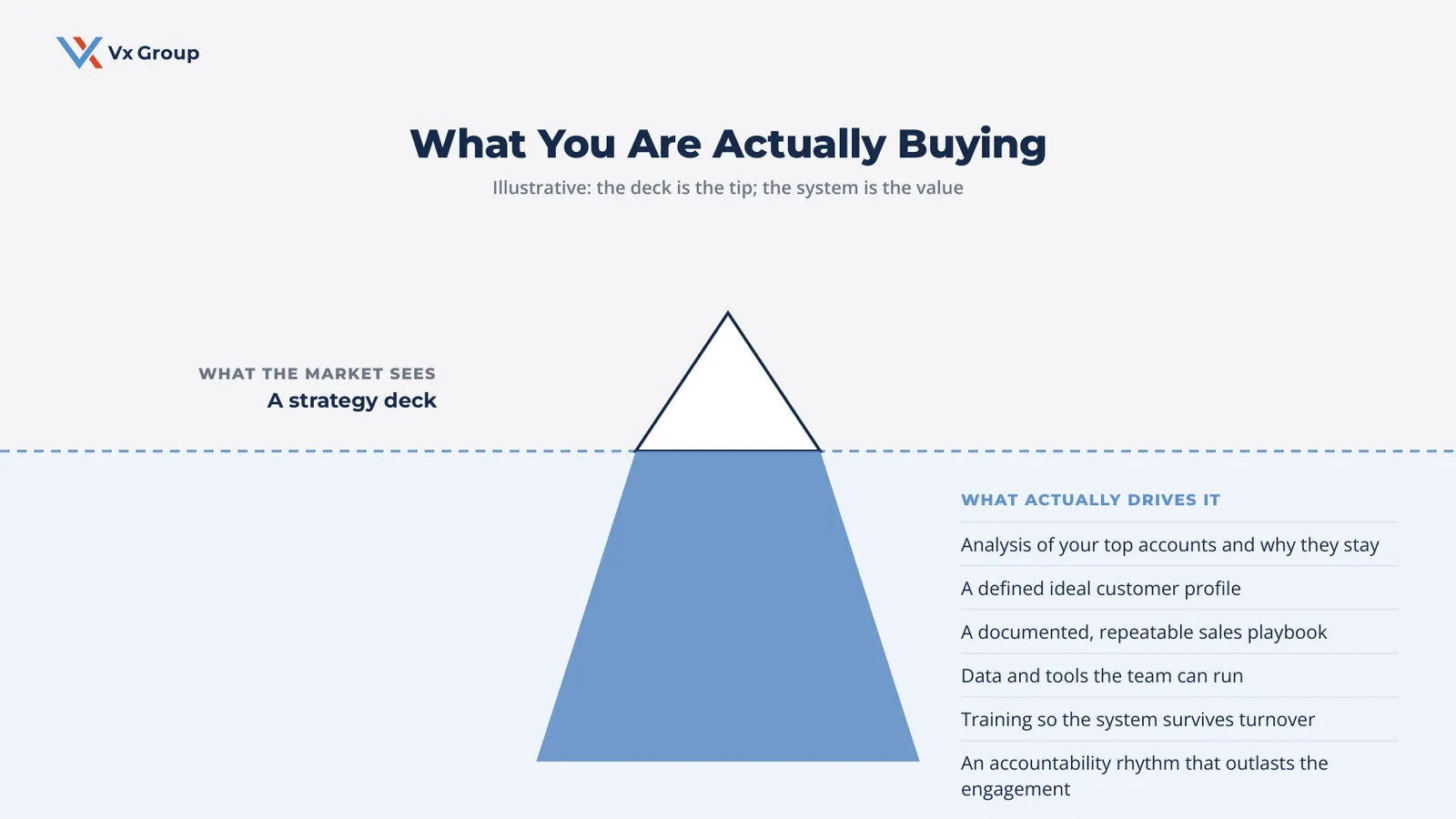
A genuine engagement leaves behind a defined ideal customer profile built from your actual best accounts, a prioritized view of which markets deserve your attention, a documented sales and relationship process your team can follow, the data and tools to run it, and training so the system does not evaporate when someone leaves. The deck is a summary of that work. The work itself is the product.
Field Notes: the deck that cost a year. A mid-market industrial supplier we encountered had paid a well-known firm a six-figure fee for a growth strategy. The deliverable was a 90-slide deck. It was sharp, well-researched, and completely unused. Nobody on the team had been trained to execute it, no process had been documented into the company’s own tools, and the one analyst who understood the model had rolled off the project. A year later the company’s growth was exactly where it started, minus the fee. The strategy itself was sound. The company simply never installed it. That is the difference between advice and capability, and it is the single most expensive mistake in this category.
If you want to go deeper on the strategy layer specifically, How to Build a B2B Growth Strategy From Scratch walks through the components a consultant should be helping you assemble and own.
Ready to grow?
Get an outside operator who installs a growth system, instead of advice that looks good and changes nothing.
What are the dangers of choosing the wrong growth consultant?
The dangers of choosing the wrong growth consultant fall into seven named patterns, and every one of them can leave you worse off than before you hired anyone. Each one is described below with the specific way it puts your company at risk, because forewarned is the only real defense here.
Danger 1: The Deck-and-Disappear
This is the most common and the most expensive. The consultant runs a discovery process, produces a polished strategy document, presents it well, and leaves. You pay for the thinking and never for the building. The deck looks like value because it is dense and confident, but it transfers nothing your team can execute.
Why it puts you in a terrible position: you spend a large fee and a quarter of your leadership’s attention, and you end up exactly where you started, except now you also have to admit the project failed. Worse, the failure often gets blamed internally on the team for “not executing the strategy,” when the real problem is that no one was ever equipped to execute it. You lose money, time, and team morale in one move.
Danger 2: The Dependency Trap
The consultant becomes the system. They run the analysis, hold the relationships, make the decisions, and keep the playbook in their own head or their own tools. Growth improves while they are engaged, which feels great, and then collapses the moment the contract ends.
Why it puts you in a terrible position: you have not bought capability, you have rented it, and the rent never stops. Every renewal is negotiated from weakness because the consultant knows your growth stops without them. A consultant who builds a dependency on purpose has a financial incentive never to make you self-sufficient. Watch for anyone who keeps the keys.
Danger 3: The Borrowed SaaS Playbook
The consultant brings a growth model built for high-velocity software companies and applies it to your legacy, relationship-driven, long-cycle business. Aggressive outbound volume, demand-gen funnels designed for a 14-day sales cycle, and vanity metrics borrowed from a world that looks nothing like yours.
Why it puts you in a terrible position: the tactics actively damage relationships that took decades to build. High-volume, low-quality outreach signals to a careful, long-cycle buyer that you do not understand how they buy. You can burn trust and brand equity chasing a model that was never designed for your market. B2B growth in legacy industries needs a different playbook than SaaS, and a consultant who does not know the difference is dangerous.
Danger 4: They’re Vanity-Metric Heavy
The consultant reports on activity instead of revenue. Leads generated, emails sent, impressions earned, meetings booked. The dashboard is green and the bank account is flat.
Why it puts you in a terrible position: vanity metrics give you the feeling of progress without the substance, which is worse than no metrics at all because it delays the moment you realize nothing is working. Months pass while the report keeps looking healthy. Then a board meeting or a cash-flow review forces the real question, and you discover the activity never converted to relationships worth having. Insist on revenue and relationship-quality measures from day one.
Danger 5: Execution Falls Flat
The consultant does the work for you instead of building your team’s ability to do it. They write the proposals, manage the key accounts, run the outreach. Results appear, but no skill takes root inside the company.
Why it puts you in a terrible position: this is dependency wearing a more flattering outfit. As long as someone outside the company is doing the doing, your team never develops the muscle, and you are one contract renewal away from losing the function entirely. You are also paying consultant rates for work an in-house hire should eventually own. The test is simple: is your team getting better at this, or just getting results delivered to them?
Danger 6: The No-Transfer Engagement
Close cousin of the dependency trap, distinct in its mechanism. Here the consultant may even intend to help, but everything they build lives in their systems, their templates, their accounts. Nothing is documented into tools your company controls.
Why it puts you in a terrible position: when the engagement ends, the work walks out the door. You cannot edit the playbook because you never had it. You cannot retrain a new hire because the knowledge was never captured in a form you own. Months of progress become unrecoverable the day access is revoked. Demand that deliverables live in your systems, in formats your team can edit, from the first week.
Danger 7: The Founder Bypass
The consultant builds the new growth system around the leader rather than with the team, often because it is faster. The founder stays the single point of contact, the rainmaker, the keeper of every key relationship.
Why it puts you in a terrible position: this entrenches the exact vulnerability you hired the consultant to fix. The company remains founder-dependent, which caps growth and destroys enterprise value at exit. A buyer or investor sees a business that cannot run without one person and discounts it accordingly. A consultant who makes the founder more central has made the problem worse while appearing to help.
Defined term: Founder-dependent sales. A sales function where new business depends on the founder’s personal relationships, instinct, and presence. It feels like a strength because it works, until it becomes the ceiling on growth and the largest single risk to the company’s value. The right engagement reduces founder dependency on purpose.
How do you choose a business growth consultant?
Choose a business growth consultant by testing for one thing above all: their plan to make themselves unnecessary. Then verify relevant experience, a diagnosis-first approach, and a deliverable model that puts owned systems and trained people into your company. Use the checklist below before you sign anything.
Questions to ask before you hire
Ask these directly and listen for specifics. Vague answers are themselves an answer.
- “What will my team be able to do at the end of this that they cannot do today?” A strong answer names capabilities. A weak answer describes deliverables.
- “Where will the deliverables live, and who can edit them?” The right answer is “in your systems, and your team.” Anything else is a no-transfer risk.
- “How will we measure success?” Listen for revenue and relationship quality. If you only hear activity metrics, walk.
- “What does your involvement look like in month one versus month six?” A good consultant’s footprint shrinks over time by design.
- “Tell me about a client who no longer needs you. What did you leave them with?” Hesitation here is a serious flag.
- “Have you worked with companies like ours, with long sales cycles and relationship-driven revenue?” Industry fit matters more than brand-name logos.
What to look for
These are the positive signals worth paying for.
- A diagnosis-first process. They study before they prescribe and refuse to recommend tactics on day one.
- Relevant experience in complex, long-cycle, relationship-driven B2B. Experience confined to high-velocity software or consumer growth rarely transfers cleanly to your market.
- A clear capability-transfer plan with documentation, training, and a defined endpoint.
- Comfort talking about how they will lower your dependence on any single person over the life of the engagement.
- References who can say “we still run the system they built, and they are no longer here.”
Red flags that should stop a deal
If you see these, slow down or walk away.
- The pitch is the deck. The entire value proposition is the quality of the strategy presentation, with no clear answer on execution and transfer.
- Guaranteed numbers with no diagnosis. Anyone who promises a specific revenue lift before diagnosing your business is guessing and charging you for the guess.
- Metrics that are all activity. Leads, sends, and impressions with no line to revenue.
- An open-ended retainer with no plan to reduce involvement. The business model is your dependency.
- A borrowed playbook. Tactics lifted from a SaaS or e-commerce world with no adaptation to how your buyers actually buy.
- Knowledge that stays with them. Tools, templates, and data in their accounts rather than yours.
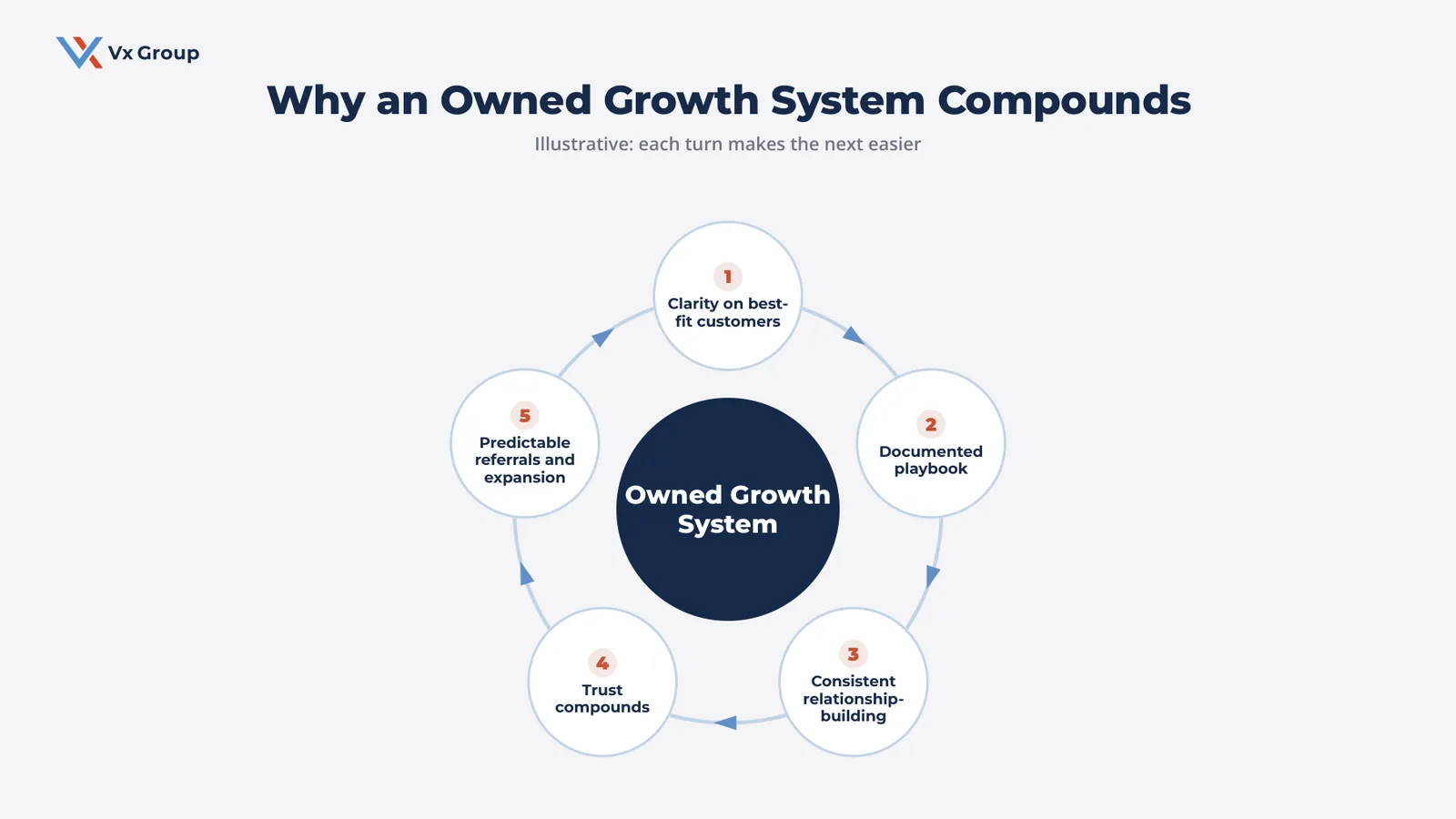
The reason capability transfer matters so much is that an owned growth system compounds. Clarity on your best-fit customers makes your playbook sharper. A documented playbook makes relationship-building consistent. Consistency builds trust. Trust produces referrals and expansion, which deepen your clarity about who you serve best. Each turn of the wheel makes the next one easier, and it keeps turning whether or not the consultant is still in the room. A dependency does the opposite: it stops the day the invoice does.
What should the first 90 days look like?
The first 90 days should be diagnosis-heavy and execution-light, ending with a documented plan your team helped build and is ready to run. Front-loading the thinking is what makes the later execution stick.
A healthy early arc looks like this. The opening weeks go to understanding the business: which accounts generate the most profit, why they stay, where the sales process breaks, and what the company is genuinely known for. From there the consultant works with your team to define the ideal customer profile and the priority markets, then documents a sales and relationship process into your tools.
By the end of the first quarter you should have a written plan, a team that helped create it and therefore believes in it, and a short list of the highest-value moves to make first. The order matters here: clarity first, then a system, then activity. A consultant who flips that order and starts with activity is guessing with your budget.
For the broader strategic context that surrounds this work, the cluster overview on B2B growth strategy and the companion piece What Is B2B Growth Consulting are both worth reading before your first conversation.
The bottom line on hiring a business growth consultant
The right business growth consultant leaves you stronger than they found you, with a system you own and a team that can run it. The wrong one leaves you with a deck, a dependency, or a borrowed playbook that quietly damages the relationships you spent decades building. The difference is rarely visible in the pitch, which is exactly why the questions, signals, and red flags in this guide matter before you sign.
If your growth has stalled and you suspect the problem is the absence of a system rather than a lack of effort, the most useful first step is to understand how a relationship-driven growth system gets built and, crucially, transferred to your team to own.
Ready to grow?
Bring in a partner who builds the system and hands it back, so growth does not depend on the consultant.
FAQs
About the Author: David Tisdale
