

Sales Prospecting: A Relationship-First Playbook for Mid-Market B2B Companies

Sales prospecting is the work of finding and starting relationships with companies that look like your best customers. For relationship-driven B2B, it means targeting a short list of high-fit accounts on purpose, researching them, and opening real conversations, rather than blasting a large list and measuring how busy you were.
TL;DR
- Prospecting is account selection first and outreach second. Pick the right companies before you write a single message.
- The fastest way to find your next great customer is to study the ten you already have and look for more that resemble them.
- Volume prospecting feels productive and produces a long, cold pipeline. Targeted prospecting produces fewer, warmer conversations that close.
- Score every candidate account on fit, access, timing, and expansion room so your team works the right list in the right order.
- Research before you reach out. A specific, relevant first touch beats a hundred generic ones.
- Measure relationships started and advanced, not dials and emails sent.
Most B2B sales teams treat prospecting as a numbers game. Build a bigger list, send more emails, book more demos, and revenue will follow. For companies that sell complex, high-value offerings into long relationships, that approach quietly works against you. It fills the calendar with low-fit conversations, trains the team to value motion over progress, and buries the handful of accounts that could actually become generational customers.
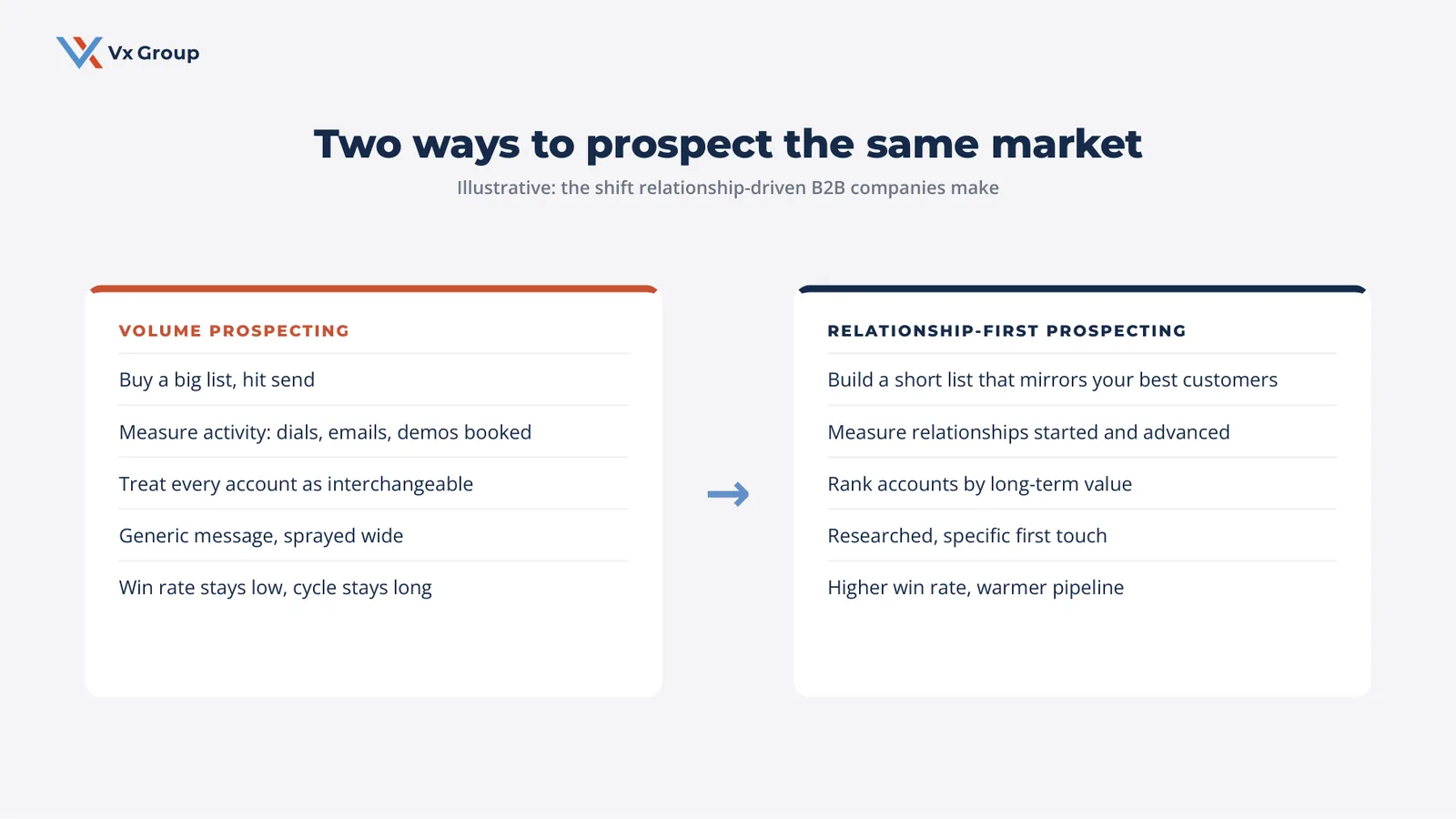
The villain here is spray-and-pray volume prospecting and the vanity activity metrics that keep it alive. Dials, emails sent, and demos booked tell you how busy the team was last week. They say nothing about whether you started a single relationship worth pursuing.
This guide lays out a relationship-first prospecting playbook built for mid-market B2B companies in industrial, manufacturing, distribution, and other legacy sectors where deals are large, cycles are long, and trust is the real currency. Every section is meant to be run, not just read.
What is sales prospecting, really?
Sales prospecting is the process of identifying companies that fit your business, then opening conversations with the right people inside them. It sits at the front of the sales process, before qualification and before any deal exists. Done well, prospecting decides the quality of everything that follows, because a pipeline can only ever be as good as the accounts you chose to put in it.
In high-velocity software sales, prospecting often means working a huge top of funnel and letting volume sort out fit. In relationship-driven B2B, the math is different. You may only need fifteen new customers this year, each worth hundreds of thousands of dollars over time. That changes prospecting from a volume exercise into a targeting exercise.
Defined term: Relationship-first prospecting
A prospecting approach that starts by selecting a small number of high-fit accounts that resemble your best existing customers, then invests real research and personalized outreach into each one. Success is measured by relationships started and advanced, not by raw activity.
Why does prospecting decide the rest of the deal?
Prospecting decides the rest of the deal because the account you choose sets a ceiling on win rate, deal size, cycle length, and retention. A perfectly executed sales process against a poor-fit account still ends in a slow loss or a customer who churns and strains your operation. Choosing well at the prospecting stage is the highest-leverage decision a B2B seller makes.
This is why prospecting cannot be delegated to a list and a sequence. The judgment about which accounts deserve your team’s limited attention is a commercial decision, and it belongs with the people who understand what your best customers have in common.
Why does volume prospecting fail for relationship-driven companies?
Volume prospecting fails because it optimizes for the wrong thing. It rewards activity that is easy to count and ignores the quality of the relationships being built. For a company with a 9 to 18 month sales cycle and six-figure deals, a thousand cold touches that produce forty low-fit conversations is not progress. It is expensive noise that exhausts the team and clogs the pipeline.
There is also a trust problem. The companies you most want as customers are run by people who have been pitched constantly. A generic, sprayed message marks you instantly as someone who did not bother to understand their business. That first impression is hard to undo, and you often only get one shot at a senior buyer in a tight industry.
What do vanity activity metrics hide?
Vanity activity metrics hide whether the team is building anything that compounds. A dashboard full of dials and emails sent can look healthy while win rate, average deal size, and pipeline quality all slide. Counting outputs feels like management, but it measures effort instead of outcomes.
The fix is to change what you put on the wall. Track how many target accounts had a meaningful interaction this month, how many relationships moved from cold to engaged, and how many engaged accounts advanced toward a real opportunity. Those numbers reward the behavior you actually want.
For a deeper look at why adding raw volume rarely solves a growth problem, see Why More Leads Is Almost Never the Answer in B2B Sales.
How do you build a target account list that matches your best customers?
You build a target account list by reverse-engineering your best existing customers and finding more companies that share their defining traits. This is the single most valuable hour your sales and leadership team can spend, because it converts prospecting from guesswork into a repeatable search.
Run it in four concrete steps.
Step 1: Rank your current customers by relationship quality, not just revenue
Pull your customer list and rank it on two axes: total long-term value and how good the relationship is to operate. Your best accounts pay well, stay for years, refer others, and are a pleasure to serve. Mark the top ten. These are the pattern you are trying to clone.
Resist the urge to rank by this year’s revenue alone. A large account that drains your operations team and beats you up on price is not a model to replicate.
Step 2: Find the pattern your best accounts share
List the traits your top ten have in common. Look at industry and sub-sector, company size and revenue band, ownership structure, the specific job title that championed you, what triggered the original purchase, and the problem you solved. Most companies find three or four traits that repeat across nearly all of their best accounts. That shared pattern is your real ideal customer profile.
If you have not formalized this yet, What Is an Ideal Customer Profile, and Why Most B2B Companies Get It Wrong walks through how to build one that actually guides targeting.
Defined term: Target Account List
A finite, named list of specific companies your team has decided to pursue because they match the profile of your best customers. It is a deliberate list of organizations, not a volume of leads.
Step 3: Source companies that match the pattern
Now go find more companies that fit the pattern. Use industry association directories, trade show exhibitor and attendee lists, supplier and customer lists of companies you already serve, LinkedIn filtered by industry and size, and the simple question every account team should ask current customers: who else in your world should we know? Build a list of 50 to 150 named companies. For most mid-market teams, that is a year of high-quality prospecting, not a week.
Step 4: Score and rank the list
Score every account so the team works it in the right order. A simple weighted model keeps prospecting from defaulting to whoever is easiest to reach instead of who matters most.
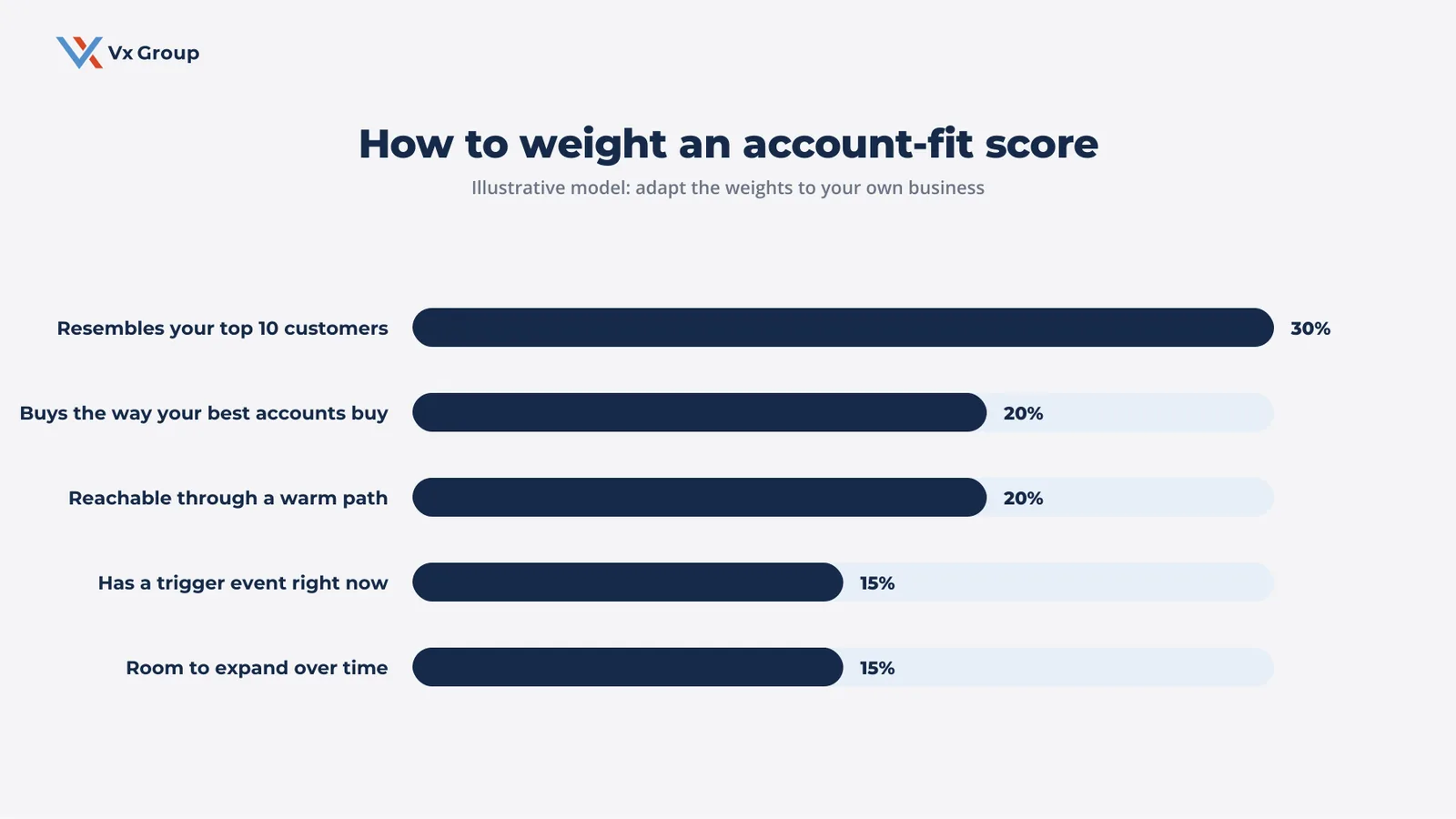
Score each account from one to five on each factor, multiply by the weight, and total it. Work the highest-scoring accounts first. The weights above are a starting point. Adjust them to match how your business actually wins.
What does a relationship-first prospecting process look like?
A relationship-first prospecting process moves an account through five clear stages: select, research, reach, engage, and advance. Each stage has an exit criterion, so the team always knows what to do next and what counts as progress. The point is to make good prospecting repeatable instead of dependent on one talented rep’s instincts.
Stage 1: Select
Pull the next account from the top of your scored list. Selection is already done if you built the list well. The discipline here is to work the list in order rather than chasing whatever shiny opportunity landed in the inbox this morning.
Stage 2: Research
Spend 15 to 30 minutes learning the account before any outreach. The next section covers exactly what to look for. The exit criterion is simple: you can name a specific, current reason this company would want to talk to you.
Stage 3: Reach
Send a researched, specific first touch to the right person. Reference the reason you found in research. The exit criterion is a reply or a clear no, not a sent message.
Stage 4: Engage
Turn the first reply into a real conversation. The goal of early outreach is a conversation, not a closed deal. The exit criterion is a scheduled call or meeting where you can understand their situation.
Stage 5: Advance
Move the engaged account toward a qualified opportunity, or place it in a deliberate nurture track if the timing is wrong. An account that is not ready today but fits perfectly is worth a quarterly check-in, not a delete.
Ready to grow?
Prospect the accounts you can actually win with a relationship-first process, not a volume blast.
How do you research an account before the first touch?
You research an account by looking for a current, specific reason to reach out and the right person to reach. Fifteen focused minutes is enough for most mid-market companies. You are not writing a dossier. You are finding one true, relevant thing that makes your message land.
Look for these in order:
First, identify a trigger event. A trigger event is any recent change that creates a reason to act now. Look for new leadership, a facility expansion, a new product line, an acquisition, a hiring spike in a relevant function, a new certification, or a public growth announcement. Company news pages, LinkedIn, and trade publications surface most of these in minutes.
Defined term: Trigger event
A recent, observable change at a target company that creates a natural reason for a conversation right now. Trigger events turn a cold outreach into a timely, relevant one.
Second, find the right person and one level above them. Identify the role that would own the problem you solve, and the executive they report to. In owner-led mid-market companies, the owner is often closer to the buying decision than an org chart suggests.
Third, connect the trigger to a problem you solve. Write one sentence in plain language that links what you noticed to a result you have delivered for similar companies. That sentence becomes the spine of your first message.
Fourth, look for a warm path. Check for shared connections, mutual customers, the same trade association, or a recent event you both attended. A warm introduction outperforms any cold message, and relationship-driven companies almost always have more warm paths available than they use.
How do you write a first touch that earns a reply?
You earn a reply by being specific, brief, and useful, and by making the message obviously written for one company. The structure that works is short: name the trigger, connect it to a relevant result, and ask for a low-pressure conversation. Three or four sentences is plenty.
A workable pattern looks like this. Open with the specific thing you noticed about their business. Follow with one sentence on a similar company you helped and the outcome, in their language. Close with a small, clear ask, such as a 20-minute call to compare notes. Skip the feature list. Skip the calendar-bombing follow-up cadence that treats a senior buyer like a metric.
How many times should you follow up?
Follow up three to five times over several weeks, and make each touch add something rather than repeat the last one. A second touch can share a relevant case or a useful piece of insight. A third can reference a different trigger. The goal is to stay useful and present without becoming the rep who emails seven times saying only “just bumping this up.”
For seven specific outreach approaches built for this kind of selling, see 7 B2B Prospecting Strategies That Work for Relationship-Driven Companies.
How do you measure prospecting without vanity metrics?
You measure prospecting by tracking the movement of relationships through your stages, not the volume of activity that produced it. The right metrics tell you whether the pipeline you are building is getting warmer and better, which is the only thing that predicts future revenue in a long-cycle business.
Use this comparison to reset what your team reports.
| What to stop measuring | What to measure instead | Why it matters |
|---|---|---|
| Dials and emails sent | Target accounts with a meaningful interaction this month | Counts relationships started, not effort spent |
| Total leads in pipeline | Engaged accounts that match your top-customer profile | Tracks pipeline quality, not just quantity |
| Demos booked | Engaged accounts that advanced a stage | Rewards progress, not motion |
| Activity per rep | Win rate and average deal size by account fit | Connects prospecting choices to revenue |
| List size | Coverage of the scored target account list | Shows whether the right accounts are being worked |
What is a healthy prospecting rhythm?
A healthy rhythm is a weekly cadence where the team reviews the scored list, reports accounts that advanced a stage, and commits to the next set of research and outreach. Monthly, leadership reviews whether the accounts being worked still match the best-customer profile and whether win rate by fit is holding. This keeps prospecting honest and prevents drift back toward easy, low-fit volume.
Field Notes
A mid-market industrial supplier was running a classic volume motion: a purchased list of several thousand contacts, a heavy email cadence, and a dashboard built on dials and demos. Activity looked strong. Win rate did not.
They rebuilt prospecting around their top accounts. Leadership ranked existing customers, found that nearly all of the best ones were privately held regional manufacturers in two adjacent sectors, and built a list of 90 named companies that fit. Reps researched each account for a trigger before reaching out and led with a relevant result instead of a feature list.
The team made fewer touches and had more conversations that mattered. The pipeline got smaller and warmer, and the accounts that entered it were the kind worth keeping for a decade. This is a representative pattern from relationship-driven sales work, not a single guaranteed result, and the mechanics are what travel from company to company.
How does prospecting fit into a larger growth system?
Prospecting works best as one connected part of a growth system, not a standalone sales activity. The target account list should be informed by the same customer insight that shapes your marketing, your trade show strategy, and your account expansion plans. When prospecting, marketing, and relationship management all aim at the same profile of company, each one makes the others stronger.
This is the difference between scattered effort and a system. A company that knows precisely who it serves best can point every growth function at that profile and stop wasting motion on accounts that were never going to fit. To see how this connects end to end, read Building a B2B Growth Strategy From Scratch.
Prospecting also feeds account expansion. The same discipline that helps you find new high-fit accounts helps you recognize expansion room inside the customers you already have, which is often the faster path to revenue. For why those existing relationships deserve protection, see What Is a Generational Customer.
Ready to grow?
Make prospecting part of a growth system your team runs, instead of a numbers game that burns the list.
The takeaway
Sales prospecting is not a volume problem to be solved with a bigger list and a louder cadence. For relationship-driven B2B companies, it is a targeting discipline: choose a short list of accounts that look like your best customers, research each one, open real conversations, and measure whether relationships are advancing. The teams that win the next decade of mid-market deals will be the ones that prospect with intention while their competitors keep counting dials.
Start with the ten customers you already love. Find more that look like them. Work that list with care, and your pipeline will get smaller, warmer, and far more valuable.
FAQs
About the Author: Jacob Camhi
