

Mutual Action Plan: The Traveler Document for AI-Assisted Buying Committees

A mutual action plan is a shared document that a seller and a buyer both work from. It lists each step from the first meeting to the signed order, with a date and an owner. It also answers the questions the buying committee will ask. Build version one after the intro call and update it at every step.
TL;DR
- A mutual action plan has two halves: a dated list of steps with an owner on each side, and written answers to the questions the buying committee will ask.
- The top-ranking guides for this keyword focus on the first half. The second half matters more now, because buyers paste your documents into an AI assistant and read the summary.
- We call our version a Traveler. It holds scope, what is out of scope, how pricing works, how we work, and answered questions. It stays with the deal.
- Send version one right after the intro call, version two after the buyer replies, and a final version before sign-off.
- Use the template in this guide as your starting point. Then paste your finished document into AI and ask what a skeptical buyer would still want to know.
Many owners we work with still sit in on the big quotes. You take the first call and send a proposal. Then you wait while the buyer talks it over with people you have never met. The proposal is one document. The deal is a series of decisions made in meetings you are not in.
A mutual action plan gives the people in those meetings something to read. It sets out what happens next, who does it, and what the committee needs to know before it says yes. It can replace several follow-up meetings with one document. Colleagues can forward it, and an AI assistant can summarize it correctly.
This guide explains what a mutual action plan is and why it matters more when buyers use AI. It then shows how to build one in six steps, with a template you can copy.
What is a mutual action plan?
A mutual action plan, often shortened to MAP, is a written plan shared between a seller and a buyer. It maps the path from the first conversation to a signed order. Every step has a date and an owner, and some of the steps belong to the buyer. Some teams call it a mutual success plan or a joint plan.
The top results for this term come mostly from sales-software vendors. The Salesforce and Highspot guides, for example, describe the plan as a shared list of milestones, dates, and owners that stays current inside the sales process. Neither treats written answers to the buying committee’s questions as part of the plan. A shared timeline is useful, and it covers the first half.
The second half of the job is a written set of answers to the questions a buying committee raises. This guide covers both halves. A timeline alone gives the committee a schedule and no reason to trust it.
Defined Term: Mutual action plan.
A shared, dated plan that lists every step from the first meeting to the signed order. It names an owner for each step on both sides, and it records the decisions and answers the buyer needs along the way.
Defined Term: Traveler.
Our name for a mutual action plan built for buyers who paste everything into AI. It is one living document that goes with the deal from the first follow-up to sign-off. It holds scope, what is out of scope, how pricing works, and how our team works. It also holds answers to the questions the buying committee is likely to ask.
Why does a mutual action plan matter more when buyers use AI?
A mutual action plan matters more now because buyers read your documents through an AI assistant. A buyer who forwards your proposal to a colleague often pastes it into an AI tool first and asks for a summary. The summary is all some committee members read.
That changes what a document has to do. A document that names the scope, the price basis, the dates, and the owners produces an accurate summary. Every person on the committee then gets the same picture.
Three things follow for an owner-led manufacturer:
- The committee reads you secondhand. Our guide to the B2B buying committee maps the roles that review a deal. Most of them will never take a call with you. Your document speaks for you in those meetings.
- Plain sentences survive a summary. Specific facts stated in text come through intact. Marketing language gets cut down to a single line like “vendor offers custom parts.”
- The proposal covers one moment. A proposal states the offer and the price. It says little about what happens in week two, who on the buyer’s side signs, or what is outside the scope. A mutual action plan covers the whole path.
The table below shows how different documents hold up when a buyer’s AI summarizes them. It is an example, based on what we see when we test our own documents.
| Document | What an AI summary tends to say | What the committee is left to guess |
|---|---|---|
| Proposal only | The vendor offers the product at a stated price | Next steps, owners, what is excluded |
| Dated checklist only | A list of dates and tasks | Why the buyer should trust the plan, how the price was built |
| Traveler (both halves) | Scope, exclusions, price basis, dates, owners, and answers to common questions | Very little, and the gaps are visible |
The same habit that helps with documents helps with your website. Our guide to LLM SEO covers how AI systems find and compare suppliers. They reward the same specifics: facts stated in text, in plain words.
1. How do you set the goal and the deadline at the top of the plan?
Start the plan with one sentence that states what the buyer wants and the date they need it. Everything below it serves that sentence. Every person who opens the document sees the goal first.
Write it in the buyer’s own words from the call. If the buyer said late deliveries cost a full shift each time, use that language. A buyer who sees their own words trusts that you listened. They also correct you fast when you got it wrong.
Write the goal sentence from your call notes
Use this pattern: “[Company] needs [outcome] by [date] because [consequence they named].”
For example: “Ridgeline Components needs a second source for machined housings by March 15, because a single-supplier delay has stopped their line twice this year.” That sentence is so specific that a summary cannot weaken it.
Add the buyer's decision date
Ask when they need to decide, and write the date next to the goal. If they do not know, write “decision date to be confirmed” and make it the first question in your next email. An open date is a risk, and the document should show it.
2. How do you write the scope and what is out of scope?
List what you will deliver in four to six plain lines. Then list what is outside the scope in a separate block. The out-of-scope list prevents the disputes that otherwise show up at contract time.
Think about the questions a purchasing manager or an engineer asks late in the process. Does the price include tooling? Who handles freight? What happens if the spec changes? Answering them early shortens the conversation later.
List the deliverables in the buyer's terms
Name each deliverable the way the buyer would describe it, such as “machined aluminum housings, part number 4471, 2,000 per quarter.” A specific line like that gives an AI assistant something to repeat.
List what is out of scope
Write a short block titled “Outside this plan” and put every common assumption in it. Typical items for a manufacturer include:
- Tooling changes after the first article is approved
- Field service and on-site installation
- Expedited freight
- Design changes to the part after the quote date
- Volumes above the stated run size
Each line should name something the buyer might reasonably assume. That way the committee can accept it or ask for a change before the contract stage.
3. How do you explain how pricing works?
Explain how the price is built in two or three sentences, and show which factors move it. A buyer who sees a number with no explanation will ask an AI assistant to judge it, and the AI will guess.
Name what drives the price so the buyer can reason about it and defend it to their own finance team. Your margin stays private.
Name the three to five factors that set the price
For a manufacturer the factors are usually material, tolerance, run size, finish, and service level. Write them as a short list with one line on each. For example: “Run size: the price per unit drops at 1,000, 2,500, and 5,000 pieces, because setup is spread across more parts.”
State what would change the price
Add a sentence on what moves the number after the quote: a material price shift, a change to tolerance, a volume change. A committee that knows the rules in advance does not need a meeting to argue about them.
Ready to grow?
Bring one live deal and see how a plan like this fits your sales process.
4. How do you describe how your team works?
Describe who the buyer will deal with, how often you will talk, and how problems get raised. This section tells the committee what it is like to work with you. A written description lets a buyer see that before the first order.
For a relationship-driven manufacturer, this is often the strongest part of the document. Your customers stay for years. The people, the response time, and the way you handle a bad week are why. Writing it down lets a buyer who has never met you see it.
Name the people and their roles
List three to five names with one line each: who handles quoting, who runs the job, who owns quality, and who the buyer calls when something goes wrong. Include the owner or president if they stay involved. A name in a document is a promise that a real person is accountable.
Set the communication rhythm
State how often you will update the buyer and in what form: a short weekly email during the first order, a monthly call after that, and an immediate phone call if a delivery will slip. Buyers read a rhythm like that as proof you have done this before.
Say what happens when something goes wrong
Write two or three sentences on how you handle a late shipment or a quality issue: who calls, how fast, and what you commit to fix. Committees ask this question in every deal. A written answer carries more weight than a verbal one.
5. How do you add dated steps with an owner on both sides?
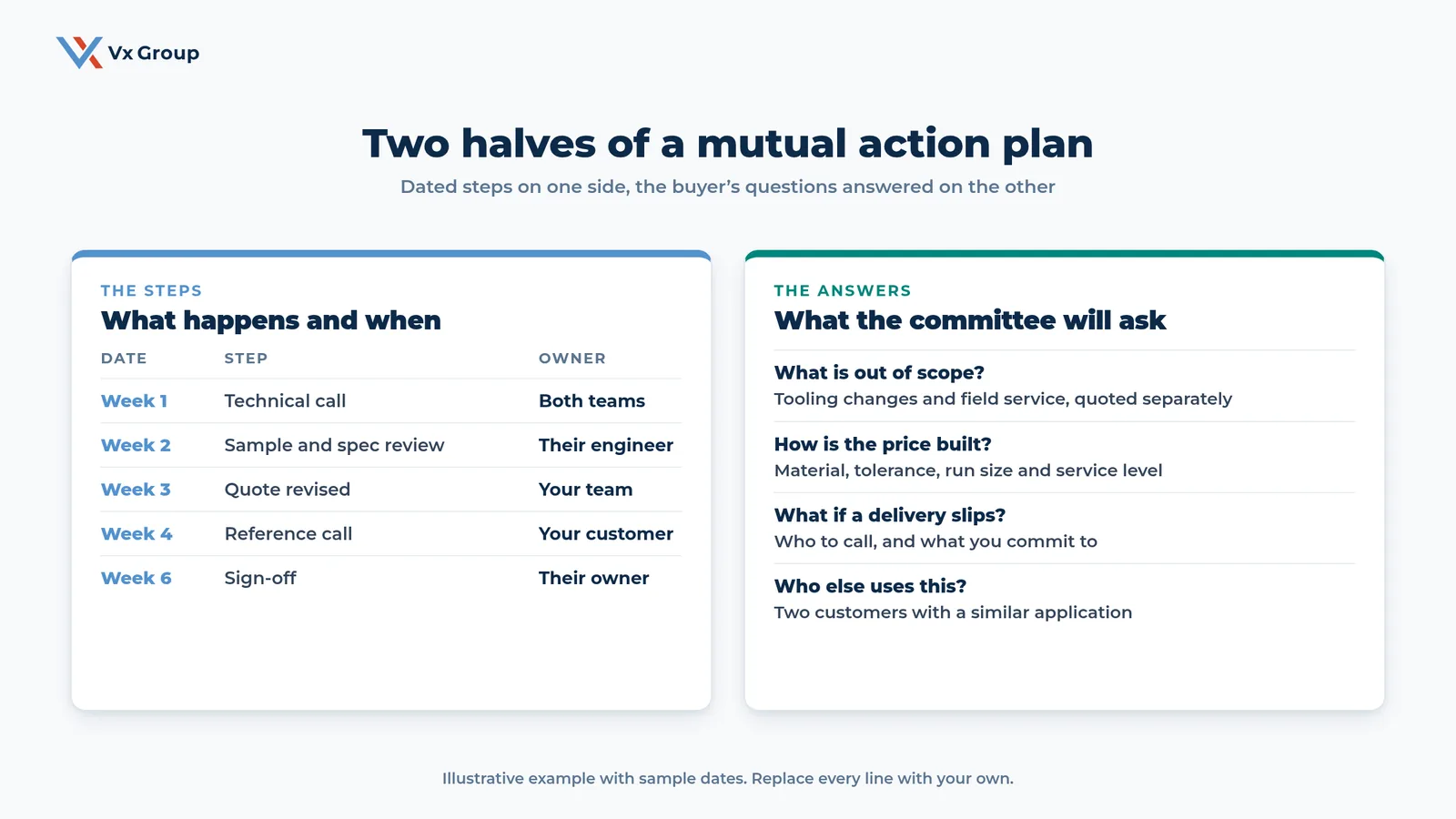
Add a table of steps from today to sign-off, with a date, an owner, and a status for each. This is the half most mutual action plan guides focus on. It gives the buyer a schedule they can hold you to.
Build the steps backward from the decision date
Start at the date the buyer needs to decide and work backward. If sign-off is week six, then the reference call is week four, the revised quote is week three, and the sample review is week two. Working backward shows early whether the buyer’s date is realistic.
Put the buyer's name on the buyer's steps
Give at least a third of the steps to the buyer’s side: a technical review by their engineer, a sample test, an internal approval. A plan where the seller owns every step is a seller’s to-do list. When both sides own steps, the buyer has agreed to a process.
Use this layout for the table:
| Date | Step | Owner | Status |
|---|---|---|---|
| Week 1 | Technical call on the part and the line | Both teams | Scheduled |
| Week 2 | Sample and spec review | Buyer’s engineer | Open |
| Week 3 | Revised quote with price basis | Our team | Open |
| Week 4 | Reference call with a similar customer | Our customer | Open |
| Week 6 | Internal approval and sign-off | Buyer’s owner | Open |
The dates are samples. Replace every line with the real steps for your deal. Keep the list to eight steps or fewer, because a longer list reads as a project plan nobody will maintain.
6. How do you answer the committee's questions before they ask?
Write the questions the committee will raise, and answer each in two or three sentences. This is the part that makes a mutual action plan work for buyers who use AI. A list of questions with plain answers is the easiest content for a summary to carry correctly.
You already know most of the questions. They come from the buyer’s roles and from the deals you have lost.
Collect the questions by role
Use this table as a starting list. Add the questions your own customers ask most often.
| Role on the committee | Question they usually ask |
|---|---|
| Owner or president | What happens to us if this supplier fails? |
| Finance | What drives the price, and what could change it? |
| Operations | What is the lead time, and what happens when it slips? |
| Engineering | Can you hold the tolerance, and how do you check it? |
| Quality | What certifications do you hold, and how do you handle a nonconforming part? |
| Purchasing | What are the payment terms, and what is the minimum order? |
Answer each question in plain sentences
Keep each answer to two or three sentences and put the fact first: “Our standard lead time is five weeks, and we hold it for orders placed before the fifteenth of the month. If a delivery will slip, we call within a day and give a new date.” A reader, or an AI assistant, can lift that answer without any context.
Add the questions from your last three lost deals
Think back to the last three deals you lost and write down the question that came up late. Add it, with an answer, to your standard plan. That habit keeps the document tied to real deals.
Field Notes:
In our own sales process at Vx Group, the Traveler matters more than the proposal. Buyers forward it, they paste it into AI, and they come back to the next meeting with better questions. The document answers what it can in advance. That leaves the live conversation for the decisions that need people to talk.
How do you update a mutual action plan from the first call to sign-off?
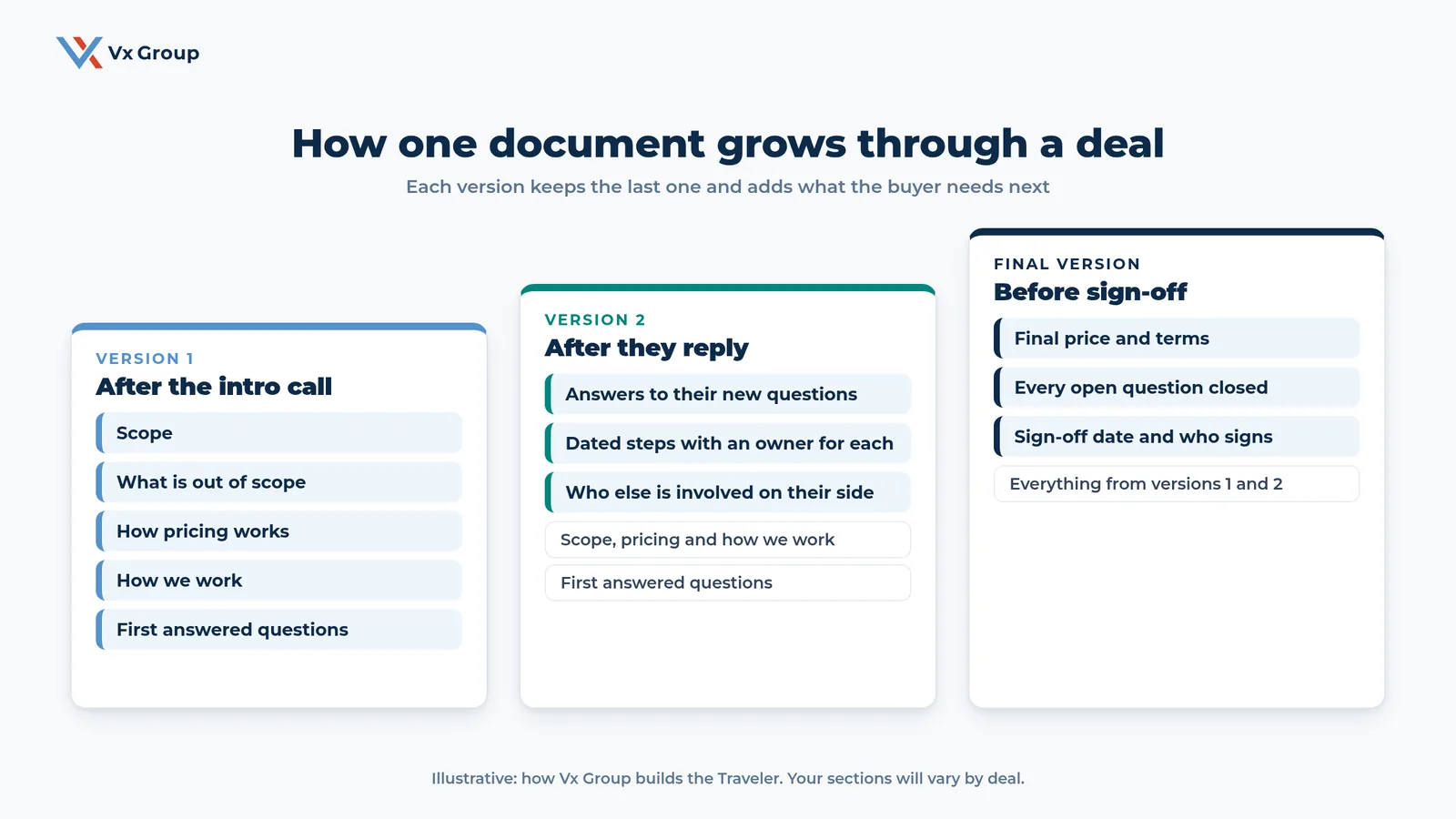
Treat the plan as one living document with three named versions: version one after the intro call, version two after the buyer replies, and a final version before sign-off. Each version keeps the last one and adds what the buyer needs next.
Send version one within a day of the intro call
Version one holds the goal sentence, the scope, the out-of-scope list, how pricing works, how your team works, and your first answered questions. Send it with a short email that summarizes the call in the buyer’s words. Our guide to the sales follow-up email gives the templates for that message. It also covers the second email, which asks two better questions.
Send version two after the buyer replies
When the buyer answers your questions, add the answers to the document and add the dated steps with owners on both sides. Add the names of the other people who have joined the conversation. Mark the changes in the email so nobody has to hunt for them.
Send the final version before sign-off
The final version holds the agreed price and terms, every open question closed, and the sign-off date with the name of the person who signs. When a late-joining colleague opens it, they can catch up quickly without a meeting.
Keep the same file name with a version number, such as “Ridgeline-Traveler-V2.” One document with a clear history is easier to trust than three attachments that disagree.
What does a mutual action plan template look like?
A mutual action plan template has seven sections: the goal, the scope, what is out of scope, how pricing works, how your team works, the dated steps, and the committee’s questions. Copy the outline below into a document and fill it in after your next intro call.
| Section | What goes in it | Sample opening line |
|---|---|---|
| 1. Goal and decision date | The buyer’s outcome in their words, and the date they need to decide | “[Company] needs [outcome] by [date] because [consequence].” |
| 2. Scope | Four to six deliverables, named as the buyer names them | “We will supply [part, quantity, frequency].” |
| 3. Out of scope | Every common assumption that is excluded | “Outside this plan: [item].” |
| 4. Pricing | The three to five factors that set the price and what would change it | “The price depends on material, tolerance, and run size.” |
| 5. How we work | People, roles, update rhythm, and what happens when something goes wrong | “Your main contact is [name], who responds within one business day.” |
| 6. Dated steps | Date, step, owner, status, with owners on both sides | “Week 1: technical call, both teams.” |
| 7. Questions and answers | The committee’s likely questions, grouped by role, with plain answers | “How long is the lead time? Five weeks, held for orders placed by the fifteenth.” |
Keep the whole document to two or three pages. A buyer will forward a short document and skim a long one. An AI assistant also summarizes a focused page more accurately than a sprawling one.
If you want to see how this fits a longer sales process, our guide to sales cycle stages shows where each version of the plan belongs in a complex deal.
How do you get the buyer to actually use the plan?
Ask the buyer to edit it. Send the plan as a shared document or a short PDF with an invitation to correct anything wrong, and name one step on their side for the next week. A buyer who has changed a line in the document owns part of it.
Four habits raise the odds that the plan gets used:
- Introduce it as a way to save the buyer time. Say that the document will answer their colleagues’ questions so they do not have to relay them.
- Invite the other readers by name. Ask the buyer who else should see it, and offer to send it directly.
- Review it at the start of every call. Open with the dated steps and ask what has changed. This keeps the plan current and sets the agenda.
- Run a skeptic’s check before you send it. Paste the finished document into an AI assistant. Ask for a five-sentence summary written by a skeptical buyer, followed by a list of the questions the document does not answer. Fix the gaps it finds. Remove confidential details first, and check your company’s rules on AI tools before you paste.
That last check takes a few minutes. It shows you what the committee will read before they read it.
What mistakes make a mutual action plan fail?
A mutual action plan fails when it becomes a seller’s checklist, when it goes stale, or when it hides the information the buyer wants. These are the mistakes we see most often:
- Giving every step to the seller. If the buyer owns nothing, the buyer has agreed to nothing.
- Listing twenty steps. Long plans go unmaintained. Keep it to eight or fewer.
- Skipping the out-of-scope list. The disputes that show up at contract time come from assumptions nobody wrote down.
- Hiding the price basis. A number with no explanation invites the buyer, or their AI assistant, to invent a reason.
- Writing in marketing language. “Quality service for every industry” gets cut down to nothing. Name the part, the quantity, and the date.
- Letting it go stale. A plan with last month’s dates tells the buyer the deal is drifting. Update it after every meeting.
- Sending it once. The value comes from the versions. A single send at the start leaves the committee with an outdated picture.
How does a mutual action plan fit with the proposal?
Send the mutual action plan first, and let the proposal become one section inside it. The plan covers the whole path to a signed order. The proposal states the offer and the price at one point along that path.
This order has a practical benefit for owner-led companies. Your proposal arrives after a conversation the buyer already understands, with scope, exclusions, and price basis agreed in version two. The proposal then confirms what the committee has already read, and fewer questions arrive after it lands.
How does a mutual action plan work in a long sales cycle?
In a long sales cycle, the mutual action plan keeps the deal moving between meetings. It also keeps every new person on the buyer’s side informed. Relationship-driven manufacturers often wait months between steps, and the document holds the context while other work piles up.
Three connections to the rest of your sales process help the plan last:
- Pipeline review. Open the current plan for each active deal in your weekly review. A deal with stale dates is a deal that needs attention. Our guide to sales pipeline management shows how to run a pipeline that does not live in one person’s head.
- Playbook. Save the template, the standard answers, and the versions in your sales playbook so every salesperson starts from the same page.
- Owner involvement. If you still carry key relationships personally, the plan lets your team run the deal with your words and your standards. Our piece on founder-dependent sales explains why growth stalls when one person holds every relationship.
Questions that arrive late in the deal are a good source for the next version. Add them, with answers, to your standard plan. The document gets better with every deal you work.
Build version one this week
Take the intro call you had most recently and open your notes. Write the goal sentence, the scope, the out-of-scope list, and two sentences on how pricing works. Add the names of the people the buyer will deal with, then three questions the committee is likely to ask. Send it with a short email, and schedule version two for when they reply.
The first plan takes an hour or two. Later ones start from your own template and go faster.
Ready to grow?
Bring one live deal and we will walk through how to build the plan around it.
FAQs
About the Author: David Tisdale
