

AI in Procurement: What It Means When You Are the Supplier

AI in procurement means buyers use AI tools to find, compare, and rank suppliers before a salesperson is involved. A buyer can load your quote, your specs, and two competing quotes into an AI assistant and ask which supplier is the safest choice. Your documents have to answer that question on their own.
TL;DR
- AI in procurement is the use of AI by buying teams to find suppliers, read quotes, check risk, and recommend a choice. Most guides on it are written for the buyer. This one is written for the supplier whose quote is being read.
- A July 2026 Semrush survey of 519 B2B buyers who use AI at work found that 92% say AI shaped their shortlist and 83% say it shaped their final pick.
- Generative AI reads unstructured documents such as quotes, PDFs, and contracts. A buyer needs no integration with you to compare you against competitors.
- Buyer AI tools look for five facts first: an itemized price, a lead time, certifications with numbers, named references, and specs in plain text.
- Quotes and proposals that state those five facts on page one, in text, survive an AI summary. Quotes that leave gaps force the AI to guess.
- Relationships still decide close calls. A buyer who trusts you calls to check what the AI said. Give buyers people to call, and ask what they have already found.
What this guide covers
- What is AI in procurement?
- How is generative AI different from older procurement software?
- How many B2B buyers use AI to choose suppliers?
- What does a buyer’s AI do with your quote?
- How does AI-led buying change the sales cycle?
- What do buyer AI tools look for in a supplier?
- How do you write a quote or proposal that AI can read?
- How do you explain a higher price when AI compares quotes?
- How do you make your company easy for buyer AI to find and trust?
- How should you handle a buyer who uses AI in the sales conversation?
- What risks should a supplier watch?
- What should a manufacturer do in the next 30 days?
- What mistakes do suppliers make?
- Where should an owner start today?
A buyer you have never spoken to may already have compared you to two competitors. Nobody called you and nobody asked a question. The buyer loaded three quotes, the project specs, and a budget into an AI assistant. Then the buyer asked which supplier looked safest.
That is AI in procurement as the supplier sees it. Nearly everything written on the topic speaks to the buyer: how to choose software, how to cut spend, how to automate sourcing. Very little speaks to the company whose quote is being read.
This guide is for owners of private manufacturers and industrial B2B companies. Their buyers now use AI. The guide covers what buyers do with AI and what the AI reads in your documents. It also covers what to change in your quotes, your website, and your sales conversations.
The problem is the hidden first round. A comparison happens before anyone calls you, and it uses only what you wrote down.
What is AI in procurement?
AI in procurement is the use of artificial intelligence by buying teams to find suppliers, read and compare quotes, check supplier risk, and recommend a choice. Buyers use it for work that once took days of reading, such as comparing five quotes line by line.
Defined Term: AI in procurement.
The use of AI tools by a buying team to find suppliers, read and compare their documents, score risk, and prepare a recommendation. For a supplier, it means the first evaluation often happens without a conversation.
The guides that rank for this topic come from procurement software vendors, a professional body, and buyer communities. They cover spend analysis, contract review, supplier risk scores, and automated sourcing events. They describe what the buyer’s tools can do. They say little about what those tools find when they read your documents.
That gap is the subject of this guide. Buyers give AI five kinds of jobs, and each one touches something you control.
| Job the buyer gives AI | A typical request | What the AI reads from you |
|---|---|---|
| Find suppliers | “Who makes this part in North America?” | Your website, directories, trade articles |
| Compare quotes | “Compare these three quotes.” | Your quote, price, lead time, terms |
| Check risk | “Which supplier is the safest choice?” | Certifications, references, delivery history |
| Review contracts | “What obligations does this put on us?” | Your terms and conditions |
| Prepare the negotiation | “Where is each quote weakest?” | Everything above, side by side |
Each row is a place where your documents either answer the question or leave the AI to guess.
How is generative AI in procurement different from older procurement software?
Generative AI in procurement reads unstructured documents such as quotes, PDFs, emails, and contracts. It answers plain-language questions about them. Older procurement software works on structured data such as purchase orders and spend categories. It needs a supplier to be loaded into a system first.
That difference matters to you because a generative tool needs no integration. A buyer can paste your quote into an assistant in seconds. It makes no difference whether your company sits in any procurement system the buyer owns.
Three things follow for a supplier:
- Your documents are the data. The AI has only what you sent and what it can find about you. Anything you left out is a blank.
- Format affects what gets read. Prices inside images, specs inside scanned catalogs, and key terms buried in long paragraphs are harder for an AI to pull out. Plain text with clear headings is easier.
- You cannot see it happening. The buyer’s prompt and the AI’s answer stay on the buyer’s side.
Many buyers also run these comparisons in personal AI accounts that their own IT team does not know about. A supplier cannot see the prompt or the answer. A supplier cannot correct a mistake in it. The one thing you control is the quality of what you hand over.
How many B2B buyers use AI to choose suppliers?
A July 2026 Semrush survey of 519 B2B buyers who use AI at work found that 92% say AI shaped their shortlist and 83% say it shaped their final pick. The figures cover buyers who already use AI at work. That is a subset of all buyers, but it is large enough to plan around.
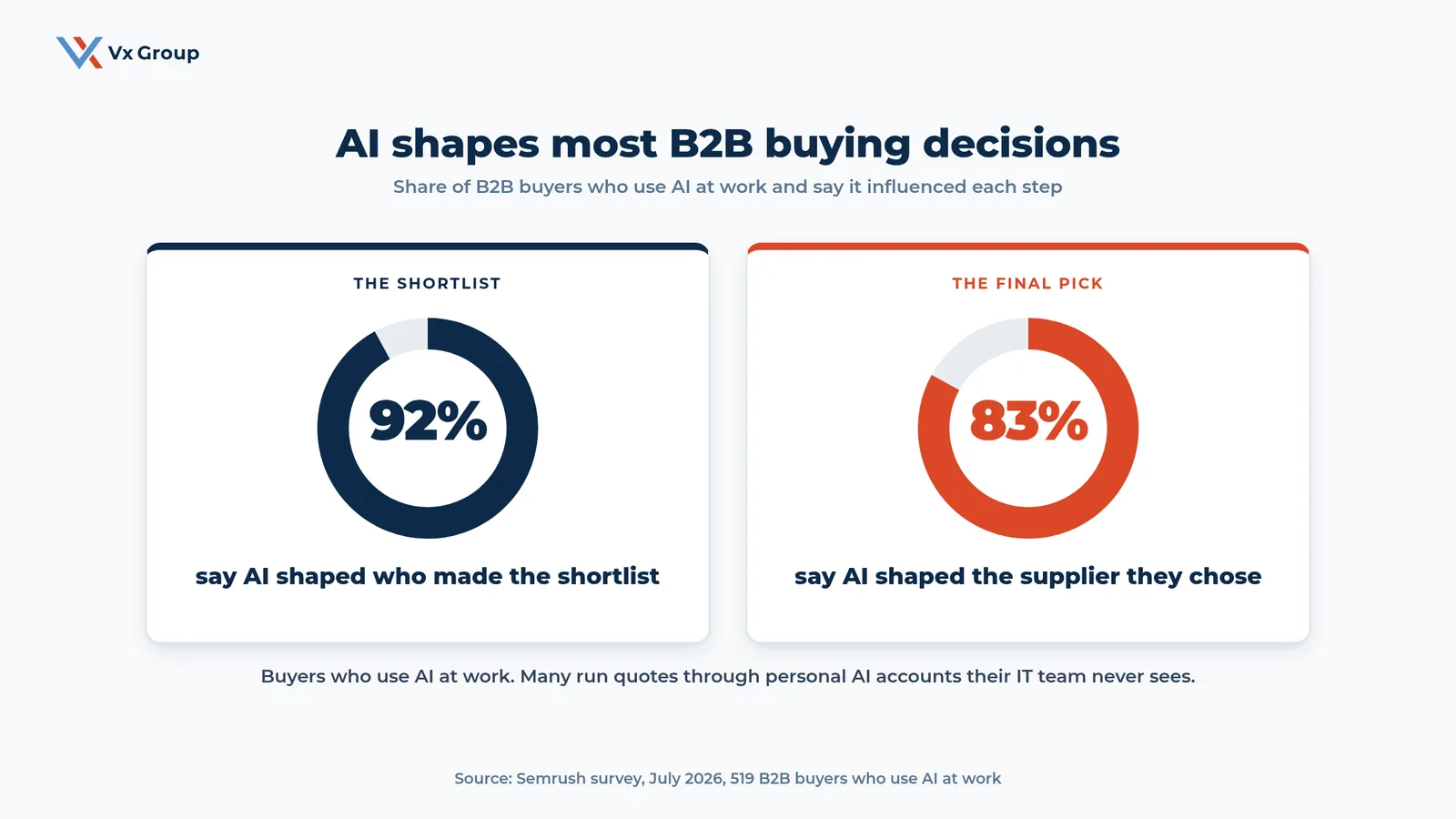
Read the two numbers together. The shortlist is where suppliers get cut without a conversation. The final pick is where the quote and the terms decide. Both stages run on documents that you wrote.
Here is how to find out where this already affects your pipeline.
Count the AI steps in your last three lost deals
Pull your last three lost quotes. For each one, write down the date you sent it, the date you heard back, and who at the buyer received it. If you have a relationship with that buyer, ask a plain question: “Did you run our quote through an AI tool when you compared the options?” Many buyers will tell you.
Ask your sales team what buyers have said
Ask each salesperson one question at the next team meeting: “Has a buyer mentioned using ChatGPT, Copilot, or another AI tool to look at us?” Write the answers in one shared document. After a month you will see a pattern. You will also have the first real data on how your own buyers work.
What does a buyer's AI do with your quote?
A buyer’s AI reads every document it is given. It pulls out the price, lead time, certifications, terms, and references. Then it compares them against each other and against the project requirements. Where a fact is missing, it flags the gap or fills it with a guess.
A buyer starts by giving the AI context: the request for quote, the specs and drawings, quotes from past suppliers, and the budget and deadline. Then the buyer asks questions.
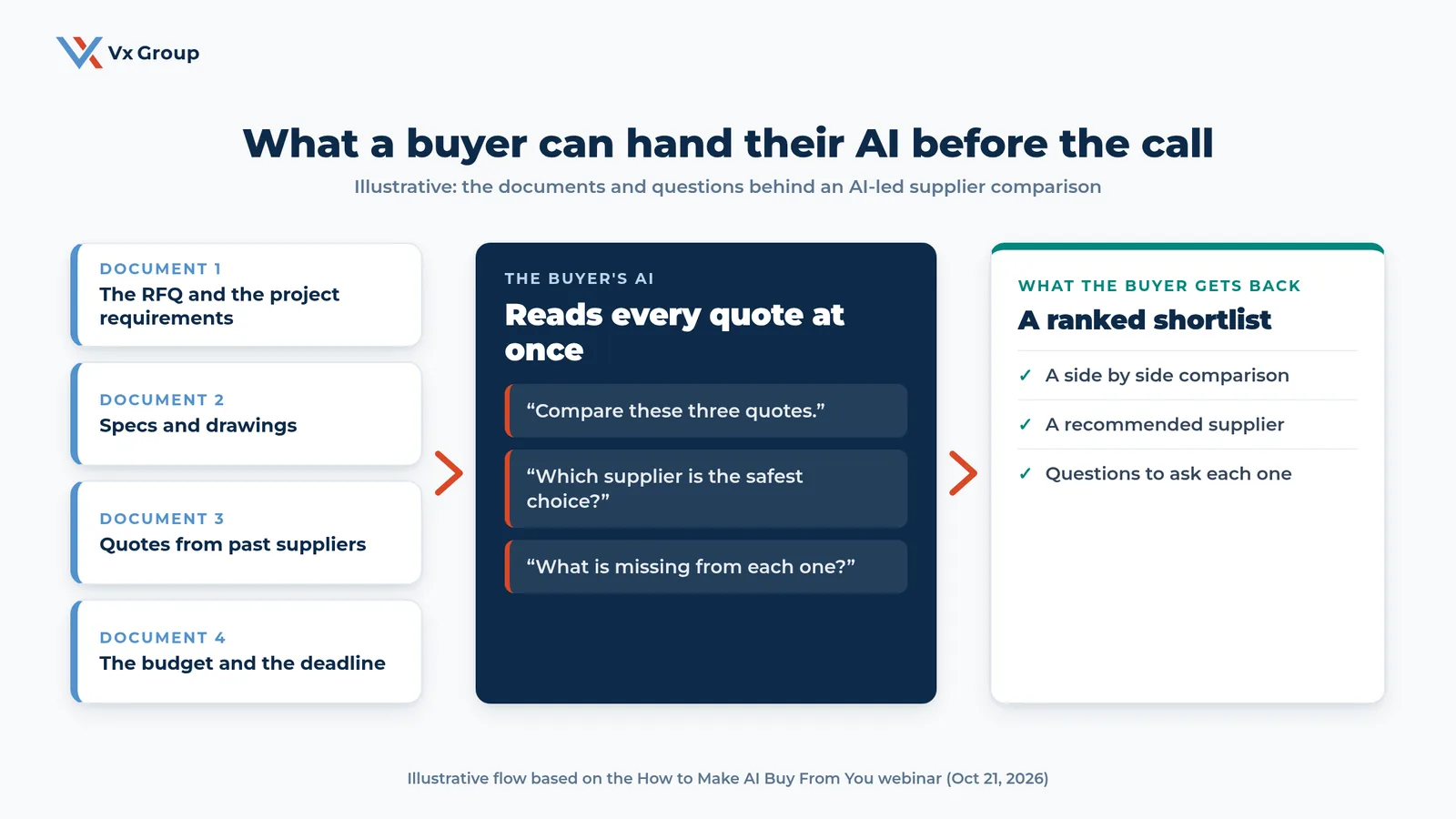
These are the prompts a buyer might type:
- “Compare these three quotes.”
- “Which supplier is the safest choice?”
- “What is missing from each quote?”
- “Which quote gives the clearest delivery commitment?”
- “Write the questions I should ask each supplier before we decide.”
The last two matter most. They show that the AI also writes the buyer’s follow-up questions. If your quote leaves a gap, the buyer arrives at your next call with a question about it. The AI drafted that question.
Field Notes:
This is an illustrative scenario with no real client behind it. A buyer at an equipment maker has three quotes for a custom enclosure. Quote one gives a single price and a delivery range of six to ten weeks. Quote two itemizes tooling, material, and finishing. It commits to eight weeks from approved drawing and names two customers who bought the same part family. Quote three has the lowest price and says certification is in progress. The buyer asks an AI to compare them. The summary ranks quote two first because it is the only quote whose claims the buyer can check. It flags quote three’s certification as a risk. It notes that quote one’s delivery range makes scheduling impossible.
The AI has no loyalty to any supplier. It rewards whichever quote is easiest to verify and defend. A careful human buyer wants the same thing. The AI applies that standard to every quote in the same way.
How does AI-led buying change the B2B sales cycle?
AI-led buying moves the first comparison ahead of your first meeting. It also turns every extra meeting into more time for the buyer to compare you with other suppliers. The overview a salesperson once gave on the intro call is often finished before the call is booked.
| Stage | Traditional buying | AI-led buying |
|---|---|---|
| First research | The buyer reads supplier pages and calls a few | The buyer asks an AI who makes the product and gets a short list |
| Company overview | Learned on the intro call | Done before the intro call |
| Quote comparison | The buyer reads each quote | The AI summarizes and compares the quotes |
| Meetings | Each meeting adds to the relationship | Each meeting also adds time to compare you elsewhere |
| Call notes | The buyer’s memory and notes | A notetaker that records and summarizes every word |
| Decision | The buyer’s judgment | The buyer’s judgment, informed by the AI’s summary |
The buying committee adds more readers. Our guide to the B2B buying committee maps the roles that review a deal. Several of them can run their own AI comparison with their own questions. The finance reader asks about price and payment terms. The operations reader asks about lead time and capacity. The technical reader asks about specs and tolerances.
Relationships keep their value here. A buyer who trusts you calls to check what the AI said. A buyer who has never heard of you has only the AI’s version. That is why the work in this guide pairs with the relationship work in our guide to sales cycle stages. That guide follows the same buyer from first contact to signed order.
What do buyer AI tools look for in a supplier?
Buyer AI tools look first for five facts: an itemized price, a lead time, certifications with numbers, named references, and specs in plain text. A buyer needs these facts to defend a decision to a boss or a committee. A tool built to give a recommendation the buyer can defend reaches for them first.
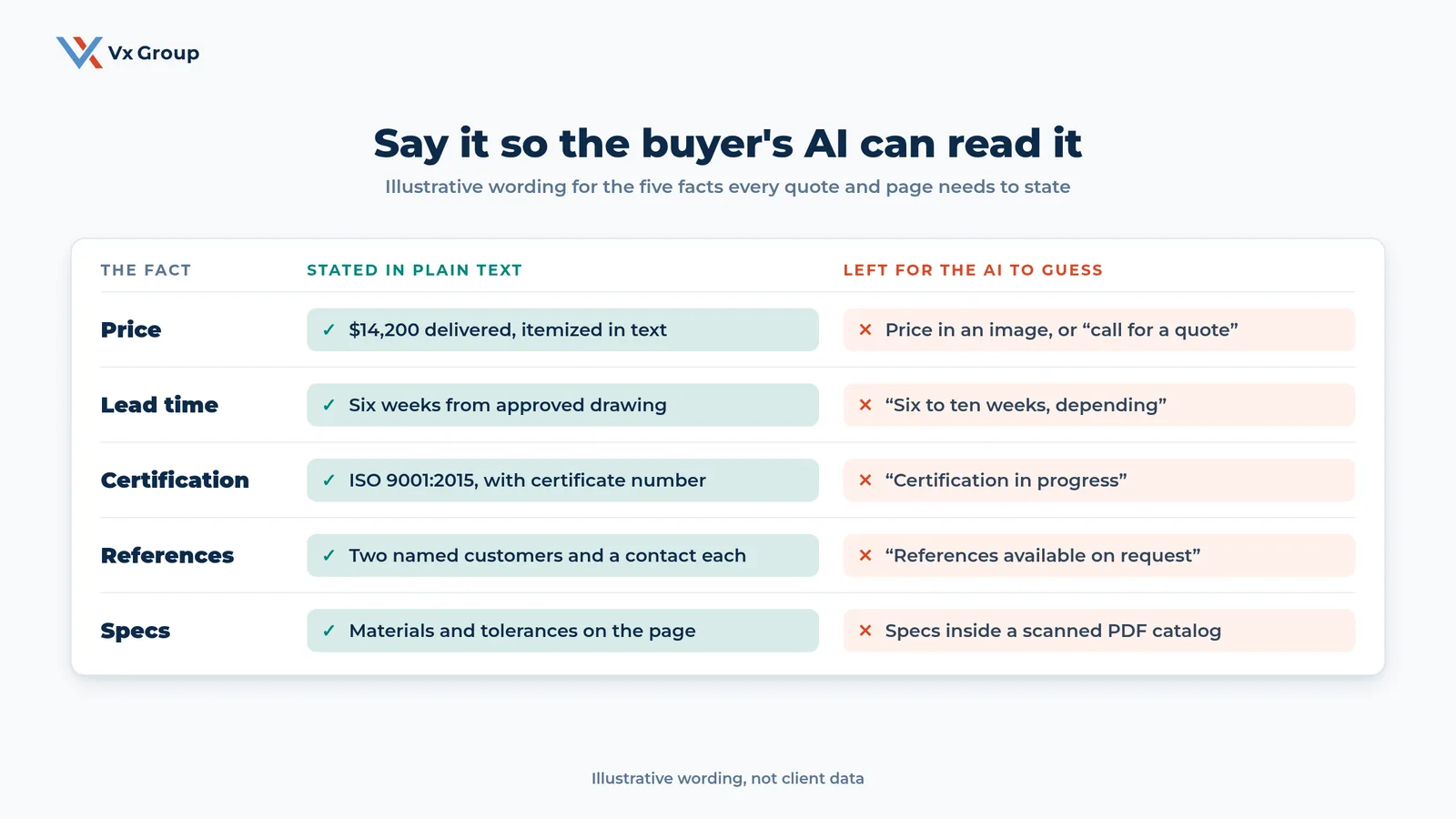
Each fact has a version the AI can read and a version it has to guess at. The five steps below show how to write the readable version.
State the price and what it includes
Write the total, the line items, and what the price excludes, all in text. A single number leaves the AI to guess why you cost more or less than the next quote. With no reason for a price gap, the AI has to make one up. The made-up reason rarely favors you.
Use a template like this: “Total price: $14,200 delivered. Includes tooling, material, finishing, and packaging. Excludes freight insurance. Price holds for 30 days.”
Give lead time as a number with a start point
Write lead time in weeks or days, and name the event that starts the clock. “Six weeks from approved drawing” gives a scheduler something to plan around. “Six to ten weeks, depending” is a range wide enough for the AI to flag as a risk.
If your lead time varies with material availability, say what drives it and name the date you will confirm it. A commitment with a stated condition reads better than a vague range.
Publish certifications with numbers and dates
State the standard, the certificate number, the issuing body, and the expiry date. “ISO 9001:2015, certificate number and expiry date on page two” can be checked. “Certification in progress” cannot be checked, and an AI asked about safety will flag it.
Put the same details on your website and in the quote. A buyer’s AI that finds the certificate on both pages is more likely to treat the claim as confirmed.
Name two references the buyer can call
Offer two named customers. Give each a contact name and a one-line description of the work you did together. Get their permission first. A buyer who sees “References available on request” has to take an extra step before checking you. An AI has nothing to verify.
Pick references that match the buyer’s situation: a similar part, a similar volume, a similar industry.
Put specs on the page in text
Write materials, tolerances, finishes, and standards in the body of a page or the quote itself. A spec sheet that exists only as a scanned PDF catalog may be skipped or misread. Our guide to PDF SEO explains why AI skips the specs in a product catalog and how to fix that page by page.
Ready to grow?
Bring your last lost quote and we will mark which of the five facts a buyer’s AI could not find.
How do you write a quote or proposal that AI can read?
Write page one as a standalone summary in plain text. State the buyer’s problem, your price, lead time, certifications, and references. Then put the terms in numbered sections with defined terms. Many buyers will read only the AI’s summary of your document. Page one has to hold up when it is the only page read.
Defined Term: AI-readable quote.
A quote whose first page states the buyer’s problem, the price and what it includes, the lead time and its start point, certifications with numbers, and named references, all in plain text. The terms that follow are written in numbered sections with defined terms and measurable obligations.
Open page one with the buyer's problem in their words
Copy the buyer’s own language from the request for quote or from your call notes. If the buyer wrote “we need a replacement housing that survives washdown,” use those words. An AI summarizing your quote will carry that language into its summary. The buyer will recognize the problem as theirs.
Explain your price in two sentences
Add two sentences under the price: what drives it, and why it differs from a lower bid if you know about one. An illustrative example: “The price reflects hardened tooling built for long production runs and a finishing step that removes a second operation at your plant.” A reason the AI can quote protects you better than silence.
Write terms in numbered sections with defined terms
Number every section and define each key term once, in a place the reader can find it. Write obligations that can be measured. “Shipment within 15 business days of approved drawings” can be checked against a calendar. Phrases such as “reasonable efforts” and “as soon as practicable” give the AI nothing to measure. It will flag them as a risk or guess at a meaning.
Have your attorney review any change to contract language. The aim here is clearer wording of commitments you already make.
Send the quote as text and as a PDF
Put the page-one summary in the body of the email, and attach the full PDF. A buyer can paste email text into an assistant without opening the attachment. Our guide to the sales follow-up email covers what to send after the first meeting, including a summary a buyer can forward.
Use this checklist before any quote goes out:
- The buyer’s problem appears on page one in their words.
- The total price and its line items appear in text.
- The lead time is a number with a stated start point.
- Each certification has a standard, a number, and a date.
- Two references are named, with permission.
- Every key term is defined once, and every obligation can be measured.
How do you explain a higher price when AI compares quotes?
A higher price survives an AI comparison when the quote explains, in plain text, what the buyer gets for the difference. The AI ranks documents on how well their claims hold together. Price is one claim among several. When a buyer asks why quote two costs $2,400 more, the answer comes from whatever you wrote.
| Situation | What the AI sees | What to write |
|---|---|---|
| Your price is the highest | A gap with no stated reason | Two sentences on what the extra cost buys, such as longer tool life or one fewer operation at the buyer’s plant |
| Your price is the lowest | A low number with thin detail | Line items and exclusions, so the buyer can see what is and is not covered |
| Your price sits in the middle | Little to separate you from the others | The commitment that matters most to this buyer, such as a firm ship date |
| The quote bundles several items | One total for unlike things | A separate line for each item so each can be compared on its own |
Write the explanation once for each recurring pattern and keep it in your quote template. Salespeople then start from a good default. The AI summary of every quote carries your reason for the price.
Total cost belongs in the explanation too. Freight, rework rates, warranty terms, and payment terms all change what a quote costs a buyer over a year. State the ones you can document and leave out the ones you cannot.
How do you make your company easy for buyer AI to find and trust?
Check what AI already says about you. Make outside sources agree with your website. Publish plain-text pages for the questions buyers ask. AI answers come from many places at once. Two sources that disagree are the most common reason an answer comes out wrong.
Run an AI visibility audit this week
Ask an AI assistant what it knows about your company and to show its sources. Then compare the sources to your website. Our guide to an AI visibility audit walks through a 10-minute version and a monthly routine. The audit is the quickest way to see the version of your company that a buyer’s AI will describe.
Make outside sources agree with your website
Check your distributor pages, your directory listings, your association profiles, and any trade articles that describe you. Send each source a one-page fact sheet with your correct details. Old catalogs and wrong part numbers on a distributor’s site often conflict with your own pages. The AI has to choose between them.
Write pages that answer the questions buyers ask
Publish one plain page for each question a buyer asks before choosing a supplier: what you make, which tolerances you hold, which industries you serve, how fast you ship. Our guides on SEO for manufacturing companies and LLM SEO cover what those pages need to state. For buyers who start in ChatGPT, our guide to how to rank in ChatGPT adds a ten-prompt scorecard. To see where classic search and AI answers overlap, read SEO vs AEO.
Remove keyword stuffing from your pages
Pages written to repeat a phrase give an AI less to quote than pages that state facts. A 2024 KDD paper on generative engine optimization found that stuffing keywords lowered visibility in generative answers. Our guide to keyword stuffing in AI search shows what to cut and what to write in its place.
How should you handle a buyer who uses AI in the sales conversation?
Ask about it. A buyer who has used AI already holds an overview of you. Use your first call to learn what that overview says and to fill in what it left out.
Ask what the buyer has already found
Open the call with a question: “What have you looked at so far, and what did it tell you?” The answer shows you which of your facts the buyer has and which ones are wrong. It also shows which competitors the AI placed beside you. And it tells the buyer you are comfortable being compared.
Send a one-page summary built for comparison
After the first meeting, send one page that the buyer can paste into an assistant and forward to a colleague. State the five facts and the commitments from the call. A summary written for comparison puts your version of the facts into the buyer’s AI conversation. It sits beside the version the AI found on its own.
Assume the notetaker is listening
Many buyers now use a meeting notetaker that records and summarizes every call. Say only what you can stand behind in writing. State commitments in plain words that read well in a summary. A casual “we can probably do five weeks” becomes a line item in the buyer’s notes.
Give buyers people to call
Offer the names of two customers and two of your own people the buyer can reach directly. When the AI’s summary raises a doubt, a call to a real reference settles it. Our guide to the mutual action plan shows how a shared document keeps a buying committee moving. Our guide to top customers as a growth strategy explains why your best accounts make your best references.
What risks of AI in procurement should a supplier watch?
Suppliers face four practical risks from AI in procurement: summaries that misstate a quote, old documents that keep circulating, comparisons the supplier never sees, and the urge to overstate claims to look better on paper. Each has a direct response.
- The AI misreads your quote. Clear structure and plain text lower the odds. When you can, ask the buyer whether anything in your quote was unclear.
- Old documents circulate. A retired price list or catalog can sit on a distributor’s site for years. Date your documents and ask distributors to remove old versions.
- You cannot see the comparison. Treat every quote as one that an AI will read. That habit costs nothing and covers the cases you never learn about.
- Overstated claims get checked. An AI that cross-checks a claim against another source will surface a mismatch. State only what you can document.
A fifth risk sits inside your own company. Check your policy on pasting customer pricing or specs into public AI tools, and set a rule for your team.
What should a manufacturer do in the next 30 days?
Spend 30 days on four moves. Audit what AI says about you. Rewrite page one of your quote template. Fix conflicting outside sources. Add one question to every first call. Each one has an owner and an output.
| Week | Action | Owner | Output |
|---|---|---|---|
| 1 | Run the AI visibility audit and read your last three quotes against the five facts | Owner or president, with the marketing lead | A list of gaps in your quotes and in what AI says about you |
| 2 | Rewrite page one of the quote template to state the five facts in text | Sales leader | A new quote template, reviewed by your attorney where terms change |
| 3 | Write the one-page fact sheet and send corrections to distributors and directories | Marketing lead | A fact sheet, a log of who was asked, and a due date for each |
| 4 | Add “What have you looked at so far?” to every first call and log the answers | Sales leader | A shared list of what buyers say AI told them |
At the end of the month, review the list of answers from buyers. It shows which of your facts buyers already have and which ones they got wrong. It also shows which competitors keep appearing beside you. Use it to choose the next round of fixes.
Assign the work to named people with dates. A plan with no named owner rarely gets finished.
What mistakes do suppliers make with AI in procurement?
The common mistakes come from treating AI as someone else’s problem. These seven show up most often:
- Waiting for buyers to mention it. Most buyers will not say that they used AI. Ask them.
- Hiding the price. “Call for a quote” on a page leaves the AI to estimate your price from other sources.
- Quoting a range for lead time. A wide range reads as a scheduling risk.
- Listing certifications without numbers. An unverifiable claim gets flagged.
- Leaving specs inside scanned PDFs. The AI may skip them or misread them.
- Letting outside pages contradict your site. The AI has to choose, and it may blend the two.
- Writing for the AI and forgetting the person. The reader at the end of the process is still a buyer who wants to trust someone. Use the same facts, written clearly, for both.
Where should an owner start today?
Pull your last quote and read page one as if you were a buyer’s AI. Check each of the five facts: price with line items, lead time with a start point, certifications with numbers, two named references, and specs in text. Write down every fact that is missing or vague.
Then fix page one of your quote template before the next quote goes out. That change takes an hour and touches every deal after it. Next week, run the audit on your company and send the fact sheet to your distributors.
AI in procurement will keep spreading. The suppliers who do best will be the ones whose documents answer a buyer’s questions without a phone call. Relationships still close deals, and clear documents decide which suppliers get the call.
Ready to grow?
Bring a recent quote and we will walk through what a buyer’s AI would find in it and what to fix first.
FAQs
About the Author: Jacob Camhi
