

Demand Generation Marketing for B2B Manufacturers

Demand generation marketing is everything you do to make the right buyers want your product before they ask for a quote. For an owner-led manufacturer, it starts with the people who already know you: your best customers, the people they refer, and your channel partners. Paid media and content come after that.
TL;DR
- Demand generation creates interest in your company before a buyer is ready to buy. Lead generation captures the buyers who raise their hand.
- Owner-led manufacturers with long sales cycles get most of their best deals from customers, referrals, partners, and events. Start there.
- Look at your last 20 won deals first. The source of those deals tells you where demand already comes from.
- Build demand in this order: existing customers, referrals, channel partners, events, content, then paid media.
- Capture the demand you create with a fast response to every quote request and a named owner for every follow-up.
- Measure signals that move months before revenue: introductions, repeat meetings, partner activity, and quote requests from people who already know you.
In this guide:
- What demand generation marketing is
- Why it works differently when relationships close the deal
- How to find where your demand comes from today
- How to create demand through your existing customers
- How to build demand through referrals
- How channel partners create demand
- How events fit in
- When to add content and paid media
- How to capture the demand you create
- How to measure it
- Common mistakes
- Where to start this week
A manufacturer with a $20 million business and a twelve-month sales cycle usually has a marketing budget and no clear answer to a simple question. Where did the last five big customers come from?
The usual answer is “mostly referrals and people who already knew us.” Then the marketing spend goes to a trade show booth, a few ads, and a website that was redesigned three years ago. The spending goes to places that rarely produce the deals.
We call that pattern random acts of marketing. It is the villain in this guide. This guide is for owners and presidents of privately held manufacturers, roughly $5M to $50M in revenue. It shows how to put your demand work where your best deals actually start.
It builds on our definitions in what is B2B demand generation and B2B demand generation: what it is and how to do it right. Read those for the full definitions. This guide is the how-to.
What is demand generation marketing for a B2B manufacturer?
Demand generation marketing is the set of activities that build awareness, trust, and preference with buyers before they enter a buying process. For a manufacturer, that means the engineer, plant manager, or purchasing lead has already heard your name, trusts it, and thinks of you first when a need comes up.
Defined Term: Demand generation.
The work of creating interest in your company and its products among the right buyers, before they are ready to buy. It covers customer relationships, referrals, partners, events, content, and advertising. Its goal is a buyer who asks for you by name.
Defined Term: Lead capture.
The work of responding to a buyer who has already raised a hand, through a quote request, a phone call, or a form. Lead capture turns interest that already exists into a conversation.
Most ranking guides on this topic come from software and advertising vendors. They treat demand generation as a campaign and a tool exercise. A manufacturer with a long sales cycle has a different starting point, because the buying committee forms opinions long before anyone fills out a form.
Compare demand generation and lead generation side by side
The two terms get mixed up constantly. The table below separates them on five questions an owner asks.
| Question | Demand generation | Lead generation |
|---|---|---|
| What is the goal? | A buyer who knows and trusts you before a need appears | A named contact who raises a hand now |
| When does it pay off? | Months to years later | Days to weeks later |
| What does it measure? | Introductions, repeat meetings, partner activity | Form fills, quote requests, calls |
| Who does the work? | Owner, sales leaders, account managers, partners | Marketing, website, inside sales |
| What happens if you skip it? | The pipeline fills with price shoppers | The pipeline gets few new names |
A company needs both. Lead capture without demand generation brings quote requests from buyers who are comparing five suppliers on price. Demand generation without lead capture creates interest that never turns into a conversation.
Why does demand generation work differently when relationships close the deal?
Demand generation works differently in a relationship-driven manufacturer because buyers form their short list privately and early. By the time they send a quote request, they have usually talked to peers, checked your website, and decided which two or three suppliers to call.
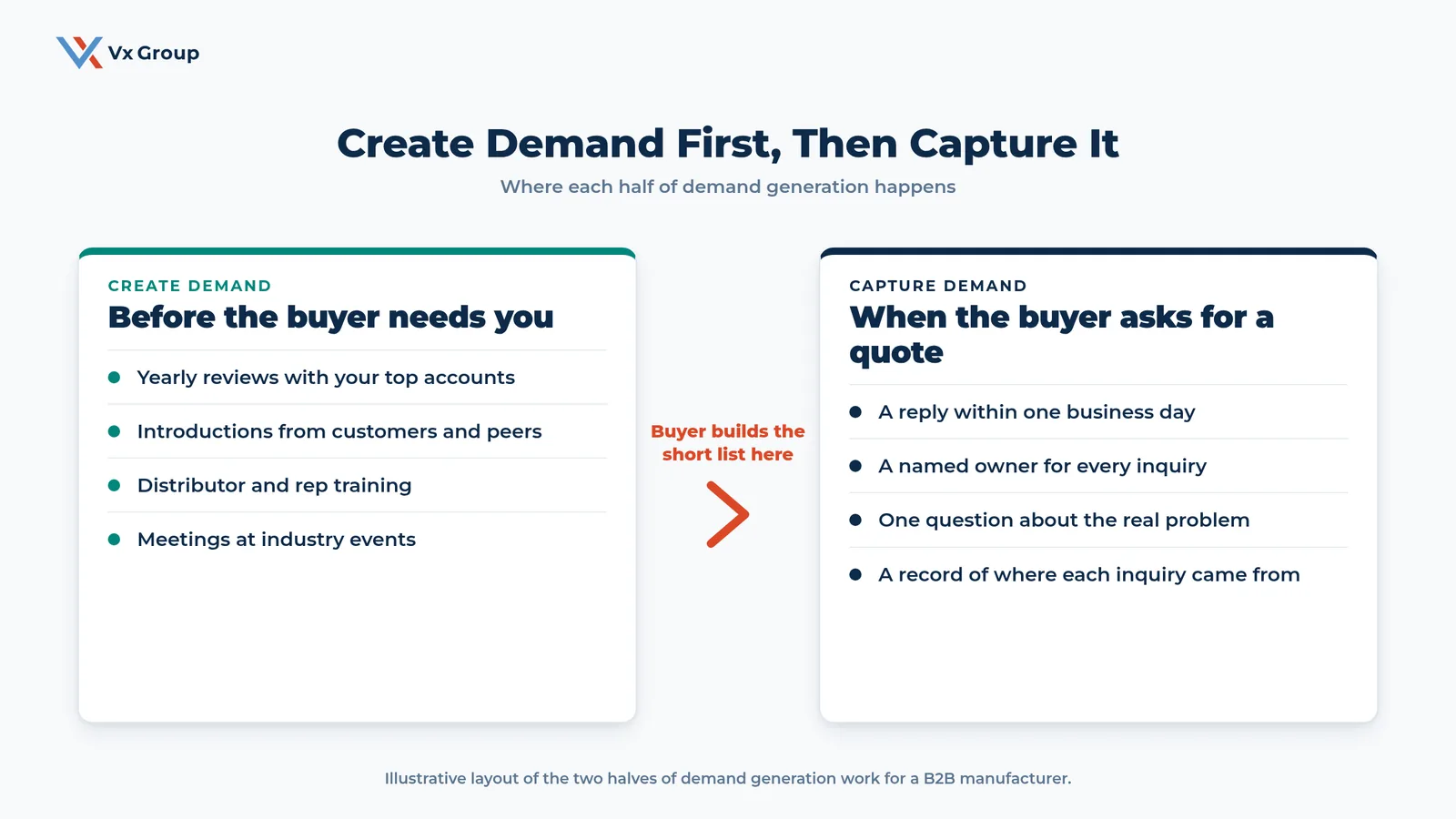
Demand creation sits on the left side of that picture. It happens in customer meetings, introductions, partner training, and industry events, and the buyer decides who makes the short list there. Demand capture sits on the right. It happens in the quote request, the first call, and the follow-up. A company that only works on the right side competes on price against everyone else who made the list.
Three facts about long-cycle manufacturing change how you build demand:
- The buying committee is larger than one buyer. An engineer, a plant lead, purchasing, and finance may all weigh in. Our guide on the B2B buying process covers who sits on that committee.
- Trust takes years to build and one bad delivery to lose. Customers who have bought from you for a decade are your strongest source of new demand.
- Your best accounts are worth far more than a new lead. A customer who stays twenty years can be worth millions. Our post on why more leads is almost never the answer explains why.
The practical result is that a $20 million manufacturer should spend its first demand generation hours on customers and referrals. Paid ads can come later.
How do you find out where your demand comes from today?
You find out where demand comes from by tracing your last 20 won deals back to the first conversation. The result takes about two hours and replaces guesses with a list. It also tells you which parts of your marketing spend have no record of producing a deal.
Pull the last 20 won deals
Open your CRM or your invoice history. List the 20 most recent new customers or new projects, with the first order date and the first order value. If a deal came from an existing customer, still list it.
Tag how each deal started
For each deal, ask the salesperson or the owner one question: who introduced us, and when? Write down the answer in plain words, then group the answers into the source categories in the table below.
| Source category | What to look for | Example answer |
|---|---|---|
| Existing customer | A current buyer brought you into a new plant or product line | “Their plant in Ohio asked for us” |
| Referral | A person outside the account made an introduction | “Our freight partner mentioned us” |
| Channel partner | A distributor or rep brought the opportunity | “The distributor in Texas called us” |
| Event | The first meeting was at a show or industry meeting | “Met at the spring trade show” |
| Inbound search | The buyer found you through search or your website | “Found us online” |
| Outbound | Your team reached out cold | “Our rep called them” |
Rank sources by revenue and cycle length
Add the first-year revenue for each source category and the average days from first contact to first order. Many owner-led manufacturers find that two or three sources produce most of the revenue. Those sources are where demand generation hours go first.
The result also shows a gap. If 14 of 20 deals started with a customer or a referral, and your marketing plan has no line for either one, the plan needs a rewrite.
How do you create demand through your existing customers?
You create demand through existing customers by making it easy for them to grow with you and to introduce you to peers. Your top 10 customers hold more new demand than any list you can buy. Our top 10 customers as strategy post covers how to pick them.
Name your top 10 accounts and a relationship owner for each
List the ten accounts with the highest lifetime revenue or the highest future potential. Put one named person from your team beside each one. That person is accountable for the relationship, and the owner reviews the list every quarter.
Hold a yearly business review with each top account
Schedule a 60-minute review once a year with the customer’s decision makers. Cover what you delivered, what is changing in their business, and what they need next year. Our guide to the quarterly business review gives a full agenda.
Map the people you do not know yet
Most top accounts have more plants, product lines, or departments than you serve today. Ask your contact who else in the company has the problem you solve. Then ask for an introduction. This is how a $200,000 account can grow into a $1 million account, and our posts on account expansion and share of wallet go deeper.
Ask what the customer wishes you did
Add one question to every review: what do you wish we did differently? The answers feed your product, your service, and your messaging. They also show you which accounts are at risk before they leave.
How do you build demand through referrals?
You build demand through referrals by asking for specific introductions on a schedule and by thanking everyone who makes one. A referral from a trusted peer shortens the early part of the cycle, and it reduces the price comparison that a cold quote request starts with.
Ask for one specific introduction
A general “send us anyone you know” request produces nothing. Ask for a named type of person: “Do you know a plant manager at another packaging company who has the same changeover problem?” Make the ask during a business review, when the customer has just heard what you delivered.
Give the referrer a short script
Send your customer two sentences they can forward. The first says who you are and what you did for them. The second says what kind of problem you solve. A forwardable note makes the introduction a thirty-second task.
Thank the referrer within 48 hours
Call or write to the person who made the introduction, whether or not the deal closes. Tell them what happened. People refer again when they hear the outcome.
Track every referral in one place
Add a “referred by” field to your CRM and fill it in on every new opportunity. In a year, you will know exactly which customers and partners send you the best deals.
Ready to grow?
If most of your best deals start with relationships, we can help you build a demand plan around them.
How do channel partners and distributors create demand?
Channel partners create demand when they know your product well, trust you, and have a reason to bring you into their customer conversations. A distributor that sells thousands of products will mention the ones it understands and the ones that pay it well.
Our guide to channel marketing for manufacturers and distributors covers the full program. For demand generation, three actions matter most.
Train partner sales teams on one problem you solve
Pick the single problem your product solves best. Give the distributor’s reps a one-page summary and a 30-minute training session. Reps sell what they can explain in two sentences.
Share a short list of target accounts with each partner
Send each partner five to ten accounts where you want an introduction. Ask which ones they already sell to. This turns a general relationship into a specific plan.
Review partner activity every quarter
Meet each of your top partners once a quarter. Ask what they quoted, what they lost, and what they need from you. Those meetings keep your product in front of the people who talk to buyers every day.
How do events and trade shows fit into demand generation?
Events fit into demand generation as places to meet people you already know and to be introduced to people you want to know. A show produces demand when you book meetings with customers and partners before it opens, and when you follow up within a week.
Our posts on trade show metrics and whether trade shows are worth it cover the decision in depth. Here is the demand generation view in three points:
- Set meetings with named customers, partners, and prospects before the show.
- Count introductions and second meetings as results. Badge scans measure traffic.
- Send a personal follow-up note to every meeting within five business days.
When should you add content and paid media?
You add content and paid media after the relationship channels are running. Content answers the questions buyers research on their own. Paid media widens the audience once you know which message works with the buyers you already win.
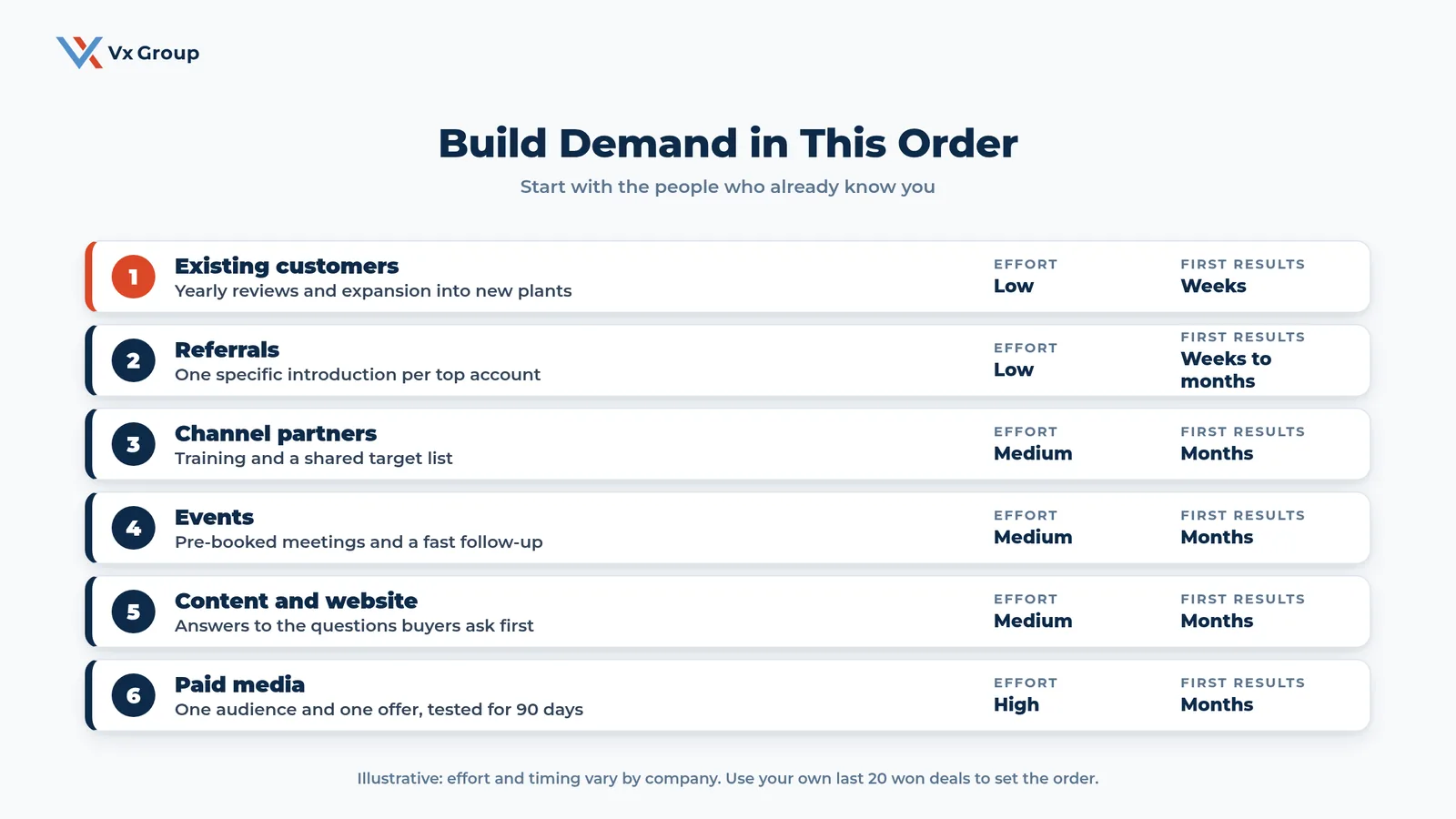
The picture above shows the order. The effort and timing marks are illustrative and depend on your company. Customers and referrals give the quickest return for the least spend, and paid media takes the most budget and the most testing.
Write content that answers a buyer's early questions
Collect the ten questions your sales team hears most in the first meeting. Write one page for each, in plain language, with a real number or example in it. Our guides on industrial content marketing and B2B SEO strategy show how.
Make the website answer a buyer's first search
Check that your website says what you make, who you serve, and what makes you different, in the first screen. A buyer who got your name from a referral will visit the site within a day. It should confirm what they heard.
Test paid media with one clear audience
Pick one audience, such as plant managers in one industry, and one offer. Run a small test for 90 days. Keep it only if the resulting conversations match the customers you want.
How do you capture the demand you create?
You capture demand by answering every quote request and inquiry quickly, with a named person, and by tracking every one to a result. Demand that reaches a slow or confusing response is lost, and buyers rarely tell you.
Set a response time and an owner
Choose a target, such as one business day for every quote request. Name the person who owns the inbox and a backup. Write the target in your sales process so it holds when someone is out.
Ask one question in the first reply
Reply with a short answer and one question about the problem behind the request. The question starts a conversation. A bare quote starts a price comparison.
Log the source of every inquiry
Record how each inquiry reached you, including the “referred by” detail. This is the data that makes the next quarter’s demand plan better. Our guides on the B2B sales funnel and sales pipeline management show how to track it.
How do you measure demand generation in a long sales cycle?
You measure demand generation with signals that move months before revenue shows up. Closed revenue is the final proof, but it arrives too late to guide a quarterly decision. Track the six signals below and review them with your sales leader once a month.
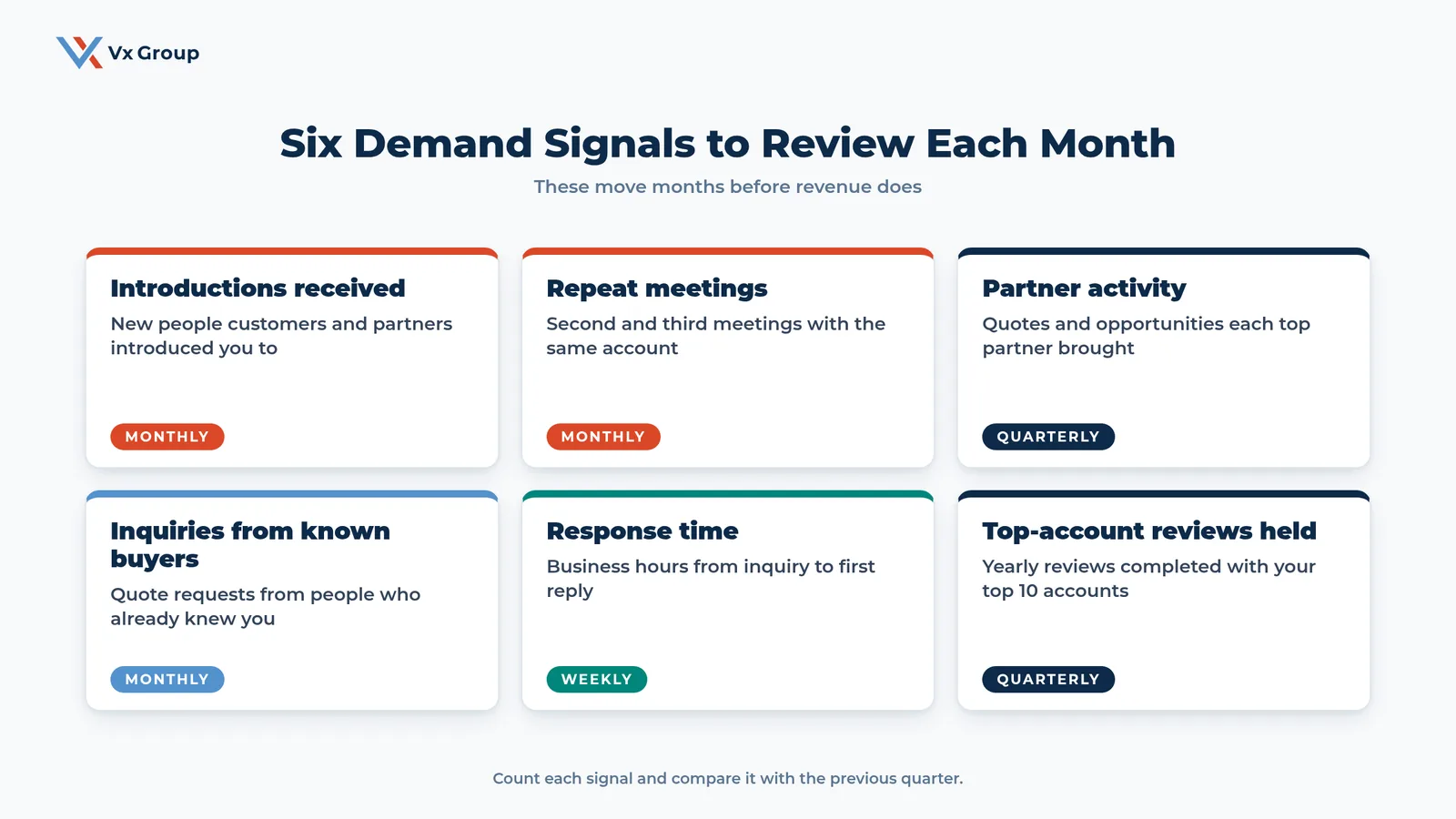
The scorecard lists six signals and how often to check each. Introductions received and top-account reviews held come first, because both come from relationship work. Response time sits next to them because it shows how well you capture what you create.
Use the six-signal table in your monthly review
Count each signal and compare it with the previous quarter. The table gives a plain definition for each one.
| Signal | What to count | How often |
|---|---|---|
| Introductions received | New people customers and partners introduced you to | Monthly |
| Repeat meetings | Second and third meetings with the same account | Monthly |
| Partner activity | Quotes and opportunities each top partner brought | Quarterly |
| Inquiries from known buyers | Quote requests from people who already knew you | Monthly |
| Response time | Business hours from inquiry to first reply | Weekly |
| Top-account reviews held | Yearly reviews completed with your top 10 accounts | Quarterly |
Our post on business leading indicators explains why signals like these predict revenue. A rising count of introductions and repeat meetings often shows up in the pipeline within a few quarters.
Connect the signals to revenue once a year
Once a year, take the deals that closed and trace them back to the signals. You will see which activities produced revenue and which produced activity. Drop the second group.
What are the most common demand generation mistakes for manufacturers?
The most common demand generation mistakes are spending on ads before checking where deals come from, treating lead volume as the goal, and leaving the work to one person. Each one is easy to fix once you can see it.
- Starting with paid media. Ads reach strangers. Your best deals come from people who know you. Start with the people who know you.
- Counting leads and ignoring introductions. Lead counts rise and fall with spend. Introductions show how strong your relationships are.
- Keeping demand in one person’s head. When the owner or a senior salesperson holds every key relationship, the whole plan leaves with them. Our post on founder-dependent sales covers this risk.
- Skipping the follow-up. An introduction or a show meeting with no follow-up within a week goes cold.
- Copying a software company’s playbook. Short-cycle, high-volume methods assume a buyer who decides in days. A manufacturer’s buyer decides over months.
Where should you start this week?
Start this week by tracing your last 20 won deals to their first conversation. That single exercise takes about two hours and shows where to put your next marketing dollar. Then do three more things in the next 30 days.
- Name a relationship owner for each of your top 10 accounts.
- Schedule one business review with a top account and ask for one introduction.
- Set a one-business-day response target for every quote request and name the person who owns it.
Those steps cost very little and start building demand that compounds. Paid media, new content, and a bigger show presence can come later, with a clear picture of what is already working.
Ready to grow?
We help owner-led manufacturers build a demand plan around the relationships that already produce their best deals.
FAQs
About the Author: David Tisdale
