

The B2B Sales Funnel for Long-Cycle, Relationship-Driven Companies

A B2B sales funnel maps how a prospect moves from first contact to a signed deal. Companies with long, trust-based sales cycles need a funnel that tracks real relationship thresholds instead of marketing activity: a qualified relationship, a shared opportunity, a presented solution, and a closed deal. Email opens and form fills measure attention, but rarely whether a relationship moved forward.
Defined term: B2B sales funnel
The structured path a prospect moves through from first contact to a closed deal. In a relationship-driven business, each stage should represent a real threshold crossed in the relationship instead of a marketing or activity milestone logged in a CRM.
TL;DR
- A B2B sales funnel maps how a relationship moves from first contact to a closed deal.
- Long-cycle B2B companies often borrow SaaS funnel stages like MQL and SQL that measure attention instead of relationship progress.
- A relationship-driven funnel tracks four real thresholds: a qualified relationship, a shared opportunity, a presented solution, and a closed deal.
- Reps and CRMs routinely mark a stage complete before the relationship has actually earned it, which turns the pipeline into fiction.
- Diagnosing stalled growth means finding the exact stage where relationships get stuck instead of adding more leads at the top.
- Track relationship advancement and account depth as the primary signal, then use activity counts as a supporting check.
- Building the funnel starts with a written definition of what has to be true before a deal can move to the next stage.
Most relationship-driven B2B companies inherited their sales funnel from somewhere else. A marketing hire builds it from a SaaS playbook. A CRM vendor ships a default pipeline with stage names built for a different kind of business. A rep who used to sell software brings the old vocabulary along out of habit. None of it was built for a company that sells into long, high-trust relationships, and the mismatch shows up everywhere: pipeline reports leadership doesn’t trust, forecasts that miss by a wide margin, and a sales team spending its week logging activity instead of building relationships.
That borrowed playbook is the real problem behind most of the sales funnel complaints coming out of legacy manufacturers, distributors, and other relationship-driven B2B companies. Fixing it starts with a funnel built around what actually has to happen for a relationship-driven deal to close, stage by stage, instead of a generic pipeline borrowed from someplace else. It’s the same root cause behind why so many B2B companies grow by accident instead of on purpose.
What Does a B2B Sales Funnel Actually Measure in a Long-Cycle Business?
A B2B sales funnel, built correctly, measures how far a relationship has progressed toward a decision instead of how much activity happened around it. Every stage in the funnel should correspond to something real that changed between your company and the prospect, something more than a task a rep checked off in a system.
In a long sales cycle, a deal can take the better part of a year to close, and it usually involves more than one person on the buying side. A plant manager who first raised the idea, a procurement lead who has to sign off, and an owner who ultimately decides all play a role, often at different points in the process.
A funnel that only tracks whether someone downloaded a spec sheet or opened a follow-up email tells you almost nothing about where that group actually stands, and it gives no credit to the quiet work of relationship-first sales prospecting that got the account this far.
What the funnel should tell you, at any point, is simple: has this relationship reached the point where a genuine need exists, has that need turned into a shared opportunity, has your team responded with something specific, and has the prospect actually committed. Those four questions are the whole model. Everything else, the CRM fields, the automated sequences, the lead-scoring rules, exists to help you answer them accurately.
The companies that get the most value from their funnel are the ones that resist the temptation to track everything. A funnel with fifteen stages measuring every micro-interaction usually produces a report nobody reads closely enough to catch problems, while a funnel with four honest thresholds produces one leadership can actually use to run the business.
Why Doesn’t the Standard SaaS Sales Funnel Fit Relationship-Driven B2B Companies?
The standard SaaS funnel doesn’t fit because it was built to measure marketing activity in a short, low-trust buying process, and relationship-driven B2B runs on the opposite of both. Awareness, marketing-qualified lead, sales-qualified lead, and close work well for a tool someone can try this afternoon. They fall apart for a company selling a complex, multi-stakeholder offering into a relationship that has to be built over months.
Defined term: The borrowed playbook
The practice of applying a sales or marketing model built for short-cycle, transactional businesses to a company whose growth depends on long, high-trust relationships. The tactics don’t transfer cleanly, and forcing them on a relationship-driven business produces plenty of activity and very little signal.
In a transactional model, a form fill is a meaningful signal because the buyer’s decision is cheap and fast. Someone fills out a form, gets a demo, and decides within a week or two. The cost of a wrong read is low, so a rough proxy like “downloaded the pricing page” is good enough to act on.
In a relationship-driven model, that same form fill tells you almost nothing. The buying decision is expensive, slow, and shared across several people who each weigh risk differently. A plant manager might download a spec sheet out of curiosity, with no authority or intention to buy anything for another year. Treating that download as a qualified lead wastes a rep’s time and, worse, teaches the sales team that the funnel’s signals can’t be trusted.
The table below lays out the difference plainly.
| Signal or stage | Activity Funnel (built for SaaS) | Relationship Funnel (built for long-cycle B2B) |
|---|---|---|
| What counts as qualified | An email open or a form fill | A confirmed fit with real, demonstrated interest |
| What counts as an opportunity | A rep manufactures a reason to quote | The customer surfaces a real need on their own |
| What counts as a proposal | A standard deck sent to everyone | A tailored response to what was actually surfaced |
| What counts as a win | A signed contract | A relationship built correctly across every prior stage |
| What the funnel measures | Marketing and sales activity | Relationship progress toward a decision |
What Are the Real Stages of a Relationship-Driven B2B Sales Funnel?
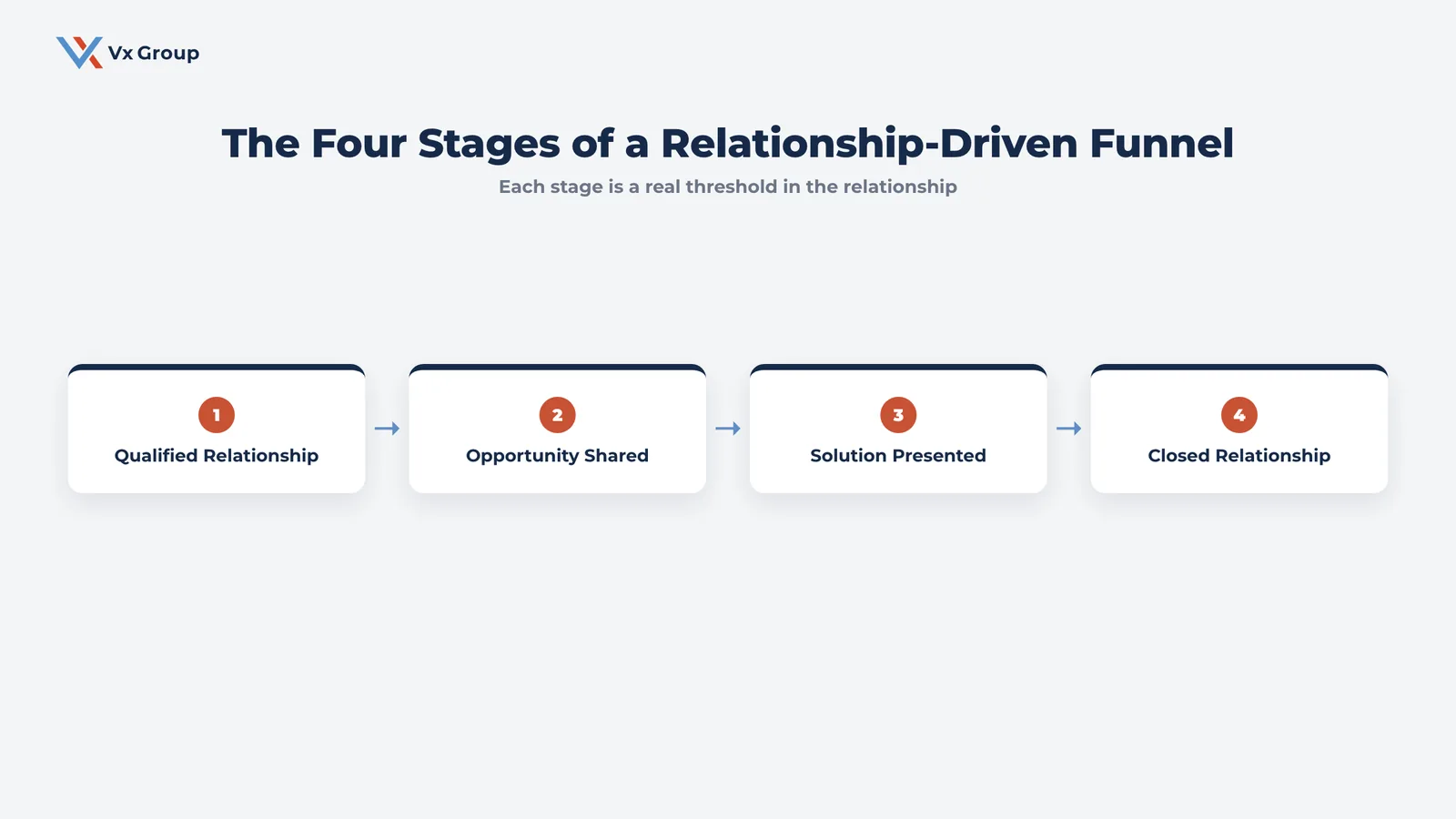
The real stages of a relationship-driven funnel are thresholds: a qualified relationship, a shared opportunity, a presented solution, and a closed deal. Each one represents a moment when something genuine changed in the relationship, and reaching it requires real work rather than a checkbox.
Stage one: a qualified relationship
The first real stage is a genuine, trust-based connection with someone who fits your ideal customer profile. A name captured at a trade show doesn’t qualify on its own, and neither does a contact who opened three emails. A qualified relationship exists when a real person has engaged, shown authentic interest, and been confirmed as a fit against a real ideal customer profile, not a gut feeling.
This distinction carries weight because everything downstream depends on it. A funnel full of names that were never truly qualified will underperform no matter how good the later stages are, because the foundation was never real to begin with. A sales team chasing a list of unqualified contacts stays busy without necessarily becoming more productive.
Stage two: a shared opportunity
The second stage is reached when a qualified relationship surfaces a real need that fits your products or services. The key word is surfaces. The opportunity comes from the customer because enough trust has been established for them to raise it, rather than from a salesperson pushing for a reason to send a quote.
A rep who has been genuinely useful up to this point earns the opportunity when it appears. A rep who pushes for it too early, before the relationship has earned that level of openness, tends to get a polite decline or a quote request that goes nowhere. The difference between the two outcomes usually traces back to whether stage one was actually completed or just assumed, which is the same discipline behind account-based selling done well instead of chasing volume.
Ready to grow?
Get a straight read on how your pipeline actually reflects your sales process.
Stage three: a presented solution
The third stage is reached when your team responds to the shared opportunity with something specific and tailored to what the prospect actually described. A standard deck sent to every prospect regardless of their situation does not count, even if it technically gets sent.
Reaching this stage means the relationship has earned enough trust that a formal proposal makes sense on both sides. A solution presented before that trust exists tends to get compared on price against every other vendor in the running, because nothing about the pitch signaled that your company understood the specific problem.
Stage four: a closed relationship
The fourth stage is reached when the prospect commits to moving forward. This is where most sales training focuses all its attention, though a strong close is usually just the natural result of every prior threshold being crossed with real intention, stage by stage, over the length of the relationship.
| Stage | What it really means | What it is often mistaken for |
|---|---|---|
| 1. Qualified relationship | A real person, engaged and confirmed as a fit | A name in a CRM or an opened email |
| 2. Opportunity shared | The customer surfaces a genuine need | A rep manufacturing a reason to quote |
| 3. Solution presented | A tailored response to what was surfaced | A generic pitch sent to everyone |
| 4. Closed relationship | A committed relationship, built stage by stage | A clever closing tactic at the end |
Defined Term: Field Notes
This is one of the most common patterns we see when a company enforces real stage definitions for the first time. Pipelines that looked healthy for months turn out to be full of deals marked “qualified” that never actually earned it. Once the definition gets applied honestly, a meaningful share of the pipeline drops out immediately. What’s left is smaller, but it’s real, and forecasts built from it start landing close to what actually happens. The shakeout feels uncomfortable in the moment, but it’s usually the first sign the funnel is finally telling the truth.
How Do You Tell a Real Threshold From a Logged Activity?
You tell the difference by asking what actually changed in the relationship instead of what task got completed in the CRM. A logged activity is something a rep did. A real threshold is something that became true about the relationship as a result.
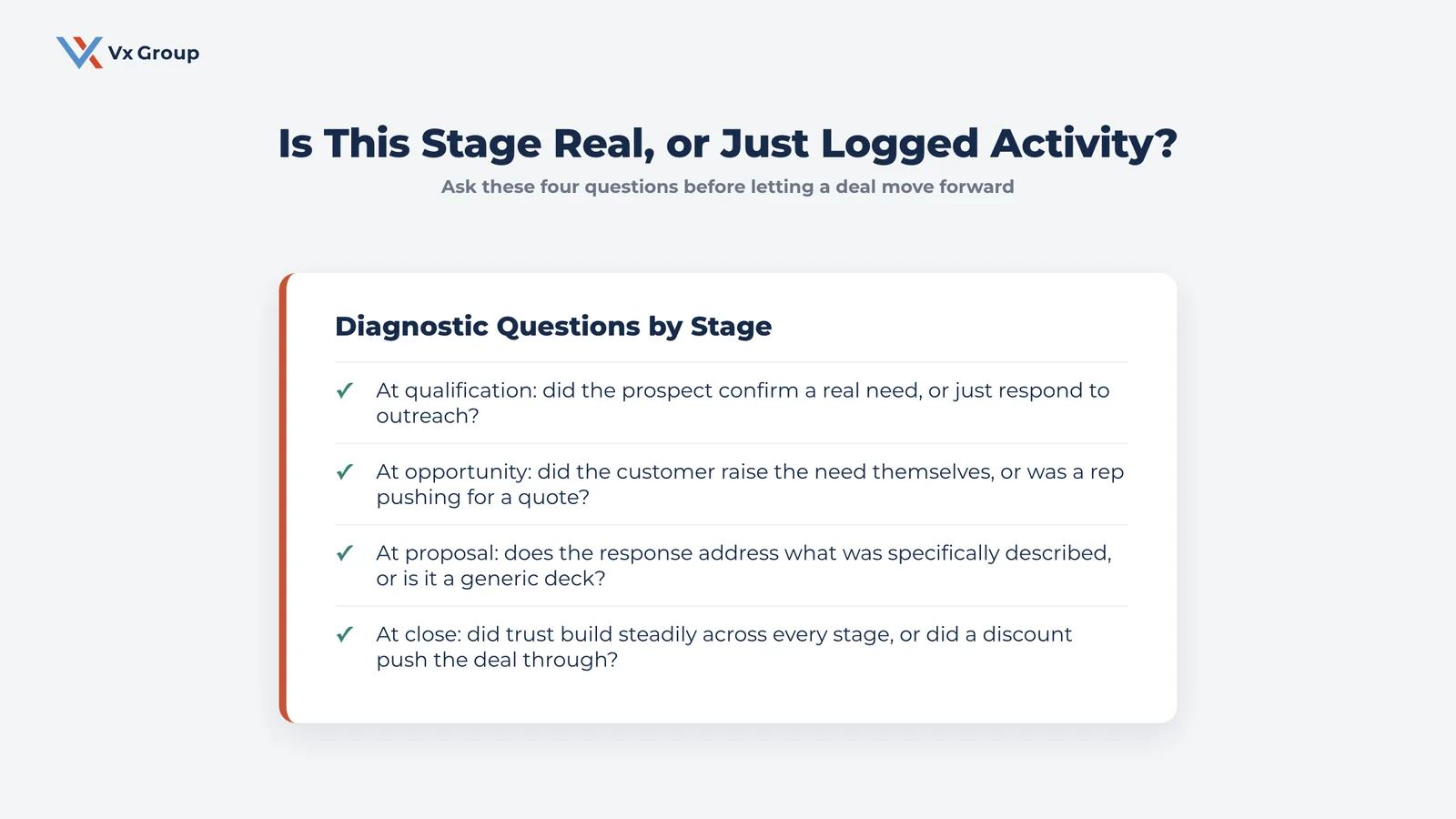
Use these questions at each stage before letting a deal move forward:
- At qualification: Has this person confirmed a real need, or did they just respond to an outreach sequence?
- At opportunity: Did the customer raise this need themselves, or did a rep talk them into requesting a quote?
- At proposal: Does this response address what the customer specifically described, or is it the same deck sent to the last five prospects?
- At close: Did trust build steadily across every prior stage, or is this a deal that got pushed through on a discount at the end?
If the honest answer to any of these is the second option, the stage hasn’t actually been earned yet, no matter what the CRM says. Fixing this requires a shared, written definition of each stage that the whole sales team uses the same way. Without that definition, one rep’s read on “qualified” becomes another rep’s “cold,” and the pipeline report turns into a document of opinions instead of a source of truth.
Why Are Most B2B Sales Pipelines Exaggerated?
Most B2B sales pipelines are exaggerated because stages get claimed on activity instead of on what actually happened in the relationship. A rep makes a single call and marks the contact qualified. A short conversation happens and the deal jumps straight to proposal. None of it necessarily reflects whether the relationship crossed a real threshold.
This happens for reasons that are understandable even when the result is a bad pipeline. Reps are measured on activity, so they log activity. Sales managers want a full-looking pipeline, so stages get generous benefit of the doubt. Nobody sits down and writes out what has to be true at each stage, so everyone applies their own private definition.
The cost shows up at the worst possible time. Deals sit in late stages that were never really earned, inflating the forecast. Leadership makes hiring and investment decisions based on a pipeline that looks healthier than it is. When those late-stage deals don’t close, the miss gets blamed on the market or the sales team, when the actual problem is a pipeline that was never measuring anything real to begin with.
Fixing this is a definitional exercise more than a technology upgrade. A relationship is qualified when interest and fit are genuinely established, and that has to be spelled out clearly enough that two different reps would reach the same conclusion about the same prospect. Once every stage has a real, shared definition, the pipeline becomes something leadership can actually trust when they’re making decisions.
Ready to grow?
Walk through where the gap between your pipeline reports and your forecast is actually coming from.
How Do You Use the Funnel to Diagnose Where Growth Is Stalling?
You diagnose stalled growth by finding the specific stage where relationships consistently get stuck, instead of assuming the answer is always more activity at the top. The funnel’s real value is diagnostic: it shows you exactly where momentum dies so you can fix the actual problem instead of guessing.
Three patterns show up most often in relationship-driven B2B companies:
Relationships pile up at qualification and never become real opportunities.
This usually points to a relationship-building gap instead of a shortage of leads. The company is meeting plenty of people who fit the ideal customer profile, but nobody on the team is doing the work of building enough trust for a real need to surface.
Opportunities get shared, but solutions never land.
This points to a response problem. The team may be too slow, too generic, or too disconnected from what the customer actually described. A proposal that arrives three weeks late or reads like a form letter loses the trust that got the opportunity shared in the first place.
Solutions get presented, but deals stall before closing.
This usually means trust wasn’t deep enough before the proposal went out. A prospect who hasn’t fully bought into your team yet will sit on a proposal indefinitely, or shop it around for a better price, because nothing about the relationship made your solution feel like the obvious choice.
Most companies respond to flat sales by adding more leads at the top of the funnel. If the constraint is actually in the middle, at qualification or opportunity-sharing, more leads just make the clog worse. The team ends up managing a longer list of unqualified names instead of fixing the actual bottleneck, which usually has more to do with how relationships are built than how many prospects enter the pipeline.
This is the same discipline that makes a pipeline reliable rather than dependent on one person’s memory: defining the stages by what is real, so the funnel becomes a diagnostic tool leadership can act on instead of a wish list the sales team hopes comes true.
What Should You Measure Instead of Activity Alone?
You should measure relationship advancement and account depth as the primary signals, and keep activity counts as a supporting check instead of the main scoreboard. Activity metrics like calls made and emails sent are easy to track, which is exactly why they get overused. They tell you how busy the team is, but rarely whether the business is actually growing.
| Metric type | Activity-based version | Relationship-based version |
|---|---|---|
| Pipeline health | Number of open deals | Number of deals with a genuinely earned stage |
| Rep performance | Calls and emails sent per week | Relationships advanced to the next real threshold |
| Account growth | New logos closed | Wallet share and depth within existing accounts |
| Forecast accuracy | Stage-weighted deal value | Stage-weighted deal value, adjusted against verified threshold criteria |
None of this means activity metrics are useless. A rep who makes zero calls in a month has a real problem. But activity should function as a floor, a baseline level of effort, instead of the number leadership uses to judge whether the pipeline is healthy. The moment activity becomes the scoreboard, the sales team optimizes for activity, and the funnel fills with logged tasks instead of real relationship progress.
Account depth deserves particular attention in a relationship-driven business. A single long-standing account that anchors a meaningful share of revenue often contributes more to the business than several new logos combined, and a funnel that only tracks new-business activity misses that entirely. Adding more top-of-funnel leads is rarely the fastest path to growth when the real opportunity is expanding relationships that already exist.
How Do You Build This Funnel Into Your Own Sales Process?
You build this funnel by writing down what has to be true at each stage, training the team on that definition, and reviewing the pipeline against it regularly instead of taking stage labels at face value. This is a process change more than a technology change, though the CRM has to support it.
Write a one-sentence definition for each stage.
What has to be true, specifically, for a deal to sit in qualified relationship, opportunity shared, solution presented, and closed. Keep the language concrete enough that two reps would apply it the same way to the same deal.
Audit the current pipeline against those definitions.
Go through every open deal and ask honestly whether it has actually earned its current stage. Expect some deals to move backward. That’s the system working correctly.
Rebuild the CRM stages to match your funnel.
Most CRMs ship with a default pipeline built for a generic sales process. Rename and reconfigure the stages so the tool reflects your actual funnel instead of forcing your funnel to fit the tool’s defaults.
Train the team on what counts as real evidence at each stage.
A rep should be able to point to something specific the prospect said or did. A general feeling that the deal seems close isn’t enough.
Review the pipeline on the new definitions every week.
The first few reviews will surface disagreements about what counts. That’s useful. Resolving those disagreements is how the definitions get sharper over time.
The companies that stick with this process for a full sales cycle typically end up with a smaller pipeline and a more accurate forecast. That trade is almost always worth making, because a smaller, honest pipeline is more useful to leadership than a large one nobody fully trusts, and it sets up the same account discipline behind lasting customer retention strategies.
Who Should Own Each Stage of the Funnel?
Ownership should follow the work required to earn each threshold, which usually means more than one role touches the funnel even on a small sales team. Confusion about ownership is one of the quieter reasons pipelines drift back toward activity-based fiction.
- Qualified relationship: Whoever does the relationship-building, whether that’s a dedicated business development role or an owner who still handles early conversations personally. This stage requires patience and real listening more than a sales pitch.
- Opportunity shared: The same person who built the relationship, in most relationship-driven companies, because the trust that produces a shared opportunity was built by them specifically.
- Solution presented: Whoever has the technical or product depth to build a response that’s actually tailored, which may mean a sales engineer, an estimator, or the owner, depending on the size of the company.
- Closed relationship: Shared ownership between the person who built the relationship and whoever has authority to negotiate final terms, since a clean handoff at this stage protects the trust built at every prior one.
Smaller companies often have one person covering all four roles, and that’s fine as long as the stage definitions stay clear. The real risk is having no shared definition at all, so the funnel becomes whatever that one person happens to remember about each relationship.
The Bottom Line on Building a Sales Funnel That Reflects Reality
An honest, four-stage funnel does more for a relationship-driven B2B company than a complicated one ever will. Four real thresholds, clearly defined and consistently applied, tell leadership more about the health of the business than fifteen activity-based stages ever could.
The work is unglamorous: sitting down with the sales team, agreeing on what has to be true at each stage, and having the discipline to move deals backward when they haven’t actually earned their position. A funnel built this way becomes a tool that shows exactly where a relationship-driven business is winning and where it’s stuck, instead of a report nobody fully trusts.
Ready to grow?
Get a clear read on where relationships in your pipeline are actually stalling.
Subscribe to Insights →
FAQs
About the Author: David Tisdale
