

How to Run a Quarterly Business Review Customers Want to Attend

A quarterly business review is a scheduled 60 to 90 minute meeting where a supplier and a customer review the last quarter, surface what is changing, and agree on commitments for the next one. The version customers value is built around their goals, with your performance as one section of the agenda.
TL;DR
- A QBR built around your own delivery metrics wastes the customer’s hour. They already know whether things are going well.
- Get the right people in the room first. Most QBRs fail on the invite list before the agenda matters.
- Send a pre-read 48 hours ahead so the meeting is a discussion and the slides are already absorbed.
- Spend the first 20 minutes on what changed in the customer’s business, then 15 on your performance.
- Four questions surface every risk worth knowing: what is changing, what are we making harder, who else are you evaluating, and what would make you expand.
- End with written commitments in both directions, each with a name and a date, and send the recap inside 48 hours.
The standard QBR goes like this. The supplier arrives with 20 slides. Slide four is on-time delivery. Slide seven is a ticket-volume chart. Slide twelve is a roadmap the customer did not ask about. Somewhere around minute 50, someone says “any questions,” there are none, and everyone leaves having decided nothing.
The customer sat through a performance recap of information they already had. They know whether shipments arrive on time. They live with the product every day. What they did not get was an hour of anyone’s attention on the thing they are actually worried about, which is usually something happening inside their own company that will change what they need from you in six months.
That gap is expensive. The QBR is the one recurring meeting where a customer will tell you what is coming, if you build it so they can. Suppliers who use it as a slide deck find out about the RFP after it is issued.
Defined Term: Quarterly business review (QBR).
A recurring strategic meeting between a supplier and a customer, typically 60 to 90 minutes each quarter, covering performance against commitments, changes in the customer’s business, risks in the relationship, and a joint plan for the next quarter. Often called a customer business review or a business review meeting.
What is a quarterly business review, and how is it different from a status call?
A QBR looks forward and includes people with authority to decide something. A status call reviews the current week’s work with the people handling it. Confusing the two is the most common structural mistake, and it produces a 90 minute meeting that could have been an email.
A status call covers open tickets, shipment timing, and this week’s problems. It happens weekly or monthly at the working level. A QBR covers where the customer’s business is heading, whether the relationship is delivering what both sides expected, and what should change. It happens quarterly and it includes someone with budget authority on both sides.
The other distinction worth naming: QBRs come in two forms, and the word gets used for both.
- An internal QBR is a leadership meeting where a company reviews its own quarter, its targets, and its plan. Departments present, leadership decides.
- An external or customer QBR is a meeting between a supplier and a strategic account. This is the one covered here, and it is the one that protects revenue you already have.
Know which accounts earn a quarterly meeting
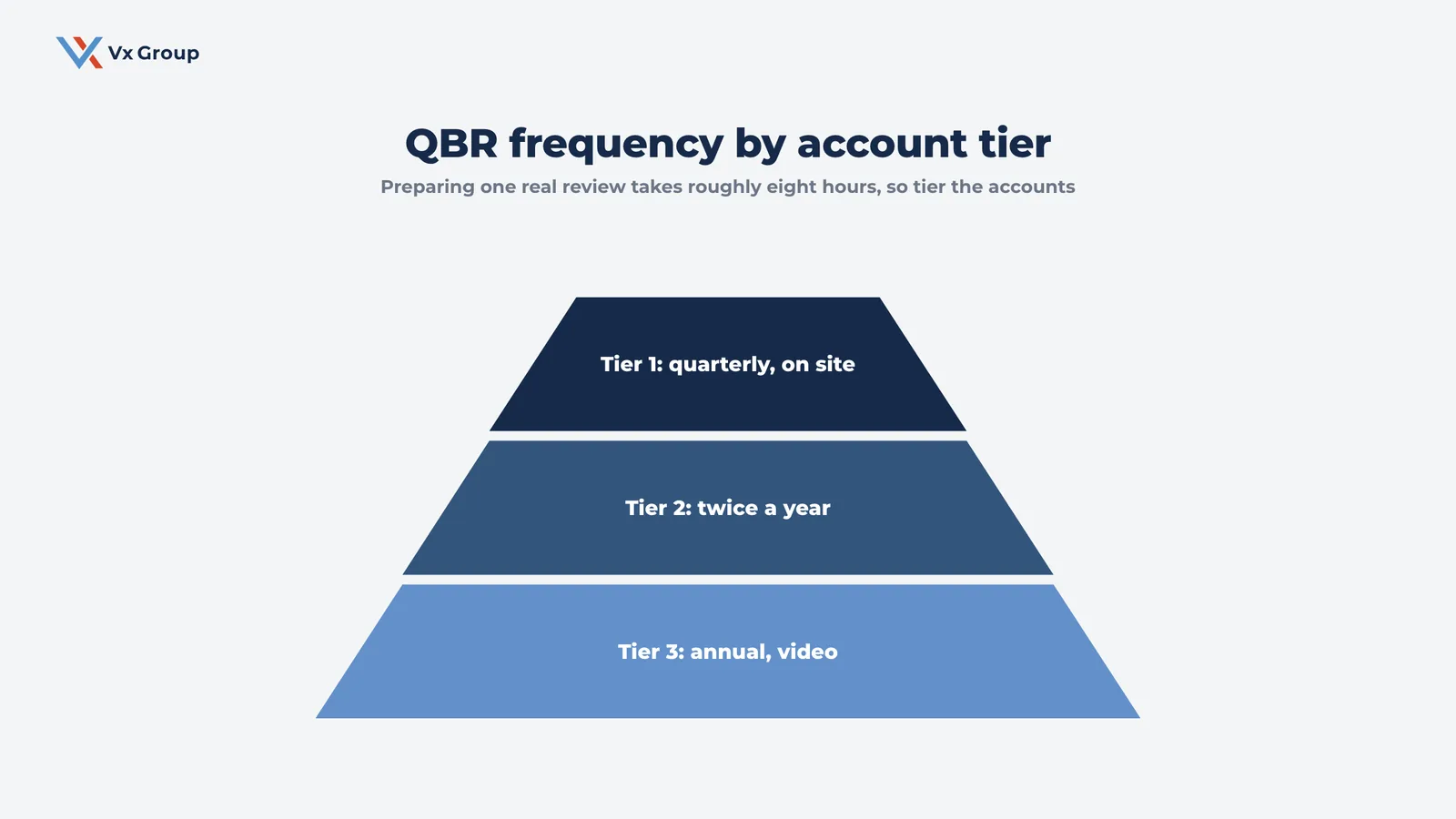
Running a real QBR takes roughly eight hours of preparation. You cannot do that for 200 accounts, and attempting it produces thin meetings that annoy everyone. Tier your accounts and match the frequency to the revenue and the risk.
| Tier | Which accounts | Frequency | Format |
|---|---|---|---|
| Tier 1 | Your top 10 by revenue, plus any account where losing them would change your year | Quarterly | On site where possible, video otherwise |
| Tier 2 | Accounts with real expansion room, or where a competitor is active | Twice a year | One on site, one video |
| Tier 3 | Steady accounts with predictable volume and low risk | Annually | Video, 60 minutes |
The tiering conversation is worth having with sales and operations together, because operations often knows which relationship is fragile before sales does.
Step 1: Who needs to be in the room, and why does this decide the meeting?
Decide the invite list before the agenda, because the wrong room caps what the meeting can accomplish no matter how good the slides are. A QBR with two account managers and a coordinator cannot make a decision, so it becomes a status call with a longer agenda.
Get one decision maker from each side
From your side: the person who owns the relationship, plus one person who can commit resources without asking permission. From the customer’s side: your day-to-day contact, plus their manager or the budget owner. Two to four people per side is the working range. Above eight total, the meeting turns into a presentation and the honest conversation stops.
Bring the person who does the work, once a year
Once a year, bring the plant manager, the lead engineer, or the service supervisor who actually handles the account. Customers consistently report that the most useful QBR of the year was the one where the person doing the work answered questions directly. It also gives your own team a face for the account, which changes how they treat it.
Ask the customer who else should attend
Send the invite with one line: “Is there anyone on your side who should be part of this?” That question surfaces the new operations director you did not know had been hired, and the procurement lead who is quietly running a market check. Both are worth knowing about a quarter early.
Confirm attendance a week out and move the meeting if a decision maker drops
A QBR where the budget owner drops out at the last minute should move to a new date. Running it anyway trains everyone that attendance is optional, and by the third quarter you are meeting with a coordinator.
Step 2: How do you send a pre-read that makes the meeting a discussion?
Send a short pre-read 48 hours ahead covering the numbers, so the meeting itself can be spent on judgment. Presenting data live is the single largest waste of QBR time, because reading a chart aloud to people who can read takes 20 minutes that a two-page document handles in four.
Keep the pre-read to two pages
Page one: performance against what you committed last quarter, in a simple table. Volume, on-time percentage, quality issues and how they were resolved, spend versus plan, open items from the last meeting with current status. Page two: what you observed and the three things you want to discuss.
No cover slide, no company boilerplate, no roadmap. Two pages, PDF, in the calendar invite.
Include the open items from last quarter with honest status
Every commitment from the last QBR gets a row and a status: done, in progress with a date, or missed with a reason. Suppliers who quietly drop a missed commitment from the deck lose credibility the moment the customer notices, and the customer always notices. Listing a miss plainly, with what you are doing about it, buys more trust than a clean slide would.
Send three questions with the pre-read
Give the customer the three questions you most want to discuss, in advance. It gives them time to prepare a considered answer, and it signals that you want their input on the agenda. Something like: “What has changed in your production plan for next year?” “Where are we creating friction for your team?” “What are you being measured on this year that we could help with?”
Step 3: How should you structure a QBR agenda around the customer's goals?
Build the agenda so the customer’s business gets the first and largest block of time, and your performance gets one section in the middle. That ordering does most of the work. It also changes who talks first, which changes the whole tone of the meeting.
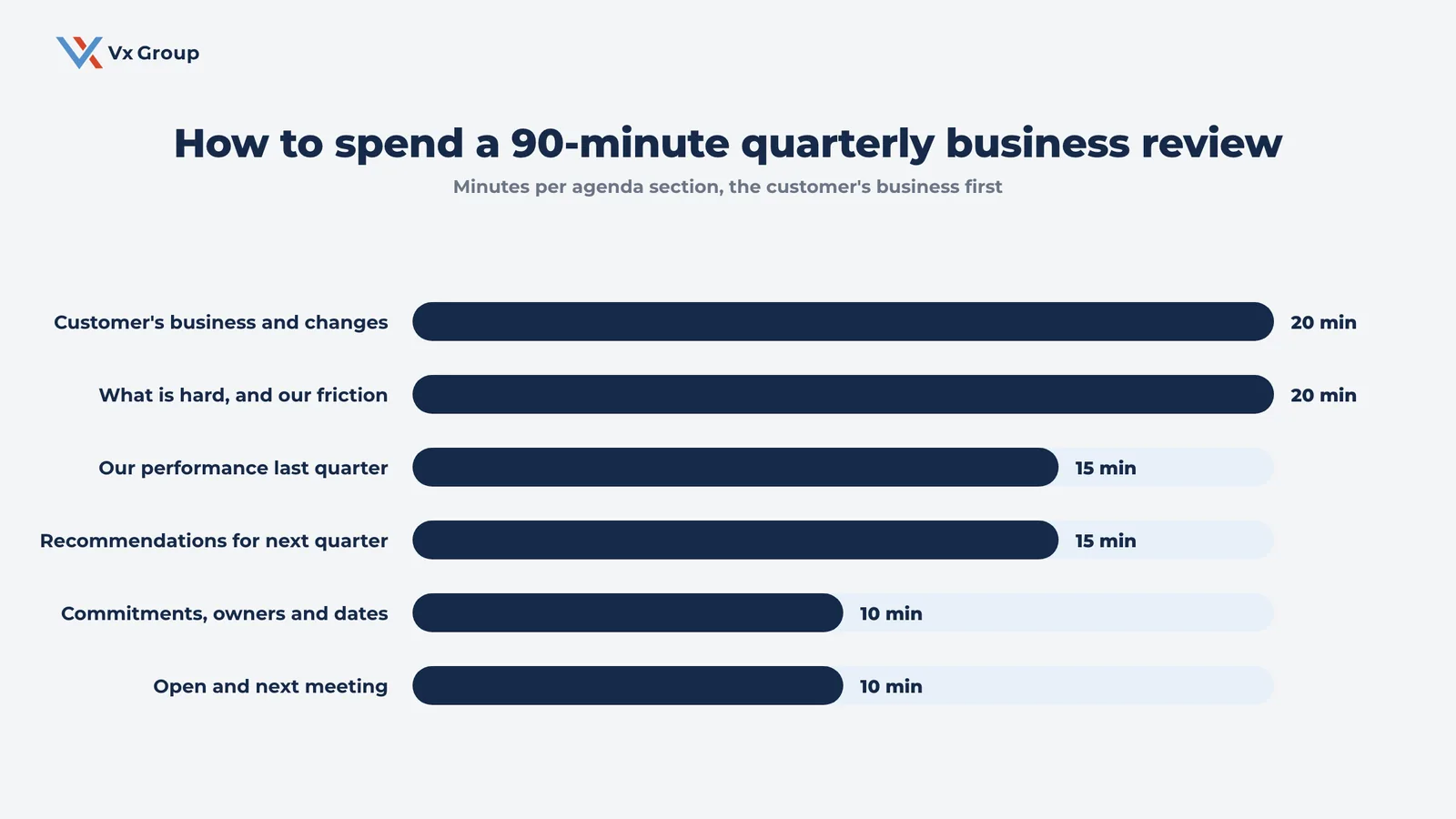
Here is the 90 minute structure that works:
| Time | Section | Who leads |
|---|---|---|
| 0 to 5 min | Welcome, confirm the agenda, name the outcome you want | Your account lead |
| 5 to 25 min | What changed in the customer’s business this quarter, and what is coming | The customer |
| 25 to 40 min | Your performance against last quarter’s commitments | You |
| 40 to 60 min | What is hard right now, including where you are creating friction | Both |
| 60 to 75 min | What you recommend for next quarter, with the reasoning | You |
| 75 to 85 min | Commitments in both directions, with names and dates | Both |
| 85 to 90 min | Confirm the next meeting and who attends | Your account lead |
Open by naming the outcome you want from the hour
Start with one sentence: “By the end of this, I want us to have agreed on three things for next quarter and to understand what is changing on your side for the second half.” It gives the meeting a standard to be judged against, and it tells the customer to expect a conversation.
Hand the customer the first 20 minutes
This is the part most suppliers cannot bring themselves to do. Ask what changed, what is coming, what they are being measured on, and what the pressure is. Then take notes and stay quiet. Twenty minutes of a customer describing their own business will tell you more about next year’s revenue than any report you could have built.
Keep your performance section to 15 minutes and lead with the problem
Cover the misses first, with what you did about them. Then the wins, briefly. Then anything that surprised you in the data. Fifteen minutes is enough because the pre-read already carried the numbers.
Ready to grow?
See how a working account rhythm gets built across your top relationships.
Step 4: What four questions surface risk in a customer relationship?
Ask these four, in this order, every quarter, and write down the answers verbatim. They surface the things that show up later as a lost renewal or a surprise RFP, usually two or three quarters before the loss would have become visible any other way.
- “What is changing on your side over the next two quarters?” New plant, new ERP, a merger, a retirement, a new VP with a mandate. Every one of these changes what they need from you, and most of them are known internally months before a supplier hears about it.
- “Where are we making your job harder?” Phrase it exactly this way. Asking “how are we doing” gets you “fine.” Asking what you are making harder gets you the invoicing problem, the portal nobody can log into, and the rep who takes three days to answer email.
- “Who else are you evaluating, and for what?” Ask it plainly and without defensiveness. Most customers will answer honestly, because they would rather you improve than switch. A vague answer is itself information.
- “What would have to be true for you to buy more from us?” This finds the expansion path in the customer’s own words. Sometimes it is a certification you could get in a quarter. Sometimes it is a service you already offer and they did not know about.
Write the answers down in the customer's words
Do not paraphrase into your own language during the meeting. “We are consolidating to two suppliers per category by Q3” is a different sentence from “customer mentioned consolidation,” and the first one is the one that should reach your leadership.
Route what you hear to someone who can act on it
An answer that lives in a rep’s notebook changes nothing. Anything in the four answers that touches pricing, capacity, product, or a competitive threat needs to reach the person who can respond, inside a week, with the customer’s exact words attached.
Step 5: How do you close a QBR so something actually happens?
Close with written commitments in both directions, each with a named owner and a date, read aloud before anyone leaves. The single largest difference between a QBR that produces results and one that produces goodwill is whether the last 10 minutes generate a list.
Write commitments live, on the screen
Open a shared document and type them while everyone watches. Three to five items is the right number. Each one needs a specific action, one name, and a date. A commitment reads like “Dana will have the consolidated invoice format to Mark by March 14.” Anything vaguer than that, such as “we will look into the invoicing issue,” will still be open at the next meeting.
Ask the customer for commitments too
This feels uncomfortable the first time and it changes the relationship. When both sides leave with something to do, the meeting becomes a working partnership, and a customer who has committed to something has a reason to care how the quarter goes. Ask directly: “What can your team commit to before we meet again?” Often it is small: introduce you to the new operations director, share the production forecast, get a decision on the second plant.
Read the list aloud before anyone leaves
Thirty seconds. It catches the item someone misheard and it makes the commitments feel real.
Set the next meeting date in the room
Put it on calendars before people stand up. QBRs that get scheduled afterward slip a month, then a quarter, then quietly stop happening.
Step 6: What does the 48 hour follow-up look like?
Send the recap inside 48 hours, while the meeting is still in everyone’s memory, containing exactly what was agreed. The document is short and it does three jobs: it confirms the commitments, it creates a record for people who were not in the room, and it gives your own team a working plan.
Include:
- The commitment list, both sides, with owners and dates
- What the customer said is changing, in their words
- Anything you agreed to look into and when they will hear back
- The next meeting date and who is expected
Then do the small commitment first. If one item on your list can be finished inside a week, finish it that week and tell them. Speed on a small commitment does more for credibility than a perfect answer on a large one delivered in a month.
Track commitments where the next QBR will find them
Every commitment goes into the account record with its date. Ninety days later, that list becomes the open-items table in the next pre-read. Companies that keep this record have a QBR that compounds. Companies that rebuild the deck from scratch each quarter have four unrelated meetings a year.
Where quarterly business reviews go wrong
The failure patterns are consistent:
- The deck is about you. Delivery metrics and ticket charts fill the hour, and the customer’s business gets 10 minutes at the end.
- The wrong people are in the room. Nobody present can commit budget or change a process, so nothing gets decided.
- Data gets presented live. Twenty minutes of reading charts aloud replaces the conversation the meeting existed for.
- Nobody asks what is hard. “How are we doing” gets “fine,” and the friction stays invisible until it becomes a reason to leave.
- The close has no list. Everyone agrees things were productive, and 90 days later the same items come up again.
- Only the supplier commits. The customer becomes an audience, and the relationship stays one-directional.
- Every account gets the same meeting. Tier 3 accounts get quarterly meetings they do not want while Tier 1 accounts get a generic agenda.
Field Notes:
A components manufacturer had run quarterly reviews with its largest customer for six years, always the same format: on-time delivery, quality, open tickets, roadmap. The relationship was worth about $4M a year and everyone considered it secure. We changed one thing. The account lead gave the customer the first 20 minutes and asked what was changing. The customer’s operations VP explained that a corporate mandate would cut their approved supplier list from nine to four within 18 months, and that the decision criteria included on-site technical support, which the manufacturer did not offer in that region. That was the first anyone on the supplier side had heard of it. They had four quarters to respond, and they used them. The information had existed inside the customer’s building for months. The old agenda had no place for it.
Where to start with your next QBR
Take your next scheduled review and change three things. Send a two-page pre-read 48 hours ahead. Give the customer the first 20 minutes and ask what is changing. Close with a written list of commitments from both sides, with names and dates.
Those three changes cost you nothing and they will change what you learn in the meeting. Then tier your accounts and decide which relationships genuinely warrant four of these a year. The rest of the system, the account plans, the routing of what you hear, the tracking that makes each quarter build on the last, follows from getting the meeting itself right.
Ready to grow?
We help companies build the account rhythm that protects the revenue they already have.
Related reading
- Account Expansion
- How to Improve Customer Retention in B2B
- Your Top 10 Customers Are a Strategy
- Customer Concentration Risk: What It Is and How to Reduce It
- Distributor Management
- Channel Sales Strategy
FAQs
About the Author: Jacob Camhi
