

B2B Demand Generation: What It Is and How to Do It Right

B2B demand generation is the work of making the right buyers aware of you, trust you, and want what you do before they ever enter a sales conversation. For relationship-driven companies, that demand is built through reputation, referrals, and useful expertise rather than the landing-page funnels borrowed from software marketing.
TL;DR
- Demand generation builds awareness, trust, and want before a sales conversation; lead generation captures contact details from people who are already looking.
- For relationship-driven B2B, demand forms through reputation, referrals, and expertise, so most demand gen advice written for SaaS ad funnels does not transfer.
- Demand has two halves: demand creation, which warms a market that is not buying yet, and demand capture, which converts the intent that already exists.
- The companies that win are known and trusted before the RFP goes out, so they are rarely compared on price alone.
- A real demand generation strategy invests in the large share of your market that is not in-market this quarter.
- Most lead-capture metrics miss demand entirely. Measure reach, trust, and how warm your pipeline starts.
- A demand generation agency should fit how your buyers actually decide, which for long-cycle B2B means relationships ahead of ad spend.
Most of what gets published about demand generation was written for a different kind of company than yours. It assumes a short sales cycle, a self-serve product, and a buyer who finds you through a paid ad, fills out a form, and books a demo the same week. That playbook produces a tidy funnel and a dashboard full of conversions.
It also falls apart the moment your deals take nine months, your buyers stay for fifteen years, and the most important conversations start with a referral instead of a click. For relationship-driven B2B companies, demand does not come from a funnel. It comes from being known, trusted, and top of mind long before anyone is ready to buy. This guide explains what demand generation means in that world, how it differs from lead generation, and how to build a strategy that fits the way your market actually decides.
What is B2B demand generation?
B2B demand generation is everything you do to make a defined market aware of you, confident in you, and interested in the outcome you deliver, so that buying conversations start warm. It works on the whole market, including the large majority who are not ready to buy this quarter, and it plays out over months and years rather than days.
Defined Term: Demand generation
The ongoing work of creating awareness, trust, and interest across your whole market so that the right buyers already know and want what you do before a sales conversation begins. It is broader than any single campaign and longer-term than any one quarter’s pipeline.
The phrase confuses people because it gets used two ways. Software marketers often mean a measurable funnel of ads, gated content, and lead scoring. For relationship-driven companies the meaning is closer to its plain reading: generating genuine demand for what you do. That demand shows up as inbound referrals, prospects who arrive already convinced, and a shortlist that includes you by default.
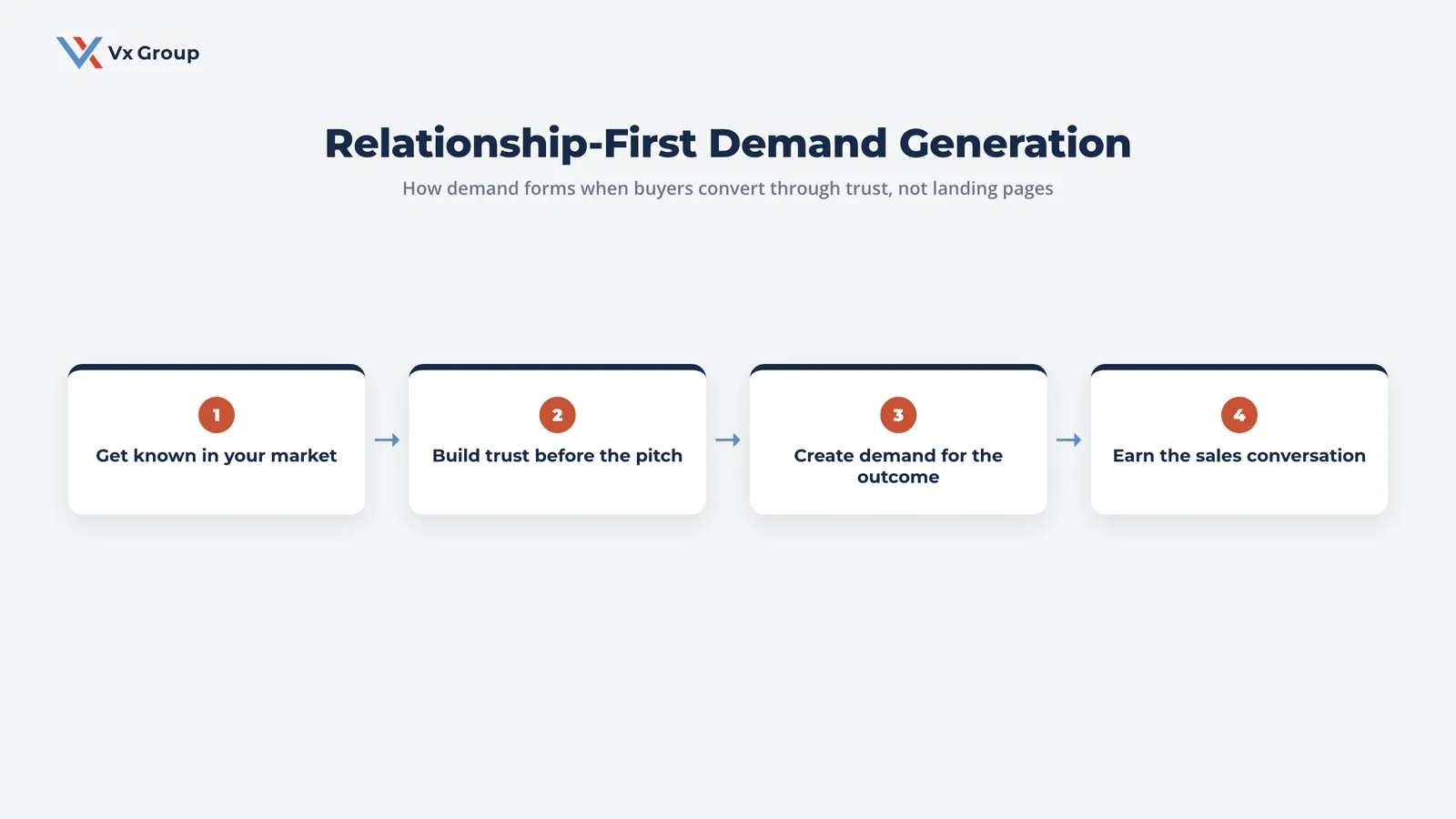
Demand forms in a sequence. First you get known in the market you care about. Then you build trust by being visibly useful, through expertise, reputation, and the way you show up. That trust turns into demand for the specific outcome you deliver. Only then do you earn the sales conversation, and by that point it barely feels like selling. Each step depends on the one before it, which is why companies that skip straight to capturing leads find the leads cold and the conversion slow.
What is the difference between demand generation and lead generation?
Demand generation and lead generation are different jobs, and confusing them is the most common reason a growth program underperforms. Lead generation captures contact information from people who are already in some stage of looking. Demand generation creates the want in the first place and keeps you in front of buyers long before they raise their hand.
Defined Term: Lead generation
The work of capturing contact details from people showing some buying interest, so sales has someone to follow up with. It harvests existing demand rather than creating it.
Both matter. The mistake is running only lead capture and calling it demand generation, then wondering why the pipeline is thin and price-driven. If you are only ever harvesting the small slice of the market that is actively shopping, you are competing for the most price-sensitive, most contested buyers, and you are invisible to everyone who will be ready next year. This is the same trap we describe in why more leads is almost never the answer: more captured leads rarely fixes a demand problem.
| Demand generation | Lead generation |
|---|---|
| Creates awareness, trust, and want | Captures contacts who already show interest |
| Works the whole market, including future buyers | Works the small slice that is in-market now |
| Plays out over months and years | Measured in days and weeks |
| Wins the deal before the RFP | Competes inside the RFP |
| Measured by reach, trust, and pipeline warmth | Measured by form fills and MQLs |
| Reduces price sensitivity | Often increases price competition |
For a fuller treatment of the definitional side, our companion article on what B2B demand generation means for relationship-driven companies goes deeper on the language. This guide stays focused on strategy.
What is the difference between demand creation and demand capture?
A complete demand generation strategy does two jobs at once: it creates demand among people who are not buying yet, and it captures the demand that already exists. Most companies are passable at capture and almost absent at creation, which is why their growth depends entirely on whoever happens to be shopping this quarter.
Defined Term: Demand creation
The work of building awareness and trust among buyers who are not in-market yet, so that when they do enter a buying cycle you are already the name they reach for. It is the half of demand generation that compounds.
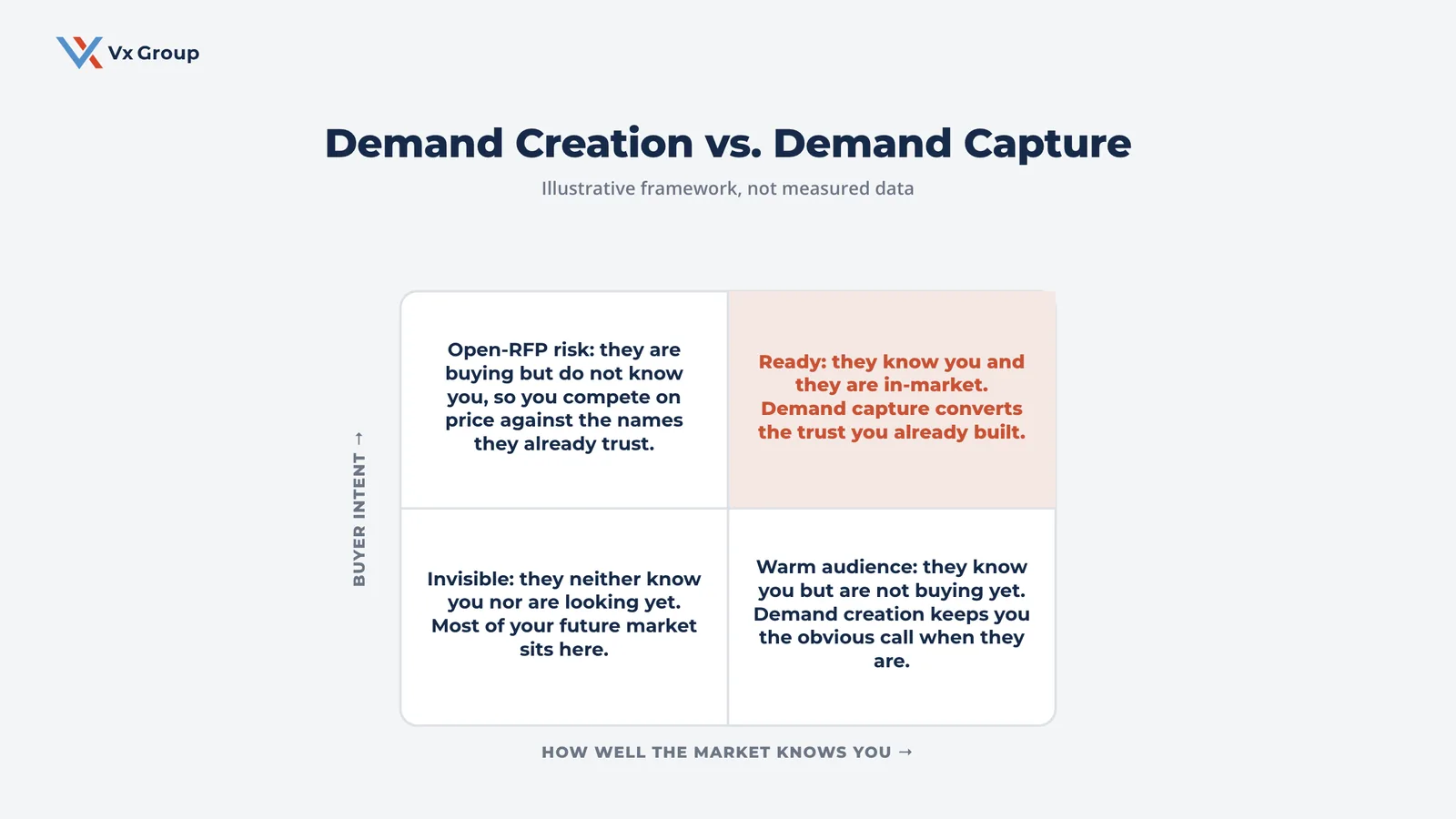
The framework above maps your market on two axes: how well buyers know you, and how ready they are to buy. The buyers in the top right already know you and are in-market, so capture converts them quickly. The dangerous quadrant is the top left, where buyers are ready but do not know you, so you arrive late to an RFP and compete on price against the names they trust. Demand creation is how you move buyers out of the invisible bottom-left corner and into the warm audience that thinks of you first. Capture without creation leaves most of your market permanently out of reach.
The numbers behind this are well established in B2B: at any given moment only a small fraction of your market is actively buying. The rest are future pipeline. A strategy that ignores them is a strategy that re-fights for scraps every quarter.
Why is demand generation different for relationship-driven B2B companies?
Relationship-driven B2B companies generate demand differently because their buyers decide differently. A manufacturer choosing a distribution partner, a family business selecting a long-term supplier, or an operator picking an advisor is not going to convert from a retargeting ad. They decide based on reputation, referrals from people they trust, and a track record they can verify. The trust has to exist before the need becomes urgent.
This is where borrowing the SaaS playbook becomes expensive. Gated ebooks, aggressive paid funnels, and lead-scoring models are built for high-velocity, low-consideration purchases. Applied to a 12-month, high-stakes decision, they generate activity without demand: a pile of cold contacts, a busy dashboard, and a sales team chasing people who were never close to buying. That is the activity illusion at work, and it is a form of random acts of marketing dressed up as a funnel.
The relationship-first alternative treats demand generation as part of how the whole business shows up. It connects to how you build a B2B growth strategy from scratch and sits inside the broader system that runs your growth. The work is concrete: become genuinely known in your niche, publish expertise that proves you understand your buyers’ world, turn satisfied customers into a referral engine, and make sure your brand and digital presence look like they belong in the room. None of it converts on a one-week timeline. All of it compounds.
Ready to grow?
If your pipeline depends on whoever is shopping this quarter and you want to build demand that lasts longer than a campaign.
How do you build a B2B demand generation strategy?
Building a relationship-first demand generation strategy is a sequence you can start this quarter. The point is to create demand deliberately instead of hoping it shows up.
1. Define the market you actually want
Demand generation aimed at everyone reaches no one. Get specific about the segments, industries, and buyer roles where you win, and concentrate your reach there. A tight definition makes every later step sharper and cheaper.
2. Decide what you want to be known for
Pick the outcome and point of view you want to own in that market. Buyers remember a company that stands for something specific. The goal is to be the obvious call for a particular problem, which means saying one clear thing repeatedly rather than many things occasionally.
3. Be visibly useful
Publish the expertise your buyers actually need: how they should think about the decision, what good looks like, where the risks hide. Useful content earns trust at scale and does the demand-creation work while you sleep. This is also how you get cited by buyers and by the AI tools they increasingly ask.
4. Turn relationships into a referral engine
Your existing customers and partners are your most credible demand channel. Make referrals a deliberate motion with a clear ask and a reason for them to advocate, rather than a happy accident you wait on.
5. Make your presence match your quality
If your brand, site, and proposals make you look smaller than you are, you lose deals you never see. First impressions are the first trust deposit, and they decide whether demand-creation work converts.
6. Connect demand to the sales conversation
Define what a warm, sales-ready relationship looks like and how it gets handed off. Demand that never reaches a conversation is wasted, and a handoff that treats a warm relationship like a cold lead burns the trust you spent months building.
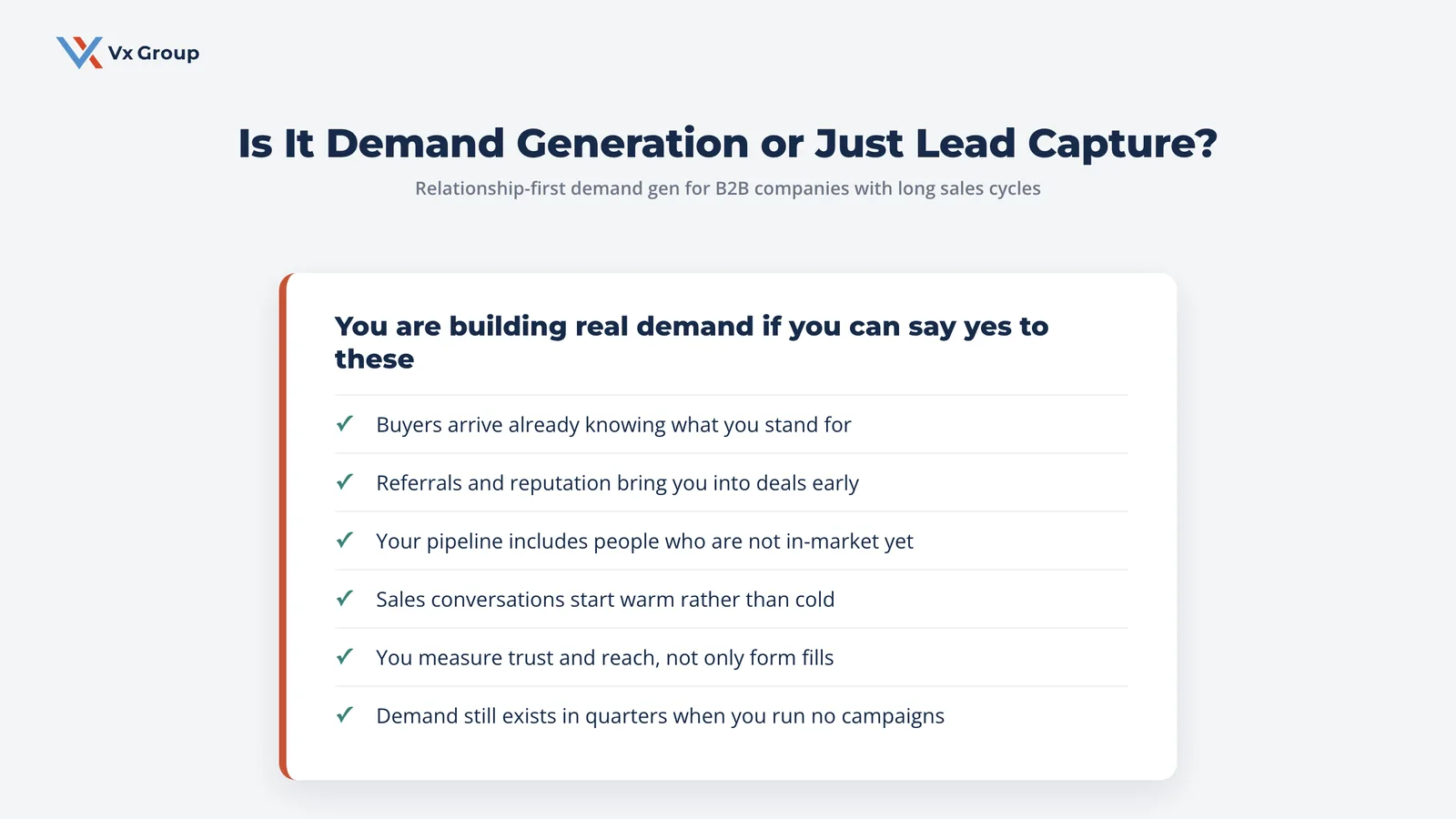
Run the checklist above against your current program. If most of your answers are no, you are capturing leads rather than building demand, and the fix is upstream of any campaign. A demand generation program works best when it lives inside a documented system rather than a set of disconnected tactics, which is the whole idea behind a business growth operating system.
What does a demand generation agency do, and how do you choose one?
A demand generation agency builds and runs the system that creates and captures demand for your business. The good ones design the strategy, produce the expertise and campaigns that build awareness and trust, set up the measurement, and connect all of it to your sales motion. Weaker ones stop at paid-media funnels and report leads regardless of whether those leads turn into demand.
The catch for relationship-driven companies is that most of the market labeled “demand gen agency” or “b2b demand generation agency” is built around the SaaS funnel model. They are excellent at capturing in-market intent through ads and landing pages. They are usually not built for a 12-month, referral-led, reputation-driven buying process. Hiring that model for a relationship-driven business produces the same activity illusion in-house teams fall into, just outsourced.
When you evaluate a demand generation agency, look for a few things:
- They ask about your buyers’ decision process before they pitch tactics.
- They can explain how they build demand among people who are not in-market yet, beyond how they capture those who already are.
- They measure reach, trust, and pipeline quality rather than lead volume alone.
- They treat your brand and reputation as part of the work rather than an afterthought.
- They understand that in your world, relationships and referrals outperform ad spend.
If an agency’s entire answer is paid media and landing pages, it is a lead-capture shop, and it will struggle with the half of the job that actually moves a relationship-driven business. This is the same lens we bring to evaluating any growth partner, covered in our guide to what B2B growth consulting is and when you need it.
How do you measure B2B demand generation?
Measuring demand generation is harder than measuring lead capture, which is exactly why so many teams default to the easy numbers and chase the wrong thing. Form fills and marketing-qualified leads are simple to count and tell you almost nothing about whether demand is growing.
Better signals track the things demand is actually made of:
- Reach in your defined market: are the right people seeing you, and is that number growing?
- Branded and direct demand: are more buyers seeking you out by name over time?
- Referral and inbound volume: how many opportunities arrive warm, through trust rather than cold outreach?
- Pipeline warmth: what share of new conversations start with the buyer already knowing and trusting you?
- Win rate and price competition: are you being compared on price less often because you arrive pre-trusted?
These move slowly, and that is the point. Demand generation is a long game, so the measurement has to respect the time horizon instead of forcing a quarterly funnel report onto a multi-year trust-building effort.
Field Notes: the funnel that produced everything but demand
A B2B services firm came to us proud of its demand generation. The dashboard was busy: thousands of downloads, a steady flow of marketing-qualified leads, a paid-media program with a respectable cost per lead. On paper, demand looked strong. The pipeline told a different story. Almost every closed deal traced back to a referral or a long-standing relationship, not the funnel. The leads from the ad program rarely closed, took forever, and competed hard on price. The company was spending most of its budget capturing the small, contested slice of buyers who were actively shopping, and almost nothing on becoming the trusted name for the much larger group who would buy later. The fix was not a better funnel. It was a shift of investment toward demand creation: publishing real expertise in their niche, building a deliberate referral motion, and making their brand look like the category leader they already were on the work. Within a few quarters, more conversations started warm, and the deals that did come through the funnel closed faster because buyers had heard of them first.
Where to start
If your growth depends on whoever happens to be shopping this quarter, you have a demand problem, and no amount of additional lead capture will fix it. Start by defining the market you want, deciding what you want to be known for, and investing in the trust that has to exist before the need does. Capture the demand that is already there, and build the demand that is not yet.
Demand generation done this way is slower than a paid funnel and far more durable. It produces a market that knows you, trusts you, and reaches for you first, which is the closest thing to an unfair advantage a relationship-driven B2B company can build.
Ready to grow?
To map a demand generation strategy built for how your buyers actually decide.
FAQs
About the Author: Jacob Camhi
