

Sales Leadership for Long-Cycle B2B Companies

Sales leadership in a long-cycle B2B company is the work of coaching people, covering relationships, keeping the forecast honest, and setting account strategy for deals that take nine to eighteen months. A leader here judges the team by what buyers do next, such as new contacts, meetings, and decisions. Call counts say little when the sale runs a year.
TL;DR
- A sales leader in a nine to eighteen month business does four jobs: coaching, relationship coverage, forecast honesty, and account strategy.
- Weekly activity reviews and call-count dashboards come from short-cycle selling. On a long cycle they produce busy reps and forecasts nobody trusts.
- Run the weekly one-to-one on one or two named deals and the relationships behind them. Keep status updates in the CRM.
- Run the pipeline review on five deals at a time, with the same four questions for each deal.
- Manage leading indicators such as new contacts at target accounts, buyer-confirmed next steps, and deals with two or more contacts.
- Plan for the top performer whose big accounts rest on one relationship before that person leaves, gets promoted, or retires.
- Set a quarterly rhythm for the leader: account reviews, forecast checks, coverage maps, and one hiring or coaching decision.
What this guide covers
- What sales leadership is on a long sales cycle
- How it differs from sales management
- Why activity dashboards fail on 12-month deals
- How to run the weekly one-to-one
- How to run the pipeline review
- How to keep the forecast honest
- What to measure
- How to coach a relationship
- How to handle a single-threaded top performer
- The leader’s quarterly rhythm
- Where to start this week
Many sales leaders in owner-led companies got the job because they were the best seller. Nobody taught them how to lead. So they borrow what they see in books and software demos. That means weekly activity reviews, call counts, and a dashboard with a green, yellow, or red light for every rep.
Those tools were built for teams that close in thirty days. A team whose deals take a year gets busy reps, forecasts nobody believes, and no earlier warning than it had before the dashboard arrived. A rep can hit every activity target and still lose the account the company needed.
This guide is for owners, presidents, and sales leaders at privately held B2B manufacturers and distributors. It lays out what the job is, how to run the meetings that matter, and what to measure. Each section gives you something to use the same week.
What does sales leadership mean when the sales cycle runs nine to eighteen months?
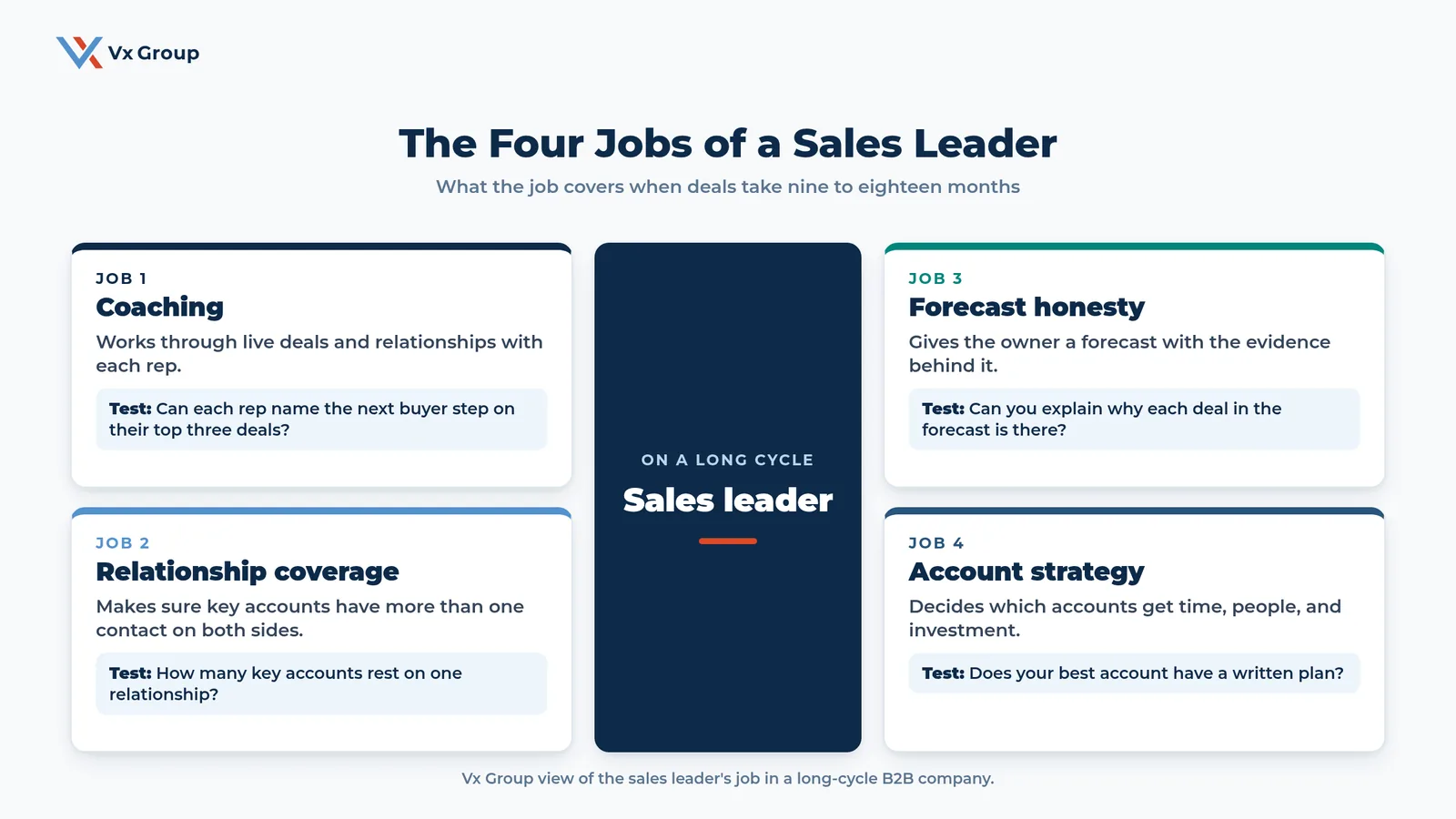
Sales leadership on a long cycle means developing the people who sell and protecting the relationships they build. The leader coaches reps on specific accounts and makes sure more than one person knows each buyer. The leader also tells the owner the real forecast and decides where the team spends its time.
The graphic above shows the four jobs. Each one has a test you can apply to your own team.
| Job | What the leader does | A test you can run this week |
|---|---|---|
| Coaching | Works through live deals and relationships with each rep | Can each rep name the next buyer step on their top three deals? |
| Relationship coverage | Makes sure each key account has more than one contact on both sides | How many key accounts rest on one relationship? |
| Forecast honesty | Gives the owner a forecast with the evidence behind it | Can you explain why each deal in the forecast is there? |
| Account strategy | Decides which accounts get time, people, and investment | Does your best account have a written plan? |
The jobs depend on each other. Each job covers a gap the others leave. A leader who coaches well but skips the coverage check learns about a single-threaded account when the contact retires.
Defined Term: Relationship coverage.
The number of people at a customer who know your company, matched with the number of people at your company who know them. An account with one contact on each side has a coverage of one.
For the mechanics of the sale itself, see our guides on sales cycle stages and sales pipeline management. This guide covers the person leading the team through those stages.
How is sales leadership different from sales management?
Sales management handles the administration of the team: quotas, territories, reports, forecasting mechanics, and pay plans. Sales leadership handles judgment: who to coach, which relationships need attention, and where the company should place its effort. Both jobs are needed, and a small company often has one person doing both.
The split matters because management work crowds out leadership work. Reports are due on a schedule. Coaching has no deadline, so it slips.
A useful check is to look at last week’s calendar. Add up the hours spent on reports, forecast calls, and CRM cleanup. Then add up the hours spent in a conversation with a rep about a specific buyer. Most leaders find the first number is several times larger than the second.
Pay design belongs to management, and we cover it in how to build a sales compensation plan for long sales cycles. Team structure and territory design are separate questions as well. This guide stays on the daily and weekly craft of leading the people.
Why do activity dashboards fail on a twelve-month sales cycle?
Activity dashboards fail on long cycles because activity is a poor predictor of a deal that closes a year from now. A rep who makes forty calls a week can be calling the wrong people. A rep who makes ten calls can be building the one relationship that wins a $2 million account.
Three problems show up in most teams that run the short-cycle playbook.
Look for reps who work the dashboard
When the dashboard is the scoreboard, reps work the dashboard. They log short calls, add contacts who will never reply, and move deals forward a stage to look healthy. The numbers go up. The pipeline gets no better.
Look for forecasts nobody trusts
A weekly forecast built on rep optimism changes every Monday. The owner learns to discount it. After a few quarters the leader discounts it too, and the forecast becomes a document everyone produces and nobody uses.
Look for late warnings
A dashboard flags a problem when a number drops. On a long cycle, the number drops after the problem has done its damage. The buyer stopped answering emails six weeks ago. The rep said nothing because the deal was still marked “proposal.”
Here is a quick test for your own team. Pick your five largest open deals. For each one, write down when a buyer last did something: sent a message, joined a meeting, introduced a colleague, or asked a question. If you cannot find a date inside the last thirty days for a deal in “late stage,” the dashboard and the buyer disagree, and the buyer is right.
How do you run a weekly one-to-one that coaches a rep?
A coaching one-to-one picks one or two deals or accounts and works through them with the rep. The leader asks questions about the buyer and the relationship. The rep leaves with a specific action. Status lives in the CRM, where the leader reads it before the meeting.
A 45-minute meeting works well. Here is how to set it up.
Set a fixed agenda and send it the day before
Use the same three blocks every week. Spend ten minutes on wins and problems since the last meeting. Give twenty-five minutes to the one or two accounts the rep chose. Use the last ten minutes for next week’s commitment. A fixed agenda tells the rep what to prepare, and it stops the meeting from sliding back into a status report.
Start with the buyer and ask open questions
Open each account with a question about the buyer. Ask who the key people are, what each one wants, and what changed since you last talked. Good prompts include:
- “Who at this company wants this to happen, and who does not?”
- “What did the buyer say last time that surprised you?”
- “Who else at their company should know us by now?”
- “What would make the buyer stop answering?”
Listen for the places where the rep says “I think” or “probably.” Those are the gaps in what the rep knows, and they are where coaching helps most.
End with one written commitment
Close each one-to-one with one action the rep will take before next week, such as “ask the plant manager to introduce the quality lead.” Write it down in the CRM. Open next week’s meeting by checking it. A leader who follows up on commitments gets reps who make them honestly.
Reps also need a place to put what they learn. If your CRM sits empty, the one-to-one has nothing to review, and we cover the usual causes in why your CRM is empty and how to fix adoption.
How do you run a pipeline review that helps reps think?
A good pipeline review looks at a small number of deals in depth and asks every rep the same questions. It gives the team a chance to think out loud and borrow ideas. A review that grills reps on every line of the CRM makes them defend their numbers and hide the doubts that matter.
Limit the review to five deals
Pick the five deals that matter most this quarter: the largest, the ones that moved, and the ones that stalled. Spend ten minutes on each. Reviewing thirty deals in an hour gives each one two minutes, which is time enough to read the stage and no time to learn anything.
Ask the same four questions on every deal
Use the same four questions every time so reps know what to prepare.
- Who at the buyer has the money and the authority, and when did we last speak to them?
- How many people at the buyer know us, and who is missing?
- What did the buyer agree to do next, and by when?
- What would change our view of this deal in the next thirty days?
The questions put buyer behavior ahead of seller activity. Question three is the most useful. Count a next step as evidence only when the buyer agreed to it. A step the rep plans to take alone belongs in the plan.
Invite the team to add ideas
Ask the other reps what they have seen in similar deals. A rep who closed a similar account last year may know which contact to call. The review becomes a place where the team improves deals together, and reps stop treating it as a trial.
Many teams build a mutual action plan with the buyer so that agreed next steps live in a document both sides can see. A shared plan gives the review something concrete to inspect.
Ready to grow?
If your team’s reviews feel like status calls, we can help you set up coaching and review routines built for a long sales cycle.
How do you keep the sales forecast honest?
An honest forecast ties each deal to evidence from the buyer and puts a probability on it that the leader can defend. It is built from what buyers did, such as meetings held, contacts added, and written commitments.
The forecast is a leader’s tool for telling the owner the truth early. An owner who plans hiring, inventory, and cash around a forecast needs to know how much of it is solid.
Sort every forecast deal into three bins
Label each deal in the forecast as one of three types:
- Committed. The buyer has said in writing or in a meeting with several people that they plan to buy, and the open items are minor.
- Likely. The buyer is engaged, has a named decision maker, and has agreed to a dated next step.
- Possible. The rep believes it can close, but the buyer has not done anything in the last thirty days that shows it.
Report the three bins to the owner separately. Do not blend them into one weighted number until you have a year of history showing how each bin turned out.
Track how each bin turned out
At the end of each quarter, record what happened to every deal in each bin. After three or four quarters you will know your own numbers. You may find that “likely” deals close at 60 percent in your business, and you can then forecast with your real data. Until then, use the bins and avoid fake precision.
Make it safe to move a deal down
Reps hide bad news when moving a deal down costs them a hard conversation. Thank the rep who moves a deal from “likely” to “possible” early. A leader who hears bad news in week two has ten weeks to help. Bad news in week twelve leaves time only to report it.
What should a sales leader measure when activity metrics mislead?
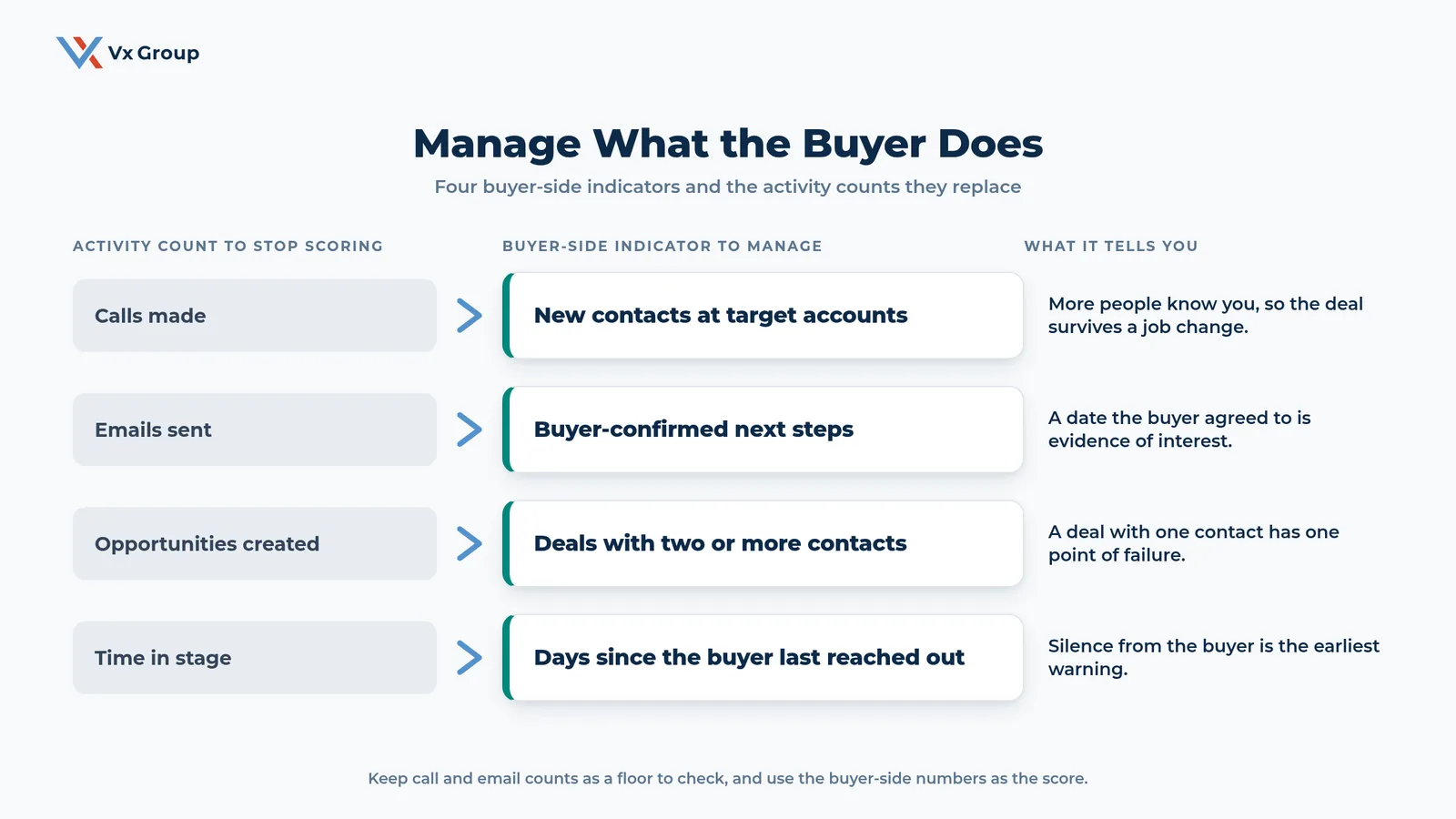
A sales leader on a long cycle should manage leading indicators that show buyer behavior and relationship strength. Good ones are new contacts at target accounts, buyer-confirmed next steps, deals with two or more contacts, and time since the last buyer-initiated contact. Activity counts are inputs the leader can watch as a floor.
The graphic above lines up the four indicators worth managing against four common activity metrics. Buyer-side numbers tell you where deals are heading. Seller-side numbers tell you how busy the team was. We cover the broader set of company-level signals in the leading indicators that predict B2B revenue.
Compare leading indicators with activity metrics
| Worth managing | Why it predicts a close | Common activity metric it replaces |
|---|---|---|
| New contacts at target accounts | More people who know you means a deal that survives a job change | Calls made |
| Buyer-confirmed next steps | A date the buyer agreed to is evidence of interest | Emails sent |
| Deals with two or more contacts | A deal with one contact has one point of failure | Opportunities created |
| Days since the last buyer-initiated contact | Silence from the buyer is an early warning | Time in stage |
| Proposals that reached a decision meeting | The buyer put you in front of the people who decide | Proposals sent |
Pick three or four of these. Measure them weekly in the one-to-one and monthly for the team. More than four turns the list into another dashboard.
Set targets from your own history
Use your own closed deals to set targets. Look at your last ten wins. Count the contacts you had at each buyer before the quote went out. If the average is four, a target of four contacts before quoting is grounded in what works for your company. A number copied from a vendor’s blog post has no connection to your buyers.
Keep one or two activity numbers as a floor
Activity still has a place. A rep who has had no meetings in a month has a problem to look into. Treat activity as a floor you check. A rep above the floor gets coached on the people at the buyer, and call volume stops being the topic.
How do you coach a rep on a customer relationship?
Coaching a relationship means working with the rep on the people at the buyer. Cover who they are, what each one cares about, and how the rep earns trust over time. A deal ends when it closes or dies, and a relationship carries on across many deals. In this business the relationship is the lasting asset.
This lines up with how consultative selling works on a long cycle. The rep earns the right to understand the buyer’s problem before pushing a quote.
Map the people on one page for each key account
Ask the rep to draw the account on one page. List every person at the buyer who touches the purchase: the user, the engineer, the buyer in procurement, the plant manager, and the executive who signs. Next to each name, write who at your company knows them and when they last spoke.
A map with three names and two blanks tells the rep which conversation to seek next. Our guide to the B2B buying committee shows who tends to be in the room.
Ask for one introduction per account per quarter
Set a simple habit. Each quarter, every key account gets one introduction from a current contact to someone new at the same company. The rep asks for it directly: “Who else on your team should know what we are working on?” Most contacts say yes when asked plainly.
Review the relationship record before the one-to-one
Before each one-to-one, read the rep’s notes on the account for the last ninety days. Look for personal details, concerns the buyer raised, and promises made. A rep who records that the buyer’s daughter is starting college has the beginning of a real relationship. A record that says only “followed up” has nothing to coach.
Account growth follows the same logic after the first sale. See account expansion for how to grow what a customer buys once you have earned the trust.
How do you handle a top performer whose accounts rest on one relationship?
A top performer with single-threaded accounts is a risk the owner should hear about in plain numbers. If one rep holds the relationship for accounts worth 30 percent of revenue, that rep leaving, retiring, or being recruited away puts that revenue in question. The leader’s job is to add coverage without making the rep feel replaced.
This is one of the hardest conversations in sales leadership, because the rep is usually the person the company depends on most. Handle it in three steps.
Put the exposure in dollars
List the top performer’s accounts and the revenue each one brings in. Mark which ones have only one contact at your company. Add up the revenue. Share the total with the owner and the rep. A number like “$6.4 million rests on one person” gets attention fast.
For the company-level view, read founder-dependent sales and customer concentration risk.
Pair the rep with a second person on each account
Choose a second person for each at-risk account: a service lead, an application engineer, or a newer rep. Ask the top performer to bring that person to the next two meetings and introduce them. Tell the rep the reason directly. The company wants the accounts to stay strong, and it wants the rep to be able to take a vacation without a customer calling the owner.
Reward the handoff
Put coverage in the rep’s goals and pay. A rep who is paid only for personal sales has no reason to share a key contact. If the plan rewards accounts that hold steady with two or more contacts, the top performer gains something by doing what the company needs. Our account management strategy guide shows how to build that plan account by account.
Field Notes:
This is a composite of patterns we see in owner-led manufacturers, with details changed. A $24 million maker of industrial components had a sales leader who ran a Monday call-count review for five reps. Every rep hit the target. Pipeline stayed flat, two forecasted deals slipped in the same quarter, and the owner stopped using the forecast. The leader changed three things over two quarters. The leader replaced the Monday review with a 45-minute one-to-one on two named accounts per rep. The pipeline review moved to five deals a week with four fixed questions. A one-page contact map for the fifteen largest accounts was added. The map showed that nine of the fifteen had one contact at the company, and six of those nine belonged to one rep. The company added a second contact on each of the nine accounts over the next two quarters. The forecast was reported in three bins, and the owner started using it for hiring decisions.
The details in the example are illustrative, and your numbers will differ. Leadership improved in this company when the leader looked at the buyer side of each deal.
What does a sales leader's quarterly rhythm look like?
A sales leader’s rhythm has a weekly layer, a monthly layer, and a quarterly layer. The weekly layer is coaching and the pipeline review. The monthly layer is coverage and forecast checks. The quarterly layer is account strategy, hiring and coaching decisions, and a review with the owner.
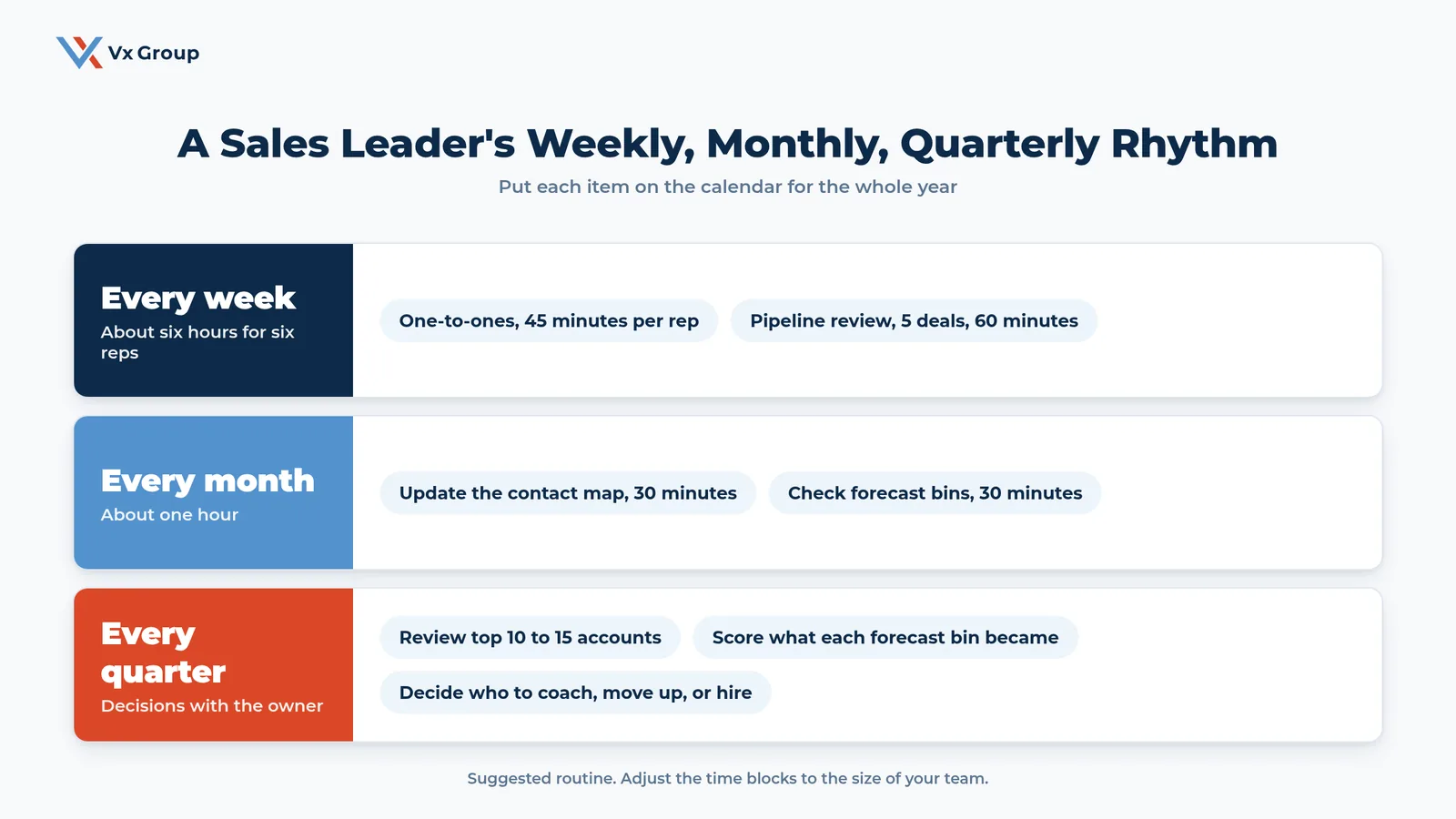
The graphic above shows the three layers and what happens in each. Put each item on the calendar for the whole year so it survives a busy month.
Block the weekly layer first
Each week, hold the one-to-ones (45 minutes per rep) and the pipeline review (60 minutes for the team). If you lead six reps, that is about five hours of coaching and one hour of review. Put those blocks in the calendar before you accept other meetings.
Add the monthly layer for coverage and forecast checks
Once a month, update the contact map for your key accounts and compare the forecast bins with what happened. Thirty minutes on each is enough when the habit is regular. Many leaders do these on the first Friday of the month.
Finish with the quarterly layer for decisions
Each quarter, hold three sessions. First, a review of your top ten to fifteen accounts with the owner, where you discuss growth plans and risks. Second, a look at what each bin of the forecast turned into. Third, a decision about people: who needs coaching, who is ready for bigger accounts, and where you need to hire. Our guide to the quarterly business review covers the customer-facing version of the same habit.
New hires fit into this rhythm as well. A rep joining a twelve-month cycle needs a plan for the first year. See how to onboard a salesperson into a 12-month sales cycle. A written sales playbook gives the leader something to coach against.
How should marketing and the owner fit into sales leadership?
The sales leader works best when the owner and marketing agree on which customers the company wants. Marketing can send the right buyers to the team, and the owner can open doors to the people the sales team cannot reach alone. In an owner-led company, the owner is often the strongest relationship holder, and that makes the owner’s role part of the plan.
Three habits help:
- Share the contact map with the owner. The owner often knows the executives at your largest accounts. Ask which relationships the owner wants to keep personally and which to hand to the team.
- Give marketing the closed-won reasons. Send marketing a short summary each quarter of why you won and lost. Our guide on aligning marketing and sales around one plan shows a simple way to do it.
- Tell the owner the truth about the forecast. An owner who hears three bins and the evidence behind them can plan. An owner who hears one optimistic number learns to ignore it.
Some owners wonder whether software will take over parts of this job. Our look at whether AI will replace salespeople explains why relationship-heavy selling still needs human leaders.
Where should a sales leader start this week?
Start with four steps that take about two hours in total and need no new software.
- List your five largest open deals and find the last buyer action. Write the date next to each. Any deal with no buyer action in thirty days goes on the agenda for your next one-to-one.
- Draw a contact map for your three largest accounts. Mark who at your company knows each person. Count the blanks.
- Pick one rep and change one one-to-one. Use the fixed agenda in this guide and end with one written commitment.
- Write the three forecast bins for this quarter. Share them with the owner next to your usual number.
Run these for a month, then add the pipeline review format and the leading indicators from this guide.
Start with the buyer side of every deal
A sales leader on a long cycle earns results by looking at what buyers do and how many people know the company. Coach on named accounts, review a few deals well, report the forecast in bins, and add a second contact on the accounts that matter most.
Pick one change from the list above and run it for a month. The first forecast your team brings to the owner will show whether it worked.
Ready to grow?
Walk us through your top ten accounts and we will show you where one relationship carries too much of the load.
FAQs
About the Author: David Tisdale
