

What Is Consultative Selling (and How to Actually Do It)

Consultative selling means diagnosing a buyer’s problem before you propose anything to solve it. In long-cycle B2B, that means running discovery to understand the buyer’s situation, cost, and constraints first, then recommending only what genuinely fits. The pitch comes last, and sometimes not at all.
TL;DR
- Consultative selling is a diagnose-first approach: you understand the buyer’s real problem before proposing a solution, so the recommendation fits instead of getting forced.
- It matters most in long, high-trust, multi-stakeholder B2B cycles, where a mismatched pitch ends the conversation before it starts.
- The whole method turns on question quality. Five diagnostic questions do more than any pitch deck.
- You can tell a discovery call worked when the buyer tells you something you could not have found on your own.
- Most teams that say they sell consultatively are faking it in one of two ways: leading questions that fish for the pitch, or jumping to the demo.
Defined Term: Consultative selling
A sales approach where the seller acts as a diagnostician first and a vendor second. The seller uses structured questions to understand the buyer’s situation, quantify the cost of the problem, and map who is affected, then recommends a solution only when there is a real fit. The alternative is pitch-first selling, where the product is presented before the problem is understood.
What is consultative selling?
Consultative selling is a sales method where you diagnose the buyer’s problem before recommending anything. Instead of opening with what you sell, you open with what the buyer is dealing with, ask questions that surface the real issue, and let the diagnosis shape the recommendation. The seller behaves like an advisor who happens to have a product, rather than a vendor looking for a place to put one.
The term goes back to Mack Hanan’s 1970 book of the same name, but the idea has outlived the era that produced it because the underlying logic still holds: people buy from someone who understands their problem better than they do. A buyer can find product specs, pricing pages, and competitor comparisons in ten minutes. But the one thing a salesperson can add that the internet can’t?
Judgment about the buyer’s specific situation. That judgment comes from diagnosis.
A consultative sales approach has three moving parts.
First, research: you learn enough about the account before the conversation to ask thoughtful, educated questions.
Second, diagnosis: you use the live conversation to understand the problem the buyer has, including the parts they have not articulated.
Third, prescription: you recommend a path, and you are willing to say “this is not for you” when it is not.
How is consultative selling different from transactional selling?
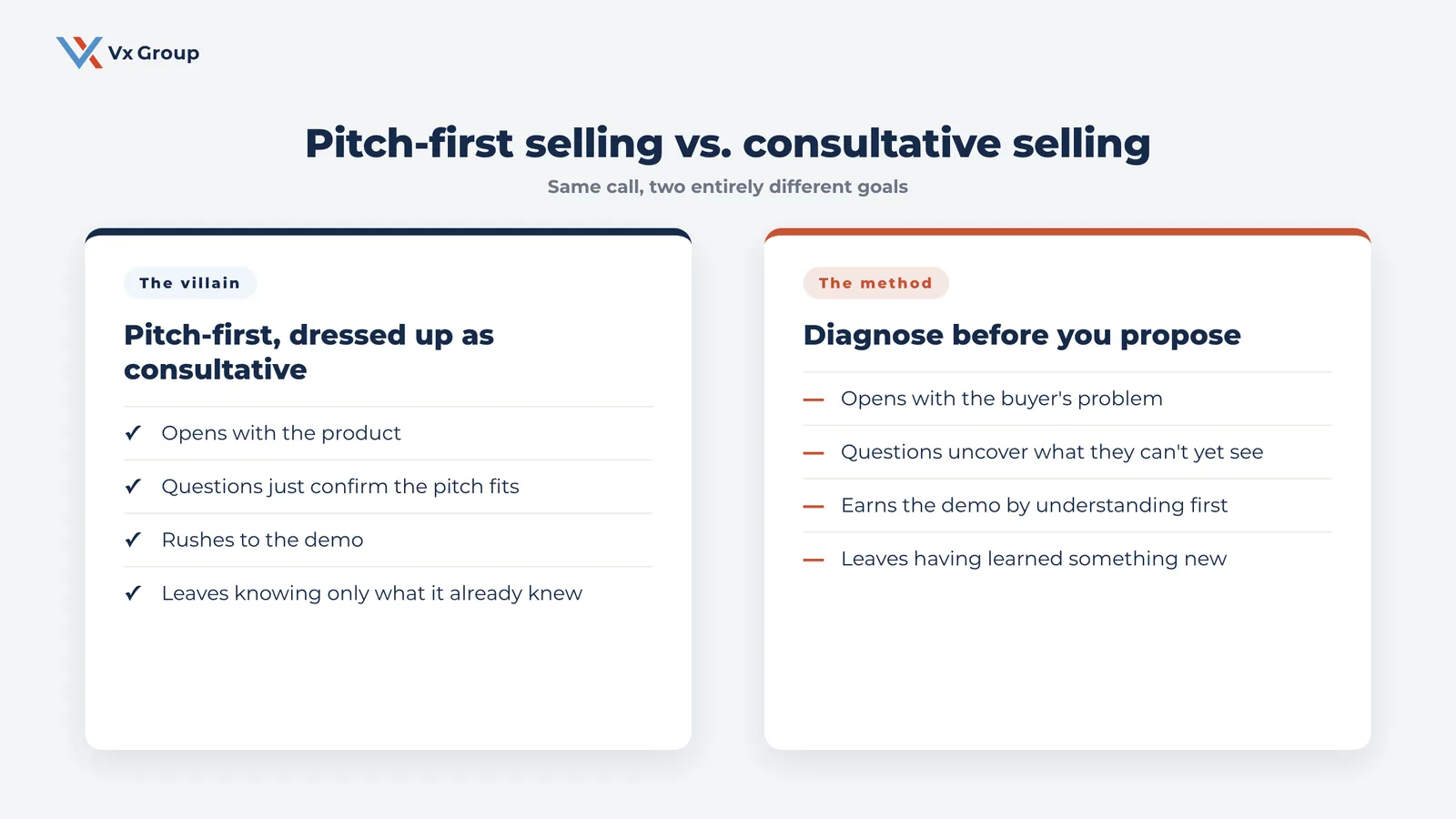
Consultative selling and transactional selling differ in one decision: whether you diagnose before you propose. Transactional selling opens with the product and uses questions, if it uses them at all, to confirm the pitch fits. Consultative selling opens with the problem and uses questions to find out what the buyer cannot yet see. The consultative vs transactional selling distinction comes down to the order of operations: diagnosis before the pitch, every time.
Transactional selling is the right tool for short, low-consideration purchases where the buyer already knows what they want and the main job is to make buying easy. Nobody wants a forty-minute diagnostic call to buy printer toner. The problem shows up when a seller carries that short-cycle reflex into a complex, high-value, relationship-driven deal, where the buyer has a twelve-month cycle, four people who have to agree, and a real cost to getting it wrong. In that setting, a pitch-first motion signals that you are more interested in closing than in understanding, and a careful B2B buyer reads that signal instantly.
Here is how the two approaches diverge across the parts of a deal that matter:
| Dimension | Transactional selling | Consultative selling |
|---|---|---|
| Opening move | Present the product | Diagnose the problem |
| Purpose of questions | Confirm the pitch fits | Uncover what the buyer can’t yet see |
| Best-fit cycle | Short, low-consideration | Long, high-trust, multi-stakeholder |
| What a good call looks like | A demo booked | You learned something new |
| How the buyer feels afterward | Sold to | Understood |
| Where value comes from | The product’s features | The seller’s judgment about fit |
The row that trips teams up is the fourth one. In a transactional world, a booked demo is progress. In a consultative world, a demo you booked without understanding the problem is often a step backward, because now you are committed to showing a product before you know whether it solves anything the buyer cares about.
Why does consultative selling work better in long-cycle B2B?
Consultative selling works better in long-cycle B2B because the binding constraint on these deals is trust, more than it is information. When a purchase involves a twelve-month cycle, multiple decision-makers, and switching costs measured in years, the buyer is really asking one thing: does this person understand my situation well enough that I can rely on their recommendation?
Diagnosis is how you answer that question, and no amount of product polish substitutes for it.
The villain here is pitch-first selling dressed up as consultative. It is everywhere, because most sales training now uses the word “consultative,” so teams adopt the vocabulary without changing the behavior. The rep asks a few questions, nods, and then delivers the same demo they were always going to deliver.
The buyer notices. They have sat through that call a dozen times. The questions register as a formality, a toll booth on the way to the pitch, and the trust that consultative selling is supposed to build never forms.
There is a specific failure mode this creates in relationship-driven industries. When a company’s growth depends on referrals, repeat business, and reputation inside a tight market, a single pitch-first call that lands badly loses more than that deal. Word travels.
The buyer mentions to a peer that the vendor “just wanted to sell us something,” and the next conversation in that market starts from a deficit. Diagnosis-first selling compounds in the other direction: the buyer who felt understood becomes the reference who opens the next door.
This is the same logic that governs a long, relationship-first sales funnel and a pipeline that survives one person leaving. You can see how it plays out across the full cycle in The B2B Sales Funnel for Long-Cycle, Relationship-Driven Companies and in how a healthy pipeline is structured in Sales Pipeline Management.
What does the consultative selling process look like?
The consultative selling process is five steps that keep diagnosis ahead of prescription: research the account, open with their problem, diagnose with questions, confirm the real problem, then propose only what fits. Each step produces something specific, so you always know whether you have actually done it or just talked about it.
Research the account before you dial
Spend fifteen minutes before the call turning a generic question into a specific one. Read the last two things the company published, note any recent change (a new hire, a new location, a leadership move, an earnings comment), and write down one hypothesis about a problem that change might be creating.
The hypothesis only has to be specific enough to earn the first real question, and being correct on the first try is a bonus. “I saw you opened a second plant in Ohio in Q1, does that mean the handoff between your two ops teams is getting harder to manage?” lands very differently than “So, tell me about your business.”
The output of this step is one written hypothesis and one specific opening question. If you cannot write those two sentences, you have not done the research.
Open the call on the buyer’s problem
Start the conversation on the buyer’s side of the table. Say, in plain terms, why you thought it was worth their time, then hand the floor back to them. The goal of the first ninety seconds is simple: get the buyer talking about their situation while you stay quiet about your company. A useful opener names a specific, plausible problem and then explicitly gives the buyer permission to tell you that you are wrong: “I might be off, but here is what I was thinking.”
The output of this step is the buyer describing their situation in their own words within the first two minutes. If you are the one talking at minute two, reset.
Diagnose with questions before you propose
Use structured questions to move from the surface complaint to the underlying problem, the cost of that problem, and who is affected by it. This is the heart of the method and the part most teams shortcut. The next section gives you the five questions to run. The discipline is to keep asking until you understand the problem well enough to describe it back to the buyer in a way they had not quite put together themselves.
The output of this step is a one-sentence problem statement you can say out loud that makes the buyer say “yes, exactly.”
Confirm the real problem out loud
Before you recommend anything, play the problem back and get explicit agreement. Say, “So if I have this right, the issue is X, it is costing you roughly Y, and the person who feels it most is Z. Is that fair?” This does three things: it proves you listened, it corrects any misdiagnosis while it is still cheap to correct, and it gets the buyer to commit to the problem before you attach a price to the solution. A buyer who has agreed out loud that the problem is real and expensive is a very different buyer than one who is hearing your pitch cold.
The output of this step is a spoken “yes” to a problem statement that includes a rough cost and a named owner.
Propose only what fits
Recommend the smallest thing that solves the confirmed problem, and be willing to say when nothing you offer is the right fit. Counterintuitively, telling a buyer “honestly, for what you just described, we are not the best option, here is who is” is one of the most powerful trust-building moves in the method, because it proves every prior recommendation was about them.
When you do propose, tie every element of the recommendation back to something the buyer said, so the proposal reads as a response to their situation rather than a standard package.
The output of this step is a recommendation where the buyer can trace each part back to a problem they described.
What are the five questions that surface a real problem before you pitch?
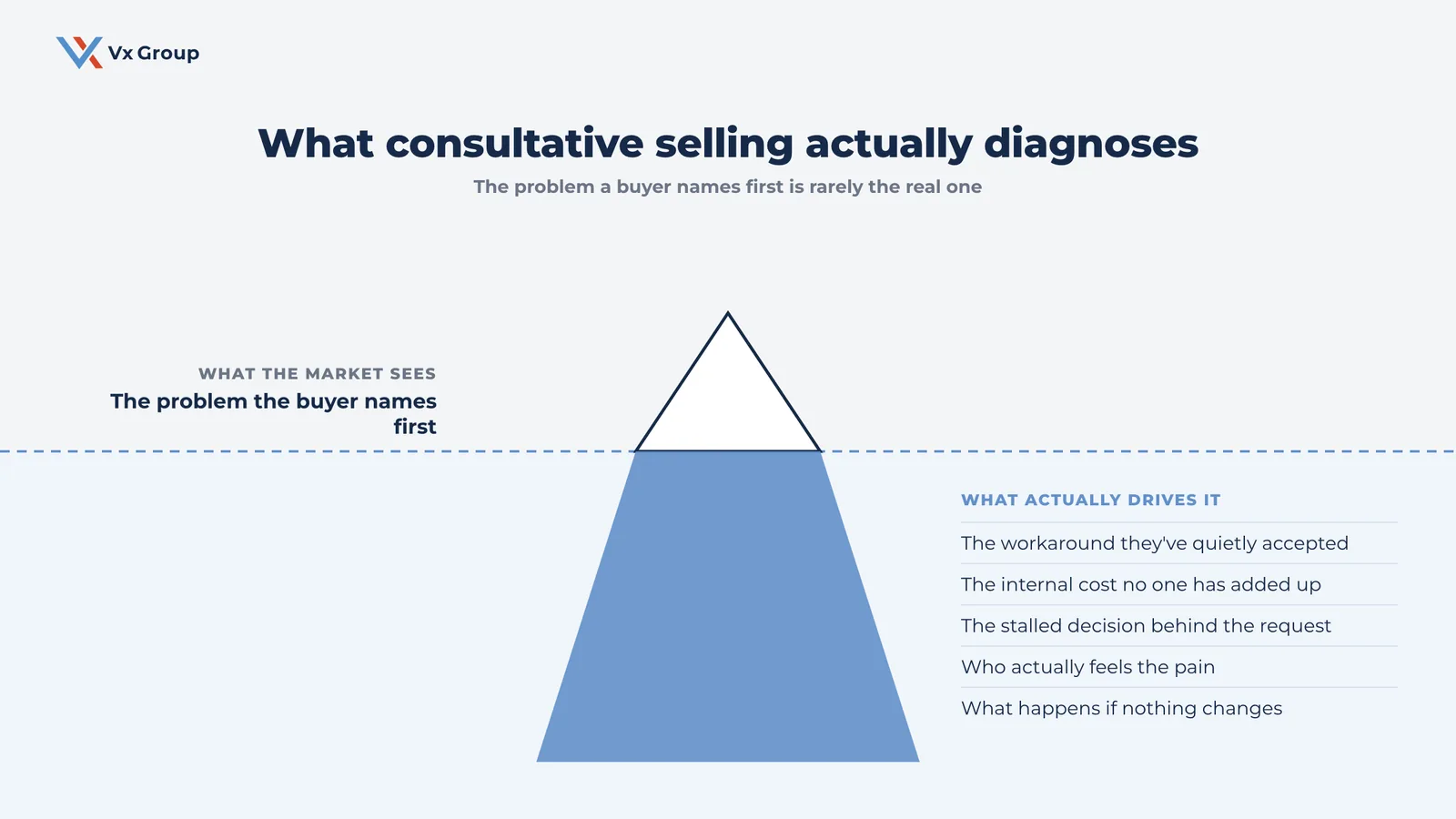
Five questions move a conversation from the surface complaint to a problem worth solving: what prompted this, what have you already tried, what does it cost, who feels it, and what happens if nothing changes. Asked in order, they take you from symptom to diagnosis without ever touching your product.
“What prompted you to look into this now?”
Timing reveals the real driver. A problem that has existed for years but suddenly became urgent points you at the actual trigger, which is usually more specific and more solvable than the general complaint. If the answer is “nothing changed, I was just curious,” you have learned that this is not a real deal yet, which is worth knowing before you invest three months in it.
“What have you tried so far, and where did it fall short?”
This surfaces the workaround the buyer has quietly accepted, which is often the real competitor. In most deals your real competitor is the buyer’s own workaround: “the spreadsheet we built” or “the way we have always done it.” Knowing exactly where the current approach breaks tells you what your recommendation actually has to beat.
“What is this costing you, roughly, in a quarter?”
This converts a vague annoyance into a number the buyer will defend to their own leadership. You want the buyer to do the arithmetic out loud, even a rough figure, because a problem with a dollar figure attached gets budget and a problem without one gets deferred. If the buyer cannot estimate a cost, the problem may not be big enough to buy a solution for, and you have saved yourself a long cycle to nowhere.
“Besides you, who feels this problem, and who would have to sign off on fixing it?”
This maps the buying group early, before it ambushes you late. In long-cycle B2B, the person you are talking to is rarely the only decision-maker, and the deal that dies in month six usually dies because a stakeholder you never met said no. Finding out who is affected also tells you whose pain you can build the business case around.
“If you did nothing about this for the next six months, what happens?”
This tests whether the problem is urgent enough to overcome the buyer’s inertia. Doing nothing is always the buyer’s easiest option and your most common competitor. If the honest answer is “not much,” you are looking at a low-priority deal that will stall. If the answer is “we miss the target” or “we lose the account,” you have found the stakes that will carry the deal to a decision.
Notice what these five questions have in common: not one of them mentions your product. Each one earns you information the buyer would not have volunteered, and together they build a diagnosis you can act on.
How do you know a discovery call actually went well?
You know a discovery call went well when the buyer told you something you could not have found on your own. That is the single cleanest signal. A booked next meeting feels like progress, but buyers agree to next meetings out of politeness all the time. New information is harder to fake, because it means the buyer trusted you enough to think out loud in front of you, and thinking out loud is where the real problem surfaces.
There are a handful of other signals worth watching for, and most of them are about who was doing the work in the conversation:
- You changed your view of their problem mid-call. If you walked in with a hypothesis and walked out with a better one, the diagnosis worked. If your hypothesis survived untouched, you may not have asked hard enough.
- The buyer corrected one of your assumptions out loud. Correction is a sign of engagement and trust. A disengaged buyer lets your wrong assumptions slide because they do not care enough to fix them.
- The next step was the buyer’s idea. “Can you talk to my VP of ops next week?” is a very different outcome than “Can I book time with your VP of ops?” When the buyer proposes the advance, they have taken ownership of the problem.
- You talked less than the buyer did. In a strong discovery call, the buyer does most of the talking, because your job was to ask and listen. If you filled the airtime, you were probably pitching.
None of these are a scorecard, and a call can go well while missing some of them. Treat them as evidence rather than a checklist, and pay the most attention to the first one. If you learned nothing new, no amount of politeness at the end of the call should convince you it went well.
What does consultative selling sound like in practice?
Consultative selling sounds like a seller who is genuinely trying to figure out whether they can help, and pitch-first selling sounds like a seller who has already decided. The difference is easiest to hear in exact wording, so here are matched examples: the same outreach and the same discovery call, run both ways.
Rewrite the cold email so it earns a reply
The pitch-first email leads with the product and asks for a demo before establishing any reason to care. It reads like a hundred others in the inbox:
Pitch-first version
Subject: Cut your onboarding time by 40%
Hi Dana, I’m Sam with Northwind. We help manufacturers like Acme reduce new-hire onboarding time by up to 40% with our workflow platform. Teams love how fast they get up and running. Do you have 15 minutes Thursday for a quick demo? Best, Sam
The consultative version leads with a specific, researched hypothesis about Dana’s situation, gives her explicit permission to say it does not apply, and asks for a small, low-pressure next step instead of a demo:
Consultative version
Subject: the handoff between your two ops teams
Hi Dana, I saw Acme opened the second line in Columbus in Q1. When a plant scales that fast, the handoff between the original ops team and the new one is usually where new hires fall through, and it tends to show up as slow ramp time before anyone names it as a problem. Might not be true for you. If it is, I have two questions that would tell us in about ten minutes whether this is worth your time. If it’s not, I’ll leave you be. Worth a short call next week? Sam
The consultative email is not softer or friendlier for its own sake. Every line does a job: the trigger proves you did the work, the hypothesis shows you understand the buyer’s world, the permission to decline lowers the buyer’s guard, and the “two questions in ten minutes” ask is small enough to say yes to.
Run the discovery call without slipping into a pitch
On the phone, the pitch-first call reveals itself in the first thirty seconds, when the rep uses a single throwaway question as a ramp into the demo:
Pitch-first version
Rep: Thanks for taking the call. So, quick background, we’re a workflow platform built for manufacturers. Are you currently looking for a way to speed up onboarding? Buyer: I mean, maybe, it’s been a bit rough since we grew. Rep: Perfect, that’s exactly what we solve. Let me just share my screen and walk you through how it works.
The buyer said “it’s been a bit rough since we grew,” and the rep drove past it straight into a demo. Everything useful in that call was in the phrase the rep skipped. The consultative version stops and digs:
Consultative version
Rep: Before I say anything about what we do, I want to make sure it’s even relevant. Can I ask what prompted you to take the call?
Buyer: Onboarding’s been a mess since we grew.
Rep: When you say a mess, walk me through the last new hire you brought on. Where did it actually break?
Buyer: They sat for two weeks before anyone showed them the line, because the two ops leads each assumed the other had it.
Rep: Got it. When a handoff drops like that, who feels it first, and roughly what does a two-week delay cost you per hire?
Buyer: The line supervisor, mostly. And honestly, a slow hire probably costs us a few thousand in lost output before they’re productive.
Rep: Last thing before I react: if this kept happening for the next six months, what’s the impact?
Buyer: We miss the Q4 ramp we promised the customer, which is the whole reason we opened the second line.
Rep: Okay. So the real issue isn’t onboarding speed in general, it’s that nobody owns the handoff between the two ops leads, and it’s putting the Q4 customer commitment at risk. Is that fair?
Buyer: Yeah. That’s exactly it.
By the end of the consultative call, the rep has a problem statement the buyer confirmed out loud, a rough cost, a named owner, and a stake that reaches all the way to a customer commitment. Only now has the rep earned the right to talk about a solution, and when they do, every part of it will map to something the buyer said. The pitch-first rep, by contrast, is demoing features to someone whose real problem they never uncovered.
This is the same discipline that separates real prospecting from spray-and-pray outreach. The mechanics of doing it at the top of the funnel are in Sales Prospecting: A Relationship-First Playbook.
What are the two most common ways teams fake consultative selling?
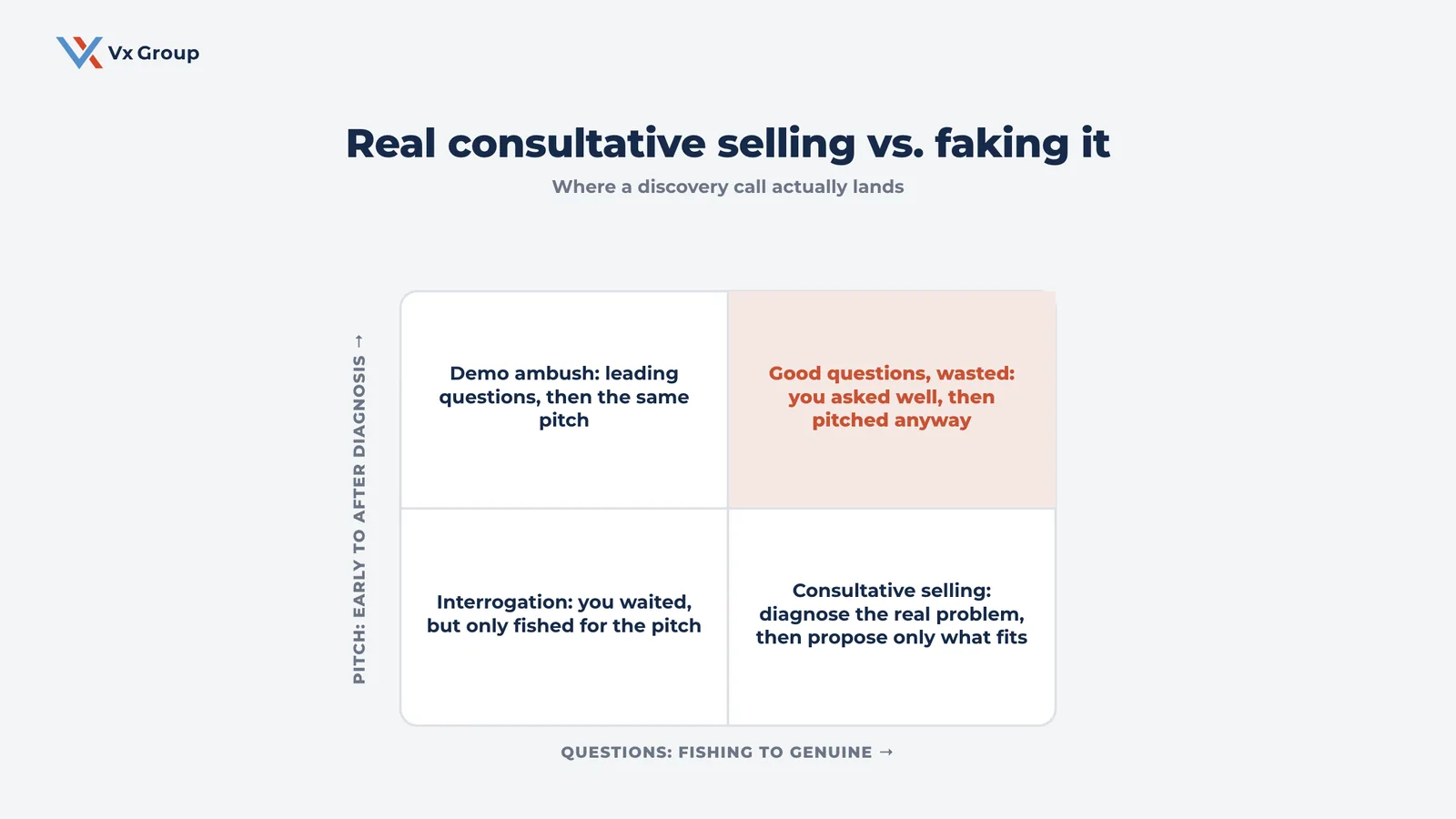
The two most common ways teams fake consultative selling are asking leading questions that fish for the pitch, and jumping to the demo the moment they hear a keyword. Both let a rep feel consultative while behaving transactionally, which is why they are so persistent. A rep can check the “I asked questions” box and still learn nothing.
The first fake is the leading question. Instead of asking what the buyer is dealing with, the rep asks questions engineered to produce the answer that sets up the pitch: “Wouldn’t it be valuable to onboard new hires faster?” or “Are you finding your current process a bit manual?”
Those are pitch cues wearing a question mark. The buyer can hear the demo loading behind them, and the questions build no trust because they reveal that the rep already decided what the answer would be. A genuine diagnostic question is one where you do not know what the buyer will say and where their answer could change your recommendation.
The second fake is jumping to the demo. The rep asks one open question, hears a word that matches a feature, and immediately reaches for the screen share. The tell is that the demo starts before the problem is confirmed, before the cost is known, and before anyone has mapped who else is involved. It feels like momentum, and reps are trained to value momentum, but a demo delivered against an undiagnosed problem is just a longer pitch.
The fix is a rule: no demo until you can state the buyer’s problem, its cost, and its owner in one sentence and get a “yes.”
Defined Term: Field Notes
A rep we worked with had a strong first call with a regional distributor. The buyer opened with “we’re thinking about replacing our inventory system,” and the rep, hearing a perfect fit, spent the next forty minutes demoing the inventory module. The buyer was polite, said it looked great, and asked for a proposal. The deal stalled for two months and then died. On a later call, the buyer mentioned the real issue almost as an aside: the CFO had frozen all software spend until a pending acquisition closed, and the “new inventory system” was really the ops manager trying to look proactive before a reorg. None of that surfaced, because the rep never asked what prompted the timing, who else had to sign off, or what happened if they did nothing. A diagnosis-first call would have found the acquisition and the spending freeze in the first ten minutes, and the rep would have nurtured the relationship for the six months it actually needed instead of burning a proposal on a deal that was never going to close that quarter.
How do you build a consultative sales approach across a whole team?
You build a consultative sales approach across a team by making the diagnosis repeatable, so it does not depend on which rep happens to be naturally curious. Individual talent produces occasional great discovery calls. A system produces them consistently, and it survives the day your best diagnostician takes another job. Three moves turn the method from a personal skill into a team standard.
Write the five questions into the call structure
Put the five diagnostic questions into your call framework and your CRM as required fields, so a rep cannot advance a deal without having captured the trigger, the prior attempts, the cost, the buying group, and the cost of inaction. This does two things: it forces the diagnosis to happen, and it makes the quality of discovery visible to a manager reviewing the pipeline. A deal with those five fields empty is a deal that has not really been qualified, no matter how good the rep says the call felt.
Coach to the “what did you learn” standard
Change the question managers ask in deal reviews from “did you book the next step” to “what did you learn that you could not have Googled.” This single shift redirects the whole team toward diagnosis, because reps optimize for whatever their manager inspects. When the standard is new information, reps start listening for it, and the leading-question and jump-to-demo habits fade because they stop being rewarded.
Make it survive a handoff
Document each deal’s diagnosis where the whole team can see it, so the relationship and the context do not live only in one rep’s head. When discovery is captured in a shared, structured place, a deal can change hands without starting the diagnosis over, and the account survives a resignation.
This is the same principle that keeps a pipeline from living in one person’s memory, and it is what turns consultative selling from a talented individual’s habit into an asset the company owns.
Relationship Selling, a companion approach focused on the depth of the relationship rather than the diagnostic technique, extends this further, and we cover it in a separate guide.
Ready to grow?
See how a diagnosis-first sales approach would work inside your own pipeline.
Subscribe to Insights → for practical B2B growth playbooks like this one.
FAQs
About the Author: Jacob Camhi
