

SEO vs AEO: What Changed and What Still Works

SEO and AEO share the same foundation. SEO gets your pages found and ranked in a list of results. AEO gets your facts read and named inside an AI assistant’s answer. Keep your SEO basics, write each page for the full question a buyer asks, and drop keyword stuffing. Most owners need one program with a wider target.
TL;DR
- SEO (search engine optimization) ranks pages in a list. AEO (answer engine optimization) gets your facts used inside an AI-written answer. The same pages feed both.
- Fast pages, clear titles, links from trusted sites, and pages that answer real buyer questions still work. Keep all four.
- The big change is the query. A buyer’s Google search runs about three words. The same buyer’s AI prompt can run twenty or more and carry region, run size, material, tolerance, and certification.
- Write each page for the full prompt. State specs, price basis, lead time, and references in plain text.
- Drop keyword stuffing. A 2024 KDD paper on generative engine optimization found it gave little to no improvement in AI answers.
- Measure both. Track rankings and clicks for SEO, and test ten real buyer prompts in two AI assistants every quarter for AEO.
Search is splitting into two jobs, and most of what is written about it makes the split sound bigger than it is. Agencies sell AEO as a new discipline that replaces SEO. Other agencies say AEO is a rebrand and nothing changed. Both camps skip the part that matters to an owner of a $5 million to $50 million manufacturer: your buyers are asking longer, more specific questions, and your pages either contain the answers or they do not.
This guide compares SEO and AEO side by side, shows what still works, names what changed, and gives you a short list of moves for this month. It is written for owners and leadership teams of privately held B2B manufacturers and distributors, where the sale takes months and a single account can fund a year of growth.
What is the difference between SEO and AEO?
SEO is the work of making your pages easy to find, crawl, and rank in a list of search results. AEO is the work of making your pages easy to read, trust, and quote when an AI assistant writes a direct answer.
Defined Term: SEO (search engine optimization).
The work of making a website findable in a search engine’s list of results. It covers page speed, titles and headings, content that matches what people search for, and links from other sites.
Defined Term: AEO (answer engine optimization).
The work of making a website’s facts easy for an AI assistant to find, read, and use when it writes an answer. The buyer may never click through to a list of results, so the goal is to be named and quoted in the answer itself.
You will also see the term GEO, short for generative engine optimization. It describes nearly the same work, and the two terms are used interchangeably in most vendor material. This guide uses AEO throughout. The people searching for these terms are also asking for the comparison: Semrush shows about 720 monthly US searches for “seo vs aeo” and about 2,900 for “aeo vs seo.”
The table below compares the two across the points an owner cares about.
| Point of comparison | SEO | AEO |
|---|---|---|
| What the buyer sees | A list of links to choose from | A written answer, often with a short list of suppliers |
| What you win | A click to your site | A mention, a quote, or a place on the shortlist |
| Typical query | Two to four words | A full sentence or paragraph with several requirements |
| What the system checks | Relevance, authority, and page quality | Whether your page states facts that match each requirement |
| Where the facts must live | On the page, in titles, headings, and body text | In plain text on the page, readable without a PDF viewer or an image |
| Main signal of trust | Links from other sites | Links, plus named customers and facts that other sources repeat |
| How you measure it | Rankings, clicks, impressions | How often assistants name you across a set of real buyer prompts |
| Speed of feedback | Weeks to months | A re-test of the same prompts, often within weeks of a page change |
Both columns describe real pages on a real website. The work overlaps far more than it diverges, which is why one program can cover both. Our guide to LLM SEO goes deeper on how AI assistants find, read, and compare suppliers, and this article stays on the comparison and the decision.
What does a buyer's search look like in SEO versus AEO?
A Google search for a machined part runs about three words, such as “cnc machining aerospace.” The same buyer asking an AI assistant writes a sentence of twenty or more words that carries the region, the run size, the material, the tolerance, and the certification. That difference in the query drives every other difference between SEO and AEO.
Here is the same need written both ways. The short search leaves the buyer to sort out the details by clicking through ten results. The AI prompt hands all of those details to the assistant in one line, and the assistant does the sorting.
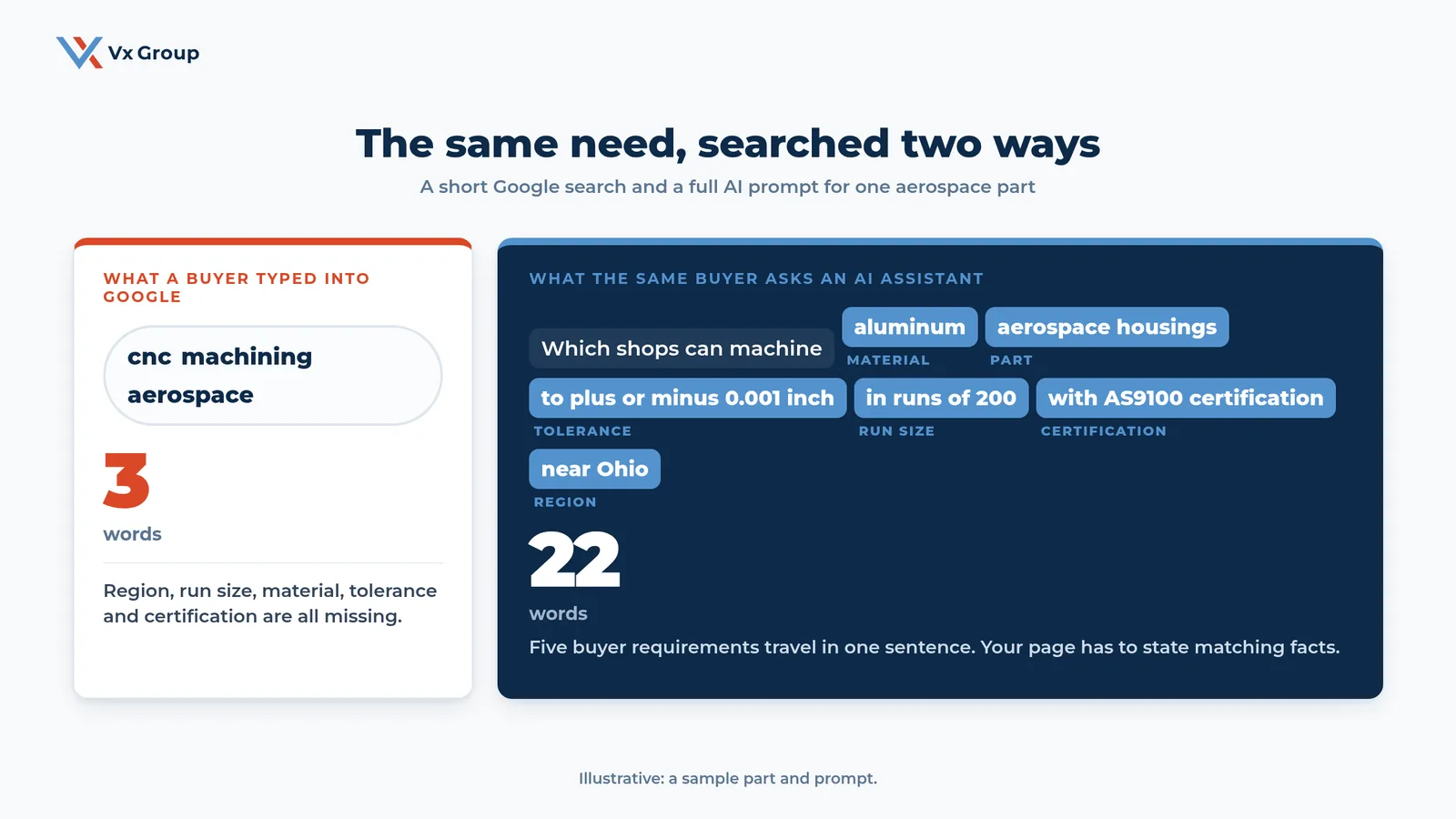
The prompt in the graphic is a sample, and it has 22 words: “Which shops can machine aluminum aerospace housings to plus or minus 0.001 inch, in runs of 200, with AS9100 certification, near Ohio?” Each phrase is a requirement. A page that states none of them gives the assistant nothing to match.
Count the details in your last real inquiry
Pull your three most recent inbound requests for quote or website inquiries. For each one, list every requirement the buyer named: part, material, tolerance, quantity, certification, location, deadline, and anything else. Most owners find six to ten per inquiry.
That count is your target. Each page that sells a product line should state the same kinds of facts the buyer used to describe the need.
Write the prompt your best customer would type
Pick your best customer and write the exact sentence they would type into an AI assistant to find a supplier like you. Use their words, including the part names and standards they use. Keep the result on a sheet of paper.
Then read your product page against that sentence. Mark every requirement the page answers in plain text. The unmarked ones are the gaps, and they are the first edits to make.
Check the length of your keyword list
A keyword list built for SEO usually holds short phrases. Keep it, because those phrases still show where demand exists. Add a second column next to each phrase and write the full question behind it. The second column becomes the outline for the page.
Our guide to SEO for manufacturing companies shows how to turn a sample buyer prompt into spec lines that an AI assistant can match, and it gives a template you can copy.
Ready to grow?
Bring your last three inquiries and see how your pages answer them.
What still works in SEO now that buyers ask AI?
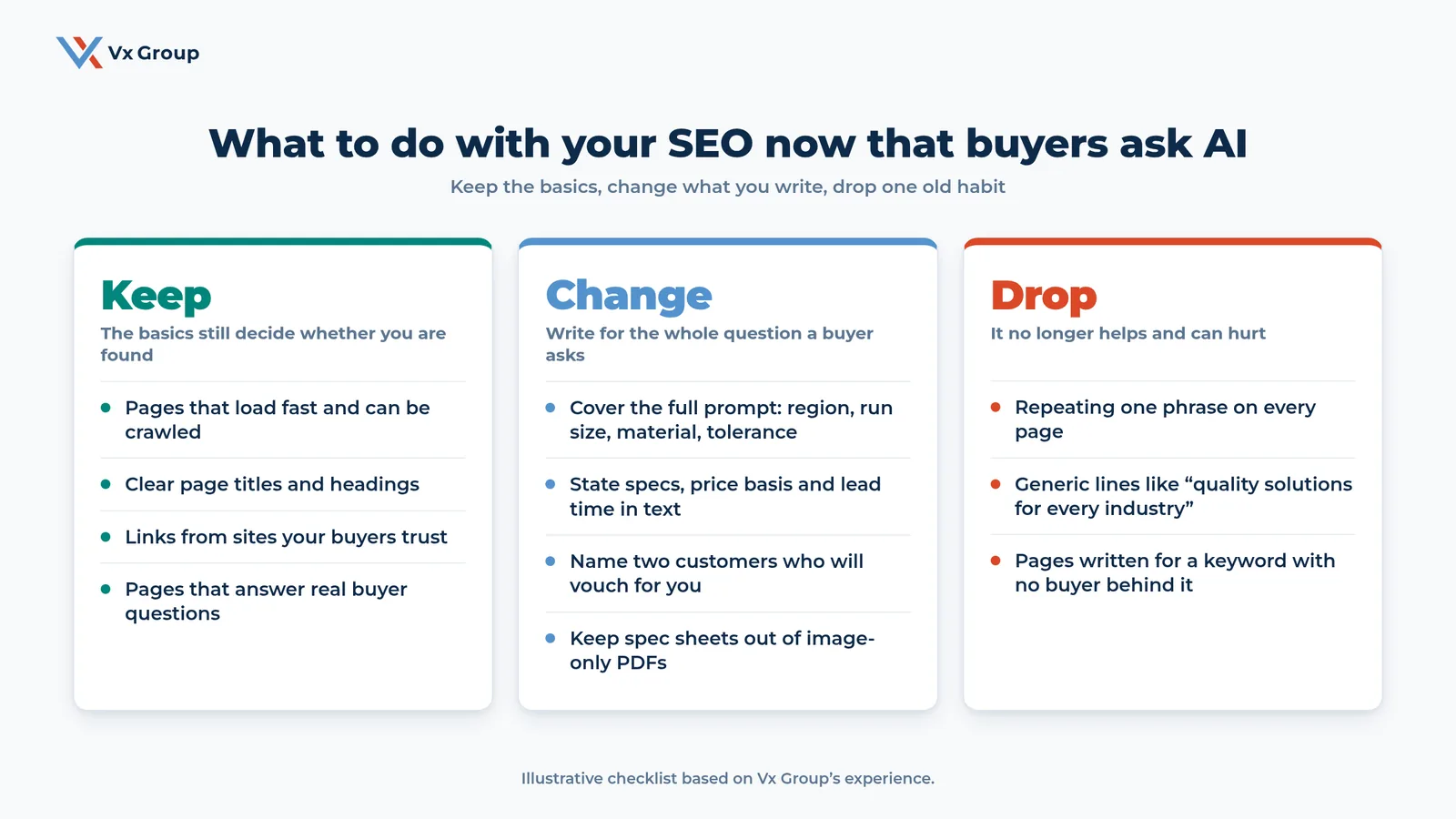
Four SEO basics still work: fast pages that can be crawled, clear titles and headings, links from sites your buyers trust, and pages that answer real buyer questions. AI assistants draw on the same web that search engines index, so a page that cannot be found or read has no chance of being named.
This section matters because the loudest advice right now says to start over. An owner who rebuilds a site that already ranks, to chase AEO, can lose the traffic that pays the bills today. The better move is to keep what works and change what the pages say.
Keep your pages fast and crawlable
Test your ten most important pages with a free page-speed tool and fix the slowest ones first. Confirm that a search engine can reach each page: check that the page is not blocked in your robots file and appears in your sitemap. If a person can load the page but a crawler cannot, an AI assistant that relies on search results will miss it too.
Keep titles and headings plain
Write each page title so it names the product and the buyer, in about 60 characters. Use headings that sound like the questions buyers ask. Plain headings help a search engine rank the page and help an AI assistant lift a clean answer from under the right heading.
Keep earning links from sites your buyers trust
Links from industry associations, trade publications, customers, and suppliers still signal that your company is real and respected. Make a list of ten places that already know you, such as the associations you belong to and the customers who list their approved vendors. Ask each one for a link to the right page on your site.
Keep writing pages that answer real buyer questions
Look at the questions your sales team answers every week. Each one that arrives more than twice is a page or a section. Write the answer in the first two sentences, then add the detail. This habit has paid off in SEO for years and it fits AEO exactly, because an assistant looks for a direct answer it can quote.
What changed with AEO, and what should you do differently?
Three things changed: the query got longer, the buyer started reading one summary of what ten pages say, and facts that sit in images or PDFs became hard to use. Your response is to write for the whole prompt, state facts in plain text, and give the assistant reasons to trust you.
Cover the full prompt on each product page
For every product line, write one page that states the requirements a buyer would put in a prompt: what you make, in which materials, to what tolerances, in which quantities, with which certifications, and where you ship from. Put these in a short specifications block near the top, then explain each in the body.
A good test is to read the page aloud to someone who has never visited your plant. If they can repeat the requirements back, an assistant can match them.
State specs, price basis, and lead time in text
Move any fact that lives only in a PDF, an image, or a drawing into the page as text. Buyers and assistants both use lead times, price drivers, and certifications to compare suppliers, and a spec table inside a scanned catalog may never be read.
You do not have to publish a price list. Write a sentence on what drives price: material, tolerance, volume, and finish. An assistant asked to judge your quote will explain your price with whatever it can find. Give it your explanation. Our guide to sales follow-up email applies the same logic to what you send after the first meeting, because buyers paste those emails into assistants too.
Name two customers who will vouch for you
Ask two customers for permission to be named on your site, with one sentence on what you do for them. A named reference gives an assistant a second source to match against your own claims. Pages that make claims without any named support tend to read as marketing copy, and assistants tend to skip them.
If a customer cannot be named, describe the situation in specific terms: the industry, the problem, and the result. Specifics still give the assistant something to work with.
Give each page one buyer and one question
A page that tries to cover every product, industry, and certification gives an assistant too many things to untangle. Assign each page one buyer type and one main question. Link the pages together so the full picture is visible across the site.
This also helps people. A buying committee has different readers, and each one lands on the page that speaks to their question. Our guide to the B2B buying committee shows who those readers are and what each one checks before they sign.
Field Notes:
Picture a machining shop whose capabilities page says “precision machining for demanding industries.” A buyer asks an AI assistant for titanium brackets in runs of a few hundred from an AS9100 shop in the Midwest. The shop’s page states no material, no run size, and no certification, so the assistant has nothing to match and names three competitors that do. This is a sample scenario, and the fix takes an afternoon: add the facts the shop already knows to the page as text.
Why does keyword stuffing hurt in AI search?
Keyword stuffing, the habit of repeating a target phrase many times on a page, no longer helps in AI search. A 2024 paper presented at the KDD conference tested nine ways of rewriting web content for generative engines, including keyword stuffing, and reported little to no improvement from stuffing. Repeating a phrase gives an assistant no new fact to use.
The paper, titled GEO: Generative Engine Optimization, compared tactics that add substance with tactics that add repetition. The authors reported that substance, such as quotations, statistics, and cited sources, performed better than stuffed keywords. We read that as support for something sales teams already know: a buyer is persuaded by specifics.
The practical effect shows up on pages written years ago for a keyword report. A page that repeats “custom metal fabrication” in every paragraph gives a reader and an assistant the same sentence over and over. A page that names the alloys, the thicknesses, the weld certifications, and the shipping radius gives them facts to use.
Rewrite one stuffed page this week
Find the page on your site with the most repeated phrase. Count how many times the phrase appears, then rewrite the page so each paragraph adds a new fact: a material, a limit, a process, a customer type, or a lead time. Keep the phrase in the title, in one heading, and in the first paragraph. Cut every other repeat.
Replace slogans with statements a buyer can check
A slogan such as “quality solutions for every industry” gives an assistant nothing to compare. A statement such as “ISO 9001 certified, 48 CNC machines, ships from Dayton, Ohio” gives it three facts. Use only the facts you can document, and keep them current when anything changes.
How do you measure SEO and AEO?
Measure SEO with rankings, clicks, and impressions, and measure AEO by testing a fixed set of buyer prompts in AI assistants and recording whether your company is named. The two measures complement each other, because a page can rank well and still go unnamed in an assistant’s answer.
| What you measure | SEO method | AEO method |
|---|---|---|
| Visibility | Average position and impressions in Google Search Console | How many of ten test prompts name your company |
| Interest | Clicks and click-through rate | Whether the answer describes you correctly |
| Quality of traffic | Inquiries from search visitors | Inquiries from buyers who mention an assistant |
| Gaps | Queries where you rank past page two | Prompts where competitors are named and you are not |
| Rhythm | Monthly review | Quarterly re-test with the same ten prompts |
Build a set of ten buyer prompts
Write ten prompts that your real buyers would type. Cover your main products, your main industries, and a few comparison questions such as “Which supplier is best for…” Save the list in a spreadsheet and keep the wording fixed so results compare from quarter to quarter.
Run them in two assistants and record the result
Run all ten prompts in at least two AI assistants. For each prompt, record whether your company was named, whether the description was accurate, and which competitors appeared. The first run is your baseline. Our LLM SEO guide walks through this test in more detail.
Read the failures as a to-do list
Every prompt where you were absent points to a missing fact. Open the pages for the products in that prompt and check them against the requirements in the prompt. Add what is missing, then re-run the prompt after a few weeks.
Which should an owner invest in first, SEO or AEO?
Start with the SEO basics if your site is slow, hard to crawl, or has no pages for your main products. Start with AEO edits if your pages already rank and the content is thin on specifics. Most owner-led manufacturers need a small amount of both, and the work is the same writing and the same pages.
Use this table to decide where to put the first month of effort.
| Your situation | Start here | Why |
|---|---|---|
| Site loads slowly or pages are missing from search | SEO basics | Nothing can be named if it cannot be found |
| Pages rank but capabilities copy is generic | AEO edits to existing pages | The traffic exists and the content lacks facts to match |
| Specs live in PDFs or image catalogs | Move specs to page text | Assistants and buyers both need to read them |
| No named customers anywhere on the site | Collect two named references | Gives assistants a second source |
| Sales cycle runs many months and a few accounts matter most | One page per key account type | Long cycles reward pages a buying committee can forward |
| You already have a strong marketing team | Test the ten prompts first | The test shows where the team’s next hour should go |
If you are weighing outside help, our guide on when an owner-led B2B company needs a marketing consultant lays out when to hire and when to wait. Search sits inside your wider plan for reaching buyers, and our guide to the B2B go-to-market strategy shows where it fits.
What mistakes do manufacturers make when moving from SEO to AEO?
The most common mistakes are rebuilding a site that already ranks, writing pages for assistants in a robotic style, hiding specs in PDFs, and treating AEO as a one-time project. Each one wastes effort that could go to adding facts to pages you already have.
- Starting over. A site with years of links and rankings is an asset. Edit the pages and leave the structure in place.
- Writing in a stiff, machine-flavored voice. Buyers read your pages too. Plain, specific language works for both audiences.
- Leaving specs in PDFs. A catalog PDF holds the facts a buyer needs, and a crawler may skip it. Put the specs on the page.
- Chasing every new acronym. SEO, AEO, GEO, and LLMO describe overlapping work. Pick the tasks, and ignore the labels.
- Buying a tool before writing a prompt list. A spreadsheet with ten prompts shows more than a dashboard that tracks nothing you chose.
- Publishing once and forgetting. Assistants and buyers both reward pages that stay current. Review the ten prompts every quarter.
- Ignoring how salespeople use AI. Buyers paste your quotes and emails into assistants. Our guide to AI in sales covers where AI helps and where the relationship still has to come from a person.
Where should an owner start this month?
Start with four small moves: write your ten buyer prompts, run them in two assistants, fix the three product pages with the biggest gaps, and move one PDF’s specs into page text. The whole list fits in a month and needs no new software.
- Week one: Write the ten prompts and the full-question column for your top keywords.
- Week two: Run the prompts in two assistants and record who is named.
- Week three: Rewrite three product pages with a specifications block, a price-basis sentence, and a lead time.
- Week four: Ask two customers for permission to be named, and move one PDF catalog’s specs into text.
After the month, re-run the same ten prompts and compare. If the changes helped, repeat the cycle on the next three pages.
SEO and AEO ask for the same thing from your website: accurate, specific, readable facts about what you make and who you make it for. The buyers who find you through an assistant and the buyers who find you through Google both end up reading the same pages. Make those pages worth reading.
Ready to grow?
Share your ten buyer prompts and see where your pages answer them and where they fall short.
FAQs
About the Author: David Tisdale
