

How to Find Distributors for Your Product

To find distributors, write a one-page profile of the distributor you want, then source candidates from places where they already know your product: your own customers, nearby makers, trade shows, industry associations, and your lost quotes. Score each one on a scorecard before the first call. Run that call as a two-way evaluation, and prove the fit with a 90-day trial.
TL;DR
- Most manufacturers find distributors by searching for who is available. Firms with open capacity are often firms with few customers.
- Write a one-page distributor profile first. It tells you what to look for and what to turn down.
- Five sources work best: your end customers, nearby non-competing makers, trade show floors, industry associations, and lost-quote records.
- Score every candidate on a written scorecard before the first real conversation. Drop anyone below your cutoff.
- Treat the first call as a two-way evaluation. Ask more than you pitch.
- Start with a 90-day trial that has numbers to hit, a named contact on each side, and a date to decide.
A plant manager at a $20M manufacturer has a new product line and a gap on the map. The owner opens a browser, searches for distributors in that region, and sends a polite email to the first ten names that come up. Three reply. Two ask for a price list. One signs.
Six months later, that distributor has placed one stocking order and has not called a single customer. Nobody did anything wrong. The owner picked the firms that were easiest to find. The easiest firms to find are often the ones with the most time on their hands.
This article is for owners and presidents of privately held manufacturers, roughly $5M to $50M in revenue, who sell through distributors or plan to. It covers five steps: define the distributor you want, find candidates, qualify them, run the approach call, and structure a trial. Each step ends with something you can build this month.
What does a good distributor look like for your product?
A good distributor already sells to your end customers. It carries products that sit next to yours without competing. Its reps can explain a technical product. You define this on paper before you search. Without a written profile, every candidate looks promising, and you pick on charm.
Defined Term: Distributor profile.
A one-page description of the distributor you want, covering the customers they serve, the lines they carry, the territory they cover, and the support they must give your product.
Write the one-page distributor profile
Start with your best end customers. List the ten accounts you most want more of. For each one, write down who they buy from today and how they buy: by phone, by catalog, through a rep, or online.
Then fill in five lines of the profile:
- Customers served. The industries and company sizes they sell to.
- Territory. The states, regions, or plants they cover.
- Lines carried. The adjacent products they already sell, and the competing lines they must not carry.
- Technical depth. Whether their reps can talk about specs, tolerances, and applications.
- Support needed. Stock, samples, training, and service they will have to provide.
Keep the profile to one page. A profile that runs to three pages will not get used.
Set the must-haves and the deal-breakers
Split the profile into must-haves and deal-breakers. A must-have is something you will not start without, such as coverage of your top three plants. A deal-breaker is something that ends the talk, such as carrying a direct competitor in the same product family.
Write both lists before you see a single candidate. People who read the lists later tend to bend them for a distributor they like. Written lists give you a reason to say no.
Decide how many distributors the territory needs
Pick the number of distributors per territory before you recruit. One distributor per territory gives that firm a reason to invest in your line. Several distributors in one territory give customers more choice and give each distributor less reason to train its reps on you.
Our guide to building a distribution strategy walks through how many distributors a territory can support. For a first distributor in a new territory, one is usually the right start.
Where do you find distributors who will sell your product?
The best distributors are the ones already succeeding with adjacent lines, and they rarely advertise that they are looking. You find them through people who already know your product: your customers, nearby makers, show floors, associations, and your own quote history. Each source below gives you names with a reason to call.
The graphic below sums up the five sources and what to ask for at each one.
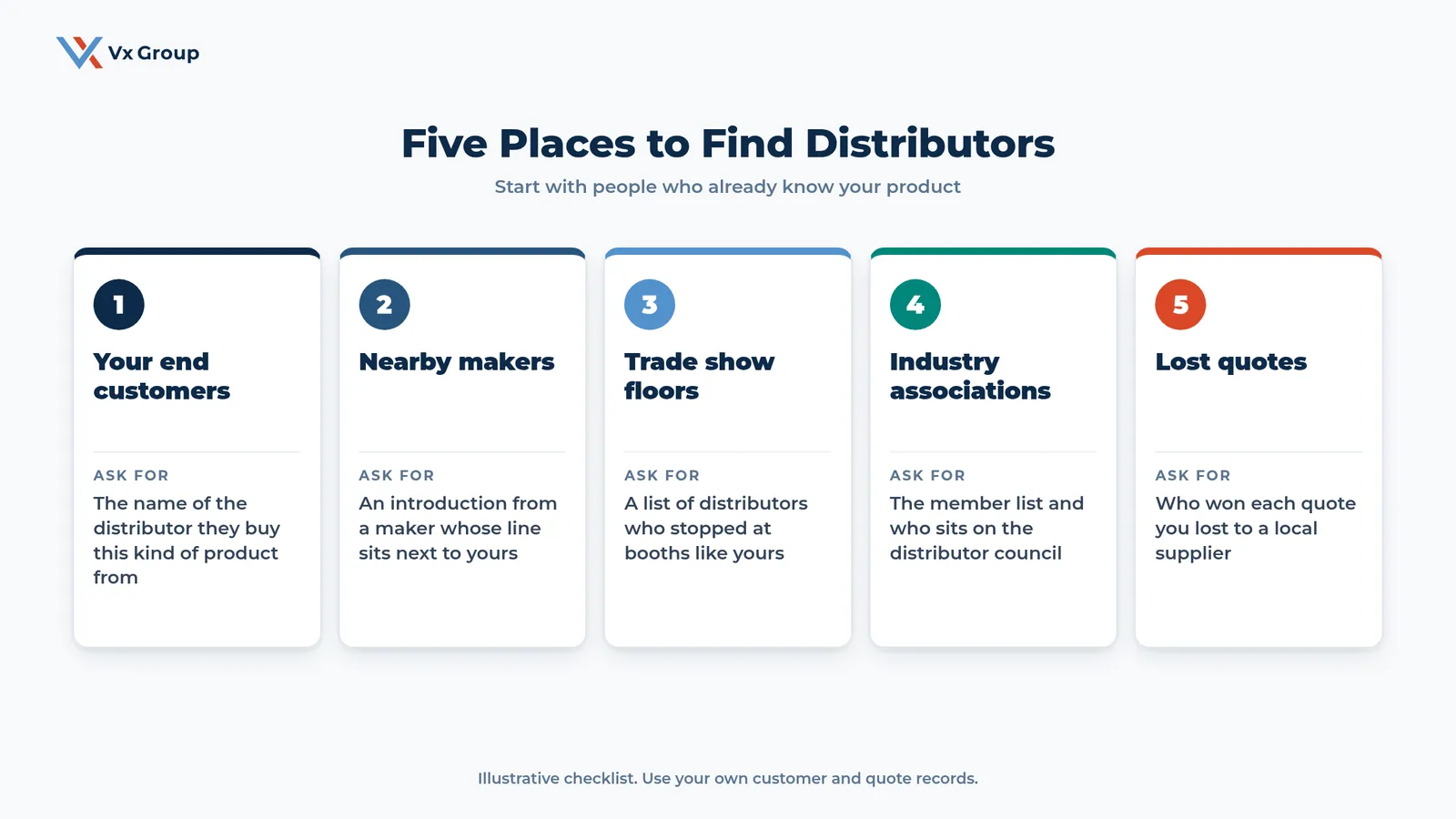
Together the five sources give a manufacturer a working list of eight to twelve names in a few weeks. Each source puts you in front of a distributor with a reason to take the call.
Ask your end customers who they buy from
Your end customers know their distributors well. Call ten of your best accounts. Ask which distributor they buy this kind of product from. Ask who they would call first if they needed it tomorrow.
Customers like this question because it is about their own convenience. You will usually get two or three names that come up more than once. Those names go to the top of your list.
Ask nearby makers for an introduction
A maker whose product sits next to yours, without competing, already has distributor relationships. A manufacturer of gaskets and a manufacturer of pumps sell to the same buyers through some of the same firms.
Call the owner or sales head of two or three of these firms. Ask which distributors do the best job for them and whether they would make an introduction. Owners tend to say yes, because a stronger distributor helps their line too.
Walk the trade show floor with a list
Distributors walk shows to find new lines. Before the next show, ask the show organizer for a list of attending distributors, then mark the ones that fit your profile. If you exhibit, ask your booth staff to log every distributor who stops by.
Our guide to trade show metrics covers how to track those visits so the names do not disappear after the show.
Use industry association member lists
Industry associations publish member lists, and many run distributor councils or buying groups. A list of members in your region gives you named firms in your industry, and the association often knows which members are growing.
Call the association and ask who runs the distributor council. A short conversation with that person can save weeks of searching.
Review your lost quotes
Your lost-quote records show who beat you. When a customer chose a local supplier or distributor over you, that firm already has the relationship and the stock. Pull the last 12 to 24 months of lost quotes and write down who won each one.
Some of those winners are competitors. Others are distributors who sell lines next to yours. The second group is a source of strong candidates, since they have already shown they can win in your accounts.
Combine the five lists into one ranked shortlist
Put every name from the five sources on one sheet. Mark the names that came up more than once. A distributor that a customer named, a nearby maker recommended, and your lost-quote records also show is a stronger candidate than one that appeared in a single place.
Rank the sheet by how many sources named each firm, then keep the top eight to twelve. That shortlist is what you score in the next step.
Ready to grow?
Bring your distributor profile and we will help you test it against the accounts you most want to grow.
How do you qualify a distributor before the first call?
You qualify a distributor by scoring each candidate on five to seven criteria from your profile, using what you can learn without talking to them. A candidate who fails the scorecard never reaches the call. This keeps you from spending hours on friendly firms that do not fit.
Build the distributor sourcing scorecard
Turn your profile into a scorecard. Score each criterion from 1 to 5 and weight the criteria that matter most. The table below shows a starting version.
| Criterion | What to check | Weight |
|---|---|---|
| Customer overlap | How many of your top 10 accounts buy from them | High |
| Competing lines | Whether they carry a direct competitor in your product family | Deal-breaker if yes |
| Territory coverage | Whether their branches and reps reach your key plants | High |
| Technical depth | Whether their site, catalog, and reps show real product knowledge | Medium |
| Stock and delivery | Whether they hold inventory or ship on request | Medium |
| Account health | Years in business, staff turnover, and what customers say | Medium |
| Reason to take your line | Whether your product fills a gap in their offer | High |
The last row is the one most manufacturers skip. A distributor takes on a new line when it fills a gap in what their customers keep asking for. If you cannot name the gap, the pitch will be weak.
Score candidates from public information
Fill in the scorecard from public sources: the distributor’s website, their line card, job postings, and what your own customers say. A line card lists the manufacturers a distributor carries. It tells you at a glance which competing lines they already sell.
Job postings show whether they are hiring technical reps. A firm that has posted the same sales role for six months may have trouble keeping people.
Set a cutoff and drop the rest
Pick a cutoff before you score, for example 22 out of 30 with no deal-breakers. Anyone below it comes off the list, whatever their email sounded like.
Keep the scorecard on file. When you recruit the next distributor, you will reuse it and refine it.
How do you run the first conversation with a distributor?
Run the first conversation as a two-way evaluation. You are deciding whether they fit your line, and they are deciding whether your line is worth their time. Ask questions for most of the call, share what makes your product easy to sell, and agree on one next step before you hang up.
Open with their business before your product
Start by asking how they work. Distributors respond well to a manufacturer who wants to understand their business before pitching theirs. Plan these opening questions:
- Which customers do you sell to most, and what do they ask you for that you cannot supply?
- Which of your suppliers do you rely on most, and why?
- How do your reps learn a new line, and how long does it take?
- What would make you drop a supplier?
The answers tell you how they see their business. They also tell you what a good supplier looks like from their side.
Use real approach language
Many owners hesitate on the first email or call. Here is language that works in plain terms:
“We make [product] for [industry]. Several of your customers buy it today from someone else. We are choosing one distributor for [territory], and we would like to learn how you work before we decide. Do you have 30 minutes this week?”
This opening names the product and the reason for the call. It tells the distributor they are one of a few firms under consideration. It sets up the two-way tone from the first sentence.
On the call itself, you can say:
“Here is what we offer a distributor on this line: a protected territory, margin you can plan around, samples, and training for your reps. Here is what we ask in return: stock on the shelf and calls on your top accounts. How does that look from your side?”
Then stop talking and listen. The pause after that question often brings out the real concerns, such as thin margin or a worry about your direct sales team.
Send a short summary within 48 hours
Write a half-page note after every first call. State what you heard about their business, what you offered, what they asked for, and the next step with a date. Send it within two days.
The note shows the distributor you listened. It also gives you a record to compare across candidates when you decide who moves to a trial. If a firm does not answer a clear summary and a dated next step, you have learned something about how they will treat your line.
Ask for references and offer yours
Ask for two customers who can speak to how the distributor handles a new line. Offer two distributors you work with who will talk to them in turn. Reference calls take an hour and show you how the firm treats the suppliers it carries.
Reference calls also tell the distributor that you run a serious program. Firms that expect to be one of fifty lines in a catalog treat the relationship differently from firms that expect real support.
Hold back terms until the fit is clear
Do not discuss price lists, exclusivity, or an agreement on the first call. Those come after both sides agree the fit is worth testing. Our guide to the distributor agreement covers what to settle before anyone signs.
If you need a refresher on how distributors differ from other channel partners, see what a distributor is and what a channel partner is.
How do you structure a trial with a new distributor?
Structure the trial as a 90-day test with written targets, a named contact on each side, and a date to decide. A trial gives both sides an easy way to say yes and an easy way to end it without hurt feelings. It also replaces promises with results.
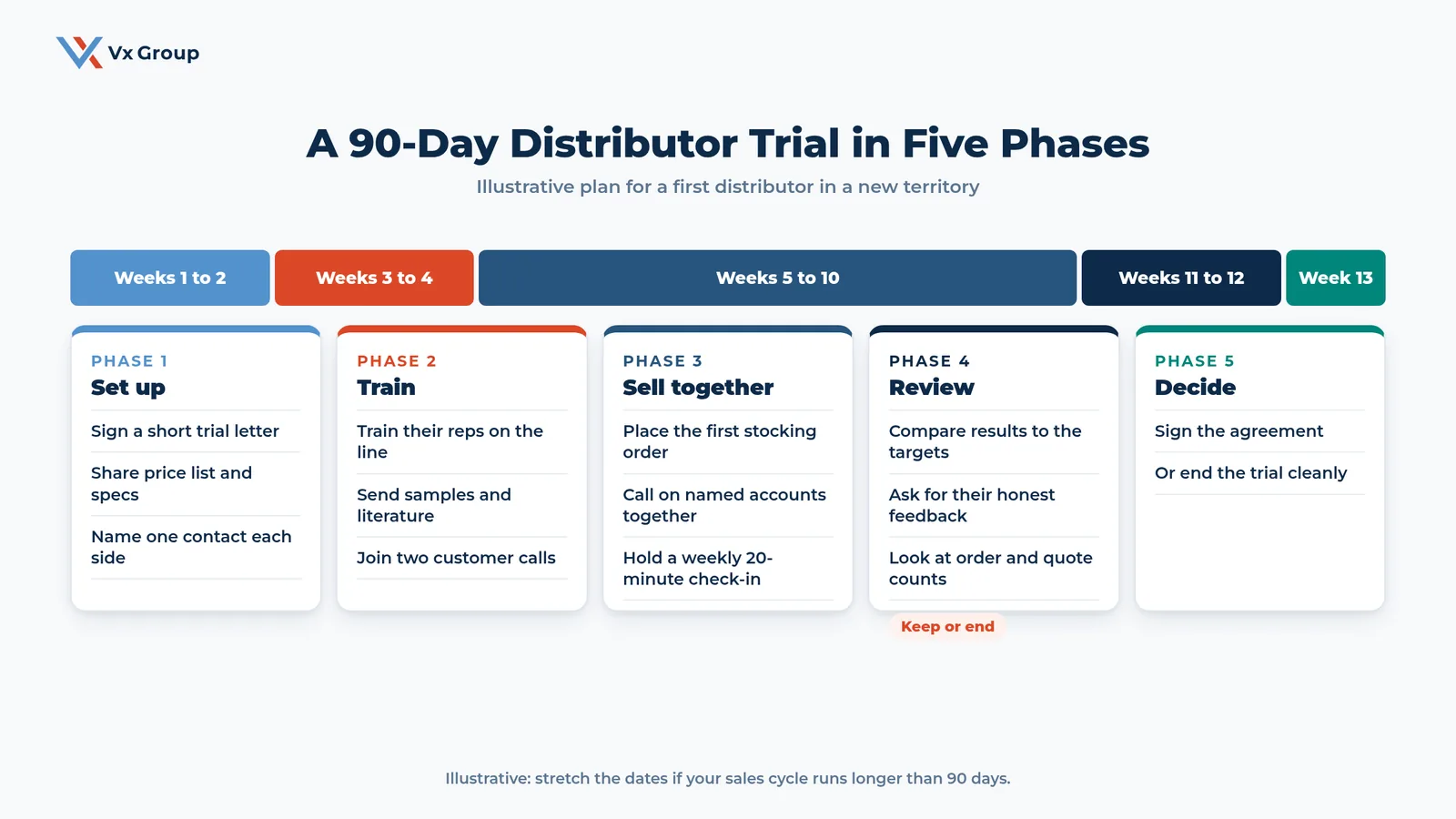
The graphic shows a 90-day trial in five phases. Setup and training take the first four weeks. The distributor and your team then sell together for six weeks, review the numbers in weeks 11 and 12, and decide in week 13.
Write the trial targets before the trial starts
Pick three to five targets with the distributor, in writing. The table below lists targets that fit most first trials. Replace the sample numbers with your own.
| Target | What it proves | Example measure |
|---|---|---|
| First stocking order | The distributor is willing to put money behind the line | An order placed by week 6 |
| Rep training | Their reps can explain the product | Two training sessions held |
| Named account calls | They are calling on the accounts you care about | Calls to five named accounts |
| Quotes issued | Customers are asking about the line | A quote count agreed in advance |
| Weekly check-in | Both sides stay in touch | One 20-minute call every week |
The numbers are examples. Your trial targets depend on your product, your sales cycle, and the size of the territory.
Name one owner on each side
Give the trial one owner at your company and one at the distributor. The owner at your company answers calls, ships samples, and joins customer visits. The owner at the distributor keeps their reps focused on the line.
Without a named owner, trials drift. Reps forget the product, and the weekly check-in turns into a monthly one, then stops.
Review honestly and decide on a date
Put the review on the calendar when the trial starts. At the review, compare results with the targets and ask the distributor what slowed them down. Often the answer points to something you can fix, such as missing literature or a confusing price list.
If the numbers are close, you can extend the trial for 30 days with new targets. If the numbers are far apart and the distributor cannot say why, end the trial and move to the next name on your list. After a good trial, sign the agreement and move to onboarding.
Our guide to channel partner onboarding gives a 90-day plan for the weeks after signing. Once the distributor is selling, distributor management covers how to keep them selling.
What mistakes cost manufacturers the most when they look for distributors?
The most expensive mistakes are choosing the first firm that says yes, skipping the written profile, and giving away exclusive territory before the trial. Each one is easy to avoid with the steps above, and each one tends to show up about six months after signing.
Avoid signing the first firm that replies
The first reply feels like a win. Compare that firm to the same scorecard as everyone else. If it scores well, keep going. If it scores low, say thank you and wait for better matches.
Avoid giving exclusive territory before the trial
Exclusive territory is a strong offer, and it is hard to take back. Save it for a distributor who has passed the trial. A short trial letter can state that exclusivity is under discussion if targets are met.
Avoid forgetting your own pricing and conflicts
A new distributor can collide with your direct accounts or with distributors you already have. Decide before recruiting who owns which accounts. Our guides to distributor pricing strategy and channel conflict cover both topics.
Next step for owners
Pick one product line and one territory. Write the one-page distributor profile this week, then make a list of ten end customers and call three of them about who they buy from. Within a month, you will have a short list of distributors with a reason to take your call.
The same steps work for dealers and other channel partners. Our guide to dealer network strategy applies them to a dealer channel.
Ready to grow?
Tell us which territory you want to open and we will help you build the profile and the shortlist.
FAQs
About the Author: David Tisdale
