

Channel Partner Engagement for Manufacturers

Channel partner engagement is the steady contact that keeps your distributors, dealers, and reps actively selling your product. It runs on a set rhythm of calls, visits, and joint plans, owned by named people on your team. Partners sell for the people they know, so the contact has to come from a person.
TL;DR
- Channel partners go quiet when a competitor’s rep calls more often than you do. They sell what is easiest and most familiar.
- Real engagement is a written contact rhythm: a monthly call, a quarterly planning review, two site visits a year, and a one-page joint plan.
- Spread contact across four pairs of people, so a resignation on either side leaves the relationship in place.
- Each touch should give the partner something useful: a lead, a quote answer, a market number, or a way to win a deal.
- Track what the partner does: real conversations, quote requests, registered deals, and partner-sourced pipeline.
- Portals, mass newsletters, and annual kickoffs create activity. Contact needs a person on the phone.
A distributor signs your agreement, sits through onboarding, and sells a few orders in the first quarter. A year later, your product is on page nine of their catalog. Their best rep has never called a customer about it. Nobody at your company can say when someone last spoke with the partner’s owner.
Nothing dramatic happened. The partner drifted, because partners carry dozens of lines, and each rep sells what is easiest and most familiar. If your product is neither, it falls off the list.
We see this often with owner-led manufacturers who sell through distributors, dealers, and independent reps. The company spends real money to recruit and onboard partners. Then it relies on a partner portal, a monthly email, and an annual kickoff to keep them interested. Those tools produce activity. They rarely produce a call.
This article is for owners and presidents of privately held manufacturers, roughly $5M to $50M in revenue, who sell through partners. It covers why partners go dormant, what a working contact rhythm looks like, who should own it, what to say in each touch, which numbers to track, and how to win back a partner that has gone quiet.
What is channel partner engagement?
Channel partner engagement is the ongoing contact between a manufacturer and the people at a channel partner who sell its product. It covers calls, visits, joint planning, and day-to-day help with quotes and deals. It starts after onboarding ends and runs for as long as the partner sells your line.
Defined Term: Channel partner engagement.
The set rhythm of two-way contact that keeps a channel partner actively selling your product. It includes value-adding touches, joint planning, and check-ins that have nothing to sell, and it is owned by named people on your team.
Engagement sits between two things you may already do. Channel partner onboarding gets a new partner ready to sell. Partner enablement gives partners the training and tools to sell well. Engagement keeps the relationship alive after both of those are done.
If you sell through dealers, our guide to dealer engagement covers the same ideas for that channel. The rhythm below works for distributors, dealers, and reps alike.
Why do channel partners go dormant?
Channel partners go dormant because their reps sell what is easiest and most familiar. Without regular contact from you, your product loses to lines they hear about every week. Dormancy shows up as fewer quote requests long before it shows up as lost revenue.
Four causes show up again and again.
Replace the silence that follows onboarding
After onboarding, many manufacturers go quiet. The partner manager moves on to the next signing. The partner hears nothing until a problem or a price change arrives. Set a first-year calendar before the onboarding call ends, so the next contact is already booked.
Find out who actually sells your product
The owner of a distributor signed your agreement. The person who quotes your product is a counter rep you have never met. If your contact stops at the owner, the people who decide what gets pushed never hear from you. List the names of the people at each partner who quote, sell, or answer questions about your line.
Check what competing lines give the partner
Your partner’s other suppliers probably send a rep every month, run spiffs, and invite the sales team to dinners. Look at what the top two competing lines do for the same partner. Match the items that matter most and know what you are up against.
Look for a single point of failure
Most of the relationship may sit with one person on your side. When that person leaves, the partner hears nothing. The section on ownership below covers how to prevent this.
What does a real channel partner engagement rhythm look like?
A real engagement rhythm has four routines: a monthly check-in call, a quarterly planning review, one or two visits a year, and a one-page joint plan. Write it down, put every date on the calendar, and treat it as seriously as a customer order.
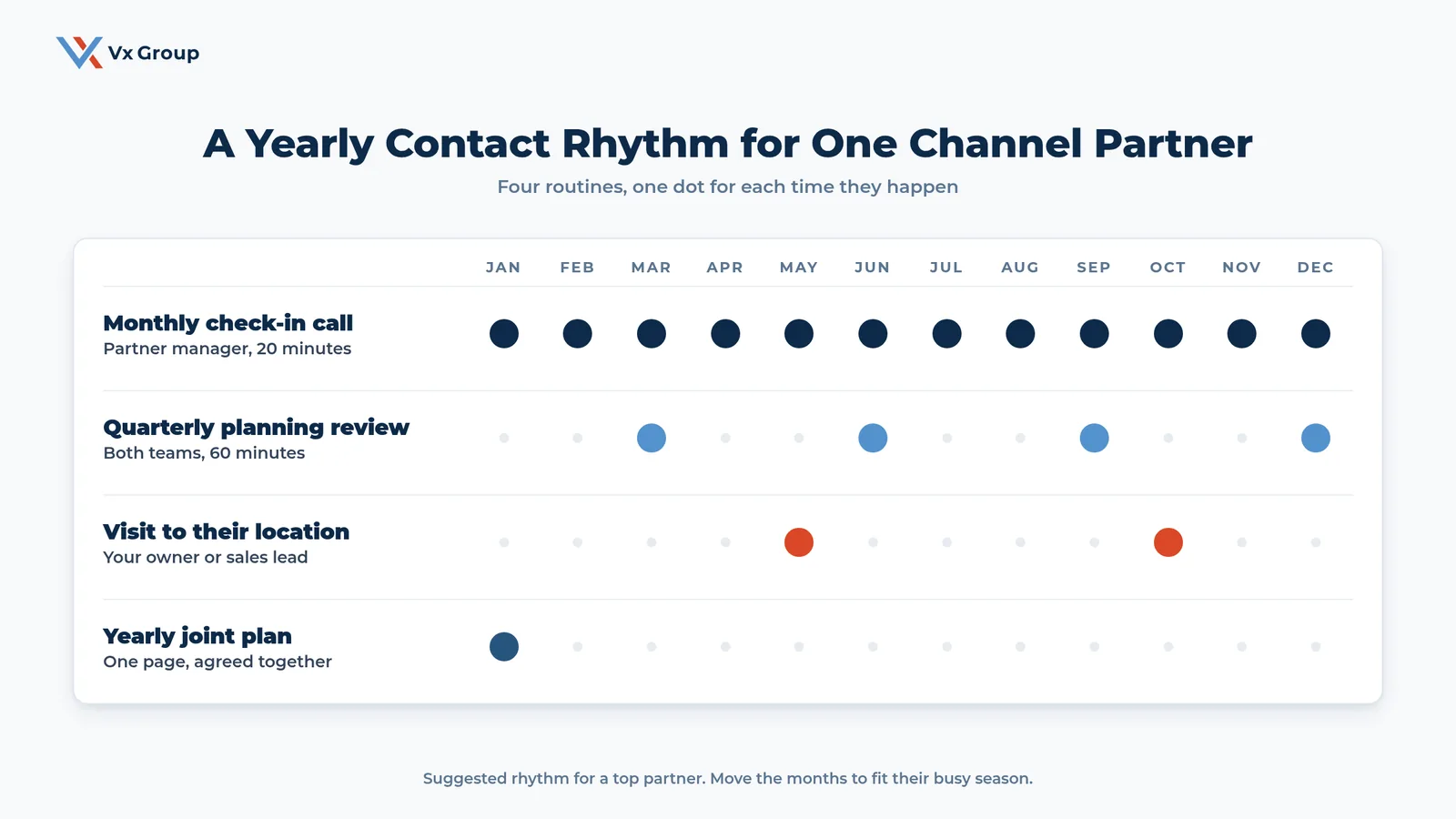
The graphic above shows the full year for one top partner. Twelve monthly calls, four quarterly reviews, two visits, and one plan add up to about nineteen planned touches. Your most important partners get all of them. Smaller partners may get the monthly call and one quarterly review.
Hold a 20-minute check-in call every month
The monthly call is the backbone. Keep it short. The partner manager asks three questions: what is moving, what is stuck, and what do you need from us this month? Then the manager closes the loop on anything open from the last call.
Send a two-line recap after each call. It shows the partner that someone listened, and it gives you a record.
Run a 60-minute planning review every quarter
The quarterly review brings in the partner’s sales manager and one of your regional leads. Look at the last three months of quotes and orders, pick two accounts or markets to work together, and set a date for the next review.
Keep the agenda on a single page. If the review turns into a presentation, the partner stops showing up.
Visit the partner's location once or twice a year
A visit from your owner or sales lead tells the partner’s team they matter. Spend the day with their reps as well as the owner. Ride along on one customer call if they will allow it.
Write a one-page joint plan every January
The plan lists the partner’s goal for your line, the two markets you will work together, who on each side owns what, and the dates of the quarterly reviews. Both sides sign off. It takes about an hour to write.
Ready to grow?
If your partners sell your line but never call you first, we can help you build the contact rhythm and the owner list behind it.
Who owns channel partner engagement?
Channel partner engagement needs a named owner for every partner, plus a second contact on your side. One person cannot own it alone, because that person will eventually leave, change roles, or get busy. Spread contact across several pairs of people and keep the records in a shared file.
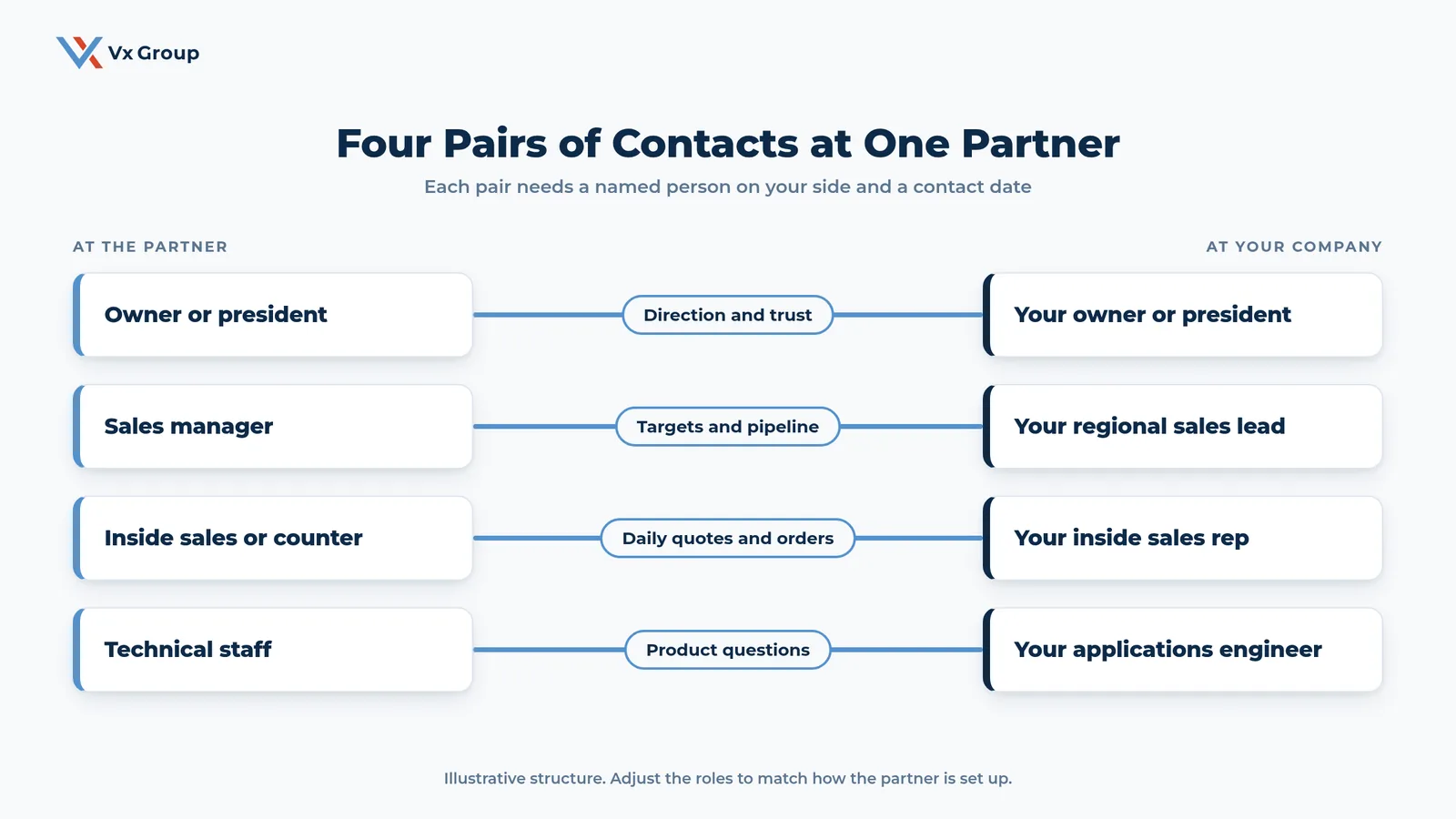
The graphic above shows four pairs. Your owner talks with their owner. Your regional sales lead talks with their sales manager. Your inside sales rep talks with their counter staff. Your applications engineer talks with their technical people. Each pair has its own reason to talk, and each pair builds trust the others can lean on.
Name one partner manager for each partner
Give every active partner one partner manager. That person owns the rhythm, the notes, and the follow-up. A partner manager can handle roughly 15 to 25 active partners, depending on how large they are. Adjust that number to your own workload.
Name a backup for every partner manager
Every partner also needs a second person who has spoken with the partner in the last 90 days. The backup joins one quarterly review a year and reads the partner file before it. If the partner manager leaves, the backup steps in with the relationship intact.
Keep a one-page partner file
The partner file lists the people at the partner, their roles, the last five contacts, the open items, and the joint plan. Keep it in your CRM or a shared folder. Anyone covering for the partner manager should be able to read it in five minutes and make a good call.
Plan for a resignation on either side
A single resignation can dissolve years of trust if nothing is written down. Decide in advance what happens when your partner manager leaves: who calls each partner within a week, and what they say. Also plan for the day a key person leaves the partner. Your pairs of contacts give you someone else to call.
This is why we say systems protect the human side of the relationship. A written rhythm leaves the people in charge and keeps their work from vanishing when they leave.
What should you say in each partner touch?
Every partner touch should give the partner something useful. A good touch answers a quote question, shares a lead, explains a price change before it lands, or helps win a specific deal. A touch that only asks for orders trains the partner to avoid your calls.
The table below lists six kinds of touch, what each one gives the partner, and how often to use it.
| Kind of touch | What the partner gets | How often |
|---|---|---|
| Deal help | Your engineer joins a quote or a customer call | When a partner asks |
| Lead pass | A customer inquiry in the partner’s territory | As leads arrive |
| Market update | A short note on demand, lead times, or pricing | Monthly |
| Product briefing | A 20-minute session on one new product or change | Quarterly |
| Recognition | A thank-you for a win, shared with their team | After a win |
| Check-in with nothing to sell | A call to hear how things are going | Monthly |
Most manufacturers do the first two when asked and skip the rest. The last row matters most. A call with no pitch tells the partner you care about the relationship beyond the next order.
Pass leads to partners fast
When a customer in a partner’s territory contacts you directly, send the lead to the partner within a day and say you did. Partners notice how you treat leads. A manufacturer that passes them along earns a place near the top of the partner’s list.
Explain price and policy changes before they land
Call the partner before a price increase, a lead-time change, or a new policy takes effect. Give the reason in plain words. Partners handle bad news well when they hear it first from you.
Keep recognition specific
When a partner wins a deal with your product, send a short note that names the rep and the customer. Copy the partner’s owner. Specific thanks lands well.
How do you measure channel partner engagement?
Measure channel partner engagement by counting what the partner does. Four numbers work well: real conversations, quote requests, registered deals, and partner-sourced pipeline. Each one shows a different part of the relationship, and each one can be pulled from records you probably already keep.
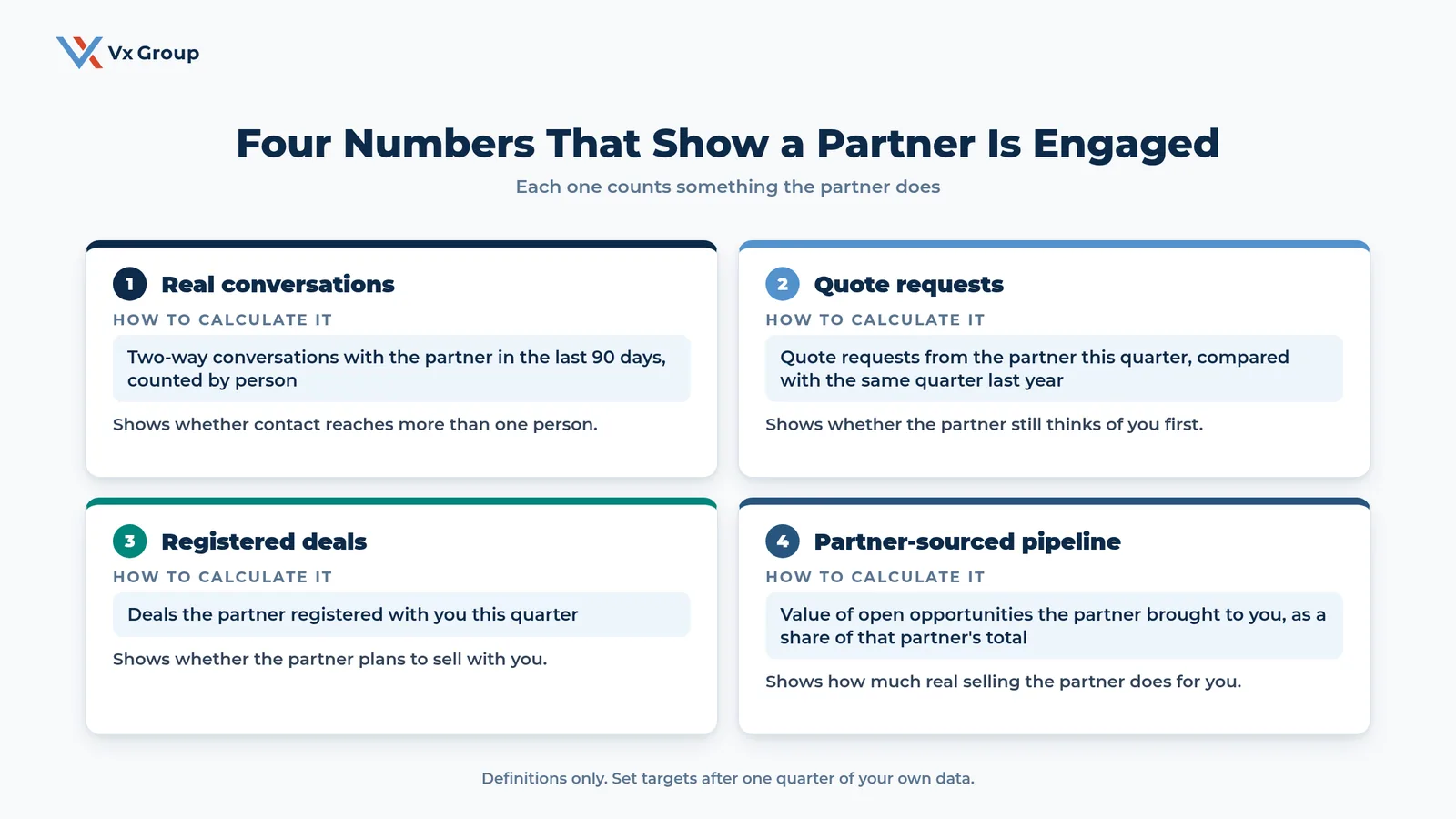
The graphic above defines all four. Real conversations counts two-way contact by person over the last 90 days. Quote requests compares this quarter with the same quarter last year. Registered deals counts deals the partner has logged with you. Partner-sourced pipeline measures how much of the open pipeline the partner brought in.
Count real conversations by person
A conversation is two-way contact with a named person at the partner. Emails you sent do not count. Count how many different people at each partner you spoke with in the last 90 days. If the answer is one, the relationship is thin.
Track quote requests by partner each quarter
Pull quote requests from your quoting system and compare each partner with the same quarter last year. A falling count is the earliest warning that a partner is drifting. It shows up months before orders drop.
Count registered deals
If you run a deal registration process, the number of deals a partner registers tells you how much they plan to sell with you. Our guide to the channel partner program covers how to set that up.
Compare partner-sourced pipeline to the partner's total
Look at the open opportunities a partner brought you and divide by their total with you. A partner with a growing share is actively selling. A partner whose share keeps shrinking is coasting on repeat orders.
Set targets only after one quarter of your own data. The first quarter shows you what a normal partner looks like in your business.
How do you re-engage a channel partner that went quiet?
Re-engage a quiet partner by calling their owner, asking what changed, and agreeing on one small joint project within 30 days. Open with a question. A price cut teaches the partner to go quiet whenever they want a better deal.
Check your own records first
Before you call, pull the last 12 months of quotes, orders, and contacts. Find out when the drop began and whether anything on your side changed at the same time, such as a new partner in the territory, a lead-time slip, or a departed rep.
Call the owner and ask one open question
Ask the partner’s owner what has changed on their side. Listen for the answer. Partners often tell you something specific, like a new line that took their rep’s attention or a delivery problem that cost them a customer.
Agree on one joint project
Pick one account or one market and work on it together for 30 days. Your engineer joins a call or two. Your partner manager follows up each week. A small win rebuilds the habit of working together faster than any promise.
Add the partner back to the rhythm
Once the project ends, put the partner back on the monthly call and the quarterly review. If the partner stays quiet after two real tries, it may be time to rethink the territory. Our article on channel conflict covers what to weigh before you add or move partners.
What engagement tactics should you drop?
Drop the tactics that create activity without contact. Partner portals, mass newsletters, and annual kickoffs all have a place, but none of them keeps a partner selling by itself. A partner who logs into a portal has not necessarily talked to anyone about your product.
Keep the portal as a reference library
A portal holds price lists, spec sheets, and order forms. Partners use it when they need something. Keep it current, and leave logins out of your engagement count.
Send fewer, more useful emails
A monthly email to every partner gets skimmed. Send a short market update to the right contacts and write it like a note from a person. If you want a deeper look at partner marketing, see our guide to channel partner marketing.
Treat the annual kickoff as one touch among many
A yearly meeting gets partners in a room and builds some goodwill. It happens once. The monthly calls, quarterly reviews, and visits are what carry the relationship the other fifty weeks.
How do you start channel partner engagement this month?
Start with your top five partners. Spend the first week listing the people at each one, the second week naming a partner manager and a backup for each, and the third week booking the next three months of calls and reviews. In week four, hold the first monthly calls.
Here is the four-week plan in one place:
- Week 1: For each of your top five partners, list the owner, the sales manager, the counter or inside staff, and the technical people.
- Week 2: Name a partner manager and a backup for each partner. Write the one-page partner file.
- Week 3: Book the next three monthly calls and the next quarterly review. Send each partner a short note about the new rhythm.
- Week 4: Hold the first calls. Ask the three questions: what is moving, what is stuck, and what do you need from us?
After 90 days, pull the four numbers for those five partners and compare them with last year. Then extend the rhythm to your next ten partners.
For help with the larger picture, see our guide to channel sales strategy and our overview of what a channel partner is.
Field Notes:
Picture a $20M manufacturer with 40 distributors and one partner manager. The partner manager knew about ten of them well. When that person gave notice, the company found that no one else had spoken with the other thirty in over a year. The fix takes one quarter: a partner file for each active distributor, a backup contact, and a monthly call list. This is an illustrative example, and your numbers will differ.
Where should you go from here?
Channel partner engagement works when it is written down, owned by named people, and measured by what partners do. Start small with your top five partners, keep the rhythm for a full year, and expand once it holds.
Your partners already know your product. What they need from you is regular, useful contact from people they know. A rhythm of calls, visits, and plans gives them that, and it keeps the relationship in place when people change jobs.
Ready to grow?
Tell us how your partners sell today, and we will help you set up the rhythm, the owners, and the numbers to track.
FAQs
About the Author: David Tisdale
