

Post-Merger Integration: A Practical Guide to Keeping the Revenue You Bought

Post-merger integration is the work of combining two companies after a deal closes: systems, teams, processes, and customer relationships. Most plans handle the first three carefully and assume the fourth takes care of itself. The revenue you paid for sits with people, and those people decide in the first ninety days whether they stay.
TL;DR
- Post-merger integration covers three separate jobs: the legal and financial close, the operational combination, and the commercial work of keeping customers. Most plans staff the first two and hope for the third.
- Cost savings are inside your control. Revenue depends on a customer choosing you again, which is why cost targets land on schedule and revenue targets slip.
- Contracts transfer at close. Trust gets re-earned, usually with people who now have a new business card, a new comp plan, and a competitor calling them.
- The first ninety days are spent protecting revenue. Name one owner per account in writing, tell your largest customers yourself, and freeze the changes that force a customer to re-decide.
- Write every revenue assumption as a named list of accounts with an owner and a date. An assumption with no name attached is a hope with a spreadsheet around it.
- Measure revenue retention by account, order frequency, and margin by segment monthly through the first year. Those three catch a leak while you can still fix it.
- Put one person on integration, take something else off their plate, and set the date the integration ends.
Most integration plans I read are strong on everything you can put in a project tracker. Consolidate the ERP. Combine the two insurance programs. Renegotiate freight. Decide which facility keeps the CNC work. Pick a name, a logo, and an email domain. Every one of those tasks has a clear owner, a due date, and a dollar figure next to it, which is exactly why they get done.
Then there is the line in the model that says the combined company grows faster than either one did alone. That line rarely has an owner. It rarely has a date. It almost never has a list of the customers it depends on.
That gap is the villain in this guide. The plan treats customer relationships as an asset that transfers with the equipment and the receivables. Relationships do not work that way. They live with a handful of people, and those people just watched their company get bought.
What is post-merger integration?
Post-merger integration is everything you do after a deal closes to make two companies operate as one and hold onto the value you paid for. It runs from the day the wire clears through the first twelve to eighteen months, and it covers three separate jobs that get treated as one.
Defined Term: Post-merger integration.
The work of combining two businesses after close so the combined company performs at least as well as the two did apart, covering legal and financial consolidation, operational combination, and the commercial work of keeping and growing customer revenue.
Separate the three integration jobs before you plan any of them
Write your plan in three columns, because these three jobs run on different clocks and need different people.
- The close-out work. Legal entity structure, insurance, banking, payroll, benefits, the audit trail, the first combined month-end. Finite, scheduled, and mostly done inside ninety days.
- The operational work. Systems, facilities, purchasing, production scheduling, service coverage, quality documentation. Twelve to twenty-four months, heavy on internal change, and the source of most of the savings in the model.
- The commercial work. Who owns each customer, what the combined company sells, what pricing a customer sees, who calls them and how often, and what happens to the two sales teams. This is where the revenue in the model either shows up or quietly leaves.
The reason to split them on paper is staffing. The first two jobs get a project manager and a spreadsheet. The third needs someone with authority who knows the customers, and in most deals that person was never assigned.
Decide how much you are actually combining
Pick one of four models in the first thirty days and say it out loud to both teams. Ambiguity here costs more than any of the four choices. Serial acquirers should pick a default and reuse it, because a buy and build strategy or a roll-up needs one integration pattern the team can run again and again.
| Model | What you combine | What stays separate | Best when |
|---|---|---|---|
| Hold separate | Reporting, banking, board rhythm | Brand, sales team, systems, operations | The acquired company’s customers buy from a specific brand and specific people |
| Back office only | Finance, HR, insurance, purchasing | Brand, sales coverage, production | Two good businesses with different customers and overlapping overhead |
| Commercial combine | Brand, sales team, pricing, customer list, back office | Plants and production where geography matters | Same customers, same buying process, real cross-sell overlap |
| Full absorb | Everything, including the name | Nothing | You bought capacity, a product line, or a book of business, and there is no standalone company to preserve |
Two failure patterns come from skipping this decision. The first is drifting toward full absorb by default, one system at a time, until the acquired company’s customers no longer recognize who they buy from. The second is holding separate for so long that none of the savings in the model ever appear. Choose deliberately, write it down, and tell both teams which one you picked.
Ready to grow?
We help acquirers plan the commercial side of integration before close, while it still costs nothing to change the plan.
What should happen in the first 90 days after a merger closes?
Spend the first ninety days protecting revenue and answering the questions your customers and your employees are already asking. Systems work can wait a quarter without costing you a dollar. A key customer wondering whether the company they trusted still exists needs an answer this week.
Here is the sequence that holds up across deals.
Day 1. Both teams hear the news in person or on a live call, from the person now accountable for them. Every customer-facing employee gets one page: what is changing, what is not changing this quarter, who to call with a question, and what to say when a customer asks. Written answers keep sixty people from inventing sixty versions.
Week 1. The top twenty customers of the acquired company hear from a human being who already knows them, with the new owner on the call or right behind it. Written notice can follow the conversation.
Days 2 through 30. Every account above your revenue line has one named owner inside the business. Interview the two or three people who hold the most customer knowledge and write down what is in their heads. Publish the pricing and terms answer, even if the answer is “nothing changes before January.”
Days 31 through 90. Combine what customers never see: banking, insurance, purchasing, reporting. Run the first joint review of the top accounts. Start the account plans. Leave rep assignments and pricing alone unless a customer is asking you to change them.
Days 91 through 365. Systems, facilities, branding, and the commercial changes you deliberately deferred. By now you know which relationships are solid and which ones were thinner than the revenue suggested.
If you are building the broader plan for the first few months after a deal, our private equity 100-day plan guide covers the operating side in more depth. This section is the customer-facing half of that same window.
Tell your top twenty customers before they hear it somewhere else
Build the call list before close and work it in the first week. For each of the top twenty accounts, write four things: who at the customer needs to hear it, who from your side has the actual relationship, what specifically changes for them, and what does not change this quarter. That last one matters more than the announcement. Most customer anxiety after a deal is about disruption to something that currently works.
A competitor with any sense is calling your new customers in week two with a simple message about uncertainty. Your only defense is having gotten there first.
Name one owner for every significant account, in writing
Pull the customer list, sort by trailing twelve-month revenue, draw a line where the top eighty percent of revenue sits, and put exactly one name next to every account above that line. One name per account, and it has to be a person with a phone number.
Then publish the list internally. The version that lives in a spreadsheet on someone’s laptop does not count, because the point of the exercise is that every person in the building can answer the question “who owns this customer” the same way.
Defined Term: Relationship owner.
The single named person accountable for the health of one customer relationship, including who else in the account is known, when the last real conversation happened, and what the plan is for the next twelve months.
Freeze the changes that force a customer to re-decide
For ninety days, hold off on anything that makes a customer reconsider the buying decision they already made:
- Reassigning their salesperson
- Changing prices, discounts, or payment terms
- Renaming products or changing part numbers
- Moving their order to a different plant
- Switching the phone number, portal, or email address they use
- Retiring the brand they think they buy from
Every item on that list may need to change eventually. Doing any of it in the first quarter, while a customer is already wondering what this deal means for them, turns a routine reorder into a fresh evaluation. That is when they take the competitor’s call.
What actually transfers at close, and what has to be re-earned?
Contracts, purchase orders, and receivables transfer at close. The trust behind them does not, because it belongs to people, and half of those people are now deciding whether they like the new arrangement.
| Transfers with the deal | Has to be re-earned after close |
|---|---|
| Signed contracts and open purchase orders | The next order that was never under contract |
| The customer list and order history | Who inside the account actually returns a call |
| Pricing agreements in writing | Willingness to accept the next price increase |
| Brand names and trademarks | Whether the brand still means the same thing to a buyer |
| Employees on payroll | Whether the two people who hold the relationships stay past the first bonus cycle |
| CRM records and contact data | The context that was never written down |
| Certifications and approvals | The engineer who specifies you because of a favor you did in 2019 |
The right column is where deals get won or lost, and none of it appears on a standard integration tracker. Most of it lives with a small number of long-tenured people. Before close, find out who they are, and put it in what you check before buying alongside the financials. In the first month, sit down with each of them and write down what they know: which buyer trusts whom, which relationships are fragile, which accounts have quietly shrunk, who at the customer is retiring.
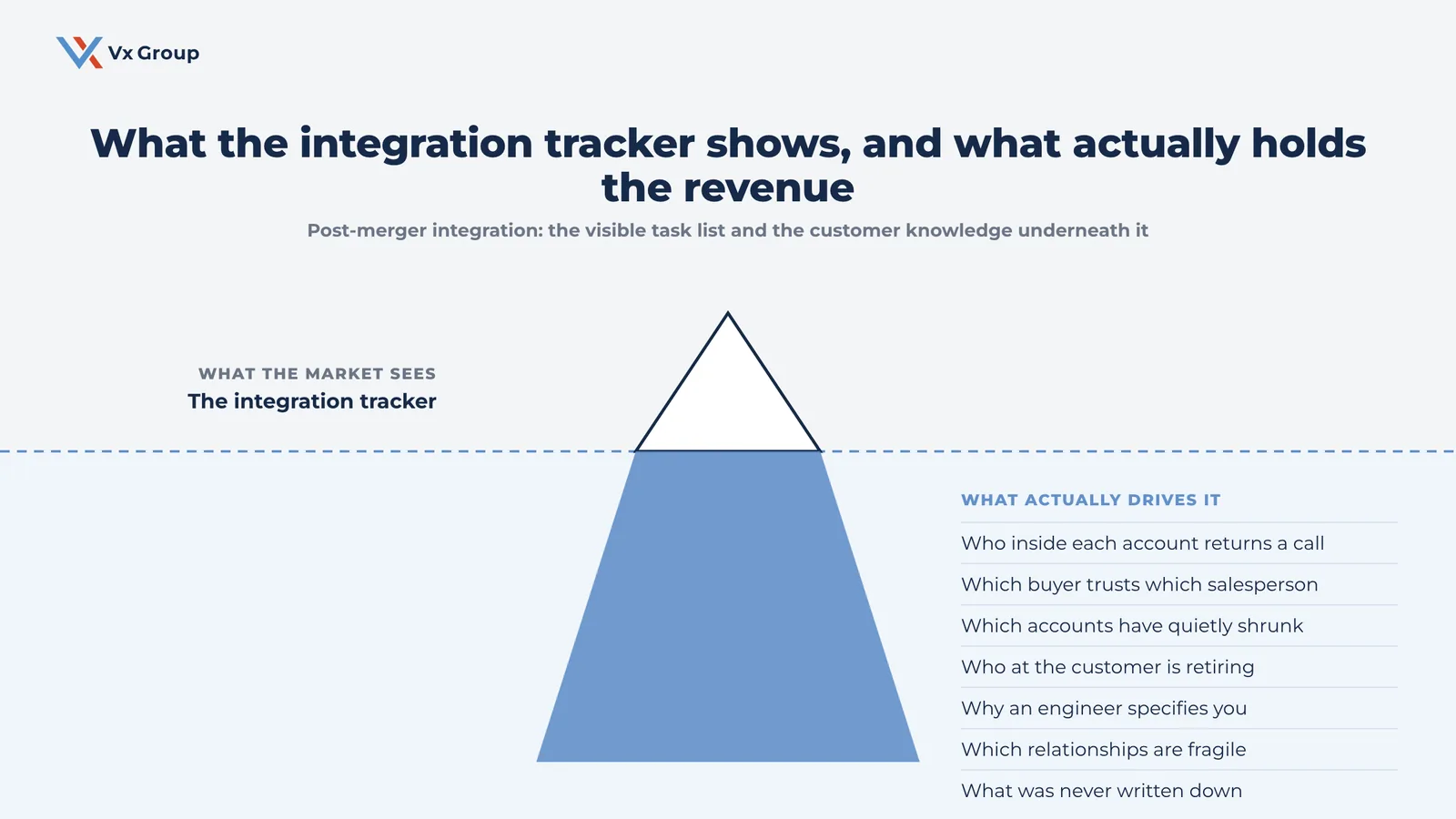
That interview is the cheapest insurance in the whole deal. It costs a few hours and it converts a resignation from a revenue event into a staffing event.
Why do revenue synergies miss when cost synergies land?
Cost savings sit inside your control, and revenue growth depends on a customer deciding something. You can consolidate two insurance policies without asking anyone’s permission. You cannot decide on a customer’s behalf to buy the other company’s product line.
Defined Term: Revenue synergies.
The additional revenue the combined company is expected to generate that neither business could have produced alone, usually through selling each company’s products to the other’s customers, entering a new territory, or winning larger contracts as a bigger supplier.
Here is the arithmetic that gets modeled, using round numbers to show the shape of the problem.
| Assumption in the model | What it usually rests on | What holds up in practice |
|---|---|---|
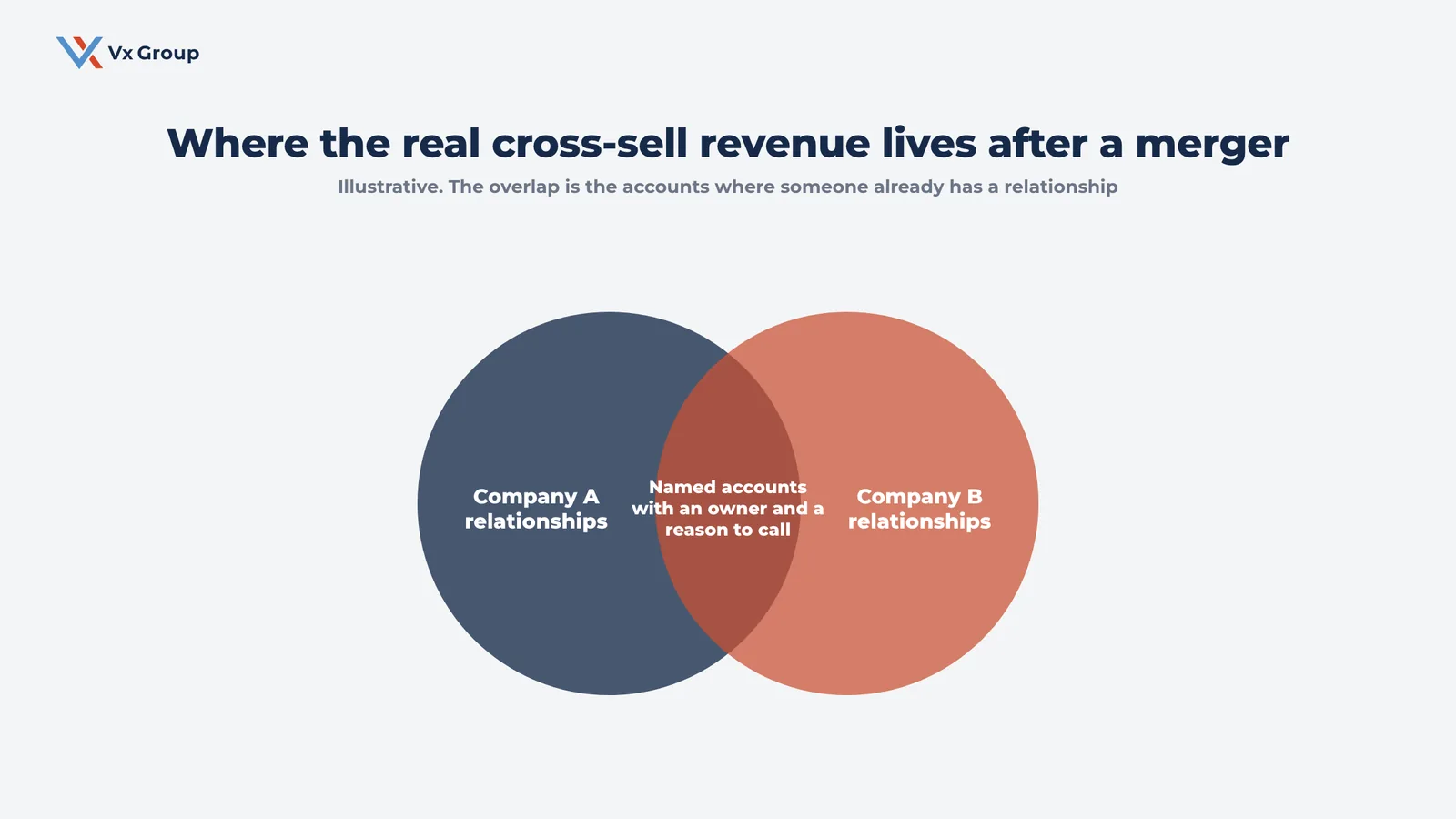
| Sell product B into 200 of company A’s customers | A count of accounts in the CRM | The 40 accounts where someone has an actual relationship and a reason to call |
| 15% of A’s customers buy B in year one | A percentage that felt reasonable | Closer to 3% to 5% without a named owner and a real plan per account |
| Both sales teams sell the full line | An org chart | Whichever line pays the rep more, until you fix the comp plan |
| Larger combined company wins bigger contracts | Scale | True in year two or three, after you can prove combined performance |
Illustrative figures that show the shape of the problem. There is no measured data behind them.
The fix is to replace the percentage with names.
Write every revenue assumption as a named list of accounts
Take each revenue line in the plan and rewrite it as a list: the specific accounts, the person who owns each relationship, the product you expect them to add, the reason a buyer would say yes, and the month you expect the first order. If a line in the plan cannot survive being written this way, it was a guess. The same test applies to the wider value creation plan: every line needs a name and a date.
A hundred-account assumption usually reduces to twenty-two real opportunities on first contact with reality. Twenty-two named opportunities with owners and dates beat two hundred imaginary ones, because someone can actually work the list on Monday.
Discount every cross-sell assumption by who holds the relationship
Score each cross-sell opportunity on three questions before you count it:
- Does someone on our side have a real relationship with the person who would make this decision? If no, this is new business development with a warm introduction, and it should be timed accordingly.
- Does the customer have a reason to consolidate suppliers, or are we asking them to do it for our convenience?
- Who at the customer loses something if they switch? A specification, a favored supplier, a personal relationship of their own.
The third question is the one that gets skipped, and it explains most missed cross-sell targets. Somebody inside the customer’s building is attached to the incumbent, and no amount of combined-company logic moves them in a quarter.
What belongs on a post-merger integration checklist?
A post-merger integration checklist should cover four windows: Day 1, the first thirty days, days thirty-one through ninety, and the balance of the first year. Below is the version I would hand a leadership team, with the commercial items that standard checklists leave out.
Day 1
- Both teams hear the news live, from the person accountable for them
- One-page talking points in every customer-facing employee’s hands
- Payroll, benefits, and banking confirmed working
- One named person to call with any question, internal or external
- Customer-facing systems verified: phones, portal, order entry, shipping
First 30 days
- Top twenty customers contacted personally
- One named relationship owner for every account above the revenue line, published internally
- Knowledge interviews completed with the two or three people who hold the most customer history
- Integration model chosen and announced: hold separate, back office, commercial combine, or full absorb
- Retention plan in place for the customer-facing people you cannot afford to lose
- Pricing and terms question answered in writing, even if the answer is “no change this quarter”
- Combined reporting live for revenue by account and gross margin by segment
Days 31 to 90
- Invisible functions combined: insurance, purchasing, banking, month-end close
- First joint review of the top accounts, both companies in the room
- Account plans started for the top twenty relationships
- Overlap analysis complete: which customers both companies already sell to
- Revenue assumptions rewritten as named account lists with owners and dates
- Employee questions answered on comp, titles, and reporting lines, with dates attached
Days 91 to 365
- Systems consolidation on a published schedule
- Brand and naming decisions executed, with customer notice ahead of each change
- Comp plans rebuilt once, with the effective date announced in advance
- One customer profile written for the combined company
- Territory and coverage changes made, relationship owners preserved
- Quarterly check on revenue retention by account against the pre-close baseline
- Integration formally closed, with remaining work handed to the people who run the business
Print it, put a name and a date next to every line, and review it monthly. A checklist nobody owns is a document, and documents do not integrate companies.
How do you combine two sales teams without losing customers?
Combine the back end first and the customer-facing front end last, and keep every relationship owner in place through the transition even when the territory map changes. The order matters, because a customer notices a new salesperson immediately and never notices that you consolidated two purchasing systems.
Map the overlap account by account before you touch territories
Put both customer lists side by side and sort into four groups: accounts only company A serves, accounts only company B serves, accounts both serve, and accounts both have called on where neither has won. That fourth group is usually the most interesting, and it never shows up in a revenue model.
For the shared accounts, find out who has the stronger relationship and at what level, then decide who leads. Two salespeople from the same company calling on one buyer with different pricing is the fastest way to look disorganized to a customer who is already watching you closely.
Keep the relationship owner even when the territory changes
Territories will get redrawn. When they do, carve out the long-standing relationship owners first and draw the map around them. If a rep has covered an account for nine years, that account stays with them regardless of what the new map says, and you handle the geography with an inside partner or a service resource. You can fix a suboptimal territory line next year. You cannot un-lose a customer who felt handed off.
Write one customer profile for the combined company
Two companies have two definitions of a good customer, and they are usually different in ways nobody has articulated. Write one profile, on one page, covering: industry and application, revenue range, what triggers a purchase, who signs, cycle length, the margin you should expect, and the three signs an account will grow.
Test it the way I test any customer profile. Hand it to a new hire with two prospects and ask them to pick the better one and explain why. If they cannot, the profile is still a description, and it needs another pass to become a decision tool. Our ideal customer profile template walks through the fields in detail.
Rebuild the comp plan once, and announce the date
Salespeople make decisions about their future based on what they think their next twelve months of income looks like. Uncertainty on that question is the single biggest reason good reps take a competitor’s call during integration.
Say the date early, even before you know the answer: “the combined plan takes effect January 1, and you will see it in November.” Then change it once. Three revisions in a year teaches a sales team to start planning their exit.
Ready to grow?
We build the commercial side of integration with acquirers, from the account-owner map through the combined customer profile.
What should you measure during post-merger integration?
Measure revenue retention by account, order frequency, and gross margin by segment every month against a pre-close baseline, alongside the operational milestones. Total revenue hides the leak, because a growing account can mask three shrinking ones for two or three quarters.
| Metric | Definition | What good looks like |
|---|---|---|
| Revenue retention by account | Trailing twelve-month revenue per account against the same account’s pre-close trailing twelve months | Top twenty accounts at or above baseline through the first year |
| Order frequency | Orders per account per quarter against the pre-close pattern | Steady or rising; a lengthening gap is the earliest warning you will get |
| Gross margin by segment | Margin by customer type or product line, reported monthly | Holding without price concessions used to keep accounts calm |
| Relationship coverage | Number of people at the customer with a real working relationship on your side | Two or more in every account above the revenue line |
| Documented account plans | Share of top accounts with a written plan and a named owner | 100% of the top twenty by day ninety |
| Customer-facing retention | Retention rate among salespeople, service, and account managers | Higher scrutiny than company-wide retention, because these departures take revenue with them |
| Quote-to-order cycle | Days from request to order for repeat customers | Stable; a slowdown means a buyer started comparing again |
If a large share of the revenue you just bought sits with a few accounts, treat customer concentration risk as part of the integration plan. It belongs on the same monthly report.
Two of these deserve a place in the monthly report to owners and investors: revenue retention by account and relationship coverage. They are the two that tell you whether the thing you bought is still there.
Who should own post-merger integration?
One named person inside the business should own integration, with decision rights in writing and something taken off their plate to make room for it. The common alternative, splitting integration across the leadership team as an addition to everyone’s day job, produces a status meeting where six people report that they have been busy.
Put one name on it, and remove something else from their plate
Integration is a job with its own hours. Whoever takes it needs three things: the authority to make decisions in a defined range, direct access to whoever holds the capital, and roughly half their calendar. If you cannot free up half their calendar, you have picked the wrong person or you are about to get a slower integration than the model assumed.
Separate the integration lead from the growth owner
These two roles pull in opposite directions and should not sit with one person. The integration lead is inward-facing: systems, facilities, processes, the close-out list. The growth owner is outward-facing: customers, pricing, coverage, the account plans. When one person holds both, the internal work wins every time, because it has deadlines and the customer work has relationships.
Name both roles by title in the first thirty days. Our guide to building a growth system inside a company after a deal covers what the growth owner should actually build, and if the acquirer is a private equity firm, the operating partner role covers who inside the firm usually carries this work.
Set the date the integration ends
Pick a date, publish it, and define what has to be true on that date for integration to be over. Open-ended integrations become a permanent second organization with its own meetings and reports, running alongside the business it was supposed to combine. Twelve to eighteen months is the range where most of these should land, with the remaining work handed to the people who run the business day to day.
What are the most common post-merger integration mistakes?
Eight patterns account for most of the value that leaks out after close.
- Treating customers as an asset that transferred. The contracts transferred. The trust needs a plan.
- Changing what customers see in the first quarter. New rep, new prices, new part numbers, new brand, all while the customer is already unsettled.
- Leaving accounts without a named owner. When everyone owns a relationship, the first sign of trouble is an RFP you were not invited to.
- Never capturing what the long-tenured people know. A resignation should cost you a person. Without documentation, it costs you a customer.
- Modeling revenue as a percentage. A percentage cannot be worked on a Monday morning. A named list of accounts with owners and dates can be.
- Leaving comp uncertain. Ambiguity about next year’s income drives good salespeople toward recruiters.
- Measuring only total revenue. One growing account hides three shrinking ones long enough for the damage to compound.
- Running integration as a committee. Six part-time owners turn integration into a standing status meeting where everyone reports that they have been busy.
Every one of these is cheap to prevent in the first ninety days and expensive to reverse in year two.
Where to start
If a deal you own closed in the last quarter, start with a list of the top twenty accounts and two columns: who owns this relationship, and what happens if that person leaves. Most teams can fill in the first column. The second one is where the room usually goes quiet.
That exercise takes about two hours and it tends to reset the whole integration plan. It also reframes what the acquired business actually is. You bought equipment, a customer list, a brand, and a set of relationships, and the relationships are the part that keeps producing revenue after the equipment depreciates. If you are thinking about the wider value plan, our guide to portfolio company value creation covers where growth work fits alongside the operational program.
Two questions worth sitting with. For the accounts that justified the price you paid, can you name the person on your side who owns each one? And if the two people who hold the most customer knowledge in that business both left this quarter, how much of what you bought would still be there next year?
Ready to grow?
We work with acquirers on the commercial side of integration, from the account-owner map through the first year of account plans.
FAQs
About the Author: Eric Zoromski
